In the Dark Summary, Characters and Themes
In the Dark by Chelsea Curto is a psychological romance novel that explores themes of obsession, control, and intense attraction between two individuals. Hunter, a haunted house actor, becomes fixated on Maxine after a brief encounter at a Halloween attraction.
What begins as a thrilling and passionate moment soon spirals into a darker obsession, leading Hunter to stalk Maxine, track her every move, and manipulate their encounters. Maxine, a teacher who is recovering from a broken relationship, finds herself caught in the whirlwind of their intense and toxic bond. As they navigate their feelings for each other, Maxine must confront the terrifying reality of Hunter’s obsession and whether or not she can escape it.
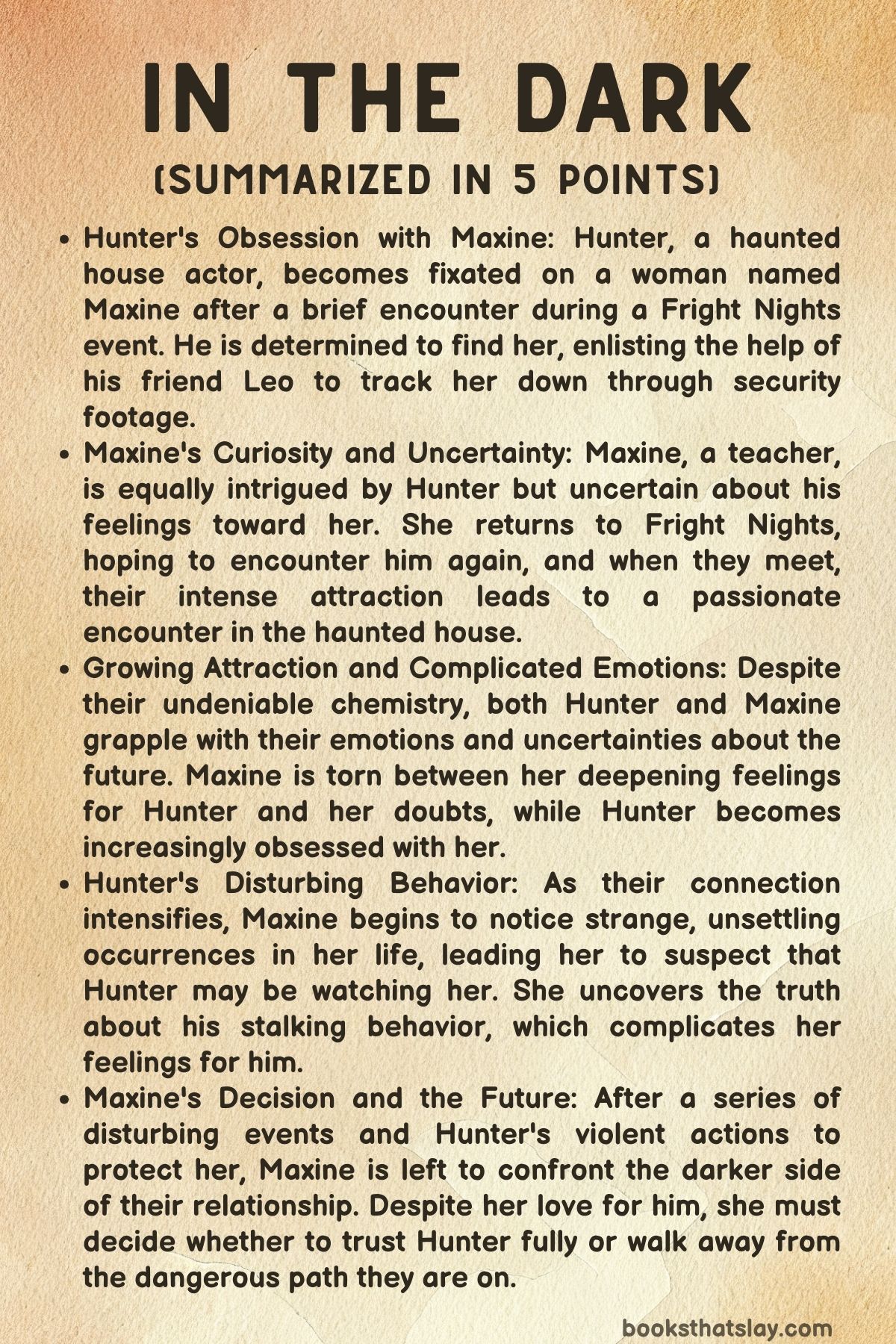
Summary
Hunter, a haunted house actor, reflects on a moment during a Halloween attraction when he encountered Maxine, a woman who got lost during the event. He felt an immediate connection with her, though she was not his usual type.
Intrigued by her, Hunter is determined to find her again. His friend Leo, who works with him, encourages him to pursue her, suggesting they check the security footage to track her down.
Despite his hesitations, Hunter becomes increasingly obsessed with Maxine and begins fantasizing about their next meeting.
Hunter’s emotional struggles are compounded by the memory of his late mother, especially during Halloween, a time that always brings up unresolved grief. Nevertheless, his desire to find Maxine becomes his sole focus.
With Leo’s help, they use the security footage to locate Maxine. Eventually, Hunter makes the decision to act, his fixation on her intensifying.
Meanwhile, Maxine, after the haunted house event, is processing her feelings. She is embarrassed by her disorientation but cannot stop thinking about Hunter.
She spends hours researching him online, curious but uncertain whether he remembers her. Driven by a desire to see him again, Maxine buys a VIP pass for Fright Nights and returns to the haunted house, hoping to encounter him once more.
When she does, the chemistry between them is undeniable. Hunter confronts her, pulling her aside from the crowd, and they engage in an intimate conversation.
Despite his abruptness, there is a palpable attraction between them.
As their conversation turns sexual, Maxine confesses that she came back specifically to see him, and Hunter’s dominant yet attentive approach encourages her to explore her desires. Maxine, initially hesitant, becomes more confident in the moment, giving in to the thrill of their encounter.
They engage in a passionate and steamy rendezvous inside the haunted house, with Maxine discovering new aspects of her own sensuality. Despite the forbidden nature of their actions, Maxine feels liberated as Hunter gently pushes her boundaries.
Hunter’s dominance continues, but he ensures Maxine feels safe and cared for throughout their encounter. As they explore each other more intimately, Maxine begins to trust Hunter, even as she questions her feelings.
Despite their intense connection, she is uncertain about what it all means. As the night ends, both Hunter and Maxine are left with unresolved emotions.
Hunter believes they have something special, but Maxine remains uncertain, still processing the whirlwind of their encounter.
The next day, Maxine, a first-grade teacher, cannot stop thinking about the passionate moment they shared. Confiding in her best friend Molly, she admits her uncertainty, especially after a recent breakup with her cheating ex, Brian.
Molly encourages Maxine to explore new possibilities, and Maxine wonders if her brief encounter with Hunter could lead to something more. Meanwhile, Hunter is consumed by the memory of Maxine, determined to find her again.
He uses technology to track her down, eventually locating her through Leo’s help.
Maxine and Hunter’s worlds collide again when Maxine, unaware that Hunter will be at the Fright Nights performer party, attends with her friend Skyler. At the party, the attraction between Maxine and Hunter flares up again.
They share flirtations and quickly become lost in each other’s company. After sneaking away to a quieter area, their connection deepens, and Maxine begins to open up about her life and her past.
The sexual tension between them builds to a breaking point, and they share another passionate encounter.
Maxine is left conflicted after their encounter, unsure of whether what they shared was a fleeting moment or the start of something more. She receives a selfie from an unknown number, and realizing it’s from Hunter, she smiles, unsure about her feelings.
While she enjoys the thrill of their connection, she remains uncertain about where this relationship is headed.
As Maxine returns home one evening, she feels uneasy. Her house seems off, with signs that someone has been there.
The rug is uneven, her laundry is folded, and groceries are placed in her kitchen, including items she dislikes. Maxine calls her friend Skyler, who confirms she hasn’t been home, and her suspicions grow that something is wrong.
She calls Hunter for reassurance, but the strange occurrences continue. Eventually, Maxine realizes someone has been watching her and begins to fear for her safety.
Maxine continues to investigate the unsettling situation, and Hunter reassures her that everything is fine, but she cannot shake the feeling that her privacy has been violated. She confronts him and eventually discovers the truth: Hunter has been stalking her.
He has hidden cameras in her home and has even gone so far as to break into her house to fold her laundry and fill her fridge. Despite his disturbing actions, Maxine is torn between feeling violated and being drawn to his affection.
Maxine confides in Skyler, who expresses concern about Hunter’s behavior but respects Maxine’s decision. Maxine continues her on-again, off-again relationship with Hunter, who continues to express his love for her in increasingly extreme ways.
Eventually, Maxine confronts the darker side of Hunter’s personality, including his violent tendencies, and must decide whether to stay with him or break free from the relationship.
Max’s fears come to a head when she is kidnapped by a man named Connor, who reveals that he intends to kill Hunter. Hunter, however, tracks Maxine down and rescues her, killing Connor in the process.
Maxine is shaken by the violence and trauma but is comforted by Hunter’s protective love. Hunter takes care of the aftermath, and Maxine begins to recover emotionally.
Hunter promises to protect her, and their bond grows stronger.
As time passes, Maxine struggles with her trauma, but Hunter’s care and support help her heal. At a Halloween event, where they first met, Hunter surprises Maxine with a marriage proposal.
Overwhelmed with emotion, Maxine says yes, and they look forward to building a future together, leaving the darkness of their past behind.
Characters
Hunter
Hunter, a haunted house actor, is a complex and multifaceted character, shaped by a blend of grief, obsession, and a deep desire for connection. His haunting past, marked by the loss of his mother, influences his actions throughout the story.
Halloween, in particular, is a time of emotional turmoil for him, and it triggers unresolved grief that fuels his search for solace. Hunter’s encounter with Maxine sparks an intense obsession, and his fixation on her grows into an all-consuming force.
Despite his somewhat sinister tendencies—he crosses moral boundaries and resorts to stalking—there is a softer side to him. He is genuinely affectionate and caring toward Maxine, constantly reassuring her and seeking to make her feel desired and safe.
Hunter’s behaviors reflect his struggle between his darker impulses and his desire for love and connection. Ultimately, Hunter is a man torn between his need for control and his emotional vulnerability, and his actions serve as both a testament to his deep affection for Maxine and a manifestation of his internal conflicts.
Maxine
Maxine, a first-grade teacher, is a woman caught between desire and self-doubt. Her encounter with Hunter at the haunted house, though intense, leaves her questioning her own desires and what she wants from a partner.
She is still healing from a recent breakup with her ex, Brian, and her emotional vulnerability makes her both cautious and curious about Hunter. Maxine’s initial reaction to their sexual encounter is one of hesitation, yet she is soon swept up in the passion and intensity of the moment.
As their relationship develops, she finds herself torn between the thrill of their connection and the unsettling realization of Hunter’s possessiveness and dark tendencies. Despite her growing feelings for him, Maxine remains cautious, struggling with the fear that Hunter’s affection may not be as safe as it seems.
Throughout the story, Maxine is depicted as someone learning to navigate her own desires and boundaries, attempting to balance her emotional needs with her instincts for self-preservation. Her inner conflict intensifies as she faces the darker sides of Hunter’s behavior, and she is forced to question whether she can reconcile her attraction to him with the dangerous implications of his actions.
Leo
Leo is Hunter’s close friend and confidant, playing a crucial role in the unfolding of the story. His personality serves as a foil to Hunter’s intense emotions and darker impulses.
While Hunter is driven by obsession and desire, Leo is more practical, offering advice that reflects a sense of grounded realism. He encourages Hunter to pursue Maxine, suggesting that women appreciate being pursued, but his role in the narrative extends beyond just advice.
Leo acts as a support system for Hunter, helping him track down Maxine through security footage and providing a sense of camaraderie during Hunter’s emotional turmoil. Despite the tension between Maxine and Hunter, Leo remains neutral and often acts as a sounding board for Hunter’s thoughts, providing a sense of balance.
Though not as central as Hunter and Maxine, Leo’s presence adds depth to the story, serving as a reminder of the relationships that exist outside of the central, obsessive connection.
Molly
Molly is Maxine’s best friend, and her role in the story is vital in helping Maxine process the emotional turbulence she experiences, especially after her breakup with Brian and her intense encounter with Hunter. She provides a safe space for Maxine to open up, offering a mix of support and pragmatism.
While Maxine wrestles with her conflicting emotions about Hunter, Molly encourages her to explore new possibilities and embrace the unknown. Her influence helps Maxine gain the courage to entertain the idea of moving forward and taking risks in her personal life.
Molly’s role as a supportive and understanding friend provides Maxine with an emotional anchor, allowing her to confront her inner turmoil and make decisions about her future with Hunter.
Skyler
Skyler, Maxine’s roommate, is a stunt performer at Fright Nights and a practical, grounded presence in Maxine’s life. While Maxine becomes consumed with her complex feelings toward Hunter, Skyler acts as a voice of reason, encouraging Maxine to be cautious and to trust her instincts.
Skyler’s warnings about being watched, especially as Maxine begins to suspect that Hunter might be tracking her, add a layer of tension to the story. Her awareness of the unsettling feelings surrounding surveillance serves as a cautionary note to Maxine, who finds herself increasingly conflicted about her relationship with Hunter.
Skyler represents a more rational perspective, contrasting with Maxine’s emotional and impulsive reactions, and her advice helps guide Maxine as she navigates the complexities of her relationship.
Connor (Brian)
Connor, who initially appears as Maxine’s ex, Brian, is a character who represents the darkness that can arise from unresolved pain and obsession. His relationship with Maxine ended after his betrayal, and he reappears in the story with violent intent.
The revelation that his true identity is Connor, and that he harbors a deep resentment toward Hunter, introduces a significant threat to Maxine’s safety. His plan to use Maxine to exact revenge on Hunter highlights his manipulative and unhinged nature.
Despite his violent tendencies, Connor is not entirely without depth, as his actions stem from jealousy and a desire for control. His role in the narrative brings about a significant turning point in Maxine’s life, forcing her to confront both her past relationship with him and the dangerous world she’s been thrust into.
His violent actions ultimately serve as a catalyst for Maxine to reassess her feelings and choices regarding Hunter.
Themes
Obsession and Control
In In the Dark, the theme of obsession and control is explored through Hunter’s increasingly unhealthy fixation on Maxine. From their first encounter, Hunter becomes captivated by her, and this obsession quickly intensifies.
He goes to extreme lengths, using technology and even enlisting the help of his friend to track her down. His desire to know everything about her, including invading her privacy by accessing security footage, shows how far his obsession goes.
Hunter’s actions are not just limited to tracking her down; he crosses boundaries by stalking her and manipulating situations to make her feel desired and ultimately dependent on him. His behavior, although masked as love and affection, is deeply controlling, as he insists on being involved in every aspect of her life, whether she wants him to or not.
This theme reaches its climax when Hunter is revealed to have been secretly watching Maxine through hidden cameras and breaking into her home to perform intimate tasks, such as folding her laundry and filling her fridge. This violation of Maxine’s privacy is a stark depiction of the dangers of unchecked obsession, where love transforms into possessiveness and control.
Maxine, despite her fear and discomfort, struggles to reconcile the affection she feels for Hunter with the realization that his actions are manipulative and invasive. Ultimately, the theme of obsession and control examines the blurred lines between affection and possessiveness, raising questions about the nature of love and the boundaries of personal space and autonomy.
Guilt and Redemption
The theme of guilt and redemption plays a significant role in shaping both Hunter and Maxine’s emotional journeys throughout In the Dark. For Hunter, guilt is a pervasive force, often interwoven with his desire to protect and care for Maxine.
After the violent incident with Maxine’s ex, Brian, Hunter feels an intense responsibility for her safety. His protective instincts lead him to make choices that blur the lines between right and wrong, including tracking her every move and resorting to violence to protect her.
His sense of guilt is evident in how he reassures Maxine after saving her, constantly telling her that she is not to blame for the dangerous situation. Yet, his actions—especially his violent response to threats—illustrate how guilt can be twisted into justification for harmful behaviors.
For Maxine, guilt manifests in her inability to fully trust her feelings for Hunter, knowing that his actions, while protective, are also dangerous and morally questionable. She experiences guilt for being torn between her emotions for him and the reality of his violent tendencies.
The theme of redemption comes into play as both characters attempt to reconcile their darker actions. Hunter seeks to redeem himself by protecting Maxine and providing her with a safe space to heal.
However, redemption is not easily achieved. Maxine’s struggle to accept Hunter’s behavior and reconcile her feelings of guilt with her desire for him complicates her path to redemption.
In the end, both characters seem to find some semblance of redemption through their love for one another, though the darker elements of their relationship persist, leaving them with a sense of unresolved tension.
Trust and Betrayal
The theme of trust and betrayal is central to the development of Maxine and Hunter’s relationship. Throughout In the Dark, Maxine grapples with the issue of trust, particularly when she uncovers the extent of Hunter’s surveillance and manipulation.
Initially, she feels a deep connection with him, but as Hunter’s obsessive behavior becomes more apparent, Maxine begins to question the authenticity of his feelings. His actions, such as stalking her and invading her privacy, represent a profound betrayal of the trust that she initially had in him.
This betrayal forces Maxine to confront the darker side of their relationship, causing her to reevaluate what it means to trust someone who claims to love her but acts in ways that make her feel unsafe. On the other hand, Hunter’s journey is defined by his struggle to gain Maxine’s trust.
His obsessive pursuit of her, while driven by his feelings for her, is also a reaction to his own insecurities and need for validation. His manipulative actions are driven by a fear of rejection, leading him to betray Maxine’s trust repeatedly.
This complex dynamic between trust and betrayal creates an emotional tug-of-war for Maxine, who feels both drawn to and repelled by Hunter. The theme reaches a poignant moment when Maxine must decide whether she can continue to trust Hunter, knowing the extent of his transgressions, or if she must walk away to protect herself.
Ultimately, the theme of trust and betrayal examines the complexity of relationships where the line between love and manipulation is often blurred, forcing individuals to navigate the emotional fallout of broken trust and the challenge of rebuilding it.
Identity and Self-Discovery
In In the Dark, both Hunter and Maxine embark on a journey of self-discovery, though their paths are shaped by vastly different experiences. Maxine’s journey is primarily one of identity and self-exploration, as she comes to terms with her desires and emotional needs.
Throughout her encounters with Hunter, she is forced to confront aspects of her identity that she had not fully explored before. The intense attraction she feels for him pushes her to question her own boundaries, particularly in terms of her sexual desires and fantasies.
Maxine’s struggle lies in reconciling her innocence with the darker aspects of her desires, and Hunter’s actions serve as both a catalyst and a challenge in this process. Her journey is complicated by her past experiences, such as her breakup with Brian, which makes her hesitant to fully trust in her feelings for Hunter.
As she navigates this turbulent emotional terrain, Maxine slowly begins to discover what she truly wants in a partner, moving beyond the expectations of society and embracing her more primal needs. Hunter’s journey of self-discovery is less about sexual exploration and more about coming to terms with his own emotional baggage.
His actions, driven by a deep-seated need for validation, reflect a lack of self-awareness and an inability to fully comprehend the impact of his obsessive behavior. His connection with Maxine forces him to confront his own darkness, including his violent tendencies and unhealthy attachment to control.
Both characters are ultimately changed by their experiences, and their personal growth is defined by their willingness to accept their own flaws and desires. The theme of identity and self-discovery in this context is about understanding the complexities of one’s own nature and learning to accept and embrace those complexities, even when they challenge preconceived notions of who we are or who we should be.