The Heir Apparent Summary, Characters and Themes
The Heir Apparent by Rebecca Armitage is a contemporary royal drama told through Lexi’s sharp, guarded perspective. On the surface it’s about succession: a woman who ran from the crown is dragged back when tragedy wipes out everyone ahead of her.
Underneath, it’s about grief, control, and the way institutions turn private pain into public property. Lexi returns to palaces that once shaped her, to relationships that never healed cleanly, and to a nation hungry for a story. As she becomes the new heir, she’s forced to decide what she owes to duty, to family, and to herself.
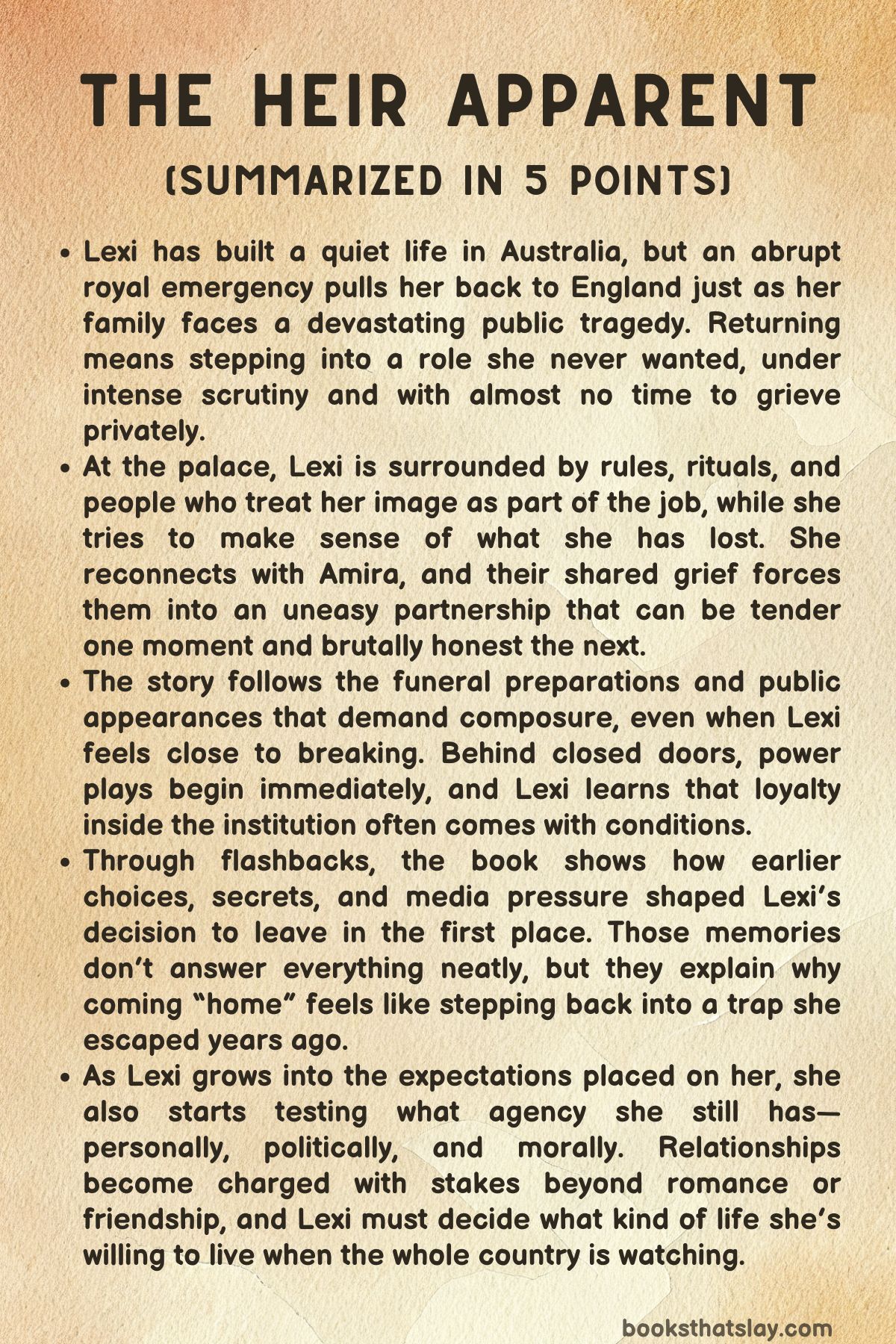
Summary
On New Year’s Day 2023, Lexi is camping on Maria Island in Australia with her best friend Jack and their friend Finn. She and Jack keep their annual tradition of watching the sunrise, and the closeness between them feels newly risky—hand-holding, a near-kiss, the sense that something is finally about to change.
Then a helicopter lands nearby. An older palace aide, Stewart, steps out and calls her back to a life she walked away from three years earlier.
Lexi assumes the Queen has died, but Stewart is terrified for a different reason: Lexi’s father, Prince Frederick, is dead after a skiing accident in Switzerland, and Lexi’s twin brother Louis has been critically injured in an avalanche.
Stewart hustles Lexi through Hobart and onto a private jet. Palace staff begin reshaping her into a “presentable” version of herself, removing her nail polish, choosing her clothes, managing her face and hair before she even reaches England.
Lexi is furious at being handled and recoils when Stewart tries to calm her with a sedative he once used after her mother’s death. On the plane she watches her phone fill with headlines and rumors.
The press reports Frederick’s death, Louis’s condition, and the near-fatal injuries of Krishiv “Kris” Shankar, the brother of Amira—Louis’s wife. Lexi clings to a thin hope that Louis might survive, remembering stories about people pulled back from cold-water and ice-related accidents.
She also receives a message from Amira, the first in years, asking her to come home because she needs her.
While Lexi is in transit, the worst happens. Louis dies at a Swiss medical centre.
Amira makes the decision to turn off his life support, and she also turns off Kris’s shortly afterward. Lexi learns the news mid-journey during a refuelling stop, and the shock folds her in half.
By the time she lands in England on 2 January 2023, she is no longer just the absent spare; she is now the heir.
A prime minister, Jenny Walsh, meets Lexi on the tarmac and escorts her under heavy security toward London. Lexi tries to get a clear explanation of what happened on the mountain, but Jenny implies the Queen may want to deliver the details herself.
The narrative then steps back to show the avalanche: Louis, Amira, Kris, and later Frederick are in Zermatt for a birthday trip. Against sensible caution, Louis pushes for one final off-piste run with an instructor.
Conditions seem manageable until a fault line breaks; the snow gives way and swallows them. Rescue is chaotic and under-equipped.
Kris is found first, unresponsive. Frederick is recovered with fatal injuries.
Louis is pulled out with a weak pulse, but he never wakes.
Back at Buckingham Palace, crowds gather at the gates in mourning. Lexi is brought inside to face the Queen, her grandmother, who is shaken but clinging to routine.
Lexi finds Amira in Louis’s childhood room, hollowed out by grief and exhaustion. They cling to each other.
Amira shares the brutal reality of identification and the small details that won’t stop replaying. She gives Lexi one of Louis’s old rugby shirts and begs her not to disappear again.
Lexi promises she won’t.
The days that follow are full of meetings, rules, and quiet power grabs. Lexi wakes disoriented, calls Finn in Hobart, and lies about having her phone taken, trying to keep her old life from snapping completely.
A young staffer named Mary escorts her through the palace and lets slip how much internal politics churn beneath the formal surface. Funeral plans are laid out: Frederick and Louis will lie in state in Westminster Hall, then one joint funeral will take place at Westminster Abbey, followed by burial.
Lexi’s uncle Richard presses for visibility and influence, pushing to include his daughters, Demelza and Birdie, in the public procession. The Queen asks Lexi to decide, and Lexi agrees the girls should walk if they wish.
After the meeting, Richard corners Lexi privately. He frames the Queen as fragile and claims Amira’s presence is a problem, then asks for Amira to be removed so he can install himself at the Queen’s side.
Lexi sees the maneuver for what it is. Instead of letting Amira be isolated, Lexi proposes that she and Amira move together into Louis and Amira’s apartment at Cumberland Palace, taking themselves out of Richard’s reach.
In Cumberland, grief mixes with alcohol, anger, and the strain of unfinished history. Lexi learns Amira had been preparing for an egg retrieval the following week, after months of planning and self-denial, and the deaths have shattered the timeline she built her body around.
They drink together, dance through the night, and crack open old resentments. Later, drunk and aching, Lexi calls Jack in Tasmania and finally says the thing that has been sitting between them: were they about to kiss before the helicopter arrived?
Jack admits he was going to. He also insists that Lexi’s title is not what draws him to her.
The call steadies her and scares her at once—because love feels real, and real love is hard to protect inside a palace.
Flashbacks show how Lexi ended up in Australia in the first place. After her mother’s death, her mother’s twin brother, James, publicly defies the palace script at the funeral and secretly offers Lexi an escape route.
Over time he helps her use a gap-year plan as cover, then supports her when she abandons the official itinerary, applies for a visa, and builds a new life in Hobart studying chemistry. Stewart once tried to pressure her to return, warning she would lose access to money and status.
Lexi stayed away anyway.
Back in 2023, tabloids quickly set their teeth into the new crisis. A front page claims Lexi and Amira threw a loud party and were pushed out of the palace because the Queen couldn’t cope.
It praises Richard and attacks Lexi as unstable, while painting Amira as reckless. Amira’s mother, Vikki, warns Lexi that if she wants to hold her position as heir, she will have to fight, because people are already trying to discredit her and push Amira out of the family story.
The weeks after the funeral harden into a new routine: public duty, grooming, surveillance, and strategic appearances. Lexi meets Colin, an aristocrat who knew Louis, and she finds herself hungry for stories about her brother—anything that lets her know Louis as a person rather than as an icon.
Colin becomes a strange bridge: someone who understands the world Lexi is trapped inside, and who also hints at how leaks and narratives are manufactured from within the court.
More of the past comes into focus. In 2012, as the twins turn eighteen and the tabloids obsess over their bodies and sex lives, Louis is hiding that he loves Kris.
Only Lexi and Amira know. The palace leans into a public pairing between Louis and Amira as cover, and the plan expands: Amira will travel with Louis and Kris to keep the public story intact.
Lexi feels betrayed—not only because the deception uses Amira as a shield, but because it turns Amira into a target for racist and sexist attacks, and it shuts Lexi out of her brother’s truth at the moment she most needs honesty. The fracture helps drive Lexi’s final decision to run.
By mid-2023, Lexi is back in London full-time, doing the work expected of an heir. During Trooping the Colour, the Queen talks to Lexi about sacrifice and queenship.
Lexi tries to keep her private self alive through calls with Jack, and she chooses a cause that matters to her: obstetric fistula care, inspired by her desire to become a doctor. Jack plans to come to London for a November reception linked to the cause, a small promise of normal life crossing into her new world.
The palace, meanwhile, keeps offering Lexi “solutions” that look like traps. Colin flirts with the idea of a match between them, dressing it up as inevitability: shared class, shared understanding, shared need for heirs.
Lexi briefly slips into a kiss with him, then pulls back, sensing how easily affection becomes leverage. Colin later admits he once had an affair with Amira and uses it to suggest Amira cannot be trusted.
Lexi sees that Colin’s interest is bound up with dynasty and advantage. A marriage to him would be clean on paper and suffocating in practice.
On 17 November 2023, Lexi hosts a palace reception to raise awareness about obstetric fistula and honours a doctor from Nairobi. She navigates cameras, greetings, and the Prime Minister’s presence with practiced calm.
Richard tries to threaten her with exposure of a secret tied to her mother’s death and a man named Davide Rossi, but Lexi refuses to fold. She also breaks from her scripted remarks, speaking openly about Britain’s imperial legacy and the need for truth and repair, even as Stewart seethes at the breach.
Later, Lexi and Amira finally confront the mess between them: the secrets, the manipulation, the pressure applied by the Queen to keep Lexi close to the crown. Amira admits she followed orders in the early crisis, including bringing Mary into Lexi’s orbit, partly because the Queen wanted Lexi contained and partly because Amira herself couldn’t bear losing Lexi again.
Amira also admits the loneliness inside her marriage—marrying Louis for stability while knowing his heart was with Kris, then having an affair with Colin, then turning to IVF as a way to steady a public story that was already cracking. The avalanche ended everything before any of their plans could resolve.
Christmas 2023 brings another round of silent warfare. Lexi warns Demelza about leaking and makes it clear to Richard that she sees what he is doing.
The Queen’s worldview is laid bare: monarchy as stability, not a platform. Lexi’s birthday on 28 December brings access to her trust—£12.7 million, with a large payout that day.
She quietly makes a major anonymous donation to the Nairobi clinic, choosing impact over display.
Then Lexi makes her decision. With Mary’s help, she executes an escape from the palace.
When Stewart arrives unexpectedly, Lexi drugs him to prevent interference, hides herself inside a cleaning trolley, and is wheeled out in a carpet-cleaning van driven by Mary’s brother. Outside London, Lexi meets Jenny Walsh and constitutional scholar Emmanuel Mensah.
She signs a letter renouncing her claim and asks Parliament to ratify it, refusing the palace’s preferred version that would glorify Richard. Jenny provides a new passport under the name Alexandrina Anne Barbara Mary Villiers.
Lexi gives Mary money to build a different life and arranges for Chino to be sent to Australia.
But the palace fight follows her. Mary calls with urgent news: Richard has tipped journalists to investigate Lexi’s mother’s death and has named Davide Rossi.
Lexi chooses a second plan: she meets an American reporter, Dee, and decides to tell the truth on her own terms, before the institution can bury it. Rossi agrees to speak without payment, offering his account of Lexi’s mother and Lexi’s bond with her.
On 31 December 2023, Lexi lands in Hobart. James picks her up and takes her to Jack at the Jennings vineyard.
Lexi learns Amira already told Jack everything and had to stop him from rushing into danger by flying to London. In the vines, Lexi and Jack meet again without ceremony, without handlers, without a script.
Jack tells her he doesn’t hate her, that he has always known, and that he loves her. Lexi finally says it back.
They kiss as the new year approaches, bracing together for whatever the truth will bring once it reaches the world.
Characters
Lexi (Alexandrina “Lexi” Villiers)
Lexi begins the story as someone who has deliberately built a life far away from monarchy, not because she is careless, but because distance is the only way she has learned to breathe. In The Heir Apparent, her return to England after the avalanche deaths forces her into a version of herself the palace wants to “restore”: polished, controlled, visually compliant, and emotionally quiet.
What makes Lexi compelling is that she is not simply rebellious; she is grief-shaped. Her mother’s death, the suffocating scrutiny around her body and sexuality as a teen, and the role of “spare” created a person who equates royal duty with personal erasure.
When Louis dies and she becomes heir, the role she was never trained to desire becomes unavoidable, and the narrative tracks the psychological violence of that transition—panic attacks, dissociation, nausea, and the constant pressure to perform stability while privately collapsing. Yet Lexi is also clinically minded and ethically stubborn, which is why she’s drawn to medicine and later to speaking honestly about imperial harm at her reception even when Stewart edits her speech.
Her arc is ultimately about agency: she tests the system’s limits, realizes that every “choice” inside it is engineered, and then takes the only true choice available—renouncing power and reclaiming a self that is not a symbol. Even her final act of telling the truth is not framed as revenge; it is framed as refusing to keep paying for other people’s secrets with her silence.
Prince Louis
Louis exists in the narrative as both absence and revelation: he dies early, but he keeps becoming more complicated the more people speak about him. He is introduced as the designated heir and twin to Lexi, someone whose public self is curated from birth to avoid “constitutional confusion,” and that controlled origin becomes a metaphor for his whole life.
Louis carries the monarchy like a weight that reshapes his interior world—he learns to conceal, to measure his desires against national consequence, and to treat intimacy as a liability. His love for Kris is not portrayed as a simple forbidden romance; it is a political impossibility inside the family’s machinery, so Louis chooses a life of performance, using Amira as misdirection while trying to protect the person he loves and the institution he is trapped inside.
The tragedy is that his choices harm people even when they are made with protective intent, and that harm fractures his bond with Lexi when she realizes she is being asked to collude. Louis’s emotional distance also becomes a quiet grief for Lexi after his death: she aches not only for him, but for the fact that she cannot know whether he was happy, whether he ever felt free, or whether he died still negotiating his life like a press statement.
In The Heir Apparent, Louis is the clearest example of how monarchy turns a human being into a problem to be managed, and how that management can kill intimacy long before it kills the body.
Amira
Amira is written as someone forced into permanent double consciousness: she must survive private truths while living inside a public fiction that feeds on her. She is intelligent, strategic, and exhausted, and her grief is complicated because she loses not only Louis but also the future she was trying to build—an IVF plan, a stabilizing narrative, and whatever fragile partnership she and Louis had engineered to endure.
The story refuses to let her be reduced to archetype; she is not only the glamorous royal wife, nor only the schemer, nor only the victim. She is all three at different moments because she is playing a game where the rules keep changing and the punishments are public.
Her blunt insistence that Lexi’s “job” is marriage and an heir can sound cruel, but it also reveals how thoroughly Amira has internalized what the monarchy demands from women: love is optional, optics are mandatory, and survival requires adaptation. Her relationship with Lexi is the emotional hinge of The Heir Apparent—they move from fragile reunion, to drunken intimacy, to deep rupture, to reconciliation built on confession.
When Amira admits she followed the Queen’s orders and also wanted Lexi to stay, it lands as both betrayal and longing, suggesting she is terrified of being abandoned again and of losing the only person who truly understands what Louis’s life cost. Amira’s real power is not political leverage but emotional truth: she eventually pushes Lexi to decide what she wants, not what duty scripts, and that push—messy, imperfect, sometimes sharp—is part of what frees Lexi.
Prince Frederick
Frederick is portrayed less as a villain than as an embodiment of institutional coldness disguised as paternal authority. He is capable of family intimacy, but his primary loyalty is to the crown’s continuity and the optics that protect it, which makes him dangerous in the way “reasonable” powerful people can be dangerous.
His response to crisis is control: he sends aides like Stewart to manage Lexi, threatens inheritance restrictions, and treats scandal as something that can be paid down and buried. Even after death, Frederick’s legacy shapes Lexi’s choices—his money, his secrets, and the culture of silence he upheld are all part of the cage she must escape.
Queen Eleanor
Queen Eleanor is stability made human, and the narrative treats her with both tenderness and critique. She is grieving, shaken, and increasingly frail, but she responds to loss through routine because routine is how monarchy survives—ceremony as anaesthetic.
What makes her complex is that she clearly loves Lexi, yet she is willing to override Lexi’s autonomy to preserve the institution, including orchestrating Lexi’s return and limiting her freedom. She speaks of sacrifice and queenship as if they are moral virtues rather than systemic demands, revealing a worldview where personal pain is not an argument against duty but proof of its seriousness.
At the same time, she is not written as a cartoon tyrant; she is a woman who has lived so long inside the role that she cannot tell where the person ends and the crown begins. Her belief that monarchy is “stability, not a platform” becomes a final philosophical conflict with Lexi, who increasingly sees that stability built on silence is not neutral—it is a choice that protects some people by consuming others.
Stewart
Stewart functions as the palace’s nervous system: he carries messages, applies pressure, and keeps bodies moving in the direction tradition demands. His frightened arrival by helicopter shows that even insiders are unsettled when the line of succession breaks, and his instinct is to treat Lexi as something to be processed—transported, dressed, sedated, presented.
The sedative elixir is especially revealing: he frames it as care, but it is also a tool of compliance, a way to quiet a woman in distress so the machine can keep running. Lexi’s fury at his touch and his methods signals her refusal to be managed again.
Yet Stewart is not purely monstrous; he is also a bureaucrat of grief, someone who has likely spent decades watching people fall apart behind palace walls and responding with the only solutions the system allows. His later moment—being drugged by Lexi during her escape—feels like a reversal of power: the caretaker of coercion becomes the coerced, and the narrative suggests that in this world, “care” is often indistinguishable from control.
Jack
Jack represents an ordinary intimacy that feels extraordinary to Lexi because it is not conditional. He is steady, teasing, emotionally present, and unthreatened by her status even as he recognizes how dangerous it can be for her.
Their relationship is shaped by timing and interruption—the almost-kiss at sunrise, the long-distance calls threaded through grief, the way he becomes both anchor and temptation when Lexi is being pulled back into monarchy. Jack’s importance in The Heir Apparent is not that he is a flawless romantic ideal; it is that he offers Lexi a mirror in which she can be a person rather than a symbol.
When Lexi worries her title is what makes her interesting, Jack’s insistence that he doesn’t care is less romantic reassurance than existential rescue: it confirms that love can exist without choreography. He also becomes a quiet moral barometer—his suggested charity focus connects to Lexi’s medical calling, reinforcing that her most authentic self is the one oriented toward healing rather than ruling.
By the end, Jack is not a “prize” for leaving; he is the proof that leaving makes space for real life.
Finn
Finn operates as the grounded witness to Lexi’s Australian self, the friend who knows her without mythology. He is practical, protective, and tuned to the emotional subtext Lexi tries to hide, urging her toward connection when she starts retreating into palace isolation.
Finn’s presence also complicates the palace worldview, because he represents a community that cannot be bought or controlled through protocol. The 2020 flashback where Louis meets Jack and Finn shows Finn’s broader narrative function: he is part of the alternate family Lexi built, and his existence demonstrates that Lexi did not merely run away—she successfully constructed a different life with real bonds.
Finn is a reminder that Lexi’s identity outside royalty is not a fantasy; it is already real, already inhabited, and therefore possible to return to.
Krishiv “Kris” Shankar
Kris is central even in death because he exposes the monarchy’s deepest hypocrisy: the institution demands perfect narratives, and queer love threatens its illusion of orderly inheritance. His relationship with Louis is portrayed as genuine and formative, but it is treated publicly as impossible, requiring a performance that endangers everyone around them.
Kris’s injury and death alongside Louis make the tragedy feel doubly cruel, because even in catastrophe the hierarchy of importance persists—guards want CPR prioritized for princes, while the instructor chooses to treat Kris first, an act that underlines Kris’s humanity against the institution’s ranking of lives. Kris’s presence also sharpens Lexi’s moral clarity: she recognizes the racist and sexist violence that will land on Amira as cover, and she sees how easily the palace would sacrifice outsiders to protect the heir’s image.
Kris symbolizes both love and erasure: a man essential to the heir’s private life, yet structurally excluded from legitimacy.
Vikki Shankar
Vikki is a strategist who understands power as something you anticipate, not something you request. She reads tabloids and palace factions like weather, warning Lexi that if she wants to claim her new position, she must fight because the fight has already begun.
Her earlier willingness to endorse Amira’s role as “protection” for Kris reveals a complicated morality: she is not naïve about what the institution can do to a gay British Indian man, and she chooses a plan that reduces harm in one direction while creating it in another. That tension makes her a morally ambiguous figure rather than a simple manipulator.
Vikki represents a kind of immigrant pragmatism colliding with aristocratic myth—she knows the crown will not reward loyalty, only usefulness, so she builds leverage where she can. She is also fiercely maternal, but her maternal instinct expresses itself through tactics, which can look cold until you realize the world she’s navigating is colder.
Prime Minister Jenny Walsh
Jenny Walsh is the story’s most visible example of power that must cooperate with monarchy while also containing it. Her early interactions with Lexi carry the careful restraint of constitutional reality: she offers condolences, escorts her, and withholds details when the Queen “may prefer” to speak, demonstrating how even elected authority must sometimes defer to royal management of narrative.
Later, Jenny becomes pivotal to Lexi’s escape, which reframes her not as merely a ceremonial companion but as someone willing to facilitate Lexi’s agency when it intersects with constitutional process. Jenny embodies the uneasy partnership between democracy and monarchy: she cannot openly attack the institution, but she can create procedural pathways for truth and choice, and she ultimately helps Lexi translate personal rebellion into lawful action.
Mary
Mary begins as a seemingly minor aide—young, observant, and positioned close enough to the royals to know their rhythms but far enough to see the absurdity. Her humor about running Annabelle’s social media hints at a sharper intelligence: she understands how the palace manufactures reality online as much as it does in person.
Over time, Mary becomes more than staff; she becomes a co-conspirator in Lexi’s liberation, using her access, her brother Charlie, and her own willingness to burn bridges to get Lexi out. What makes Mary significant is that she represents a new kind of loyalty—loyalty to a person rather than the institution.
She is also a quiet study in class dynamics: she moves through elite spaces in service roles, learns where the exits are, and then uses that knowledge to dismantle a royal script from the inside.
Uncle Richard
Richard is the clearest antagonist in the book’s present timeline, not because he is the only cruel person, but because he is openly predatory about opportunity. He treats the Queen’s grief and frailty as a vacancy to be filled, pushing Amira out so he can move in, and positioning his daughters in the procession as a symbolic claim to proximity.
His cruelty is often delivered through “barbed” comments, which is precisely how aristocratic aggression preserves plausible deniability. Richard’s threats—especially leveraging secrets and tabloids—show that his real weapon is narrative control; he understands that modern monarchy is not secured by law alone but by public belief.
Richard represents the monarchy’s worst evolutionary trait: an ability to adapt old entitlement into new media warfare. He is not just fighting for affection or legacy; he is fighting for the story that decides who deserves the crown.
Demelza
Demelza functions as a bridge between innocence and complicity. She is close enough to Richard to be part of his orbit, yet not always old or hardened enough to understand the cost of what he is doing.
Her presence in the funeral procession becomes a symbolic expansion of who gets to be seen as “family” at the center of power, and later Lexi’s confrontation suggests Demelza may be involved—directly or indirectly—in the leaking culture that fuels tabloid attacks. Demelza embodies the way younger royals can be trained into the same weapons their parents use, sometimes without realizing they are being trained at all.
Birdie
Birdie is portrayed as more impulsive and physically vulnerable, which makes her injury during the aristocratic games feel like a small but telling rupture in the glamour of that world. Lexi treating Birdie’s foot highlights Lexi’s medical instincts and the way she defaults to care even in hostile environments.
Birdie’s role is less about political maneuvering and more about atmosphere: she illustrates how the royal younger generation is raised amid reckless privilege, where danger is treated like entertainment until blood appears. Birdie helps show Lexi what she is expected to belong to—and why she doesn’t.
Annabelle
Annabelle remains mostly off-stage, yet her absence is a form of presence: she retreats to Elton Park while the family reorganizes itself, which signals both self-protection and a refusal to be consumed by the core royal drama. Through Mary’s comments about managing her social media and joking she is “worse” than Frederick, Annabelle is framed as someone intensely invested in image, perhaps more modern in method but equally committed to control.
In the novel, Annabelle represents the influencer-era version of royal power: less about speeches and more about branding, less about tradition and more about perception management.
James
James is Lexi’s lifeline and the book’s clearest representation of family love unapproved by the palace. His defiant funeral speech for Lexi’s mother establishes him as someone unwilling to participate in royal sanitization, and his secret offer of rescue gives Lexi a real exit strategy rather than a fantasy.
James supports her materially and emotionally in Australia, which contrasts sharply with Frederick’s inheritance threats. James symbolizes alternative inheritance: not money or titles, but truth, accountability, and chosen freedom.
His later urging that Lexi forgive herself about her mother suggests his role is not just enabling escape, but helping Lexi heal enough to stop living as punishment.
Dee (the American reporter)
Dee appears late, but she matters because she offers Lexi a route to truth that is not controlled by palace courtiers or British tabloid ecosystems. By choosing to meet Dee, Lexi stops trying to outmaneuver the monarchy’s narrative machine and instead steps outside it, betting on transparency rather than strategy.
Dee’s function is structural: she represents the public sphere where monarchy has less power to edit reality, and she enables Lexi’s story to exist without being rewritten into a compliant statement.
Davide Rossi
Rossi is an emblem of how the palace manages scandal: he is not simply a person in Lexi’s past, but a potential headline, a lever Richard can pull, and a reminder that private relationships become weapons in royal politics. The fact that payments and silence agreements hover around him highlights the transactional machinery used to keep the institution clean.
When Rossi agrees to speak without payment, it challenges that machinery, suggesting that some truths persist even when money is offered to erase them. Rossi represents the monarchy’s fear of ordinary human messiness—love, grief, error—because those realities undermine the myth of controlled virtue.
Dr Esther Miloyo
Dr Miloyo is not central to the family plot, but she is central to Lexi’s moral identity. Honoring her at the obstetric fistula reception anchors Lexi’s public role in something concrete and reparative rather than ceremonial.
Dr Miloyo represents the life Lexi is drawn toward: medicine, service, and truth spoken plainly. The reception also becomes a battlefield where Lexi chooses honesty about imperial legacy, making Dr Miloyo’s presence a catalyst for Lexi’s refusal to let royalty be only performance.
Charlie (Mary’s brother)
Charlie is a practical agent of escape, which is exactly what the story needs at the moment when ideas must become logistics. The carpet-cleaning van, the trolley, the bypassing of guards—Charlie’s role shows that dismantling a monarchy’s hold on someone can require ordinary working knowledge more than grand heroism.
Charlie represents the material reality beneath palace spectacle: doors, schedules, uniforms, and routes—systems built by labor that can also be used to slip the crown’s grasp.
Chino
Chino’s presence during Lexi’s escape underscores how deeply surveillance and risk permeate Lexi’s world by the end. He is part of the operational layer—movement, concealment, and getting out—rather than the emotional layer, but that contrast is meaningful: by the time Lexi flees, her life has become a security problem the palace would rather solve than a person’s life they would rather understand.
Chino symbolizes the final phase of Lexi’s transformation: she stops negotiating and starts executing a plan.
Themes
Identity under surveillance
Lexi’s return to Britain turns her body and personality into a managed public object, and that pressure shapes how she understands herself. The first hours after the helicopter arrival show how quickly private identity is overwritten by institutional expectation: her nail polish is removed, her clothes are chosen for symbolism, and even her facial expression is treated as something to arrange.
That treatment is not simply about etiquette; it is a form of control that tells her who she is allowed to be and when. The tension is heightened because Lexi has lived for years in Tasmania where she is known as a friend and a student rather than a headline.
When she is forced back into “appropriate” presentation, she experiences the change as physical violation, which is why Stewart’s familiar sedative feels less like help and more like a reminder that her emotions are inconvenient to the system. What makes this theme sharper is that surveillance doesn’t come only from photographers outside the gates.
It appears in gossip channels, staff networks, court faction briefings, and planted narratives that shape what the public believes before Lexi can even speak. The tabloid story about eviction after a party demonstrates how fast false identity can be manufactured and how it travels through class interests that benefit from her being seen as unstable.
Over time, Lexi learns that being watched is not the same as being known; even inside the family, people project roles onto her—disruptor, savior, future queen—without asking what she wants. Her phone calls to Jack act as a counterweight because they restore a version of her that is not optimized for optics.
Yet those calls also expose how difficult it is to maintain a private self when danger follows her across continents. By the end, when she chooses to renounce her claim and adopt a new name, the act reads less like reinvention for novelty and more like a refusal to let her identity be continuously edited by others.
The surveillance never truly disappears, but she changes her relationship to it by deciding that her inner life will no longer be negotiated through palace image management.
Grief as interruption and as inheritance
Loss in The Heir Apparent is not a single event that characters “process” and move beyond; it behaves like a force that interrupts time, routines, and relationships, leaving people stranded between duty and shock. Lexi’s grief begins before she even lands in England, with the cruelty of being in transit while the world updates without her.
The delayed disclosure of Louis’s death shows how grief can be administered like information, released at moments of convenience rather than moments of care. When she reaches the palace, the Queen’s reliance on routine becomes a survival strategy, but it also reveals a generational habit of treating emotion as something to contain.
Lexi’s own reactions—panic attacks, nausea, disorientation—suggest that grief is not only sadness; it is the body refusing to cooperate with public expectations. The lying-in-state and funeral rituals create a formal container for mourning, yet those same rituals flatten the complexity of who Frederick and Louis were, turning them into symbols.
Lexi’s private moment in Westminster Hall becomes important because it is one of the few places where grief is not immediately converted into performance.
Grief is also inherited through stories, secrets, and unfinished conversations. Lexi realizes she doesn’t know whether Louis was happy, and that uncertainty becomes its own kind of mourning: she isn’t only grieving his death but also the parts of his life that were hidden, managed, or sacrificed.
Colin’s account of Louis at school unexpectedly comforts her because it provides a normal human detail, and that hunger for ordinary stories reveals how royalty can deprive people of intimate knowledge even within families. Amira’s grief carries a different texture: she has identified bodies, managed medical decisions, and watched months of fertility preparation collapse into meaninglessness.
Her exhaustion and medications show grief blended with a sense of bodily betrayal, as though time itself has stolen her future. The theme becomes more complicated when Lexi later confronts the truth that the family has been grieving for years, not only for deaths but for lives restricted by public scripts—Louis’s love for Kris, Amira’s loneliness inside a marriage built for stability, and Lexi’s earlier flight after her mother’s death.
By the end, grief is no longer only what happens after tragedy; it becomes a legacy that shapes choices. Lexi’s decision to speak to a reporter and tell the truth is fueled by grief’s insistence that silence has already cost too much, and that the next generation cannot keep inheriting pain disguised as tradition.
Power, succession, and the mechanics of control
The story treats succession not as a ceremonial line on paper but as a living mechanism that rearranges everyone’s incentives the moment the heir dies. Lexi’s shift from spare to heir triggers an immediate scramble among courtiers and family members, and those movements reveal how power operates through access, proximity, and narrative leverage rather than only titles.
Richard’s behavior illustrates this clearly: he frames his maneuvering as concern for the Queen’s comfort, but the request to remove Amira and install himself at the monarch’s side is a calculated bid for influence during a vulnerable transition. Lexi’s agreement to move out appears cooperative, yet it is also her first strategic move, an early recognition that resisting openly inside the palace can be less effective than repositioning quietly.
The funeral planning meeting shows how even grief becomes a site for negotiation: who walks, who stands closest, who is seen by cameras. Tradition is invoked as a tool, and the people who claim to protect it often do so because it preserves their advantage.
This theme deepens through the repeated message that the monarchy’s main product is stability. The Queen’s view that the institution cannot become a personal platform is not presented as pure malice; it is a worldview in which the system’s survival matters more than the individuals inside it.
That belief justifies confiscating Lexi’s passport, shaping her schedule, editing her speeches, and pressuring her romantic choices. Even seemingly small interventions—grooming routines, jewelry selection, staged appearances—operate as techniques of compliance training.
Lexi’s charity work becomes a battlefield because it threatens to convert ceremonial visibility into moral speech. When Stewart edits her reception toast to remove colonial history references, the edit reveals what the institution fears: not embarrassment, but the destabilizing effect of honesty.
Lexi’s decision to go off-script is a direct challenge to the unwritten rules that keep the monarchy politically useful by keeping it emotionally and historically vague.
The mechanics of control also appear in how money and secrecy reinforce authority. The trust fund restriction, the payoff to Rossi, and the threat of tabloid exposure demonstrate that the palace’s power is partly financial and partly informational.
Richard’s attempt to blackmail Lexi relies on the idea that shame will keep her obedient. Lexi’s response—building alliances, recognizing staff politics, and finally renouncing in a way that blocks the palace’s preferred narrative—shows her learning the system well enough to exit it on her own terms.
The theme lands hardest in the escape sequence: a literal hiding in a cleaning trolley becomes the physical expression of a larger truth that royal power depends on controlled movement and controlled stories, and the most radical act is choosing where your body and your name will exist.
Love, desire, and the politics of partnership
Romance in The Heir Apparent is never simply private; it is assessed as risk, strategy, and public messaging. Lexi’s connection with Jack begins in a space designed to be outside politics—camping, sunrise, ordinary affection—yet it becomes instantly threatened by the helicopter arrival, as if the institution itself interrupts intimacy.
When Lexi later questions Jack about whether they were about to kiss, the moment matters because it shows her craving a relationship that exists before titles, not after them. Her fear that her status makes her “interesting” points to a deeper insecurity: she worries love will always be contaminated by power.
Jack’s refusal to treat her as a trophy offers relief, but it does not solve the structural problem that her role makes even sincere love dangerous and exploitable.
In contrast, Louis and Amira’s marriage exposes partnership as a public instrument. Their relationship is structured as misdirection that protects Louis and Kris while asking Amira to absorb racist and sexist hostility.
The plan is presented as necessary, but the emotional cost is enormous: Amira is required to perform devotion while being denied a full claim to it. That requirement reshapes her understanding of love into something secondary to compatibility and survival.
When she tells Lexi that her “job” is to marry, stay married, and produce an heir, she is not only being harsh; she is repeating the rules that have defined her own life. The brutality of that conversation is that it reduces Lexi’s future to function, and it also reveals Amira’s fear that love is unreliable within this world.
Lexi’s tears after that exchange show her refusal to accept a life where intimacy must always serve a dynasty.
Colin’s courtship proposal brings the theme to its most explicit political form. His language about “people like us” exposes how class solidarity can be disguised as compatibility, and his vision of marriage as a tidy solution for stability makes clear that he wants Lexi as a partner in management, not as a person with messy human needs.
Lexi’s recognition that such a marriage would be built on power and secrecy is a turning point: she can see how desire gets redirected into institution-friendly arrangements. Her eventual confession of love to Jack, and her choice to face fallout with him, becomes a statement that partnership should be a shared life rather than a negotiated role.
The story does not suggest love fixes everything; it shows that love can be a compass when everything else is bargaining. By choosing Jack while also choosing truth, Lexi links intimacy to honesty and consent, rejecting relationships where people are used as shields, symbols, or stepping stones.
Truth, secrecy, and the cost of protecting an image
Secrets in the narrative are not decorative twists; they are the currency that buys stability. The palace’s approach to information is consistent: control what is said, when it is said, and who is allowed to know it.
Lexi’s delayed news about Louis’s death is an early example of secrecy justified as protection, but it also trains her to distrust the people supposedly caring for her. As events unfold, Lexi learns that the most dangerous secrets are not only personal ones but institutional ones—payoffs, cover stories, staff leaks, and managed public relationships.
Even the tabloid ecosystem is shown as partly internal, fed by courtiers who gain advantage when the “right” narrative dominates. Colin’s warning that leaks often come from staff and courtiers sharpens this theme because it suggests the monarchy’s public image is maintained through constant internal betrayal, not through unity.
Secrecy is portrayed as corrosive because it isolates individuals and turns relationships into strategic positions. Louis’s hidden relationship with Kris protects the future king from crisis, but it also traps him in loneliness and forces Amira into a role that makes her a target.
Lexi’s escape to Australia is partly a rejection of that secrecy culture; she cannot bear being drafted into lies that harm others. Later, when she returns, she finds that secrecy has only grown more intricate: alliances are pre-arranged, staff placements are deliberate, and her movements are constrained.
The story shows how quickly secrecy becomes self-justifying. Once the palace believes stability depends on a specific version of events, truth becomes framed as a threat rather than a virtue.
Lexi’s speech about imperial legacy is the most visible rupture in this system because it introduces a kind of truth that cannot be easily confined to family drama. By speaking publicly about amends, she risks political controversy, but she also challenges the deeper rule that the monarchy should never name harm clearly.
The consequences are immediate: mixed applause, displeased aides, and heightened factional hostility. Richard’s attempt to weaponize Lexi’s private history demonstrates the standard method of enforcing silence—turning truth into scandal, and scandal into obedience.
Lexi’s decision to choose “plan B” and speak to a reporter reverses that logic. Instead of letting others drip-feed her story as punishment, she claims it proactively as a moral decision.
The cost is real: she anticipates attacks on her credibility and understands that truth will not be welcomed by the institution she is leaving behind. Yet the narrative insists that secrecy has already been expensive, paid for in guilt, fear, and distorted relationships.
By ending with Lexi returning to Hobart and preparing for fallout, the theme resolves not in perfect vindication but in a clear trade: she accepts uncertainty in exchange for not living inside a lie.