Their Vicious Darling Summary, Characters and Themes
Their Vicious Darling (Vicious Lost Boys #3) by Nikki St. Crowe is a dark why-choose romantasy that reimagines the Peter Pan mythos with aged-up characters, heavy spice, moral ambiguity, violence, and supernatural power struggles.
The story picks up immediately after the events of The Dark One, blending intense polyamorous relationships with escalating war on Neverland.
Summary
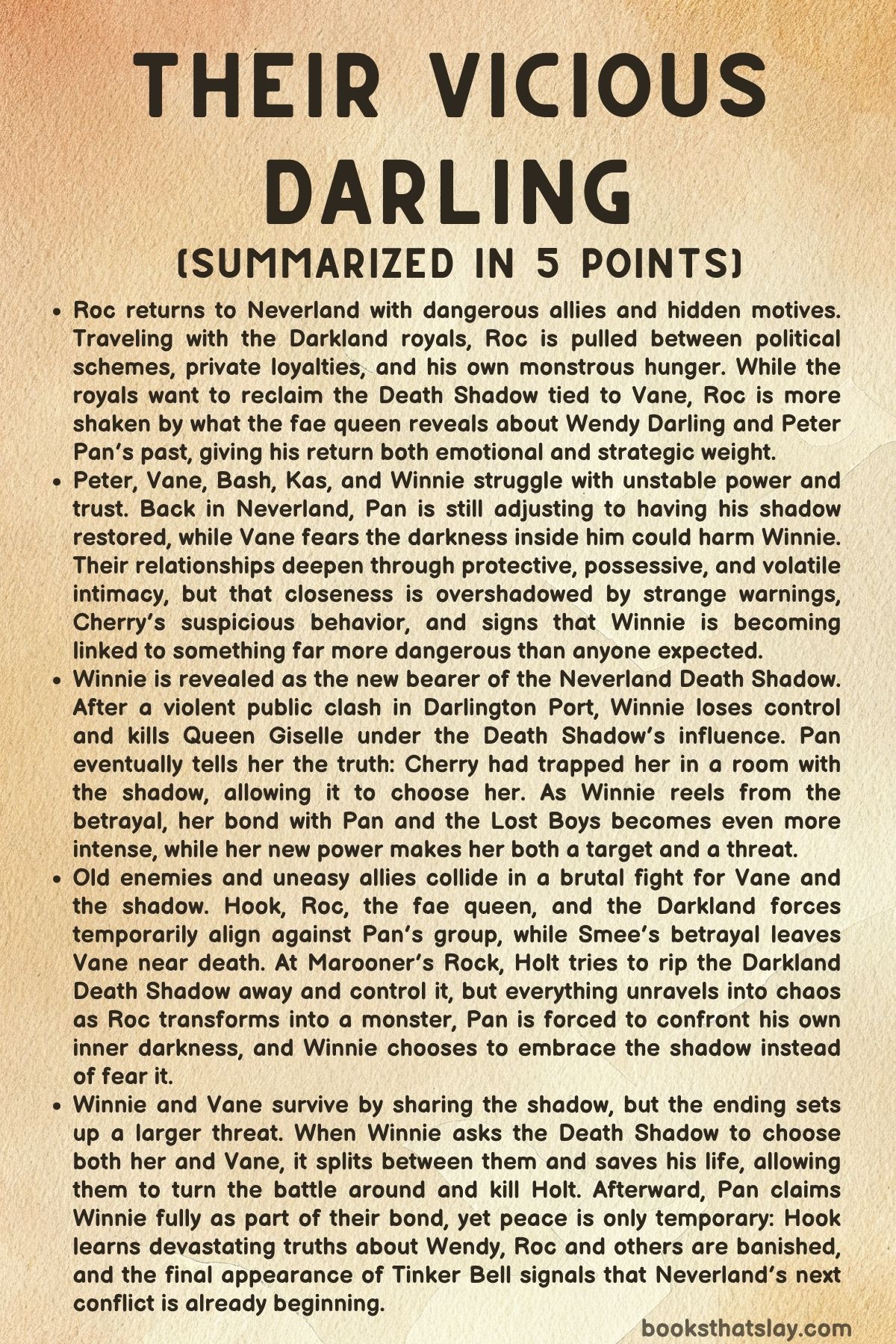
The story follows several groups whose goals begin colliding as danger builds across Neverland. Roc, also called the Crocodile, travels to Neverland with the wealthy Darkland royals, including Queen Giselle, Princess Amara, and Holt.
Roc is already entangled with this family in messy and intimate ways. He has been sleeping with both Giselle and Amara, even while Holt openly distrusts him.
Although Roc acts indifferent, he has private reasons for returning to Neverland. The fae queen, Tilly, has summoned him with promises that she can reveal hidden truths about Peter Pan.
The Darkland royals also want something from him: they hope to reclaim the Darkland Death Shadow, which is now connected to Roc’s younger brother, Vane. Roc pretends that Vane means nothing to him, but inwardly he knows he could never truly give his brother up.
During the voyage, the royal family questions Roc over dinner about how he plans to approach Vane once they arrive. Roc insists that he should handle the matter alone and warns them not to provoke Peter Pan or the Lost Boys.
Holt pushes for a more direct plan and suggests bringing Vane to them by force, but Roc gives only vague answers. He is growing more agitated because he is fighting a private hunger and feels time slipping away.
Once he leaves the table, he drags a servant girl into his cabin and reveals that sex is not enough to satisfy what he really is. He must feed.
Even as he apologizes, he attacks her, showing that he is no longer fully governed by ordinary human limits.
In Neverland, Peter Pan, Vane, and the fae twins Bash and Kas are returning from battle after Pan has finally recovered his shadow. Pan feels strange and unsettled now that he is whole again, while Vane confesses that his connection to darkness still makes intimacy with Winnie Darling dangerous.
He fears that if he cannot direct his violent nature properly, he may hurt her in ways he cannot undo. When the group senses something is wrong, a wolf appears and leads them toward the treehouse.
Pan rushes ahead and finds the house damaged. Inside, Cherry is hiding in Winnie’s room while the wolf guards Winnie as she sleeps through the destruction.
Cherry lies repeatedly when questioned, and Pan notices injuries on her body that suggest far more has happened than she will admit.
The wolf’s presence becomes important as Bash and Kas begin to suspect that he may be Balder, a wolf cub they loved long ago before their mother, Tinker Bell, had him killed. When Winnie wakes, she feels an unusual bond not only with the wolf but also with the emotions of the twins and Vane.
The animal seems able to communicate simple instincts to her, especially a strong need to protect her. Winnie later finds Pan on the beach at sunrise, where he is experiencing something he has not had in a long time now that his shadow has returned.
He admits his fear of losing it again. Their tenderness turns physical, and soon Vane is drawn into the encounter after catching them together.
Pan uses the moment to test whether Vane can handle Winnie safely now that Pan’s shadow is back. For a moment, it seems possible.
But after the encounter ends, Winnie suddenly becomes ill, collapses, and terrifies all of them.
Smee is brought in to help. She revives Winnie and claims the problem is simple exhaustion and malnourishment, though her behavior suggests that she understands more than she reveals.
Everyone remains uneasy, especially because Cherry is still hiding something. That tension grows worse when Roc arrives in Neverland with the Darkland royals and leads them to the fae palace.
There, Queen Tilly tells Roc that Peter Pan is newly vulnerable because he has only recently regained his shadow. She also reveals that Pan’s greatest weaknesses are Vane and a new Darling girl named Winnie.
Then she offers Roc a far more personal wound: from memories taken from other Darling women, Tilly learned that Wendy Darling was never safely returned to the mortal world. She had been taken away while begging Pan to come for her and to get Roc.
Worse still, Wendy had left Neverland pregnant. Roc is overcome with rage and grief when he realizes she had been carrying Peter Pan’s child.
At the same time, Cherry is close to fleeing Neverland. She is drunk, panicked, and breaking under years of pain and abandonment.
Bash tries to comfort her with simple kindness, and for a moment she nearly confesses everything. Before she can, Vane summons her to explain why Winnie had disappeared from the tomb earlier.
Roc’s sudden arrival interrupts the confrontation. He enters with his usual mix of danger and charm, flirting with Cherry even as he announces that he has returned because of what he learned from the fae queen and because Peter Pan is at the center of it all.
Meanwhile, Pan takes Winnie to the lagoon to recover and later into Darlington Port so she can eat and regain strength. He also uses the outing to publicly reassert his authority now that his shadow is restored.
In town, Winnie sees more of Neverland’s strange beauty and social order. Pan produces gold with shadow magic, buys her boots, and is openly recognized as the Never King.
In a tavern, he announces that his shadow is back and reminds the people that he rules the island. The calm shatters when Giselle and the Darkland royals arrive.
Something dark inside Winnie reacts instantly. Under the influence of the Neverland Death Shadow, Winnie attacks and kills Giselle, then turns her power on another princess.
Guards rush in. Peter fights them.
Roc points a gun at Winnie and demands action from Pan, but the fight spirals into chaos. Winnie even wounds Roc with the shadow’s power before Pan takes her and escapes.
Back at the treehouse, Pan hides what really happened from the others and tells Winnie the truth: she has somehow taken in the Neverland Death Shadow. She cannot accept it and runs, but the force inside her reacts violently when Vane confronts her.
What begins as conflict turns into another intense encounter shaped by aggression, desire, and the shadow’s influence. Vane escalates things further by turning the situation into a hunt, ordering Winnie to run into the forest.
Bash and Kas find her first and have her before Vane catches up and carries her into the sky. Pan joins them, and together he and Vane punish her while pushing her body and mind to dangerous limits.
During this, Winnie finally feels the Death Shadow more fully and begins to understand that it is becoming part of her.
Later, the group tries to care for her, but Winnie finally remembers how the shadow entered her at all. Cherry had lured her into a room under false pretenses, locked her inside with the Death Shadow, and let it choose her instead.
Elsewhere, Roc collapses wounded at Hook’s home after the violence in town. Hook hates him but keeps him alive.
Roc explains that Winnie now carries the Death Shadow, that the fae queen has been manipulating events, and that the Darkland royals came to recover what they lost. He also admits that he belongs to the Bone Society and must feed on blood to stop himself from becoming a beast.
Even with their history of hatred, Hook and Roc find common cause in opposing Peter Pan.
Things worsen when Smee stabs Vane with a magical sword. He begins dying in a way Pan cannot heal because Vane’s own shadow is rejecting help.
Winnie refuses to leave him and helps take him to the lagoon, hoping its healing power can save him. While they struggle to keep him alive, Hook, Roc, Holt, Tilly, and their forces form a temporary alliance and move in to attack.
At Marooner’s Rock, Vane offers to surrender his shadow if Winnie is spared, but Holt ignores him. Winnie is restrained and threatened.
Then Holt uses a magical stone to rip the Darkland Death Shadow out of Vane and trap it, leaving him emptied out and close to death.
At the same time, Roc loses control and transforms into his monstrous crocodile form, attacking friend and enemy alike. Peter is dragged underwater by the lagoon and has a vision that forces him to face his fear of darkness, loss, and abandonment.
On the rock above, Winnie finally stops resisting the force inside her. She asks the shadow to choose not only her but Vane as well.
When Holt kicks Vane off the cliff, Winnie jumps after him. Darkness catches them and softens their fall into the sea.
When they rise again, Vane’s wound is gone. The Death Shadow has split between them, binding them both to its power.
They return to confront Holt, who is unable to claim Vane’s old shadow because a shadow must willingly choose its bearer. Winnie takes revenge on him for his cruelty, forcing him into humiliation before turning his own blade against him.
Vane finishes him by kicking him to his death. Pan, overwhelmed with relief and love, openly claims Winnie as belonging with them.
In the aftermath, Pan spares Hook but banishes Hook, Cherry, and Roc from the island within two days. Hook later learns from Smee that Wendy had been pregnant and that Winnie is descended from him.
Feeling betrayed, he decides to leave Neverland and search for Wendy. Elsewhere, Queen Tilly makes a desperate offering to the lagoon by sacrificing the fae throne, and the water answers by darkening and releasing something terrible.
The book closes with a fragile moment of peace as Pan wakes beside Winnie, Vane, Bash, and Kas, comforted by their presence. But when he steps outside, he finds Tinker Bell waiting for him, glowing on the balcony, making it clear that the past has not stayed buried and a new threat is only beginning.
Characters
Winnie Darling
Winnie stands at the center of the story as a figure whose importance keeps changing as the plot moves forward. She begins as someone caught between forces larger than herself, but she does not remain passive for long.
What makes her compelling is that she is not simply a victim, a love interest, or a chosen vessel for power. She is all of those things at different moments, yet she keeps developing beyond them.
Her body becomes a battleground for shadow magic, male desire, family history, and island politics, but the deeper conflict is about whether she will be shaped entirely by what others want from her. The answer gradually becomes no.
Even when she is afraid, confused, or manipulated, she keeps moving toward self-possession.
Her connection to power is especially important. The Death Shadow does not merely attach itself to her as an outside curse; it reveals qualities already present in her, including endurance, anger, and the capacity to make brutal decisions when pushed too far.
That makes her transformation more interesting than a simple corruption arc. The darkness inside her amplifies what is already there, forcing her to confront parts of herself that would otherwise remain hidden.
Her eventual acceptance of that darkness is not framed as moral collapse alone, but as a refusal to stay weak in a world that rewards force.
Winnie is also central because she changes the emotional structure of the male characters around her. Peter, Vane, Bash, and Kas do not just desire her; they react to her as a destabilizing presence who alters the balance among them.
She becomes proof that intimacy in this world is never soft or uncomplicated, yet she also becomes one of the few characters able to hold together people who are full of violence and grief. By the end, she is no longer simply someone being acted upon.
She is a participant in power, vengeance, and survival, and that shift gives her real narrative weight.
Peter Pan
Peter is written as a ruler first and a romantic figure second, which gives his character a harder edge than a traditional fantasy love interest. He is possessive, strategic, territorial, and often emotionally guarded even when acting with great intensity.
His regained shadow matters because it restores more than magical ability. It restores identity, confidence, and a sense of wholeness he has been missing.
Yet that restoration does not calm him. Instead, it leaves him more aware of what he could lose, especially once Winnie becomes important to him.
His fear is not just about losing power again, but about being forced back into incompleteness and isolation.
One of the strongest aspects of his characterization is the tension between control and vulnerability. Peter constantly performs authority in public and private.
He wants Neverland to see him as absolute, and he wants the people closest to him to recognize his claim. But underneath that image is someone deeply shaped by abandonment, memory, and old damage.
His reaction to sunrise after regaining his shadow shows that he is not merely a cruel king; he is someone for whom ordinary experiences have become emotionally loaded. He wants to appear untouchable, yet some of his most defining moments are rooted in fear.
His relationship with Winnie also reveals the limits of his power. He can protect, command, punish, and hide truths, but he cannot fully control what she becomes.
That is crucial to his development. He begins in a position of dominance, but the story repeatedly forces him to respond rather than dictate.
He has to reckon with the fact that love, desire, and attachment make him weaker in some ways and more human in others. In Their Vicious Darling, Peter is not a softened villain or a redeemed monster.
He remains dangerous throughout, but the story lets that danger exist alongside devotion, insecurity, and genuine need.
Vane
Vane is one of the most internally conflicted characters in the story. He is introduced as someone who understands his own darkness very clearly and does not trust himself to contain it forever.
Unlike Peter, who tends to project certainty, Vane is more openly fractured. He knows that his nature includes hunger, violence, and the possibility of causing real harm to the person he cares about.
This self-knowledge gives him a tragic dimension. He is not ignorant of what he is; he is terrified that he may be exactly what he fears.
That tension makes his bond with Winnie especially charged. He wants her, but he is also afraid of what wanting means.
Much of his emotional depth comes from the fact that desire, guilt, protectiveness, and aggression all live in him at once. He does not have clean emotional lines.
Even his controlling behavior often comes from panic, fear, or the instinct to prevent something worse. That does not excuse his cruelty, but it does explain why he feels more unstable than simply evil.
He is constantly caught between the urge to dominate and the urge to protect.
His connection to the Death Shadow also reinforces his role as a character defined by divided identity. When he is wounded and his shadow begins rejecting healing, the story makes literal what has already been true psychologically: he is becoming separated from himself.
Later, when the shadow is split between him and Winnie, his character changes again. He is no longer the only one carrying that darkness, and this shared burden allows him to move from isolated torment toward a more collective identity.
That shift does not make him gentle, but it does make him less alone. He remains dangerous, but he is no longer locked inside his darkness by himself.
Roc
Roc is one of the most layered and volatile figures in the novel. He enters as someone outwardly charming, sexually manipulative, and politically useful, but those surface traits hide a much more unstable core.
His hunger is literal as well as symbolic. He is driven by blood, by old wounds, by obsession, and by unresolved grief.
The story presents him as both predator and mourner, and that combination makes him unpredictable. He can flirt, threaten, seduce, and attack within the same emotional space, which gives him a presence that is both theatrical and deeply unsettling.
What makes Roc especially interesting is that his cruelty never fully erases his attachments. He lies about not caring for Vane, yet his internal life makes it obvious that this is false.
His feelings for his brother remain one of the few things that cut through his self-serving behavior. That emotional contradiction matters because it prevents him from becoming a simple monster.
He belongs to a violent order and must feed to survive, but he is also shaped by loyalty and memory. His reaction to learning about Wendy’s pregnancy reveals how much of his current identity is built on loss that was never resolved.
Roc also functions as a character who links many of the story’s major conflicts. He ties together the Darkland royals, the fae queen, Hook, Vane, Wendy’s past, and the larger struggle around Pan.
His body itself becomes a symbol of excess and collapse, especially when he loses control and becomes the monstrous crocodile. That transformation is not only physical.
It reflects the truth that his appetites are always threatening to consume his remaining humanity. In Their Vicious Darling, Roc embodies corrupted devotion.
He is dangerous because he still feels deeply, and those feelings are twisted by hunger, history, and rage.
Hook
Hook is written with more emotional weariness than open theatrical villainy, which gives him a strong presence even when he is not at the center of the action. He is bitter, suspicious, and capable of cruelty, but much of that hardness comes from having lived too long with betrayal and loss.
His relationship with Roc is defined by hatred layered over shared history, and that makes every interaction between them feel unstable. He wants Roc dead, yet he also recognizes that they are bound by old wounds and overlapping interests.
That tension gives Hook complexity beyond straightforward revenge.
His role in relation to Cherry is one of the most revealing parts of his characterization. Around her, the story shows a man capable of tenderness, guilt, and protectiveness.
He understands what it means to be shaped by abusive love, and he recognizes that Cherry has been broken by exactly that kind of history. His promise to find her a real home is one of his most human moments because it suggests that, beneath his anger, he still wants to repair something rather than merely destroy.
That desire for repair is rare in a world where most people respond to pain by inflicting more of it.
The revelation about Wendy and Winnie changes Hook in a major way. It is not just new information; it is proof that parts of his past were hidden from him in ways that reshape his understanding of family, loyalty, and loss.
His response is not grand speechmaking but a deeply personal decision to leave and seek Wendy. That choice matters because it shows he is still moved by the possibility of what was stolen from him.
He is dangerous, but he is not empty. He is a character formed by resentment who still carries the capacity to hope, and that makes him more than an enemy figure.
Cherry
Cherry is one of the most psychologically wounded characters in the story. Her actions are harmful, manipulative, and cowardly at crucial moments, but the narrative makes clear that these choices grow out of a life shaped by neglect, fear, and emotional abandonment.
She lies repeatedly, panics easily, and tries to escape consequences rather than face them. Yet she is not written as someone who enjoys evil for its own sake.
She is written as someone whose desperation has hollowed out her judgment. That distinction matters because it keeps her from becoming flat.
Her betrayal of Winnie is one of the most important things she does, because it shows how pain can make her choose survival over morality. She traps Winnie with the Death Shadow not because she has grand ambitions, but because she is trapped in her own damaged thinking and cannot imagine a clean way out.
The act is still monstrous, but it is rooted in brokenness rather than pure malice. Her fear after the fact is not only fear of punishment.
It is also fear of being fully seen for what she has done.
Cherry’s scenes with Bash and Hook reveal what she lacks most: steady love that does not ask her to become useful, obedient, or disposable. Bash’s gentle care nearly opens her into honesty, while Hook’s promise of home reaches the abandoned child still living inside her adult self.
She is a character shaped by substitution and displacement, always taking someone else’s place and never feeling chosen in her own right. That emotional condition explains why she is so fragile and so dangerous at once.
Smee
Smee plays the role of hidden knowledge and controlled intervention. She often appears practical, calm, and useful, but beneath that surface she is carrying enormous secrets that shape the entire story.
She understands more than most characters about women’s bodies, shadow magic, family lineage, and the buried history connecting Wendy to the present. Her importance lies in the fact that she never acts as a neutral caretaker.
Even when she helps, she is choosing what to reveal, what to hide, and what risks to take.
Her stabbing of Vane with the magical sword shows that she is willing to commit extreme acts if she believes they serve a larger purpose. That moment makes her morally difficult to pin down.
She can revive Winnie, tend Roc, hide a child, preserve family lines, and still be responsible for near-fatal violence. This mixture of care and ruthlessness makes her one of the most consequential supporting characters.
She is maternal in some ways, but not safe.
What defines Smee most is her long-view relationship to history. She has been watching the Darling line for years, and her decisions are shaped by the idea that some truths must be managed rather than spoken openly.
This gives her almost a guardian quality, though not a purely benevolent one. She protects through concealment, and the story makes clear that concealment always carries a cost.
She represents the burden of keeping others alive through half-truths, and the damage that accumulates when survival depends on secrecy.
Bash
Bash brings a gentler emotional current into a story otherwise driven by dominance, violence, and rivalry. He is still part of the same dark world and participates in its cruelty, but his first instinct is often care rather than control.
His concern for Winnie, his tenderness toward Cherry, and his memories of Balder all reveal a character who has not lost his capacity for attachment. That quality makes him emotionally important because he reflects a softer possibility within a brutal environment.
His connection to childhood memory also matters. The recollection of Balder and Tinker Bell’s cruelty suggests that Bash has carried grief for a long time and has not become numb to it.
He still feels the loss of innocence, even if innocence itself no longer exists for him. This makes him more emotionally transparent than Peter or Vane.
He is not free of darkness, but he is less armored against feeling.
Bash also serves an important relational role inside the central group. He helps stabilize the emotional atmosphere when others become too volatile.
His kindness does not erase the moral darkness of his actions, but it adds dimension to the collective dynamic. He suggests that intimacy in this world is not built from one kind of masculinity alone.
There is room for care, reassurance, and grief alongside threat and possession. That balance makes him more than a secondary lover figure.
Kas
Kas shares many qualities with Bash, but he has a sharper and more watchful energy. He is emotionally perceptive and often quick to sense shifts in danger, magic, or mood.
His recognition of the importance of the lagoon’s healing power shows that he is attentive in ways that matter practically as well as emotionally. He does not dominate scenes through force of personality, but he is quietly essential because he notices what others miss.
His bond with Bash is one of the understated strengths of the story. Together they function almost like dual expressions of one emotional history, especially in relation to Balder, Tinker Bell, and the lingering wounds of childhood.
Yet Kas does not disappear into the twin bond. He carries his own distinct sensitivity and his own loyalty to the group.
His protectiveness toward Winnie is part of that. He does not merely desire her; he watches over her in a way that reflects commitment as much as hunger.
Kas represents continuity within the chosen family structure around Peter. In a story full of dramatic collisions, hidden lineages, and volatile power shifts, he is one of the characters who makes ongoing connection feel believable.
He is still dangerous, still implicated in the group’s darker behaviors, but he is also one of the figures most invested in keeping the emotional center from collapsing.
Queen Tilly
Tilly operates as a manipulator whose power comes less from physical dominance than from knowledge, timing, and emotional provocation. She understands exactly what truths will wound people most deeply and uses those truths strategically.
Her revelation to Roc about Wendy is not an act of honesty for its own sake. It is a weapon designed to redirect his anger and set larger events into motion.
That makes her one of the clearest examples of power exercised through information rather than direct combat.
Her role in the broader conflict also shows that she is willing to treat people as pieces in a larger design. She identifies Pan’s weaknesses, pushes alliances into place, and later makes a desperate offering to the lagoon in an attempt to force a response from powers older and more dangerous than herself.
This suggests that even she may not fully control what she is summoning. She is manipulative, but not omnipotent.
Her intelligence pushes events forward, yet it also exposes the recklessness of trying to command forces beyond one’s depth.
Tilly’s final actions are especially revealing because they show desperation beneath calculation. The sacrifice of the fae throne is not the move of someone secure in her position.
It is the choice of someone who believes the current order has failed and that a more dangerous answer must be called forth. She represents ambition that has crossed into spiritual risk, making her one of the story’s most unsettling political figures.
Holt
Holt embodies entitlement sharpened into cruelty. From the beginning, he distrusts Roc and treats others with the confidence of someone who believes rank justifies whatever he wants to do.
Unlike more layered antagonists, Holt’s defining quality is not inner conflict but a consistent commitment to domination. He wants control over Vane, over the shadow, over the terms of punishment, and over Winnie’s fate.
He does not merely seek victory. He wants humiliation and submission from those beneath him.
His threats toward Winnie are important because they reveal the kind of power he values. He does not think in terms of justice or restoration.
He thinks in terms of spectacle, possession, and terror. The magical stone he uses to rip the shadow from Vane shows his willingness to violate body and identity alike in order to claim power that is not his.
He believes that force alone should be enough to make something belong to him. The story ultimately rejects that belief when he fails to master the shadow.
Holt’s death is fitting because it comes after he has been stripped of the authority he assumes is permanent. Winnie’s revenge exposes him as someone whose strength depends on others being restrained.
Once that control breaks, he has nothing but arrogance left. He is less psychologically rich than some of the other figures, but that simplicity serves a purpose.
He personifies abuse of status in its rawest form.
Queen Giselle
Giselle is not on the page long enough to become fully developed, but she serves a clear purpose in the story’s power structure. She represents decadent royal entitlement mixed with sexual confidence and political calculation.
Her relationship with Roc shows that intimacy among the elite is rarely separate from influence or leverage. She approaches Peter suggestively in public, which signals both personal boldness and a willingness to test boundaries in front of witnesses.
She is used to operating from a position where consequences can be managed through status.
Her death matters less because of who she is privately and more because of what her death means publicly. When Winnie kills her, the act marks a point of no return.
It is not just a violent outburst. It is a political rupture that confirms the Death Shadow inside Winnie is now an active and uncontrollable force.
Giselle becomes the body through which the conflict escalates from tension and maneuvering into open bloodshed.
Even with limited page time, she contributes to the atmosphere of corrupt nobility surrounding the Darkland royals. She is elegant, predatory, and accustomed to power, and those traits help define the world Roc enters when he travels with them.
Princess Amara
Amara is presented as seductive, persuasive, and emotionally aware enough to influence Roc even when he resists. She helps reveal the intimate and manipulative environment inside the royal family.
Her interactions with Roc are not simply romantic or sexual; they are also about access, pressure, and emotional leverage. She understands how to pull him into situations he would prefer to avoid, and that makes her more active than decorative.
She is also useful as a contrast to Giselle and Holt. Where Holt is openly hostile and Giselle carries queenly authority, Amara works through closeness and suggestion.
That gives the royal family a broader range of interpersonal control. She is part of the same dangerous structure, but her methods are softer on the surface.
Her presence reinforces the sense that every member of this family knows how to use relationship as strategy.
Although she is not as central as some of the other figures, Amara helps establish the emotional messiness surrounding Roc and the predatory texture of Darkland royalty. She is part of the atmosphere of temptation, surveillance, and quiet coercion that surrounds his arrival in Neverland.
Balder
Balder functions less as a conventional speaking character and more as a symbol made real through return. The wolf’s loyalty to Winnie and his instinct to guard her create an immediate sense that some older magic is at work.
For Bash and Kas, the possibility that he is the lost cub from their childhood turns him into a living connection to innocence, memory, and grief. His presence reminds them that Neverland does not forget, even when it transforms what it returns.
What makes Balder meaningful is that he represents protective love without manipulation. In a story where many bonds are possessive, violent, or tangled with power, his devotion is simple and direct.
He protects Winnie because he knows she needs protecting. That clarity stands out.
He becomes a quiet answer to the chaos around her, especially when human motives grow too tangled to trust.
Balder also deepens the supernatural atmosphere of the island. He suggests that death, memory, and identity in this world do not follow ordinary rules.
The past can return altered but still recognizable, and that possibility broadens the emotional and magical scope of the story.
Themes
Power That Demands Possession
Authority in Their Vicious Darling is rarely shown as stable leadership. It appears instead as ownership over bodies, shadows, loyalty, and fear.
Peter asserts his rule publicly in Darlington Port, Holt treats power as the right to torture and seize, Tilly manipulates through hidden knowledge, and the Darkland royals approach even intimate relationships as tools of control. The story keeps returning to the idea that power is not satisfied with obedience alone.
It wants access, claim, and proof. This is why shadows matter so much.
They are not only magical extensions of the self, but symbols of identity that others keep trying to capture or force into service. The failure of Holt to claim Vane’s shadow becomes one of the clearest statements in the novel: true power cannot be secured through coercion alone.
Something as essential as a shadow must choose. The same principle applies to emotional bonds.
Characters can command, threaten, or restrain, but those methods do not guarantee real belonging. The novel keeps exposing the weakness inside possessive power by showing how often force produces rebellion, collapse, or unintended transformation.
Hunger as Identity
Hunger is not treated as a passing urge but as a defining condition. Roc’s need for blood is the most direct example, yet he is far from the only character driven by appetite.
Vane fears the violence inside his desire. Peter’s possessiveness carries its own consuming force.
Winnie herself becomes host to a darkness that behaves like hunger, seeking expression through her body and choices. In this world, appetite is tied to truth.
It reveals what a character is when manners, rank, and performance fall away. That makes hunger frightening, but also clarifying.
Characters often lie about motives, hide loyalties, or perform indifference, yet their hungers betray them. Roc claims distance from Vane but cannot emotionally sever that bond.
Vane wants control but is ruled by fear of harming the person he wants most. Winnie resists the shadow until she understands that rejecting it entirely will not save her.
Hunger here is not simply destructive desire. It is the force that strips away self-deception.
The danger lies in whether characters can live with what that revelation shows them about themselves.
Inheritance of Violence and Secrecy
Family in the novel is less a source of comfort than a system through which damage travels across generations. Wendy’s hidden pregnancy, Smee’s concealed protection of the Darling line, Hook’s ignorance of his own history, Cherry’s abuse, and Winnie’s unexpected place inside an older bloodline all show how the past keeps shaping the present through silence.
Secrecy is not incidental. It is one of the main ways violence survives.
People withhold truth to protect, manipulate, delay, or control, but the result is almost always another form of injury. Children inherit consequences long before they understand causes.
Cherry grows up emotionally starved. Winnie steps into a legacy she never chose.
Hook learns too late that crucial parts of his life were hidden from him. Even the struggle over shadows carries this sense of inheritance, since magical burdens move along family and political lines.
The novel suggests that violence is rarely isolated to one act. It becomes structure, memory, and bloodline.
What one generation buries, the next is forced to survive. This makes revelation painful but necessary, because hidden truths keep reproducing harm until someone finally names them.
Love Entangled With Fear
Affection in the story is almost never clean, and that is exactly what gives it force. Characters love each other through jealousy, control, panic, dependency, and guilt.
Peter fears losing both his shadow and the people who make him feel less alone. Vane’s care for Winnie is tied to terror about what he could do to her.
Roc’s attachments survive even under layers of cruelty and denial. Hook’s care for Cherry is filtered through regret and bitterness.
The result is not a sentimental portrait of love healing darkness. Instead, love exposes darkness by making characters vulnerable to loss, humiliation, and change.
This theme is especially strong because fear does not cancel love here; it travels with it. Characters protect because they are afraid.
They dominate because they are afraid. They conceal truth because they are afraid.
That makes intimacy unstable, sometimes destructive, but emotionally convincing within the novel’s world. Love matters because it threatens the identities these characters have built around power and survival.
To care deeply is to risk being altered, and nearly every central figure resists that risk even while moving toward it.