Unhinged Habits Summary, Characters and Themes | Jonathan Goodman
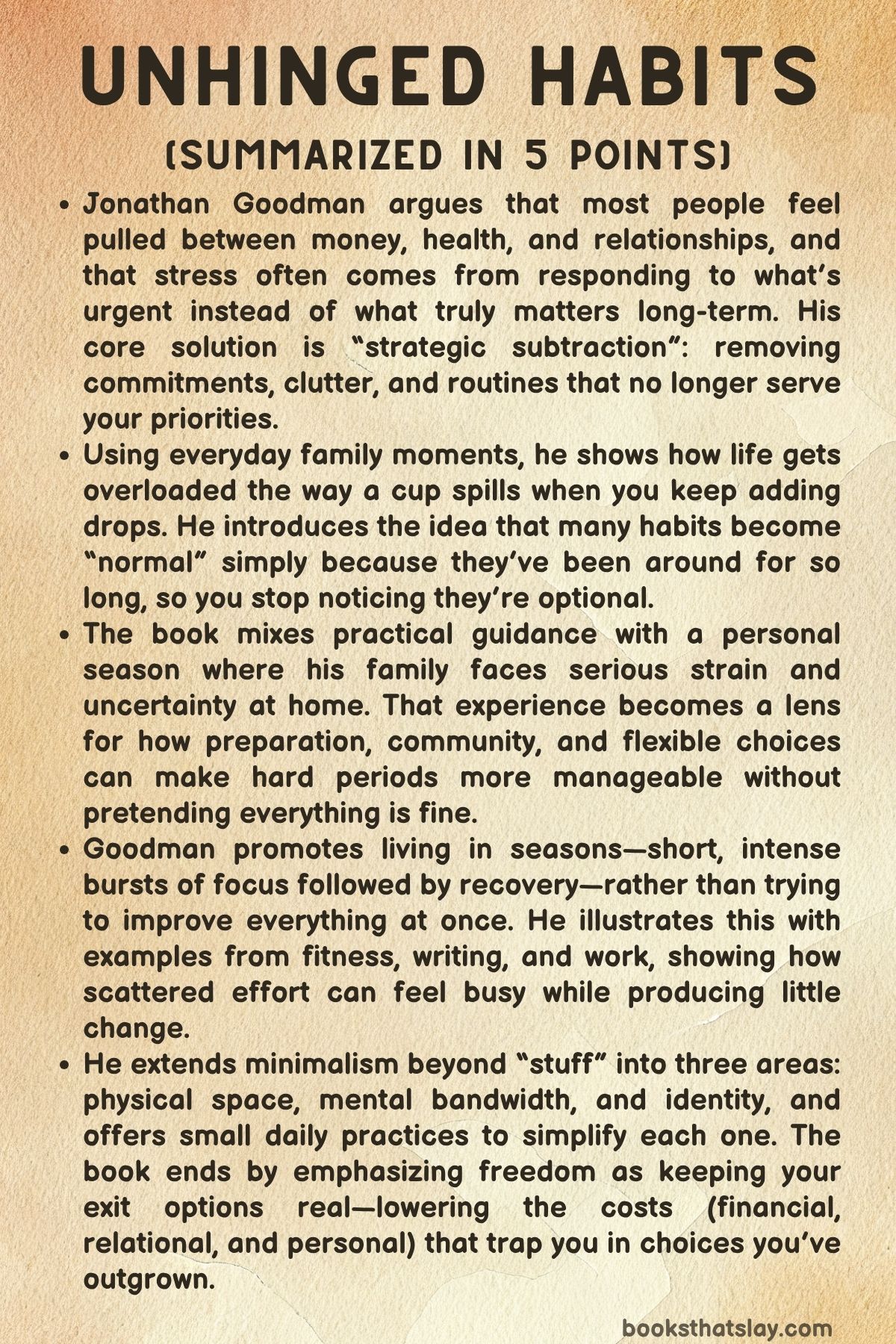
Unhinged Habits by Jonathan Goodman is a practical, story-driven guide to living with more room, more focus, and fewer automatic commitments. Goodman argues that most people are stretched between money, health, and relationships, and that stress often comes from trying to add fixes instead of removing what no longer fits.
Using candid moments from family life, travel, work, and friendship, he introduces “strategic subtraction” and a seasonal approach to change: choose what matters most right now, protect it with simple systems, and rebuild your schedule before it overfills again. The book blends clear frameworks with lived examples of how to stay steady when life gets complicated.
Summary
Jonathan Goodman begins with a blunt observation: life tends to pull people in three directions—earning money, staying healthy, and nurturing relationships—and it’s uncommon to have all three flourishing at the same time. Most people can name what matters in the long run, yet they spend their days reacting to what feels urgent.
Work gets done because there’s external accountability; health and relationships slide because the accountability is mostly private. Goodman’s promise is not another productivity stack or a new habit tracker.
His core idea is subtraction: remove what is unnecessary so the essentials have space to thrive.
A small moment at home captures the problem. His kids fill a cup with water until it’s already at the brim, then keep adding drops until it spills onto the table.
Adults, he says, do the same thing with calendars, commitments, and endless “just one more” obligations. When the cup is full, adding anything creates a mess.
What’s missing is a regular clean-out function that tosses the accumulated junk.
This push for subtraction becomes personal. On September 23, 2024, a positive pregnancy test sits on his desk.
Jonathan and his wife Alison already have two boys, but they’ve also lived through repeated pregnancy loss. Alison senses this pregnancy is different, yet she soon becomes severely sick—so sick she can barely stand without vomiting.
Jonathan writes his editor, Tim, explaining that he’s working, but Alison’s illness may force him to ask for more time. His default instinct is to force normal life to continue, to push through.
That reflex, he realizes, is powered by routines—sometimes helpful, sometimes harmful—because habits can keep you moving even when your situation has changed and your priorities should, too.
After months abroad, he returns home and notices something in their bedroom that has become strangely invisible: their son once strung yarn across the bedposts like a spiderweb, and a Slinky hangs in the middle as if it’s the centerpiece. It has been there for over a year.
They’ve stopped seeing it. Goodman names this the “Slinky Effect”—the way outdated choices, small clutter, and unchosen routines become normal over time.
The same thing happens in work, relationships, and self-care: what began as temporary becomes permanent simply because no one questions it.
From there, he argues that constant busyness often acts as cover. People can use full schedules as proof they’re “doing their best,” even when those schedules quietly excuse neglect of their bodies, their partners, their friends, and their own attention.
Instead of doing more to feel less behind, he suggests doing fewer things with sharper intention. He hints that Alison’s illness will serve as a real-life stress test of whether their systems create resilience—or just the appearance of control.
To show how people break automatic living, he shares stories of travel and deliberate disruption. He describes being stranded on Ometepe, Nicaragua, where a basic breakfast and instant coffee in a plastic cup becomes the best coffee he can remember—not because it’s objectively superior, but because he’s fully present.
He contrasts trips that wake you up with vacations that numb you out. His advice isn’t to chase novelty nonstop; it’s to stop overplanning.
Don’t research every detail. Don’t rush to check boxes.
Accept you cannot do it all, and let that limitation sharpen what you choose.
Small episodes reinforce the point. He watches tourists judge a crater view against a photo instead of noticing the real scene.
He tells of a traveler who marks “Mexico” off his list after an unplanned refueling stop, and of a stamp collector who flies to a remote French archipelago for the stamp itself. On a bus in Montevideo, he sees a man selling Band-Aids to commuters with blistered feet, and he treats it as a lesson: opportunity shows up when you’re alert, not when you’re mentally elsewhere.
A friend named Andrew becomes a key example. Feeling bored and isolated, Andrew commits to a “month of yes,” showing up to invitations he would normally reject.
At a vodka bar he meets Amy, runs after her at the end of the night, and the choice sets his life on a new course. Goodman uses the story to argue for a controlled amount of uncertainty—enough to grow, not so much that you break.
He shares a hiking misadventure in Mexico where poor markings lead him off route, scraped up and dealing with ticks, until a stranger offers a truck ride back toward town. The lesson isn’t recklessness; it’s learning how to be “lost” without panicking: keep your tools ready, maintain a general direction, and accept help.
From these experiences he builds a framework he calls an explorer’s compass: develop your instruments (skills, fitness, adaptability), choose risks along a spectrum (small experiments up to bolder challenges), set flexible goals that guide direction rather than rigid outcomes, and reflect afterward so the comfort zone expands in a real way.
Next, Goodman challenges the idea of improving everything at once. Trying to make steady progress in every area often creates guilt, thin effort, and slow results.
Instead, he proposes seasons: intense focus on one priority for a defined period, followed by renewal and maintenance. He compares it to physical training.
Basic movement helps, but major transformation requires making it a true priority. A short, demanding season can change your baseline, then long-term consistency holds the gain.
He connects this to writing. Small daily sessions can work, but they often get consumed by “reloading” context—rereading, remembering, reorganizing—so output stays tiny.
His books get finished when he creates protected blocks and commits to a season where the main work is unavoidable. Without that commitment, people can spend years doing “in-between” actions that feel productive while avoiding the work that would actually change their situation.
He illustrates with Taylor, a trainer who wants marriage and children but feels trapped by an income model built on nonstop in-person sessions. She bought his course years earlier and tried to build an online offer between clients, yet gained only one remote client in three years.
When her wedding date becomes a real deadline, she commits to a twelve-week push with coaching support. She stops posting generic content and instead identifies the clients she most enjoys and who pay best.
She builds detailed profiles, lists everyone she knows who matches those profiles, and reaches out one-by-one for advice about the program she’s creating. Those conversations reveal what her ideal clients actually want, and she builds around that reality.
For twelve weeks she keeps her current work going but says no to most social plans, uses meal delivery, and channels spare hours into building and selling the offer. The result is $21,000 in contracted revenue and fourteen remote clients, giving her a path out of trading time for money.
Goodman then offers a metaphor from Richard Feynman observing ants: the first route to a goal is messy, but repetition improves it. People don’t need perfect plans; they need attempts that refine the path.
He contrasts how travel reshaped his own routine with how friends back home stayed stuck. Over time, he adapts naturally to different climates and rhythms abroad.
Returning to Toronto, he sees friends exhausted in familiar patterns, wanting change but repeating the same weeks. He compares this to a monkey trap: the animal won’t let go of the rice even though releasing it would mean freedom.
Comfort can become its own cage.
His family designs life with contrast: eight months in Toronto with full obligations, and four months abroad with a lighter schedule, more movement, and more reading. Their son Calvin experiences contrast too—structured school at home, a different kind of schooling abroad, and open days where curiosity leads.
Goodman notes how quickly people get used to even remarkable experiences, like watching a spectacular sunset every evening until it stops registering. Renewal, he argues, comes from stops and starts: ending seasons, resetting commitments, and rebuilding the calendar before it fills again.
The book’s ideas face their hardest test during Alison’s illness in October 2024. On his thirty-ninth birthday, Alison has been nearly bedridden for weeks.
Screens, reading, and food can worsen the nausea; short walks can require hours of recovery. Jonathan is also carrying a heavy professional load: writing a new book, marketing an earlier one, producing daily content, and running two companies—while taking on extra childcare, cooking, cleaning, and logistics.
On paper it is too much, yet he feels steadier than expected. The reason, he believes, is that their life has been built with margin: nearby family, supportive neighbors, and choices that kept their “cup” from being permanently full.
He compares this with friends whose household runs on rigid scheduling because there is no extra capacity. Their systems function only as long as nothing goes wrong.
Goodman argues that space—time, flexibility, and community—is not a luxury add-on but a form of resilience. He credits earlier decisions: living near family instead of chasing a bigger career city, keeping their child’s schedule less packed, and maintaining a life where help can flow both ways.
Then another crisis arrives: their neighbor and close friend Eliane is diagnosed with aggressive breast cancer. With no benefits and two young daughters, she faces treatment that disrupts everything.
Jonathan prepares to help with school pickups, dinners, and childcare during chemotherapy days when Eliane can’t be around her kids. The message is clear: hardship is not hypothetical, and margin turns kindness from an intention into an action.
Along the way, Goodman examines how people postpone what matters through “when I finally” thinking—waiting for some future condition before they start living the way they claim they want. He shares an honest conversation with Alison about his desire for more public recognition and her warning that chasing it could warp his choices.
They take a quiet trip together and intentionally keep it private, refusing to turn it into content. He describes how stressful family travel moments later become treasured memories, and how imagining an entirely different life can reveal that what you want is often closer than you think.
He also turns to friendship and community as forms of support. Adult friendships can become brief and seasonal, especially with travel and life phases.
He sorts relationships into categories—contacts, acquaintances, one-sided online bonds, and true friends—then highlights Andrew as an enduring friend whose loyalty persists even across long silence. He contrasts that with transactional connections and emphasizes local community built through frequent small interactions: neighbors, gatherings, familiar faces, shared routines.
In another thread, he tells how a forced packing constraint on December 31, 2023—being unable to check bags—pushes their family to travel with carry-ons only for months abroad. The limitation improves the trip by cutting excess.
He uses this to argue that people overpack their homes and days because they’re afraid of being without, and that too many options create stress when you haven’t decided what truly matters.
He expands into intentional minimalism across three areas: physical space, mental bandwidth, and identity. Start small, he suggests: a ten-minute daily challenge to clear a drawer, simplify a phone screen, reduce notifications, and remove easy distractions.
He shares how he values tools that do the essential job without creating extra dependency. He explains how living in a small house forces closeness and prevents lifestyle expansion that demands more money, more space, and more obligations.
Even one decision—such as owning one car and biking more—can quietly shape years of health.
He also argues against endless self-improvement aimed at “balancing” every weakness. Instead, identify your core strength and build life around it.
For him, that is writing, so he designs his days to protect it with early mornings, early nights, and selective commitments.
Freedom, Goodman says, is having options. To keep options, keep the cost of walking away low—financially, socially, and in terms of identity.
This idea returns through Andrew’s later message: after years of accumulating obligations, Andrew finally leaves the life he hates and moves his family to Austin, terrified and relieved. Jonathan supports him through the emotional storm, feeling both loss and pride.
The book closes with updates that underline the long arc. Alison reaches the second trimester and shares news of a strong ultrasound, and Jonathan privately releases the strain he’s been carrying.
Eliane later announces she is cancer-free. Their daughter Jasmine is born on May 13.
Goodman ends not with a grand finale, but with a simple image of home: unpacking, hanging a few shirts, and choosing the small, useful things that support the life he actually wants—proof, in his view, that subtraction can be a way back to what matters most.
Key People
Jonathan Goodman
Jonathan Goodman functions as both narrator and case study in Unhinged Habits. His central tension is the gap between what he intellectually knows matters long-term (health, relationships, meaningful work) and what his instincts push him toward in the moment (defaulting to productivity, “pushing through,” and treating disruption as an inconvenience to overcome).
Across the book’s episodes—family illness, travel disorientation, business pressure—he reveals a personality that is ambitious and systems-oriented, but increasingly suspicious of busyness as a self-justifying mask. He is at his best when he practices “strategic subtraction” as an identity, not a tactic: leaving space in the calendar, narrowing focus into seasons, and choosing simpler defaults that reduce decision fatigue.
Importantly, he is not portrayed as serenely minimalist by nature; rather, he’s someone who has to repeatedly notice how quickly clutter (physical, mental, relational) becomes normal, then intentionally rebuild his life design so that steadiness is possible when hardship arrives.
Alison
Alison is the emotional anchor and moral counterweight to the narrator’s achievement reflex. Her severe pregnancy sickness exposes how fragile “normal operations” really are and forces the household to run on support, flexibility, and compassion rather than optimization.
She also embodies quiet creativity and resilience in constraints—when she can’t read in the usual way, she adapts by inventing stories from picture books, maintaining warmth and presence with her children despite physical misery. Alison’s influence is also philosophical: she challenges the narrator’s craving for public recognition, warning him that chasing visibility would distort his choices, which positions her as someone who protects the family’s values from being outsourced to external validation.
She represents a kind of integrity-based prioritization—choosing depth over display, and connection over content—which repeatedly steers the narrator back to the life he claims to want.
Calvin
Calvin is portrayed as a living test of the book’s argument about space, curiosity, and unstructured time. Because his schedule is not overfilled, he develops a comfort with autonomy—roaming the neighborhood, knocking on doors, and building social confidence in other families’ homes—showing how “capacity” is not just a productivity concept but a childhood development strategy.
His reading moments, especially the bedtime plea for “one more chapter,” become a mirror for the narrator’s daily choice between relational investment and work-driven urgency; Calvin is less a symbol of innocence and more a clear, persistent invitation to presence. In travel contrasts—structured school in Toronto versus jungle school abroad—Calvin’s adaptability illustrates how novelty, when supported, can expand a person rather than destabilize them.
He also embodies the “Slinky Effect” in reverse: children notice and create strange, playful environments, and adults learn how easily they stop seeing what surrounds them.
Tim
Tim appears at a crucial junction where private life and public output collide. The narrator’s email to him—trying to reassure progress while admitting Alison’s severe illness—shows how external accountability (deadlines, deliverables, professional expectations) can dominate even when the true emergency is personal.
Tim’s role is subtle but important: he symbolizes the legitimate demands of craft and career, which the narrator does not demonize, but must renegotiate through boundaries and realism. By communicating openly about the need for an extension, the narrator begins shifting from performative toughness to honest capacity management, making Tim a catalyst for a more sustainable relationship with work rather than an antagonist.
Andrew
Andrew is the most developed “friend character” in Unhinged Habits, acting as both inspiration and warning at different points in his life. His “month of yes” arc shows how deliberate exposure to uncertainty can restore aliveness, reduce loneliness, and create life-changing connection; it frames Andrew as someone willing to gamble on experience rather than remain protected by routine.
Later, when he feels trapped by accumulated obligations—payments, possessions, identity commitments—he becomes the human face of the “monkey trap” idea: holding on because letting go feels too costly. His eventual decision to leave his house and relocate his family is portrayed as terrifying but liberating, and the narrator’s overnight support call underscores the depth of their bond.
Andrew ultimately embodies the book’s definition of freedom: keeping “walking costs” low enough that change remains possible, even when it’s painful.
Amy
Amy’s role is concise but pivotal in Andrew’s transformation story. She is not depicted through deep interior detail; instead, she functions as the real-world reward that becomes possible when someone stops living defensively and starts participating in life.
What matters is less who she is in isolation and more what she represents in the narrative logic: a relationship that emerges from movement, social risk, and the willingness to act in the moment (Andrew running after her). Amy therefore symbolizes the kind of meaningful outcome that can’t be scheduled or optimized into existence, only made possible by showing up repeatedly in uncertain spaces.
Taylor
Taylor is a grounded example of how “seasons of intensity” differ from vague, perpetual self-improvement. She begins trapped in a time-for-money model and, despite owning tools and knowledge (the narrator’s course), makes negligible progress because her effort is fragmented into leftovers of time and attention.
The turning point is not motivation but constraint: a wedding date creates a hard deadline that forces real prioritization and the social cost of saying no. Taylor’s arc highlights the narrator’s bias toward specificity—identifying best clients, building profiles, reaching out one-by-one—over generic broadcasting, which reframes “hard work” as targeted, uncomfortable action rather than constant motion.
She also illustrates that transformation is often a temporary reallocation of life resources (time, meals, social calendar, energy) rather than a permanent lifestyle of grind.
Eliane
Eliane brings the book’s themes out of self-optimization and into moral community. Her aggressive breast cancer diagnosis, lack of benefits, and inability to work reveal how quickly stability can collapse for someone without buffers, and the narrator’s response moves from philosophy to responsibility—school pickups, dinners, potential sleepovers, and practical support.
Eliane’s presence also reinforces the narrator’s argument that slack in one’s life is not selfish; it is what enables showing up for others when real crises hit. Her eventual recovery provides emotional resolution, but the more significant point is the demonstration that community is built before it’s needed—through neighborly connection, mutual aid, and day-to-day trust.
Jason
Jason appears as the narrator’s peer in the messy reality of family travel and stress. Their message exchange during a chaotic Costa Rica trip functions as a reframing device: experiences that feel like failure or exhaustion in the moment often become the stories people treasure later.
Jason’s role is to normalize difficulty without romanticizing it, supporting the narrator’s broader stance that “turning on” to life includes discomfort. He is a reminder that perspective is a social resource—sometimes you need another person to help you interpret chaos as meaning rather than as proof you’re doing life wrong.
Barrett
Barrett appears in a reflective “what would we do if we won a billion dollars?” scenario that exposes desire beneath fantasy. Rather than representing greed or escapism, he helps surface a surprising conclusion: the imagined “escape” often circles back to home, belonging, and the life one already values.
His role is to show how many ambitions are proxies for something simpler—time, autonomy, proximity to loved ones—and that clarity can prompt decisive real-world change rather than endless dreaming.
Katy
Katy complements Barrett as a partner in the same thought experiment, helping turn hypothetical wealth into an honest inventory of values. Together, they model a kind of relational clarity where big questions become a tool for alignment, not just entertainment.
Katy’s narrative function is to support the book’s broader theme that the best life design is not the most expansive set of options, but the one that matches what you truly want and are willing to protect.
Steve (the Mailman)
Steve is intentionally ordinary, which is exactly why he matters. By highlighting small recurring interactions—chatting with the mailman—the narrator argues that “community” is not only close friends and dramatic gestures, but the accumulation of low-stakes familiarity that makes a place feel human.
Steve represents the overlooked layer of social life that often disappears when schedules are too tight or when people outsource everything, and his presence supports the claim that a thriving life is built partly from micro-connections that require time and attention.
Meredith Eberhart (Nimblewill Nomad)
Meredith Eberhart is presented as an extreme example of walking-light, used to challenge the reader’s assumptions about what is necessary. His long-distance walking later in life and willingness to shed assets functions as a symbolic endpoint of minimalism: a life where possessions and commitments do not determine one’s mobility.
He also counters the idea that reinvention is for the young or the privileged; his story suggests that identity can be rebuilt through action and simplicity at an age when many people assume it’s too late. In narrative terms, he embodies the book’s freedom thesis—options expand when your load shrinks—taken to its most literal form.
Richard Feynman
Richard Feynman appears as an intellectual lens rather than a direct participant in the narrator’s life. The ants story is used to emphasize iteration over perfection: routes improve through repeated attempts, not through flawless planning at the start.
In character terms, Feynman represents playful rigor—curiosity applied with patience—and serves as a legitimizing reference point for the narrator’s argument that messy progress is still progress. He also reinforces the book’s attitude toward experimentation: observe, adjust, repeat, and let the path refine itself.
Queen Alexandra
Queen Alexandra appears briefly as the reason a marathon distance was adjusted historically, and her function is illustrative rather than personal. She represents how arbitrary constraints—especially those imposed by status, tradition, or spectacle—can shape systems people later treat as fixed and natural.
In the book’s logic, this kind of detail supports the broader theme that many “standards” in life are inherited accidents, which invites readers to question whether their own routines and commitments are chosen or merely absorbed.
Themes
Strategic Subtraction and Living Below Capacity
The opening image of a cup filled to the brim captures a central tension in Unhinged Habits. The problem is not that life is demanding; it’s that people keep treating demand like a cue to add more—more systems, more habits, more commitments—until even a small extra “drop” causes a spill.
The book’s insistence on removing instead of stacking is less about minimalism as an aesthetic and more about capacity as a moral and practical choice. When calendars are packed to the minute, the cost isn’t only stress; it’s fragility.
Any unexpected illness, family crisis, or emotional need becomes a threat because there is no room to absorb it. The “trash-cleaning function” idea reframes self-improvement away from constant upgrading and toward maintenance: deciding what does not deserve a place in your life anymore, even if it once did.
That includes outdated routines that survived only because they became invisible over time, like the yarn web on the bed posts. The point is not that every odd habit is harmful; it’s that unchosen patterns silently become defaults, and defaults quietly decide your life.
This theme shows up in both physical and mental forms. Packing only carry-ons for months abroad becomes a lesson in fear-based accumulation: people bring extra because they don’t trust themselves to adapt.
The same logic applies to phones, notifications, and research spirals—too many options create agitation, not security. What makes the subtraction approach persuasive is that it’s tied to consequences that matter: a smaller home forcing closeness, a single-car choice turning transportation into daily movement, and reduced possessions preventing domino decisions like bigger mortgages and more logistics.
Even giving away ownership in businesses fits here: reducing responsibility can increase impact when it places work in the hands of people better positioned to run it. The theme ultimately argues that “having space” is not laziness or lack of ambition; it is resilience by design, created on purpose so that love, health, and meaningful work can survive real life rather than only functioning in ideal conditions.
Seasons of Intensity and the Problem With Trying to Balance Everything
The book’s argument against steady, evenly distributed progress challenges a popular self-help promise: that you can improve everything at once if you just manage time well enough. The issue is not a lack of motivation but the physics of attention.
When money, health, relationships, and creative goals all demand daily excellence, the result is diluted effort and constant guilt. The book replaces the fantasy of balance with a cycle: short periods of concentrated focus followed by renewal and maintenance.
This framing treats life less like a neat schedule and more like training cycles—hard pushes that change your baseline, then sustainable routines that keep you there. The “rocket fuel” comparison makes the claim practical: big change has a phase that feels disproportionately demanding, and pretending otherwise only creates the illusion of progress.
The examples make this theme concrete. The frustrated gym-goer does not need more tips; they need a period where the goal is allowed to be the goal.
The writer who “does a little every day” may be sincere, but tiny sessions can get eaten by ramp-up time and context recovery, producing motion without meaningful movement. Taylor’s story captures the difference between dabbling and committing.
Three years of small, scattered efforts yield almost nothing because the structure of her life doesn’t make the new path real. A defined twelve-week push changes the outcome because it reorganizes choices: evenings and weekends are reassigned, social events are filtered, and support tools like meal delivery are used strategically, not as luxuries.
What matters is not hustle for its own sake but a temporary reordering of priorities with a clear endpoint.
This theme also has an ethical dimension. Intensity is not portrayed as constant self-sacrifice; it is bounded.
The off-season checklist and relationship-focused breaks imply that maintenance isn’t a failure phase—it’s what prevents intensity from turning into burnout or neglect. The deeper message is that you can’t protect what matters by treating everything as equally urgent.
Choosing a season is choosing honesty: admitting what you are optimizing for right now, and building a plan that matches that truth instead of hiding behind busyness.
Presence, Autopilot, and Choosing Experiences That Wake You Up
A recurring set of travel moments isn’t there to romanticize escape; it’s there to diagnose numbness. The book repeatedly shows adults moving through life as if they’re half-asleep, surrounded by signals that should matter but don’t register because routine has taken over.
The coffee on Ometepe becomes extraordinary not because it’s objectively better but because the narrator is fully aware of it. That contrast exposes a blunt idea: comfort and planning can reduce life into a checklist, where even spectacular experiences are consumed through comparison, photos, or pre-formed expectations.
The family at Crater Lake treating the real view as a verification of a picture reveals how easily people outsource attention. The passport-stamp collector and the emergency refuel story highlight how “being somewhere” is not the same as being alive to where you are.
This theme is not just about travel; it’s about deliberate uncertainty as a tool for presence. The “Explorer’s Compass” frames uncertainty as something you can train for rather than fear.
Instruments—language, physical readiness, mental adaptability—are presented as ways to make risk safer without removing the feeling of the unknown. The idea of keeping “trajectory” rather than rigid goals suggests that presence improves when you stop trying to control every detail.
Getting lost on a hike becomes meaningful because it forces decision-making, humility, and acceptance of help, all of which routine can erase. The “month of yes” story shows the same principle in a social context: boredom and loneliness persist when life is overly protected.
Growth begins when someone accepts the discomfort of showing up, talking to strangers, and risking rejection.
Even the ant story functions as a presence argument disguised as a learning model. Iteration requires feedback, and feedback requires noticing.
People trapped in the same routines aren’t simply unmotivated; they have stopped seeing their own patterns. The book’s solution is not reckless spontaneity, but repeated contact with situations that require alertness—small experiments that keep the mind from defaulting to yesterday’s script.
Presence here becomes a practice: creating conditions where attention has to return, so life feels real again rather than merely efficient.
Freedom, Relationships, and the Costs of Staying Put
The book treats freedom less as a motivational slogan and more as a measurable condition: having options because the costs of change are not crushing. “Walking costs” include money, obligations, roles, and the invisible commitments that pile up until leaving any situation feels impossible.
The monkey trap story captures the mechanism: the trap works because the monkey refuses to release what it’s holding. The point is not that people are foolish; it’s that what they hold onto often once helped them.
Degrees, houses, vehicles, payment plans, identity labels, and professional pathways can begin as sensible steps and end as cages when they are never re-evaluated. Freedom requires the ability to release—sometimes literally possessions, sometimes a status goal, sometimes the need for approval.
This theme becomes emotionally grounded through illness and community. When Alison’s pregnancy sickness dominates daily life, the narrator’s steadiness isn’t framed as personal toughness alone; it’s the payoff of earlier choices that kept space available.
Living near family, keeping a child’s schedule less packed, and building relationships with neighbors create a safety net that money cannot always replace. The contrast household—two demanding jobs, heavily scheduled kids, and a nanny—shows how even abundant resources can still produce a life with no slack.
A life that runs only when every piece performs perfectly is a life that breaks the moment reality shows up.
The relationship “garden” framework also pushes against a modern distortion: treating connections as interchangeable or transactional. The book distinguishes between broad networks and true friends without pretending everyone needs a large inner circle.
What defines real friendship here is not constant contact but reliability and the willingness to be inconvenienced. Community is built in small, repeated exchanges—mailman conversations, neighborhood gatherings, shared child care—rather than grand declarations.
That matters when crises arrive, like a neighbor’s aggressive cancer diagnosis. Support becomes an active currency: time, attention, space, practical help.
The theme reaches a sharp conclusion with Andrew’s decision to leave his house and move his family, terrified and relieved. Freedom is shown as both joyful and costly: options can create loss alongside relief.
The book refuses to romanticize that trade, but it argues the trade is still worth having available—because a life without the ability to choose becomes a life lived by default.