All They Will Call You Summary and Analysis
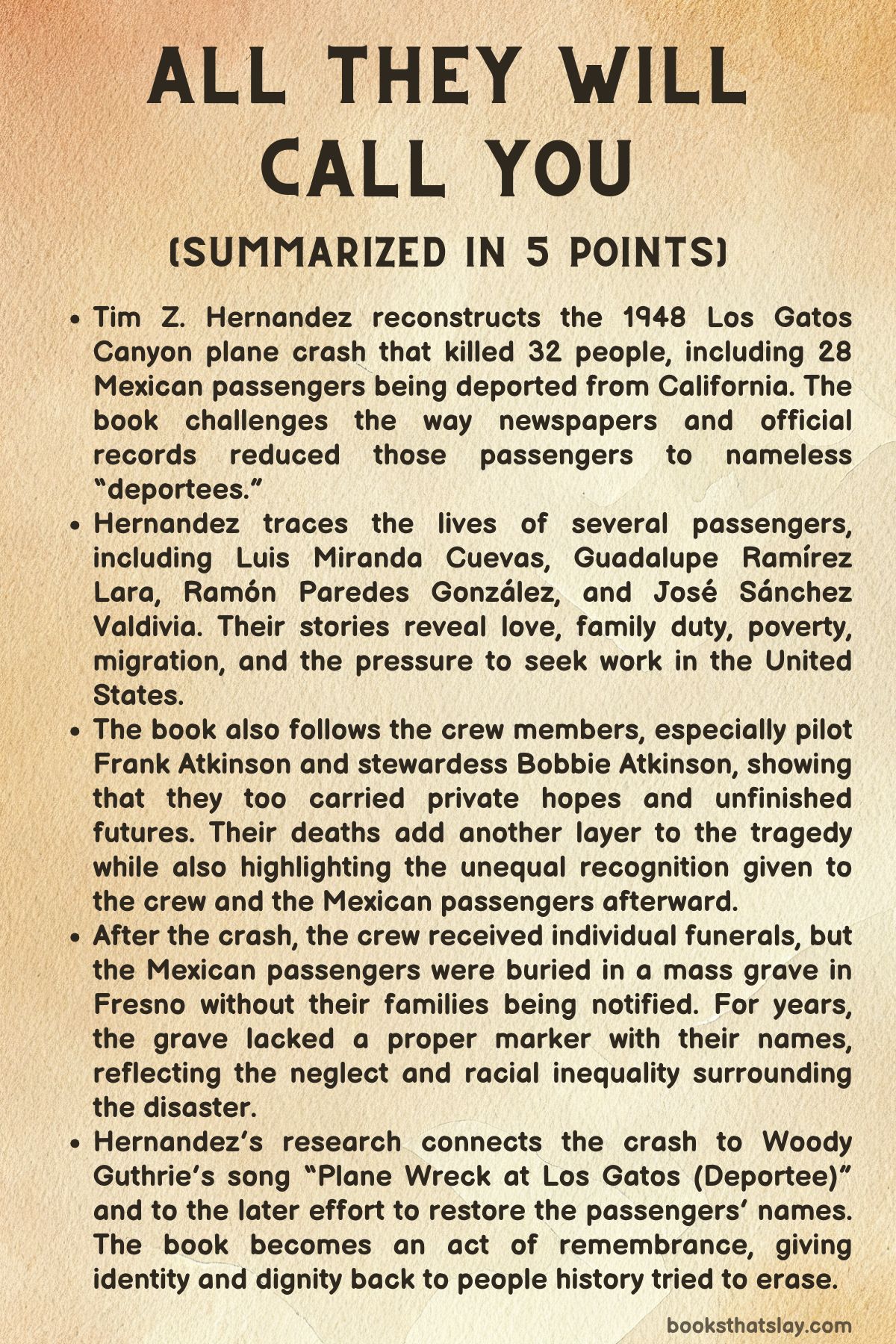
All They Will Call You by Tim Z. Hernandez is a nonfiction account of the 1948 Los Gatos Canyon plane crash that killed 32 people, including 28 Mexican passengers being deported from California. The book begins with a disaster that many newspapers reduced to a nameless tragedy, then restores identity, memory, and family history to those who died.
Hernandez combines research, interviews, field notes, folklore, and reconstructed scenes to show how migration, labor, racism, poverty, and official neglect shaped the lives behind the crash. The book is also about the long effort to place names where silence had been.
Summary
All They Will Call You centers on a plane crash that occurred in Los Gatos Canyon, California, on January 28, 1948. A plane carrying deported Mexican workers, along with the pilot, copilot, stewardess, and an immigration officer, broke apart in the air and crashed in the hills of the San Joaquin Valley.
Everyone aboard died. News reports at the time often identified the Mexican passengers only as “deportees,” leaving their names misspelled, incomplete, or absent.
Tim Z. Hernandez sets out to correct that erasure by tracing who these people were, where they came from, whom they loved, and why they had traveled north.
The book opens at the crash site. Local residents, prisoners from a nearby road camp, officials, and reporters arrive after seeing flames and wreckage.
The scene is horrific. Bodies have been burned and scattered across the field, and the people who reach the site struggle to understand how many have died or how to identify them.
Investigators and witnesses try to piece together the disaster from wreckage, body parts, documents, and memory. The official record is confused from the beginning.
Names are recorded incorrectly, genders are mistaken, and the dead are treated more as a problem of paperwork than as members of families and communities.
Hernandez then places the crash within Los Gatos Canyon and the San Joaquin Valley. The region is agricultural, shaped by oil towns, ranches, prison labor, Indigenous history, Spanish violence, Mexican settlement, and migrant work.
The valley depends on workers who come from far away, especially from Mexico, yet those workers remain socially and politically vulnerable. The land produces abundance, but many of the people who harvest that abundance live with poverty, danger, and displacement.
The book shifts from the crash to the lives of several people aboard the plane. Luis Miranda Cuevas comes from Jocotepec, Jalisco.
Through Hernandez’s interview with Casimira Navarro López, Luis’s former girlfriend, Luis becomes more than a name on a passenger list. Casimira remembers him as handsome, funny, and loving.
He had crossed north more than once for work and had promised to return, marry her, and bring a mariachi band to their wedding. His journey reflects the pressures faced by many Mexican workers: the need to earn money, the risks of crossing, and the emotional cost of leaving home.
Hernandez explains the bracero program and the unstable labor system that drew Mexican men into the United States while also criminalizing and deporting them. During World War II, the United States needed Mexican farm labor, but after the war many workers were pushed out even though growers still depended on them.
Workers were inspected, humiliated, sprayed with chemicals, and moved across the border according to the needs of American agriculture. The same system that invited their labor also treated them as disposable.
Guadalupe Ramírez Lara and Ramón Paredes González come from Charco de Pantoja, a farming town in central Mexico. Their community struggles with water scarcity, and they travel north in part to raise money for a well.
Ramón is remembered as devoted to his family and community, though also drawn to gambling. Guadalupe is strong, practical, and deeply tied to his land and people.
Their stories show migration not as adventure, but as duty. They leave because survival at home depends on wages earned elsewhere.
Their repeated crossings become a pattern: work in the United States, return to Mexico, then leave again when need demands it.
José Sánchez Valdivia’s story is tied to baseball. As a boy, he dreams of becoming a player after hearing about Babe Ruth and other great athletes.
In California, while working in the fields, he helps form a rough baseball club with other Mexican workers. Baseball becomes a release from exhausting labor and a way to claim joy, skill, and fellowship in a world that sees the workers only as hands.
José is later caught by immigration officers after a day of playing billiards and ends up among those placed on the deportation flight.
The book also tells the story of Frank Atkinson, the pilot, and Bobbie Atkinson, his wife and the stewardess on the plane. Frank grows up in Rochester, New York, obsessed with flying.
He trains hard, serves during World War II, and becomes an experienced pilot. Bobbie’s background is shaped by her mother Elizabeth’s immigration from Poland, poverty, loneliness, and the struggle to survive in America.
Frank and Bobbie marry after years of letters. On the morning of the crash, Bobbie fills in for another stewardess.
She is pregnant, and she and Frank have not yet told others. Their presence reminds readers that the crash destroyed many kinds of futures.
On the day of the flight, the detained Mexican passengers are woken early and taken to the airport. Many are afraid because they have never flown before.
The plane, a Douglas DC-3, is crowded beyond its intended capacity, and it is overdue for routine maintenance. Some passengers sit on luggage in the aisle.
The crew prepares for takeoff, while the passengers think of home, shame, fear, and reunion. Luis thinks of Casimira and the wedding he still imagines.
Ramón thinks about his family and his failure to avoid capture. José Valdivia thinks about baseball and the season he will miss.
As the plane crosses the Diablo Range, something goes wrong. The aircraft shakes.
Passengers smell burning. The left engine fails, and Frank Atkinson tries to respond.
Then the left wing and engine separate from the plane. The aircraft breaks apart and explodes.
People and wreckage fall from the sky. Witnesses on the ground see fire, smoke, and bodies.
The crash kills everyone instantly or almost instantly, leaving behind a scene so damaged that full recovery and identification are impossible.
After the crash, families learn of the deaths in uneven and painful ways. Some hear through newspapers, radio, or word of mouth.
Some receive wrong information. Because José Sánchez Valdivia and José Sánchez González have similar names, one family mistakenly believes the wrong man has died, causing years of anguish until José González returns home alive.
Casimira loses Luis and the future he promised. Ramón and Guadalupe’s families lose fathers, husbands, and community members.
Guadalupe’s dog, Lobo, is said to howl after his death, as though mourning him too.
The crew members receive individual funerals and official recognition. The Mexican passengers are treated differently.
Authorities decide that sending the remains to Mexico would cost too much. A funeral is held in Fresno, but the passengers’ families are not notified.
Twenty-eight caskets stand for the dead, though some contain little or nothing. The passengers are buried in a mass grave at Holy Cross Cemetery.
For years, the grave remains unmarked by their names. This contrast between the crew’s memorials and the passengers’ anonymity becomes one of the book’s central injustices.
The later sections connect the crash to the song “Plane Wreck at Los Gatos (Deportee).” Woody Guthrie wrote the words after being angered by news coverage that failed to name the Mexican dead. Marty Hoffman later composed the melody, and Pete Seeger helped bring the song to audiences.
The song asks why the dead are called only “deportees” instead of by their names. Hernandez’s book grows out of that question.
By finding relatives, records, letters, photographs, and memories, he works to add those names back into history.
The final part follows Hernandez’s own research from 2012 to 2015. He searches records, contacts families, struggles with misspellings and missing documents, and helps push for a proper memorial headstone.
The process is frustrating and incomplete, but it leads to a public ceremony in Fresno where the names of the dead are finally placed at the grave. Hundreds gather, including relatives, community members, clergy, dancers, and reporters.
Yet Hernandez understands that a headstone is only a beginning. Names matter, but stories matter too.
By the end, All They Will Call You becomes both a record of a disaster and an act of repair. It shows that the people on the plane were not anonymous laborers or statistics.
They were sons, daughters, lovers, husbands, wives, parents, athletes, dreamers, workers, and community members. Hernandez restores their humanity by refusing to let official neglect have the final word.
Key People
Tim Z. Hernandez
Tim Z. Hernandez is both the author and a central presence in the narrative, even though the book is not mainly about him. His role is that of a researcher, listener, witness, and cultural memory-keeper.
He enters the story many decades after the crash, but his work becomes the bridge between the dead and the living. Hernandez is driven by a need to correct the way history has reduced the Mexican passengers to a single label.
He searches for names, family members, photographs, letters, and oral histories, often facing silence, confusion, mistrust, and incomplete records. His own limitations also matter.
He is aware of his imperfect Spanish and his distance from some of the communities he visits, but he keeps listening and asking. In All They Will Call You, he becomes a figure of restoration rather than invention: he does not simply tell a tragedy, he tries to return dignity to people whose lives were left out of the official story.
Luis Miranda Cuevas
Luis Miranda Cuevas is one of the most tenderly remembered passengers in the book, largely through the memories of Casimira Navarro López. He is presented as charming, humorous, devoted, and full of plans for the future.
His relationship with Casimira gives his story emotional weight because his death is not only the end of one life, but the end of a promised marriage, a shared home, and a future family. Luis’s repeated journeys to the United States show the practical pressures behind migration.
He does not leave Mexico because he rejects his home; he leaves because work across the border offers money that his life in Jocotepec cannot provide. His promises to Casimira reveal his hope that migration will be temporary, a sacrifice made in order to return with stability.
His final phone call, in which he tells her he has been caught and is coming home, is painful because it turns deportation into what he imagines as reunion. Luis represents the cruel gap between hope and historical reality.
Casimira Navarro López
Casimira Navarro López is not on the plane, but she is one of the most important keepers of memory in the book. Her recollections preserve Luis Miranda Cuevas as a full person rather than a name on a list.
Even as an elderly woman, she remembers him with strong emotion, suggesting that grief can remain alive across decades when the loss is unresolved. Casimira’s character also shows how migration affects those left behind.
She waits, hopes, remembers promises, and carries the pain of a future that never happened. Her memories of courtship, humor, and marriage plans give warmth to Luis’s story, but they also sharpen the tragedy.
Through her, the reader sees that the crash did not only kill passengers; it altered the lives of lovers, parents, children, and communities in Mexico. Casimira stands for private mourning, the kind that does not appear in government files but gives the dead their human meaning.
Guadalupe Ramírez Lara
Guadalupe Ramírez Lara is portrayed as strong, practical, loyal, and deeply tied to Charco de Pantoja. His life is shaped by responsibility to family and community.
He travels north not as a man chasing personal gain, but as someone trying to help solve the water crisis that threatens his town. His connection to the land is central to his character.
Even when he crosses into the United States again and again, his sense of belonging remains rooted in his home community. Guadalupe’s photograph before leaving becomes an especially powerful symbol.
It is meant to comfort his wife, but it also becomes one of the traces by which later generations remember him. His care for his nephew Fermin shows his generosity and his willingness to take on fatherly duties beyond obligation.
Guadalupe represents the migrant worker as a whole human being: a husband, adoptive father, farmer, protector, and community member whose labor abroad is tied to survival at home.
Ramón Paredes González
Ramón Paredes González is a complex figure because he combines devotion, pride, weakness, and responsibility. He loves his family and his community, yet he also gambles, hoping to raise money in a risky way.
His loss at gambling does not make him careless so much as desperate. He understands that poverty gives him few good options, and his decision to go north comes from the belief that he must help provide water for Charco de Pantoja.
Ramón’s final letter to Elisa reveals exhaustion, tenderness, and frustration with poverty. He is not romanticized as perfect; instead, he is shown as a man carrying pressure from several directions.
He wants to be a provider, a husband, a father, and a responsible community member. His capture and death turn his journey into a devastating failure through no moral fault of his own.
Ramón’s story shows how economic hardship can push ordinary people into dangerous systems that treat them as replaceable.
Elisa Murillo Granados
Elisa Murillo Granados, Ramón’s wife, represents the burden carried by families who remain at home while men migrate for work. Her role is marked by worry, endurance, and emotional strength.
When Ramón decides to go north, Elisa makes him promise to return, which turns that promise into one of the most painful details of his story. She is left with children, uncertainty, illness, and then grief.
Her character gives domestic reality to the larger history of labor migration. The decision to migrate is not made by one person alone; it affects the household, the children, the rhythm of daily life, and the emotional security of those waiting.
Elisa’s suffering also exposes the cruelty of the state’s failure to notify families properly. Her husband dies in a public disaster, yet the people who loved him most are not treated as central to the aftermath.
Through Elisa, loss becomes intimate and personal.
Micaela
Micaela, Guadalupe’s wife, is practical, loving, and emotionally perceptive. Her insistence that Guadalupe sit for a photograph before leaving reveals her understanding of absence.
She knows that migration carries danger, even if she cannot predict the exact tragedy ahead. The photograph becomes an act of love and preservation.
It gives her something to hold while he is away and later gives the family a way to remember him. Micaela’s skepticism about Guadalupe’s journey does not mean she lacks courage; rather, she understands the cost of leaving.
Like Elisa, she bears the quiet hardship of waiting while her husband crosses borders for work. Her character also reflects the emotional labor of women in migrant families.
She must support the practical need for income while living with fear, loneliness, and uncertainty. Micaela gives Guadalupe’s story a home, a marriage, and a human center beyond the fields where he works.
José Sánchez Valdivia
José Sánchez Valdivia is defined by energy, friendship, and dreams that exceed the narrow life assigned to him by poverty and farm labor. His love of baseball gives him individuality and joy.
He is not described only as a worker, but as a young man with imagination, skill, and ambition. The image of him swinging at dirt clods as if they were baseballs captures his refusal to let harsh conditions erase play from his life.
His friendship with José Sánchez González is central to his identity; they become almost like brothers through shared work and sport. José’s capture after playing billiards shows how ordinary pleasures could suddenly be interrupted by immigration enforcement.
His decision to take Amado’s place on the plane because Amado feared flying adds courage and loyalty to his character, but it also makes his death especially painful. José represents youthful promise cut short by a system that never recognized his full humanity.
José Sánchez González
José Sánchez González is important because his life becomes entangled with José Valdivia’s death through confusion of names. His friendship with Valdivia gives readers a sense of the community formed among migrant workers in California.
They work together, play baseball, and create a bond that softens the loneliness of migrant life. Yet the similarity of their names leads to a terrible mistake after the crash, when González’s family believes he has died.
His eventual return years later produces relief, but also exposes how poor documentation and rumor could torment families. José González’s character therefore carries a double meaning.
He is a friend who helps preserve Valdivia’s memory, and he is also a living example of how easily migrant identities were confused or mishandled. His story shows that the violence of the crash extended beyond the dead; it spread through uncertainty, misidentification, and the absence of reliable communication.
María de Jesús
María de Jesús, José González’s mother, is one of the clearest examples of how misinformation can become a form of suffering. Believing that her son may have died in the crash, she becomes consumed by radio reports and the hope of confirmation.
Her grief exists in a suspended state because she does not know the truth. This uncertainty damages her deeply.
When José González finally returns, her reaction is a mixture of disbelief, relief, and the release of years of fear. María’s character highlights the emotional violence caused by official carelessness.
A name written badly or passed along incorrectly is not a small error when a family’s entire world depends on it. Through her, the book shows that records are not merely administrative; they can determine whether a mother mourns, waits, or breaks under uncertainty.
Frank Atkinson
Frank Atkinson, the pilot, is presented as ambitious, disciplined, brave, and deeply attached to flying. From childhood, he dreams of becoming a pilot and works hard to overcome obstacles, including poor eyesight.
His wartime service gives him experience and confidence, especially with the type of aircraft involved in the crash. Frank is not portrayed as a careless man.
On the contrary, he is skilled and serious about flight. This makes the crash feel less like a simple failure by one pilot and more like the result of broader mechanical, regulatory, and institutional problems.
His relationship with Bobbie also humanizes him. He is a husband, an expectant father, and a man looking toward a new stage of life after war.
Frank’s final moments are tragic because he is likely the only person aboard who fully understands the disaster as it unfolds. He represents professionalism trapped inside a doomed system.
Bobbie Atkinson
Bobbie Atkinson is one of the most tragic figures in the book because she boards the plane not only as a stewardess, but as Frank’s wife and a pregnant woman. Her life before the crash is shaped by longing, independence, and the complicated influence of her mother, Elizabeth.
Bobbie seeks excitement and connection beyond the restricted world her mother imagines for her. Her relationship with Frank grows through letters, patience, and shared hope.
On the day of the crash, her presence on the plane is partly accidental because she fills in for another stewardess. That detail gives her death a painful sense of chance.
Bobbie’s pregnancy intensifies the loss, turning the crash into the death of a future family as well as the death of individuals. She also serves as a reminder that everyone aboard, crew and passengers alike, carried private dreams unknown to the public reports.
Elizabeth Liebersbach
Elizabeth Liebersbach, Bobbie’s mother, broadens the book’s treatment of immigration by showing a different immigrant experience. As a Polish girl arriving in America, she learns survival through silence, hard work, and invisibility.
Her father’s death leaves her alone, and her life becomes marked by abandonment, poverty, and emotional guardedness. Elizabeth’s fear of visibility shapes how she raises Bobbie.
She wants safety, but her idea of safety is narrow and isolating. Her suspicion of risk makes sense given her own life, yet it also creates tension with Bobbie’s desire for freedom.
Elizabeth’s story parallels the Mexican passengers’ experiences in important ways, though her path is different. She too is an immigrant shaped by labor, loss, and the demand to adapt.
Through her, the book suggests that America often asks immigrants to disappear in order to survive.
Marion Ewing
Marion Ewing, the copilot, receives less attention than Frank Atkinson, but he remains an important part of the human cost of the crash. As a crew member, he is tied to the official and technical side of the flight, yet his death also leaves behind a grieving family.
His wife Dorothy’s legal action after the crash suggests frustration with how the aftermath was handled and a desire for accountability. Marion’s burial with military honors contrasts with the treatment of the Mexican passengers, whose families were not notified and whose remains were placed in a mass grave.
This contrast does not reduce Marion’s dignity; instead, it exposes the unequal dignity granted to different dead bodies. Marion’s character helps the reader see how recognition works unevenly, depending on citizenship, race, class, and official status.
Frank Chaffin
Frank Chaffin is the immigration officer aboard the plane, and his character is connected to the machinery of deportation. The book gives him a genealogy that reaches back to early colonial America, placing him within a long history of settlement, belonging, and inherited legitimacy.
That background matters because Chaffin sits among people whose right to remain in the United States is being denied. He is not presented simply as a villain, but his role makes him part of a state system that rounds up, detains, transports, and removes Mexican workers.
His presence on the plane symbolizes authority. He is the person enforcing the passengers’ return, even though many of them have labored in the fields that sustain American agriculture.
Chaffin’s death places him among the victims, but his position also reveals the unequal power structure inside the aircraft.
June Gaston
June Gaston is a witness whose memories help preserve the physical and emotional reality of the crash site. As a child connected to Los Gatos Canyon, she recalls details passed through her family and details she experienced herself.
Her memories are disturbing because they show how the crash entered local life not as an abstract event, but as something that left blood, debris, and body parts in familiar spaces. The wing falling near her family home and the later discovery of remains in the field show how disaster remained embedded in the land.
June’s character represents witness memory: imperfect, personal, and deeply affected by images that do not fade. Through her, the book shows that even those who did not know the passengers personally were changed by what they saw.
Happy Gaston
Happy Gaston is one of the local figures who responds after the crash. As a school bus driver and someone connected to the prison camp, he becomes part of the immediate rescue and recovery effort, though there is no one left to save.
His work with prisoners before the crash also places him within the social world of Los Gatos Canyon, where labor, punishment, land, and community overlap. Happy’s character is practical and grounded.
He does what needs to be done in a horrific situation. His relationship with June also matters because her memories of him help frame how the local community processed the disaster.
Happy represents ordinary local response: not the official investigation, not the national news, but the people who had to stand before the wreckage and act.
Red Childers
Red Childers is one of the first witnesses to reach the crash site, and his experience opens the book with shock and horror. He sees fire, hears screams, and encounters the immediate aftermath before officials and reporters arrive.
Red’s role is brief but important because he represents the first human confrontation with the disaster on the ground. He is not prepared for what he sees, and his stunned reaction emphasizes the scale of destruction.
The fact that others give him a shovel and begin trying to put out the flames with dirt shows the helplessness of the moment. Red’s character is significant less because of personal development and more because his witnessing anchors the event in sensory reality.
Through him, the crash becomes not a distant historical incident, but a scene of fire, sound, smell, and trauma.
Velorio “El Indio” Martínez
Velorio “El Indio” Martínez is one of the prisoners assigned to help gather remains after the crash. His story of La Huesera, the Bone Woman, gives the book one of its strongest symbolic frames.
By comparing the investigators’ work to the folklore figure who reconstructs life from bones, Velorio gives meaning to an otherwise unbearable task. He understands that gathering fragments is not only physical work; it is an attempt to restore wholeness after destruction.
His presence also complicates the social scene of the crash. Prisoners, people usually pushed to the margins, become among the first caretakers of the dead.
Velorio’s character suggests that those with little official power can still carry wisdom, ritual imagination, and moral insight. His folklore becomes a way to understand Hernandez’s later work of reconstructing stories from scattered traces.
Jaime Ramírez
Jaime Ramírez is one of the key descendants who helps Hernandez connect the mass grave to family memory. As the relative of Guadalupe Ramírez Lara and Ramón Paredes González, he gives the author access to stories that official records failed to preserve.
His discovery of the grave through public records shows determination and loyalty to the dead. His yearly visits on Día de los Muertos turn the neglected grave into a place of active remembrance.
Jaime’s character is important because he refuses to let the passengers remain anonymous. He is not only a source of information; he is a mourner and caretaker.
His connection to Woody Guthrie’s song also links family memory to public protest. Through Jaime, private grief becomes part of a larger demand for recognition.
Guillermo Ramírez
Guillermo Ramírez provides family history, personal memory, and firsthand experience with immigration detention. His recollections of the El Centro Deportation Center help connect the 1948 crash to the broader treatment of Mexican migrants.
He understands detention not as an abstract policy, but as a lived experience marked by poor conditions, uncertainty, and fear. His eventual citizenship adds complexity to his story.
He has lived through exclusion and later gained formal belonging, but that does not erase what happened to his family. Guillermo helps Hernandez understand Ramón and Guadalupe not only as victims but as men rooted in Charco de Pantoja’s struggles.
His character shows how memory travels across generations and how descendants inherit both grief and responsibility.
Fermin
Fermin, Guadalupe’s adopted son and nephew, carries the intimate family loss caused by the crash. Guadalupe raises him as a son after the death of Fermin’s mother, so Guadalupe’s death is also the loss of a father figure.
Fermin’s disappointment that the family could not hold a traditional service for Guadalupe reveals the cultural harm caused by the authorities’ decisions after the crash. Death rituals matter because they allow families to honor the dead according to their own values.
Fermin’s later conversations with Hernandez show intelligence, warmth, and a broad sense of history. His reference to outsiders who take Mexican history seriously suggests that he sees Hernandez’s work as valuable, despite cultural distance.
Fermin represents the surviving family’s need not only for information, but for proper mourning.
Pete Seeger
Pete Seeger serves as a link between the crash and its musical afterlife. He did not write the words to “Plane Wreck at Los Gatos,” but his performances helped carry the song into public memory.
In the book, he appears as an elder musician looking back on how the song entered his life and repertoire. His response to hearing Marty Hoffman’s recording suggests respect for the song’s origins and for the grief behind it.
Seeger’s role shows how art can preserve a historical wound when official records fail. Yet the book also makes clear that song alone is not enough.
The song kept the question alive, but Hernandez’s research seeks to answer it more fully by restoring individual names and stories.
Woody Guthrie
Woody Guthrie is important because his words gave moral force to the public memory of the crash. He was angered by the way newspapers identified the Mexican dead as deportees rather than as people with names.
His song lyrics challenged that erasure and asked listeners to recognize the humanity of those killed. Guthrie does not dominate the narrative as a character in action, but his presence shapes the book’s purpose.
He names the injustice before Hernandez later investigates it in depth. Guthrie’s role shows the power of protest art: it may not correct records by itself, but it can keep alive a question that later generations feel compelled to answer.
In All They Will Call You, his song becomes the seed of a larger act of recovery.
Marty Hoffman
Marty Hoffman is the musician who created the melody that helped Woody Guthrie’s words survive in performance. His life is marked by music, emotional pain, and a strong connection to songs of loss.
By composing a tune influenced by Mexican musical forms, he gives the song a sound that honors the cultural world of the people it mourns. His later death by suicide adds a sorrowful shadow to his role in the narrative.
Marty is portrayed as someone who understood loneliness and grief in a deep way, which may explain why he connected so strongly with Guthrie’s words. His character shows that memory often depends on fragile carriers: a song, a recording, a friend’s recollection, a performance passed from one person to another.
Marty helps turn the crash into a song people remember.
Themes
Names, Memory, and Human Dignity
The struggle to recover names stands at the moral center of All They Will Call You. The Mexican passengers were publicly reduced to the word “deportees,” a label that described their legal status but erased their personhood.
Hernandez’s work challenges that erasure by showing that a name is not a small detail; it is the beginning of recognition. To name someone is to admit that they had parents, lovers, children, hometowns, habits, jokes, fears, and unfinished plans.
The official record fails repeatedly through misspellings, incomplete lists, mistaken identities, and a mass grave without proper identification. These failures are not neutral mistakes.
They reflect a society willing to use migrant labor while refusing migrants full dignity in death. Memory becomes an ethical act in the book.
Interviews, photographs, letters, songs, and family stories all become forms of resistance against disappearance. The headstone matters because it gives public shape to remembrance, but Hernandez also shows that stone alone cannot hold a life.
The deeper memorial is the act of telling who these people were before the crash.
Migration, Labor, and Exploitation
Migration in the book is shaped less by choice than by economic pressure. The men who travel north do so because their families and communities need money for food, land, water, and survival.
The United States depends on their labor, especially in agriculture, yet treats them as temporary, unwanted, and disposable. This contradiction defines much of the book’s social criticism.
Mexican workers are welcomed when their bodies are needed in the fields, then detained and removed when policy shifts or when their presence becomes inconvenient. The bracero system and its aftermath reveal a cycle of recruitment, humiliation, labor, deportation, and return.
Workers endure inspections, chemical spraying, poor conditions, and separation from home, yet they continue because poverty leaves few alternatives. Hernandez refuses to present migration as a simple journey from one country to another.
It is a pattern created by unequal economies and enforced by borders that move according to labor demand. The workers’ repeated crossings show courage and devotion, but they also expose a system that profits from vulnerability while denying responsibility for the people it uses.
Family, Absence, and Unfinished Futures
The crash destroys not only the people aboard the plane but also the futures imagined around them. Luis and Casimira’s marriage never happens.
Ramón does not return to Elisa and their children. Guadalupe’s family loses a husband, father figure, and provider.
Bobbie and Frank lose the child they had not yet announced. These losses matter because the book consistently places the dead within relationships.
A migrant worker is not only someone who picks crops; he may also be a fiancé saving for land, a father writing home to a sick wife, or a community member trying to fund a well. Absence becomes a daily condition for the families long before the crash, because migration already requires waiting, worry, and separation.
The disaster makes that absence permanent. The pain is made worse by the way families learn the news, often through rumor, radio, newspapers, or delayed word of mouth.
Some never receive the rituals or official care they deserve. The book treats grief as something carried across decades, preserved in stories, photographs, letters, and the memories of descendants who continue to speak for those who could not return.
Official Neglect and Unequal Mourning
The aftermath of the crash reveals a sharp divide in how different lives are valued. The crew members receive named burials, returned remains, and public recognition, while the Mexican passengers are buried in a mass grave without their families present.
The government’s refusal to accept responsibility and the decision that transporting remains to Mexico would be too expensive show how bureaucracy can turn human loss into a matter of cost and convenience. This unequal mourning is one of the book’s most painful forms of injustice.
The passengers are treated as a group problem rather than as individual dead with families who have the right to know, grieve, and perform proper funeral customs. The poor documentation of names continues this neglect, allowing errors to become part of the historical record.
Hernandez’s later research exposes how long such injustice can last when institutions fail to care. The memorial headstone is therefore not only a tribute, but a correction.
It challenges the original treatment of the passengers and insists that public memory must include those whom official systems tried to leave unnamed.