America on Fire Summary and Analysis
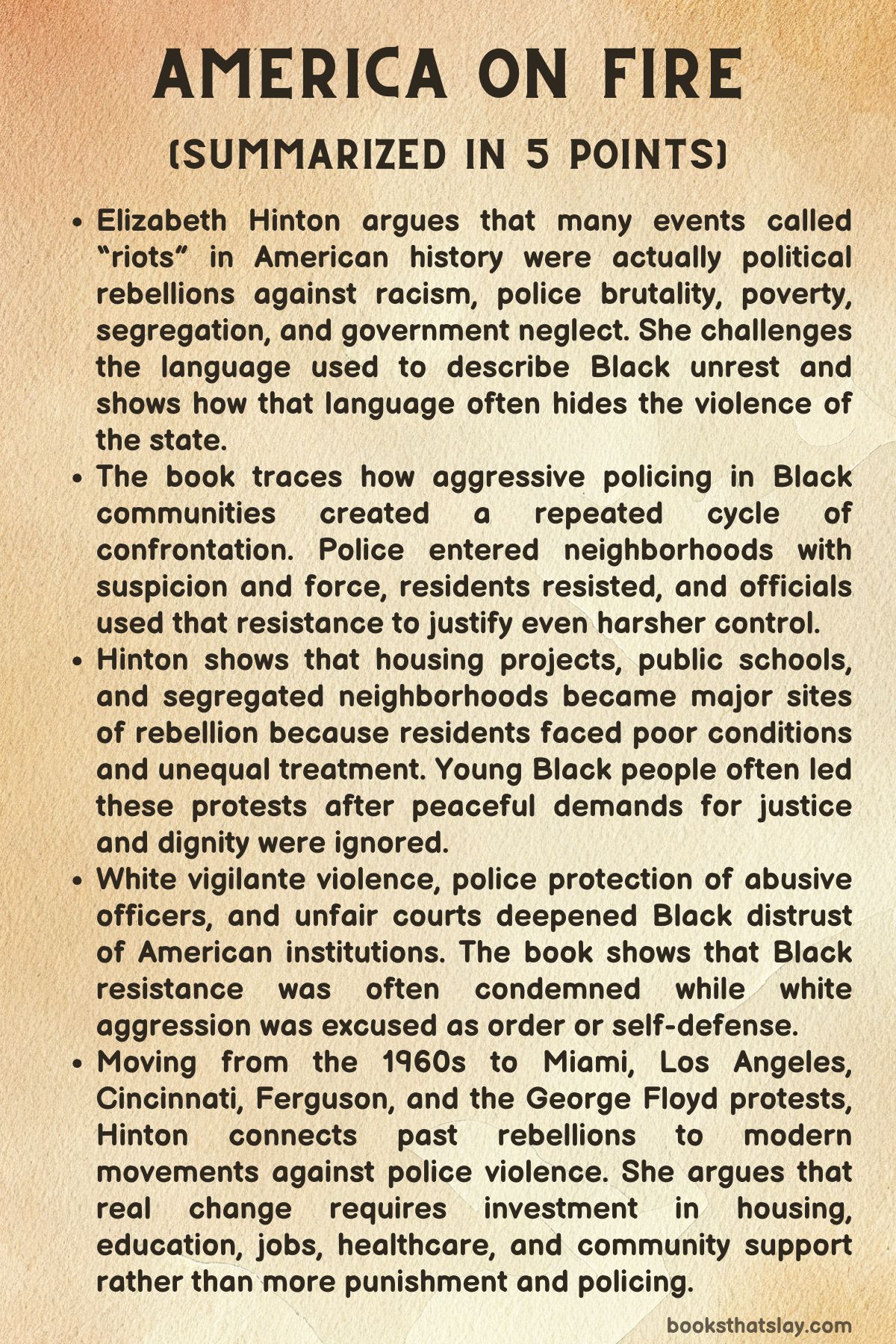
America On Fire: The Untold History of Police Violence and Black Rebellion Since the 1960s by Elizabeth Hinton is a historical study of Black rebellion, police power, and racial injustice in the United States. Hinton challenges the familiar label of “riot,” arguing that many uprisings were not random outbreaks of violence but political responses to racism, police brutality, segregation, poverty, and government neglect.
The book moves from the civil rights era into the present, showing how official answers often relied on harsher policing instead of real social repair. In clear, forceful terms, America on Fire asks readers to rethink disorder as a language of protest when other demands have been ignored.
Summary
America on Fire begins by reframing the civil unrest that spread through American cities after the civil rights movement. Elizabeth Hinton argues that the word “riot” has often been used to dismiss Black resistance as chaotic, criminal, and irrational.
She instead presents these events as rebellions against systems that repeatedly denied Black Americans safety, equality, housing, education, employment, and justice. The book’s central claim is that violence in Black communities was not born from some natural tendency toward disorder, but from specific historical conditions, especially aggressive policing and white supremacy.
Hinton opens with the civil rights movement and the rise of sit-ins, marches, and nonviolent protest. By the late 1960s, many Black Americans had grown frustrated with the limits of nonviolence.
Martin Luther King Jr.’s assassination deepened that frustration, convincing many young people that peaceful appeals had failed. Across the country, encounters with police became sparks for uprisings.
A rock thrown at a police car, an unfair arrest, a beating, or a killing could release years of anger. Officials usually answered these incidents with more police, more weapons, more surveillance, and more arrests.
That response created a cycle: police entered Black neighborhoods as an occupying force, residents resisted, and authorities used that resistance to justify still greater force.
Public housing projects became major sites of rebellion. Hinton shows how places built to house poor Black residents were often segregated, neglected, and heavily policed.
In cities such as Cairo, Illinois; Stockton, California; and Peoria, Illinois, residents lived with poor conditions while police treated their communities as centers of crime. When residents protested evictions, mistreatment, or police harassment, local governments often blamed them for damaging their own neighborhoods.
Yet these rebellions grew from real grievances: unsafe housing, racial segregation, lack of jobs, and the absence of meaningful political power.
The book also examines white vigilantism. In Cairo and York, Pennsylvania, white residents formed groups that harassed, threatened, and attacked Black communities, often with the tolerance or direct support of local authorities.
Hinton shows that white violence was frequently excused as self-defense or protection of property, while Black resistance was labeled lawless. In York, white gangs and police intimidation created an atmosphere of danger for Black residents.
The killing of Lillie Belle Allen exposed how deeply local law enforcement could side with white aggressors. Decades later, some arrests were finally made, but the long delay showed how little urgency authorities had shown when Black victims sought justice.
Hinton then turns to the fear of Black snipers, a figure that became powerful in media and police accounts during the late 1960s and early 1970s. Some Black people did arm themselves, often because they believed the police would not protect them from white violence.
Black Power groups and community organizations promoted self-defense as a way to survive. Yet police and the media exaggerated the idea of a coordinated Black campaign against officers.
This fear made law enforcement more aggressive and more likely to fire wildly or respond with overwhelming force. The result was further distrust, especially after state violence against Black activists, including the killings of Black Panther leaders Fred Hampton and Mark Clark.
A major part of America on Fire is its argument that police brutality was not simply the work of a few bad officers. Hinton uses the example of Officer Claiborne Callahan in Alexandria, Virginia, to show how abusive policing reflected a larger system.
Callahan’s assault on young Black residents and the city’s defense of him triggered rebellion. Black residents had already tried peaceful dialogue and reform, but officials ignored them until violence forced public hearings.
Even then, reforms were limited, and many white residents treated the officer as a hero. Hinton presents this as evidence that the problem was rooted in the culture of policing and the political order that protected it.
Schools also become central to the book’s account. Hinton rejects the idea that racism in education was only a Southern problem.
Across the North and South, Black students protested exclusion, racist teachers, unequal treatment, and the lack of Black history in classrooms. School officials often answered these demands by calling the police.
In Harrisburg, Burlington, and Greensboro, student protests grew into wider unrest after administrators refused to listen. Young people were beaten, arrested, gassed, and sometimes killed.
Hinton presents these student rebellions as demands for dignity and full citizenship, not as youthful disorder without purpose.
Government commissions repeatedly investigated the causes of unrest. The most famous, the Kerner Commission, identified white racism, poverty, poor housing, bad education, unemployment, and lack of political representation as major causes.
Many local commissions reached similar conclusions. Yet Hinton argues that these reports usually failed because officials did not act on their strongest recommendations.
They often described Black residents as alienated or overly emotional, which shifted some blame back onto the victims of racism. Meanwhile, police departments resisted reform, and politicians preferred short-term control over long-term investment.
The second half of America on Fire follows the legacy of these patterns into later decades. In Miami in 1980, the acquittal of officers who beat Arthur McDuffie to death set off a major uprising.
The rebellion followed years of police abuse, unequal justice, segregation, economic hardship, and racial tension. Hinton shows that the justice system punished Black people harshly while excusing police violence.
The Miami uprising included attacks on white people and businesses, but Hinton places that violence within a larger context of state failure and fear.
The book then moves to Los Angeles and the 1992 uprising after the beating of Rodney King and the acquittal of the officers involved. Hinton focuses not only on the violence but also on the attempt by Crips and Bloods leaders to create peace and rebuild their communities.
Former gang members proposed jobs, schools, healthcare, childcare, community centers, and police accountability. For a time, violence dropped.
But officials distrusted the truce and failed to invest in the proposed changes. Without public support, poverty and police hostility continued, and the fragile peace weakened.
In Cincinnati in 2001, the police killing of Timothy Thomas sparked another rebellion. Hinton presents this moment as a bridge between older urban uprisings and modern protest movements.
Cincinnati’s police had used aggressive “zero tolerance” policies that targeted Black residents, especially men. After Thomas’s death, protests, lawsuits, investigations, and coalitions forced some reforms.
Yet Hinton stresses that reform alone could not solve the deeper problems of unemployment, poverty, racial profiling, and unequal investment.
The conclusion brings the book to the protests after George Floyd’s murder in 2020. Hinton connects those demonstrations to earlier rebellions, arguing that the same issues remained: police violence, racism, poverty, and official refusal to listen until unrest forced attention.
Social media allowed millions to witness police brutality directly, making denial harder. The protests were broad and multiracial, and many called for police funding to be redirected toward housing, education, healthcare, and community support.
Hinton ends America on Fire by arguing that America must change its understanding of crime, punishment, and public safety. Rebellion, in her view, has often been a political response to injustice.
Real peace will not come from stronger policing but from addressing the conditions that produce fear, anger, and resistance. The book calls for investment in communities, a fairer tax system, rehabilitation over punishment, and a willingness to hear Black demands before violence becomes the only way authorities pay attention.
Key People
Elizabeth Hinton
Elizabeth Hinton is the guiding voice and historian behind America on Fire, and her role is not simply to record events but to challenge the language and assumptions surrounding them. She questions why violent responses by Black communities are so often called riots while white mob violence, police aggression, and state repression are treated as order, security, or unfortunate necessity.
Hinton’s perspective is analytical, political, and corrective. She asks readers to see Black rebellion as a form of protest shaped by material conditions: poverty, segregation, abusive policing, failed schools, and unequal courts.
Her strength as a narrator lies in how she connects local incidents to national policy. A single police encounter in a housing project, school, street, or neighborhood is never isolated in her analysis; it becomes evidence of a larger system that repeatedly produces violence and then blames the victims for reacting to it.
Through Hinton, the book becomes a reconsideration of American public memory, especially the way official narratives often erase the political meaning of Black resistance.
Black Youth
Black youth occupy one of the most important roles in the book because they are often the first to confront police power directly. They appear in streets, schools, housing projects, parks, and neighborhoods, and they are frequently treated by authorities as threats before they have done anything serious.
Hinton presents them not as reckless troublemakers but as young people growing up under constant surveillance and humiliation. Their actions, such as throwing rocks, refusing school assemblies, resisting arrests, or joining protests, emerge from a world where adults in power have ignored peaceful demands.
Many of these youths believe that the nonviolent civil rights movement did not bring enough protection or equality, especially after Martin Luther King Jr.’s assassination. Their rebellion is shaped by disappointment, anger, and a desire for dignity.
They also reveal how the criminal justice system begins targeting Black Americans early in life. The state responds to them not as children in need of support, but as future criminals who must be controlled.
Police
Police function as one of the central forces in the narrative, often appearing less as protectors than as agents of occupation in Black communities. Hinton shows police departments entering neighborhoods with riot gear, tear gas, military-style weapons, patrols, and aggressive arrest tactics.
Their presence frequently creates the very disorder they claim to prevent. Rather than asking whether over-policing is producing resistance, departments often interpret every confrontation as proof that more force is needed.
The police are not portrayed as a collection of unrelated individuals making occasional mistakes; they represent an institution shaped by racial suspicion, political support, and a culture of impunity. Officers often dismiss complaints, defend abusive colleagues, and treat Black residents as enemies.
Even when reforms are proposed, departments resist them or accept them only in limited ways. This institutional role is crucial because the book argues that rebellion is not caused by isolated incidents alone, but by repeated encounters with a system that refuses accountability.
President Lyndon B. Johnson
President Lyndon B. Johnson appears as a complicated political figure. On one hand, he understands that poverty, racism, unemployment, and poor housing contribute to unrest.
On the other hand, his practical response relies heavily on law enforcement. His War on Crime marks a turning point because federal power and money flow into police departments rather than into the social programs that might have addressed the roots of rebellion.
Johnson’s role reveals the limits of liberal reform when political leaders fear alienating white voters or appearing weak on crime. He recognizes that Black communities have legitimate grievances, yet he still helps expand the policing structures that intensify conflict.
This contradiction makes him important to Hinton’s argument: even leaders who publicly support civil rights can strengthen punitive systems when they choose order over justice. Johnson is not presented as a simple villain, but as a figure whose compromises help build the conditions for continued rebellion.
Martin Luther King Jr.
Martin Luther King Jr. is not analyzed mainly as an active participant in the later rebellions, but his death becomes a major emotional and political turning point. His assassination intensifies the belief among many Black Americans that peaceful protest had not been enough to protect Black life or secure justice.
In the book’s historical world, King represents the promise and limits of nonviolent civil rights activism. Young rebels look back on his approach with respect but also frustration, feeling that moral appeals had been met with murder, police repression, and slow reform.
His absence leaves a vacuum in which Black Power organizations and local defense groups become more influential. King’s role is therefore symbolic as much as historical.
He represents a path that many had hoped would transform America, and his killing becomes evidence, for some, that the country would not change unless forced to confront the anger it had created.
Black Power Organizations
Black Power organizations serve as expressions of self-defense, community control, and political impatience. Groups such as the Black Panthers and local organizations like the United Front are presented as responses to conditions that traditional politics failed to fix.
Hinton shows that these groups did more than advocate armed resistance; they organized communities, challenged police power, supported residents, and demanded housing, employment, dignity, and racial justice. Their willingness to use firearms or monitor police activity made them frightening to officials, but the book places that militancy in the context of white vigilantism and police violence.
These organizations reveal a central double standard: armed white citizens are often described as defending property, while armed Black citizens are treated as revolutionaries or criminals. Their importance lies in their insistence that Black communities have the right to defend themselves when the state fails or actively harms them.
The Black Panthers
The Black Panthers are among the most visible Black Power figures in the narrative. Hinton presents them as an organization that understood policing as a central site of racial oppression.
Their practice of monitoring officers, carrying weapons legally, and supporting arrested community members directly challenged the authority of police departments. They are often treated by government officials and media sources as dangerous radicals, but the book places their actions within the logic of survival.
For communities that experienced police as violent and unaccountable, the Panthers offered a form of protection and political education. The killings of Fred Hampton and Mark Clark show the danger they faced from law enforcement and federal agencies.
These deaths strengthen Hinton’s argument that state violence against Black activists was not accidental, but part of a larger attempt to suppress movements that questioned the foundations of American policing and racial power.
Charles Koen
Charles Koen is one of the most important community leaders in the book because he represents organized Black resistance rooted in local struggle. As a leader of the United Front in Cairo, he helps Black residents respond to segregation, white vigilantism, poor housing, and economic exclusion.
Koen’s activism combines religious language, anti-capitalist ideas, self-defense, and practical community support. He does not wait for city officials to solve problems they have long ignored.
Instead, he helps organize boycotts, community aid, and collective resistance. His leadership shows that rebellion is not merely a spontaneous emotional reaction; it can be linked to disciplined organizing and clear political demands.
Koen also exposes how white authorities often respond to Black leadership by treating it as dangerous, outside agitation, or criminal influence. In reality, his work grows from the lived conditions of Cairo’s Black residents and their need for protection and dignity.
John Lewis
John Lewis appears as a civil rights activist who brings the moral authority of the earlier movement into local struggles over segregation and racial injustice. His role in the book is connected to demands for employment, representation, and an end to segregation.
Lewis represents the continuity between nonviolent civil rights activism and later forms of rebellion. Hinton does not present these as completely separate worlds.
Instead, she shows that many of the demands remained the same: jobs, fair treatment, political inclusion, and safety. Lewis’s presence also highlights the failure of local governments to respond meaningfully even when demands are made through respected civil rights channels.
When officials ignore or minimize these demands, they help create the conditions in which more confrontational forms of resistance gain support.
White Vigilantes
White vigilantes are crucial to the book’s moral and political argument because they expose the hypocrisy of official narratives about violence. Groups such as the White Hats in Cairo and white gangs in York claim to protect property and order, but their actions include harassment, threats, shootings, intimidation, and direct terror against Black communities.
Hinton shows that these groups often include respectable local figures or receive support from police, making it impossible to separate private white violence from public authority. White vigilantes are rarely treated with the same condemnation reserved for Black rebels.
Their violence is excused, minimized, or described as defensive. This contrast reveals how racial power shapes language: Black resistance becomes criminal, while white aggression becomes civic concern.
Their role also shows why many Black residents come to see self-defense as necessary.
The White Hats
The White Hats represent organized white supremacy operating under the appearance of citizen protection. In Cairo, they terrorize Black residents while claiming to defend property and community order.
Their membership includes influential local people, which shows how deeply racism is embedded in civic life. They are not outsiders disrupting an otherwise fair society; they are part of the social and political structure.
Their actions help trigger Black rebellion, but public blame often falls on Black residents rather than on the white group that created fear and danger. The White Hats demonstrate how white violence can gain legitimacy through local power.
They also reveal the limits of official intervention, because authorities act decisively only when the violence threatens broader stability or economic interests, not simply because Black residents are being harmed.
Gerald Montroy
Gerald Montroy, a white priest who speaks against the White Hats, represents the minority of white citizens willing to confront white supremacy openly. His importance lies in the fact that his criticism makes him a target.
By defending Black residents and condemning vigilante violence, he challenges the idea that Cairo’s racial conflict is a balanced fight between two equally guilty sides. Montroy’s presence shows that white people have choices within racist systems: they can protect their comfort and status, or they can risk social punishment by opposing injustice.
He also reveals how white supremacist groups treat solidarity itself as betrayal. His role is morally important because it shows that resistance to racism is not limited to Black communities, though the greatest burdens and risks remain on Black residents.
Lillie Belle Allen
Lillie Belle Allen is one of the most tragic figures in the book. Her killing in York shows how racial violence can erupt from the ordinary act of taking a wrong turn.
She is not presented as a political organizer or rebel, but as an innocent Black woman whose death exposes the brutality of white gang violence and police indifference. Her murder also shows how the justice system can delay accountability for decades when the victim is Black and the perpetrators are protected by local power.
The fact that her case is revisited much later underscores one of Hinton’s major concerns: history often remembers Black unrest but forgets the Black suffering that preceded it. Allen’s role is to force readers to see the human cost hidden beneath official claims about law and order.
Clifford Green
Clifford Green plays a small but revealing role. His claim that white gang members set him on fire turns out to be false, yet the reaction to it shows how believable racial terror was in York’s Black community.
The fact that such a claim could spark conflict reveals a background of real fear, hostility, and violence. Green’s role is not mainly about whether his statement was accurate; it is about the racial atmosphere that made it powerful.
In a city where Black residents already experienced police bias and white gang aggression, the story fit what many people knew could happen. His episode shows how communities living under threat can reach a point where rumor and reality carry similar emotional force because both are shaped by long experience.
Henry Schaad
Henry Schaad, the police officer killed during unrest in York, represents how the death of an officer can transform public narratives and intensify state violence. His killing becomes a justification for harsher police action and greater retaliation against Black residents.
Hinton does not ignore the seriousness of violence against police, but she shows that official concern is often uneven. An officer’s death receives urgent attention, while Black victims of police and vigilante violence are ignored, blamed, or forgotten.
Schaad’s role reveals how the state defines whose lives demand punishment and whose deaths can be excused. His death also strengthens the perception among white authorities that they are under attack, which feeds further militarization and fear.
Claiborne T. Callahan
Claiborne T. Callahan is one of the book’s clearest examples of the so-called bad apple who actually reveals a larger poisoned system. His aggressive behavior toward Black residents in Alexandria, especially young people, turns him into a symbol of everyday police abuse.
When he beats Keith Strickland and attacks others who try to intervene, the violence is shocking, but what matters even more is the official response. Police leadership and many white residents defend him rather than hold him accountable.
Callahan’s character shows how abusive officers are protected by institutional loyalty, racial bias, and public praise from those who value control over justice. He becomes important not because he is unusual, but because he is treated as normal and even admirable by people with power.
Keith Strickland
Keith Strickland represents the vulnerability of Black children and teenagers under aggressive policing. His beating by Callahan shows how quickly a minor public encounter can become violent when police treat Black youth as enemies.
Strickland is not a powerful activist or public official; he is a young person harmed in a setting where adults should have protected him. His suffering becomes a catalyst for community outrage because residents recognize it as part of a wider pattern.
He also exposes the failure of emergency and civic systems when even medical help is delayed or absent. Through Strickland, Hinton shows how rebellion can begin with the defense of children and the refusal to accept their mistreatment as routine.
Sadie Pinn
Sadie Pinn, Keith Strickland’s mother, represents parental anguish and community resistance. Her attempt to protect her son and secure medical help places her in direct conflict with a system that has already failed him.
She is important because she shows that Black rebellion is not only led by young militants or political organizations; it also grows from mothers, families, and neighbors who witness state violence against their children. Pinn’s experience captures the emotional reality behind public unrest.
When officials ignore the pain of parents and excuse police abuse, they deepen the sense that ordinary channels of justice are closed. Her role turns the political argument into a personal one: the fight against police violence is also a fight for the safety of family life.
Russell Hawes
Russell Hawes, the police chief in Alexandria, represents institutional defensiveness. His support for Callahan shows how police leadership often protects officers even when community complaints are serious and well founded.
Hawes’s view of Black residents appears shaped by outdated and racist assumptions, and his resignation suggests that public pressure can force some change. Yet his role also shows the limits of removing one official.
The deeper culture of policing remains intact unless the system itself is transformed. Hawes is important because he demonstrates how leadership can either open the way to accountability or block it.
In this case, he largely blocks it, confirming for Black residents that the department is not interested in justice unless compelled by unrest.
Sirita Hines
Sirita Hines is a striking example of how poor Black women are caught between housing insecurity, police power, and public neglect. Her mistreatment by police in Peoria helps trigger rebellion, and her later eviction becomes another flashpoint.
Hines represents residents whose personal crises are produced by larger structures: poverty, unstable housing, and official disrespect. Her story shows that rebellion does not only emerge from spectacular acts of violence such as police shootings; it can also come from eviction, humiliation, and the sense that poor residents have no secure place in the city.
The community’s decision to move furniture back into her apartment becomes an act of collective protection. Hines’s role shows how private hardship becomes public protest when people recognize that one person’s treatment reflects the condition of many.
Horace Jones
Horace Jones, associated with the United Front Organization in Peoria, represents grassroots leadership in moments of direct confrontation. His role in helping residents resist the eviction of Sirita Hines and Dorothy Johnson shows how community organizers turn individual injustice into collective action.
Jones is important because he demonstrates that rebellion has leaders, aims, and moral reasoning. The act of moving furniture back into an apartment is not random destruction; it is a statement that poor Black residents have a right to housing and dignity.
Through Jones, Hinton shows that local organizers often understand the roots of unrest more clearly than city officials do. They see that policing cannot solve problems created by poverty and neglect.
Darnell Stephen Summers
Darnell Stephen Summers represents the influence of Black veterans and self-defense politics. As a young Black soldier and organizer in Inkster, he helps create the Black Youth Council and supports the Malcolm X Cultural Center.
His military background makes him especially threatening to law enforcement, which fears trained Black men who might resist police power. Summers’s role shows how Black veterans return from serving the nation only to face racism, surveillance, and suspicion at home.
His organizing is cultural as well as defensive: the Malcolm X Cultural Center becomes a place of identity, education, and community strength. The police reaction to it shows that authorities are threatened not only by weapons but also by independent Black political consciousness.
James Matthews
James Matthews, the fourteen-year-old killed by officers in Inkster, represents the deadly consequences of police fear and racial profiling. He is targeted on the basis of little more than suspicion and appearance, and his death reveals how quickly Black children can be transformed into imagined threats.
Hinton uses such deaths to show that police violence is not simply reactive; it is shaped by assumptions about Black danger. Matthews’s killing also strengthens community support for the Malcolm X Cultural Center, showing that state violence can deepen political commitment rather than destroy it.
His role is brief but powerful because he stands for the young lives lost when police act on paranoia and face few consequences.
Fred Hampton and Mark Clark
Fred Hampton and Mark Clark symbolize the violent suppression of Black radical leadership. Their deaths at the hands of law enforcement are presented as part of a larger pattern in which the state treats Black political organization as a threat to national order.
Hampton especially represents charisma, discipline, and the possibility of broad coalition politics, while Clark’s death reinforces the danger faced by those associated with the Black Panthers. Their killings show why many Black communities distrust official claims that police are neutral protectors.
When leaders are killed in their homes by agents of the state, the line between law enforcement and political repression becomes impossible to ignore. Their role in the book is to connect local policing to national campaigns against Black liberation movements.
Arthur McDuffie
Arthur McDuffie is central to the Miami uprising. His beating death by police and the acquittal of the officers involved become a breaking point for Black residents who already believe the justice system is stacked against them.
McDuffie’s role is important because his death is not treated as an isolated tragedy. It follows other abuses, humiliations, and legal double standards.
The failure to punish the officers tells the community that Black life can be destroyed without meaningful consequence. The uprising that follows is therefore not only about McDuffie as an individual, but about the accumulated belief that the courts, police, and political leaders will not protect Black people.
His death becomes a symbol of state violence and judicial betrayal.
Janet Reno
Janet Reno appears as a representative of the legal system in Miami, where many Black residents believe justice is applied unevenly. Her role is connected to the perception that Black defendants can be punished severely while police officers who harm Black citizens escape accountability.
Hinton uses this contrast to show that distrust of the justice system is not abstract; it grows from visible differences in prosecution, punishment, and official priorities. Reno’s role is not simply personal but institutional.
She stands for a legal order that claims neutrality while producing outcomes that many Black residents experience as deeply racialized. Her presence helps explain why the McDuffie verdict becomes so explosive.
Johnny L. Jones
Johnny L. Jones, the Black superintendent of Miami’s public schools, represents another side of unequal justice. His prosecution for alleged theft is seen by many as harsh and possibly politically motivated, especially when compared with the leniency shown to police officers accused of brutal violence.
Jones’s role shows how Black public figures can be disciplined severely by the legal system while white or police defendants receive protection. Whether viewed as a victim of framing or as a public official caught in scandal, his treatment contributes to the community’s belief that justice in Miami is not fair.
He matters because his case deepens the sense of racial double standards before the McDuffie verdict sets off rebellion.
Jeffrey Kulp, Michael Kulp, and Debra Gettman
Jeffrey Kulp, Michael Kulp, and Debra Gettman appear in the Miami section as white outsiders who drive into a Black neighborhood during a moment of intense unrest. Jeffrey Kulp’s death during the uprising is a brutal example of anti-white violence, and Hinton does not present it lightly.
At the same time, she places it within a broader context of anger, fear, segregation, and repeated state violence against Black residents. Their role shows how rebellion can produce innocent victims and morally disturbing acts, even when rooted in legitimate grievances.
They also show how racial violence can spill beyond direct confrontations with police and become a wider social explosion. Hinton’s analysis asks readers to hold two truths at once: such violence is tragic, and it did not arise without cause.
Rodney King
Rodney King becomes a national symbol of police brutality because his beating is captured on video and seen by the public. His role is especially important because visual evidence does not lead to the justice many people expect.
The acquittal of the officers involved shows Black communities that even undeniable footage may not be enough to overcome the legal protection given to police. King’s beating and the verdict that follows help ignite the Los Angeles uprising, but his significance extends beyond one city.
He represents the gap between public visibility and legal accountability. In Hinton’s argument, King’s case foreshadows the later importance of video evidence in police killings while also showing the limits of visibility when institutions refuse to act.
The Crips and Bloods
The Crips and Bloods are presented in a more complex way than common crime narratives allow. Hinton acknowledges their role in gang violence, but she also examines the social conditions that produced gangs: unemployment, incarceration, poverty, territorial pressure, and a lack of opportunity for young Black men.
Their truce after the Rodney King verdict becomes one of the book’s most important examples of community-led reform. Leaders from both gangs imagine a future built around jobs, schools, healthcare, childcare, neighborhood repair, and police accountability.
This proposal challenges the stereotype that gang members only produce violence. It shows that people labeled criminal can also become organizers with serious political visions.
The failure of officials to support the truce reveals how little the state invests in transformation when it comes from marginalized communities.
George H. W. Bush
George H. W. Bush represents the federal response to the Los Angeles uprising. He expresses concern over the Rodney King video and verdict, but his administration also frames the rebellion through crime, gangs, and immigration.
This response shifts attention away from police brutality and systemic inequality. Bush’s role shows how national leaders can acknowledge injustice while still relying on punitive language and force.
By emphasizing disorder and criminality, his administration helps narrow the public understanding of the uprising. Rather than treating it as a political response to state violence, officials present it as a breakdown caused by dangerous groups.
This pattern echoes earlier government responses in which social causes are recognized but policing remains the preferred solution.
Timothy Thomas
Timothy Thomas is central to the Cincinnati uprising and represents the deadly consequences of low-level criminalization. His record is built from repeated police stops and minor violations, yet that record is later used to justify the officer’s actions after he is killed.
Hinton shows how policing can manufacture criminality by repeatedly targeting Black men for small infractions, creating warrants and records that make them appear dangerous in court. Thomas’s death becomes the final outrage after years of police killings in Cincinnati.
His role shows how a city can turn poverty and racial profiling into legal vulnerability. He is not only a victim of one officer’s gunfire; he is a victim of a system that had already marked him as disposable.
Angela Leisure
Angela Leisure, Timothy Thomas’s mother, represents grief transformed into public demand. Her leadership after her son’s death shows how families of police victims often become activists because the system leaves them no other path.
She brings the pain of private loss into civic space by confronting city officials and demanding justice. Her role is emotionally powerful because she refuses to let her son be reduced to a police record or legal argument.
Like other mothers in the book, she shows that rebellion and protest are often rooted in family devastation. Her presence also reveals the failure of official empathy: city leaders respond cautiously and reluctantly, even when a mother is asking for accountability for her dead child.
Michael Brown
Michael Brown appears as part of the book’s later discussion of police violence and modern protest. His killing in Ferguson becomes a national symbol of the continuing pattern Hinton traces across decades.
Brown’s role shows that the problems of police aggression, racial suspicion, and community rebellion did not end with the twentieth century. The response to his death also connects earlier uprisings to contemporary movements demanding police accountability.
Brown represents a generation of Black victims whose deaths are rapidly publicized, debated, and politicized. His case shows how old patterns persist in new media environments: the victim’s behavior is scrutinized, the police account is defended, and the community’s anger is often treated as the real problem.
Samuel DuBose
Samuel DuBose’s killing in Cincinnati shows both the value and the limits of reform. His death occurs after earlier efforts to improve police-community relations, and the city does not erupt in the same way it had after Timothy Thomas’s killing.
That relative calm suggests that reforms can matter. Yet the failure to secure full justice for DuBose also shows that reform does not necessarily end impunity.
His role is important because he demonstrates Hinton’s argument that police reform may reduce conflict but cannot fully solve the deeper structures that place Black people at risk. DuBose becomes evidence that without broader cultural and institutional change, the cycle can continue even in cities that have already faced crisis.
George Floyd
George Floyd is the final major symbolic figure in the book’s historical arc. His murder in Minneapolis triggers massive protests across the United States and beyond.
Floyd’s death is important not only because of its brutality, but because it is witnessed through video by millions. His final moments make visible what Black communities had described for generations: the casual, deadly power police can exercise over Black bodies.
The protests after his death are multiracial and national in scale, connecting police violence to demands for social investment, racial justice, and new definitions of public safety. Floyd’s role brings Hinton’s argument into the present, showing that the history described in America on Fire remains unresolved.
Breonna Taylor
Breonna Taylor represents the danger of police violence entering the home. Her death expands the book’s focus beyond street encounters, traffic stops, and public uprisings by showing that Black people can be endangered even in private spaces.
Taylor’s killing becomes one of the major sources of outrage in 2020 because it reveals the reach of militarized policing and the vulnerability of Black women within that system. Her role also challenges narratives that center only Black men as victims of police violence.
Hinton’s conclusion places her alongside other deaths that fueled national protest, showing that the movement for racial justice is also a movement against the broad conditions that make Black life unsafe in many forms.
Ahmaud Arbery
Ahmaud Arbery represents the continuing threat of white vigilante violence in modern America. His killing recalls earlier patterns in which white civilians claim the right to police Black movement, Black presence, and Black freedom.
Arbery’s role connects the book’s discussion of white vigilantes in earlier decades to the present day. His death shows that racial terror is not only a matter of official policing; it can also come from private citizens who feel authorized to pursue and punish Black people.
The outrage over his killing helps fuel the broader protests of 2020 because it exposes the overlap between vigilantism, racism, and delayed justice. Through Arbery, Hinton’s historical argument reaches beyond police departments into American culture itself.
Themes
Rebellion as Political Protest
The book challenges the idea that urban unrest in Black communities should be understood as random criminal disorder. Hinton argues that many events commonly labeled riots were political rebellions shaped by clear grievances.
These included police brutality, racist courts, segregated housing, poor schools, unemployment, and the refusal of officials to listen to peaceful demands. The language used to describe unrest matters because it determines whether the public sees participants as citizens making demands or criminals causing damage.
When officials call these events riots, they can avoid discussing the conditions that produced them. The book repeatedly shows that violence often followed years of ignored complaints, failed meetings, weak commissions, and broken reform promises.
Rebellion becomes a form of communication when other forms have been dismissed. This does not mean the violence is romanticized or treated as harmless.
People are injured, businesses are destroyed, and innocent lives are sometimes lost. But Hinton insists that moral judgment must include the violence that came before the uprising: police beatings, white attacks, housing neglect, school racism, and legal betrayal.
In America on Fire, rebellion is presented as a desperate political act produced by a society that often responds to Black suffering only when that suffering disrupts public order.
Policing and the Cycle of Violence
Policing is shown as a force that often creates the conditions it claims to control. In many cities, Black residents experience police not as neutral protectors but as aggressive outsiders who enter neighborhoods with suspicion, weapons, and a readiness to use force.
Minor encounters become dangerous because officers treat young Black people as threats. A street game, party, school protest, traffic stop, or eviction can become the beginning of a wider confrontation.
When residents resist, authorities interpret that resistance as proof that the community needs more policing. This produces a cycle: surveillance leads to anger, anger leads to rebellion, rebellion leads to stronger police action, and stronger police action leads to more anger.
Hinton’s analysis is especially powerful because she does not reduce the problem to individual cruelty. Abusive officers matter, but they are protected by departments, courts, politicians, and white public opinion.
Even reform efforts often fail because police departments resist oversight and continue to view Black communities through an enemy framework. The theme shows that public safety cannot be built through fear.
When police operate like an occupying force, they weaken trust, increase danger, and make future unrest more likely. The book argues that the cycle will continue unless America changes both police culture and the social conditions police are sent to manage.
White Violence and the Double Standard of Order
White violence is one of the book’s most important but often hidden forces. Hinton shows that white vigilantes, gangs, business leaders, and ordinary citizens frequently participate in intimidation and attacks against Black communities.
Yet their violence is often described as defense of property, community protection, or understandable fear. Black resistance, by contrast, is treated as criminal chaos.
This double standard shapes public memory. When Black residents rebel after being harassed, segregated, or attacked, the rebellion becomes the main story, while the white violence that helped cause it fades into the background.
The book’s examples of white vigilante groups and racially biased police support show that private white aggression and official state power often reinforce each other. Police may ignore white attackers, arm them, protect them, or share their assumptions.
This makes it difficult for Black residents to see the legal system as legitimate. The theme also connects past and present.
The same logic that allowed white vigilantes to claim they were defending their neighborhoods appears in later acts of racial pursuit and violence. Hinton asks readers to question who gets to be seen as orderly, who gets labeled dangerous, and how those labels protect racial power.
The book shows that American order has often depended on excusing white aggression while punishing Black resistance.
Failed Reform and the Need for Structural Change
Again and again, commissions, investigations, lawsuits, and reform proposals identify real causes of unrest but fail to create lasting change. Reports acknowledge racism, poverty, unemployment, poor housing, weak schools, and police abuse, yet political leaders often choose limited reforms or stronger law enforcement instead of deep investment.
This pattern reveals the difference between recognizing a problem and having the will to solve it. Hinton shows that authorities often prefer symbolic action: public hearings, statements of concern, sensitivity training, or small policy changes.
These steps may calm public anger temporarily, but they do not transform the conditions that created rebellion. Even when reforms improve police behavior in some places, deeper issues remain, such as poverty, segregation, lack of jobs, and the criminalization of Black life.
The book also highlights community-led alternatives, including gang truces, boycotts, youth programs, housing demands, and proposals for healthcare, education, and employment. These efforts show that marginalized communities often know what they need, but officials refuse to fund or trust their plans.
The theme points toward a larger argument: real peace requires redistribution, social support, fair courts, housing security, better schools, and a justice system based less on punishment. Reform is not dismissed entirely, but it is shown as insufficient when it leaves the structure of inequality intact.