Amina’s Voice Summary, Characters and Themes
Amina’s Voice by Hena Khan is a middle-grade novel about identity, friendship, faith, and finding courage. Amina Khokar is a Pakistani American sixth grader with a beautiful singing voice, but she is terrified of performing in public.
As her best friend Soojin considers changing her name, her uncle visits from Pakistan, and her Islamic Center faces a hateful attack, Amina is forced to think about who she is and what matters to her. The book follows her as she learns that confidence is not about becoming someone else. It is about trusting her own voice.
Summary
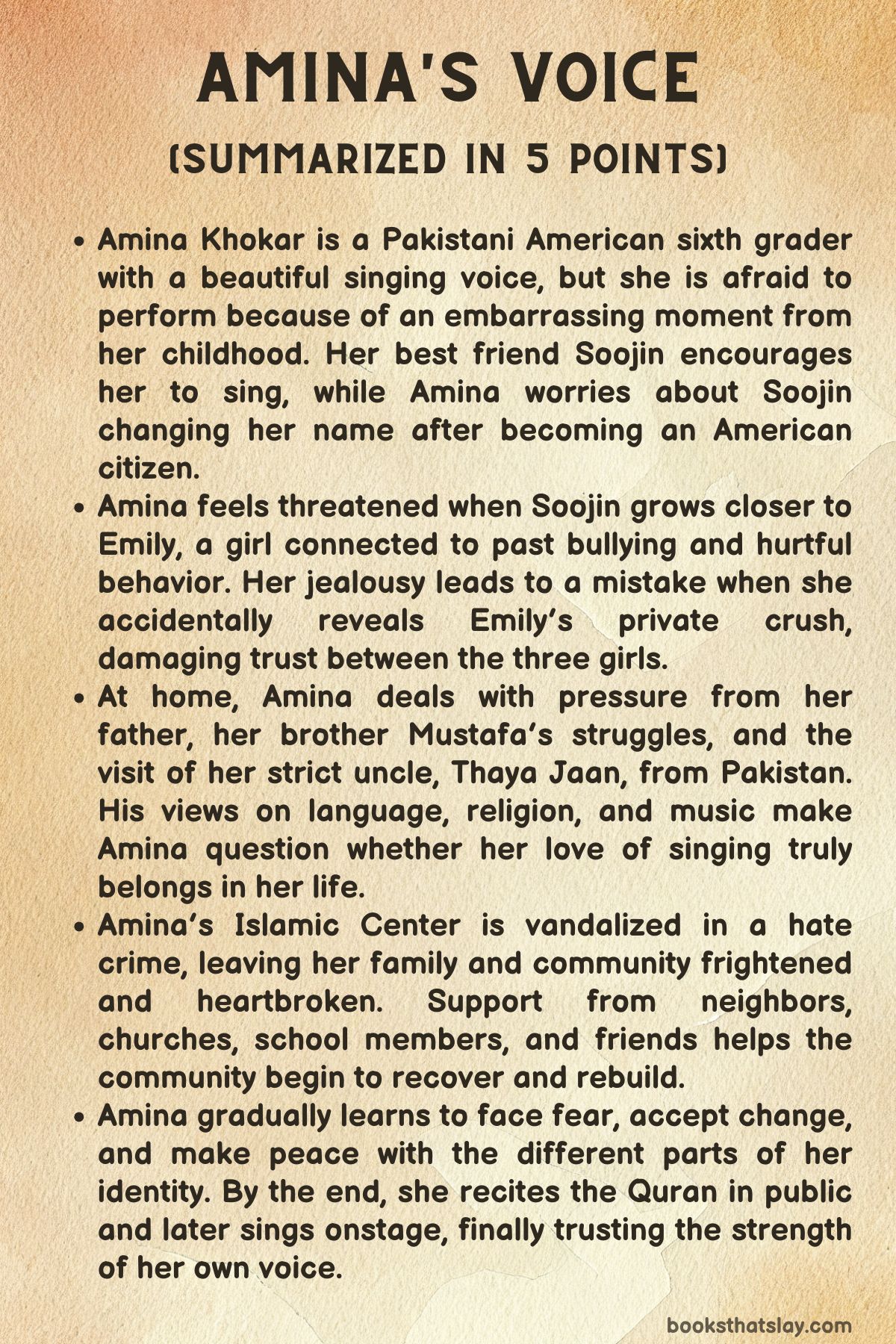
Amina’s Voice follows Amina Khokar, a sixth-grade Pakistani American girl living in Greendale, Wisconsin. Amina loves music and has a remarkable singing voice, but she is afraid to sing in front of others.
Her fear comes from a humiliating moment in second grade, when she froze during a school performance and could not say her line. Since then, she has avoided the spotlight, even though her music teacher and her best friend, Soojin, believe she has real talent.
Amina’s closest friend, Soojin, is Korean American. The two girls have bonded partly because their names are different from many of their classmates’ names, and they know what it feels like when teachers stumble over them.
Amina is unsettled when Soojin tells her that her family is becoming American citizens and that she may choose a new American name. Soojin considers names like Heidi, Jessica, Melanie, Fiona, and later Susan.
Amina feels as if she is losing something important. To her, Soojin’s name is part of who she is.
She worries that if Soojin changes her name, their friendship might change too.
Amina’s anxiety grows when Emily, a girl who used to be close to a mean classmate and once joined in hurtful behavior toward Amina and Soojin, starts spending time with them. Emily is placed in their social studies group for an Oregon Trail project, along with Bradley, an awkward boy who makes Amina uncomfortable.
Amina does not trust Emily and cannot understand why Soojin seems willing to forgive her. As Emily becomes warmer and more open, Amina feels jealous and left out.
She fears that Soojin is moving on without her.
At home, Amina has her own family pressures. Her father, Baba, is loving but strict about school, behavior, and faith.
Her older brother, Mustafa, is adjusting to high school. His grades have slipped, and he wants to play basketball, which worries Baba because he values academics and discipline.
The family is also preparing for a long visit from Baba’s older brother, Thaya Jaan, who is coming from Pakistan. Baba wants the children to behave perfectly so his brother will approve of the life he has built in America.
Thaya Jaan’s arrival makes Amina nervous at first, but he is warmer than she expects. He brings gifts from Pakistan and reminds the family of relatives Amina barely knows.
Still, he also makes Amina feel judged. He questions why Amina and Mustafa do not speak Urdu and suggests that their father should use only Urdu at home.
Amina feels ashamed, as though she has failed at being Pakistani enough. Her father explains that he has focused more on English and Arabic, but Amina senses the tension between their American life and their Pakistani roots.
Amina is also anxious about a Quran recitation competition at the Islamic Center. Baba signs up both Amina and Mustafa after Imam Malik asks him to.
Amina dreads reciting in public, even though Thaya Jaan helps her practice. She struggles with Arabic pronunciation and worries that she will freeze the way she once did at school.
Yet when she hears Thaya Jaan recite the Quran beautifully, she recognizes a connection between his voice and her own love of music. For the first time, Quran recitation feels musical to her, not just difficult.
A painful conflict arises when Amina overhears Thaya Jaan telling Baba that music is forbidden in Islam and that Amina should spend less time singing and playing piano. Amina is devastated, especially because her father does not immediately defend her.
She begins to wonder whether something she loves might be wrong. When she finally asks her parents why God hates music, her mother strongly assures her that God does not hate music and that Amina’s talent is a gift.
Baba explains that some Muslims are stricter than others and that he does not believe Amina’s music is wrong. This helps Amina feel seen and supported again.
Meanwhile, Amina makes a serious mistake with Emily. Emily confides that she has a crush on Justin, a boy at school.
Later, Amina accidentally lets the secret slip to Bradley. Soon Luke teases Emily publicly, and Emily is humiliated.
Soojin is furious with Amina, and Emily feels betrayed. Amina is ashamed because she knows she has damaged their trust, even if she did not mean to.
She writes an apology to Emily and wants to make things right, but for a while both girls avoid her.
Amina’s guilt deepens when Thaya Jaan teaches her a Quran passage warning against speaking badly about others. Amina fears she has become a bad person, but her mother helps her understand the difference between a cruel act and a mistake.
She tells Amina to seek forgiveness from God and from her friends, but also reminds her that one mistake does not define her.
Then the story takes a darker turn. Early one morning, Amina learns that the Islamic Center has been vandalized.
The Sunday school rooms are covered in hateful graffiti, the library is badly damaged, and the mosque has fire damage. The attack shakes Amina deeply.
The Islamic Center has always been a place of peace, prayer, learning, and belonging. Seeing it harmed makes her feel unsafe and heartbroken.
Her parents and community members are frightened and angry, and the repairs will be expensive.
After the attack, people gather at Amina’s home and watch news coverage of the hate crime. The community is shaken, but they are not alone.
At a public meeting at Amina’s school, local officials, neighbors, and members of other faith communities show their support. Soojin comes with her family, and Emily’s father offers to help repair the Islamic Center through his construction company at a reduced cost.
This generosity moves Amina. It also helps her reconnect with Soojin, who forgives her for the mistake with Emily.
Emily forgives her too. Amina begins to see Emily not as an intruder, but as a real friend.
Soojin also decides not to change her name after all. She realizes she cannot imagine no longer being Soojin.
This brings Amina relief, not because Soojin has done what Amina wanted, but because Soojin has chosen what feels true to herself. Their friendship becomes stronger because they have both faced change, hurt, and forgiveness.
Because the Islamic Center cannot host the Quran competition and carnival, Amina suggests holding the event at Soojin’s church. The idea works.
Members of the church, synagogue volunteers, school staff, and families from many parts of the community come together to help. What began as a moment of hate becomes an opportunity for neighbors to stand with one another.
On the day of the Quran competition, Amina is still nervous, but Imam Malik helps by letting her go first. She recites a familiar passage and focuses on the rhythm, meaning, and sounds of the Arabic words.
Instead of freezing, she continues. Her voice grows steadier, and she completes the recitation.
Emily praises her sincerely, and Amina accepts her as a friend. Mustafa also recites beautifully and wins first prize.
He decides to use part of his prize money to start a boys’ basketball club at the Islamic Center, showing his own growth and confidence.
The event becomes a joyful carnival filled with games, food, and support from different communities. Thaya Jaan, who once seemed critical of American life, recognizes that Amina’s parents have raised their children well.
He admits that he has learned from them too. His approval means a great deal to Baba and helps ease the tension between tradition and change.
The story ends with Amina facing her biggest fear. During the musical performance, she first plays piano, then steps forward to sing.
This time, she does not hide behind the instrument or let fear stop her. She sings in public, using the voice she has spent so long protecting.
By the end of Amina’s Voice, Amina has learned that her identity does not have to be split between faith, family, friendship, and music. All of these parts belong to her, and her voice is strongest when she accepts them together.
Characters
Amina Khokar
Amina Khokar is the emotional center of Amina’s Voice, and her growth comes from learning how to accept every part of herself. She is a Pakistani American sixth grader with a powerful singing voice, but she is held back by stage fright and self-doubt.
Her fear of public performance began after an embarrassing childhood moment, and that memory continues to control how she sees herself. Amina’s love of music is deep and private; singing gives her comfort, confidence, and joy, but she struggles to share that gift with others.
Her journey is not only about overcoming fear onstage. It is also about understanding that her voice matters in every sense: as a singer, as a friend, as a daughter, as a Muslim, and as a young person trying to define herself.
Amina is also sensitive to change, especially in her friendship with Soojin. When Soojin considers changing her name and grows closer to Emily, Amina feels threatened and left behind.
Her jealousy does not make her cruel, but it does expose her insecurity. She wants things to stay familiar because familiar things feel safe.
Her mistake with Emily’s secret becomes an important turning point because it forces her to face the consequences of acting carelessly while hurt. Amina’s guilt shows her strong conscience, and her effort to apologize shows her capacity for growth.
By the end, she becomes more open, braver, and more generous. She learns that friendship can grow without disappearing, that faith can support creativity, and that courage often begins before fear goes away.
Soojin
Soojin is Amina’s best friend and one of the main figures through whom the novel explores identity and change. She is Korean American, and like Amina, she knows what it feels like to have a name that stands out.
Her decision to consider an American name after her family becomes citizens unsettles Amina because Soojin’s name has always been part of their shared experience. For Soojin, however, the name question is more personal and complicated.
She is not rejecting who she is; she is trying to understand how she wants to belong in a country that is becoming officially hers.
Soojin is friendly, adaptable, and more willing than Amina to give people a second chance. Her openness toward Emily frustrates Amina, but it also shows that Soojin is changing in a healthy way.
She refuses to remain stuck in old judgments if someone seems to be acting differently. At the same time, Soojin is not perfect.
She becomes angry when Amina betrays Emily’s confidence, and her anger feels especially painful because she has rarely spoken to Amina that way before. Still, Soojin’s ability to forgive shows emotional maturity.
Her final decision not to change her name is meaningful because it comes from her own reflection, not from pressure. She remains Soojin because she realizes that her name still feels true to her.
Emily
Emily begins as a source of discomfort for Amina because she is connected to past bullying and exclusion. Amina remembers Emily as someone who joined in when others mocked Soojin’s food and made hurtful comments about language and difference.
Because of this history, Amina has trouble believing that Emily’s kindness is genuine. Emily’s presence creates tension not because she is actively cruel in the present, but because Amina cannot easily separate who Emily used to be from who she might be becoming.
As the story develops, Emily becomes a more sympathetic character. She shows interest in Soojin’s Korean food, shares pieces of her own family life, and tries to become part of the friendship in an honest way.
Her confession about liking Justin makes her vulnerable, and Amina’s accidental betrayal hurts her deeply. Emily’s reaction shows that she truly trusted Amina and Soojin, which makes Amina realize that Emily was not simply forcing herself into their friendship.
She wanted to belong. Emily’s forgiveness later in the story is important because it confirms her growth.
She is no longer only the girl from Amina’s memories; she becomes someone capable of kindness, trust, and understanding.
Mustafa Khokar
Mustafa, Amina’s older brother, represents the pressures of growing up under family expectations while trying to form an independent identity. He used to be a strong student, but his grades have begun to slip during high school, worrying his father.
Mustafa wants to play basketball, but Baba sees sports as a possible distraction from academics. This conflict shows the gap between parental hopes and a teenager’s need to explore his own interests.
Mustafa is not rejecting his family’s values; he is trying to find a place where he can feel confident and capable.
Mustafa’s character becomes more layered when Amina overhears Imam Malik speaking to him about being around boys who were smoking. Mustafa insists that he was not smoking, and his fear is less about guilt than about disappointing his father and losing basketball.
This moment shows how trapped he feels between trust and suspicion. He is protective of Amina, especially after the Islamic Center is attacked.
When she fears that her wish to avoid the Quran competition caused the destruction, Mustafa firmly tells her it is not her fault. His recitation at the competition and his decision to use prize money for a basketball club show his growth.
He finds a way to connect faith, community, and his own passion.
Baba
Baba, Amina’s father, is loving, disciplined, and deeply invested in his children’s future. He values education, respect, religious commitment, and family honor.
His questions at school events and his concern about Mustafa’s grades show that he wants his children to succeed and be taken seriously. Sometimes, however, his care comes across as pressure.
He worries about how Thaya Jaan will judge the family’s American life, and this makes him stricter with Amina and Mustafa. His desire to prove that he made the right decision in raising his children in America reveals his own insecurity.
Baba is also a man balancing tradition and adaptation. He respects Thaya Jaan and struggles to challenge him directly, even when his brother’s views make Amina feel hurt.
His silence during the discussion about music wounds Amina because she expects him to defend her gift. Yet Baba later clarifies that he does not believe Amina’s music is wrong and that he values her talent.
This makes him a more human character: he is not always confident in the moment, but he is willing to listen and correct himself. His grief after the attack on the Islamic Center shows how deeply he loves his community.
By the end, Thaya Jaan’s praise means so much to him because Baba has wanted his brother to see that his family’s life in America has dignity and strength.
Mama
Mama is one of the strongest sources of emotional balance in Amina’s Voice. She is practical, observant, loving, and protective.
She manages the household, prepares for Thaya Jaan’s visit, supports the children, and often notices when Amina is troubled before anyone else does. Unlike Baba, she is more direct when someone’s words hurt her child.
When Amina worries that music may be wrong, Mama immediately reassures her that her talent is a gift and that God would not give her such ability only for it to be rejected.
Mama also guides Amina through guilt and friendship conflict. When Amina fears she has become a bad person because of what happened with Emily, Mama helps her understand the difference between a mistake and intentional cruelty.
She does not excuse Amina’s behavior, but she also does not let Amina define herself by one failure. This makes Mama an important moral guide.
After the attack on the Islamic Center, Mama’s fear and shock reveal how deeply the violence affects the family, but she continues to act with steadiness. Her character shows the quiet strength of a parent who holds a family together while helping her children understand both pain and responsibility.
Thaya Jaan
Thaya Jaan is Baba’s older brother from Pakistan, and his visit brings questions of culture, religion, judgment, and belonging into Amina’s home. At first, Amina expects him to be intimidating, and in some ways he is.
He is religiously conservative, critical of the children’s lack of Urdu, and doubtful about Amina’s musical interests. His comments make Amina feel as though she is not Pakistani enough or not Muslim enough.
Because Baba respects him so deeply, Thaya Jaan’s opinions carry weight in the family.
Yet Thaya Jaan is not presented as a flat or purely harsh character. He is affectionate when he arrives, brings thoughtful gifts, and helps Amina and Mustafa prepare for the Quran competition.
His Quran recitation is beautiful and opens Amina’s mind to the musical quality of sacred language. He becomes a bridge to family history and religious discipline, even when his strictness causes pain.
By the end, he changes too. He sees the strength of Amina’s family, the generosity of their community, and the value in the life Baba has built in America.
His admission that he has learned from the children and their parents softens him. He remains traditional, but he becomes more open.
Rabiya
Rabiya is Amina’s friend from the Islamic Center and a source of comfort outside school. She is more confident in Sunday school than Amina and seems more at ease in the religious setting.
Her presence shows that Amina’s life is not limited to school friendships; she also has a Muslim community where she belongs. Rabiya encourages Amina’s singing and pushes her to record herself, showing that she recognizes Amina’s talent even when Amina hides from it.
Rabiya also gives Amina a space where she can be playful and relaxed. Their conversations about music, costumes, videos, and sleepovers show a normal friendship built on shared interests and humor.
At a time when Amina feels uncertain about Soojin and Emily, Rabiya reminds her that she has other meaningful relationships. Still, Amina’s thoughts make clear that Rabiya cannot simply replace Soojin.
Rabiya’s role is important because she helps show the different parts of Amina’s social world: school, family, faith, and friendship all shape her in different ways.
Imam Malik
Imam Malik is a trusted religious leader who combines authority with warmth. Baba respects him deeply, which is why his request that Amina and Mustafa enter the Quran competition carries so much force.
For Amina, this creates pressure, but Imam Malik is not insensitive. Later, when Amina admits her stage fright, he responds with honesty by saying that he also experiences nervousness despite speaking publicly often.
This makes him approachable and helps Amina feel less alone.
His interaction with Mustafa also shows his role as a mentor. When he catches Mustafa near boys who were smoking, he could immediately tell Baba, but he listens to Mustafa and gives him a chance to make better choices.
He reminds Mustafa that the Islamic Center is like family, suggesting that faith communities should guide young people rather than only punish them. After the attack on the Center, Imam Malik becomes a steady public voice, helping the community respond with courage and organization.
His character represents faith leadership rooted in responsibility, compassion, and trust.
Bradley
Bradley is socially awkward and often misunderstood by the other students. Amina finds him strange and uncomfortable, partly because he does not always understand personal space or social cues.
In the Oregon Trail project, he becomes an unwanted group member, and Amina initially sees him as a burden. His crush on Emily adds to the awkwardness and becomes part of the chain of events that leads to Emily’s secret being exposed.
Bradley’s role is small but important because he shows how careless words can travel. Amina does not mean to hurt Emily, but speaking loosely to Bradley creates consequences she cannot control.
At the same time, Bradley is not shown as malicious. He is lonely, interested in being included, and unsure how to connect with others.
His character helps reveal Amina’s flaws too. She is not cruel to him, but she is often dismissive of him.
Through Bradley, the story quietly asks readers to think about how easily children can label someone as odd and stop seeing their full humanity.
Justin
Justin is not a deeply developed character, but he has a strong effect on Emily and Amina. For Emily, he is the boy she likes and trusts her friends enough to talk about.
When Luke publicly teases her and Justin rejects the idea in front of others, Emily feels humiliated. His reaction may be typical middle-school embarrassment, but it still causes real pain.
For Amina, Justin is connected to an older memory of shame. When he once commented on the hair on her legs, Amina felt embarrassed and began avoiding him.
This detail shows how small remarks can stay with a child for years. Justin represents the casual cruelty and awkwardness that often shape middle-school life.
He is not the main source of conflict, but he contributes to the emotional atmosphere in which Amina feels self-conscious and guarded.
Luke
Luke represents the open meanness that Amina and her friends encounter at school. He mocks others, teases Emily about Justin, and has previously insulted Amina in a way that made her feel ashamed of the smells associated with her mother’s cooking.
His behavior is not just ordinary teasing; it often targets vulnerability, difference, and embarrassment. Through Luke, the story shows how children can use social power to make others feel small.
Luke’s actions also move the plot forward because his teasing exposes Emily’s secret publicly. He becomes the person who turns Amina’s private mistake into a painful public incident.
While he is not explored with much sympathy, his presence matters because he reflects the kind of everyday cruelty that Amina must learn to stand against, directly or indirectly. He also contrasts with characters like Soojin, Emily, and Bradley, who are imperfect but capable of growth.
Dahlia
Dahlia is a friend from the Islamic Center who helps broaden the picture of Muslim identity in the story. She wears hijab all the time, and Amina admires her beauty and confidence while wondering what it would feel like to be the only hijab-wearing student at her own school.
Dahlia’s presence shows that there is no single way to be a Muslim girl. Her experience is different from Amina’s, but both belong within the same community.
Dahlia also participates in conversations about Arabic pronunciation and cultural background. Her comments about Egyptians and Pakistanis reveal the smaller differences and assumptions that can exist within a religious community.
This helps the story avoid presenting Muslims as one uniform group. Dahlia’s role is brief, but she adds depth to Amina’s world by showing diversity within shared faith.
Mrs. Holly
Mrs. Holly, Amina’s music teacher, recognizes Amina’s talent and encourages her to use it. She knows Amina is afraid to sing publicly, so she gives her a way to participate through piano accompaniment.
This shows that Mrs. Holly respects Amina’s limits while still keeping her connected to music. She does not force Amina into the spotlight before she is ready, but she also does not ignore her gift.
Mrs. Holly’s support becomes especially meaningful because Amina’s confidence in music is shaken by Thaya Jaan’s views. In a world where Amina receives mixed messages about singing, Mrs. Holly represents artistic encouragement.
She sees Amina as capable, talented, and worthy of being heard. Her presence at the community event also shows that support for Amina’s Muslim community comes from many places, including her school.
Mrs. Barton
Mrs. Barton is Amina’s social studies teacher, and her main role is to bring together Amina, Soojin, Emily, and Bradley through the Oregon Trail project. By assigning Bradley and allowing the group structure that includes Emily, she unknowingly creates the social situation that tests Amina’s friendships.
The project forces Amina to interact with people she would rather avoid, especially Emily and Bradley.
Mrs. Barton’s classroom also reflects ordinary middle-school life, where group work, social tension, and shifting friendships all happen at once. She is not central to the emotional arc, but her class provides an important setting for Amina’s jealousy, discomfort, and mistakes.
Through this school environment, the story shows how everyday assignments can become emotionally charged when students are already dealing with insecurity and change.
Salma Auntie
Salma Auntie is Rabiya and Yusuf’s mother and a close family friend of the Khokars. She represents the extended community that surrounds Amina’s family.
Her home, meals, and conversations show the closeness of Pakistani Muslim family friendships, where adults and children gather often and community feels like an extension of family life. She is practical and firm, as seen when she refuses sleepovers because the girls stay up too late and struggle the next day.
After the attack on the Islamic Center, Salma Auntie becomes part of the network of adults responding to crisis. Her conversations with Mama help reveal the emotional shock felt by the community.
She is not a major individual force in the plot, but she helps establish the sense of shared life that makes the attack on the Center feel so personal. The Center is not just a building; it is tied to families like hers.
Yusuf
Yusuf, Rabiya’s older brother, has a smaller role, but he helps reflect family dynamics among the children in Amina’s community. He often treats Rabiya poorly, which places him in contrast with Mustafa, who, despite his own struggles, is protective of Amina in important moments.
Yusuf’s behavior adds realism to the portrayal of sibling relationships, especially among older brothers and younger sisters.
His presence also gives Amina another example of boys from the Islamic Center, which becomes relevant when Baba suggests that Mustafa should spend more time with boys from that community. Amina knows that community boys are not automatically better influences, especially after what she overhears about Mustafa’s peers.
Yusuf is not deeply analyzed in the story, but he helps complicate the adults’ assumptions about which friendships are safest or most respectable.
Themes
Identity and the Meaning of Names
Names carry emotional weight throughout Amina’s Voice because they are tied to belonging, memory, and self-respect. Amina’s discomfort with Soojin’s possible name change comes from more than simple resistance to change.
She sees Soojin’s name as part of the bond they share as girls whose identities do not always fit easily into their school environment. When teachers mispronounce their names or classmates treat them as different, Amina and Soojin have understood each other.
Soojin’s possible choice of an American name feels to Amina like a step away from that shared experience. Yet the story treats the issue with care by showing that Soojin’s decision belongs to her.
She is becoming an American citizen, and she is thinking about how she wants to present herself in that new stage of life. Amina must learn that loving someone does not mean controlling how that person changes.
Soojin’s final choice to keep her name is powerful because it comes from self-recognition, not from Amina’s pressure. The theme also connects to Amina’s own identity as a Pakistani American Muslim girl who is learning that she does not need to reduce herself to one label.
Her name, faith, music, family, and friendships all belong to her.
Finding Courage Through Voice
Amina’s voice is both literal and symbolic. Literally, she has a beautiful singing voice, but she is afraid to use it in front of others.
Symbolically, her voice represents confidence, self-expression, and the right to take up space. Her stage fright is not a small fear; it shapes how she moves through school, music, and religious life.
She would rather remain in the background as a piano accompanist than risk freezing again. This fear is connected to a deeper worry that she will be judged, laughed at, or found lacking.
Her Quran recitation becomes an important bridge between fear and courage because it allows her to think of voice in a new way. Reciting sacred words is not the same as singing for applause, but it still requires breath, sound, control, and trust.
When Amina begins to understand the music-like beauty of Quranic recitation, she sees that her voice can serve many purposes. By the end, singing publicly becomes an act of self-acceptance.
Courage does not arrive because Amina suddenly becomes fearless. It arrives because she acts despite fear.
Her final performance matters because she no longer hides the gift she has been protecting.
Friendship, Jealousy, and Forgiveness
The friendships in the story are realistic because they are shaped by affection, insecurity, mistakes, and repair. Amina loves Soojin deeply, but that love becomes mixed with fear when Soojin grows closer to Emily.
Amina worries that friendship is a limited space and that Emily’s arrival means there will be less room for her. Her jealousy causes her to judge Emily harshly and to resist evidence that Emily may have changed.
This emotional conflict leads to Amina’s careless mistake with Emily’s secret. The betrayal is painful precisely because Emily has begun to trust Amina.
The story does not excuse Amina simply because she did not intend harm. Instead, it shows that accidental harm still requires responsibility.
Amina has to apologize, wait, and accept that forgiveness cannot be demanded. Soojin’s anger also matters because it shows that even strong friendships can be strained when trust is broken.
What makes the friendships stronger is not the absence of conflict, but the willingness to face it honestly. Emily’s forgiveness, Soojin’s apology for yelling, and Amina’s remorse all show that friendship grows when people admit hurt and choose to rebuild trust.
Faith, Community, and Resistance to Hate
The Islamic Center is one of the most meaningful places in Amina’s life. It is where she studies, prays, sees friends, hears Quran recitation, and feels part of a larger Muslim community.
Before the attack, Amina sometimes feels anxious there because of the Quran competition, but the Center still represents safety and belonging. When it is vandalized, the damage is not only physical.
The attack wounds the community’s sense of security and forces Amina to face hatred directed at people like her family. Her fear, anger, and confusion are natural responses to an act meant to make Muslims feel unwelcome.
Yet the response to the attack changes the meaning of community. Support comes not only from Muslims but also from churches, synagogues, school staff, local officials, neighbors, and friends.
Holding the Quran competition and carnival at Soojin’s church becomes an act of resistance because the community refuses to be isolated by hate. Faith in the story is not shown only through rules or rituals.
It is shown through mercy, service, courage, and solidarity. The attack causes pain, but the response proves that belonging can become stronger when people stand together.