Amos Fortune, Free Man Summary, Characters and Themes
Amos Fortune, Free Man is a historical novel by Elizabeth Yates about a man who is born into leadership in Africa, stolen into slavery, and forced to rebuild his life in colonial America. The book follows Amos from childhood through old age, showing how he survives loss, learns a trade, gains freedom, and uses his earnings to help others.
It is a story about dignity, faith, patience, and the hard work of becoming free in a society that still treats Black people unfairly. The novel presents Amos as a man whose quiet strength shapes every stage of his life.
Summary
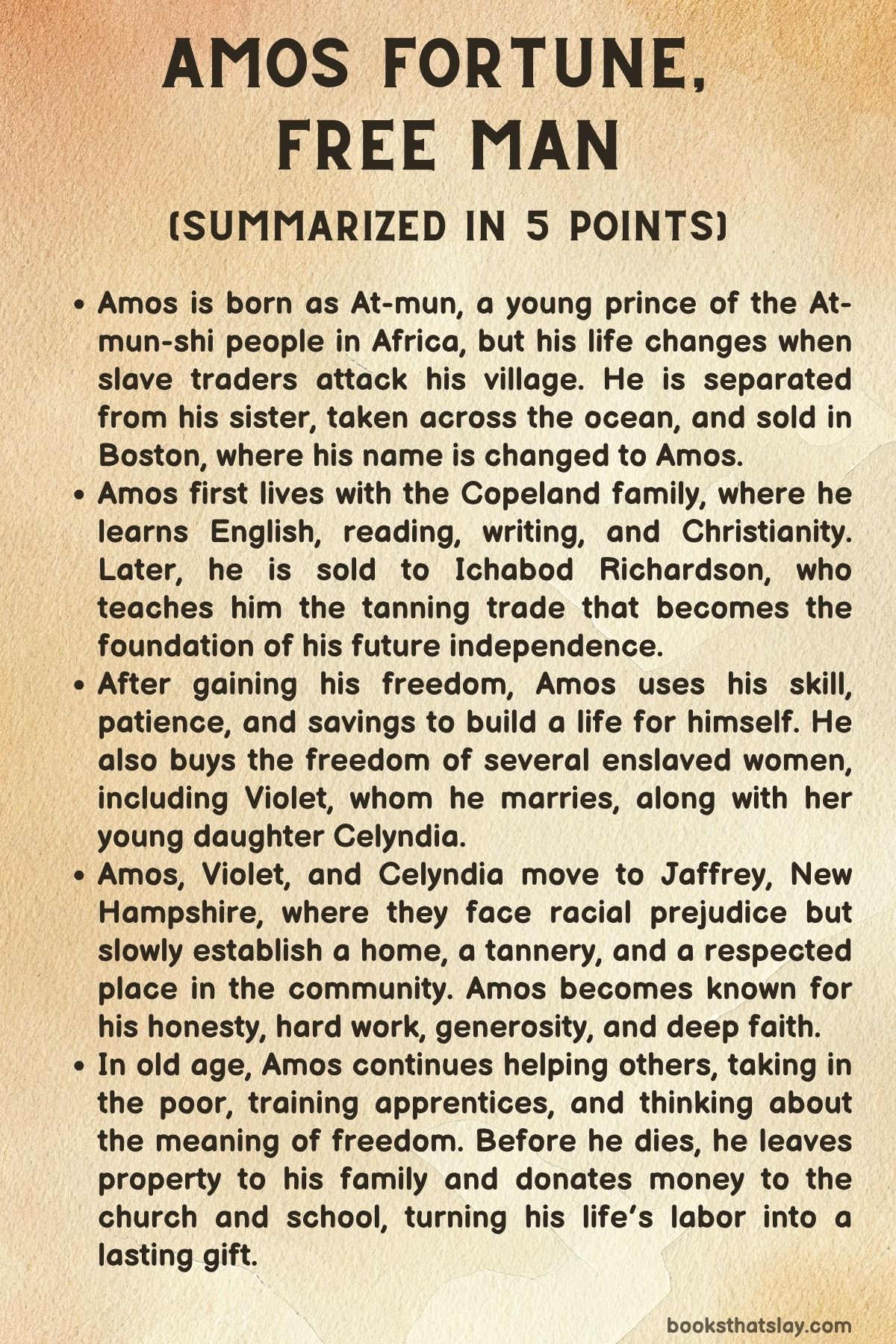
Amos Fortune, Free Man begins in Africa in 1725, where a young prince named At-mun lives among the At-mun-shi people. He is the son of the chief and is expected to become a wise and caring leader.
During a peaceful celebration for the planting season, the people gather to sing, dance, and honor the earth, sun, moon, and rain. At-mun stands beside his father and younger sister, Ath-mun, who depends on him for comfort and protection.
The people trust At-mun and believe he will lead with kindness and courage.
That night, their village is attacked by men who have come to capture people for slavery. The chief is killed, and At-mun instantly becomes the new chief, though he has no chance to rule.
He is separated from his sister, chained, and forced away with other captives. Before he leaves, he tells Ath-mun that she must lead the people who remain.
This moment marks the end of his old life and the beginning of a long struggle to hold on to his identity.
The captives are marched to a river, placed in canoes, and taken toward the sea. At-mun thinks about escaping, but he decides the time is not right.
After reaching the coast, the prisoners are kept in terrible conditions before being forced onto a ship bound for America. During the Middle Passage, they suffer hunger, sickness, confinement, and violence.
Many die or are sold before the ship reaches Boston. By the time At-mun arrives, he is the only one of his people left on board.
At the auction, his name is misunderstood and changed to Amos. A Quaker man named Caleb Copeland buys him.
Caleb and his wife, Celia, do not see themselves as supporters of slavery, yet they still keep Amos in bondage. They believe they are giving him a Christian home and education.
Amos struggles at first because he does not know English and cannot understand the household customs. Over time, Celia teaches him language, manners, reading, and writing.
Amos attends church and studies the Bible. One day, while reading a passage about people being “kings and priests” before God, he remembers that he was once a prince and says that he is a king.
This becomes an important part of his inner life. Even though he has been stripped of his old home and rank, he begins to think of dignity as something that cannot be fully taken from him.
As the years pass, Amos grows close to the Copeland family. Caleb considers freeing him, but Amos does not accept freedom at once.
He has seen how difficult life can be for free Black people without money, security, or community. He also continues going to the harbor whenever slave ships arrive, hoping to find his sister Ath-mun and buy her freedom if she appears.
He quietly saves money for this purpose. After Caleb dies, Amos is sold because of the family’s debts.
He is bought by Ichabod Richardson, a tanner from Woburn.
Under Richardson, Amos learns the tanning trade and becomes highly skilled. Richardson is strict but trains enslaved people, pays them small wages, teaches them Christianity, and often frees them before old age.
Amos works hard, sings often, and becomes known for his reliability. He continues visiting the wharf in Boston, still searching for Ath-mun, but as time passes he realizes she would no longer be the young girl he has been imagining.
This brings him deep sorrow. Eventually, Richardson arranges for Amos to gain freedom, and after Richardson’s death, Mrs. Richardson frees him without requiring further payment.
Now nearly sixty, Amos compares himself to Moses, still strong in old age. He remains in Woburn, working at the tannery and learning carpentry.
He also begins using his savings to free enslaved women he hopes to marry. First he buys the freedom of Lily, but she dies soon afterward.
Later he meets Lydia, a woman who has a leg injury from her own painful journey into slavery. Amos works for years to purchase her freedom and marries her, but she also dies.
These losses weigh on him, yet they strengthen his desire to use freedom not only for himself but for others.
Amos later hears of Violet, an enslaved woman with a young daughter named Celyndia. He travels to Keene, New Hampshire, hoping to find a place where he can build a life with them.
During the trip, he thinks of the biblical Joshua seeking a promised land. In Keene, he is treated unfairly because he is Black, but he also meets people who recognize the value of his tanning skill.
A cobbler tells him that a good tanner would have many customers in the area. Amos takes this as a sign that he should settle nearby.
He buys Violet and Celyndia’s freedom and marries Violet.
The family eventually moves to Jaffrey, New Hampshire. Violet is nervous about leaving the familiar life she once knew, but she trusts Amos.
When they arrive, the town constable warns them that they may not be welcome because of their race. Amos calmly insists on staying.
Once the constable sees Amos’s skill and understands that the town needs a tanner, he becomes more accepting. Parson Ainsworth welcomes the family and lends them land where Amos can build a home and tannery.
Life in Jaffrey is demanding. Amos, Violet, and Celyndia build their house and business from very little.
Amos works long days at tanning, while Violet helps with the business and later sells linen. Celyndia grows up with more freedom than her parents had known, though she still faces the limits of racism.
Amos becomes respected for his skill, patience, and honesty, but he and his family are still made to sit separately in church. He joins the church after many years, though the community’s acceptance is incomplete.
As Amos prospers, he dreams of buying land of his own. He saves money in an iron kettle, but his generosity creates tension with Violet.
After seeing the poverty of Lois Burdoo and her children, Amos wants to use his savings to help them. Violet hides the kettle because she believes Amos should secure his own family’s future first.
Amos goes to the mountain to pray and think. There he decides that owning land will give his family lasting stability.
He returns home, and Violet gives back the money. They buy the land, and Amos builds a stronger home and business.
Amos still feels responsible for those who suffer. When the town auctions poor children into service, Lois Burdoo’s sick daughter Polly is among them.
Amos attends the auction and buys Polly with a large bid so she can live in freedom and safety. Polly comes to his home, but she is weak and ill.
Violet cares for her, and Celyndia treats her like a sister. Polly soon dies in Amos’s arms.
Amos is grateful that she died free from the worst conditions of poverty, though the event is painful for everyone.
In old age, Amos remains active, respected, and thoughtful. He takes on apprentices, including a white boy named Charlie Toothaker, and teaches him the trade along with reading and writing.
Violet says Amos will teach Charlie how to be a free man. Amos reflects on the people whose freedom he bought and on Ath-mun, whom he never found.
He hopes to meet her again after death.
As Amos senses the end of his life approaching, he thinks about the racism that still surrounds him: the separate church seating, the insults Violet and Celyndia endure, and the scar on his own back from slavery. He decides his final act should serve both Black and white people.
He makes a will leaving property to Violet and Celyndia, arranging proper graves for himself and Violet, and giving money to the church and school. Some of that money comes from painful moments in his life, including the payment returned after Polly’s death and coins from a man who once humiliated him.
By donating it, Amos turns insult and grief into a gift for the community.
Amos Fortune, Free Man ends with Amos ready to die in peace. His life has moved from royal childhood to enslavement, from labor to independence, and from personal freedom to service.
Though he never regains his first home or finds his sister, he builds a life marked by faith, discipline, generosity, and a steady belief that true freedom includes responsibility for others.
Characters
Amos Fortune
Amos Fortune is the central figure of Amos Fortune, Free Man, and his character is shaped by a movement from inherited leadership to earned dignity. Born as At-mun, a prince among the At-mun-shi people, he begins life with a clear place in his community and a future as chief.
After he is captured and enslaved, that public identity is violently taken from him, but his inner sense of worth remains. Amos is quiet, patient, observant, and deeply controlled.
He often chooses restraint where others might choose rebellion, not because he lacks courage, but because he believes survival, timing, and moral discipline matter. His faith becomes a guiding force, helping him interpret suffering through biblical figures such as Moses and Joshua.
Yet Amos is not passive. He learns to read, masters tanning, earns money, buys freedom for others, builds a home, supports the poor, and leaves money for public good.
His greatest strength is his ability to turn pain into responsibility. He does not define freedom as mere independence; for him, freedom is meaningful only when it allows him to protect, teach, provide, and give.
At-mun
At-mun is Amos’s original self, and this identity remains important even after his name is changed. As a young prince, At-mun represents promise, belonging, and natural leadership.
His people admire him because he leads with warmth rather than pride. His bond with his sister Ath-mun shows his tenderness, while his command during the attack shows his readiness for responsibility.
When his father is killed, At-mun becomes chief in a moment of disaster, but he cannot remain with his people. This makes his kingship tragic, because he receives authority at the same moment he loses his homeland.
Throughout his later life as Amos, the memory of At-mun never fully disappears. It becomes a hidden source of self-respect.
Even when others see him as property, servant, worker, or outsider, he remembers that he was once born to lead. This memory helps him understand freedom as something spiritual and moral, not only legal.
Ath-mun
Ath-mun is Amos’s younger sister and one of the deepest emotional presences in the story, even though she appears directly only early on. She is physically vulnerable because of her leg disability, and she depends on At-mun for safety and confidence.
Her shyness contrasts with his public strength, but she is not weak in spirit. When At-mun is taken away, he tells her that she must lead the people who remain.
Her acceptance of this responsibility shows that she carries quiet courage. For Amos, Ath-mun becomes a lifelong symbol of lost family, lost homeland, and unfinished duty.
His repeated visits to the wharf are driven by the hope that he might find and free her. Even after he realizes that she would no longer be the young girl he remembers, she continues to influence his choices.
In a sense, every woman whose freedom Amos buys is partly connected to Ath-mun. She becomes the emotional reason behind his generosity.
The At-mun-shi Chief
The At-mun-shi chief is Amos’s father and the first model of leadership in the story. He appears as a dignified ruler whose authority is accepted by his people without fear.
During the village celebration, he does not need to dominate the gathering; a simple gesture from him is enough to guide the community. His leadership is ceremonial, protective, and rooted in tradition.
His death during the attack marks the destruction of the old world Amos knew. It also forces Amos into adulthood instantly.
The chief’s importance lies not only in his role as father but also in what he represents: a stable society, ancestral authority, and a form of Black leadership that existed before slavery tried to erase it. Through him, the story reminds the reader that Amos was not born powerless.
He came from a culture with structure, honor, and memory.
Caleb Copeland
Caleb Copeland is a complicated character because he is kind in some ways but still participates in slavery. As a Quaker, he claims to oppose slavery, yet he buys Amos and keeps him in bondage.
Caleb believes that by giving Amos a Christian home and education, he is doing something generous. This shows the moral contradiction in his character.
He is not cruel like the captors or auctioneers, but his kindness exists inside an unjust system that benefits him. Caleb teaches Amos useful skills and eventually considers freeing him, but he does not fully understand the harm of owning another person.
His relationship with Amos is marked by affection, but it is also shaped by unequal power. Caleb’s death leaves Amos vulnerable to being sold again, proving that even a relatively gentle enslaver cannot give true security.
Caleb’s character shows how good intentions can still support injustice when they do not challenge the system itself.
Celia Copeland
Celia Copeland is practical, patient, and perceptive. When Amos enters the Copeland household, she recognizes that his silence does not mean emptiness or lack of intelligence.
She understands that he has a language and a past that the family does not know. Her role as teacher is important because she helps Amos learn English, reading, writing, and household customs.
Like Caleb, however, Celia is morally limited by her acceptance of Amos’s enslaved position. She treats him with care, but she does not immediately see that care cannot make ownership right.
Her teaching opens doors for Amos, especially through literacy and Bible study, but the structure of their relationship remains unequal. Celia’s character therefore reveals both the value and the limits of kindness within slavery.
She helps Amos grow, but she does not free him from the system that controls his life.
Roxanna Copeland
Roxanna Copeland helps bring out an important part of Amos’s identity. As a child in the Copeland household, she reads with him and shares the Bible passage that leads Amos to say he is a king.
Her surprise at hearing him speak more fully shows how little the family has understood his inner life. Roxanna is not a major force in the action, but she matters because she is present at a turning point in Amos’s self-expression.
Through her, the story shows how education can awaken memory and dignity. She also reflects the innocence of childhood within a household built on inequality.
She grows up with Amos nearby, but she does not fully share his burdens. Her character helps reveal the distance between those who are protected by society and those who must fight to preserve their humanity.
Roger Copeland
Roger Copeland has a smaller role, but he represents the ordinary continuation of white family life around Amos. He grows up, learns weaving, marries, and moves away.
His life progresses naturally and socially, while Amos’s life remains controlled by ownership and delayed freedom. Roger’s presence helps show the contrast between the opportunities available to the Copeland children and the restrictions placed on Amos.
He does not appear as openly harmful, yet his ordinary path highlights the unfairness around him. While Amos works, learns, and waits, Roger inherits a world where family, trade, and independence come more easily.
His character is useful because he shows how inequality can exist quietly in daily life, not only in moments of violence.
Ichabod Richardson
Ichabod Richardson is stern, disciplined, and business-minded. He buys enslaved Africans, trains them in a trade, gives them religious instruction, pays them small wages, and eventually frees many of them.
Compared with cruel enslavers, he appears more responsible, but like Caleb, he still treats human beings as property. His character is built on order and usefulness.
He sees value in training Amos and recognizes his reliability. Under Richardson, Amos becomes a skilled tanner, and this skill later becomes the foundation of his independence.
Richardson’s importance lies in his role as a harsh but formative master. He does not give Amos full freedom quickly, but he gives him the trade that allows him to survive as a free man.
His character shows the uncomfortable truth that Amos’s later success is built partly from skills learned under bondage.
Mrs. Richardson
Mrs. Richardson plays a significant role in Amos’s movement toward freedom. After her husband’s death, she draws up new papers that free Amos immediately rather than making him continue paying.
This act shows a degree of fairness and compassion. She also advises Amos to find a wife and allows him to keep working in the tannery until he can establish himself.
Unlike many others, she seems able to see Amos as a man with a future rather than merely as a worker. Her kindness has practical value because it gives Amos a chance to begin free life with some stability.
She does not erase the injustice he has suffered, but she helps him cross an important threshold. Her character represents one of the moments when personal decency reduces harm, even if it does not undo the larger wrong.
Lily
Lily is one of the enslaved women Amos hopes to free and marry. Her role is brief but meaningful.
Amos works and saves so that he can purchase her freedom before asking her to become his wife. This reveals his respect for marriage and his belief that love should not be built on bondage.
Lily’s illness and death deny Amos the family life he hopes for. She represents the fragility of happiness for people whose lives have been shaped by slavery, poverty, and physical hardship.
Through Lily, the story shows that freedom, once gained, does not automatically repair the damage caused by years of suffering. Her death also deepens Amos’s loneliness and prepares the reader to understand why his later family with Violet and Celyndia matters so much.
Lydia
Lydia is Amos’s second wife and another woman whose freedom he purchases. She has a leg injury from the Middle Passage, which connects her suffering to Amos’s own traumatic past.
Her singing and laughter draw Amos to her, suggesting that she carries joy despite pain. Lydia gives Amos companionship and a chance to share memories of Africa, captivity, and survival.
Their conversations help both characters face experiences that are difficult to speak about. Like Lily, Lydia dies after only a short period of freedom and marriage.
Her death reinforces the repeated loss in Amos’s life. Yet Lydia is not only a victim.
She is a woman of spirit, music, and warmth. Amos’s effort to free her shows his belief that dignity must be restored wherever possible, even when happiness may be brief.
Violet
Violet is one of the most important characters in Amos Fortune, Free Man because she is not simply grateful, obedient, or symbolic. She is strong-willed, practical, and sometimes sharply opposed to Amos.
After Amos buys her freedom and marries her, she becomes his partner in building a new life. Violet helps with work, cares for the household, supports Celyndia, and contributes through weaving and linen-making.
At the same time, she worries about security. Her decision to hide the iron kettle shows her fear that Amos’s generosity may leave their family unprotected.
This conflict makes her character especially human. She values charity, but she also believes Amos has earned the right to use his money for his own land and dignity.
Violet’s love is not passive agreement. She challenges Amos when she thinks he is wrong.
Her presence gives the story a fuller picture of freedom as a family responsibility, not only an individual achievement.
Celyndia
Celyndia is Violet’s daughter and Amos’s adopted child. She enters the story as a young girl who gains freedom because Amos purchases both her and her mother.
Her childhood in Jaffrey reflects the promise and limits of freedom. Unlike Amos, she is able to attend school, play with other children, and grow up in a household built by free Black parents.
Yet she still faces racism, discomfort, and a sense of not fully belonging among white classmates. Celyndia’s love for the brown doll Amos makes for her is meaningful because it shows her learning to value what is made with love rather than what society teaches her to desire.
As she grows older, she becomes attached to home, weaving, and family life. Celyndia represents the next generation, one that has more opportunity than Amos had but is still not free from prejudice.
Lois Burdoo
Lois Burdoo is a struggling Black mother whose poverty becomes a moral test for Amos and Violet. She has many children and cannot provide for them adequately after her husband dies.
Amos feels sympathy for her and wants to help, while Violet is more critical of Lois’s inability to improve her situation. Lois is important because she exposes the limits of individual success.
Amos has worked hard and prospered, but Lois shows that not every free Black person can rise through discipline alone. Poverty, grief, lack of support, and social prejudice keep her trapped.
Her children’s suffering forces the community to confront poverty, though their solution is harsh and dehumanizing. Lois’s character complicates the story’s view of freedom by showing that legal freedom without stability can still leave people powerless.
Polly Burdoo
Polly Burdoo is Lois’s frail daughter, and her story is one of the saddest parts of the novel. She is auctioned because her family is poor, and Amos buys her to keep her from harsher treatment.
Polly is thin, sick, dreamy, and unable to meet the expectations of school or housework. Other people see her as useless, but Amos sees her as a child who deserves care.
Her inability to explain her thoughts makes her seem distant, as if illness and hardship have already pulled her partly away from the world. When she dies in Amos’s arms, her death becomes both painful and meaningful.
Amos cannot save her life, but he can give her a final experience of safety and freedom. Polly reveals Amos’s deepest form of compassion: he helps even when there is no practical reward.
Moses Burdoo
Moses Burdoo, Lois’s son, represents the harsh fate of poor children in a society that treats poverty as a problem to be managed through labor. When he is auctioned, he is taken by Joseph Stewart, a harsh man who has hired him before.
Lois fears he will be beaten, and her fear suggests that Moses’s future is likely to be difficult. Moses’s character is not explored as fully as Polly’s, but his situation matters.
He shows how children without protection can be pushed into dangerous dependence on adults who may mistreat them. Through Moses, the story shows that freedom in name does not guarantee childhood safety.
His auction also reveals a painful parallel between slavery and public poverty systems, since both reduce vulnerable people to labor arrangements decided by others.
Samuel George
Samuel George, the cobbler in Keene, is important because his conversation with Amos helps guide Amos toward a new home. He recognizes the quality of Amos’s leather and tells him that a good tanner would find customers in the area.
Amos receives this as a sign that he should settle nearby. George is also financially strained, and Amos responds with generosity by allowing him partial credit.
This exchange shows Amos’s fairness as a businessman and his instinct to help without humiliating others. At the same time, George’s reaction to Amos choosing fine clothing reveals a patronizing attitude.
He sees Amos’s desire for wedding clothes as childish rather than dignified. Samuel George is therefore a mixed figure: useful, honest in business, and appreciative of Amos’s skill, but still limited by racial assumptions.
Parson Ainsworth
Parson Ainsworth is one of the more welcoming white figures in Amos’s later life. When Amos and his family arrive in Jaffrey, Ainsworth treats them with warmth, offers food, and helps them find land.
His support gives the Fortune family a chance to begin again. He also represents religious community, though that community remains imperfect because Black members are still segregated in church.
Ainsworth’s kindness matters because it opens a door for Amos, Violet, and Celyndia, but his world is not free of prejudice. He helps Amos personally, yet the church and town still maintain unequal customs.
His character shows that individual welcome can exist alongside social injustice. He is a good man within a flawed community, and his actions help Amos build stability.
Laban Ainsworth
Laban Ainsworth is the young preacher in Jaffrey whose injured arm makes him physically distinct. He leads the church with energy, and his role connects Amos to the religious life of the town.
For Amos, church membership is deeply important because it affirms his spiritual belonging, even though racial segregation limits that belonging. Laban’s character is not as developed as Amos or Violet, but he helps represent the church as both a source of faith and a site of exclusion.
The presence of a young preacher with his own physical limitation may also suggest that weakness and authority can exist together. Under his ministry, Amos eventually becomes a church member, which gives Amos joy despite the community’s lingering prejudice.
Deacon Spofford
Deacon Spofford appears near the end of Amos’s life as the person Amos trusts to carry out his will. He is warm, reliable, and respected enough to serve as executor.
His role is brief but important because he helps Amos turn his final wishes into a lasting public act. Through Spofford, Amos leaves property to his family, arranges proper burial, and donates money to the church and school.
Spofford’s willingness to help shows that Amos has earned trust in the community. He also acts as a bridge between Amos’s private moral vision and the town’s public institutions.
His character supports the final stage of Amos’s life, where freedom becomes legacy.
Charlie Toothaker
Charlie Toothaker is Amos’s white apprentice, and his presence reverses the power arrangement that shaped much of Amos’s earlier life. Amos, once enslaved and trained by others, now becomes a master in the legal and trade sense.
Charlie is bound to obey and learn, while Amos must provide for him and teach him tanning, reading, and writing. Amos takes this responsibility seriously, reading the contract to ensure he fulfills his duties.
Charlie’s character is important because he shows Amos as a teacher and moral guide. Violet says Amos will teach him how to be a free man, which suggests that freedom is not only a status but a way of living with discipline, fairness, skill, and conscience.
Charlie allows Amos to pass on the values he has spent his life earning.
The Captors and Traders
The captors and traders are not developed as individual characters, but they are powerful forces in Amos’s life. They represent the violence of the slave trade and the reduction of human beings to profit.
The men who attack the At-mun-shi people destroy a peaceful community and turn Amos from a prince into a captive. The ship master, auctioneer, and buyers at the wharf continue this process by treating enslaved people as bodies to inspect, price, and sell.
Their lack of individual depth is part of their function in the story: they represent a system more than personal complexity. Through them, the novel shows how slavery depends on many participants, from attackers to merchants to ordinary buyers.
The Jaffrey Townspeople
The people of Jaffrey form a mixed social background around Amos’s later life. Some welcome him because they need his tanning skills; others hold racist views and maintain unequal customs.
They respect Amos for his hard work, success, and honesty, but their respect does not erase segregation or prejudice. Their treatment of the Burdoo family also reveals the town’s harsh attitude toward poverty.
They can admire Amos while failing to protect the most vulnerable. This makes the townspeople important as a collective character.
They are not purely cruel, but their acceptance often depends on usefulness, reputation, and social order. Through them, the story presents community as something Amos joins and improves, but never fully changes.
Themes
Freedom as Responsibility
Freedom in Amos’s life is never shown as a simple escape from slavery into comfort. It is a responsibility that grows heavier as he gains more control over his own life.
When Amos is enslaved, he dreams of freedom, but he also understands that freedom without money, skill, shelter, or protection can be dangerous. This is why he waits, learns, works, and prepares.
Once he becomes free, he does not use his independence only for personal gain. He buys the freedom of Lily, Lydia, Violet, and Celyndia.
He takes in Polly, trains apprentices, supports the Burdoo children, builds a business, and leaves money for the church and school. In Amos Fortune, Free Man, freedom becomes a moral condition rather than just a legal one.
Amos believes that a free person must act with discipline, generosity, and care for others. His life suggests that freedom is incomplete if it ends with the self.
True freedom allows a person to create safety, restore dignity, and improve the lives of those who are still vulnerable.
Memory, Identity, and Dignity
Amos’s identity begins before slavery, and that fact shapes everything about him. He is not introduced as a nameless victim but as At-mun, a prince with family, culture, responsibility, and honor.
When he is captured, renamed, and sold, the world around him tries to reduce him to property. Yet memory protects part of his dignity.
He remembers his father, his sister, his people, and the fact that he was once meant to lead. Over time, some memories fade, including his language, but the emotional truth of his former life remains.
His statement that he is a king is not childish pride; it is a recovery of selfhood. Even when he becomes Amos Fortune, the spirit of At-mun remains within him.
This theme is especially powerful because the story shows slavery as an attack not only on the body but also on memory and identity. Amos survives by carrying an inner knowledge that others cannot fully erase.
His dignity comes from this private continuity between who he was, who he becomes, and what he chooses to do.
Faith as Moral Strength
Faith gives Amos a way to endure suffering without becoming hard or bitter. He turns often to biblical figures and stories, especially Moses and Joshua, because their journeys help him understand his own.
The Bible gives him language for captivity, promised land, old age, leadership, and service. His faith does not remove pain, nor does it make injustice acceptable.
Instead, it gives him a structure for patience and action. When Amos faces difficult choices, such as whether to help Lois Burdoo or buy land for his family, he prays and seeks guidance.
His faith also shapes his generosity. He sees money, work, and freedom as gifts that should serve God and community.
At the same time, the religious world around him is imperfect. The church accepts him slowly and still separates Black worshippers from white ones.
This contrast is important. Amos’s faith is deeper than the prejudice of the church community.
He finds spiritual dignity even when religious institutions fail to practice full equality.
Racism, Community, and Conditional Acceptance
Amos spends much of his free life earning respect, but the respect he receives is often conditional. People value his skill as a tanner, his honesty, his age, and his usefulness to the town.
Yet racism remains present in daily life. He is overcharged because he is Black, warned that his family may not be welcome, made to sit separately in church, and humiliated by men who feel entitled to treat him as inferior.
Violet and Celyndia also face disrespect, showing that Amos’s success cannot fully shield his family. The town’s acceptance improves when people see that Amos can provide a needed service, but usefulness is not the same as equality.
This theme shows how prejudice can survive even inside a community that calls a Black man respectable. Amos becomes admired, but admiration does not erase the social boundaries placed around him.
His final donations to the church and school are therefore significant. He gives to institutions that have not fully honored him, turning personal injury into a public gift and leaving behind a moral challenge for the community.