An Ember in the Ashes Summary, Characters and Themes
An Ember in the Ashes by Sabaa Tahir is a fantasy novel set in a brutal empire where military power rules over a conquered Scholar population. The story follows Laia, a Scholar girl who becomes a spy to save her imprisoned brother, and Elias, a Mask soldier trained to serve the Empire but desperate to escape its cruelty.
Their lives meet inside Blackcliff Academy, a place built on fear, violence, and obedience. As Laia searches for courage and Elias fights for freedom, both are forced to decide what they are willing to risk for the people they love.
Summary
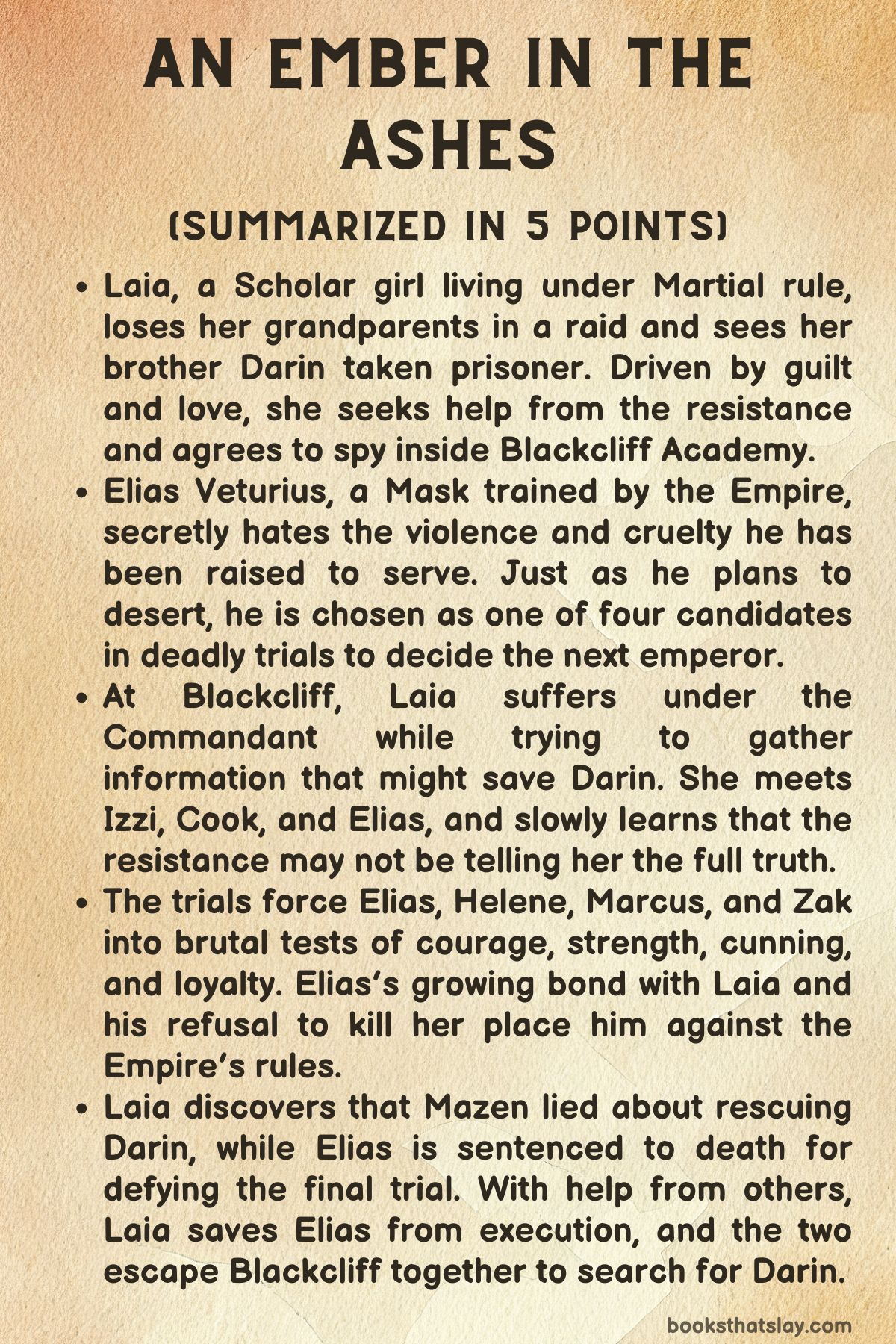
An Ember in the Ashes begins with Laia, a young Scholar living under Martial rule, waiting anxiously as her brother Darin returns home late at night. The Martials have conquered the Scholars and keep them controlled through fear, raids, prisons, and public punishment.
Laia suspects Darin may be involved in something dangerous, especially when she discovers drawings connected to Martial weapon-making. Before she can understand the truth, Martial soldiers raid their home.
Laia’s grandparents are killed, Darin is arrested, and Laia escapes only because Darin tells her to run. His screams remain with her, and her guilt becomes the force that drives her forward.
With nowhere safe to go, Laia enters the catacombs beneath the city in search of the Scholar resistance. She finds them, but their leader, Mazen, is not eager to help.
Laia reveals that her parents were once important members of the resistance, and Mazen agrees to help rescue Darin only if Laia becomes a spy at Blackcliff Academy. Her task is to serve the Commandant, the cruel head of the academy, and gather information about the trials that will choose a new Martial emperor.
At the same time, Elias Veturius, one of Blackcliff’s best students, is preparing to desert. He is a Mask, trained from childhood to become a ruthless soldier, but he hates the Empire and what it has made him do.
His mother is the Commandant, a woman feared even by her own soldiers, and Elias wants nothing to do with her world. Just before he can leave, the Augurs, mysterious holy figures with strange powers, announce that the old imperial line is ending.
Four newly graduated Masks will compete in trials to decide the next emperor. Elias, his best friend Helene, the brutal Marcus, and Marcus’s brother Zak are chosen.
If Elias refuses, he will lose the chance to gain the freedom he wants, so he stays.
Laia is sold into slavery and brought to Blackcliff, where the Commandant strips her of her name and identity. Life in the Commandant’s house is constant terror.
Laia is beaten, branded, and threatened, but she keeps searching for information. She befriends Izzi, another enslaved Scholar, and comes under the watch of the cook, a scarred woman who once had ties to the resistance.
The cook recognizes that Laia is hiding something and warns her that the resistance may not be as trustworthy as she believes.
The trials begin. Elias is forced to face a vision of everyone he has killed or may one day kill.
The experience shakes him deeply, especially when he sees Laia among the dead. He and Helene survive the first trial, though Marcus is named the winner after the Augurs find no proof that Marcus and Zak attacked them unfairly.
The second trial becomes a fight for survival against supernatural forces. Helene’s singing reveals a hidden power when it helps save Elias, but they know that if anyone discovers what she can do, she could be executed.
As Laia continues spying, she learns that the blacksmith Darin had visited was not helping the Empire. Darin had actually been learning the secret of making Martial weapons so the Scholars might one day resist.
Laia also learns that the Commandant is connected to the Nightbringer, a powerful being linked to old stories of jinn, betrayal, and revenge. The Nightbringer and the Commandant want Marcus to win because he can be controlled.
Laia’s mission becomes harder as she is drawn toward both Keenan, a young resistance fighter, and Elias, who shows her unexpected kindness. Elias protects her after finding her injured and terrified, and later helps her and Izzi return safely to Blackcliff after a Martial raid interrupts a festival.
Laia begins to see that Elias is not like other Masks, while Elias sees in Laia a strength she does not yet recognize in herself. Their connection grows slowly through shared fear, guilt, and the desire to be more than what their world has named them.
The danger inside Blackcliff increases. Marcus attacks Laia, and Elias and Helene save her, though Helene’s loyalty to Martial law keeps her from acting as fully as Elias wants.
Laia nearly dies, but Helene secretly heals her with song. The third trial is even more devastating.
Elias and Helene are forced to lead their own soldiers against each other in a battle where mercy is punished. Elias tries to avoid killing, but the rules of the trial force his hand.
He defeats Helene, and she is disqualified because of forbidden armor given to her after an earlier victory. Elias wins, but the victory feels empty because it nearly costs him the person closest to him.
For winning, Elias is given Laia as a “prize.” Instead of harming her, he frees her from her bonds and listens to her story. He tells her that some of what the resistance has said about Darin may be false, including the claim that he is about to be executed in the prison they named.
Laia begins to doubt Mazen. She and Elias share stories about their pasts, and their bond deepens.
Laia reminds him that he still has a soul, even after everything Blackcliff has done to him.
The final trial reveals the full cruelty of the Augurs’ design. Elias, Helene, and Marcus are told that whoever kills Laia will win.
Elias refuses and protects her. Helene, desperate to save Elias in the only way she believes possible, offers to kill Laia quickly and later release Elias from service.
Marcus appears to kill Laia, though the blood is actually from an Augur. Because Marcus believes he has killed her, the Augurs declare that enough.
The emperor is then reported dead, killed by Scholar rebels, and Marcus becomes the new emperor. Helene is made his second, while Elias is sentenced to execution for refusing the rules of the trial.
Laia discovers that Mazen lied to her. There was never a real plan to save Darin.
He used her mission to serve his own rebellion and concealed the truth from his own people. Darin has been moved to a far worse prison.
Keenan helps Laia escape and offers her a way out of the city, but Laia refuses to abandon Elias, Izzi, and Darin. With help from the blacksmith, the cook, and Izzi, she creates a plan to disrupt Elias’s execution.
At dawn, Elias prepares to die, believing that his refusal to kill Laia was the first truly free choice he has made. Laia hides beneath the execution platform and sets off explosions as Helene’s blade falls.
In the chaos, she reaches Elias and frees him. Elias agrees to help her rescue Darin.
They flee to his room, where he reveals a tunnel he dug long ago for his own escape. Helene arrives and chooses to let them go, explaining that the Augurs told her Elias would die unless she swore loyalty to the new emperor.
Elias asks her not to become like Marcus, then escapes with Laia into the tunnels. The novel ends with Elias finally free from Blackcliff, and Laia moving toward the dangerous mission of saving her brother.
Characters
Laia
In An Ember in the Ashes, Laia is the emotional center of the book, and her journey begins from fear rather than heroism. She is not introduced as a fearless rebel or a trained fighter; she is a young Scholar girl who panics, runs, and survives while her family is destroyed around her.
This makes her character feel human, because her courage is not natural or effortless. It has to be built through guilt, love, pain, and repeated choices.
Her greatest wound is the belief that she failed Darin by running when he was captured, and much of her character is shaped by her need to make that failure right. At Blackcliff, Laia is forced into a world designed to break her identity.
The Commandant strips her of her name, scars her body, and tries to teach her that she is powerless. Yet Laia’s growth comes from refusing to let fear have the final word.
She is often terrified, but she continues spying, protecting Izzi, questioning the resistance, and eventually saving Elias. Her strength is not the strength of a warrior; it is the strength of someone who keeps acting even when she feels weak.
By the end of the book, Laia has changed from a girl who runs because she sees no other choice into someone who chooses danger because others need her.
Elias Veturius
Elias gives An Ember in the Ashes its clearest conflict between duty and conscience. As a Mask trained at Blackcliff, he has been shaped by violence since childhood, but he never truly accepts the Empire’s values.
He is physically capable, disciplined, and admired by many around him, yet inwardly he is disgusted by the life he has been forced to live. His planned desertion shows that he does not simply dislike the Empire; he wants to remove himself from it completely.
What makes Elias complex is that escape alone is not enough. The Augurs force him into the trials, where he must face not only enemies but the darker parts of himself.
He fears becoming like the Commandant, and every killing confirms that fear. His relationship with Helene reveals his loyalty and emotional confusion, while his connection with Laia awakens a different side of him: protective, tender, and hopeful.
Elias is not innocent, and the book does not pretend that he is untouched by what Blackcliff has made him do. His importance lies in his resistance to becoming numb.
When he refuses to kill Laia, he chooses moral freedom over survival, status, and even the future he has wanted for years. His escape at the end is not just physical; it marks his first real step toward living by his own conscience.
Helene Aquilla
Helene is one of the most conflicted characters in the book because she stands between love, loyalty, and belief in the Empire. She is Elias’s closest friend and one of the few people who truly knows him, yet she is also deeply committed to the Martial system that he hates.
Her strength is obvious: she is a skilled fighter, disciplined, intelligent, and capable of surviving situations that would destroy most people. However, her tragedy lies in the way she separates feeling from duty.
She loves Elias, but she cannot fully follow him into rebellion because her identity has been built around loyalty to Martial law. Her healing song reveals that she contains power beyond the ordinary military world, but even that gift must be hidden because the Empire would punish what it cannot control.
Helene’s love for Elias is painful because it does not free her; it traps her between protecting him and obeying the role assigned to her. Her decision to serve Marcus is not simple approval of him.
It comes from fear, prophecy, and her attempt to keep Elias alive. This makes Helene a character shaped by sacrifice, but also by compromise.
She does not become a villain, yet she chooses a path that places her beside one.
Darin
Darin is central to the story even though he spends much of the book absent. His capture gives Laia her purpose, but he is more than a motivation for her actions.
Through Darin, the book reveals that resistance can take quieter forms than open rebellion. Laia believes he may have betrayed their people, but the truth is that he has been learning how Martial weapons are made so the Scholars might one day defend themselves.
This changes the reader’s understanding of him from a secretive brother into someone carrying a dangerous burden. Darin’s silence under interrogation also shows his courage.
He protects information even when facing torture, and his strength contrasts with Laia’s fear in the opening scenes. Yet he is not used only as an ideal figure.
Laia’s uncertainty about how well she knew him adds emotional depth to their relationship. Darin represents family, guilt, hope, and unfinished duty.
His imprisonment also exposes the cruelty of the Empire and the dishonesty of the resistance, since both sides use his fate to control Laia. By the end, Darin remains a promise the story has not yet fulfilled, and saving him becomes the mission that binds Laia and Elias together.
The Commandant
The Commandant is one of the most frightening figures in An Ember in the Ashes because her cruelty is controlled, intelligent, and deeply personal. She does not act out of random rage; she uses fear as a method of rule.
At Blackcliff, she has created an environment where pain is routine and compassion is treated as weakness. Her treatment of Laia shows her desire to erase identity and hope, while her treatment of Elias reveals a colder, more private hatred.
As Elias’s mother, she should represent protection, but she is instead the origin of his deepest wound. Her confession about abandoning him as an infant explains part of her bitterness without excusing it.
She resents Elias because he survived, because he became important to her father, and because his existence reminds her of a vulnerability she tried to destroy. The Commandant also functions as a political actor.
Her alliance with the Nightbringer and her manipulation of events show that she is not merely a brutal school leader but someone with ambitions beyond Blackcliff. She understands systems of power and exploits them without hesitation.
Her character represents what happens when cruelty becomes discipline, ambition, and ideology all at once.
Mazen
Mazen appears at first as the leader Laia desperately needs, but his role becomes more morally disturbing as the book progresses. He represents the danger of a resistance movement that has lost its ethical center.
When Laia comes to him begging for help, he uses her family history and her love for Darin to push her into a deadly mission. His promise to rescue Darin gives Laia hope, but later it becomes clear that he has manipulated her.
Mazen’s betrayal is important because the book refuses to divide the world into pure rebels and evil rulers. The Empire is openly violent, but Mazen shows that people fighting oppression can still exploit the vulnerable.
His actions are especially cruel because he uses the language of sacrifice and rebellion to hide self-interest and strategy. He sees Laia less as a person than as a tool.
His decision to lie about Darin and silence dissent within the resistance makes him a mirror of the systems he claims to fight. Through Mazen, the book questions whether a cause remains worthy when its leaders treat human beings as disposable.
Keenan
Keenan is a guarded and emotionally wounded member of the resistance whose hardness comes from survival. At first, he seems harsh toward Laia, but his behavior gradually reveals a young man who has been shaped by loss, hunger, and devotion to the rebel cause.
His connection to Laia’s father gives him a personal link to her family, and this history helps explain why he becomes invested in her safety. Keenan’s relationship with Laia is built on shared danger and loneliness.
He offers her moments of tenderness in a world where she is usually threatened or harmed, and his concern gives her comfort when she badly needs it. However, Keenan is also tied to a resistance network that deceives her.
His decision to help her after Mazen’s betrayal shows that he has a stronger moral sense than his leader, but his feelings for Laia also complicate his judgment. He wants to protect her, yet he cannot fully understand her need to return for Elias and the others.
Keenan’s role in the book is that of a possible refuge, but not a complete answer. He gives Laia help, but he cannot define her path for her.
Izzi
Izzi is one of the gentlest and most quietly brave characters in the book. As an enslaved Scholar at Blackcliff, she lives under constant threat, and her missing eye is a visible sign of the violence she has already endured.
Yet she does not become cold or selfish. Her friendship with Laia is one of the few sources of warmth inside the Commandant’s household.
Izzi understands the dangers of Blackcliff better than Laia does, but she still chooses to help her. This makes her courage especially meaningful because it comes from someone who has every reason to avoid risk.
Her desire to see the moon festival shows how much ordinary freedom has been denied to her. For Izzi, joy itself becomes an act of resistance.
She is not a warrior or a strategist, but she helps Laia survive emotionally and practically. When Laia sends Izzi away to safety, it confirms how much Izzi matters.
Saving her is not a side event; it is proof that Laia’s mission has grown beyond Darin alone. Izzi represents the innocent people trapped inside systems of violence and the small acts of loyalty that keep them human.
Cook
Cook is a mysterious and damaged figure whose bitterness comes from experience. She has lived through the failure of resistance, the cruelty of the Commandant, and the loss of almost everything she once valued.
Her scarred face and harsh warnings make her seem severe, but her severity is rooted in fear and memory. She recognizes Laia’s mission because she once tried something similar, and she knows the cost of being discovered.
Her attitude toward the resistance is shaped by betrayal and despair; she no longer believes in heroic causes because she has seen how badly they can fail. Yet Cook is not empty of compassion.
She cares for Laia’s wounds, warns her, and eventually helps her rescue Elias. Her knowledge of old stories, the Nightbringer, and the past suggests that she carries secrets larger than her role in the kitchen.
She also forces Laia to confront hard truths, especially the possibility that the resistance is not worthy of blind trust. Cook’s character is important because she shows what survival can do to a person.
She is guarded and angry, but beneath that is someone who has not fully stopped caring.
Marcus Farrar
Marcus is the book’s clearest example of cruelty encouraged by power. He is violent, entitled, and predatory, and Blackcliff has not restrained those traits; it has rewarded them.
His threats toward Helene and attack on Laia show his need to dominate those he sees as weaker or available to him. Unlike Elias, Marcus does not seem troubled by the brutality of Martial training.
He thrives in it because it gives him permission to act on his worst impulses. Yet his character is not only a simple bully.
His relationship with Zak reveals that he also controls through dependence and fear. When Zak dies, Marcus is shaken, suggesting that even he is not free from attachment, though his attachment is possessive and damaged.
His rise to emperor is disturbing because it proves that the system does not accidentally produce monsters; it selects for them. Marcus does not win because he is wise or just.
He wins because he is willing to accept the rules of violence without moral resistance. His victory shows how dangerous a society becomes when ambition and cruelty are treated as qualifications for leadership.
Zak Farrar
Zak is quieter than Marcus, but his role is important because he shows another way cruelty can trap a person. He is not as openly vicious as his brother, and at times he appears frightened, conflicted, or even sympathetic.
His admission that he does not know who he is without Marcus reveals the emotional damage at the center of his character. Zak has been shaped by dependence, and that dependence keeps him tied to someone who harms others and likely harms him as well.
His warning to Elias about supernatural forces suggests that he understands more than he usually says, and his concern for Helene complicates the reader’s view of him. Zak is not innocent, because he participates in Marcus’s schemes and violence, but he is also not presented as purely heartless.
He is a person whose weakness has become loyalty to the wrong figure. His death during the trials is one of the many ways the book shows that Blackcliff destroys even those who seem to benefit from it.
Zak’s tragedy is that he never fully separates himself from Marcus before it is too late.
The Augurs
The Augurs are powerful, unsettling figures who guide the political and supernatural direction of the story. They appear to know possible futures, but their knowledge does not make them comforting or morally clear.
They push Elias into the trials, allow suffering to continue, and arrange tests that force people into terrible choices. Their behavior suggests that they are working toward a larger goal, but the human cost of that goal is severe.
They are especially disturbing because they rarely explain themselves fully. Instead, they speak in fragments, prophecies, and warnings, leaving characters to suffer through the consequences.
Their treatment of Elias and Helene shows how they manipulate love, fear, loyalty, and guilt. At the same time, they are not simply servants of the Empire.
They oppose certain forces, protect Laia at key moments, and seem invested in correcting an ancient wrong. This makes them morally ambiguous rather than purely good or evil.
The Augurs represent fate as a force that does not remove choice but pressures characters into revealing who they are through impossible decisions.
The Nightbringer
The Nightbringer brings the book’s mythic history into the present conflict. He is tied to the story of the jinn, their imprisonment, and their revenge against the Scholars.
His presence expands the conflict beyond Empire and rebellion, showing that current violence has roots in older betrayals. Unlike the Martials, who rule through armies and institutions, the Nightbringer works through secrecy, manipulation, and ancient anger.
His alliance with the Commandant is especially dangerous because it joins supernatural vengeance with political ambition. He is not simply a monster from legend; he is a figure with a history of loss and rage, though the book does not ask the reader to excuse what he does.
His role complicates the moral landscape because the Scholars, too, are connected to past wrongs. The Nightbringer’s existence suggests that violence does not disappear when one empire falls or one battle ends.
It can survive as memory, revenge, and inherited hatred. As an antagonist, he represents the long life of injustice and the terrible cost of trying to answer old harm with new destruction.
The Blacksmith
The blacksmith is a practical and courageous figure who works against the Empire through skill rather than open battle. His connection to Darin reveals the truth behind Darin’s secretive behavior and gives Laia a clearer understanding of her brother’s purpose.
The blacksmith’s refusal to continue making weapons for the Martials is a form of resistance that carries serious risk. He understands the importance of knowledge, especially the knowledge of how the Empire’s weapons are made, and he sees that Darin’s work could matter for the future of the Scholars.
His interactions with Laia also show a careful balance between caution and compassion. He does not romanticize rebellion, but he helps when help is needed.
By assisting Laia with her cuffs and giving her a blade for Darin, he becomes part of the chain of people who make her final rescue attempt possible. The blacksmith represents resistance through craft, secrecy, and moral refusal.
He is not at the center of the action, but his choices prove that small, skilled acts can threaten a powerful system.
Laia’s Grandparents
Laia’s grandparents appear briefly, but their deaths carry major emotional weight. They represent the fragile home Laia loses at the beginning of the story.
Their presence shows that Laia and Darin had a family structure built on care, memory, and ordinary survival under occupation. When the Mask kills them during the raid, the violence is not presented as distant politics; it enters the home and destroys the last safety Laia has known.
Their deaths also shape Laia’s guilt. She is not only trying to save Darin; she is carrying the grief of having survived when others did not.
The grandparents’ murder establishes the brutality of Martial rule more effectively than any explanation could. They are elderly, defenseless, and still treated as disposable.
Through them, the book shows how oppression reaches across generations. Their loss marks the end of Laia’s childhood and begins her movement into a much harsher world.
Laia’s Parents
Laia’s parents are dead before the main events of the book, but their legacy strongly shapes Laia’s identity. Her mother was a famous resistance leader, remembered for courage and strength, while Laia feels painfully aware that she does not match that image.
This comparison becomes one of Laia’s deepest insecurities. She believes she is weaker than her mother, and other characters, especially Mazen, use that insecurity against her.
Her parents represent both inspiration and burden. Their history opens doors for Laia, but it also creates expectations she struggles to meet.
As the book progresses, Laia’s understanding of courage becomes less dependent on becoming like them. She does not need to copy her mother’s form of bravery to prove herself.
Her parents also connect the present rebellion to past betrayals, especially through the story of the Nightbringer and the fall of the earlier resistance. Their importance lies in how memory can both guide and pressure the living.
Laia honors them most not by becoming identical to them, but by finding her own way to resist.
Themes
Fear and Courage
At the center of An Ember in the Ashes is the idea that courage is not the absence of fear but action taken while fear remains present. Laia’s story makes this especially clear.
She begins the book believing herself to be a coward because she runs during the raid that destroys her family and leads to Darin’s capture. That moment becomes the wound she carries into every later decision.
Yet the story slowly challenges her own judgment of herself. At Blackcliff, she is afraid almost constantly, and with good reason.
The Commandant has power over her body, her movements, and her life. Still, Laia listens, spies, lies, protects Izzi, questions Mazen, and returns to save Elias when escape would be safer.
Her courage grows through repeated choices rather than sudden transformation. Elias faces a different kind of fear: the fear that he is already ruined by what he has done.
His courage lies in refusing to accept the identity Blackcliff created for him. Both characters show that bravery is not clean or confident.
It can shake, doubt, hesitate, and still move forward. The book treats courage as a practice, not a personality trait.
Freedom and Control
Freedom in the story is not simply a matter of leaving one place and entering another. Elias wants to desert Blackcliff because he believes physical escape will save him from the Empire, but the Augurs warn him that running alone will not free him from his future.
His real prison is not only the academy; it is also guilt, training, violence, family expectation, and fear of what he might become. Laia’s lack of freedom is more visible.
She is enslaved, renamed, branded, watched, and punished. The Commandant tries to control her by attacking her sense of self.
Yet Laia gradually finds forms of inner freedom through choice. She cannot control the system around her, but she can decide whom to trust, when to resist, and whom to save.
Helene complicates the theme further because she has status, skill, and authority, yet she is trapped by loyalty and prophecy. Marcus becomes emperor, but even his victory feels shaped by forces beyond him.
The book suggests that control can wear many faces: chains, duty, fear, ambition, love, and destiny. True freedom begins when a character chooses according to conscience rather than fear or command.
Power, Cruelty, and the Cost of Empire
The Martial Empire maintains power through public violence, military training, slavery, and fear. Blackcliff is the clearest example of how that power reproduces itself.
Students are trained to obey without mercy, to celebrate punishment, and to treat weakness as shameful. The academy does not only create soldiers; it creates people who can hurt others without questioning the system that commands them.
The Commandant understands this perfectly, which is why her cruelty is so effective. She uses pain not just to punish but to teach people who they are allowed to be.
The Scholars suffer under this order, but the book also shows that the Empire damages its own children. Elias, Helene, Zak, and even Marcus are shaped by a system that replaces compassion with dominance.
The trials reveal the logic of empire in concentrated form: people are forced to kill friends, betray values, and sacrifice others for power. The cost is moral as well as physical.
Bodies are wounded, but so are loyalties, memories, and identities. The book argues that an empire built on cruelty cannot remain separate from that cruelty.
It spreads into families, friendships, politics, and the private mind.
Loyalty and Betrayal
Loyalty in the story is never simple because characters are often loyal to people, causes, and systems that demand conflicting choices. Laia’s loyalty to Darin drives her into the resistance, but that same loyalty is exploited by Mazen, who lies to her about the plan to rescue her brother.
This betrayal forces Laia to learn that a cause is not automatically honorable because it opposes a cruel empire. Elias is loyal to Helene, but he cannot be loyal to the Empire she serves.
Helene is loyal to Elias, yet she also binds herself to Martial duty and eventually to Marcus because she believes it is the only way to save Elias’s life. Her loyalty becomes painful because it leads her away from the person she loves.
Zak’s loyalty to Marcus is another damaged form of attachment, built on dependence and fear rather than respect. Even the Augurs operate through a strange loyalty to a future they refuse to fully explain, allowing present suffering in the name of a larger design.
The book treats betrayal not only as a broken promise, but as a moment when characters discover the true cost of the loyalties they have chosen.