An Enquiry Concerning Human Understanding Summary and Analysis
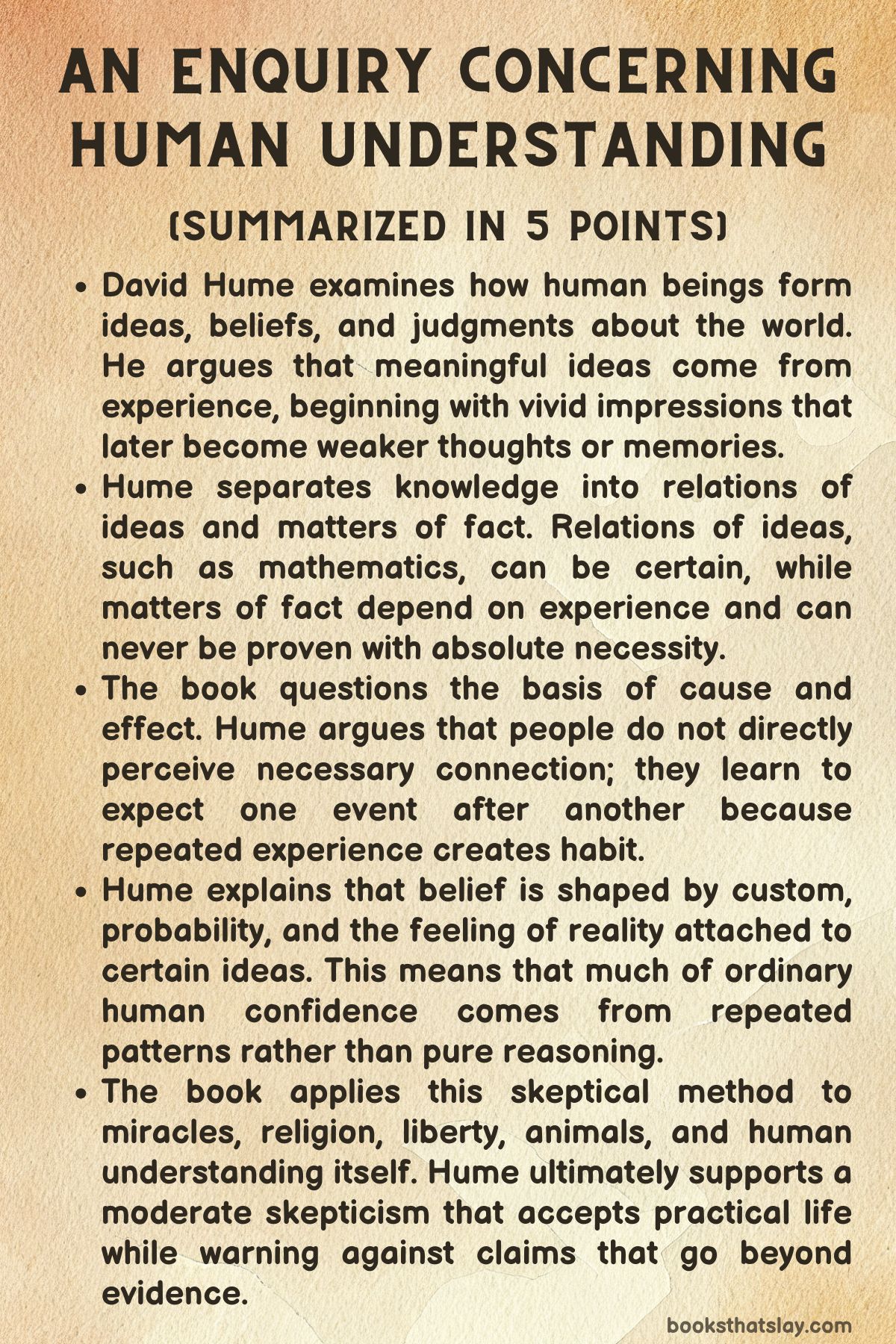
An Enquiry Concerning Human Understanding is David Hume’s major work on how the human mind knows, believes, and judges the world. Rather than accepting inherited ideas about reason, religion, causation, or certainty, Hume asks what human understanding can actually prove.
He argues that many of our strongest beliefs come not from pure reason, but from experience, habit, probability, and repeated observation. The book is not a story-driven work but a philosophical investigation into knowledge itself. It challenges confidence in miracles, metaphysics, and abstract speculation while defending a cautious, practical form of skepticism grounded in everyday life.
Summary
An Enquiry Concerning Human Understanding begins by distinguishing two broad approaches to philosophy. One kind treats human beings as active creatures concerned with virtue, happiness, conduct, and ordinary life.
This approach is easier to understand and more likely to gain public approval because it speaks to practical concerns. The other kind treats human beings as rational creatures and studies the hidden operations of thought, judgment, and knowledge.
This second approach is more abstract and often unpopular because it appears difficult and remote from common life. Hume does not dismiss practical philosophy, but he argues that careful, exact thinking is necessary if human beings are to understand the mind and free themselves from confusion and superstition.
Hume then turns to the origin of ideas. He claims that the mind’s contents can be divided into impressions and ideas.
Impressions are vivid experiences: sensations, emotions, and immediate perceptions. Ideas are weaker copies of those impressions, appearing in memory or imagination.
For example, actually feeling heat is stronger and clearer than merely remembering heat. From this distinction, Hume develops one of his central claims: every meaningful idea must be traceable to some original impression.
If a philosopher uses an abstract term but cannot identify the experience from which it arose, that term is likely empty or confused.
The book next explains how ideas are connected in the mind. Hume argues that thought does not move randomly.
Ideas tend to follow one another according to certain natural principles: resemblance, nearness in time or place, and cause and effect. If someone thinks of a portrait, they may think of the person it resembles.
If they think of one room in a house, they may think of the adjoining rooms. If they think of a wound, they may think of pain.
These patterns of association help explain how memory, imagination, conversation, and reasoning move from one thought to another.
Hume then addresses the objects of human reason. He divides them into relations of ideas and matters of fact.
Relations of ideas include truths such as mathematics and logic. These are certain because their denial would be contradictory.
Matters of fact, however, concern the world of experience. They are never known with the same absolute certainty because the opposite of any matter of fact is always conceivable.
A person may believe the sun will rise tomorrow, but it is not logically impossible that it will not. This distinction leads Hume to examine why human beings trust claims about the world beyond immediate experience.
His answer centers on cause and effect. People constantly reason from observed events to unobserved ones.
Smoke suggests fire. A wound suggests pain.
Dark clouds suggest rain. Yet Hume argues that cause and effect are not discovered by reason alone.
When we first encounter an object, we cannot deduce its effects simply by inspecting it. Experience teaches us what usually follows what.
A person learns that fire burns only after encountering fire or hearing from others who have. The mind then expects the future to resemble the past, but Hume insists that this expectation cannot itself be proven by reason.
This creates the problem of induction. Human beings rely on past experience to predict future events, but there is no logical proof that the future must match the past.
We have seen bread nourish, fire burn, and water suffocate, so we expect these patterns to continue. Still, our expectation rests on custom, not demonstration.
Hume’s point is not that people should stop relying on experience. Rather, he shows that much of what we call knowledge is based on habit formed by repeated observation.
Hume’s skeptical solution is to explain belief psychologically. When two events have often appeared together, the mind naturally passes from one to the other.
This transition is not a product of strict reasoning but of custom. Habit creates expectation, and expectation gives certain ideas greater force.
This is what separates belief from fiction. A fictional idea may be imagined clearly, but a believed idea carries a special feeling of reality because it is supported by experience, memory, and repeated association.
Probability also plays a major role in human life. Hume denies that chance is a real force governing events, but he accepts that limited knowledge makes the world appear uncertain.
Since people rarely possess complete evidence, they judge by degrees of likelihood. The stronger and more consistent past experience has been, the stronger belief becomes.
If an event has always followed a certain pattern, belief in its continuation is firm. If experience has been mixed, belief weakens accordingly.
Hume then studies the idea of necessary connection. People commonly think that causes contain some hidden power that produces their effects.
Yet Hume argues that we never actually perceive such power. We observe one event followed by another, and when this sequence repeats many times, the mind forms a strong expectation.
What we call necessity is therefore not an observed force inside objects but a mental habit created by constant conjunction. Cause means that one kind of event is regularly followed by another, and the mind expects the second when it observes the first.
This view shapes Hume’s discussion of liberty and necessity. He argues that human actions, like natural events, show regular patterns.
People act from motives, desires, habits, and character. Human conduct is not chaotic; it is often predictable because similar motives tend to produce similar actions.
Hume thinks confusion arises because people use terms such as liberty and necessity unclearly. He defines liberty not as action without cause, but as the ability to act according to one’s will without external constraint.
Under this definition, liberty and necessity are compatible. Human actions may have causes and still be free when they arise from the person’s own motives.
Hume extends his account of experience to animals. Animals learn from repeated events just as humans do.
A dog learns where food is found, a horse becomes accustomed to paths, and young creatures avoid pain after experience. Hume uses this to support his claim that causal expectation is not based on advanced reasoning.
It is a natural instinct shared across living beings, including children before they can reason carefully.
The book then turns to miracles. Hume defines a miracle as a violation of the normal course of nature.
Since belief should be proportioned to evidence, testimony for a miracle must be weighed against the vast and consistent experience that supports natural laws. Hume argues that it is always more likely that testimony is mistaken, exaggerated, deceptive, or shaped by human love of wonder than that a law of nature has truly been suspended.
He also notes that miracle claims from different religions often conflict with one another, weakening their authority as evidence.
Hume next considers religious arguments about providence and the afterlife. He questions whether human beings can reason from the world to a divine designer with confidence.
We know the world only as an effect, and we have no direct experience of the cause that supposedly produced it. Since we cannot compare worlds or observe creation itself, claims about God’s nature go beyond what experience can justify.
Likewise, questions about a future state after death cannot be settled by reason because no one has experiential knowledge of such a condition.
In the conclusion, Hume defends moderate skepticism. He rejects extreme doubt that makes life and action impossible, but he also rejects careless certainty.
The proper philosopher should recognize the limits of human understanding, test conclusions, distrust obscure speculation, and rely on clear reasoning and experience. Mathematics and experimental reasoning remain useful, but claims that cannot be tied to either should be treated with suspicion.
An Enquiry Concerning Human Understanding ends as a disciplined call for intellectual humility: human beings should believe according to evidence, accept the power of habit in ordinary life, and avoid pretending to know what the mind cannot truly establish.
Key Figures
David Hume
David Hume is the central guiding presence in the book rather than a character in the usual fictional sense. In An Enquiry Concerning Human Understanding, he acts as the thinker, examiner, and voice of philosophical restraint.
His role is to question how much human beings can truly know, where ideas come from, and why people trust certain beliefs. Hume is not presented as a dramatic personality, but his intellectual character is clear: he is cautious, skeptical, precise, and deeply suspicious of claims that cannot be traced back to experience.
He does not reject ordinary life or practical belief; instead, he tries to show that many human convictions are built on habit rather than pure reason. This makes him a disciplined critic of overconfidence.
He is especially important because he does not simply destroy belief; he asks people to proportion belief to evidence. His character as a philosopher is shaped by balance.
He rejects wild speculation, but he also rejects extreme doubt that would make life impossible. Through him, the book becomes a study of human limits, intellectual honesty, and the need to separate meaningful ideas from empty abstractions.
The Human Mind
The human mind functions almost like the main subject of the book. It is not a person, but Hume treats it as the central object under examination.
The mind receives impressions, stores ideas, connects thoughts, forms expectations, and mistakes repeated experience for necessary truth. In this sense, the mind appears both powerful and limited.
It can imagine distant places, form abstract thoughts, remember past sensations, and organize experience through resemblance, closeness, and cause and effect. Yet it cannot directly perceive hidden powers behind events, nor can it prove that the future must resemble the past.
The mind in the book is therefore creative but dependent, active but restricted. It builds belief from custom, turns repeated patterns into expectations, and gives certain ideas the feeling of reality.
Hume’s analysis makes the mind seem less like a perfect reasoning machine and more like a natural faculty shaped by experience. Its strength lies in practical adaptation, while its weakness lies in mistaking habit for certainty.
The Common Person
The common person represents ordinary human life, practical judgment, and the natural preference for clear, useful ideas over difficult abstraction. Hume presents ordinary people as more comfortable with moral and practical philosophy than with complex speculative thought.
They value action, happiness, virtue, and everyday usefulness. This figure is important because Hume does not treat common life as foolish.
Instead, he recognizes that human beings must live, act, choose, and believe even when they cannot prove everything with philosophical certainty. The common person’s instincts reveal something essential about human nature: people rely on experience, habit, and probability because they must.
However, the common person is also vulnerable to superstition, wonder, and dramatic testimony, especially when claims appeal to fear, religious feeling, or curiosity. Hume’s treatment is balanced.
He respects ordinary life as necessary and natural, but he also argues that it needs correction from careful inquiry. The common person shows why philosophy must remain connected to life rather than becoming useless abstraction.
The Abstract Philosopher
The abstract philosopher represents the side of human inquiry that searches for precision, hidden principles, and exact understanding. This figure is often misunderstood by ordinary readers because abstract reasoning can appear obscure and detached from real life.
In the book, however, Hume gives this kind of thinker an important purpose. The abstract philosopher investigates the powers of the mind, examines the origin of ideas, and challenges confused language.
This figure helps expose false assumptions about causation, miracles, necessity, and religious reasoning. At the same time, Hume does not allow abstract philosophy unlimited authority.
When it becomes too remote from experience, it risks producing empty speculation. The abstract philosopher is valuable only when disciplined by evidence and clarity.
In An Enquiry Concerning Human Understanding, this figure stands for the serious work of intellectual purification: removing confusion, testing assumptions, and asking whether an idea can be connected to a real impression.
The Skeptic
The skeptic is one of the most important intellectual figures in the book. Hume distinguishes between destructive skepticism and moderate skepticism.
The extreme skeptic doubts too much and risks making action impossible. Such a person questions the senses, reason, and even ordinary existence so radically that no useful conclusion can follow.
Hume does not accept this as a livable position. The moderate skeptic, however, is presented much more positively.
This figure questions rash conclusions, demands evidence, and recognizes the limits of human understanding. The moderate skeptic does not refuse to believe anything; instead, this thinker believes carefully and proportionately.
This character is central to Hume’s philosophical method because the book repeatedly asks readers to pause before accepting claims about causation, miracles, God, or the afterlife. The skeptic’s value lies in restraint.
By refusing to go beyond what experience and sound reasoning can support, the skeptic becomes a defender of intellectual responsibility.
The Religious Believer
The religious believer appears mainly through Hume’s discussion of miracles, providence, divine design, and the future state. This figure is not treated simply as irrational, but as someone whose beliefs often exceed the available evidence.
The religious believer may accept testimony about miracles, infer divine intelligence from the order of nature, or believe in an afterlife despite lacking direct experience of it. Hume’s criticism focuses on the reasoning behind these beliefs.
He argues that miracle claims are weaker than the consistent experience supporting natural laws, and that claims about divine causes go beyond what human beings can actually observe. The religious believer is also connected to the human love of wonder.
People often accept extraordinary stories because such stories excite imagination, strengthen communal feeling, or support existing faith. In the book, this figure reveals how emotion, tradition, and testimony can shape belief more strongly than evidence.
Hume’s concern is not merely religion itself, but the tendency to mistake desire or inherited belief for knowledge.
The Defender of Miracles
The defender of miracles is a more specific version of the religious believer. This figure argues that testimony can establish the reality of supernatural events.
Hume’s response is that testimony must always be weighed against probability. Since a miracle is defined as a violation of the usual course of nature, the evidence for it must be stronger than the evidence supporting natural regularity.
The defender of miracles becomes important because this figure tests Hume’s rule that belief should match evidence. Hume suggests that human testimony is often unreliable, especially when people are drawn to astonishing events.
Witnesses may be mistaken, deceived, influenced by excitement, or motivated by religious loyalty. The defender of miracles therefore represents the human willingness to accept extraordinary claims too quickly.
In An Enquiry Concerning Human Understanding, this figure helps Hume show why remarkable claims require unusually strong proof.
The Imagined Interlocutor
The imagined interlocutor appears as a conversational figure through whom Hume explores arguments about providence and a future state. This figure allows Hume to present religious and philosophical claims in a dialogic form rather than as a simple lecture.
The interlocutor is important because he gives shape to objections and counterarguments. Through this figure, Hume examines whether the order of the world proves the existence or nature of God.
The interlocutor’s role is not to act like a fictional character with a private life, but to represent a reasoning position. He helps dramatize the uncertainty surrounding divine design.
If human beings know only the world as an effect, Hume asks, how can they confidently describe the cause behind it? The imagined interlocutor therefore gives the book a more active intellectual structure.
He allows Hume to test claims in conversation and show that certain religious conclusions depend on assumptions rather than direct experience.
Animals
Animals serve as philosophical evidence in the book. Hume uses them to show that learning from experience does not depend on advanced rational argument.
Animals observe repeated patterns, form expectations, and adjust behavior. They learn where food is found, what causes pain, and which actions lead to certain outcomes.
This matters because Hume wants to prove that causal expectation is rooted in custom or instinct rather than pure reason. If animals and young children can learn from experience before performing formal reasoning, then human causal belief must also come from a natural principle deeper than logic.
Animals therefore reveal continuity between human and nonhuman learning. They reduce human pride by showing that much of what people call reason may be a refined form of habit.
Their role is small but powerful because they support Hume’s larger claim that belief grows from repeated experience rather than rational proof.
Children
Children appear as another example of pre-rational learning. Like animals, they experience consequences and form expectations before they can reason abstractly.
A child learns through repeated contact with the world: pain, pleasure, reward, danger, and routine. Hume uses this figure to show that human beings begin by depending on experience rather than philosophical argument.
Children do not need formal proof to expect similar effects from similar causes. Their behavior demonstrates that the mind naturally moves from repetition to belief.
The child’s role also makes Hume’s theory more concrete. Instead of presenting knowledge as something that begins with mature reasoning, he shows that belief is rooted in early, instinctive life.
Children reveal that custom is not a weakness added later by society; it is part of how human understanding develops from the beginning.
Themes
The Limits of Human Understanding
Hume repeatedly narrows the field of what human beings can honestly claim to know. The mind can reason, compare, remember, imagine, and calculate, but it cannot pass beyond experience without losing secure ground.
This theme is central because Hume challenges the confidence of philosophers, theologians, and ordinary believers who assume that reason can uncover hidden powers, divine purposes, or absolute truths about the world. He argues that meaningful ideas must be connected to impressions, and when an idea cannot be traced back to experience, it becomes suspect.
This does not make knowledge impossible, but it makes knowledge more modest. Human beings can know relations of ideas with certainty, as in mathematics, and they can form practical beliefs about matters of fact through observation.
Yet they cannot prove that the future must resemble the past, that causes contain secret powers, or that religious claims about unseen realities are certain. This theme gives the book its disciplined force.
Hume asks readers to accept that the human mind is useful and capable, but not unlimited. Wisdom begins when people stop pretending that their beliefs are stronger than the evidence supporting them.
Experience, Habit, and Belief
Belief in the book is not presented as the result of pure logic alone. Hume argues that much of what people believe comes from repeated experience and the habits formed by that repetition.
When one event regularly follows another, the mind begins to expect the second after seeing the first. This expectation feels natural, even obvious, but Hume insists that it is not rationally proven.
A person who has always seen fire burn expects fire to burn again, yet the expectation rests on past experience, not on a logical demonstration that fire must always behave the same way. This idea reshapes the meaning of human knowledge.
Everyday life depends on custom: people eat, travel, speak, work, and plan because they trust patterns learned over time. Hume does not deny the usefulness of such belief.
He shows that it is psychologically natural rather than philosophically certain. This theme makes An Enquiry Concerning Human Understanding both skeptical and practical.
It questions the foundation of belief while explaining why people cannot live without it. Habit becomes the hidden engine of ordinary certainty.
Cause and Effect
Cause and effect is one of the book’s most important concerns because it supports nearly all reasoning about matters of fact. Human beings constantly move from observed events to unobserved ones.
They see smoke and infer fire, hear a voice and infer a speaker, or observe dark clouds and expect rain. Hume asks what justifies this movement of thought.
His answer is unsettling: people never directly perceive necessary connection. They do not see a secret power passing from cause to effect.
They only see one event followed by another, and when this sequence is repeated often enough, the mind forms an expectation. The idea of causal necessity therefore arises from mental habit, not from direct observation of power.
This theme changes how reality is understood. Causation remains practically unavoidable, but its philosophical foundation is weaker than people assume.
Hume’s view does not make science or daily reasoning useless; instead, it makes them dependent on experience and probability. Cause and effect become less a window into hidden necessity and more a pattern the mind learns to trust through repeated contact with the world.
Skepticism and Intellectual Humility
Hume’s skepticism is not a command to reject all belief. It is a method of discipline.
He criticizes extreme skepticism because it would prevent action and make ordinary life impossible. People cannot live while doubting every sense impression, every memory, and every expectation.
Yet Hume also rejects careless certainty, especially when people make claims about miracles, divine providence, the afterlife, or metaphysical powers beyond experience. His preferred position is moderate skepticism, a careful attitude that tests claims, limits conclusions, and asks whether evidence is strong enough.
This theme is especially important because it gives the book its ethical character as well as its philosophical one. Hume is not only concerned with what people know, but with how responsibly they believe.
Intellectual humility requires admitting that many cherished ideas may rest on custom, testimony, imagination, or emotional attraction rather than proof. Such humility does not weaken the mind; it protects it from superstition and empty abstraction.
Hume’s skepticism encourages readers to keep inquiry alive while refusing to claim certainty where certainty is unavailable.