Atlas of the Heart Summary and Analysis
Atlas of the Heart by Brené Brown is a nonfiction guide to understanding human emotion with clearer language and more self-awareness. Brown argues that people often rely on a tiny emotional vocabulary, usually words like happy, sad, and angry, even though our inner lives are far more complex.
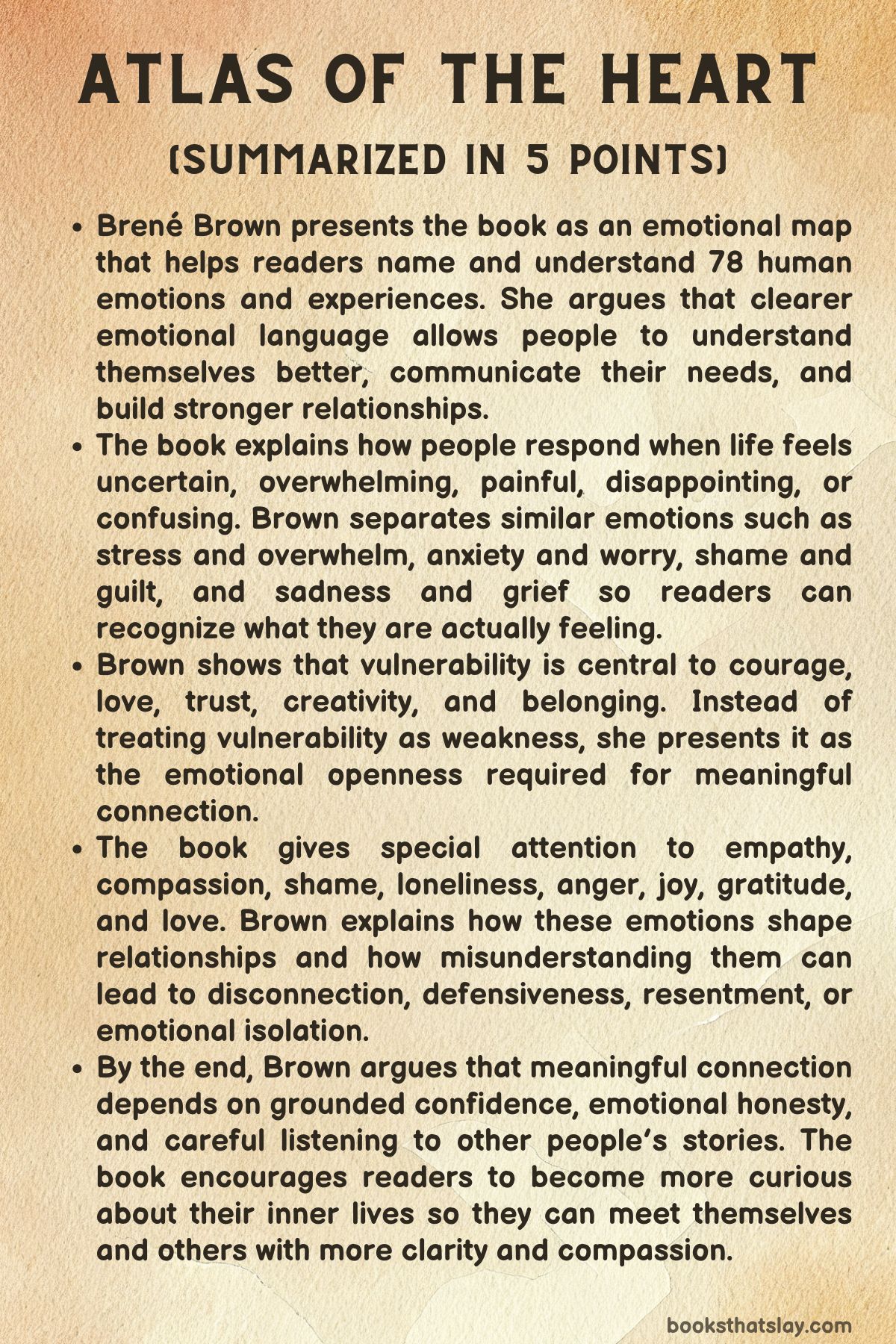
The book acts as an emotional map, naming 87 emotions and experiences so readers can better understand themselves, communicate needs, and build stronger relationships. Brown combines research, personal stories, and practical definitions to show how language can help us move from confusion and isolation toward connection.
Summary
Atlas of the Heart is not a traditional plot-driven book, but it does have a clear movement: Brené Brown begins with her own lifelong habit of watching people closely, then turns that habit into a researched guide for naming and understanding emotion. As a child, Brown noticed shifts in people’s moods and behavior.
She could often predict conflict, disappointment, or approval before others spoke directly. This skill helped her survive difficult situations, but it also made her anxious and overly alert.
Later in life, through sobriety, therapy, and research, she began asking how people think, feel, and act, and why naming emotion matters so much.
The central idea of the book is that language shapes connection. Brown explains that many people can name only a few emotions when asked what they feel.
This lack of emotional precision limits the ability to understand experience, express needs, and receive support. Brown wants readers to develop emotional granularity: the ability to identify feelings with more accuracy.
The book’s mapmaking metaphor comes from this goal. Just as a physical map helps us know where we are and where we might go, emotional language helps us locate ourselves within experience and relate more honestly to others.
Brown first addresses the emotions that arise when life feels uncertain or too much. She separates stress from overwhelm, explaining that stress means we are still functioning but stretched, while overwhelm can make us shut down.
Anxiety is tied to uncertainty and worst-case thinking, while worry is the mental activity that often comes with anxiety. Avoidance may seem protective, but it usually requires great effort and keeps people from dealing with what they fear.
Brown also distinguishes anxiety from excitement, dread, and fear. In this section, vulnerability becomes a major theme.
Rather than treating vulnerability as weakness, Brown presents it as the emotional exposure required for courage, love, leadership, and real connection.
She then turns to comparison. Human beings compare themselves almost automatically, often pulled between wanting to belong and wanting to come out ahead.
Comparison can lead to admiration, which may inspire growth, or reverence, which brings a sense of connection to something larger. It can also lead to envy, jealousy, and resentment.
Brown makes careful distinctions: envy means wanting something someone else has, while jealousy means fearing the loss of something already valued. Resentment, she argues, is often closer to envy than anger because it may reveal an unspoken need or an unfair balance.
She also contrasts taking pleasure in someone else’s pain with taking pleasure in someone else’s success, showing that the latter strengthens empathy and community.
When things do not go as planned, Brown explores boredom, disappointment, regret, discouragement, frustration, and resignation. Boredom can be uncomfortable, but it can also create space for creativity.
Disappointment comes from unmet expectations, especially expectations that were never spoken or examined. Regret is different because it involves the belief that our own decisions shaped the outcome.
Brown does not treat regret as useless pain; she sees it as a signal that can help us reflect and act with more courage later. Discouragement, frustration, and resignation all involve blocked progress, but they differ in whether we still believe change is possible.
The book also studies emotions that arise when life feels larger than our understanding. Awe and wonder help us respond to beauty, mystery, nature, art, ideas, and spiritual experience.
Wonder makes us want to understand, while awe invites us to stand before something vast or beautiful without needing to control it. Confusion, interest, curiosity, and surprise also appear here.
Brown argues that confusion is not failure; it is often part of learning. Curiosity requires humility because it asks us to admit that we do not know.
Surprise is brief but powerful because it intensifies whatever emotion follows.
Brown then examines experiences that occur when things are not what they seem. Amusement comes from recognizing an unexpected mismatch, often in humor.
Bittersweetness holds happiness and sadness together, while nostalgia combines sweetness with longing and loss. Brown warns that nostalgia can become harmful when people idealize the past and ignore who was excluded or harmed in that earlier time.
Cognitive dissonance occurs when a person holds conflicting beliefs or attitudes and feels pressure to reduce the discomfort. Brown also discusses paradox, irony, and sarcasm.
She sees paradox as a way to hold complexity, while sarcasm can either be playful or become a shield against honesty.
A major part of Atlas of the Heart focuses on pain. Brown describes anguish as a severe mix of shock, grief, powerlessness, and trauma.
It can affect the body as well as the mind, and it often requires support and time to recover. She contrasts hope, hopelessness, and despair.
Hope is not simple optimism; it involves goals, pathways, and a belief in one’s ability to act. Hopelessness can arise when people blame themselves and feel unable to change their circumstances.
Despair is broader and more dangerous because it can affect a person’s entire sense of future. Brown also separates sadness from grief.
Sadness may lead to reflection, while grief is a larger process involving loss, longing, and feeling disoriented.
Connection with others becomes another core subject. Brown defines compassion as a daily practice rooted in shared humanity and action in response to suffering.
Empathy is the skill that supports compassion. It does not require having the same experience as another person; it requires listening, believing, and staying present with their pain.
Brown contrasts empathy with sympathy and pity, which often keep distance between people. She also stresses the importance of boundaries.
Without boundaries, people may confuse empathy with overidentification or emotional exhaustion. True compassion requires both openness and a clear sense of where one person ends and another begins.
Brown gives special attention to shame, one of her best-known research subjects. Shame is the belief that we are flawed and unworthy of love, belonging, and connection.
It thrives in secrecy and silence, but it weakens when met with empathy and self-compassion. Brown separates shame from guilt.
Guilt says, “I did something wrong,” and can lead to repair. Shame says, “I am wrong,” and often leads to hiding or destructive behavior.
She also explains perfectionism as an attempt to avoid shame by appearing flawless. Humiliation and embarrassment are related but different: humiliation involves feeling unfairly degraded, while embarrassment is usually brief and less damaging.
The search for connection leads Brown into belonging, loneliness, invisibility, and insecurity. Belonging is not the same as fitting in.
Fitting in asks people to change themselves for approval; belonging asks people to be present as they are. Brown shows how painful belonging uncertainty can be, especially for people whose identities or circumstances place them at social risk.
Connection means feeling seen, heard, and valued. Disconnection can cause emotional and even physical pain, and it can lead people to hide important parts of themselves.
Loneliness is not the same as solitude; it is the absence of meaningful social contact.
When the heart is open, Brown explores love, heartbreak, trust, betrayal, defensiveness, flooding, and hurt. Love is something people nurture through vulnerability, care, respect, and attention.
Because love requires openness, it also creates the possibility of heartbreak. Trust involves risking something valuable with another person, and self-trust involves protecting what matters within oneself.
Betrayal hurts deeply because it breaks trust. Defensiveness protects the ego but blocks growth, while flooding describes the state of being so emotionally overwhelmed that productive conversation becomes almost impossible.
Brown also studies positive states such as joy, happiness, calm, contentment, gratitude, relief, and tranquility. Joy is intense and often connected to gratitude, while happiness is steadier and more connected to present circumstances.
Calm is a practice of perspective and emotional regulation. Contentment involves a peaceful sense of enoughness.
Gratitude, when practiced, strengthens well-being and helps people notice what they value. Brown also names foreboding joy, the fear that something bad will happen when life feels good.
Her answer is not to protect ourselves from joy, but to practice gratitude and allow ourselves to feel it.
The book’s darker social emotions include anger, contempt, disgust, dehumanization, hate, and self-righteousness. Brown does not present anger as always bad; it can signal injustice and motivate action.
Contempt, however, places one person above another and corrodes relationships. Disgust can become dangerous when aimed at people because it can support dehumanization.
Dehumanization allows people to harm others by treating them as less than fully human. Hate goes further by wanting removal or destruction.
Self-righteousness closes people off from humility and learning.
Near the end, Brown examines pride, hubris, narcissism, and humility. Healthy pride celebrates effort and achievement.
Hubris inflates the self and often hides insecurity. Narcissism, in Brown’s framing, grows from shame and the fear of being ordinary.
Humility is not self-erasure; it is grounded self-understanding, with an honest view of strengths and limits.
Atlas of the Heart closes by returning to meaningful connection. Brown argues that connection requires grounded confidence, the courage to walk alongside others, and story stewardship.
Grounded confidence replaces proving with learning. Walking alongside others means practicing empathy rather than control.
Story stewardship means honoring another person’s experience without taking it over, dismissing it, or turning away. The final message is that better emotional language can help people understand themselves, listen to others, and build relationships based on courage, compassion, and truth.
Key Figures
Brené Brown
Brené Brown is the central guiding presence in the book, even though Atlas of the Heart is nonfiction rather than a character-driven story. She appears as researcher, storyteller, teacher, and self-observer.
Brown’s role is not only to explain emotions but also to show how difficult it can be to live with them honestly. Her childhood habit of reading people’s moods reveals someone who learned early to protect herself through observation.
This ability made her perceptive, but it also carried a cost: anxiety, emotional guardedness, and discomfort with vulnerability. As an adult, Brown becomes more reflective about this pattern.
Her sobriety, research, and personal work shape her into a narrator who is willing to question her own defenses. She does not present herself as someone above the emotions she studies.
Instead, she often uses her own reactions, mistakes, fears, and relationships to make emotional language feel practical and human. Brown’s importance in the book comes from this balance between authority and openness.
She is the expert, but she is also a learner, and that makes her analysis feel grounded rather than distant.
Brown as the Researcher
Brown as the researcher is a major figure in the book because her authority comes from years of studying shame, vulnerability, courage, connection, and human behavior. This side of her character is careful, structured, and deeply interested in language.
She does not treat emotions as vague moods but as experiences that can be named, compared, and understood with precision. Her research identity gives the book its map-like structure.
She gathers data, listens to thousands of people, studies emotional patterns, consults therapists and scholars, and then organizes those findings into categories readers can recognize. This version of Brown is especially focused on the consequences of imprecise language.
When people can only say they are sad, mad, or happy, they lose access to the deeper truth of what they feel. Brown the researcher believes that better words create better self-knowledge, and better self-knowledge creates stronger connection.
Her work makes emotion feel less chaotic, not because she simplifies it, but because she gives readers tools to understand its many forms.
Brown as the Vulnerable Narrator
Brown as the vulnerable narrator is just as important as Brown the researcher. In this role, she turns the book away from being only informational and makes it personal.
She admits to anxiety, defensiveness, resentment, shame, fear, and grief. She shares moments from family life, marriage, parenting, sobriety, professional settings, and painful personal experiences.
These disclosures matter because they model the kind of honesty the book asks from readers. Brown does not simply define vulnerability; she practices it on the page.
This version of her character helps readers see that emotional courage is not the absence of fear or discomfort. It is the willingness to stay present with truth even when it is difficult.
Her vulnerability also prevents the book from becoming judgmental. When she writes about perfectionism, resentment, defensiveness, or foreboding joy, she often includes herself among those who struggle.
That choice makes her voice more trustworthy. She is not standing outside human emotion and explaining it from a distance; she is inside the same emotional world as her readers.
Brown’s Mother
Brown’s mother is not a central figure in terms of page presence, but she has an important influence on Brown’s emotional development. Her recovery and therapy after divorce become part of Brown’s own path toward self-examination.
In the book, Brown’s mother represents the possibility that emotional patterns can be faced rather than avoided. Her decision to seek healing affects her daughter, showing how one person’s inner work can create change across a family system.
Brown’s mother also helps reveal one of the book’s larger concerns: the connection between family, emotional inheritance, and personal responsibility. People often learn their first emotional habits at home.
They learn what is safe to say, what must be hidden, how conflict is handled, and how vulnerability is treated. Brown’s mother’s recovery becomes a turning point because it shows that inherited patterns are not fixed forever.
Her presence helps frame emotional growth as something active and courageous, not something that happens automatically.
Brown’s Father
Brown’s father appears mainly through the family context that shaped Brown’s early emotional awareness. He is part of the household atmosphere in which Brown learned to observe conflict and anticipate reactions.
His role in the book is less individually developed than Brown’s own, but he still contributes to the emotional landscape that formed her. Through him and the family dynamic around him, readers see how children can become highly skilled at reading tension long before they fully understand it.
Brown’s awareness of her parents’ conflict becomes one of the early examples of emotional vigilance. Her father’s presence, therefore, is tied to the book’s interest in how people learn self-protection.
In childhood, these strategies may help a person function. Later, however, they can become barriers to vulnerability and trust.
His role helps show that emotional maps are often drawn first inside families, where love, fear, conflict, silence, and protection can exist side by side.
Brown’s Husband
Brown’s husband appears in the book through examples that show how emotional language affects everyday relationships. He is especially important in moments where Brown discusses expectations, disappointment, conflict, and communication.
Their marriage becomes a practical space where ideas about emotion are tested. For example, unspoken expectations can lead to tension, resentment, or bickering, while expressed expectations create a chance for clarity.
Brown’s husband is not presented as a dramatic figure but as a partner in ordinary emotional life. That ordinariness is important.
The book is not only about crisis, trauma, or major life events; it is also about weekends, conversations, irritation, planning, and repair. His presence helps show that emotional awareness is not abstract.
It matters in the small negotiations of intimacy. Through their relationship, Brown demonstrates that connection requires language, honesty, boundaries, and the willingness to examine what each person is assuming before disappointment turns into blame.
Brown’s Children
Brown’s children represent love, vulnerability, joy, and fear. They are important because parenting gives Brown some of her clearest examples of emotional openness.
Through them, the book explores foreboding joy, the fear that happiness will be taken away just when life feels good. Brown explains that many parents experience this feeling when they look at their children and suddenly imagine danger or loss.
Her children therefore become symbols of how love opens the heart while also making people aware of risk. They also help illustrate belonging, connection, and the responsibility adults have to model emotional honesty.
Brown’s reflections on parenting show that love is not only affection; it is also the work of staying open when the instinct is to protect oneself from possible pain. Her children bring out some of the book’s most human tensions: the desire to cherish life fully, the fear of loss, and the need to practice gratitude rather than emotional armor.
Daisy
Daisy, Brown’s pet, is a small but emotionally meaningful figure in the book. Daisy represents the deep bond that can exist between humans and animals, and Brown uses her loss to explore heartbreak.
The importance of Daisy lies in the way her death reveals that grief is not measured by social categories of importance. A pet can become part of a family’s emotional life, daily routine, and sense of love.
Brown’s grief over Daisy shows that heartbreak comes from attachment, care, and belonging. Daisy’s role also supports one of the book’s strongest ideas: love always carries risk.
To love anyone or anything deeply is to accept the possibility of pain. Brown does not treat that pain as a reason to love less.
Instead, Daisy’s presence helps show that grief can be evidence of courage, because it means the heart was open enough to form a real bond.
Paola Sánchez Valdez
Paola Sánchez Valdez appears as an important figure in the discussion of belonging and belonging uncertainty. Her experience as an undocumented person gives the book a more socially grounded understanding of connection.
Through her, belonging is not just a personal feeling but also a social and political reality. Paola’s presence shows that some people are made to question whether they are safe, accepted, or fully recognized in places where others move with ease.
Her story expands the book’s emotional map beyond private relationships and into systems, identity, exclusion, and dignity. Brown uses Paola’s experience to show that belonging cannot be reduced to confidence or attitude.
It is also shaped by whether communities, workplaces, institutions, and nations recognize someone’s humanity. Paola’s role deepens the book’s treatment of connection by reminding readers that emotional pain is often connected to social conditions, not only individual insecurity.
Abby Wambach
Abby Wambach appears as an example of shared success and generous recognition. Brown uses her habit of pointing to teammates after scoring to illustrate joy in another person’s contribution.
In the book, Wambach represents a healthier alternative to envy, rivalry, and comparison. Her gesture turns achievement into connection rather than individual superiority.
This matters because Brown is interested in how people respond to the success of others. Some people feel threatened by another person’s achievement, while others can celebrate it.
Wambach’s example shows that success does not have to isolate people or create competition. It can become communal when credit is shared.
Her presence in the book also helps define emotional maturity as the ability to honor others without feeling diminished. She becomes a symbol of confidence that is not self-centered, and of celebration that strengthens the group.
Charles Feltman
Charles Feltman is significant because his definition of trust shapes Brown’s discussion of vulnerability and relationships. His idea that trust means choosing to risk something valuable to another person’s actions gives Brown a clear foundation for explaining why betrayal hurts so deeply.
Feltman’s role in Atlas of the Heart is intellectual rather than narrative, but his influence is important. He helps Brown frame trust as an active choice rather than a vague feeling.
Trust requires risk, judgment, and the belief that another person will handle what matters with care. This definition also applies to self-trust, which Brown connects to her own sobriety and personal commitments.
Feltman’s contribution makes trust more concrete. It allows readers to see why boundaries, accountability, reliability, and integrity are not separate from love and connection but essential to them.
bell hooks
bell hooks appears as a major intellectual influence in Brown’s discussion of love. Her work helps Brown connect personal love to social justice, care, and responsibility.
Through hooks, love becomes more than emotion or attachment. It becomes an ethical practice that can challenge domination, oppression, and collective harm.
This influence is important because Brown does not want love to remain sentimental or private. She presents lovelessness as something that can exist in systems as well as relationships.
The presence of bell hooks expands the book’s moral range. Love is not only what happens between partners, parents, children, or friends; it is also connected to how people build communities and treat those with less power.
hooks helps Brown argue that a society without love becomes more capable of exclusion and cruelty.
The Reader
The reader functions almost like an implied character in the book. Brown repeatedly addresses the reader as someone who has emotions they may not yet know how to name.
The book assumes that the reader has experienced anxiety, shame, disappointment, grief, resentment, joy, longing, anger, or loneliness, even if they have not always recognized those feelings clearly. This makes the reader part of the emotional journey.
Brown is not merely presenting information; she is asking the reader to practice noticing, naming, and communicating inner experience. The reader’s role is active because the book’s value depends on personal reflection.
Each definition becomes an invitation to ask, “Where have I felt this?” or “How has this shaped my relationships?” In that sense, the reader becomes a participant in the book’s central project: building the language needed for self-understanding and connection.
Themes
Emotional Language as a Path to Self-Understanding
Precise emotional language is treated as a necessary tool for understanding the self. Brown argues that many people move through life with a limited emotional vocabulary, often using broad words such as happy, sad, or angry to describe experiences that are much more specific.
This lack of precision creates confusion because a person cannot respond wisely to a feeling they cannot name. Anxiety, dread, fear, worry, and overwhelm may feel similar in the body, but each one asks for a different kind of attention.
The same is true of shame, guilt, humiliation, and embarrassment. When these experiences are collapsed into one general feeling, people may respond in ways that worsen the pain.
Atlas of the Heart presents naming as a form of emotional orientation. To name an emotion is to locate oneself more accurately.
It allows a person to understand what is happening internally, communicate needs more clearly, and seek the right kind of support. This theme also explains the book’s mapmaking structure.
Brown is not trying to control emotion through labels; she is showing that language can create enough clarity for people to move through emotional life with more honesty and less isolation.
Vulnerability and Courage
Vulnerability is presented as one of the central conditions of meaningful human life. Brown challenges the common belief that vulnerability is weakness and instead defines it as the emotional exposure that appears whenever people face uncertainty, risk, or openness.
Love requires vulnerability because loving someone means accepting the possibility of loss, rejection, or heartbreak. Trust requires vulnerability because it means placing something valuable in another person’s care.
Creativity, leadership, apology, grief, and belonging also require a willingness to be seen without full control over the outcome. Brown’s treatment of vulnerability is powerful because she does not romanticize it.
She recognizes that it can feel frightening and physically uncomfortable. People often defend against it through perfectionism, sarcasm, control, avoidance, or emotional numbness.
Yet those defenses also block connection. Courage, in Brown’s view, is not a dramatic absence of fear but the choice to remain open and honest when hiding would be easier.
This theme gives the book much of its emotional force. It suggests that the life people want, especially a life filled with love, trust, creativity, and belonging, cannot be reached without risking emotional exposure.
Connection, Belonging, and Empathy
Human connection is shown as a basic need rather than a luxury. Brown separates true belonging from fitting in, and that distinction shapes much of the book’s emotional argument.
Fitting in requires a person to adjust, hide, or perform in order to gain approval. Belonging asks for presence without self-betrayal.
This difference matters because people can be surrounded by others and still feel lonely if they are not truly seen or valued. Brown also connects belonging to empathy and compassion.
Empathy is not about fixing another person’s pain, competing with it, judging it, or keeping a safe emotional distance. It is the willingness to listen to another person’s experience and believe them, even when their story differs from one’s own.
Compassion then turns that recognition into care and action. The theme becomes especially important when Brown discusses invisibility, loneliness, and social exclusion.
Connection is not only personal; it also has cultural and institutional dimensions. People need relationships and communities where their humanity is acknowledged.
Without that recognition, disconnection can become a source of deep emotional and even physical pain.
Shame, Worthiness, and Emotional Armor
Shame is one of the most destructive forces in the book because it attacks a person’s sense of worth. Brown defines shame as the belief that one is flawed and therefore undeserving of love, belonging, and connection.
This makes shame different from guilt. Guilt can lead to accountability because it focuses on behavior: a person did something wrong and can try to repair it.
Shame focuses on identity: a person believes they are wrong at the core. Because shame is so painful, people often build emotional armor to survive it.
Perfectionism is one form of armor, promising that if a person looks perfect enough, performs well enough, or avoids mistakes, they may escape criticism and rejection. Defensiveness, blame, contempt, and withdrawal can serve similar purposes.
Brown’s analysis shows that this armor may feel protective, but it often creates more loneliness and fear. Healing shame requires the opposite movement: self-compassion, honest language, and trusted connection.
When shame is spoken in a safe relationship, it loses some of its power. This theme makes the book’s larger argument clear: emotional courage is not about becoming invulnerable, but about believing one is worthy of connection even while imperfect.