Atlas Shrugged Summary, Characters and Themes
Atlas Shrugged is Ayn Rand’s large-scale novel about a collapsing United States where productive thinkers, inventors, and business leaders begin to vanish. At its center are Dagny Taggart, the fierce operating mind behind a major railroad, and Hank Rearden, a steelmaker whose new metal could transform industry.
Around them, politicians, pressure groups, and weak executives drain the country while claiming moral authority. The novel presents Rand’s philosophy of Objectivism through a story of railroads, factories, romance, sabotage, and rebellion. It asks what happens when the people who keep the world running refuse to be sacrificed.
Summary
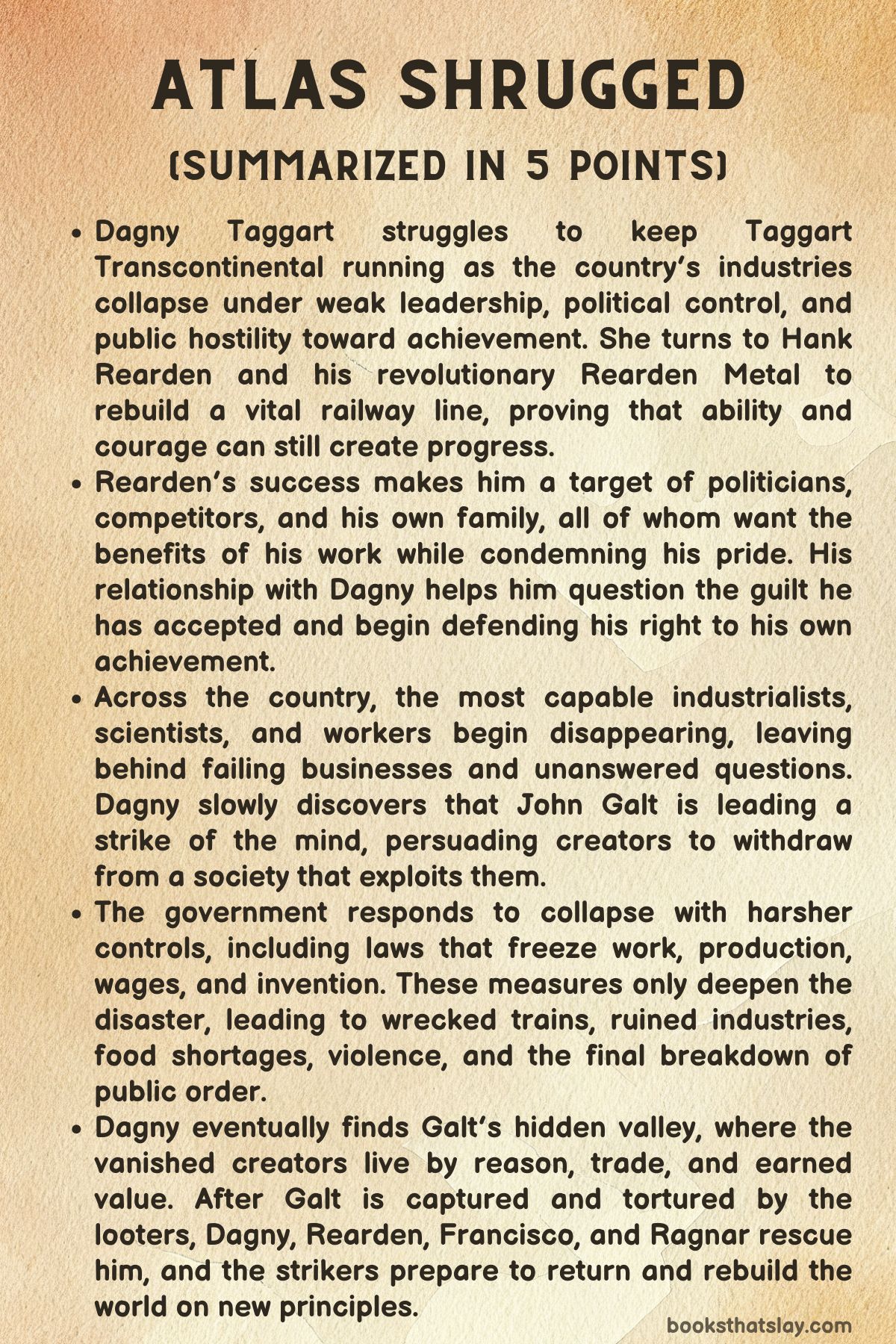
In Atlas Shrugged, the United States is already showing signs of decay. Streets are worn down, businesses are failing, and people answer every problem with the hopeless phrase, “Who is John Galt?” Eddie Willers, a loyal employee of Taggart Transcontinental, sees the crisis clearly, but the company’s president, Jim Taggart, avoids responsibility.
The railroad’s Rio Norte Line, vital to Colorado’s booming industry, is falling apart. Jim has relied on political friendships and weak suppliers, while his sister Dagny Taggart, the real force behind the railroad, sees that the company must act quickly or lose everything.
Dagny cancels a delayed steel order and turns to Hank Rearden, an industrialist who has created a revolutionary alloy called Rearden Metal. Rearden has spent years developing it, and he sees it as the achievement of his career.
Yet at home he receives only criticism from his wife Lilian, his mother, and his brother Philip, who all depend on him while treating his ambition as a moral flaw. Dagny recognizes Rearden’s ability and orders rails made from his metal, despite public suspicion and pressure from experts who condemn it without evidence.
The country’s powerful business and political circles are dominated by people who survive through favors rather than achievement. Jim Taggart, Orren Boyle, Wesley Mouch, and others use Washington connections to protect themselves from competition.
They support rules that punish successful companies and reward failing ones. One such rule destroys the Phoenix-Durango railroad, which had been serving Colorado better than Taggart Transcontinental.
Its owner, Dan Conway, refuses to fight and retires, leaving Dagny with the burden of keeping Colorado connected before industrialist Ellis Wyatt loses his business.
Dagny has a complicated past with Francisco d’Anconia, heir to a great copper fortune and once the most brilliant young man she knew. They grew up together, became lovers, and shared the same joy in achievement.
But Francisco later appeared to become a useless playboy, wasting his gifts and damaging his own enterprises. Dagny cannot understand why he has changed.
When his San Sebastian mines in Mexico are nationalized and revealed to be worthless, it seems that he has deliberately ruined investors. Francisco hints that he is fighting the very people who feed on productive minds, though Dagny is not yet ready to understand him.
As opposition to Rearden Metal grows, Dagny forms a separate company to rebuild the Rio Norte Line. She names it the John Galt Line as an act of defiance against the common phrase of defeat.
Rearden supports her, and the most capable industrialists invest. Against public ridicule, union warnings, and official hostility, Dagny and Rearden complete the line.
Its first run is a triumph. The train moves faster and more safely than anyone expected, proving the value of Rearden Metal.
After the successful journey, Dagny and Rearden begin an affair based on mutual admiration, desire, and shared pride in achievement.
Their victory is brief. Dagny and Rearden discover the ruins of the Twentieth Century Motor Company, where they find the remains of a motor that could have drawn static electricity from the air.
Dagny becomes determined to find its inventor. Her investigation reveals that the factory collapsed after adopting a system based on need rather than ability.
The policy destroyed morale, punished competence, and turned workers against one another. The mysterious inventor, later revealed as John Galt, had walked away from the factory after declaring that he would stop the motor of the world.
Meanwhile, the government continues to tighten control. Colorado, once the country’s most productive region, is punished with taxes and rules.
Ellis Wyatt finally gives up. Rather than let looters take his work, he sets his oil fields on fire and disappears.
His burning wells become a symbol of the productive mind withdrawing from a society that exploits it. More capable people vanish: contractors, executives, bankers, scientists, and workers of integrity.
Dagny begins to suspect that a “destroyer” is persuading the best people to quit.
Rearden faces legal persecution for violating unfair economic regulations, but he refuses to accept guilt. At his trial, he rejects the moral basis of the charges and states that he works for his own profit and by his own right.
The court, afraid of public reaction, gives him only a token punishment. Francisco grows closer to Rearden and tries to make him see that the looters survive only because their victims continue to support them.
Rearden resists the idea, still believing he can fight and win within the existing world.
The country worsens under Directive 10-289, a sweeping order that freezes jobs, production, wages, spending, patents, and innovation. People are forbidden to leave work, businesses cannot close, and inventions become state property.
Dagny quits in protest and retreats to a cabin, but a catastrophic railway disaster brings her back. The Taggart Tunnel is destroyed after incompetent officials order a coal-burning engine into a tunnel where it cannot safely operate.
Everyone aboard the train dies. Dagny returns to save what remains of the railroad, though the system she serves is rotting beyond repair.
Rearden is blackmailed into signing over the rights to Rearden Metal when officials threaten to expose his affair with Dagny in a way that would damage her reputation. Dagny later publicly reveals the affair herself, exposing the blackmail and freeing them both from that weapon.
Rearden begins to see the nature of the system more clearly. Ragnar Danneskjold, a pirate who attacks government relief ships, gives Rearden gold as repayment for wealth taken from him by force.
Ragnar explains that he is reclaiming stolen value for its rightful owners.
Dagny’s search for the motor’s inventor leads her to Quentin Daniels, a scientist trying to rebuild it. When Daniels decides to quit rather than hand his work to the state, Dagny races to stop him.
She follows a plane carrying him and crashes in the Rocky Mountains. There she discovers Galt’s Gulch, a hidden valley where the vanished men and women have built their own community.
John Galt himself rescues her. The valley is protected by advanced technology and run by people who trade value for value, using gold and living by reason, independence, and earned respect.
In Galt’s Gulch, Dagny meets the people she thought had been lost: Midas Mulligan, Owen Kellogg, Ragnar Danneskjold, Francisco, and many others. They are on strike against a world that demands their minds while condemning their motives.
Galt explains that they have withdrawn their ability, leaving the outside world to face the consequences of its own moral code. Dagny is moved by the valley but refuses to remain.
She still believes she can save her railroad and the remnants of the old world. Galt loves her and has watched her for years, but he lets her choose.
Back outside, the collapse accelerates. The government reveals Project X, a sound weapon powerful enough to destroy entire areas.
Civil freedom disappears, industry breaks down, and Taggart Transcontinental barely functions. Cheryl Taggart, Jim’s wife, slowly realizes that she has admired the wrong person.
She had believed Jim was responsible for the John Galt Line, but she learns that Dagny was the true achiever. When Jim reveals his hatred of goodness and his desire to break her spirit, Cheryl is destroyed by the truth and takes her own life.
Francisco finally destroys the remains of d’Anconia Copper before the government can seize it. Rearden’s mills are attacked under government orders, and Tony, the young official once assigned to supervise him, dies trying to warn him.
Francisco reveals that he has been working secretly in Rearden’s mills and saves Rearden during the violence. Rearden at last accepts the strike and disappears to join Galt.
Then John Galt seizes the national airwaves and gives a long speech explaining the philosophy behind the strike. He rejects sacrifice as a moral duty, defends reason, productive work, individual rights, and rational self-interest, and tells the people that they must stop living through force and guilt.
The government panics and tries to find him. Dagny tracks Galt down in New York, but she is followed, and he is captured.
He orders her to pretend that she betrayed him so the looters will not suspect her loyalty.
Officials try to persuade Galt to rule the collapsing country for them. He refuses.
They stage public events to make it seem as though he has joined them, but he openly tells people to get out of his way. When persuasion fails, they torture him with an electric device called the Ferris Persuader, trying to force him to think for them.
Galt remains mentally undefeated. Jim Taggart, watching the torture, breaks under the realization of his own evil.
Dagny, Rearden, Francisco, and Ragnar rescue Galt. As they leave by plane, New York’s lights go out below them, marking the final failure of the old order.
Eddie Willers, still loyal to the railroad, is stranded in the desert with the broken Taggart Comet and cannot bring himself to abandon it. In Galt’s Gulch, the strikers prepare to return to the world once the old system has collapsed completely.
Dagny and Galt look toward the future, ready to rebuild on the principles for which the strikers withdrew.
Characters
Dagny Taggart
Dagny Taggart is one of the central figures in Atlas Shrugged, and she represents practical intelligence, discipline, courage, and an almost sacred devotion to productive work. She is not merely attached to Taggart Transcontinental as a family inheritance; she treats the railroad as a living system that must be protected through competence.
Unlike her brother Jim, who holds formal authority without moral or intellectual strength, Dagny earns her authority through action. She understands tracks, schedules, engines, materials, employees, and industrial consequences.
Her strength lies in seeing reality clearly and refusing to hide from it. When others panic, evade, delay, or blame, Dagny acts.
Her greatest conflict comes from her refusal to abandon the outside world. Even when she sees that government policies and weak men are destroying industry, she keeps trying to save the railroad because she cannot accept the surrender of something valuable.
This makes her heroic but also vulnerable. She believes that if she works hard enough, thinks clearly enough, and holds the system together long enough, reason will eventually win.
Her time in Galt’s Gulch challenges this belief. There, she sees a society built on the values she has always lived by, but she is not ready to leave the broken world behind.
Dagny’s character arc is the painful movement from fighting for a dying system to recognizing that her own ability should not be sacrificed to those who hate it. Her romantic relationships with Francisco, Rearden, and Galt also reflect stages in her growth: youthful shared ambition, adult partnership in struggle, and finally a complete philosophical union.
Hank Rearden
Hank Rearden is a self-made industrialist whose life is built around work, invention, and achievement. His creation of Rearden Metal is not just a business success; it is the physical expression of his mind, effort, and patience.
He began with nothing, worked his way through the steel industry, and made himself into a man capable of changing the future of transportation and construction. Yet Rearden begins the book with a deep moral confusion.
He knows how to produce, but he does not yet know how to defend the moral meaning of production. He accepts guilt for his own desires, his pride, his wealth, and even his need for happiness.
This inner weakness allows his family and the looters to exploit him. His wife Lilian, his mother, and his brother Philip depend on him while condemning the qualities that make their comfort possible.
Rearden continues to support them because he has been taught to treat self-sacrifice as virtue. His relationship with Dagny helps him begin to reject that code.
She sees him without resentment or pity; she honors his strength. His trial becomes a turning point because he refuses to defend himself on the looters’ terms.
Later, the blackmail involving Dagny shows the last hold that guilt has over him. By the time he joins the strike, Rearden has learned that his work, desire, pride, and happiness are not sins.
His arc is one of moral liberation.
John Galt
John Galt is the hidden force behind the disappearance of the world’s most capable people and the philosophical center of Atlas Shrugged. For much of the book, his name functions as a phrase of despair, but the man himself is the opposite of surrender.
He is an inventor, thinker, worker, and moral revolutionary. His invention of the motor marks him as a mind of extraordinary genius, but his greater act is refusing to let that genius serve a society that punishes ability and rewards dependence.
When the Twentieth Century Motor Company adopts a system based on need rather than merit, Galt understands that the issue is not only economic but moral. He walks away and begins the strike of the mind.
Galt’s power lies in his absolute consistency. He does not compromise with force, guilt, or emotional manipulation.
He persuades the best people to withdraw, not through deceit, but by showing them the contradiction in serving their own destroyers. His love for Dagny is intense but never possessive.
He wants her to choose the truth freely. Even when captured and tortured, he remains undefeated because the looters can control his body but cannot command his mind.
Galt represents Rand’s ideal man: rational, productive, proud, self-owning, and unwilling to live for the sake of those who deny his right to exist.
Francisco d’Anconia
Francisco d’Anconia is one of the most layered characters in the novel because he appears for much of the story to be a fallen man. As a child and young adult, he is brilliant, joyful, disciplined, and almost superhuman in his capacity for work and pleasure.
Dagny knows him first as someone who treats achievement as an adventure. His later public image as a reckless playboy is therefore painful and confusing to her.
In truth, Francisco’s decline is an act of controlled destruction. He is deliberately ruining d’Anconia Copper so that the looters cannot inherit the wealth created by generations of ability.
Francisco’s tragedy is that he must wear the mask of corruption while remaining one of the purest moral figures in the story. He loves Dagny, but he gives her up because he has accepted Galt’s strike and she has not.
He values Rearden and tries patiently to lead him toward moral clarity, even when Rearden misjudges and strikes him. Francisco’s speeches about money, sex, and moral responsibility reveal his role as both rebel and teacher.
His destruction of his own empire is not nihilism; it is refusal. He would rather erase his fortune than let it become fuel for a system built on theft.
His charm hides discipline, and his apparent carelessness hides sacrifice made in the name of principle.
Eddie Willers
Eddie Willers is loyal, decent, and sincere, but he lacks the creative power of Dagny, Rearden, Galt, or Francisco. His importance lies in his moral innocence and his devotion to the railroad.
He loves Taggart Transcontinental not as a source of power but as a symbol of order, movement, and human effort. He recognizes Dagny’s greatness and serves her with complete honesty.
His conversations with the unnamed worker, later revealed as Galt, make him a quiet carrier of information, though he never fully understands the larger struggle taking place around him.
Eddie’s tragedy is that he belongs emotionally to the world Dagny is trying to save, but he does not possess the strength to transcend it. He cannot join the looters because he is too honest, yet he cannot join the strikers because he cannot abandon the railroad.
His final scene with the broken Taggart Comet in the desert is deeply revealing. The railroad has failed, the world has failed, and yet Eddie remains with the machine he loved.
He is not evil, weak in character, or corrupt; he is limited. Through him, the book shows the fate of good ordinary people who depend on the creators but cannot fully grasp the moral battle that determines their survival.
James Taggart
James Taggart is the opposite of Dagny in nearly every meaningful way. He has the title of president of Taggart Transcontinental but none of the competence required to run it.
His power comes from inheritance, manipulation, public relations, and political connections. Jim does not want to build, solve, or produce.
He wants status without achievement and moral approval without virtue. He survives by hiding behind committees, slogans, favors, and false humanitarian language.
Whenever Dagny succeeds, Jim tries to claim credit; whenever failure approaches, he shifts blame.
What makes Jim especially dangerous is that he is not merely incompetent. He resents competence itself.
He cannot bear Dagny’s ability because it exposes his emptiness. His marriage to Cheryl reveals the cruelty at his core.
He enjoys her admiration when it is based on illusion, but once she begins to understand greatness and seeks to rise toward it, he wants to break her. His hatred is not only social or professional; it is metaphysical.
He hates the good because the existence of the good judges him. His breakdown during Galt’s torture shows the truth he has evaded: he does not merely want unearned wealth or influence; he wants to destroy those who make achievement possible.
Cheryl Taggart
Cheryl Taggart begins as a naive young woman who believes in heroism but places her admiration in the wrong person. She thinks Jim Taggart is responsible for the John Galt Line and sees him as a noble figure of achievement.
Her mistake comes from innocence rather than corruption. She wants to honor greatness, and because she does not yet understand the world of power and publicity, she believes the public story.
Her marriage to Jim becomes a moral education through suffering.
As Cheryl learns the truth, she undergoes one of the most painful awakenings in the story. She discovers that Dagny, not Jim, is the person worthy of admiration.
Her meeting with Dagny is important because it gives Cheryl a brief vision of moral clarity and sisterhood. Dagny does not mock her mistake; she recognizes Cheryl’s honest desire to value the good.
But Cheryl is trapped with Jim, whose cruelty intensifies when he sees that she is no longer spiritually beneath him. Her death is the result of a soul unable to survive the full discovery of evil without enough strength, support, or time to rebuild itself.
Cheryl shows how innocence can be destroyed when it meets corruption disguised as virtue.
Lilian Rearden
Lilian Rearden is elegant, socially polished, and emotionally destructive. She does not love Hank Rearden; she wants to diminish him.
Her marriage is built on the attempt to make him feel guilty for his strength, his work, his desire, and his pride. She understands enough about him to know where to wound him.
The bracelet made of Rearden Metal is a clear symbol of this dynamic. To Rearden, it represents achievement; to Lilian, it is something to mock.
When Dagny values it and trades a diamond bracelet for it, Lilian’s failure to understand true value is exposed.
Lilian’s power depends on moral inversion. She treats need, weakness, and social refinement as superior to production and passion.
She wants Rearden’s wealth while condemning the virtues that created it. Her reaction to his affair with Dagny is not rooted in wounded love but in humiliation and control.
She cannot bear that Rearden desires a woman who is his equal in strength and values. When she later faces poverty and loss of influence, she tries apology as another form of manipulation.
Rearden’s final indifference defeats her because she can no longer use guilt as a weapon. Lilian represents the parasitic morality of contempt wrapped in sophistication.
Ragnar Danneskjold
Ragnar Danneskjold is a pirate, but the book presents him as a moral counterforce rather than a criminal in the usual sense. He attacks government relief ships and returns stolen wealth to the productive people from whom it was taken.
His actions are extreme, but they are governed by a clear ethical code. He sees himself as correcting a moral imbalance: if the state uses force to seize the products of ability, then he uses force against that system to return value to its creators.
Ragnar’s importance lies in his challenge to conventional moral labels. The world calls him a pirate because he fights official power, but official power itself has become organized theft.
His meeting with Rearden is significant because he gives Rearden gold not as charity but as restitution. Ragnar respects Rearden as a producer and wants him to understand that his wealth was morally his.
He is also part of the trio of Galt, Francisco, and Ragnar, each fighting the looters in a different way. Galt leads the intellectual strike, Francisco destroys value before it can be seized, and Ragnar reclaims stolen value by force.
Dr. Robert Stadler
Dr. Robert Stadler is a brilliant scientist who becomes one of the book’s clearest examples of intellectual betrayal. He once had a great mind and a real devotion to science, but he separates thought from moral responsibility.
He wants the prestige of pure intellect while avoiding the consequences of how his work is used. His leadership of the State Science Institute shows this compromise.
The institute claims scientific authority, yet it becomes a tool of political pressure, public manipulation, and technological violence.
Stadler’s tragedy is that he knows better. He recognizes the value of Rearden Metal, the genius behind Galt’s motor, and the corruption of men like Ferris.
Still, he refuses to fight clearly and early. He tells himself that he can remain above politics, but his silence gives evil the sanction of intelligence.
Project X is the full result of this evasion: science turned into a weapon of terror. Stadler’s end near the destructive machine is fitting because he is destroyed by the kind of power he enabled but did not morally govern.
He represents intellect without courage, and the book treats that as a fatal failure.
Dr. Floyd Ferris
Dr. Floyd Ferris is the political scientist as enforcer. Unlike Stadler, he is not torn between truth and compromise; he is openly committed to power.
He understands that ideas can be used to control people, and he has no respect for objective truth except as something to bend. His book, his public statements, his blackmail of Rearden, and his role in Project F all show a man who treats human beings as instruments.
Ferris is not productive, but he is skilled at exploiting the fear, guilt, and evasions of others.
His blackmail of Rearden shows his method. He does not try to defeat Rearden through merit or argument.
He uses shame and public pressure to force surrender. Later, his use of torture against Galt exposes the endpoint of his philosophy.
When persuasion fails, he turns to pain. Ferris represents the intellectual servant of tyranny: the man who provides theories, excuses, and technical devices for coercion.
He is dangerous because he gives brutality a language of public necessity and scientific authority.
Wesley Mouch
Wesley Mouch begins as Rearden’s man in Washington but quickly becomes one of the chief architects of economic control. His rise is not based on ability, vision, or courage.
It is based on flexibility, betrayal, and service to whatever political arrangement gives him more power. Mouch is the kind of bureaucrat who grows stronger as society grows weaker.
He thrives in confusion because vague rules allow him to decide who may act, produce, sell, or survive.
Mouch’s role in Directive 10-289 makes him one of the central agents of national paralysis. The directive freezes life itself: jobs, wages, production, patents, innovation, and spending.
Mouch’s mind does not create policy that encourages growth; it creates policy that prevents movement. His character shows how mediocrity becomes monstrous when given authority over excellence.
He does not need to hate industry with Jim’s emotional intensity. His danger lies in blank administrative control.
Through Mouch, the novel criticizes systems where no one produces but everyone regulates.
Mr. Thompson
Mr. Thompson, the Head of State, is a practical politician without principles. He is not driven by a grand ideology so much as by the desire to stay in control.
He wants the economy saved, but he does not want to abandon the moral and political system that destroyed it. His response to crisis is negotiation, threats, public deception, and force.
He wants Galt to rescue the country while still allowing the looters to rule it.
Thompson is significant because he shows the emptiness of power when separated from thought. He can command offices, police, broadcasts, and committees, but he cannot command production.
His attempts to flatter Galt, bargain with him, and finally permit coercion show his inability to understand that the mind cannot be forced to function. He represents political pragmatism at its lowest point: the belief that anything can be managed if one applies enough pressure.
His failure proves one of the book’s central claims: reality cannot be ruled by evasion.
Orren Boyle
Orren Boyle is a businessman in name but not in spirit. He runs Associated Steel, yet his success depends less on making good steel than on cultivating political favor.
His delayed rail order to Taggart Transcontinental shows the practical consequences of incompetence protected by connections. Boyle speaks in public-minded language and complains about unfair competition, but his real goal is to shield himself from better producers like Rearden.
Boyle’s character represents the corruption of business when it becomes dependent on government privilege. He wants the rewards of industry without the discipline of performance.
His alliance with Jim, Mouch, and others shows how weak businessmen and ambitious politicians need each other. Boyle supplies the appearance of private enterprise while supporting policies that destroy real enterprise.
His envy of Rearden is not simply professional jealousy; it is the resentment of a second-rate man toward a first-rate creator whose existence exposes him.
Paul Larkin
Paul Larkin is weak, anxious, and dependent on the goodwill of stronger men. He appears to be Rearden’s friend, but his friendship lacks loyalty under pressure.
When Rearden is forced to give up business holdings, Larkin receives his ore mines, yet he cannot handle the responsibility with the competence Rearden had. His failure becomes another burden Rearden must carry.
Larkin is not villainous in the same direct way as Ferris or Jim, but his weakness makes him morally dangerous. He wants approval, safety, and forgiveness without earning trust through action.
His constant appeals for sympathy show a man who knows he is failing but wants emotional absolution instead of correction. In the moral world of the novel, passive weakness can support evil because it gives stronger predators the room to act.
Larkin shows that betrayal often comes not from hatred but from fear and lack of character.
Midas Mulligan
Midas Mulligan is the great banker who refuses to let his judgment be overruled by need. Before joining the strike, he is forced by court order to lend money against his own rational standards.
Rather than continue in a world where his mind is treated as public property, he withdraws. His disappearance is one of the early signs that the men of ability are refusing to cooperate with their own exploitation.
As the owner of Galt’s Gulch, Mulligan becomes a symbol of earned wealth and rational judgment. His name recalls the power to turn effort into value, but the book presents that power as moral only when guided by reason.
In the valley, he participates in a society where trade replaces coercion and where no one can claim another person’s work by need. Mulligan’s importance lies in his refusal to treat financial judgment as cruelty.
For him, money is not separate from morality; it records productive choice, risk, and earned trust.
Ellis Wyatt
Ellis Wyatt is the oil industrialist whose energy transforms Colorado into the country’s last great center of growth. He is demanding, intense, and impatient because he knows exactly what his work requires.
He does not flatter Dagny when he first confronts her; he threatens to take Taggart Transcontinental down if she fails him. Yet his harshness is rooted in reality, not malice.
He needs reliable transportation because his oil fields support a wider industrial network.
Wyatt’s disappearance marks a major turning point. When government measures make it impossible for him to continue as a free producer, he destroys his own oil fields rather than leave them to the looters.
Wyatt’s Torch becomes a lasting symbol of refusal. He does not quit because he is tired of work; he quits because work under coercion has become surrender.
His character shows the moral difference between destruction as nihilism and destruction as the denial of stolen value.
Ken Danagger
Ken Danagger is a coal producer whose quiet strength and integrity make him one of Rearden’s natural allies. He sells coal to Rearden at cost when Rearden needs it, not as charity, but as a rational act of support between productive men.
Under the new laws, even this kind of honest arrangement becomes illegal. His indictment alongside Rearden reveals a system in which productive cooperation is treated as a crime.
Danagger’s decision to join the strike is painful for Dagny because she understands his value. She tries to reach him before the “destroyer” does, but she is too late.
His farewell message to Rearden, expressing love and respect, shows that the strike is not cold abandonment. It is an act of loyalty to the best within oneself and to others who share that standard.
Danagger represents the producer who finally sees that endurance has become complicity.
Owen Kellogg
Owen Kellogg is introduced as a highly capable Taggart employee whom Dagny intends to promote, but he resigns without giving her a full explanation. His departure is one of the first signs that a hidden selection process is taking place.
Dagny recognizes his quality immediately, which makes his resignation especially unsettling. He is not quitting from laziness, resentment, or failure; he is leaving because he has chosen a different moral allegiance.
Later, Kellogg appears as part of the strikers’ world, and his earlier mystery becomes clear. He is one of Galt’s men, willing to abandon conventional career success in order to stop feeding the looters.
His calmness, competence, and loyalty make him an important supporting figure. He helps Dagny during the frozen train episode and later appears in Galt’s Gulch as someone fully at home in that value-based society.
Kellogg represents the capable worker who refuses to separate ability from moral independence.
Quentin Daniels
Quentin Daniels is a young scientist hired by Dagny to reconstruct the abandoned motor. He works in obscurity, using an abandoned university laboratory, because the official institutions of science have become corrupt or useless.
Daniels respects the mind behind the motor and understands the magnitude of the invention. His work gives Dagny hope that the old world might still be saved through genius and effort.
His decision to quit is therefore devastating to Dagny. Daniels does not abandon the project because he lacks courage or interest; he refuses to let the results become property of a state that has outlawed free invention.
His choice confirms the logic of the strike. Even a discovery that could transform civilization becomes dangerous if handed to looters.
Daniels stands at the border between Dagny’s world and Galt’s, and his departure forces her into the pursuit that leads to the hidden valley.
Dr. Hugh Akston
Dr. Hugh Akston is a philosopher and one of Galt’s former teachers. When Dagny finds him working as a diner cook, the contrast is striking but meaningful.
He has not fallen; he has withdrawn. Like the other strikers, he chooses honest work over prestigious service to a corrupt society.
His simple job does not diminish him because, in the moral logic of the novel, no honest productive work is degrading.
Akston’s role is quiet but important. He represents the philosophical roots of the strike.
Galt, Francisco, and Ragnar were all shaped by his teaching, and through them his ideas become historical action. His conversation with Dagny hints at truths she is not yet ready to accept.
He does not force enlightenment on her; he lets her confront reality step by step. Akston shows that ideas are not abstractions floating above life.
They determine whether people build, submit, exploit, or withdraw.
Tony
Tony, first known by the mocking nickname “the Wet Nurse,” begins as a young government representative assigned to supervise Rearden’s mills. At first, he seems like a product of bureaucratic education: uncertain, rule-bound, and conditioned to distrust industrial freedom.
Yet unlike many officials, he is still capable of learning. Exposure to Rearden’s world changes him.
He sees competence, responsibility, and pride in action, and he begins to reject the slogans he has been taught.
His transformation is one of the most affecting smaller arcs in the book. Rearden’s teasing name for him, “Non-Absolute,” becomes affectionate because Tony is still forming his convictions.
When the mills are attacked, Tony refuses to support the betrayal and tries to warn Rearden. His death in Rearden’s arms gives him the achievement he had long lacked: he acts on a real value and succeeds in warning the man he has come to respect.
Tony represents the possibility of moral recovery for those who have been miseducated but not spiritually destroyed.
Philip Rearden
Philip Rearden is Hank Rearden’s dependent brother, and he embodies entitlement without gratitude. He asks Rearden for money while condemning the source of that money.
His charity work allows him to pose as morally superior, yet he relies entirely on the man he criticizes. Philip does not want independence; he wants support combined with the right to judge his supporter.
His relationship with Rearden exposes the false morality of need as a claim on ability. Philip treats his weakness as leverage and Rearden’s strength as an obligation.
When Rearden finally confronts him and demands gratitude or silence, it marks an important step in Rearden’s liberation from family guilt. Philip is not powerful enough to be a major villain, but he is a clear domestic version of the same principle that rules the looters: the unearned treated as a moral right.
Rearden’s Mother
Rearden’s mother uses maternal authority as a tool of emotional control. She depends on Rearden but refuses to honor him.
Her criticism is constant, and her moral language is designed to make him feel selfish for the very qualities that sustain the family. She wants him to provide endlessly while denying him admiration, joy, or moral credit.
Her importance lies in showing how the looter morality begins at home before it becomes national policy. She does not need laws or directives to exploit Rearden; she uses guilt, duty, and family obligation.
Her attitude teaches Rearden to separate love from value and responsibility from justice. When he finally becomes indifferent to her accusations, he breaks not only from his family but from the moral code that made their manipulation possible.
Bertram Scudder
Bertram Scudder is an intellectual and media figure who attacks Rearden while posing as a defender of public morality. He represents the class of commentators who do not produce but judge producers from a position of resentment.
His criticism of Rearden Metal is not rooted in technical knowledge or honest concern. It serves a cultural effort to make achievement appear suspicious.
Scudder’s role becomes more direct when Dagny is pressured to appear on his radio program. The plan is to use her credibility to reassure the public and support the government.
Instead, she exposes the blackmail against herself and Rearden. This moment turns Scudder’s platform against the people who hoped to use it.
He represents public opinion as a weapon, especially when controlled by those who value conformity over truth.
Cuffy Meigs
Cuffy Meigs is a brutal man of action on the looters’ side. Unlike the smoother politicians and intellectuals, he represents naked coercion.
He gains authority over the railroad not because he understands transportation but because the collapsing system increasingly rewards force over competence. His presence at Taggart Transcontinental shows how far the organization has fallen from Dagny’s standards.
Meigs matters because he reveals the final form of bureaucratic decay. At first, the looters speak of fairness, public welfare, emergency powers, and social duty.
As the system fails, the language gives way to threats and violence. Meigs is what remains when pretense thins out.
He cannot run a railroad, but he can intimidate people who still try to run one. Through him, the book shows that when reason is rejected, rule by muscle follows.
Dan Conway
Dan Conway is the owner of the Phoenix-Durango railroad, and his defeat is one of the early signs that ability alone cannot survive without moral self-defense. He has built a better railroad than Taggart’s Rio Norte Line and serves Colorado effectively.
Yet when the Anti-Dog-Eat-Dog rule destroys his business in favor of older, politically protected companies, he chooses not to fight.
Conway is honest and capable, but he accepts the moral authority of the system that sacrifices him. This makes him different from Dagny, Rearden, and the strikers.
He knows the ruling is wrong, but he cannot reject the code behind it. His retirement is not cowardice in the ordinary sense; it is surrender by a good man who has not learned to challenge evil at its root.
His fate warns that competence without moral certainty can still be defeated.
Jeff Allen
Jeff Allen is the homeless stowaway whom Dagny allows to ride in her private car. His importance comes from his firsthand account of the Twentieth Century Motor Company.
Through him, Dagny hears how a workplace based on need rather than merit destroyed both production and human relationships. Allen has suffered greatly, but he retains dignity and respect for work.
His story gives concrete human form to the book’s criticism of collectivist morality. The factory’s policy did not create brotherhood; it created suspicion, resentment, exhaustion, and collapse.
Allen also helps explain the origin of the phrase “Who is John Galt?” He remembers Galt as the man who refused to participate in the factory’s moral surrender. Allen is not a great creator, but he is an honest witness.
His presence shows how destructive ideas harm ordinary workers as well as industrial leaders.
Nat Taggart
Nat Taggart, the founder of Taggart Transcontinental, is dead before the main action, but his spirit remains important. He represents the older heroic age of builders who created through courage, risk, and personal judgment.
Dagny reveres him because she sees in him the same love of movement, industry, and achievement that drives her own life. His statue stands as a reminder of what the railroad once meant.
By the end, when Dagny draws the dollar sign near his statue before leaving, the gesture marks a transfer of allegiance. She is not rejecting Nat’s values; she is reclaiming them from the institution that has betrayed them.
Taggart Transcontinental no longer embodies his spirit. The true heirs of Nat Taggart are not the executives who inherited the company name, but the people who still live by creation, trade, and courage.
Themes
The Morality of Productive Achievement
In Atlas Shrugged, productive work is treated as a moral act rather than merely an economic function. Dagny’s railroad management, Rearden’s metal, Wyatt’s oil fields, Galt’s motor, and Francisco’s copper empire are all expressions of the thinking mind applied to reality.
The book repeatedly contrasts genuine production with social performance, political influence, and inherited authority. Jim Taggart has status but cannot run a railroad.
Orren Boyle owns a steel company but depends on protection from better competitors. Wesley Mouch gains power by regulating industries he could never build.
Against them stand people who create value through judgment, risk, discipline, and long-range effort.
The book argues that achievement should not require apology. Rearden’s early guilt shows how deeply he has accepted the idea that his strength must serve others without moral recognition.
His growth comes from understanding that his work is not a social debt but a personal virtue. Dagny knows this more instinctively, though she struggles to stop serving those who exploit her.
The theme reaches its clearest form in Galt’s strike, where the producers withdraw to demonstrate that the world depends on the minds it condemns. Productive achievement is not shown as greed in the shallow sense, but as the creation of life-supporting value by independent intelligence.
The Destruction Caused by Unearned Power
Political power in the story expands as productive ability declines. The people who cannot build railroads, invent metals, run mines, or manage factories increasingly gain authority over those who can.
Laws such as the Anti-Dog-Eat-Dog rule and Directive 10-289 are presented as moral and social protections, but in practice they punish success, freeze growth, and protect incompetence. The result is not fairness but decay.
Trains stop running, factories close, harvests rot, bridges fall, and disasters multiply because decisions are made by people insulated from reality.
This theme is powerful because the book does not treat collapse as sudden. It happens through a series of evasions, compromises, favors, and emergency measures.
Each rule is justified as necessary, but each one makes production harder. The looters depend on the creators while resenting and controlling them.
Their power is unearned because it does not come from knowledge, invention, or service, but from legal force and public guilt. The final breakdown of the country shows that coercion can seize goods but cannot create the mind that produces them.
A government can order a man to work, but it cannot force him to think.
Guilt as a Weapon Against the Good
Many of the strongest characters are first controlled not by physical force but by guilt. Rearden is the clearest example.
His family makes him feel selfish for caring about his mills, his invention, his pleasure, and his pride. Lilian uses marriage as a moral trap, trying to make his desire seem dirty and his ambition seem cold.
Philip uses helplessness as a claim on Rearden’s money. Rearden’s mother treats his duty to support the family as endless while denying him respect.
These private forms of guilt mirror the public methods used by politicians and intellectuals.
The book suggests that guilt becomes dangerous when it is accepted by people who have not done wrong. Rearden’s enemies do not defeat him because they are stronger; they defeat him when he grants them moral permission.
The same principle appears on a national scale. Productive people are told that their ability belongs to others, that need outranks achievement, and that self-interest is shameful.
Galt’s strike is a rejection of this moral blackmail. He teaches the creators that they must stop giving their sanction to a code designed to drain them.
The story treats the refusal of undeserved guilt as a necessary step toward freedom.
The Strike of the Mind
The disappearance of capable people is the central dramatic and philosophical action of the story. At first, it appears mysterious and threatening because Dagny sees it only as a loss.
Contractors, scientists, industrialists, workers, and financiers vanish when they are needed most. She believes some destroyer is robbing the world of its best minds.
The truth is more challenging: these people are not being destroyed; they are refusing to be consumed. They withdraw because they will no longer allow their intelligence to support a society that punishes them for using it.
The strike is not laziness, despair, or revenge in a simple sense. It is a moral demonstration.
Galt and his followers believe that the world runs on the mind, and that the mind cannot function under compulsion. By leaving, they reveal the dependence of the looters on the very people they condemn.
Galt’s Gulch shows the positive side of the strike: a society where people trade freely, respect earned value, and refuse claims based on need alone. Dagny’s journey is difficult because she shares the strikers’ values but continues to believe the old world can be saved.
Her eventual movement toward them confirms the book’s argument that the mind must be free or it will withdraw.