Augustown Summary, Characters and Themes
Augustown by Kei Miller is a novel about a Jamaican community shaped by memory, faith, violence, class division, Rastafari identity, colonial history, and the long afterlife of injustice. Set mainly around one terrible day in Augustown, the book connects the cutting of a child’s dreadlocks to older wounds: the story of Alexander Bedward, police brutality, anti-Black prejudice, poverty, and the struggle to rise above systems built to keep people down.
Its voice is lyrical but sharp, moving between myth, history, and everyday life to show how a single act of humiliation can awaken generations of pain.
Summary
The story opens above Jamaica, with a narrator looking down on the island, the sea, the green land, and the inland valley where Augustown lies. The town carries the marks of history and damage.
A scar on the hillside, left by bulldozers and industrial development, becomes a symbol for the wounds carried by the people who live there. Augustown is shown as a place of crowded houses, uneven streets, poverty, memory, and survival.
The narrator fixes attention on August 11, 1982, a day that has been watched again and again because of the disaster and wonder that will happen there.
At the center of the early story is Ma Taffy, an elderly blind woman whose real name is Irie Tafarie. Her blindness came years earlier when rats fell through her ceiling and injured her eyes.
Since then, she has learned the world through sound, smell, instinct, and memory. She is feared, respected, and trusted in Augustown.
She has a strange authority in the community, partly because she has lived through so much and partly because she seems able to sense things others miss.
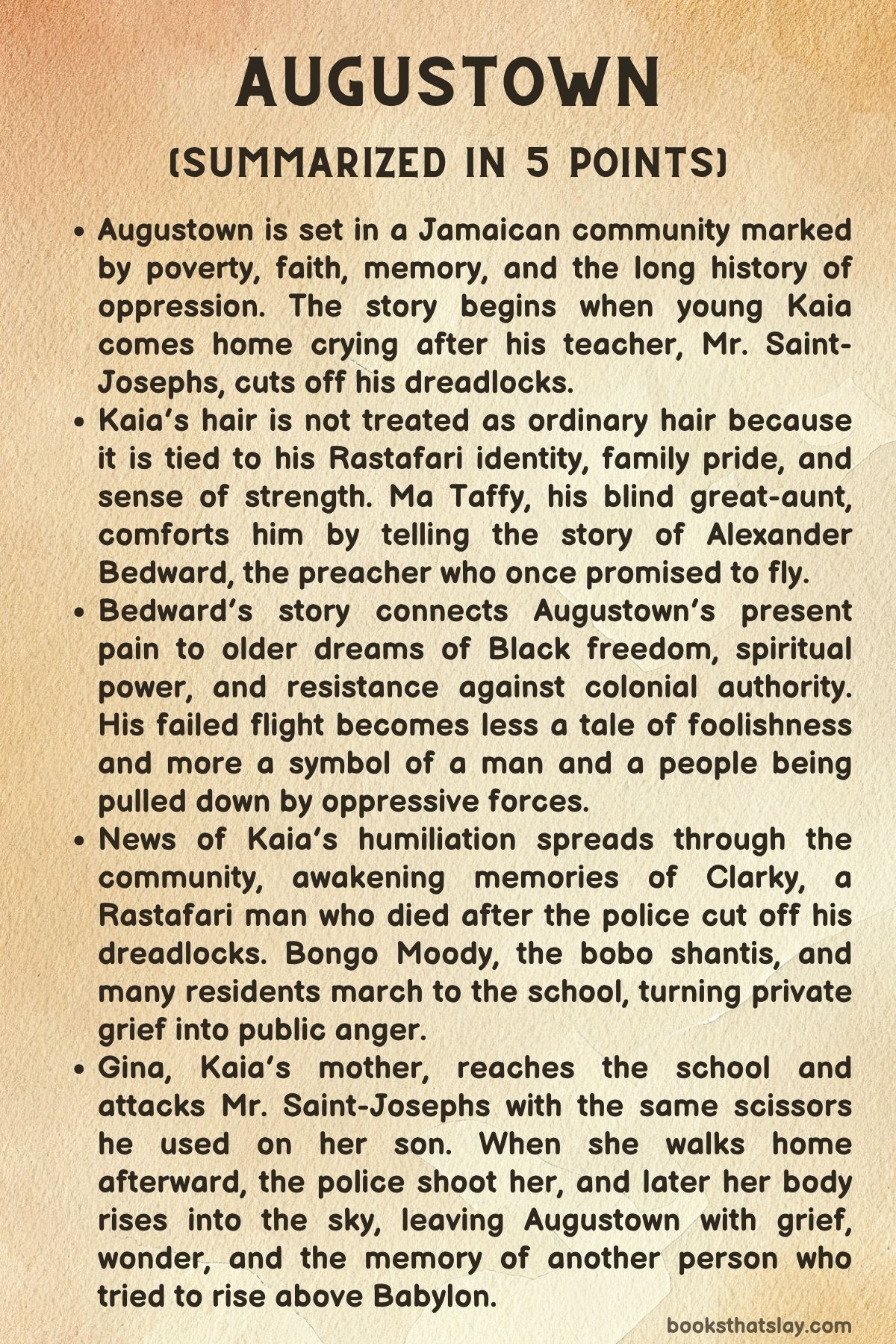
One afternoon, Ma Taffy smells something strange on her young great-nephew Kaia as he returns home from school. Kaia is crying.
The smell is sickly and wrong, connected in her mind to damage, fear, and violation. Kaia asks for his mother, Gina, though he knows she is at work.
Ma Taffy tries to comfort him. To steady him, she begins telling him the story of Alexander Bedward, the Flying Preacherman.
Ma Taffy remembers Bedward from her childhood. He was a preacher in Augustown, leader of a church called Union Camp, and a figure feared by the authorities because of his influence over poor Black Jamaicans.
Bedward claimed that one day he would fly. To many outsiders, this claim made him a fool or a fraud, but to the people of Augustown, his promised flight carried spiritual and political meaning.
It suggested release from the weight of oppression. Ma Taffy remembers her mother Norah, her mother’s partner Maas Bilby, and the prayers that surrounded Bedward when people heard he had begun floating in his sleep.
As Ma Taffy tells the story, she reaches for Kaia’s head and discovers the cause of his grief: his dreadlocks have been cut off. His teacher, Mr. Emanuel Saint-Josephs, has cut them with scissors in front of the class.
Kaia’s hair was not merely hair. As a Rastafari child, his dreadlocks were part of his faith, identity, family history, and sense of self.
The act is a public humiliation and an attack on his personhood.
The cutting of Kaia’s hair recalls another wound in Augustown’s past: the death of Clarky, a Rastafari man who sold callaloo. Clarky had once been arrested and abused by the police under false accusations.
They cut off his dreadlocks, stripping him of something sacred to him. After his release, he hanged himself from a mango tree.
To Ma Taffy and others, Clarky’s death still lives in the community’s memory. Kaia’s shorn head brings that pain back with terrible force.
Ma Taffy sends Kaia to find Soft-Paw, also known as Marlon, a gang leader connected to the Angola Gang. Soft-Paw respects Ma Taffy, though he belongs to a younger, more violent version of Augustown.
She warns him to move the guns hidden under her house because trouble is coming. She knows that if the police come and find weapons there, the situation will become even worse.
Soft-Paw thinks she is overreacting at first, but he listens and removes the guns in broad daylight while the community watches.
The story then shifts to Mr. Saint-Josephs, the teacher who cut Kaia’s hair. He is insecure, angry, and full of self-hatred.
He sees himself as refined, disciplined, and superior to the people around him. He is obsessed with order, Christian respectability, and a narrow idea of cleanliness.
He had complained before about Kaia’s dreadlocks to the principal, Mrs. Garrick, but she told him that Kaia was Rastafari and permitted to keep them. Mr. Saint-Josephs ignored this.
When Kaia whispered in class, the teacher lost control, grabbed him by the hair, lifted him from his seat, and cut off his locks.
Mr. Saint-Josephs’s cruelty is tied to his own inner damage. He rejects his Blackness and imagines himself as lighter, sharper, and more respectable than others see him.
His failed marriage to Mary reveals his deep insecurity. Mary was lighter-skinned and politically interested in Black pride, while he wanted to be seen as above Blackness.
When she called him a “blackman,” he hit her, unable to bear the word. His move to Augustown does not heal him.
Instead, his shame turns outward, and Kaia becomes one of its victims.
Ma Taffy continues the story of Bedward’s flight. Crowds once came to Augustown to witness him rise.
Bedward had already gained fame after declaring the Mona River a healing river, and reports of healing increased belief in him. Ma Taffy’s Aunt Mathilda tells of flying Africans, enslaved people who once could fly but were held down by the salt and violence of slavery.
Bedward’s promised flight becomes linked to this older dream of Black freedom.
Another observer, William Grant-Stanley, a light-skinned journalist from Kingston, comes to Augustown under a false name to report on Bedward. He watches the worship, the singing, and Bedward’s sermon.
Bedward wears chains around his waist, explaining that they hold him to the earth. He announces that he will fly into the sky, stay with the prophets, and return with power against wicked Kingston and the colonial governor.
To the authorities and the press, Bedward is a threat. Newspapers call him a false prophet and portray his followers as foolish.
Governor Probyn dismisses some fears, while businessman Richard Azaar worries that Bedward’s influence will disrupt labor and business.
When the day of Bedward’s flight arrives, the community gathers. Sister Gilzene, known for her beautiful voice, sings.
Bedward begins to rise, but the authorities mock him. Then one of them pulls him down by the neck of his robe.
Ma Taffy insists to Kaia that the story is not about a madman failing to fly. It is about a man who was pulled down by Jamaica itself.
The novel then returns to the present day. Ian Moody, now known as Bongo Moody, remembers Clarky with intense grief and love.
As a boy, Ian had worked with Clarky selling vegetables. Their bond was deep, though unspoken and complicated.
After Clarky’s arrest, humiliation, and suicide, Ian committed himself fully to Rastafari life. When Doreen, an HIV-positive sex worker, tells him what happened to Kaia, he breaks down, crying out against Babylon, the oppressive system represented by the police, state power, and anti-Rasta prejudice.
The news spreads. The bobo shantis and other Rastafari men begin to march.
Their march is quiet at first, solemn and disciplined. Then more people join, and it becomes a march of Augustown itself.
They head to the school, demanding that Mr. Saint-Josephs come out. Bongo Moody drums and leads the singing.
Sister Gilzene, old and close to death, hears the call of the moment. With a final burst of strength, she rises from her bed, tells Lloydisha that death is coming, sings the song she once sang for Bedward, and dies.
She becomes the first death of the day.
Elsewhere, the story follows Mrs. Garrick, the principal of Augustown Primary, who lives in wealthy Beverly Hills with her husband. Mrs. G once loved teaching but now feels trapped in administration, a role encouraged by her husband because he cared about status.
Her domestic helper, Miss G, is really Gina, Kaia’s mother. Mrs. G has been teaching Gina privately, preparing her for exams and helping her apply to the University of the West Indies.
Gina is brilliant, proud, and determined. On the day of the disaster, Gina receives a thick envelope from the university, likely an acceptance letter, but she refuses to open it until she can share the moment with Ma Taffy and Kaia.
Gina’s past is then revealed. Ma Taffy always saw great intelligence in her and taught her how to survive in a world ruled by Babylon.
But Gina became pregnant at fifteen and hid it. She gave birth alone and nearly drowned the newborn in the toilet, overwhelmed by shame and fear.
Ma Taffy stopped her, and the child lived. Gina named him Kaia, meaning home.
Kaia’s father is Matthew, the son of Mr. and Mrs. Garrick. Gina had met Matthew when he offered her rides to school.
They formed a relationship across class lines, and she became pregnant before he left for Harvard. She did not tell him, refusing to become the stereotype she believed others might place on her.
When Mrs. G drives Gina home, Gina sees Kaia’s shorn head and is overcome. The sight recalls Clarky and all the history of violence against Rastafari bodies.
She holds her son, then walks to the school. Her anger becomes the anger of the crowd.
She finds Mr. Saint-Josephs, sees Kaia’s hair on the floor, and asks why he did it. He calls Kaia a hooligan and insults Gina.
In that moment, Gina remembers Ma Taffy’s lesson about using the tools of Babylon against Babylon. She takes the scissors and stabs Mr. Saint-Josephs in the eye.
The crowd recoils. Gina gathers Kaia’s cut hair and the bloody scissors and walks home.
The police arrive behind her and order her to raise her hands, but she does not hear them. They shoot her.
She sees Ma Taffy and Kaia running toward her, but she does not understand what is happening as she falls.
After Gina’s death, Augustown enters a state of mourning and rage. The police leave quickly.
The community wraps Gina’s body in white sheets and places her in Ma Taffy’s yard. Fires are set in the streets.
Mrs. G, trapped in Augustown, cleans blood from the school and later sits with Ma Taffy and Kaia. Mr. Saint-Josephs survives but becomes Oney, a one-eyed madman wandering the streets of Papine.
At midnight, Ma Taffy begins to sing, and the community joins her. Gina’s body rises from the yard and floats upward like a dove.
The narrator finally reveals herself as Gina, no longer living in a human body but present as a consciousness in the sky. The people of Augustown wait for her to return with lightning against Babylon, as Bedward had promised long ago, but she will not.
She remains above, watching, floating, and existing as memory, witness, and story.
Characters
Gina
Gina is one of the central figures in the book, both as Kaia’s mother and as the narrator whose presence frames the story from above. She is intelligent, proud, wounded, loving, and full of anger that has been shaped by class, race, motherhood, and shame.
As a teenager, she becomes pregnant by Matthew, a wealthy young man from Beverly Hills, and chooses not to tell him because she refuses to be reduced to a stereotype. Her near-attempt to kill Kaia at birth reveals the depth of her fear and isolation, but her later life shows how completely she chooses him.
She works as Miss G in Mrs. Garrick’s house, studies with discipline, and prepares for university, showing that she has a fierce hunger for a different future. When Kaia’s dreadlocks are cut, the assault touches every hidden wound in her life.
Her attack on Mr. Saint-Josephs is not simply personal revenge; it is the explosion of a mother who sees her child violated by the same system that has shamed, limited, and threatened her. In Augustown, Gina becomes both victim and witness, a woman killed by police violence and transformed into the voice that watches the story from the sky.
Ma Taffy
Ma Taffy, born Irie Tafarie and earlier known as Irene Mackenzie, is the memory-keeper and moral center of Augustown. Though blind, she perceives more than most people around her, using smell, sound, intuition, and experience to understand danger before it fully appears.
Her blindness does not weaken her authority; it sharpens the almost prophetic role she plays in the community. She remembers Bedward, Clarky, family history, police violence, and the long struggle of poor Black Jamaicans against Babylon.
She is practical as well as spiritual, telling Soft-Paw to move the guns before trouble arrives. Her care for Kaia and Gina is stern, protective, and sometimes harsh, especially in the memory of Gina’s childbirth, but her harshness comes from fear and love.
Ma Taffy believes in survival, in memory, and in the need to understand oppression without surrendering to it. She links past and present, showing that the violence done to Kaia is part of a much longer history.
Kaia
Kaia is a young Rastafari child whose humiliation becomes the event that awakens the whole community. His dreadlocks are central to his identity because they connect him to his mother, Ma Taffy, Rastafari faith, and a larger history of resistance.
When Mr. Saint-Josephs cuts them, Kaia loses more than hair; he loses the symbol through which he has understood strength, belonging, and spiritual dignity. His mother has taught him that he is a lion, and after the cutting he wonders whether that is still true.
Kaia’s innocence intensifies the cruelty of the act. He has not committed a serious offense; he has merely been a child in a classroom.
Through him, the book shows how systems of prejudice often attack the vulnerable first. Kaia is also the emotional bridge between Gina and Ma Taffy, the child both women love and try to protect.
By the end, he becomes a witness to his mother’s killing, carrying forward another wound that Augustown must remember.
Mr. Emanuel Saint-Josephs
Mr. Saint-Josephs is a damaged and dangerous man whose cruelty comes from insecurity, self-hatred, and internalized anti-Blackness. He sees himself as refined, orderly, and superior, but the world does not confirm the image he has built of himself.
His fixation on dress codes, tidiness, and discipline masks his fear of being seen as ordinary, Black, weak, or socially inferior. His failed marriage to Mary exposes this wound clearly.
He cannot bear being called Black, and his violence toward Mary reveals the rage produced by his self-rejection. In the classroom, he turns that rage on Kaia.
By cutting the child’s dreadlocks, he attacks what he cannot control or understand: a confident Black and Rastafari identity. His later fate as Oney, the one-eyed madman, is a severe reversal.
The man who wanted respectability becomes a figure of public disorder, carrying on his body the consequence of the violence he began.
Bongo Moody
Bongo Moody, formerly Ian Moody, is a Rastafari man whose life has been shaped by his love for Clarky and by the trauma of Clarky’s death. As a young boy, he worked with Clarky and developed an attachment that was emotional, tender, and difficult for him to name.
After the police abused Clarky and cut off his dreadlocks, Bongo Moody became the one who found and held his body. That memory never leaves him.
His commitment to Rastafari life is partly spiritual and partly an act of loyalty to the dead. When he hears that Kaia’s hair has been cut, the past returns with force.
His cries of “fire” and his role in the march show how private grief can become public protest. Bongo Moody is not simply a militant figure; he is a grieving man whose anger is rooted in love, loss, and the memory of a friend whose dignity was destroyed.
Clarky
Clarky is physically absent from the main day of action but emotionally present throughout the book. He is a Rastafari vendor who sells callaloo and becomes a victim of police harassment.
His dreadlocks are sacred to him because of his Nazarite vow, and when the police cut them, they destroy something central to his spiritual life and selfhood. His suicide is described through the image of floating, creating a bitter link between flight, death, and release.
Clarky’s fate explains why Kaia’s shorn head causes such fear and rage in Ma Taffy, Bongo Moody, and Gina. He represents the long pattern of state violence against Rastafari people and the psychological harm caused when a person’s identity is treated as criminal or dirty.
Though he dies before the main events, his death prepares the emotional ground for the autoclaps.
Alexander Bedward
Alexander Bedward is a historical and spiritual figure whose story gives the novel much of its symbolic force. He is remembered as the Flying Preacherman, a religious leader who promised to fly and whose followers believed he carried the possibility of liberation.
To the colonial authorities and newspapers, he is a false prophet and a threat to order. To Augustown, he is a man trying to rise above the weight placed on Black people by colonial rule, poverty, and humiliation.
His chains, which he says keep him on earth, make visible the burden he claims to resist. When he begins to rise and is pulled down, his failure is not treated as foolishness but as an act of suppression.
Bedward becomes a figure through whom the book questions who gets to define reality, miracle, madness, and history.
Sister Gilzene
Sister Gilzene is a singer, witness, and spiritual force in Augustown. As a young woman, she is considered ugly by others, but her voice gives her a beauty and power that surpass physical judgment.
She sings during Bedward’s attempted flight, helping the community believe in the moment and giving strength to the miracle they need. In old age, she is near death, but the news of Kaia’s violation and the sound of the march call her back into action.
Her final song connects the present crisis to the old story of Bedward. Her death is the first death of the autoclaps, and it marks the day as something larger than an ordinary act of community anger.
Gilzene’s voice is memory made audible. Through her, song becomes a form of resistance, witness, and spiritual continuity.
Soft-Paw
Soft-Paw, also known as Marlon, is a gang leader connected to the Angola Gang, but the book gives him more depth than the label of criminal would suggest. He belongs to the newer Augustown, one shaped by guns, police conflict, and a readiness for violent defense.
Yet he respects Ma Taffy, and that respect shows that he has not separated himself completely from older forms of community authority. When Ma Taffy asks him to move the guns hidden beneath her house, he first doubts her, but he agrees when she frames it as a favor.
Soft-Paw’s character shows the complicated relationship between protection and danger in a neglected community. He wants to defend Augustown against Babylon, but his weapons also place the people at risk.
He is both a product of violence and a response to it.
Mrs. Garrick
Mrs. Garrick, often called Mrs. G, is the principal of Augustown Primary and a wealthy woman living in Beverly Hills. She is not cruel in the way her husband or Mr. Saint-Josephs can be, but she is deeply tied to the class system that separates her life from Augustown.
She once loved teaching and still finds meaning in educating Gina, whom she recognizes as brilliant. Her relationship with Gina is one of care, admiration, and inequality.
She helps Gina apply to university and wants to support her future, but she also employs her as domestic help, making their bond complicated by class power. Her failure to remove Mr. Saint-Josephs after his complaint about Kaia becomes a source of regret.
Mrs. G is a character of partial goodness and partial blindness. She can see Gina’s talent but cannot prevent the system around them from destroying her.
Mr. Garrick
Mr. Garrick represents wealth, status, pride, and the social distance between Beverly Hills and Augustown. He pressures Mrs. G to leave ordinary teaching for a principal’s role because he thinks her work in a poor school lowers his standing.
His view of Gina is shaped by class prejudice and contempt. He dislikes her confidence, her dreadlocks, and her refusal to behave as he thinks a domestic worker should.
Even when his company’s support for Gina’s education could improve its public image, he resents the idea of helping her. His extramarital affairs also reveal his hypocrisy and moral weakness.
Mr. Garrick is not the most visibly violent character, but his attitudes help sustain the social order that devalues people like Gina while benefiting from their labor.
Matthew Garrick
Matthew is Mrs. and Mr. Garrick’s son and Kaia’s father, though he does not know this during the main events. He is educated, wealthy, and bound for Harvard, representing access and possibility that Gina does not have.
His relationship with Gina is marked by genuine attraction and intellectual respect, but also by unequal power. He is surprised by her intelligence, which reveals the assumptions that come from his class position, even when he means well.
He tells her she will fly one day, a line that becomes painful in hindsight because Gina’s final flight comes only after death. Matthew is not portrayed as actively malicious, but his absence matters.
He leaves for Harvard while Gina remains behind, pregnant and alone, bearing the consequences of a relationship shaped by unequal worlds.
Doreen
Doreen is an HIV-positive sex worker who helps spread the news of what has happened to Kaia. Her role may seem small, but she is important because she belongs to the network of Augustown’s unofficial messengers, witnesses, and survivors.
She is a marginal figure in social terms, but the book treats her as part of the community’s living body. By telling Bongo Moody about Kaia’s cut hair, she helps set the march in motion.
Her presence also broadens the social world of the story, showing that Augustown is made up not only of family members, religious figures, and political actors, but also of people marked by illness, labor, stigma, and survival. Doreen’s brief appearance reinforces the idea that news, pain, and protest move through ordinary human contact.
The Cleaning Woman
The cleaning woman at the school is a minor but memorable figure. She has schizophrenia and speaks to her dog, which died many years earlier.
Her presence brings an unsettling awareness to the school building, as though even those dismissed as mentally unstable can sense the coming disaster. She sees Mr. Saint-Josephs still sitting in the classroom after cutting Kaia’s hair and later recognizes the start of the autoclaps.
Because people are used to dismissing her reports as delusions, her call to Mrs. G after Gina attacks Mr. Saint-Josephs carries an extra tension. She stands at the edge of official reality, seeing and saying things that others may ignore.
In a book concerned with who is believed and who is dismissed, she matters as a witness from the margins.
Lloydisha
Lloydisha is the young girl sent by her mother to check on Sister Gilzene. Her name, derived from her father Lloyd, places her firmly within the local naming habits and social texture of Augustown.
She becomes the child witness to Gilzene’s final moments. Through her, the news of Gilzene’s death is carried outward.
Lloydisha’s shock at seeing the old woman out of bed emphasizes how unusual and charged the day has become. She also receives Gilzene’s prophecy, becoming a small but important link in the transfer of knowledge from old to young.
Her role shows how children in Augustown are often present for events too heavy for them, forced to witness death, prophecy, and public crisis before they can fully understand them.
Norah
Norah is Ma Taffy’s mother and part of the older family history that shapes Ma Taffy’s memory. She is remembered through domestic life, food, prayer, and the household formed with Maas Bilby.
Her home is a place where stories, rumors, faith, and fear circulate. When news of Bedward’s floating reaches the family, Norah participates in the prayerful response that surrounds him.
She represents an older generation of Augustown women whose labor and belief sustain family life. Though not as dominant in the book as Ma Taffy, Norah helps show where Ma Taffy comes from.
Her presence roots the story in matrilineal memory, kitchen life, oral storytelling, and the religious imagination of the community.
Maas Bilby
Maas Bilby is Norah’s partner and a father figure in Ma Taffy’s childhood home. He supports the family through both legal and illegal means, which reflects the economic pressures faced by poor people in Augustown.
Despite his questionable activities, he is also remembered as a man who returns home for dinner and values family life. His suggestion that Bedward may be floating because the stone of oppression has fallen from him shows his ability to interpret spiritual events through the language of social burden.
Bilby is practical, flawed, and imaginative. He belongs to a world where survival may require bending the rules, but where family loyalty and belief still matter deeply.
Aunt Mathilda
Aunt Mathilda expands the story’s historical imagination by telling Ma Taffy about flying Africans. Her account connects Bedward’s promised flight to older legends of enslaved Africans who could fly before slavery and salt-heavy diets held them down.
She is important because she places Augustown’s local miracle within a wider Black Atlantic memory of enslavement, loss, and the dream of return. Aunt Mathilda’s story gives symbolic weight to flight, making it not merely a supernatural act but an image of freedom from the history of bondage.
She represents oral tradition and the way community elders preserve histories that official records may reject or mock.
Sister Liz
Sister Liz, Bedward’s wife, appears mainly through the report that Bedward is floating in his sleep and drinking only water. Her role is brief but significant because she is close to the private, domestic side of a public religious figure.
Through her, the community first hears that something unusual is happening to Bedward’s body. She asks for prayers, suggesting fear, devotion, and uncertainty.
Sister Liz reminds readers that prophets and public men also exist within households, marriages, and intimate concern. Her presence helps humanize Bedward, showing him not only as a preacher surrounded by followers but as a husband whose strange condition affects the person closest to him.
William Grant-Stanley
William Grant-Stanley, who enters Augustown under the false name Mattias Marcus, represents the educated outsider who comes to observe, interpret, and report. As a light-skinned journalist from Kingston, he occupies a position between worlds but is still marked as separate from the people he studies.
His awkward attempts at patois and his note-taking show both curiosity and distance. He is welcomed into the religious service, but he cannot fully belong to it.
His character raises questions about who controls the story of the poor, the religious, and the colonized. He sees Bedward’s congregation, but his perspective is filtered through journalism, class, and color.
He embodies the uneasy relationship between witness and exploitation.
Governor Leslie Probyn
Governor Probyn represents colonial authority in Jamaica during the time of Bedward’s promised flight. He is more irritated than frightened at first, reading foreign criticism and dealing with complaints from anxious businessmen.
His dismissal of Bedward’s influence shows the arrogance of power, which often fails to understand spiritual and political movements among the oppressed until they become impossible to ignore. Probyn’s role is important because he stands for the official system Bedward challenges.
He does not need to be personally cruel in every moment to represent a violent order. His authority rests on structures that treat Black mass belief as disorder and colonial control as common sense.
Richard Azaar
Richard Azaar is a mixed-race businessman who fears Bedward’s influence because it threatens the labor and commercial order of Kingston. He looks down on poor Black people and feels superior to them, yet he is also anxious about their numbers and collective movement.
His concerns are practical and economic: if workers leave for Augustown to witness Bedward, business suffers. Azaar’s fear of revolution shows that he understands something Probyn underestimates: oppressed people gathering around a shared belief can become politically powerful.
He represents class interest, color prejudice, and the fear of social change. His character shows how colonial society is supported not only by white rulers but also by local elites invested in hierarchy.
H. E. S. Woods, Shakespeare
H. E. S. Woods, known as Shakespeare, is a prophetic figure from Augustown’s past. He predicts disaster and later foretells that a greater man will rise from the valley and lead a great religion.
His prophecy prepares the way for Bedward’s significance. Shakespeare’s role is brief, but he strengthens the book’s concern with prediction, memory, and the burden of destiny.
He belongs to a tradition in which spiritual speech shapes how a community understands itself. His presence suggests that Augustown has long been a place where people look for signs, warnings, and deliverance.
He helps frame Bedward not as an isolated figure but as part of a continuing spiritual history.
Miss Lou
Miss Lou is Sister Gilzene’s great-grandmother and guardian. She is remembered as a woman who once lived loosely but later found religion and baptism.
Her anxiety about Gilzene’s future reflects the gendered fears placed on young girls, especially the fear of sexuality and pregnancy. She believes Gilzene’s lack of conventional beauty will protect her, a harsh judgment that reveals the social value placed on women’s appearance.
Miss Lou’s role is small, but she helps explain the world that shaped Gilzene. Through her, the book shows how older women can be both caretakers and sources of painful judgment, formed by the same restrictive moral codes they pass on.
Mary
Mary is Mr. Saint-Josephs’s former wife, and her role is essential to understanding his psychology. She is lighter-skinned, from a bourgeois family, and interested in Black Power and Marcus Garvey.
She initially sees something in Saint-Josephs that he misunderstands, believing she views him through the lens of racial pride when he wants to be seen as brown or socially elevated. Their marriage becomes sexually and emotionally broken.
Her insult, calling him a “blackman,” strikes the deepest wound in his self-image, leading him to violence. Mary exposes the fragility of his identity.
She is not simply a failed spouse; she is the person through whom his anti-Blackness and masculine insecurity become undeniable.
Petey
Petey is a young man wrongfully killed by the police after being accused of stealing money from a woman he worked for. His death is part of the background violence that defines Augustown’s relationship with Babylon.
Though he does not occupy much space in the central action, his killing explains Ma Taffy’s earlier intervention between the police and the Angola Gang. Petey represents the disposability of poor Black life under a system that can accuse, punish, and kill without justice.
His death also helps explain why figures like Soft-Paw emerge. When official law becomes a source of terror, other forms of defense and retaliation begin to appear.
The Corporal
The corporal who kills Petey represents direct state violence. He is not developed as a full private individual, but his role matters because he acts as an agent of Babylon.
By wrongfully killing Petey, he creates the anger that leads Ma Taffy to point Soft-Paw toward him. His presence shows how police brutality does not end with a single death; it produces cycles of grief, retaliation, fear, and silence.
The corporal is important because the book is less interested in his inner life than in the damage caused by the power he carries. He stands for the kind of authority that can destroy lives and then expect the community to remain still.
Miss Liza
Miss Liza is one of Mrs. G’s former domestic helpers, remembered because she leaves after stealing clothes and a radio. Her role is minor, but she helps establish Mrs. G’s domestic world before Gina enters it.
Through Miss Liza, the book shows Mrs. G’s suspicion and class expectations around household labor. Mrs. G wants a reliable helper and compares later workers against Blanche, the idealized former servant.
Miss Liza’s theft may be treated by Mrs. G as moral failure, but in the wider social context it also points toward economic inequality and the tense relationship between wealthy employers and poorer women who work inside their homes.
Blanche
Blanche is Mrs. G’s earlier domestic helper, remembered as reliable and difficult to replace. She has gone to America to help her elderly sister.
Although she appears only in reference, she functions as the standard by which Mrs. G judges later helpers. Blanche’s absence creates the opening through which Gina enters Mrs. G’s household.
Her move to America also reflects a broader pattern of migration and care work, where Caribbean women’s labor moves across households and countries. Blanche is minor, but she adds realism to the domestic world of the Garricks and shows how women’s work is often remembered only in relation to the comfort it gives employers.
The Bobo Shantis
The bobo shantis are the Rastafari group who respond collectively to Kaia’s humiliation. Their march begins in silence and discipline, carrying religious symbols, colors, and a sense of sacred protest.
As others join, they become the core of a wider Augustown movement. They represent communal dignity and organized anger.
Their presence makes clear that Kaia’s violated hair is not a private family matter but an attack on a spiritual community. They are also tied to Bongo Moody’s grief over Clarky, showing how collective action grows from remembered wounds.
In Augustown, the bobo shantis turn mourning into public witness.
Babylon
Babylon is not a single person but a central force in the story. It refers to the oppressive system of police, colonial power, class hierarchy, anti-Blackness, and social control.
The police who harass Clarky, kill Petey, threaten Augustown, and shoot Gina are part of Babylon, but the term also reaches beyond them. It includes schools that shame Rastafari children, newspapers that mock Black religious movements, employers who despise the poor, and colonial leaders who treat Black hope as disorder.
Babylon is powerful because it is both visible and invisible. It appears in uniforms and guns, but also in ideas of respectability, beauty, order, and worth.
Themes
Hair, Identity, and Spiritual Violation
Hair carries spiritual, cultural, and emotional meaning throughout Augustown. Kaia’s dreadlocks are tied to his Rastafari identity, his mother’s teachings, and his understanding of himself as a lion.
When Mr. Saint-Josephs cuts them, the act becomes a form of public violence. It is not only a teacher disciplining a child; it is a grown man attacking a sacred marker of faith and belonging.
The same harm echoes in Clarky’s story. After the police cut off Clarky’s dreadlocks, he loses the will to live, showing how bodily humiliation can become spiritual destruction.
The book treats hair as a site where power struggles happen. Babylon reads dreadlocks as disorder, dirtiness, or criminality, while the Rastafari community reads them as vow, dignity, and divine connection.
This clash reveals how oppression often begins by forcing people to reject or alter the signs of who they are. The cutting of hair becomes an attempt to make Black and Rastafari bodies acceptable to systems that hate their freedom.
Kaia’s pain, Clarky’s death, and Gina’s rage all show that identity cannot be separated from the body through which it is lived.
The Weight of History on the Present
The events of one day in Augustown are never only about that day. Every action carries the pressure of what came before.
Kaia’s humiliation recalls Clarky’s death, which recalls police brutality, which recalls the long persecution of Rastafari people, which recalls slavery and colonial rule. Bedward’s promised flight also belongs to this historical chain.
His attempt to rise is linked to stories of flying Africans and to the dream of escaping the conditions that hold Black people down. The past in the book is active, not decorative.
It shapes smell, sound, anger, prophecy, and bodily response. Ma Taffy understands this most clearly because she carries Augustown’s memory inside her.
She knows that what happens to Kaia will not remain small because similar wounds have never healed. The march to the school becomes powerful because the people are not reacting to one teacher alone; they are reacting to a history of being mocked, beaten, misrepresented, and controlled.
The present is therefore shown as a surface under which older injuries continue to move.
Class, Respectability, and the Geography of Power
The contrast between Augustown, Mona, and Beverly Hills shows how geography reflects social power. Beverly Hills sits above, wealthy and protected, while Augustown lies below, watched, judged, and vulnerable.
Mrs. G and Mr. Garrick live in comfort while Gina, their domestic helper, moves between their world and her own. This movement reveals the false intimacy of class inequality.
Gina cleans Mrs. G’s house and studies under her guidance, but she is never fully free from the role assigned to her. Mr. Garrick’s contempt for Gina exposes the cruelty behind polite society.
He resents her intelligence, her ambition, and her refusal to behave as though she is beneath him. Mr. Saint-Josephs also worships respectability, using discipline and tidiness to separate himself from those he looks down on.
Yet respectability in the book often becomes another face of violence. It teaches people to despise dreadlocks, poverty, Blackness, and spiritual difference.
The social order depends on keeping people “in their place,” and tragedy erupts when Gina, Kaia, and Augustown refuse that place.
Flight, Freedom, and the Limits of Escape
Flight appears again and again as a dream of release. Bedward promises to fly, Aunt Mathilda speaks of flying Africans, Matthew tells Gina she will fly one day, and Gina’s body finally rises after death.
Yet the book treats flight with sorrow as well as wonder. Bedward is pulled down.
Clarky’s hanging is described through the image of floating. Gina flies only after being killed.
These moments suggest that the desire to rise is real, but the world below is violently committed to keeping people down. Flight becomes a sign of spiritual freedom, historical longing, and the imagination of escape from Babylon.
At the same time, it asks whether escape that comes through death can truly be called freedom. Gina’s final ascent comforts the community and turns her into a witness beyond the reach of the police, but it does not undo her killing or protect Kaia from grief.
The people wait for her to return with lightning, but she does not. Her flight is not revenge.
It is presence, memory, and a refusal to disappear.