The American Dream Summary and Analysis
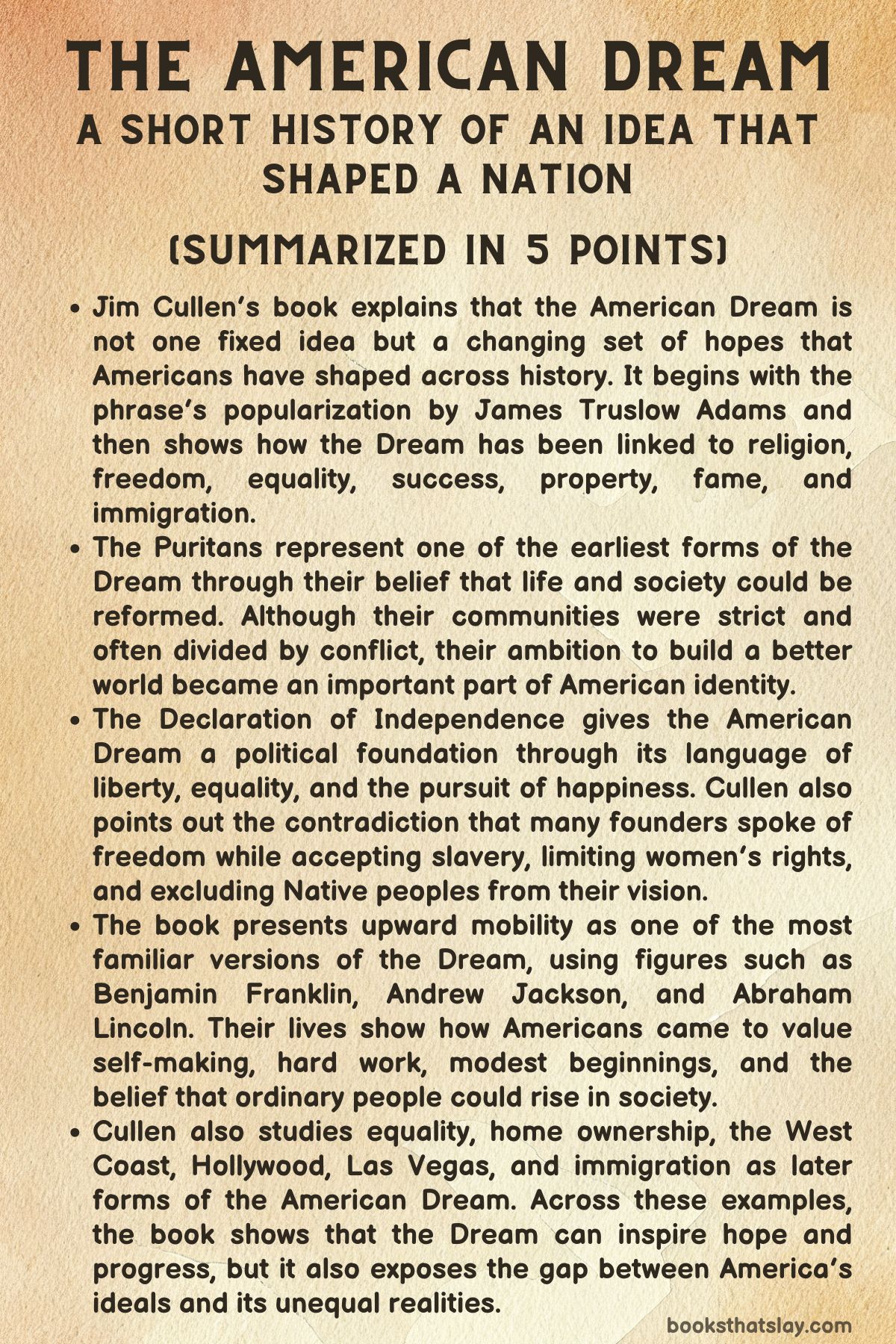
The American Dream: A Short History of an Idea that Shaped a Nation by Jim Cullen is a nonfiction study of one of America’s most powerful national ideas. Rather than treating the American Dream as one fixed promise, Cullen presents it as a set of changing hopes shaped by religion, politics, class, race, property, celebrity, immigration, and personal ambition.
The book follows how Americans have imagined a better life across different periods, from Puritan reformers and revolutionary leaders to civil rights activists, homeowners, immigrants, and seekers of fame or wealth. It shows the Dream as both inspiring and incomplete, a standard that reveals America’s ideals as well as its failures.
Summary
Jim Cullen’s The American Dream examines the phrase “American Dream” not as a simple slogan, but as a flexible national idea that has meant different things to different people across American history. The book begins by explaining how historian James Truslow Adams helped popularize the term in The Epic of America.
Adams described the Dream as more than material success; it was the hope that each person could live a better, fuller, and richer life according to ability and effort. Cullen argues that Americans often assume the Dream is real and good, yet they rarely agree on what it means.
This uncertainty is central to the book. The American Dream is presented as a shared language of hope, but also as a source of conflict because every version of it leaves some people out or depends on unequal conditions.
Cullen first turns to the Puritans, whose religious world seems far from modern American ambition but whose influence is essential. The Puritans are often remembered as stern, intolerant, and severe, but Cullen emphasizes their extraordinary belief that society could be remade.
Their Protestant faith taught them that reform was possible and necessary. Even though they believed in predestination, they also believed that discipline, preparation, community, and moral seriousness mattered.
In this sense, they helped create an early version of the Dream: the belief that human life, both spiritual and social, could be improved through effort and collective purpose.
The Puritans valued community life and civic participation. Their town meetings, religious discipline, and leaders such as John Winthrop showed a strong commitment to building a godly society.
Yet their own communities were full of tension. Disagreements over doctrine, land, authority, and personal freedom fractured the Puritan world.
Some settlers moved away from Massachusetts Bay in search of land and looser community control. Religious disputes also exposed the limits of their attempt to create harmony.
Cullen uses the Puritans to show that even the earliest American dreams contained contradiction: the desire for moral perfection existed beside conflict, exclusion, and human weakness.
The book then considers the Declaration of Independence as one of the most important foundations of the American Dream. Cullen presents the Declaration as a kind of charter for future dreams because its language of life, liberty, equality, and the pursuit of happiness has inspired generations.
The document gave Americans a way to imagine the gap between present injustice and future possibility. The revolution against Britain was first justified as a defense of colonial rights and long-standing autonomy, but the Declaration transformed it into a broader statement about freedom and human possibility.
At the same time, Cullen stresses the contradictions within the founding generation. Men such as Thomas Jefferson, George Washington, and John Adams spoke of liberty and equality, but their definitions were limited.
Many of them accepted slavery, ignored women’s political rights, and excluded Native peoples from their vision of equality. Jefferson’s idea of a republic still assumed that the most talented and virtuous men should guide public life.
The Declaration’s power, then, lies not because its authors fully lived up to it, but because its language could be used by later generations to challenge their failures. The American Dream becomes a promise that exposes hypocrisy as much as it inspires hope.
Cullen next explores upward mobility, one of the most familiar meanings of the Dream. This is the belief that people can rise in society through work, ambition, talent, education, business, or public achievement.
Benjamin Franklin becomes a key figure because his life showed how self-discipline, practical intelligence, and public usefulness could lead to success. Franklin inherited some habits from Puritan culture, especially moral discipline and plain expression, but he turned them toward worldly achievement.
He helped shape the idea that hard work could produce prosperity and that prosperity could also serve the public good.
Andrew Jackson represents a later change in the meaning of success. In earlier periods, humble origins might have been treated as something to overcome or hide.
With Jackson, modest beginnings became a source of pride. Rising from poverty became proof of strength and authenticity.
Cullen shows how this shift made upward mobility more central to American identity. Success was no longer only about wealth or status; it was also about the story of self-making.
Abraham Lincoln gives this dream its most serious political meaning. Lincoln believed deeply in the idea that ordinary people should have the chance to improve their condition.
For him, slavery threatened the nation not only because it was morally troubling, but because it damaged the possibility of free labor and social mobility. A society divided between slave labor and free labor could not preserve the promise that people might rise by effort.
Lincoln’s defense of the Union was therefore tied to his defense of a national future in which opportunity could survive.
Cullen then turns to equality, especially racial equality, as a dream that remained painfully unfinished after the abolition of slavery. Emancipation ended legal slavery, but it did not give Black Americans genuine equality.
Segregation, discrimination, violence, and Jim Crow laws created a system that denied both equal opportunity and equal treatment. Cullen distinguishes between equality of condition and equality of opportunity.
American political culture has often rejected the first as too radical, while praising the second as a national ideal. But for Black Americans living under segregation, even equality of opportunity was often an empty promise.
The civil rights movement becomes central to this part of the book. Martin Luther King Jr. is presented as one of the most important voices of the Dream of equality.
His famous vision was not separate from American ideals; it demanded that America take its own promises seriously. Cullen stresses that freedom alone was not enough if people remained trapped by poverty, discrimination, and exclusion.
King’s work showed that the American Dream had to include real equality, not just abstract language.
Cullen also gives attention to women in the civil rights movement, including Rosa Parks, Ella Baker, and Septima Clark. Parks’s refusal to surrender her bus seat helped ignite a major phase of the movement, but Cullen also recognizes the organizing work of women whose contributions are often less celebrated.
Their presence broadens the book’s understanding of equality by showing that social change depends not only on famous leaders but also on sustained local effort, education, courage, and organizing.
Another major version of the Dream is home ownership. Cullen traces this dream through America’s history as a land-seeking society.
For European settlers, land was wealth, independence, security, and identity. Government policies helped shape this dream by organizing land distribution and encouraging westward expansion.
Laws that opened land to settlers made ownership seem like a democratic promise, though this promise came at the expense of Native peoples and was often manipulated by speculators.
The rise of transportation also changed the meaning of home ownership. As cities grew, streetcars, cable cars, rail systems, and later automobiles allowed people to live outside urban centers while working within them.
This helped create suburbia, which became one of the most visible symbols of middle-class success. By the late twentieth century, most Americans lived in suburban areas.
The detached house became a sign of stability, privacy, achievement, and family life.
Yet Cullen also shows the exclusion built into this dream. For much of suburban history, Black Americans and other minorities were blocked from many neighborhoods through discrimination, custom, policy, and intimidation.
Places like Levittown became symbols of mass home ownership but also of racial exclusion. Still, Cullen notes that immigrant families often held strongly to the dream of owning a home, seeing it as evidence of arrival, security, and belonging.
The book then examines the Dream of the Coast, especially through Las Vegas and California. Las Vegas represents the dream of getting something for nothing, a world of gambling, entertainment, risk, quick reward, and escape from ordinary rules.
Its growth depended on railroads, federal investment, military activity, permissive state laws, and the business of pleasure. Cullen presents Vegas as an extreme version of American wishing: the hope that fortune might arrive suddenly and transform life.
California offers a different but related dream. Its history includes conquest, migration, land hunger, and the Gold Rush, which promised sudden wealth to those willing to chase it.
Later, California became the center of the film industry. Hollywood turned fame, beauty, luxury, and self-invention into mass fantasies.
Figures such as Douglas Fairbanks, Mary Pickford, Charlie Chaplin, and D. W. Griffith helped create a world in which celebrity itself became a kind of dream. The values of Hollywood were far removed from Puritan discipline, yet both belonged to the long history of American aspiration.
Cullen ends by considering immigration as a continuing version of the Dream of upward mobility. Immigrants have often been described as the backbone of American society, but they have also faced suspicion, hostility, and accusations that they refuse to assimilate or threaten wages.
Cullen recognizes this conflict but argues that American history has generally moved toward broader opportunity and greater acceptance. The immigrant dream reminds readers that the American Dream is not owned by one group.
It is a shared but contested ground where people imagine better lives, argue over belonging, and measure America against its own promises.
Key Figures
Jim Cullen
Jim Cullen is the guiding intellectual presence of The American Dream, and his role is less that of a storyteller than of an interpreter of national belief. He approaches the American Dream as a historian who is interested in how ideas change over time, how they gain emotional force, and how they survive even when reality contradicts them.
Cullen does not present the Dream as a single, pure ideal. Instead, he treats it as a family of dreams that includes religious reform, political liberty, upward mobility, racial equality, home ownership, celebrity, wealth, leisure, and immigrant success.
His importance in the book comes from his ability to connect different periods of American history without pretending that they all say the same thing. Cullen is also careful about contradiction.
He admires ambition, hope, courage, and reform, but he repeatedly shows how American ideals have existed beside exclusion, racism, class inequality, and hypocrisy. His voice is analytical rather than sentimental, and he asks readers to see the Dream not only as a comforting belief but also as a standard by which America can be judged.
James Truslow Adams
James Truslow Adams is important because he gave the phrase “American Dream” much of its modern public identity. In the book, he represents the act of naming something that had existed before him in many forms.
By popularizing the term, Adams helped turn a scattered set of national hopes into a recognizable concept. His idea of the Dream was not limited to money or luxury.
It involved the possibility of a richer and better life for people according to their abilities and efforts. This matters because Cullen uses Adams as a starting point for the larger argument of The American Dream: Americans may believe strongly in the Dream, but they do not always agree on what it means.
Adams’s role is therefore both historical and symbolic. He shows how a phrase can gather power, become part of national language, and shape the way a country explains itself to itself and to the world.
William Bradford
William Bradford stands for the separatist Puritan impulse that shaped early colonial dreams of religious reform. In the book, he represents a group of believers who felt that the Anglican Church was too corrupt to be repaired from within.
His decision to leave that religious structure reflects a larger American pattern: the belief that if an existing institution is impure, oppressive, or broken, people can leave and attempt to build something better. Bradford’s significance lies in his connection to disciplined faith, sacrifice, and the desire for a purified community.
Yet his world also reveals the limits of idealism. The Puritan dream of reform did not create perfect peace, and the communities that emerged from this vision were marked by disagreement, rigidity, and exclusion.
Bradford is important because he shows one of the earliest versions of American hope as a religious project, grounded in obedience, conviction, and the desire to remake life according to higher principles.
John Winthrop
John Winthrop represents the communal side of the Puritan imagination. As a major figure in Massachusetts Bay, he stands for the belief that society should be organized around shared moral duty rather than individual desire alone.
In the book, Winthrop’s importance comes from his association with civic participation, religious seriousness, and the idea that a community could become an example to others. He helps show that early American dreams were not always about private success.
For the Puritans, the good life depended on collective discipline and mutual responsibility. Yet Winthrop’s vision also raises difficult questions about authority and conformity.
A community built around a single moral purpose can inspire cooperation, but it can also punish dissent. His role in the story is therefore double-sided.
He represents one of America’s earliest attempts to connect moral ambition with public life, but he also reminds readers that dreams of unity can become harsh when they leave little room for difference.
Thomas Jefferson
Thomas Jefferson is one of the most complicated figures in the book because he gives some of the American Dream’s most powerful language while also embodying its contradictions. As the principal author of the Declaration of Independence, he helped create a political vocabulary of life, liberty, equality, and the pursuit of happiness.
That language became a foundation for future generations who demanded freedom and justice. Jefferson’s words outgrew the limits of his own world.
At the same time, his vision of equality was restricted. He did not imagine full political equality for women, enslaved people, or Native peoples, and he believed that public life should be guided by men of talent and virtue.
His role in The American Dream is therefore not simply heroic or hypocritical, but historically revealing. He shows how ideals can be both sincere and incomplete, and how later generations can use founding promises to challenge the failures of the founders themselves.
George Washington
George Washington appears as part of the founding generation whose dream was centered on freedom from British rule and the creation of an independent republic. In the book, he represents leadership, national formation, and the transition from colonial resistance to self-government.
Washington’s importance lies not in a detailed personal portrait but in what he stands for within the revolutionary imagination. He belongs to a group of elite men who saw British authority as a threat to colonial autonomy and who helped turn that grievance into a national struggle for liberty.
Yet his presence also carries the contradictions of the founding era. Like other founders, he lived in a society where the language of liberty coexisted with slavery and exclusion.
Washington therefore represents both the achievement of independence and the limits of the early American promise. His role reminds readers that the birth of the nation was also the birth of unresolved questions about who would truly share in freedom.
John Adams
John Adams represents the intellectual and political seriousness of the revolutionary generation. In the book, he appears among the founders who understood the American Dream largely as freedom from imperial control and the right to govern themselves.
His importance comes from his connection to republican thought, public virtue, and the effort to justify independence as more than rebellion. Adams helps show that the revolutionary dream was not merely emotional anger against Britain; it was also an argument about law, rights, representation, and the proper basis of political authority.
At the same time, his presence within the founding group also points to the restricted nature of early American equality. The men who built the republic spoke in universal terms while often thinking within narrow social boundaries.
Adams’s role is therefore tied to both principle and limitation. He reflects a generation that created enduring political ideals while leaving future Americans to fight over their full meaning.
Thomas Paine
Thomas Paine is the popularizer of revolutionary freedom. In the book, he matters because he helped persuade colonists to see their relationship with Britain as a form of bondage rather than merely a political dispute.
His pamphleteering transformed frustration into a broader argument for independence. Paine’s power lies in his directness.
He could take complex political tensions and express them in language that ordinary readers could understand and feel. In terms of the American Dream, Paine represents the ability of words to move people toward a new future.
He helped make freedom seem urgent, possible, and necessary. His role also shows how dreams need public language in order to spread.
Without writers and speakers who can give shape to popular feeling, political ideals may remain abstract. Paine’s importance comes from turning colonial grievance into a democratic call for action.
Benjamin Franklin
Benjamin Franklin is one of the clearest figures of upward mobility in the book. He represents the self-made person whose discipline, intelligence, practical habits, and public usefulness produce success.
Franklin’s life gives shape to a version of the American Dream based on self-improvement. Unlike the Puritans, whose discipline was centered on religious salvation and communal holiness, Franklin directed discipline toward worldly achievement and civic contribution.
His rise in the newspaper business, his fame, and his reputation for practical wisdom made him an early model of American success. Yet Franklin’s meaning is not merely financial.
He stands for the belief that personal improvement and public benefit can support each other. In the book, Franklin becomes a bridge between older religious habits and modern ambition.
He makes success look moral, useful, and available to those who cultivate the right habits.
Andrew Jackson
Andrew Jackson represents a shift in American attitudes toward humble origins. In the book, his importance lies in the way poverty and rough beginnings become signs of authenticity rather than shame.
Jackson’s rise helped strengthen the idea that a person’s lack of inherited privilege could become part of his claim to greatness. He stands for a more aggressive and democratic version of upward mobility, one in which self-making is linked to toughness, pride, and popular appeal.
Jackson’s presence also suggests that the Dream can carry harsh energies. The celebration of the self-made man may honor resilience, but it can also overlook violence, exclusion, and domination.
His role is therefore important because he shows how American admiration for hard beginnings can become politically powerful. Jackson helps transform success from a matter of refinement into a matter of struggle, will, and public identity.
Abraham Lincoln
Abraham Lincoln is one of the book’s most significant figures because he gives the Dream of upward mobility a moral and national dimension. His own rise from modest beginnings made him a living example of the belief that effort and ability could lift a person in society.
But Lincoln’s importance in The American Dream goes beyond biography. He believed that the United States represented a rare political experiment in which ordinary people could improve their condition.
Slavery threatened that experiment because it created a society where labor was degraded and opportunity was blocked. Lincoln’s opposition to the spread of slavery was tied to his belief in free labor, national unity, and the preservation of a country where mobility remained possible.
His role is complex because Cullen notes that Lincoln was not always focused on slavery in the same way later readers might expect. Still, he becomes a central figure because he links personal advancement, democratic hope, and national survival.
Martin Luther King Jr.
Martin Luther King Jr. represents the Dream of equality in its most powerful modern form. In the book, King is not treated only as a civil rights leader but as a major interpreter of American ideals.
His genius was to demand that the nation honor its own promises. He did not reject the language of the Declaration of Independence; he used it to expose the injustice of segregation and racial discrimination.
King’s vision shows that freedom without equality is incomplete. Legal rights mean little when people are denied education, safety, dignity, fair treatment, and genuine opportunity.
Cullen also recognizes King’s personal shortcomings, which makes the portrait more human and less idealized. King’s importance lies in his ability to connect moral urgency with national memory.
He made the American Dream a demand rather than a slogan, insisting that the country’s highest words had to become lived reality.
Rosa Parks
Rosa Parks represents quiet courage, disciplined resistance, and the power of a single act within a larger movement. In the book, she is associated with the refusal to give up her seat to a white passenger, an act that helped ignite a major phase of the civil rights movement.
Parks’s significance is often simplified in popular memory, but Cullen’s attention to her role places her within the broader struggle for equality. She was not merely tired in a personal sense; her action carried political meaning because it challenged a system designed to humiliate Black citizens in daily life.
Parks shows how the Dream of equality depends on people willing to confront injustice in ordinary public spaces. Her role also demonstrates that social change is not only made through speeches and laws.
It is also made through acts of refusal that reveal the moral ugliness of accepted customs.
Ella Baker
Ella Baker represents the organizing intelligence behind social change. In the book, her importance lies in the recognition that movements are not sustained by famous leaders alone.
Baker’s work points to the value of local leadership, grassroots participation, and patient institution-building. She stands for a democratic approach to activism in which ordinary people are not simply followers but active makers of change.
Her role is essential because the Dream of equality requires more than symbolic moments; it requires networks, meetings, education, strategy, and trust. Baker’s presence also broadens the gendered understanding of the civil rights movement.
Women were not marginal to the struggle; they were central to its daily strength. Baker shows that the work of equality often happens away from the spotlight, through persistence and the belief that people can claim power together.
Septima Clark
Septima Clark stands for education as a form of liberation. In the book, she is one of the women whose civil rights work helped turn the Dream of equality into practical action.
Clark’s significance lies in her connection to teaching, citizenship, and empowerment. The right to vote, the right to participate, and the right to be treated as an equal citizen require knowledge as well as legal change.
Her work shows that education can become a political force when it helps people understand their rights and act on them. Clark also represents the long labor behind public victories.
Movements need speeches and court cases, but they also need classrooms, local leaders, and people who help others gain confidence. Her role in the story reminds readers that equality is built through preparation, instruction, and community strength.
Douglas Fairbanks
Douglas Fairbanks represents the rise of Hollywood glamour and the transformation of fame into a modern dream. In the book, he appears as part of the early motion picture world that helped make California a center of fantasy, wealth, and public fascination.
Fairbanks’s importance comes from his association with celebrity culture and with the mansion known as Pickfair, which captured the popular imagination. He stands for a version of success far removed from Puritan discipline or revolutionary sacrifice.
Here, the Dream is tied to visibility, charm, luxury, entertainment, and the ability to reinvent oneself before a mass audience. Fairbanks helps show how American aspiration moved into the realm of images.
The good life became something people could watch, admire, and desire through film culture.
Mary Pickford
Mary Pickford represents celebrity, self-invention, and the power of film to shape popular dreams. In the book, she appears alongside Douglas Fairbanks as part of a Hollywood world that fascinated Americans and helped define the Dream of the Coast.
Pickford’s importance lies not only in her fame but in the way her public image became part of a larger cultural fantasy. She helped make Hollywood seem like a place where beauty, talent, wealth, and admiration could gather in one life.
Her association with Pickfair made her domestic space itself a symbol of success. Pickford’s role shows how the American Dream could shift from land, virtue, or political liberty toward performance and recognition.
She embodies a modern form of aspiration in which being seen becomes part of achievement.
Charlie Chaplin
Charlie Chaplin represents the creative force of early Hollywood and the international reach of American entertainment. In the book, he appears as one of the founders of United Artists, which connects him to the business and artistic development of the film industry.
Chaplin’s role matters because he shows how the Dream of the Coast was not only about passive luxury but also about creative control. Hollywood attracted artists who wanted space, freedom, profit, and independence from older centers of power.
Chaplin’s comic genius and global fame made him part of a new kind of American success, one built through mass media. His presence also shows that the American Dream could be exported through images, gestures, and stories that crossed national boundaries.
D. W. Griffith
D. W. Griffith represents the ambition and influence of early American filmmaking. In the book, his presence alongside Fairbanks, Pickford, and Chaplin places him within the formation of Hollywood as both an industry and a dream factory.
Griffith’s importance lies in the scale of cinematic imagination associated with early film. The move of filmmakers from New York to California was partly practical, shaped by legal and business pressures, but it also created a new cultural geography.
Griffith stands for the artistic and commercial energy that helped make California central to American fantasy. His role also reminds readers that dreams created through film are never innocent.
Cinema can inspire, entertain, and expand desire, but it can also carry the values and prejudices of its time.
The Immigrant Women Entrepreneurs
The immigrant women who appear near the end of the book represent the Dream of the immigrant as a living form of upward mobility. Although they are not presented with the same historical prominence as presidents, founders, or civil rights leaders, their role is deeply important.
They stand for ordinary people who come to America seeking opportunity and who try to build security through work, partnership, and enterprise. Their successful business becomes a small but meaningful example of the larger immigrant dream: arrival, effort, adaptation, and achievement.
They also represent the tension surrounding immigration in American life. Immigrants have often been praised as hardworking contributors while also being blamed for social and economic problems.
These women help bring the book’s argument into the present by showing that the Dream continues through practical labor, risk, and hope.
Themes
The American Dream as a Changing Idea
The central idea in The American Dream is not fixed, and that flexibility is what gives it lasting power. Cullen presents the Dream as a set of related desires rather than a single definition.
For the Puritans, it meant building a reformed religious community. For the revolutionaries, it meant freedom from imperial rule and the right to pursue happiness.
For figures such as Franklin, Jackson, and Lincoln, it became tied to upward mobility and self-making. For civil rights activists, it demanded equality.
For homeowners, immigrants, gamblers, and Hollywood celebrities, it took still other forms. This variety shows why the Dream has remained so influential: it can be adapted to different needs, classes, regions, and historical moments.
Yet this same flexibility also creates conflict. If everyone claims the Dream but defines it differently, then it becomes a battleground over values.
Cullen’s treatment suggests that the Dream survives because it is both personal and national. It gives individuals a way to imagine better lives, but it also gives the country a standard against which its failures can be judged.
Freedom and Its Limits
Freedom appears throughout the book as one of America’s most powerful promises, but Cullen repeatedly shows that freedom has rarely been distributed equally. The revolutionary generation spoke boldly about liberty while accepting slavery, denying women political equality, and excluding Native peoples from their moral framework.
The Declaration of Independence created language that could inspire future reform, but its original social world was narrow. This tension becomes one of the most important patterns in the book.
American history often moves through the gap between what the nation says and what it allows. Freedom is celebrated as a national birthright, but many groups have had to fight to be included in its meaning.
Cullen does not dismiss freedom as false; instead, he shows that its power lies partly in its incompleteness. Because the promise exists, later generations can use it as evidence against injustice.
The Dream of freedom therefore works as both inspiration and accusation. It calls people forward, but it also exposes the distance between American ideals and American realities.
Upward Mobility and Self-Making
The belief that people can rise through effort is one of the most recognizable forms of the American Dream. Cullen traces this idea through figures such as Benjamin Franklin, Andrew Jackson, and Abraham Lincoln, each of whom represents a different stage in the development of self-making.
Franklin turns discipline, practical intelligence, and work into a model of useful success. Jackson makes humble origins a badge of honor, suggesting that a rough beginning can become proof of strength.
Lincoln gives upward mobility a national and moral meaning by linking it to free labor and the survival of the Union. Yet Cullen also shows that this dream depends on conditions that are not equally available to everyone.
Hard work alone cannot overcome slavery, segregation, racial exclusion, gender barriers, or economic structures that block opportunity. The idea of mobility is powerful because it encourages ambition and dignity, but it can also become misleading when it ignores unequal starting points.
Cullen’s treatment of this theme is careful: he recognizes the beauty of self-improvement while questioning the myth that success is available to all on the same terms.
Equality as an Unfinished Promise
Equality is presented as one of the most demanding versions of the Dream because it asks America to move beyond inspiring language and confront social reality. The end of slavery did not create equal citizenship for Black Americans.
Segregation, Jim Crow laws, racial violence, and unequal institutions made freedom incomplete. Cullen’s discussion of civil rights shows that equality required organized struggle, moral pressure, legal challenges, and personal courage.
Martin Luther King Jr. becomes central because he insists that America must honor its own promises, but Cullen also highlights women such as Rosa Parks, Ella Baker, and Septima Clark to show that movements depend on many forms of labor. Equality in the book is not only a legal idea.
It includes dignity, access, recognition, education, safety, and a genuine chance to participate in society. This theme matters because it reveals the Dream at its most morally serious.
A country may celebrate opportunity, freedom, and success, but those ideals remain hollow if large groups are denied the conditions needed to pursue them.