The Aspern Papers Summary, Characters and Themes
The Aspern Papers is a short novel by Henry James about literary obsession, privacy, and moral compromise. Set in Venice, it follows an unnamed editor who believes that Juliana Bordereau, once connected to the celebrated poet Jeffrey Aspern, possesses valuable private letters.
To gain access to them, he rents rooms in her decaying house under false pretenses and manipulates her niece, Tita. What begins as literary research becomes an uneasy study of greed, secrecy, loneliness, and the limits of devotion to art. The book asks how far admiration can go before it becomes exploitation.
Summary
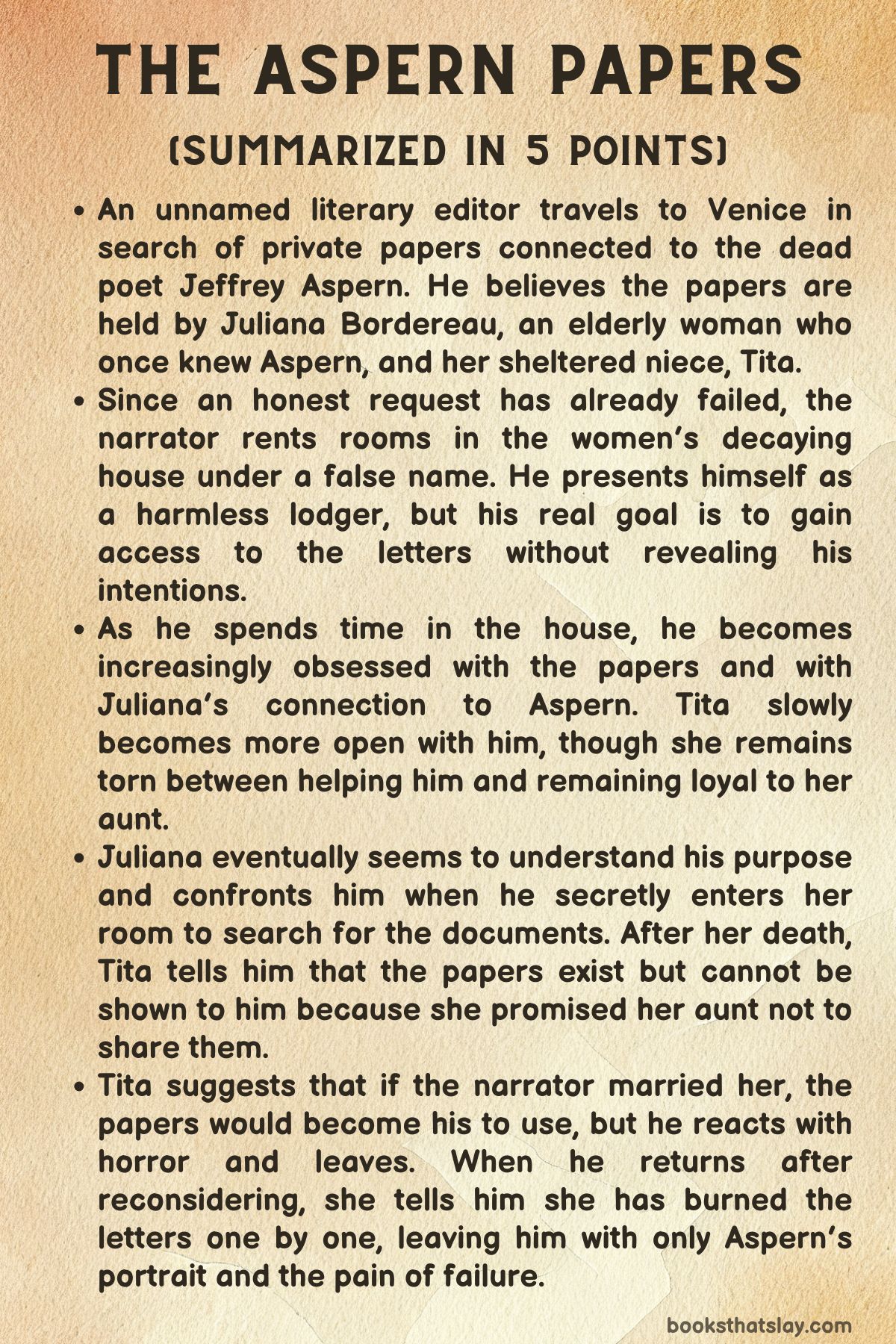
The story begins with an unnamed narrator arriving in Venice from England with a private mission. He is an editor, critic, and devoted admirer of Jeffrey Aspern, a dead poet whose reputation he treats almost with religious reverence.
To him, Aspern is not merely a writer; he is a figure of genius whose life and work deserve preservation. The narrator believes that some unpublished papers connected to Aspern still exist, and that they are in the possession of two women living quietly in Venice: the elderly Juliana Bordereau and her niece, Tita.
Juliana is believed to have had a romantic relationship with Aspern many years earlier, and the narrator is convinced that letters or documents from that period could reveal important details about the poet’s life.
The narrator’s friend, Mrs. Prest, gives him the idea that shapes his plan. Since direct inquiries have already failed, he should become a lodger in the women’s house.
John Cumnor, another scholar interested in Aspern, previously tried to obtain the papers by asking openly, but the women denied having them. Because of this, the narrator decides that he must be indirect.
He will conceal his real identity, use a false name, and present himself as a harmless foreign gentleman seeking rooms in Venice. He also considers gaining influence over Tita, believing that her loneliness and lack of experience may make her vulnerable to his attention.
Mrs. Prest shows him the Bordereau house, a large and fading Venetian residence. The place seems grand but neglected, suggesting both former wealth and present decline.
The narrator doubts whether the women would take in a lodger, but Mrs. Prest explains that they are not rich, despite the size of their home. This detail encourages him.
Money may open the door that courtesy and scholarship could not. He understands that he must proceed with care, because any sign of his true purpose could ruin the attempt.
When he visits the house, he is admitted by a servant who appears surprised to see a stranger. Tita comes to meet him, and the narrator quickly begins shaping his performance.
He praises the garden, noticing that it may give him a useful reason to seem interested in the property. He tells Tita that he has been looking for a house with a garden and would even hire someone to fill it with flowers.
He presents himself as an eccentric but respectable gentleman who wants quiet rooms for reading and writing. He does not immediately reveal his desire to rent space in the house, but eventually asks whether he may take some rooms.
Tita says she must ask her aunt.
The next day, the narrator meets Juliana Bordereau. The meeting deeply affects him because she seems to carry a living trace of Jeffrey Aspern.
Her age, secrecy, and connection to the poet make her almost sacred in the narrator’s imagination. Juliana, however, is not sentimental.
She asks practical questions and makes it clear that he may rent rooms if he is willing to pay a very high price. The amount shocks him, but he feels unable to bargain with someone he associates so strongly with Aspern.
He accepts the arrangement, even though he knows the cost is unreasonable. Later, Tita explains that Juliana is concerned about her future.
The money is meant to support Tita after her aunt dies.
After moving in, the narrator expects opportunities to appear quickly, but little happens. Weeks pass, and he barely sees the two women.
Mrs. Prest leaves Venice for the summer and advises him to be bolder, but he feels blocked. He cannot simply force his way into Juliana’s confidence.
The house gives him a strange pleasure because living there makes him feel closer to Aspern. He keeps the garden blooming as promised and imagines the past relationship between Aspern and Juliana, but he gains no real access to the papers.
One evening, after returning from time spent outside in Venice, the narrator finds Tita in the garden. She is nervous about being alone in the dark and seems glad to speak with him.
Their conversation becomes unusually open. Tita tells him that Juliana’s health appears to be weakening and that her aunt has recently wanted less attention from her.
The narrator wonders whether this encounter has been arranged to test him, but he continues talking. Tita describes earlier days when she and Juliana were more socially active in Venice.
As she prepares to go inside, she asks what he reads and writes. He answers that he often reads Jeffrey Aspern.
Tita says that Juliana used to know Aspern as a visitor but no longer speaks of him. When Tita asks whether he writes about Aspern, the narrator knows he should lie, but he cannot completely hide the truth.
He admits that he is searching for more material about the poet. Tita immediately becomes alarmed and leaves.
After this, she avoids him for two weeks.
Eventually, Tita tells him that Juliana wishes to see him. The narrator suspects that Tita may have told her aunt about his interest in Aspern, but Tita says she has not.
Juliana claims that she called him in to thank him for the flowers he has been sending. He had stopped sending them after Tita began avoiding him, and now he resolves to continue.
Juliana suggests that he take Tita out in his gondola so she can see how Venice has changed. This suggestion gives the narrator another chance to speak privately with Tita.
During their outing, Tita becomes more direct. She tells him that Juliana feared he might leave the house, which would mean losing the rent.
She advises him to give up his reasons for staying and go away. She also tells him that Juliana will never give him the Aspern papers.
The narrator presses her for information, asking whether the papers might contain painful memories or references to some past event that made Juliana suspicious. Tita is unsure but suggests that the papers may hold personal significance.
She confirms that Juliana loves them too much to destroy them casually, though she might burn them when death is near. The narrator asks Tita to prevent that.
Tita cannot promise control over her aunt, but she says she will try to help him.
Juliana later speaks with the narrator about whether he will remain longer in the house. She asks him about his writing and whether he makes money from it.
When he says that he is a critic and historian, she questions whether it is right to disturb the past. This makes him suspect that she knows why he is there.
His suspicion grows when she shows him a miniature portrait of Aspern and asks his opinion of its value. He believes she is testing or taunting him, so he pretends not to recognize the subject.
Soon afterward, Tita urgently asks him to find a doctor because she thinks Juliana is dying. He sends his servant for medical help and goes with Tita to Juliana’s rooms.
While there, he notices the room and thinks about where the papers might be hidden. Tita says that “those things” were once kept in a trunk, which alarms him because her wording suggests they may have been moved.
When the doctor arrives, the narrator leaves the room and waits anxiously. Tita later tells him that Juliana is not in immediate danger.
The narrator asks about the letters, and Tita says they have been moved from the trunk. She has looked for them but feels it would be wrong to continue searching while Juliana remains in the room.
At this point, the narrator admits more of the truth to Tita. He confesses that he came to the house for the papers and that he has been using a false name.
Later that night, after walking through Venice, he returns to the darkened house and gives in to temptation. Believing the papers may be hidden in a desk, he enters Juliana’s room secretly.
He is about to try opening it when he turns and sees Juliana watching him. She calls him a publishing scoundrel.
As he moves toward her, she collapses into Tita’s arms.
The narrator is deeply shaken. When he learns that Juliana has survived the incident, he leaves Venice and travels to nearby cities.
After twelve days, his servant informs him that Juliana has died. The narrator returns to the house and meets Tita in the garden.
She has clearly been grieving. He is careful not to ask immediately about the papers, partly because he wants to appear decent and partly because he fears what Tita may expect from him.
The next day, Tita tells him that there are many papers, but he may not see them. She explains that she stopped Juliana from burning them, but she also promised not to share them.
She gives him the miniature portrait of Aspern as a gift. When the narrator says he will leave Venice, Tita asks him to stay a little longer.
Then she suggests that everything would be different if he were a relation. Her meaning is clear: if he married her, what belonged to her would belong to him, including the papers.
The narrator is horrified by the idea. He leaves the house and considers the proposal with disgust, thinking that he cannot marry Tita simply to obtain old letters.
Yet by morning, his ambition overpowers his revulsion. He begins to think marriage may be a small price to pay for the papers.
When he returns to Tita, he is still undecided, but her expression softens him. Just as he is close to accepting, she says goodbye.
She has understood his reaction from the previous day and has acted. She tells him she burned the letters one by one during the night.
The narrator loses the object of his entire scheme. Later, he sends Tita money for the miniature, pretending that he sold it for her, though he actually keeps it above his writing table.
The portrait becomes a painful reminder of his failure, his deception, and the vanished papers he was never able to possess.
Characters
The Narrator
The narrator is the central figure of The Aspern Papers, and his character is built around obsession disguised as scholarship. He sees himself as a devoted guardian of Jeffrey Aspern’s literary legacy, but his actions reveal a deep willingness to violate other people’s privacy for professional and personal gain.
He is intelligent, observant, and patient, yet those qualities often serve manipulation rather than honesty. His decision to use a false name shows that he understands the moral weakness of his plan from the beginning.
He does not simply make a mistake under pressure; he enters the Bordereau house with deception already chosen as his method. His reverence for Aspern also distorts his judgment.
Because he treats the poet’s memory as sacred, he begins to treat Juliana and Tita less as people and more as obstacles or instruments. His greatest flaw is not only greed for the papers, but the way he justifies that greed as cultural service.
By the end of the book, his humiliation is complete. He loses the letters, fails to control Tita, and is left with only the portrait, which becomes a symbol of what his ambition cost him.
He is not a simple villain, because he is capable of shame, hesitation, and self-awareness, but those qualities arrive too late to save him from moral failure.
Juliana Bordereau
Juliana Bordereau is one of the strongest and most mysterious presences in the book. Though she is physically old and near death, she controls much of the story through secrecy, suspicion, and memory.
Her connection to Jeffrey Aspern gives her power over the narrator, because she possesses what he desperately wants: personal access to a hidden past. Juliana understands the value of what she has, both emotionally and financially.
Her demand for high rent shows that she is practical and far from helpless. She may be elderly and isolated, but she knows how to use the narrator’s desire against him.
Her question about whether it is right to disturb the past reveals her moral position. To her, private experience should not automatically become public property just because a famous man is involved.
She protects the papers because they belong to a part of her life that the narrator cannot respect in human terms. Her final confrontation with him is one of the book’s sharpest moments, because she sees through the mask he has worn and names him according to his actions.
In calling him a publishing scoundrel, she exposes the violence hidden beneath his polite manners. Juliana’s power lies in her refusal to surrender her past to someone who treats memory as material.
Tita Bordereau
Tita Bordereau is the most emotionally vulnerable character in The Aspern Papers, but she is not as powerless as she first appears. At the beginning, she seems timid, sheltered, and dependent on Juliana.
She has spent much of her life in her aunt’s shadow, cut off from normal society and trained into habits of obedience. The narrator initially sees her as someone he can influence, perhaps even seduce, in order to reach the papers.
Yet Tita’s emotional life is more complex than he imagines. She is lonely and responsive to kindness, but she also has a strong sense of duty.
Her sympathy for the narrator conflicts with her loyalty to Juliana, and much of her character develops through that conflict. She helps him to a point, but she does not fully betray her aunt.
After Juliana dies, Tita briefly holds power over the narrator because the papers have passed into her control. Her suggestion of marriage is both desperate and practical.
She wants connection, security, and perhaps affection, but she also understands that the narrator values the papers enough to consider almost anything. When she burns the letters, she makes her most decisive act.
She refuses to be merely a tool in his literary pursuit. That act transforms her from a passive figure into the person who finally determines the fate of Aspern’s private legacy.
Jeffrey Aspern
Jeffrey Aspern is dead before the story begins, but his presence dominates the novel. He exists through memory, reputation, rumor, and the objects connected to him.
For the narrator, Aspern is a heroic literary figure whose genius justifies almost endless investigation. For Juliana, he appears to belong to a private emotional past, one that may include love, pain, pride, and betrayal.
For Tita, he is partly inherited memory, someone important because her aunt’s life has been shaped by him. The important point about Aspern is that the reader never fully receives him directly.
He is filtered through other people’s needs and fantasies. The narrator wants an ideal Aspern, one who can be preserved and studied.
Juliana protects an intimate Aspern, one not available to scholars or readers. The missing papers represent the gap between public fame and private truth.
Aspern’s character therefore functions less as an active person and more as the force that reveals the living characters. The narrator’s worship of him exposes vanity.
Juliana’s silence exposes wounded dignity. Tita’s final destruction of the letters protects the boundary between life and publication.
In The Aspern Papers, Aspern is powerful because absence makes him available to everyone’s imagination.
Mrs. Prest
Mrs. Prest is practical, worldly, and socially perceptive. She is the person who gives the narrator the idea of entering the Bordereau household as a lodger, and her role is important because she helps turn his desire into a plan.
Unlike the narrator, she does not seem burdened by romantic reverence for Aspern. She looks at the situation in social and strategic terms.
She knows Venice, understands the women’s circumstances, and recognizes that money may persuade them where direct requests have failed. Her advice reveals the casual ruthlessness of the narrator’s social circle: deception is treated less as a moral problem than as a clever tactic.
Yet Mrs. Prest also serves as a contrast to the narrator. She sees the practical difficulty of the scheme and urges him to act more boldly when he seems stalled.
She is not emotionally invested in the papers in the same way, so she can view the matter with a cooler eye. Her presence at the beginning and end frames the narrator’s adventure as both a literary mission and a social intrigue.
She does not commit the worst actions herself, but she helps create the conditions in which they become possible.
John Cumnor
John Cumnor is a minor but important figure because his failed attempt to obtain the papers shapes the narrator’s entire strategy. He represents the more direct scholarly approach: he asked about the documents and was refused.
His failure teaches the narrator that honesty will not work with the Bordereau women, or at least that the narrator believes honesty will not work. Cumnor’s role also shows that the hunt for Aspern’s papers is not merely personal curiosity.
There is a small network of literary men who want access to the private remains of a famous writer, and they treat those remains as treasures that should belong to scholarship. Cumnor’s rejection gives the narrator a reason to use secrecy, but it also removes any excuse of innocence.
The narrator knows in advance that Juliana does not want to share the papers. By continuing, he knowingly violates her refusal.
Cumnor therefore functions as the story’s warning sign. His earlier failure proves that the women’s boundaries have already been stated, and the narrator’s decision to go further becomes more morally serious because of it.
The Maidservant
The maidservant has a small role, but she helps establish the strange isolation of the Bordereau house. Her surprise at seeing a visitor suggests that the household is not accustomed to ordinary social contact.
Through her, the reader senses that Juliana and Tita live in a closed world, protected from outside intrusion and perhaps trapped by habit. The maidservant also reinforces the atmosphere of secrecy that surrounds the house.
She does not need a complex inner life in the story to serve an important function. Her presence makes the narrator’s entrance feel like a disturbance.
He is not simply renting rooms in a normal home; he is entering a guarded space where visitors are unusual and every movement carries meaning. In this way, the maidservant becomes part of the social barrier the narrator must cross.
She reflects the household’s stillness, its age, and its distance from the active public world that the narrator represents.
The Narrator’s Servant
The narrator’s servant appears briefly, but his role reveals the narrator’s dependence on others even while he imagines himself as the master of the situation. When Juliana seems close to death, the narrator sends his servant for the doctor.
This action shows the practical machinery behind the narrator’s life: he can move through Venice and execute his plans because other people perform necessary tasks around him. The servant also becomes a source of information when the narrator leaves Venice and later learns that Juliana has died.
Though the servant is not developed psychologically, he supports the plot by connecting the narrator to events inside the house when the narrator is absent or unable to act directly. His presence also emphasizes class privilege.
The narrator can pursue rare documents, rent expensive rooms, and manage a private scheme because he has the means and assistance to do so. The servant quietly reflects the social world that makes the narrator’s literary ambition possible.
The Doctor
The doctor’s role is brief but meaningful because he enters the story at the moment when Juliana’s body and the narrator’s desire collide. His arrival reminds the reader that Juliana is not only a keeper of papers or a relic of Aspern’s past; she is a dying woman in need of care.
For Tita, the doctor represents urgent help and human concern. For the narrator, however, the medical crisis becomes entangled with the chance to locate the papers.
While Juliana’s life is in danger, he is already looking around the room and thinking of hidden documents. The doctor therefore helps expose the narrator’s moral disorder.
The scene should be about illness, fear, and possible death, but the narrator’s mind turns toward possession. The doctor’s ordinary professional presence contrasts with the narrator’s secret hunger.
He belongs to the world of care and practical necessity, while the narrator remains absorbed in literary acquisition.
Themes
The Violation of Privacy
Privacy stands at the center of the story because the narrator’s goal depends on crossing a boundary that Juliana has already defended. The papers he wants are not public works prepared for readers; they are private remains of a relationship, carrying emotional meanings that outsiders cannot fully know.
His belief that Aspern’s fame gives scholars a right to these materials is one of the book’s most troubling ideas. He treats literary history as a higher cause, but the story steadily shows how easily that cause becomes an excuse for intrusion.
Juliana’s resistance is not simple stubbornness. It is a defense of her own life against people who would reduce her memories to evidence.
Tita’s final burning of the letters may seem like a loss to scholarship, but it is also an act of protection. She prevents the narrator from turning intimate experience into professional achievement.
The Aspern Papers refuses to assume that the famous dead belong entirely to the public. It asks whether admiration for art can justify taking what the living and the dead chose to keep hidden.
Obsession and Moral Self-Deception
The narrator’s obsession is dangerous because he rarely sees it as selfish. He convinces himself that he is serving literature, preserving history, and honoring Aspern’s genius.
Yet his actions show a steady movement away from integrity. He lies about his name, rents rooms under false pretenses, studies Tita’s vulnerability, considers emotional manipulation, and finally sneaks into Juliana’s room.
At each stage, he knows enough to feel tension, but he keeps going because the goal seems too valuable to abandon. This is the pattern of moral self-deception in the story: the narrator does not think of himself as cruel, yet he behaves cruelly when his desire is threatened.
His worship of Aspern allows him to feel noble while acting dishonorably. The most disturbing part of his character is not that he wants the papers, but that he keeps finding ways to make his wanting seem justified.
His final pain is therefore double. He suffers because the papers are lost, but he also has to live with the knowledge that he lowered himself and still failed.
Power, Money, and Dependence
The story repeatedly shows how power shifts according to money, age, gender, knowledge, and need. At first, the narrator appears powerful because he is mobile, educated, male, and financially able to rent rooms at a high price.
He enters the Bordereau house believing he can manage the situation. Juliana, however, has power because she owns the desired papers and understands their value.
Her demand for high rent turns his obsession into income for herself and Tita. Tita seems dependent for much of the book because she lives under Juliana’s authority, but after Juliana’s death, she briefly becomes the person with control.
Her suggestion of marriage reverses the narrator’s expectations. He has tried to use her emotional loneliness, but she suddenly holds the one thing he wants most.
The story’s power relations are never fixed. Each character has a form of weakness and a form of leverage.
This makes the central conflict more unsettling, because no exchange is purely innocent. Rent, affection, memory, and marriage all become part of a struggle over possession.
The Conflict Between Public Legacy and Private Life
Fame creates a conflict between what the public wants and what individuals have the right to keep for themselves. Jeffrey Aspern’s poems have made him a public figure, but the narrator wants more than the published work.
He wants the hidden life behind it, especially the emotional history preserved in letters. The story questions the assumption that a writer’s private relationships automatically become meaningful property for readers, editors, and critics.
Juliana’s life matters not only because she knew Aspern, but the narrator often fails to see this. He values her mainly as a surviving link to him.
This is one of the story’s sharpest criticisms of literary hero worship. It can turn real people into sources, relics, or evidence.
Tita’s burning of the papers destroys a possible contribution to Aspern’s public legacy, but it also restores dignity to private experience. The ending suggests that some truths may be lost because they were never meant to be owned by strangers.
Literature may survive, but not every life behind it must be opened for inspection.