Just For The Cameras Summary, Characters and Themes
Just For The Cameras by Meghan Quinn is a sports romance about a fake relationship that becomes far more real than either person expects. The story pairs Graydon St. John, a guarded football player who hates publicity, with Maple Baker, a devoted zookeeper fighting to save her flamingo exhibit.
Their forced partnership begins with arguments, pride, and mutual irritation, but public attention pushes them into a pretend romance that slowly reveals deeper feelings. Beneath the comedy and banter, the book explores grief, family damage, trust, vulnerability, and the courage it takes to let someone love you. It’s the 1st book of the Bay Area Players series.
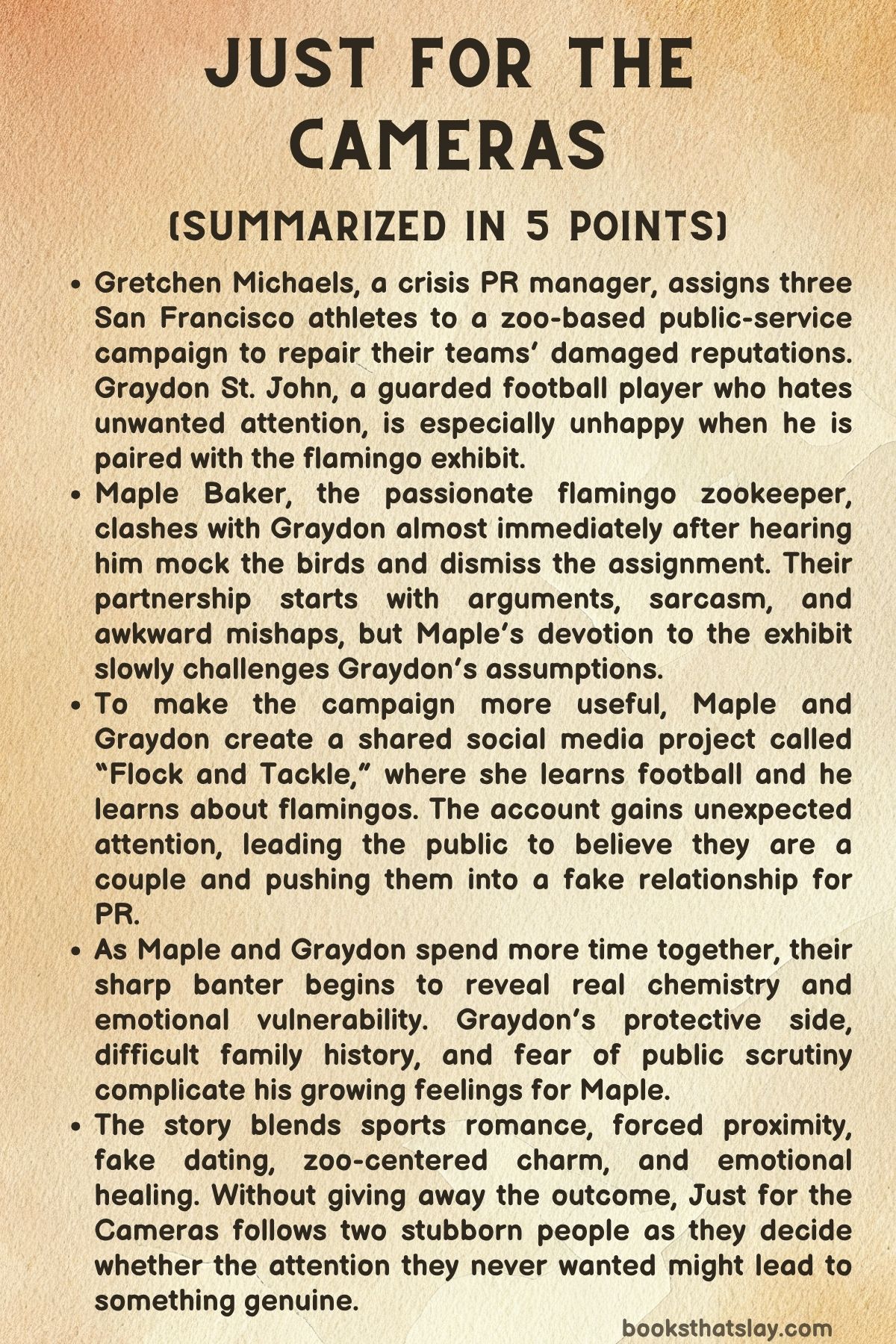
Summary
Graydon St. John wants privacy, discipline, and control. As a defensive end for the San Francisco Foghorns, he already has enough pressure from a struggling team, a demanding training schedule, and a public image he does not want to feed.
His past has taught him that fame causes damage, especially when it reaches family life, so he avoids unnecessary attention whenever he can. That becomes impossible when crisis PR manager Gretchen Michaels calls him into a meeting with two other San Francisco athletes: Bennett Brinkman, a young baseball player tied to a team scandal, and Oden “OC” O’Connor, a friendly hockey player from a combative new team.
Their teams all have image problems, and Gretchen has chosen the three men for a mandatory public-service campaign.
Their first assignment is at the San Francisco Zoo. Graydon is furious, especially because training camp is close and he does not want anything distracting him from football.
He tries to find a way out, only to discover that his contract gives him little protection against public appearances. At the zoo, Phil Foreman, the zoo’s excited public-relations leader, explains that each athlete will become the public face of a different animal exhibit.
Bennett gets lions, OC gets giraffes, and Graydon is assigned to flamingos, much to everyone else’s amusement and his own horror.
Maple Baker, the flamingo zookeeper, is assigned to work with him. Before they even properly meet, she overhears him mocking flamingos and treating the campaign like a joke.
Maple loves the birds and is desperate to improve their outdated lagoon, so Graydon’s attitude immediately offends her. Their first meeting goes badly.
She explains that the flamingo exhibit needs grants, fundraising, events, and visibility, while he tries to reduce his role to basic chores and appearances. When Maple confronts him for insulting the birds, he grows defensive.
She fires back by mocking the Foghorns’ losing record, and the exchange becomes sharp. Their first encounter ends with Graydon accidentally walking into a closet while trying to leave.
Graydon tries to escape the assignment through Coach Keenan, but Gretchen blocks him. Keenan refuses to help and even threatens to extend his time with the flamingos if he keeps complaining.
Graydon returns to the zoo, where Maple gives him a tour in a cramped golf cart. Their arguments continue as he questions the purpose of zoos and she responds with anger.
During the chaotic ride, he nearly falls out and grabs her braid by mistake. Their hostility sometimes slips into attraction, but neither is ready to admit it.
At the flamingo lagoon, Maple introduces him to the birds by name and explains their personalities. Graydon finds her devotion strange, but he also notices her confidence, beauty, and passion.
Maple worries that his poor attitude will hurt the fundraising effort and that the zoo might replace the flamingo area with a merchandise space if she cannot prove the exhibit matters.
Graydon, Bennett, and OC soon realize the zoo campaign has no clear public plan. When they confront Gretchen, she reveals that cameras have already been installed and a media strategy is coming.
During another shift, Graydon argues that it is unfair for Maple to expect him to learn about flamingos while she knows nothing about football. Maple realizes he has a point and suggests a trade: he will learn about flamingos, and she will learn about football.
They will document both sides on a shared social media account. After rejecting several bad names, they choose “Flock and Tackle.”
The account changes everything. Maple attends one of Graydon’s football training sessions, where he tries to make the workout difficult for her but backs off enough to keep her safe when he realizes she has little weightlifting experience.
They take photos, record content, and post their first image. The post goes viral almost immediately, and followers assume Maple and Graydon are dating.
Graydon is furious when his teammates tease him about the supposed relationship, but the public attention is exactly what the team and zoo want.
Gretchen tells them the front office wants them to lean into a fake PR relationship. Graydon objects because he knows Maple is not prepared for public scrutiny, but Maple agrees because the attention could bring the flamingos the money they need.
Graydon keeps warning her that publicity will invade her life, but Maple insists the birds are worth it.
The fake relationship starts to blur when Maple arrives at the training facility injured after being sideswiped by a police car. Her face is bruised and her wrist is swollen, but she shows up anyway.
Graydon becomes protective at once. He takes her to the team trainers, pushes for proper medical care, and calls her his girlfriend so she can be treated.
Her wrist has a minor fracture, and Graydon makes sure her splint is wrapped in pink.
Afterward, the people around them try to turn the accident into another PR moment, which angers Graydon. His father, Troy, also appears and treats Maple in a patronizing way while provoking Graydon.
Graydon drives Maple home, buys groceries and household items, and quietly improves her bare apartment. Maple is confused by his generosity, but Graydon says he feels responsible for protecting her.
His care is real, even when his emotions come out badly.
Graydon’s emotional wounds become more visible as the story continues. His relationship with his father is toxic, and his mother’s condition causes him deep pain.
When Graydon was sixteen, his mother suffered a brain injury that left her with anterograde amnesia. She cannot form new memories and often does not recognize him as an adult.
Sundays are reserved for visiting her, and those visits leave him emotionally wrecked. After one painful visit, Graydon lashes out at Maple in public, humiliating her.
She refuses his ride home, tells him his behavior hurt her, and says she is finished with his mixed signals and temper.
Ashamed and desperate to fix things, Graydon turns to OC and Bennett for advice. They push him to admit what he wants, and he realizes he wants Maple for real.
They suggest a gesture tied to what she loves most: the flamingos. Graydon gets permission to work at the zoo after hours and paints a bright mural at the flamingo exhibit.
He turns an ugly wall and wire area into a place that draws visitors, encourages photos, and celebrates the birds. Maple is stunned when she sees it.
She notices personal details that show Graydon painted it for her, and the mural immediately boosts interest in the exhibit.
Still, the gesture is not enough by itself. Graydon goes to Maple’s apartment and apologizes properly.
He admits his feelings scare him and that he hurt her. When he starts to pull away because he thinks he does not deserve her, Maple texts him to come back.
He returns, and they finally stop hiding from their feelings. Their relationship becomes real, and Graydon opens up about his mother, his father, and the fear that he is too damaged to love someone well.
Maple reassures him that he is a good man, even though he struggles to believe it.
Their romance becomes stronger, but outside forces keep testing them. Maple takes part in a staged football play for publicity and unexpectedly becomes the star of the moment when she protects herself from a rookie and scores a touchdown.
Graydon is proud and openly affectionate, and his friends notice how much happier he seems. Gretchen later gives Maple branded game clothing, field passes, and instructions for handling fans and press.
When old PR terms and a breakup NDA come up, Graydon fiercely defends Maple and refuses to let anyone treat their relationship as temporary.
Then the truth leaks: Maple and Graydon’s relationship began as a PR arrangement. Graydon learns that his father’s side is behind the leak.
Gretchen exposes evidence that Troy and Coach Keenan have been plotting against him, and she recommends that Troy lose access and Keenan face investigation. Graydon is furious but tries to follow the plan laid out for him.
At the zoo, Maple is overwhelmed by press attention. Hank, her coworker, tries to comfort her but also accuses Graydon of making her life worse.
He reveals that Phil may be redirecting the promised donation away from the flamingos and toward merchandise. When Graydon arrives and sees Hank holding Maple, his fears explode.
Hank’s accusations convince Graydon that he is hurting Maple, so he breaks up with her “for her own good.” Maple begs him not to push her away, but he coldly ends things and tells Gretchen to make sure Maple follows the NDA.
Maple refuses to accept that his fear is the truth. She confronts Hank, Phil, and Gretchen for their roles in the mess, then follows Graydon to his house.
He avoids her for hours and comes home drunk with Hutton’s help. Maple stays.
The next morning, Graydon tries to pretend their relationship meant little, but Maple challenges him. She tells him she loves him and knows he loves her too, then leaves him to make his own choice.
For a week, Graydon does not respond while Maple sends loving messages from the zoo. Bennett and OC tell him that protecting Maple by removing himself from her life is not love; he has to trust her strength and let her decide what she can handle.
When Maple finally says she will stop pushing and leave the choice to him, Graydon realizes he may truly lose her.
At the Foghorns’ opening game, Maple arrives terrified but wearing Graydon’s jersey. At first, Graydon sees her and walks away, breaking her heart.
Then he returns with a handwritten note. In it, he apologizes, admits he loves her, and asks her to meet him at the fifty-yard line after the game if she still wants him.
The Foghorns win their opener, with Graydon and the defense playing a major role. After the game, Graydon goes to Maple, helps her over the wall, and kisses her in front of the cheering stadium.
In the tunnel, he apologizes fully and promises to trust her. They choose each other openly.
A year later, Maple is pregnant and living with Graydon. The flamingo exhibit has been rebuilt and expanded with the donation money.
It now has murals, a larger lagoon, feeding experiences, and sold-out tickets. Maple speaks at the opening celebration while Graydon watches with pride.
His father is no longer part of his life, his relationship with Maple is secure, and their “Flock and Tackle” project has grown into something that helped the zoo, repaired the team’s image, and gave them a future together.
Characters
Graydon St. John
Graydon St. John is the central male figure in Just For The Cameras, and his character is built around tension between public strength and private damage. On the surface, he is a gruff, disciplined, intensely private defensive end who resents being forced into a publicity campaign.
His anger at the zoo assignment is not simple arrogance; it grows out of his fear of fame, his need for control, and his deep awareness of how public life can damage people. Because his contract leaves him powerless, he reacts with hostility, sarcasm, and stubbornness, especially toward Maple.
His early behavior makes him seem dismissive and rude, but the book gradually shows that he uses harshness as armor. He does not like being exposed, questioned, or emotionally cornered, and Maple does all three almost immediately.
Graydon’s emotional complexity becomes clearer through his family history. His mother’s brain injury and anterograde amnesia have left him carrying long-term grief that never fully resolves, because he keeps losing her recognition again and again.
His visits with her are painful, sacred, and destabilizing, which explains why he often returns from them emotionally raw. His relationship with his father, Troy, adds another wound.
Troy is manipulative, patronizing, and emotionally abusive, and Graydon has spent years trying not to become like him. This fear shapes Graydon’s romance with Maple: whenever he loses control or hurts her, he sees himself as dangerous and unworthy.
His instinct is not only to protect her from the world, but also to protect her from himself.
His growth comes from learning that love cannot be built on control disguised as protection. Graydon repeatedly tries to make decisions for Maple, especially when public attention, Hank’s accusations, and Troy’s schemes convince him that being with him will ruin her life.
Yet the book forces him to face the fact that Maple is not fragile, passive, or incapable of choosing. His mural for the flamingo exhibit reveals the tender, creative man beneath the athlete’s hard exterior.
It also reconnects him to his mother’s influence, showing that his ability to love is tied to memory, art, and care rather than dominance. By the end, Graydon’s public kiss with Maple at the stadium is not just a romantic gesture; it is a declaration that he is no longer hiding from love, grief, or visibility.
Maple Baker
Maple Baker is the emotional heart of the story and one of the strongest characters in the book. She is passionate, stubborn, funny, and deeply devoted to the flamingos under her care.
Her love for the birds is not treated as a quirky personality trait alone; it represents her sense of purpose. She wants the flamingo exhibit to be protected, expanded, and respected, and she is willing to endure discomfort, public scrutiny, and Graydon’s difficult moods if it means securing a better future for them.
From the beginning, Maple refuses to be intimidated by Graydon’s fame or size. She calls out his disrespect, mocks his assumptions, and demands that he take her work seriously.
Maple’s strength lies in the way she combines tenderness with confrontation. She can be wounded by Graydon’s harshness, but she does not simply absorb it silently.
When he humiliates her or sends mixed signals, she pushes back and creates boundaries. This makes her romance with him feel earned rather than one-sided.
She is attracted to him, but she is also clear-eyed about his flaws. Her willingness to learn football in exchange for teaching him about flamingos shows her fairness, while her commitment to the “Flock and Tackle” campaign shows her creativity.
She is not just the love interest; she is an active force who turns a forced assignment into something meaningful.
Maple also becomes a test of Graydon’s emotional maturity. She sees the good in him before he fully sees it in himself, especially after discovering his pain over his mother and his father.
However, she does not excuse his cruelty simply because he is hurting. This balance makes her compassionate without making her weak.
Her love confession near the end is powerful because it is not desperate surrender; it is a challenge. She tells Graydon the truth, leaves him with the choice, and refuses to chase a man who will not trust her strength.
By the epilogue, Maple’s success with the rebuilt flamingo exhibit and her life with Graydon show that her love, work, and identity have all expanded rather than disappeared into the romance.
Gretchen Michaels
Gretchen Michaels is the powerful crisis PR manager who sets the story in motion. She is strategic, blunt, and highly aware of how public perception works.
At first, she appears almost ruthless because she forces Graydon, Bennett, and OC into the zoo campaign without giving them much choice. She treats their assignments as image-management tools, and her approach often makes the athletes feel like pieces on a chessboard.
Her decision to push Maple and Graydon into a fake relationship after the public misreads their social media post shows how quickly she can turn personal chemistry into professional opportunity.
At the same time, Gretchen is not a flat manipulator. Her role becomes more layered as the book progresses.
She understands the machinery of fame better than most characters, and she is often right about how the media will respond. Her flaw is that she sometimes prioritizes optics before emotional consequences, especially where Maple’s privacy is concerned.
Yet she also proves capable of adjusting when confronted. When Graydon defends Maple against the old breakup NDA and the temporary language around their relationship, Gretchen apologizes and recognizes that the connection between them has become real.
Her most important function is that she acts as both instigator and protector. She creates the situation that throws Maple and Graydon together, but she also exposes Troy and Keenan’s plotting.
In that sense, Gretchen represents the double-edged nature of public relations in Just For The Cameras: it can exploit private life, but it can also reveal corruption, protect reputations, and redirect power. She is not warm in a traditional way, but she is competent, sharp, and eventually more loyal to the truth than to the people trying to manipulate it.
Bennett Brinkman
Bennett Brinkman is one of the three athletes chosen for the public-service campaign, and he brings a steadier, more observant energy to the group. As a young third baseman for the scandal-tainted Bombers, he understands reputation damage from a different angle than Graydon.
While Graydon responds to the campaign with anger and resistance, Bennett is more willing to assess the situation and participate in the group dynamic. His assignment with the lions gives him his own symbolic connection to strength and image, though his larger role in the story is as part of Graydon’s support system.
Bennett becomes especially important through the “Gladdy Daddies” friendship group. He and OC give Graydon a space where he can admit confusion, jealousy, and emotional vulnerability without being completely exposed to Maple.
Bennett’s advice is often more direct and emotionally intelligent than Graydon expects. He pushes Graydon to stop hiding behind anger and to recognize what he truly wants.
When Graydon believes his mural failed because Maple still leaves with Hank, Bennett helps him see that Maple’s softer response is an opening rather than a rejection.
As a supporting character, Bennett helps reveal Graydon’s capacity for friendship. Graydon may be guarded, but he still turns to Bennett and OC when he is lost.
Bennett’s presence also adds humor and balance to the heavier emotional material. He is not simply comic relief; he is part of the informal emotional coaching that helps Graydon become brave enough to apologize, pursue Maple honestly, and eventually trust love.
Oden “OC” O’Connor
Oden “OC” O’Connor is the cheerful hockey player assigned to the giraffes, and his personality contrasts strongly with Graydon’s guarded intensity. OC brings levity, social ease, and playful energy to the book.
His quick creation of the group chat shows that he naturally builds connection, even among men who have been forced into an awkward campaign. While Graydon tends to isolate himself when angry or ashamed, OC reaches outward, turning an unwanted PR obligation into a shared experience.
OC’s humor is important, but his role is not limited to jokes. He helps Graydon process his feelings by making emotional conversations feel less threatening.
Along with Bennett, he teases Graydon, but beneath the teasing is real concern. He encourages Graydon to think about Maple not as a PR partner or a problem to manage, but as someone Graydon genuinely wants.
This matters because Graydon often needs others to say the obvious before he can admit it himself.
OC also represents a healthier relationship with public attention. Unlike Graydon, he does not seem crushed by visibility in the same way.
His presence reminds the reader that fame itself is not the enemy; the real danger is losing agency, privacy, or emotional honesty within it. By helping Graydon move toward vulnerability, OC becomes one of the quiet reasons the central romance is able to survive its public and private pressures.
Hutton
Hutton is Graydon’s teammate and one of the few people who understands the depth of Graydon’s pain before Maple does. His role is quieter than Bennett’s or OC’s, but he is emotionally significant.
He knows what Sundays with Graydon’s mother do to him, and he helps Graydon prepare for practice after those visits without demanding explanations. This kind of loyalty shows that Hutton understands Graydon beyond his public image and beyond his anger.
Hutton also serves as a mirror for Graydon’s transformation. He notices when Graydon becomes happier and less guarded after his relationship with Maple becomes real.
His advice is simple but important: Graydon needs to trust Maple. This directly challenges Graydon’s pattern of deciding what is best for other people without letting them choose for themselves.
Hutton’s perspective carries weight because he has seen Graydon at his worst and still believes he is capable of more.
As a supporting character, Hutton grounds the football side of the story. He reminds the reader that Graydon is not only a romantic lead but also an athlete with discipline, teammates, and professional pressure.
His friendship with Graydon gives the book a sense of masculine loyalty that is not based on bravado alone. Hutton’s support is practical, calm, and emotionally aware, making him one of Graydon’s most reliable anchors.
Phil Foreman
Phil Foreman is the zoo’s enthusiastic vice president of public relations, and he initially appears as a cheerful, mission-focused figure. He introduces the animal liaison program and frames the athletes’ involvement as a chance to raise awareness, funding, and public interest.
His excitement about the campaign helps establish the zoo as more than a backdrop; it is a workplace with financial pressures, public needs, and competing priorities.
However, Phil becomes more morally complicated when the promised donation appears at risk of being redirected away from the flamingos and toward merchandise. This creates a direct conflict with Maple, whose entire motivation is tied to protecting and improving the flamingo exhibit.
Phil’s behavior suggests that institutional goals can easily drift away from the passionate work of the people on the ground. He may care about the zoo’s success, but his priorities do not always align with Maple’s.
Phil’s permission for Graydon to paint the mural shows that he can recognize a good opportunity when he sees one, and the mural’s success proves how meaningful public-facing improvements can be. Still, his later handling of donation money weakens trust in him.
As a character, Phil represents the tension between genuine enthusiasm and administrative self-interest. He is not purely villainous, but he is willing to compromise the very cause Maple has fought to protect.
Everly
Everly is Maple’s close friend and emotional sounding board. She provides a space where Maple can be honest about her attraction to Graydon, her frustration with him, and her growing feelings.
Because Maple spends so much of the story sparring with Graydon or defending the flamingos, Everly gives her a place to process emotions without needing to perform strength. Their milkshake conversations and later talks reveal Maple’s softer uncertainty beneath her sharp confidence.
Everly’s advice is supportive but not reckless. When Maple realizes she may be in love with Graydon, Everly encourages her not to rush the confession and to let the relationship develop naturally.
This shows that she understands both Maple’s emotional intensity and the instability of the situation. She does not dismiss Maple’s feelings, but she also helps her avoid acting from impulse alone.
Her role is important because she reinforces Maple’s independence. Maple’s romance with Graydon is central, but Everly reminds the reader that Maple has a life and emotional support outside him.
In romantic fiction, a friend like Everly helps keep the heroine’s inner world from being swallowed entirely by the love story. She is practical, affectionate, and protective in a way that balances the chaos of the public relationship.
Hank
Hank is Maple’s coworker and one of the most disruptive supporting characters in the romance. At first, he appears protective, especially when Maple is hurt by Graydon’s temper or overwhelmed by public attention.
He gives her rides and offers comfort when she is vulnerable, which makes him seem like a safer alternative to Graydon’s volatility. His concern is not entirely false; he does see Maple suffering, and he is not wrong that Graydon’s world brings complications into her life.
However, Hank’s protectiveness crosses into interference. He assumes he understands what is best for Maple and frames Graydon as a source of harm in a way that feeds Graydon’s deepest insecurities.
When Graydon sees Hank holding Maple and hears his accusations, it pushes him toward the mistaken belief that leaving Maple is an act of love. In this way, Hank becomes a catalyst for the final major separation.
Hank’s flaw is similar to Graydon’s at his worst: he does not fully trust Maple’s agency. He may think he is defending her, but he also undermines her ability to define her own relationship.
Maple’s anger at Hank later is important because it shows that she refuses to let anyone, even someone who claims to care about her, speak over her choices. Hank is not a villain in the grand sense, but he is an obstacle because his care becomes controlling.
Troy St. John
Troy St. John is one of the most damaging figures in the story and a major source of Graydon’s emotional trauma. As Graydon’s father, he should be a source of support, but instead he is manipulative, cold, and antagonistic.
His treatment of Graydon has helped shape Graydon’s belief that he is broken or dangerous. Troy’s presence often triggers Graydon’s anger because he knows exactly where to press.
Troy is also dangerous because his cruelty is tied to power. He is not merely an unpleasant parent; he is connected to the team environment and uses influence to undermine Graydon.
His involvement in leaking the truth about the PR relationship and plotting with Keenan shows that he is willing to damage his own son’s life and relationship to maintain control or protect his own interests. Gretchen’s exposure of his actions becomes one of the book’s major moments of justice.
As a character, Troy functions as the embodiment of the toxic legacy Graydon is trying to escape. Graydon fears becoming like him, but the contrast between them is clear.
Troy uses power to wound, while Graydon eventually learns to use his strength to protect, repair, and love. Troy’s removal from Graydon’s life by the epilogue is essential because it signals that Graydon has begun to break free from inherited damage.
Coach Keenan
Coach Keenan is an authority figure who initially seems to hold practical power over Graydon’s career. When Graydon tries to escape the zoo assignment, Keenan refuses to help and even threatens to extend Graydon’s time with the flamingos if he complains again.
This establishes him as someone more interested in control than understanding. He does not care about Graydon’s discomfort or emotional history; he cares about compliance.
Keenan’s later connection to Troy’s plotting makes him more openly antagonistic. Rather than supporting one of his valuable players, he becomes part of a scheme that works against Graydon’s interests.
This betrayal is especially serious because sports teams depend on trust between players and coaches. Keenan’s actions show how institutions can exploit athletes while pretending to act for the good of the team.
His character helps intensify the professional stakes around Graydon. The conflict is not only romantic or familial; Graydon is also trapped within a workplace where powerful men may be working against him.
Keenan’s investigation or potential replacement is therefore not just a plot consequence. It represents a necessary correction in a system that has allowed personal grudges and manipulation to interfere with fairness.
Darby Welcott
Darby Welcott, the team owner, plays a smaller but meaningful role. Her most notable moment comes when Graydon contacts her so Maple can receive medical care from the team trainers after her accident.
This scene shows the practical importance of institutional power. Graydon may be protective, but he still needs someone with authority to make the system respond.
Darby’s presence also helps frame the Foghorns as an organization with internal divisions. While Troy and Keenan become associated with manipulation, Darby is connected to decision-making that can either protect or expose those problems.
She is part of the meeting where Gretchen reveals evidence against Troy and Keenan, making her a witness to the truth of what has been happening behind the scenes.
Although she is not deeply developed compared with the central characters, Darby matters because she represents the possibility of accountability within the team structure. Her role helps move Graydon’s conflict out of private suffering and into institutional recognition.
The harm done to him is not just emotional; it has professional consequences, and Darby’s position makes those consequences visible.
Graydon’s Mother
Graydon’s mother is one of the most emotionally important figures in the book despite not being active in the central present-day plot. Her brain injury and anterograde amnesia shape Graydon’s grief, routine, and self-image.
Because she cannot form new memories and often does not recognize him as an adult, Graydon experiences a repeated form of loss. She is physically present but emotionally unreachable in many moments, which makes his devotion to visiting her both beautiful and painful.
Her influence is also tied to Graydon’s hidden tenderness. She taught him to paint, and that artistic connection becomes one of the clearest signs of who Graydon is beneath his rough exterior.
The mural he creates for Maple is not only a romantic apology; it is also an act rooted in his mother’s legacy. Through art, he expresses love in a way he cannot easily manage through words.
She helps explain why Graydon fears emotional attachment so deeply. Love, for him, has been connected to loss, helplessness, and the hope for brief moments of recognition.
When he opens up to Maple about his mother, he allows her to see the grief behind his temper. This revelation changes the emotional depth of their relationship and helps Maple understand him without excusing the ways he has hurt her.
Scarlett
Scarlett appears near the end as a source of support for Maple at the first game. Her role is brief, but she matters because Maple arrives at the stadium terrified and emotionally exposed.
Wearing Graydon’s jersey after their painful separation requires courage, and Scarlett’s presence helps Maple face the public setting without being completely alone.
Scarlett’s function is mainly supportive, but that support is important in the larger emotional structure of the scene. The stadium moment is about Graydon choosing love publicly, yet Maple also has to choose vulnerability.
Scarlett helps make that possible by standing beside her before Graydon finally returns with his note.
Though she is not developed in great detail, Scarlett contributes to the sense that Maple has people around her beyond Graydon. This makes Maple’s final reconciliation feel healthier.
She is not isolated, abandoned, or dependent on Graydon’s decision alone; she has support as she waits to see whether he will finally become brave enough to trust her.
Big Hermy, Dinkle, Gwendalyn, Kevin Malone, Tribbs, and Martha Stewart
The named flamingos are not human characters, but they play a major symbolic and emotional role in Just For The Cameras. Maple’s decision to introduce them by name shows how personally she understands and values them.
To Graydon, they initially seem ridiculous or intimidating, but to Maple they are individuals deserving care, funding, and dignity. This contrast becomes one of the earliest ways the book reveals the difference between Graydon’s dismissive first impression and Maple’s committed worldview.
The flamingos also function as the bridge between Maple and Graydon. Their forced partnership begins because of the flamingo exhibit, and their emotional connection deepens as Graydon starts to respect Maple’s work.
His fear of the birds creates comedy, but his willingness to learn about them shows growth. When he paints the flamingo mural, he proves that he has stopped seeing the assignment as a punishment and started seeing it through Maple’s eyes.
By the epilogue, the rebuilt flamingo exhibit represents the success of Maple’s dedication and the transformation of the central relationship. The birds are connected to fundraising, public attention, social media, art, and family.
They turn a fake campaign into something real. In that sense, the flamingos are not just background animals; they are the living cause that forces the characters to reveal what they value, what they fear, and what they are willing to fight for.
Themes
Public Image and Private Truth
Just For The Cameras uses the fake public-service campaign and staged relationship to examine how easily public image can distort private reality. Graydon, Maple, and the other athletes are pushed into roles designed for cameras, followers, and reputation repair, but the attention quickly becomes more than a marketing plan.
Graydon’s resistance comes from knowing that fame is not harmless; he has seen how public pressure, family damage, and media narratives can strip people of control. Maple, on the other hand, accepts the spotlight because it can save the flamingos, even though she does not fully understand the cost at first.
Their relationship begins as something shaped by outsiders, yet the emotions underneath become real. The conflict grows when the public discovers the arrangement, proving that truth can be twisted even when love is genuine.
The theme shows that image may attract attention, but only honesty, trust, and personal choice can create something lasting.
Emotional Guardedness and the Fear of Hurting Others
Graydon’s anger and distance are rooted in fear rather than simple arrogance. His mother’s condition, his father’s emotional abuse, and his long habit of protecting himself have taught him to expect pain from closeness.
When Maple gets injured, faces online attention, or becomes the subject of gossip, Graydon sees himself as the danger in her life. This fear makes him controlling, even when he believes he is being protective.
His worst mistake is deciding for Maple instead of trusting her strength. He breaks her heart because he thinks leaving her will save her, but the story makes clear that love cannot survive without respect for the other person’s agency.
Maple’s refusal to accept his self-punishment forces him to confront the difference between protection and avoidance. His growth comes when he stops treating himself as a burden and starts believing that Maple can choose him with open eyes.
Love as Accountability and Growth
Romance in Just For The Cameras is not shown as an instant cure for pain; it becomes meaningful because both characters are forced to change. Maple does not simply soften Graydon’s rough edges, and Graydon does not simply rescue Maple’s dream.
Instead, they challenge each other. Maple calls out his cruelty, his mixed signals, and his habit of using pain as an excuse.
Graydon pushes Maple to understand football, public pressure, and the realities of being attached to someone famous. Their connection grows through apology, effort, and repeated choices to do better.
The mural becomes important because it is not just romantic; it proves Graydon has listened to what Maple loves and has acted in a way that supports her world. Their love works because it demands accountability.
Graydon must apologize without excuses, Maple must stand firm in her own choices, and both must move from performance into genuine partnership.
Devotion to Purpose and the Value of Being Seen
Maple’s love for the flamingos gives the story its emotional center beyond romance. Her work at the zoo is not treated as a cute background detail; it represents dedication, care, and the frustration of loving something that others dismiss.
Graydon initially sees the flamingo assignment as humiliating and pointless, but Maple’s commitment forces him to recognize that her work has value. As he learns about the birds, the exhibit, and the need for funding, he begins to see Maple more fully.
The theme is not only about animal conservation, but also about respect for passions that may seem unusual from the outside. Maple wants the flamingos, the zoo, and her labor to be taken seriously.
Graydon’s transformation is shown through his willingness to support her purpose, not merely admire her. By the end, the rebuilt exhibit confirms that being seen with care can turn a dismissed cause into something celebrated.