She Made Herself a Monster Summary, Characters and Themes
She Made Herself a Monster by Anna Kovatcheva is a dark historical tale about fear, survival, and the stories people create to explain cruelty. Set in a mountain village trapped by poverty, grief, and superstition, the book follows Yana, a traveling vampire slayer whose power rests on performance rather than magic, and Anka, a young woman trying to escape a future chosen for her by a dangerous guardian.
The novel uses folklore, medicine, village rumor, and staged horror to explore how monsters are named, made, and exposed, especially when real violence hides behind respectable authority.
Summary
Yana travels from village to village as a vampire slayer, though her work is built on illusion rather than supernatural truth. She understands fear, grief, and the human need to give suffering a shape.
When villages are crushed by illness, death, bad harvests, and suspicion, she offers them a story they can believe in. Her rituals are violent and theatrical: she works over corpses, performs acts meant to look ancient and sacred, and uses her inherited reputation to convince people that she can see the unseen forces tormenting them.
Her unusual appearance and the memory of her mother’s fame make her seem powerful before she even speaks.
Her road brings her toward Koprivci, a poor village that already feels cursed. Crops have failed, children have died, and mistrust hangs over every household.
A comet burns across the sky, giving the villagers another reason to believe something terrible is moving above and around them. Into this tense place also returns Kiril, a young man who has spent a year studying medicine in the city.
He comes back with modern ideas and plans to reopen his father’s old shop as a medical salon, hoping to treat illness through knowledge rather than fear.
Kiril’s return immediately shows him how little the village has changed. On the church steps, villagers gather around a slaughtered chicken arranged like a sign, its heart cut out.
They decide that Nina, a pregnant blacksmith’s widow who has already been accused of witchcraft, must be responsible. She has been jailed and feared, and the crowd’s anger turns quickly toward violence.
Kiril steps in, fights back against one of the men, and helps Nina escape. His action marks him as someone willing to challenge the village’s cruelty, though his own character is far from simple or purely noble.
At the Captain’s house, Kiril returns to the family circle he left behind. He reunites with his cousin Anka, the housekeeper Yulia, and his uncle, known as the Captain.
The household carries its own hidden danger. Anka is the Captain’s ward, but he intends to marry her once she is considered physically mature.
She has already begun menstruating, but with Yulia’s help she hides it, knowing that the truth would bring the marriage closer. The Captain treats her future as something he owns.
Kiril’s return also brings back old bitterness. He learns that Margarita, the woman he loved, is going to marry Simeon.
His jealousy and hurt make him cruel. During dinner, instead of protecting Anka, he raises the question of whether she has matured, threatening the secret that keeps her safe for the moment.
Later, he and Anka fight, and his anger becomes physical when he nearly strangles her. This moment reveals that Kiril, despite his education and his wish to be different from the villagers, carries violence and selfishness within him.
Yulia takes Anka to Minka, an old midwife who knows how women survive under men’s control. Minka helps Anka hide her bleeding and speaks with her about ways to delay the Captain’s plan.
Anka has tried to escape before and failed. She knows that ordinary resistance will not be enough.
Meanwhile, Kiril begins setting up his medical salon and tries to build a place for himself in Koprivci. He reconnects with Simeon, who asks him to be best man at the wedding.
Kiril is forced to stand close to the life he wanted and lost. His medical knowledge gives him a role in the village, but the people around him still rely on gossip, omens, and old fears.
The Captain, although skeptical of superstition in private, sees a use for Yana when she arrives. If the village believes that a vampire is responsible for its suffering, suspicion may shift away from Nina and Anka.
Yana sets up in the garden cottage and begins creating signs of supernatural danger. She stages omens with blood, dead animals, and dramatic public gestures.
Then she declares that a vampire threatens Koprivci. The villagers are ready to believe her because belief gives them relief.
A vampire is easier to face than hunger, grief, failed harvests, or the violence of powerful men.
Anka soon realizes that Yana is not a true slayer of monsters but a skilled performer. Instead of exposing her, Anka asks for help.
She tells Yana that the Captain plans to marry her and that she cannot get free by normal means. She proposes a desperate plan: Yana will use her knowledge of death, bodies, and spectacle to make Anka appear dead.
If the village and the Captain believe she is gone, she may be able to escape.
Yana is moved by Anka’s terror and determination. Though Yana’s work has always depended on lies, those lies have often helped communities survive their fear.
Now she has a chance to use performance for one person’s freedom. She agrees to help Anka.
As Yana’s false signs become more intense, the village becomes more certain that the vampire is real. Fear spreads, but it is fear with a direction.
At the same time, Kiril’s position improves when he helps Nina give birth to a healthy daughter, Sofia. The safe birth challenges the village’s belief that Nina is cursed or dangerous.
Kiril gains respect as a doctor, and Nina becomes harder for the villagers to condemn.
During Margarita and Simeon’s wedding celebrations, the village briefly turns toward music, food, and ritual. The Captain performs a fire dance, showing his command over spectacle and danger.
Later, he privately pressures Kiril to tell him where Nina is hidden. Kiril, still weak in the face of the Captain and still capable of betrayal, reveals that Anka has been hiding her menstruation.
This gives the Captain the knowledge he needs to move forward with his plan to claim her.
The Captain takes Anka to the ruined house where her parents died. There he reveals the truth behind the tragedy that shaped her life.
He caused the fire that killed them because he loved Anka’s mother and wanted to possess what remained of her. Anka learns that the man who raised her and now intends to marry her is also responsible for destroying her family.
The horror she faces is not a creature from folklore. It is a man protected by authority, kinship, and silence.
Anka returns home shattered and acts before the plan is fully ready. She drinks the poison meant for her false death earlier than intended.
She survives, but only barely. Yana and Kiril care for her, trying to pull her back from the edge.
When the Captain attacks, Anka fights back with the sharp silver comb Kiril had given her, wounding him. Kiril finally sees the Captain for what he is and chooses not to save him.
The Captain dies.
Yana understands what the village needs in order to accept this death. She turns the Captain into the monster Koprivci has been waiting to name.
She declares that he was the vampire responsible for the village’s suffering. In the church cellar, before the watching villagers, she performs the brutal ritual that confirms the story.
She drives a brick into his mouth, making his corpse the center of the village’s fear and relief.
Afterward, Koprivci praises Anka as the one who exposed and wounded the monster. The Captain is buried outside the village, with thorns placed around his grave to keep the evil contained.
The official story gives the villagers an answer they can live with, though Anka and Yana know the deeper truth: the monster was never supernatural. He was human.
Anka prepares to leave the village that trapped her. She says goodbye to Margarita, Simeon, Yulia, Kiril, Nina, and the life she once knew.
Each farewell closes a door behind her. Then she leaves Koprivci with Yana, walking down the mountain toward the coast.
Her future is uncertain, but for the first time it belongs to her.
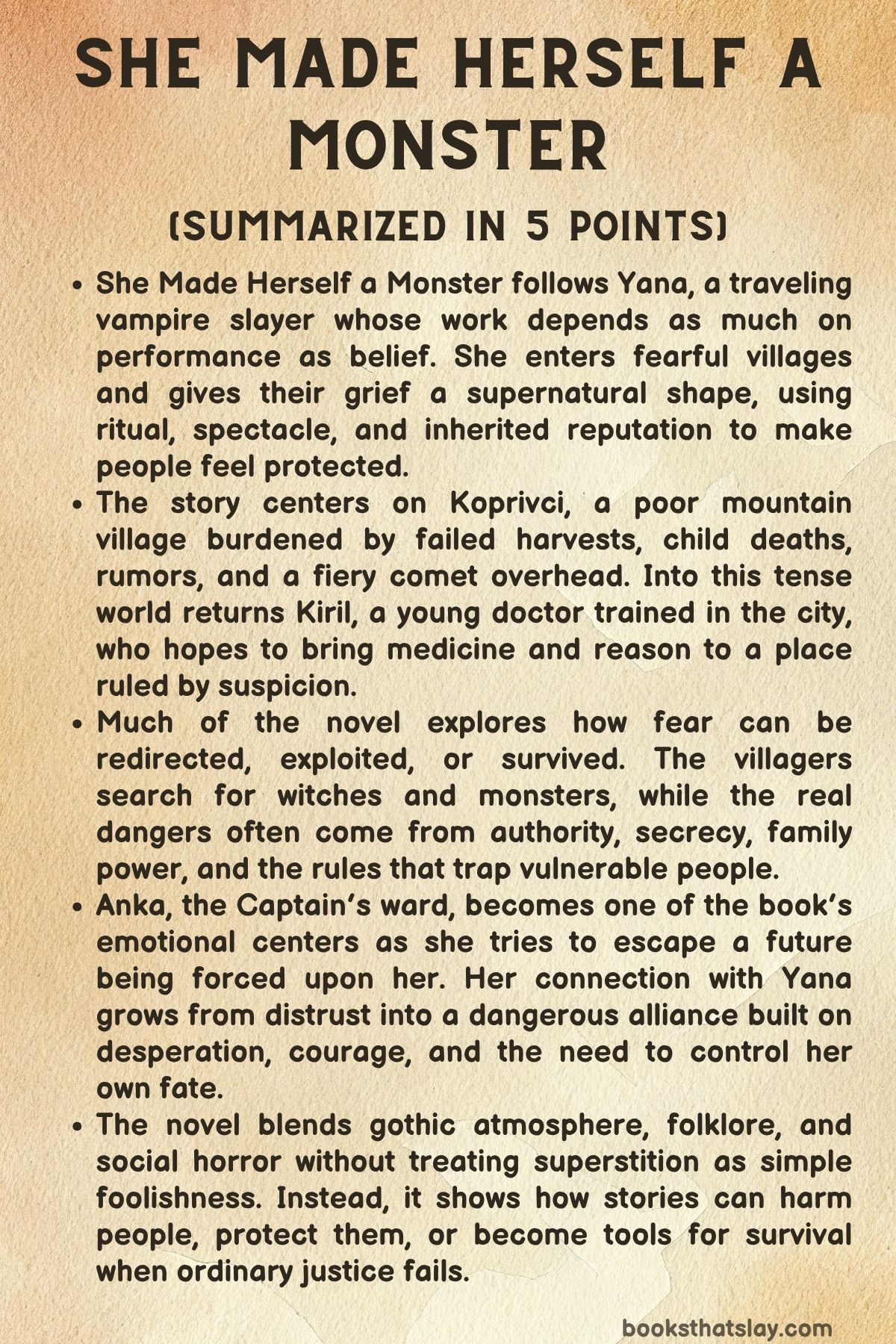
Characters
Yana
Yana is one of the most fascinating and morally layered figures in She Made Herself a Monster because she lives between fraud and compassion. On the surface, she is a traveling vampire slayer who survives by deceiving frightened villages.
She stages rituals, manipulates corpses, invents supernatural signs, and uses spectacle to give people a visible enemy for their pain. Yet the book does not present her as merely dishonest or cruel.
Her fraud grows out of an understanding of human fear: villages like Koprivci are already drowning in grief, failed harvests, dead children, suspicion, and superstition, and Yana knows that people often need a story before they can endure suffering. Her unusual appearance and inherited reputation make her powerful in the eyes of others, but her real strength lies in her ability to read a community’s emotional wounds and shape them into something people can believe.
Yana’s relationship with Anka reveals the deepest part of her character. When Anka discovers that Yana’s supernatural performances are staged, Yana could protect herself by dismissing or threatening her.
Instead, she listens. Anka’s desperation changes Yana’s role from performer to accomplice, and eventually from stranger to rescuer.
Yana’s decision to help Anka fake her death shows that she is willing to use deception not only for survival, but also as a weapon against abuse. By the end of the story, Yana transforms the Captain’s death into a public narrative that frees Anka and satisfies the village’s hunger for explanation.
This makes her both manipulative and merciful. She understands that truth alone may not save Anka, so she gives the village a version of truth it can accept.
Yana is therefore a character shaped by contradiction: she lies, but her lies expose a real monster; she performs violence on the dead, but she helps the living escape; she makes herself frightening, yet becomes a source of freedom.
Anka
Anka is the emotional center of the book, a young woman trapped inside a household, a village, and a future chosen for her by others. As the Captain’s ward, she lives under the threat of being forced into marriage with him once she is considered physically mature.
Her hidden menstruation becomes more than a private bodily change; it becomes a dangerous secret that determines whether she can keep delaying the Captain’s claim over her. This makes Anka’s body a site of control, fear, and resistance.
She is not simply a helpless victim, however. Even before Yana arrives, Anka is already fighting for time through secrecy, planning, and alliance with Yulia and Minka.
Anka’s intelligence appears most clearly in the way she understands Yana. While others are overwhelmed by fear of vampires and omens, Anka sees through the performance.
Instead of merely exposing Yana, she recognizes that Yana’s talent for spectacle can become a means of escape. Her plan to make herself appear dead is desperate, but it is also strategic.
Anka understands the world around her: she knows that the Captain has power, that the villagers can be made to believe terrifying stories, and that ordinary appeals for help may fail. Her attempted false death shows the extremity of her situation, but also her determination to claim ownership over her life.
Anka’s final confrontation with the Captain is a turning point in her development. After learning that he caused the fire that killed her parents, she sees him not only as an oppressive guardian but as the destroyer of her family and the author of much of her suffering.
When she wounds him with the silver comb, the act becomes symbolic as well as physical. She strikes back with an object connected to Kiril, but the courage is her own.
By the end of She Made Herself a Monster, Anka is no longer only the girl hidden in the Captain’s house. She becomes the person who survives him, exposes him, and leaves the village behind.
Her departure with Yana represents not a simple happy ending, but a hard-won movement toward selfhood.
Kiril
Kiril is a deeply flawed character whose journey depends on the painful difference between education and moral courage. He returns to Koprivci after studying medicine in the city, carrying modern knowledge into a village still governed by superstition and fear.
At first, he appears positioned as a rational alternative to the villagers’ panic. His defense of Nina when the crowd attacks her shows that he can be brave, compassionate, and willing to challenge cruelty.
His work as a doctor, especially when he helps Nina give birth safely, strengthens this image of him as someone capable of healing both bodies and reputations.
Yet Kiril’s knowledge does not make him noble. His jealousy over Margarita’s marriage to Simeon reveals his bitterness, and his behavior toward Anka exposes a frightening capacity for cruelty.
At dinner, he uses the question of Anka’s maturity as a weapon, knowing that it could hasten her forced marriage to the Captain. Later, his violent fight with Anka, in which he nearly strangles her, shows that he is not separate from the brutality of the world he judges.
Kiril wants to see himself as modern and reasonable, but he repeatedly acts out of wounded pride, resentment, and cowardice.
His betrayal of Anka is one of his most serious moral failures. By telling the Captain that Anka has been hiding her menstruation, he gives power to the very man who threatens her.
However, Kiril’s arc does not end in total damnation. When the Captain attacks Anka and later dies, Kiril finally sees him clearly and chooses not to save him.
This decision is morally complex because it goes against Kiril’s identity as a doctor, yet it also marks the moment when he stops protecting the authority that has harmed Anka. Kiril is therefore not a pure hero, but a compromised man who slowly recognizes the cost of his weakness.
His character shows that education, medicine, and rationality mean little unless joined with responsibility and courage.
The Captain
The Captain is the central human monster of the story, though he hides behind authority, guardianship, and respectability. He is powerful in Koprivci not because he believes in every superstition around him, but because he understands how fear can be managed.
His willingness to welcome Yana shows his practical intelligence: he sees that her staged hauntings can redirect the village’s suspicion away from Anka and Nina. Unlike the villagers, he is not simply swept away by panic.
He uses panic.
His planned marriage to Anka reveals his predatory nature. As her guardian, he should protect her, but instead he waits for signs of her physical maturity so he can claim her.
This makes his household a place of imprisonment disguised as care. The horror deepens when he takes Anka to her parents’ ruined house and confesses that he caused the fire that killed them.
His motive, rooted in his obsession with Anka’s mother, exposes the full ugliness of his possessiveness. He does not love Anka as a person; he sees her as something left behind, something he can own because he failed to possess her mother.
The Captain’s death and posthumous transformation into the village’s vampire are symbolically fitting. Although he is not a literal supernatural creature, he has fed on the lives, choices, and futures of others.
Yana’s ritual on his corpse gives the villagers a monster they can understand, but the story makes clear that his monstrosity was human all along. He represents patriarchal power, entitlement, and the violence hidden beneath social order.
In a village obsessed with imagined supernatural threats, the Captain proves that the most dangerous monster is the one already accepted inside the home.
Yulia
Yulia is a quieter but essential figure in the book because she represents practical care inside a dangerous household. As the Captain’s housekeeper, she lives close to power but does not possess much of it openly.
Her importance lies in the small acts of protection she performs for Anka. She helps Anka hide her menstruation, understanding that this secret is necessary to delay the Captain’s marriage plans.
In doing so, Yulia becomes part of a hidden network of female resistance.
Her care is not dramatic in the same way as Yana’s rituals or Anka’s final escape, but it is deeply meaningful. Yulia works within the limits of the world she inhabits.
She cannot simply overthrow the Captain or publicly accuse him, but she can help Anka survive one more day, conceal what must be concealed, and seek help from Minka. Her actions show how survival often depends on ordinary, repeated acts of loyalty.
Yulia’s character gives the story emotional warmth because she treats Anka not as property or burden, but as a young woman who deserves protection.
Minka
Minka, the old midwife, represents traditional female knowledge that exists outside official power. While Kiril brings modern medical training from the city, Minka carries older forms of bodily wisdom, especially knowledge related to women’s health, birth, bleeding, and survival.
Her role in helping Anka hide her menstruation makes her part of the same protective circle as Yulia. She understands the danger Anka faces and responds with practical methods rather than moral judgment.
Minka’s character also complicates the book’s treatment of superstition and tradition. The village’s fear of witches and vampires is destructive, especially in the way it targets Nina.
Yet not all old knowledge is foolish or harmful. Minka’s knowledge is intimate, useful, and rooted in care.
She stands in contrast to the villagers’ cruel gossip because she uses what she knows to protect vulnerable women rather than persecute them. Through Minka, the story suggests that the problem is not tradition itself, but the way fear and power twist belief into violence.
Nina
Nina is one of the clearest victims of the village’s fear. As a pregnant blacksmith’s widow accused of witchcraft, she becomes an easy target for a community desperate to explain its suffering.
The slaughtered chicken on the church steps, with its heart removed, becomes part of the villagers’ accusation against her, even though their certainty is based on panic rather than evidence. Nina’s vulnerability is intensified by her pregnancy, her widowhood, and her isolation.
She has little protection in a place eager to turn grief into blame.
Her survival and the birth of her daughter Sofia are important because they challenge the village’s assumptions. When Kiril helps her deliver a healthy child, Nina becomes harder to cast as a figure of evil.
Her childbirth is a moment of life amid death, suspicion, and decay. It also improves Kiril’s standing as a doctor, but Nina’s significance goes beyond his reputation.
She embodies the danger faced by women who are socially vulnerable and easily demonized. Her character shows how a frightened society often chooses a scapegoat before it seeks truth.
Sofia
Sofia, Nina’s newborn daughter, is not an active character in the same way as Yana, Anka, or Kiril, but she carries strong symbolic meaning. Her birth introduces life into a village obsessed with death.
Koprivci is haunted by dead children, failed harvests, and the belief that something cursed is feeding on the community. Sofia’s healthy arrival interrupts that pattern.
She becomes a sign that the future has not entirely closed.
Sofia also changes how others perceive Nina. The successful birth weakens the accusation that Nina is cursed or dangerous, because the child’s life stands against the village’s fearful story.
In this sense, Sofia’s presence helps expose the cruelty and irrationality of the villagers’ suspicion. She represents innocence, renewal, and the possibility that the next generation might not be trapped by the same fears.
Margarita
Margarita is important largely through her effect on Kiril. She is the woman he loved, and her decision to marry Simeon wounds his pride.
Although she does not dominate the action, her presence reveals Kiril’s emotional immaturity. His jealousy over her marriage contributes to his bitterness and helps trigger his cruel behavior toward Anka.
Margarita therefore functions as a mirror for Kiril’s selfishness: he responds to romantic disappointment not with acceptance, but with resentment that spills onto others.
At the same time, Margarita is not merely an object of Kiril’s desire. Her marriage to Simeon places her within the social life of the village and highlights the contrast between ordinary transitions into adulthood and Anka’s terrifying forced future.
Margarita can move toward marriage publicly and socially, while Anka’s potential marriage to the Captain is rooted in coercion. Her goodbye with Anka near the end adds emotional closure, suggesting that Anka is leaving not only danger behind, but also the familiar relationships and village life that once defined her.
Simeon
Simeon serves as a contrast to Kiril. As Margarita’s future husband and Kiril’s awkwardly reconnected acquaintance, he occupies a place in the story’s social world rather than its darkest secrets.
His request that Kiril serve as best man creates tension because it forces Kiril to stand close to the happiness he resents. Through Simeon, the book exposes Kiril’s inability to handle disappointment with grace.
Simeon also represents ordinary village continuity. While the larger story is filled with staged hauntings, hidden menstruation, accusations of witchcraft, and violent revelations, Simeon’s wedding to Margarita reflects the expected communal rituals of life.
Yet even that celebration is shadowed by the Captain’s pressure, Yana’s escalating spectacle, and Kiril’s private turmoil. Simeon is not a major agent of change, but his role helps reveal the emotional and social pressures surrounding the central characters.
The Villagers of Koprivci
The villagers function almost like a collective character. They are poor, frightened, grieving, and deeply vulnerable to superstition.
Their failed harvests, dead children, and sense of being cursed make them desperate for explanations. This desperation turns dangerous when it becomes accusation.
They attack Nina because they need someone to blame, and they accept Yana’s vampire story because it gives shape to suffering that otherwise feels meaningless.
However, the villagers are not portrayed simply as evil. Their cruelty comes from fear, grief, and helplessness.
This does not excuse their violence, but it explains why Yana’s performances work so well. They want a monster because a monster is easier to confront than poverty, death, illness, or human corruption.
By the end, when they praise Anka and accept the Captain as the vampire responsible for their suffering, they show how easily public belief can be redirected. In She Made Herself a Monster, the villagers reveal one of the story’s central ideas: communities can create monsters out of the innocent, but they can also be guided into naming a real one, even if they need myth to do it.
Anka’s Parents
Anka’s parents are absent from the present action, but their deaths shape the entire emotional and moral background of Anka’s life. Their ruined house is a place of buried truth.
For much of the story, their deaths appear to belong to the past, but the Captain’s confession reveals that the past is not finished at all. He caused the fire that killed them because of his obsession with Anka’s mother, and this revelation exposes the foundation of his control over Anka.
Anka’s parents matter because their loss made her vulnerable to the Captain’s guardianship. Their absence created the conditions that allowed him to claim authority over her life.
Once Anka learns the truth, her situation becomes even more horrifying: the man trying to marry her is not only her guardian and oppressor, but also the person responsible for destroying her family. Their story deepens the Captain’s villainy and strengthens Anka’s need to escape not just a planned marriage, but a life built on violence and lies.
Anka’s Mother
Anka’s mother is especially important as the object of the Captain’s earlier obsession. Though she is not alive in the present story, the Captain’s desire for her echoes through his treatment of Anka.
He does not see Anka as fully separate from her mother; instead, he treats her as a remnant of the woman he wanted and could not possess. This makes his interest in Anka even more disturbing, because it is tied to memory, ownership, and replacement.
Her character exists mostly through the damage left behind by the Captain’s obsession. She represents the first woman he failed to control, and Anka becomes the person he tries to claim afterward.
In this way, Anka’s mother helps reveal that the Captain’s violence is not sudden or isolated. It is part of a long pattern of entitlement.
Her absence haunts the story because Anka’s struggle is partly a struggle to avoid being consumed by the same possessive violence that destroyed her family.
Yana’s Mother
Yana’s mother is another absent but influential figure. Yana inherits her reputation from her, and that inherited name gives Yana authority before she even performs.
The villagers’ awe of Yana depends not only on what Yana does, but also on the legacy she carries. This suggests that Yana’s identity as a vampire slayer is partly constructed from family history, performance, and public belief.
Yana’s mother also helps explain why Yana understands the power of spectacle so well. Even if the details of her mother’s life remain limited, her influence is visible in Yana’s work.
Yana has inherited not simply a profession, but a way of moving through a fearful world. That inheritance is morally complicated: it allows Yana to deceive people, but it also gives her the tools to help Anka.
Through Yana’s mother, the story shows how women can inherit roles shaped by survival, danger, and performance, then reshape those roles for their own purposes.
Themes
Superstition as a Social Weapon
Fear in She Made Herself a Monster becomes more than a private emotion; it turns into a public system that decides who is safe, who is guilty, and who can be sacrificed. Koprivci’s poverty, failed harvests, dead children, and strange signs make the villagers desperate for an explanation, so suspicion quickly attaches itself to vulnerable people like Nina.
Yana understands this hunger for certainty and uses staged rituals to give suffering a shape the village can understand. Her fraud is morally complicated because it is false, yet it also exposes how easily people accept cruelty when it is dressed as protection.
The villagers do not merely believe in monsters; they need monsters because blaming one person or one corpse is easier than facing grief, failure, or injustice. By the end, the same superstition that once endangered women is redirected against the Captain, showing that belief can both harm and protect depending on who controls the story.
Female Survival Under Male Control
Anka’s struggle is built around the terrifying fact that her body is being treated as someone else’s property. Her menstruation, which should be private, becomes a deadline that threatens to trap her in marriage to the Captain.
The secrecy around her bleeding shows how little control she has over her future, and how women like Yulia and Minka must rely on hidden knowledge to protect one another. Anka cannot openly refuse the Captain because his authority is legal, social, and physical.
Her only possible escape requires performance, poison, and the appearance of death, which shows how extreme her situation has become. Yana’s help matters because she offers Anka not pity, but a practical route out of captivity.
The title She Made Herself a Monster reflects this transformation: Anka must accept being seen as strange, dangerous, or unnatural in order to survive a world that has already made ordinary freedom impossible for her.
Appearance, Performance, and Power
Public image controls much of the story’s power. Yana’s authority depends on the way people look at her: her inherited reputation, unusual appearance, and dramatic rituals make villagers believe she can name and defeat evil.
She does not possess supernatural power, but she understands staging, timing, and fear better than anyone around her. The Captain also performs a role, presenting himself as a rational authority while hiding violence, desire, and guilt beneath respectability.
Kiril performs modern confidence as a doctor, but his education does not immediately make him morally clear-sighted. Anka, meanwhile, learns that performance may be the only language her society recognizes.
If people will not believe her pain directly, they may believe a corpse, a wound, a ritual, or a monster story. The theme suggests that truth alone is often too weak in a frightened community; it must be made visible, dramatic, and undeniable before anyone will act on it.
Guilt, Complicity, and Moral Awakening
Kiril’s arc shows how education does not automatically create wisdom or goodness. He returns with medical knowledge and a desire to help, yet he is still capable of jealousy, cruelty, betrayal, and violence.
His decision to expose Anka’s secret is especially damaging because it proves that he understands danger but chooses self-interest anyway. This makes his later change more meaningful because it does not erase what he has done.
Instead, he is forced to see the consequences of his actions and recognize the Captain not as a difficult relative, but as a predator. His refusal to save the Captain becomes a grim moral turning point: he finally stops protecting power simply because it is familiar.
The theme also extends beyond Kiril. The village has participated in blaming Nina, fearing Anka, and accepting the Captain’s authority.
Justice arrives only when people are forced to confront the monster they helped ignore.