The Pohaku Summary, Characters and Themes
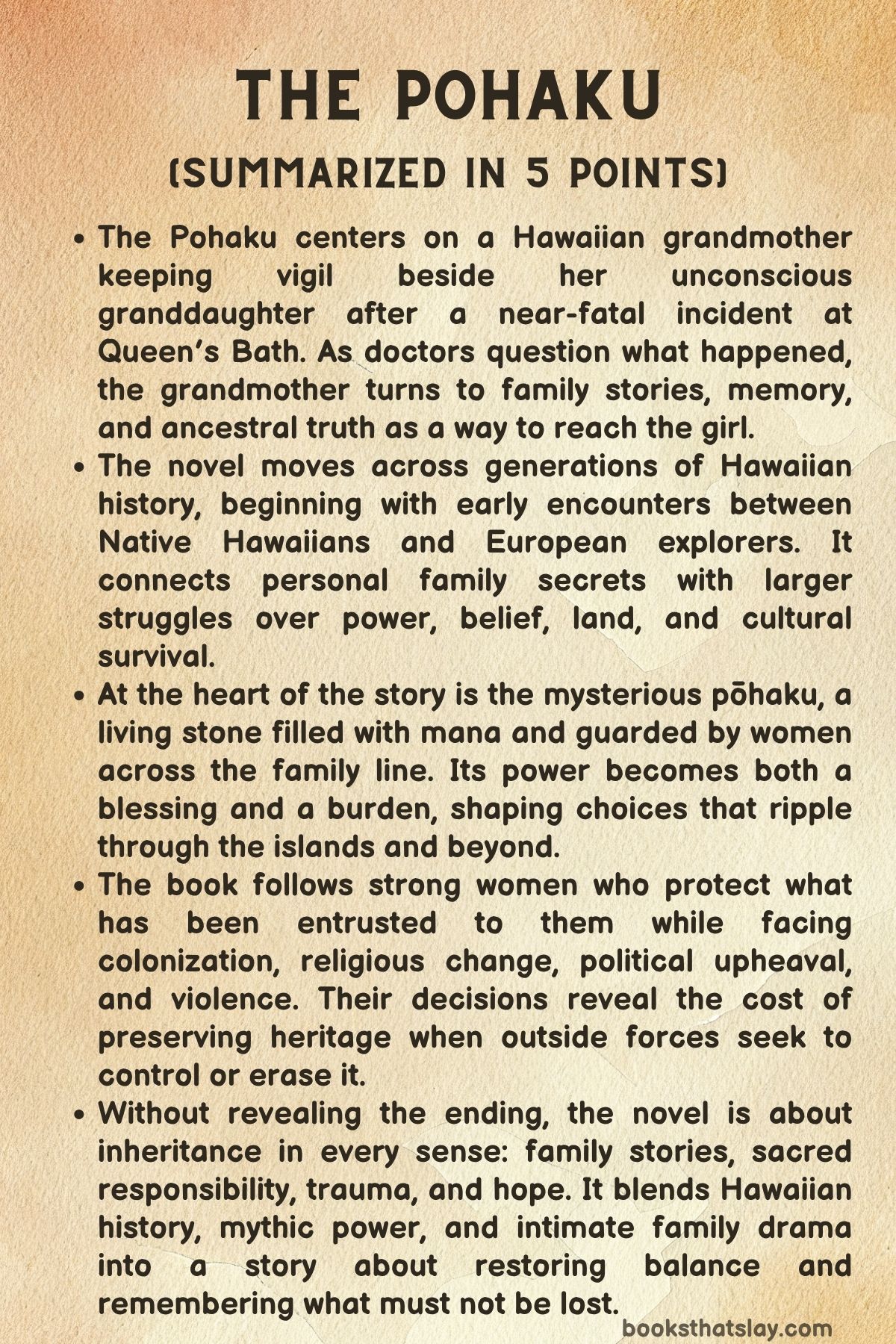
The Pohaku by Jasmin Iolani Hakes is a multigenerational historical novel shaped by Hawaiian memory, colonial violence, family duty, and the search for sacred balance. The story moves between an ICU in 1992 and earlier centuries of Hawaiian and Pacific history, tracing a hidden legacy passed through women who guard a mysterious living stone filled with mana.
Through the grandmother’s voice, the book links private family grief with larger histories of conquest, religious change, displacement, exploitation, and survival. At its center is the question of whether a story, once spoken with love and urgency, can call someone back to life.
Summary
In The Pohaku, the story begins in 1992 on Kaua`i, where a Hawaiian grandmother sits beside her unconscious granddaughter in an intensive care unit. The girl has been pulled from the ocean after being swept away at Queen’s Bath.
The doctors do not fully understand what happened, and some suspect she may have entered the water on purpose. Her grandmother rejects that idea.
She believes there is more to the accident than despair, and as machines keep the girl alive, she begins speaking to her. What she offers is not a simple comfort, but the family history that has been hidden, carried, and protected for generations.
The grandmother believes that memory has power. She also believes her granddaughter needs to know where she comes from in order to return.
So she begins with an older history, one tied to outsiders who came looking for power in Hawai`i. Captain Cook arrives in the islands while secretly searching for a prophecy connected to Oceania.
He and Lord Sandwich believe that somewhere in the Pacific there is a sacred force that could unlock extraordinary strength and influence. Cook’s pursuit of this power leads him into conflict with the Hawaiian people.
His efforts to control what he does not understand, and to force knowledge from those who hold it, end in bloodshed at Kealakekua Bay, where violence breaks out and Cook is killed.
From there, the grandmother goes further back into the family’s sacred history. On Maui, Kaahumanu is born in a cave, and at the same time something strange and powerful comes into being beside her: a living stone known as the pōhaku.
The stone is filled with mana and appears to be mysteriously connected to Kaahumanu herself. The women present at the birth understand that the stone must be kept secret.
They recognize that it is not an ordinary object and that its power could become dangerous in the hands of those who would use it for ambition or conquest.
As Kaahumanu grows, the pōhaku’s presence seems to strengthen her. Her destiny becomes tied to Kamehameha, who seeks to unite the Hawaiian Islands.
Kaahumanu becomes one of his wives and later a powerful political figure in her own right. The stone appears to aid the rise of Kamehameha’s rule, but Ka`ahumanu begins to see that even those close to her may want the pōhaku for their own purposes.
When she senses Kamehameha’s desire to possess or control it, she hides it. Her decision shows both her strength and her fear: the stone may support leaders, but it cannot safely belong to anyone who sees it only as a weapon or tool.
After Kamehameha dies, Ka`ahumanu gains even greater influence. She helps break the old kapu system, changing the religious and social order that had shaped Hawaiian life for generations.
Later, she embraces Christianity and begins turning against the old gods and sacred practices. This change creates a crisis for those entrusted with the pōhaku.
Ua, who has been one of its keepers, passes the responsibility to her daughter Palila. The duty is not only to hide the stone but to understand what it represents: a connection to older Hawaiian power, memory, and balance.
When Kaahumanu orders the destruction of sacred images and objects, Palila realizes that the pōhaku is in danger. If Kaahumanu finds it, she may try to destroy it as part of her rejection of the old ways.
Palila acts against the queen’s wishes and hides the stone. After Kapiolani survives her famous defiance of Pele, Kaahumanu becomes even more determined to erase the remaining sacred symbols of the old religion.
She demands the pōhaku, but Palila lies and claims she threw it into the ocean. In truth, Palila’s husband Keawe hides it in an underwater cave, keeping it beyond Ka`ahumanu’s reach.
Years pass, and Palila and Keawe eventually retrieve the pōhaku. They pass the responsibility to their daughter Kalehuna.
Palila sends Kalehuna away to California with John Sutter’s expedition, believing distance may protect the stone from those who would destroy or misuse it in Hawai`i. But California proves to be another place marked by greed and violence.
Kalehuna learns that Sutter is dishonest and cruel, using people for his own gain while presenting himself as a builder of settlement and opportunity. To survive, Kalehuna stays close to him and helps with the creation of New Helvetia, but she also witnesses the brutality committed against Native peoples.
Kalehuna suffers miscarriages and becomes increasingly horrified by Sutter’s power. The pōhaku, which was meant to be hidden for safety, becomes a burden in a land already being torn apart by hunger for wealth.
In desperation, she hides it in a riverbed. There, the stone causes gold to appear.
What may have been meant as concealment becomes the spark for disaster. When gold is discovered near Sutter’s mill, Kawika steals the pōhaku, and the California Gold Rush begins to spread.
The stone’s mana, removed from its proper place and purpose, seems to unleash chaos rather than balance.
Kalehuna’s daughter Mahina grows up at Hock Farm under the care of Kanaka George. Her life is shaped by the unsettled world left behind by Sutter, the gold discovery, and the violence of colonization.
Mahina becomes close to Soyo and John, two people who will become central to her life. After Sutter abuses Soyo and beats John, the three flee and seek refuge with Soyo’s people.
Soyo and John become a couple, while Mahina remains bound to them by loyalty, love, and shared survival. Soyo later gives birth to a child named Pono, strengthening the ties among them.
Their fragile safety does not last. During the violent roundup of Native people to Round Valley, Soyo becomes sick and dies.
Her death leaves John, Mahina, Kalehuna, and Pono to continue without her. John becomes increasingly obsessed with the pōhaku and the gold connected to it.
What began as fear and survival turns into fixation. He sees the stone as a path to wealth or control, while others understand it as something sacred and dangerous when misused.
His obsession ends in tragedy when he shoots Mahina and then himself. Their deaths leave the next generation, Pono and Lucia `Alohi, divided over what the pōhaku means and what should be done with its legacy.
Alohi grows into a woman connected to both Hawaiian history and political struggle. She works with Annie Bidwell and later meets King Kalākaua, becoming involved with causes tied to Hawaii’s future and sovereignty.
The family story continues through her, but the pōhaku itself remains lost. After years of searching, `Alohi believes she sees it in the rock collection of a German scientist at a San Francisco fair.
Before she can reclaim it, the scientist disappears, and the chance is lost. The stone remains out of reach, suspended between memory, hope, and danger.
Back in 1992, the grandmother explains that the family has carried the story forward because the pōhaku is not only an object to be found. It is a sign of balance that has been broken across generations: by conquest, religious conflict, greed, displacement, and family wounds.
She hopes that by telling the full truth to her granddaughter, she can help her understand the burden and strength of their inheritance.
As Hurricane Iniki approaches Kaua`i, the grandmother leaves the hospital to protect the house she has prepared for the girl’s recovery. Her action shows that she still believes the granddaughter will return.
The story ends with that faith: a grandmother speaking life into silence, guarding the past, and preparing a place for the future.
Characters
The Grandmother
The grandmother is the emotional anchor of The Pohaku, because her act of storytelling turns family history into an act of love, resistance, and hope. Sitting beside her unconscious granddaughter in the ICU, she refuses to accept the doctors’ suspicion that the girl may have jumped into the ocean.
Her refusal is not simple denial; it comes from a deep belief that her granddaughter’s life is connected to something larger than one frightening accident. Through her, the book presents memory as a form of healing.
She understands that the family’s past has been shaped by secrets, sacred duties, loss, migration, violence, and survival, and she believes that speaking these truths aloud may help restore the girl’s will to live. The grandmother is also a guardian figure, not only of her granddaughter but of the family’s hidden history.
By telling the story, she becomes part historian, part spiritual caretaker, and part witness. Her character represents the idea that elders carry more than personal memories; they carry cultural responsibility, ancestral grief, and the hope that younger generations will inherit meaning rather than silence.
The Granddaughter
The granddaughter is physically silent for most of the story, but her presence gives the entire book its urgency. She lies unconscious after being swept into the ocean at Queen’s Bath, and because she cannot speak for herself, the characters around her must confront what they believe about her, about the family, and about the past.
Her silence makes her a symbolic listener, someone suspended between life and death while the grandmother’s story tries to call her back. She represents the younger generation that may feel disconnected from ancestral history, yet is still deeply shaped by it.
The uncertainty around whether she jumped or was taken by the sea adds emotional tension to her role. She becomes more than a patient in a hospital bed; she becomes the person for whom the hidden history must finally be spoken.
Her character suggests that survival depends not only on medicine and physical recovery, but also on belonging, remembrance, and the rediscovery of one’s place within a larger family story.
Captain Cook
Captain Cook is portrayed as a figure of ambition, intrusion, and imperial violence. His secret search for a powerful prophecy connected to Hawaii reveals that he does not arrive simply as an explorer, but as someone trying to uncover and control sacred knowledge.
His interest in the prophecy reflects the colonial desire to possess what belongs to others, especially spiritual and cultural power that he does not truly understand. In the book, Cook’s downfall at Kealakekua Bay grows out of this arrogance.
He tries to force information from the Hawaiian people, and the violence that follows shows the destructive consequences of treating another culture as something to be conquered or extracted from. Cook’s character stands at the beginning of a long pattern in the story: outsiders repeatedly seek to use sacred power for their own purposes.
He is important not because he understands the pōhaku, but because his failure reveals the danger of greed when it is combined with empire, entitlement, and spiritual ignorance.
Lord Sandwich
Lord Sandwich functions as a distant but important force behind Cook’s mission. He represents the political and imperial interests that encourage exploration not as innocent curiosity, but as a search for advantage and control.
His belief that there may be a sacred force or being in Oceania capable of unlocking immense power shows how empire often turns other people’s spiritual traditions into objects of strategic desire. Unlike Cook, who physically enters Hawaii and faces the consequences of his actions, Lord Sandwich remains more removed, which makes him a symbol of power operating from a distance.
His character reflects the way colonial projects are often planned by people who do not personally suffer the harm they cause. In the story, he helps establish the atmosphere of secrecy and exploitation that surrounds the search for sacred power.
Kaahumanu
Kaahumanu is one of the most powerful and complicated figures in the book. Her birth is immediately tied to mystery because the living stone appears beside her, linking her life to sacred mana from the beginning.
As she grows, she becomes not only Kamehameha’s wife but also a major political force in her own right. Her relationship with the pōhaku suggests strength, destiny, and spiritual power, yet she is never merely a vessel for the stone.
She has her own intelligence, ambition, and will. Her decision to hide the stone when she senses Kamehameha wants to use it for himself shows her independence and her awareness that sacred power can be corrupted by political desire.
Later, after Kamehameha’s death, she helps break the old kapu system and embraces Christianity, which makes her character especially complex. She is both a protector of hidden sacred power and a destroyer of older religious structures.
Her contradictions make her compelling: she is visionary, forceful, transformative, and at times dangerous because her certainty can lead her to erase what others believe must be preserved.
Kamehameha
Kamehameha is presented as a great unifier and a figure of immense political ambition. His effort to unite the islands is strengthened by the hidden power associated with Kaahumanu and the pōhaku, but his relationship to that power is not purely noble.
He appears to recognize the usefulness of sacred force in achieving political victory, and this creates tension between him and Kaahumanu. His desire to use the stone for himself suggests that even a leader with grand historical importance can be tempted by possession and control.
In the story, Kamehameha represents the complicated nature of power: it can create unity and order, but it can also demand sacrifice, secrecy, and manipulation. His character is not simply heroic or villainous.
Instead, he is shown as a ruler whose greatness exists alongside the dangers of ambition.
Ua
Ua is one of the earliest and most important guardians of the pōhaku. Her role is rooted in secrecy, duty, and feminine knowledge.
As keeper of the stone, she protects something that powerful people might misuse if they knew its full nature. Ua’s importance lies not in public authority but in private responsibility.
She belongs to the line of women who preserve sacred knowledge outside the official structures of male rule and political ambition. By passing the duty to her daughter Palila, Ua ensures that the stone’s protection becomes a generational responsibility rather than a single person’s burden.
Her character shows that survival often depends on quiet guardianship, especially by women whose influence may not be publicly celebrated but is essential to the continuation of the family’s sacred trust.
Palila
Palila is one of the bravest protectors in The Pohaku because she must defend the stone at a time when sacred objects are under threat from Kaahumanu herself. As Ua’s daughter, she inherits not only the responsibility of keeping the stone safe but also the danger that comes with that responsibility.
Palila’s defining act is her refusal to surrender the pōhaku for destruction. When Kaahumanu demands it, Palila lies and says she threw it into the ocean, while Keawe hides it in an underwater cave.
This lie is morally significant because it is not selfish deception; it is an act of preservation. Palila understands that truth can sometimes serve power, while secrecy can protect what is sacred.
Later, she retrieves the stone and passes the duty to Kalehuna, proving that her commitment is not temporary. Her character represents courage, cunning, maternal responsibility, and the painful burden of protecting the past from those who believe they are building a better future by destroying it.
Keawe
Keawe is a loyal and practical partner in the protection of the pōhaku. While Palila carries the inherited duty, Keawe helps make that duty possible through action.
His hiding of the stone in an underwater cave is one of the story’s most important acts of preservation. He does not seek glory or ownership; instead, he supports the larger responsibility of keeping sacred power away from destruction and misuse.
Keawe’s character shows the importance of trust within a marriage shaped by danger. He is not the central keeper in the same way Palila is, but his role is essential because the stone survives partly because of his courage and discretion.
He represents partnership, steadiness, and the kind of quiet bravery that protects future generations.
Kapiolani
Kapiolani appears as a figure associated with religious transformation and public courage. Her famous challenge to Pele becomes a turning point in the conflict between older spiritual traditions and the new Christian order.
Her survival after the challenge strengthens Kaahumanu’s conviction that the old sacred objects and gods should be rejected. In the story, Kapiolani’s role is therefore symbolic as much as personal.
She represents the power of public acts to reshape belief. However, her presence also complicates the moral landscape, because what appears to some as spiritual bravery appears to others as part of a larger destruction of ancestral sacredness.
Her character helps show that cultural change is rarely simple. It can involve courage and conviction, but also loss, erasure, and conflict over what should be preserved.
Kalehuna
Kalehuna is one of the most tragic and resilient figures in the story. Sent to California with John Sutter’s expedition, she carries the responsibility of protecting the pōhaku far from Hawaii.
Her journey begins as an act of preservation, but it places her in a world of exploitation, violence, and moral corruption. Kalehuna quickly learns that Sutter is dishonest and dangerous, and she uses her closeness to him as a means of survival.
Her role in helping establish New Helvetia places her inside a colonial project that she increasingly sees as brutal, especially in its treatment of Native peoples. Her miscarriages deepen the sense of personal loss surrounding her character.
When she hides the pōhaku in a riverbed and gold appears, she becomes connected to the Gold Rush in a deeply painful way. She does not seek to unleash greed, but her attempt to hide sacred power leads to catastrophic consequences.
Kalehuna represents survival under coercion, the burden of inherited duty, and the devastating possibility that even protective acts can produce unintended harm.
John Sutter
John Sutter is one of the clearest figures of exploitation in the book. He is dishonest, manipulative, and cruel, especially in his treatment of Native peoples and those dependent on his power.
His settlement, New Helvetia, becomes a place where ambition is built through violence and domination. Sutter’s character exposes the brutality beneath frontier mythology.
Rather than representing opportunity or civilization, he represents greed disguised as progress. His abuse of Soyo and his wider exploitation of vulnerable people make him a deeply destructive presence.
Through Sutter, the story connects the history of the pōhaku to the violence of colonial expansion in California. He is important because he shows that the hunger for land, labor, and wealth can be just as spiritually dangerous as the hunger for sacred power.
Kawika
Kawika plays a crucial role in the spread of disaster surrounding the pōhaku. By stealing the stone after gold is discovered near Sutter’s mill, he helps unleash the California Gold Rush outward.
His act is driven by desire, opportunism, or perhaps fascination with the power the stone seems to hold. Whatever his exact motive, the result is destructive.
Kawika becomes an example of how sacred objects become dangerous when removed from responsibility and treated as tools of personal gain. He is not developed as deeply as some of the family guardians, but his importance lies in the consequences of his theft.
Through him, the story shows how one selfish or reckless act can magnify greed on a massive historical scale.
Mahina
Mahina is a deeply sympathetic character whose life is shaped by displacement, loyalty, and tragedy. Growing up at Hock Farm with Kanaka George, she forms strong bonds with Soyo and John, and those relationships become central to her identity.
Her decision to flee with them after Sutter’s violence shows her courage and her refusal to remain passive in the face of abuse. Mahina’s love and loyalty are complicated because she remains emotionally bound to Soyo and John even as their lives take painful turns.
After Soyo dies, Mahina continues forward with the surviving family, but John’s obsession with the pōhaku and gold ultimately destroys them. His shooting of Mahina is one of the story’s most devastating moments because it turns the greed surrounding the stone into intimate violence.
Mahina represents devotion, endurance, and the vulnerability of people who try to hold broken families together amid historical catastrophe.
Kanaka George
Kanaka George serves as part of Mahina’s early world at Hock Farm and helps connect her life to the broader movement of Hawaiian people beyond the islands. His presence suggests community, cultural continuity, and the formation of family-like bonds in a place far from home.
Although he is not described as one of the central keepers of the pōhaku, his role matters because he helps shape the environment in which Mahina grows up. He represents the Hawaiian diaspora within the story and the way people carry identity with them even when they are displaced into new and often hostile settings.
His character adds depth to the California portion of the book by showing that the story is not only about individual survival, but also about communities formed under pressure.
Soyo
Soyo is one of the most heartbreaking characters in the novel. She suffers abuse from Sutter, escapes with Mahina and John, and finds a measure of belonging among her own people before violence again overtakes her life.
Her relationship with John and the birth of Pono create hope, but that hope is shadowed by the brutal realities surrounding Native communities in California. During the roundup to Round Valley, Soyo becomes ill and dies, making her character a painful representation of Indigenous suffering under colonial violence.
Yet she is not only a victim. She is also a friend, a mother, and a person whose bonds with Mahina and John shape the next generation.
Soyo’s character brings emotional force to the story’s critique of exploitation, showing how historical violence enters bodies, families, and futures.
John
John is a tragic and morally deteriorating character. Early in the story, he is a victim of Sutter’s brutality, and his flight with Soyo and Mahina suggests that he is capable of love, loyalty, and shared survival.
However, over time, his relationship to the pōhaku and gold becomes increasingly obsessive. This obsession transforms him from someone who has suffered violence into someone who commits it.
His final act of shooting Mahina and himself shows the complete corruption of his spirit by greed, grief, and fixation. John’s character is important because he demonstrates that victimhood does not automatically make a person morally safe.
Pain can deepen compassion, but it can also curdle into possessiveness and destruction when joined with obsession. His downfall is one of the clearest examples of how the stone’s power, when misunderstood, can expose and intensify human weakness.
Pono
Pono represents inheritance marked by both love and trauma. As the child of Soyo and John, he carries forward a lineage shaped by violence, displacement, and survival.
After Soyo’s death and John’s later destruction, Pono is left with a fractured family legacy. His division from Lucia Alohi over the meaning of the pōhaku shows that the stone is not simply an object to be found; it is a question each generation must interpret.
For Pono, the stone may carry pain, danger, or unresolved burden. His character reflects the difficulty of inheriting a past filled with sacred responsibility and human damage.
He matters because he shows how family history can divide descendants when they cannot agree on whether the past should be reclaimed, feared, or released.
Lucia Alohi
Lucia Alohi is one of the most important later-generation figures because she actively continues the search for meaning around the pōhaku. Unlike those who are destroyed by obsession, Alohi’s connection to the stone is also tied to political awareness and cultural responsibility.
Her work with Annie Bidwell and her meeting with King Kalākaua connect her personal family inheritance to larger Hawaiian political causes. She is not merely searching for an object; she is searching for restoration, balance, and a way to reconnect a scattered history.
Her glimpse of what she believes is the pōhaku in a German scientist’s rock collection is especially painful because it suggests how sacred things can be removed, collected, and displayed by outsiders who do not understand them. Alohi represents persistence, cultural memory, and the longing to recover what has been stolen or lost.
Annie Bidwell
Annie Bidwell functions as a bridge between Alohi’s personal journey and broader social or political networks. Her presence in the story places Alohi near reformist and influential circles, helping connect the family’s history to wider questions of justice, advocacy, and public action.
While Annie is not part of the ancestral line of keepers, her relationship with Alohi matters because it helps create opportunities for Alohi’s political and cultural engagement. Her character reflects the complicated role of allies in stories shaped by colonization and displacement.
She may offer support and access, but the deeper burden of memory and restoration remains with Alohi and her family.
King Kalākaua
King Kalākaua represents Hawaiian sovereignty, cultural pride, and political struggle. His meeting with Alohi connects the family’s private story to the larger fate of Hawaii.
In a book so concerned with sacred power, cultural loss, and the consequences of outside domination, Kalākaua’s presence carries symbolic weight. He stands for a Hawaiian future that is politically threatened yet culturally alive.
For Alohi, encountering him strengthens the sense that the family’s search for the pōhaku is not only personal but also connected to the survival and dignity of a people. His character gives the later part of the story a broader historical and national dimension.
The German Scientist
The German scientist represents the outsider collector who possesses sacred or culturally meaningful objects without understanding their full significance. When Alohi sees what she believes may be the pōhaku in his rock collection, the moment captures the pain of cultural displacement.
The stone, once guarded through generations of danger, appears reduced to a specimen in a collection. His disappearance before Alohi can reclaim it makes him a frustrating and elusive figure.
He is less important as a fully developed individual than as a symbol of scientific possession detached from spiritual responsibility. Through him, the story shows another form of taking: not conquest through battle or settlement, but removal through classification, collecting, and ownership.
The Pōhaku
The pōhaku is not a human character, but it functions like a living presence throughout The Pohaku. Born beside Kaahumanu, filled with mana, hidden, stolen, protected, and pursued, it shapes generations of human choices.
The stone is sacred, powerful, and dangerous because it reveals the intentions of those who approach it. To guardians like Ua, Palila, Keawe, Kalehuna, and Alohi, it is a responsibility.
To figures driven by ambition or greed, it becomes a tool to be used, possessed, or exploited. Its connection to gold in California makes it especially complex, because what begins as hidden sacred power becomes tied to one of the most destructive rushes for wealth in American history.
The pōhaku represents ancestral power, cultural memory, spiritual balance, and the risk of imbalance when sacred things are severed from the people and duties that give them meaning.
Themes
Storytelling as Survival
The grandmother’s act of speaking to her unconscious granddaughter becomes more than an attempt to fill silence in the ICU. Her storytelling is a form of resistance against forgetting, against medical doubt, and against the possibility that the girl’s life may end before she understands where she comes from.
The family history she shares is full of pain, secrecy, migration, violence, and loss, yet the telling of it gives those experiences meaning. By passing the story forward, she treats memory as something living, almost like medicine.
The granddaughter cannot respond, but the grandmother believes that the voice of ancestry can still reach her. In The Pohaku, survival is not only physical; it is cultural, emotional, and spiritual.
The family continues because someone remembers, someone speaks, and someone refuses to let the past disappear. The story suggests that silence can be dangerous, because hidden histories lose their power when they are cut off from the next generation.
Speaking becomes a way of keeping the family whole.
Power and Its Corruption
The pōhaku carries mana, but the danger around it often comes from human ambition rather than from the stone itself. Captain Cook, Lord Sandwich, Kamehameha, John Sutter, Kawika, and John are all drawn toward the possibility of control, wealth, or dominance.
Each man sees power as something to possess, extract, or use for personal gain. This pattern repeats across different places and periods, showing how greed changes shape but does not disappear.
Cook’s search for sacred knowledge becomes violent conquest. Sutter’s dream of settlement becomes exploitation.
John’s desire for gold destroys the people closest to him. The stone exposes what already exists inside people: hunger, fear, pride, and the desire to command forces larger than themselves.
The women who guard it understand that sacred power must be protected, not owned. Their secrecy is not weakness but wisdom.
The theme warns that power without responsibility becomes destructive, especially when it is separated from respect, community, and spiritual balance.
Women as Guardians of History and Sacred Duty
Women carry the deepest responsibilities in this story, even when public power appears to belong to men. Kaahumanu is politically powerful, but the women around her are equally important because they understand the hidden meaning of the pōhaku.
Ua, Palila, Kalehuna, Mahina, Alohi, and the grandmother each become protectors of memory, sacred duty, and family survival. Their role is not passive; they make difficult choices under pressure, often choosing secrecy, movement, or sacrifice to protect what men might misuse.
Palila lies to save the stone from destruction. Kalehuna takes it across the ocean to keep it safe.
Alohi continues the search after the family has been scattered by violence and history. The grandmother turns the act of care into a final guardianship, using story to protect her granddaughter’s spirit.
The Pohaku presents women as the true keepers of continuity. They preserve what cannot be written in official histories: sacred knowledge, family truth, and the emotional cost of survival.
Displacement, Loss, and the Search for Balance
The family’s history is shaped by movement forced by danger, colonization, greed, and survival. Hawaii, California, rivers, caves, farms, hospitals, and oceans all become places where people lose and search for belonging.
The pōhaku’s journey mirrors this displacement. It is hidden, carried away, stolen, lost, and glimpsed again, just as the family is repeatedly separated from homeland, safety, and one another.
The California sections show how Indigenous suffering is not limited to one place; violence against Native Hawaiians and Native Californians becomes part of the same larger pattern of conquest. Yet the story does not treat loss as the end.
The search for the stone becomes a search for balance: between past and present, sacred duty and personal survival, grief and hope. The grandmother’s vigil beside her granddaughter brings this search into the present moment.
The unconscious girl represents a future that may still be saved if the broken pieces of the family’s story can be gathered, remembered, and passed on.