Going Too Far Summary, Characters and Themes
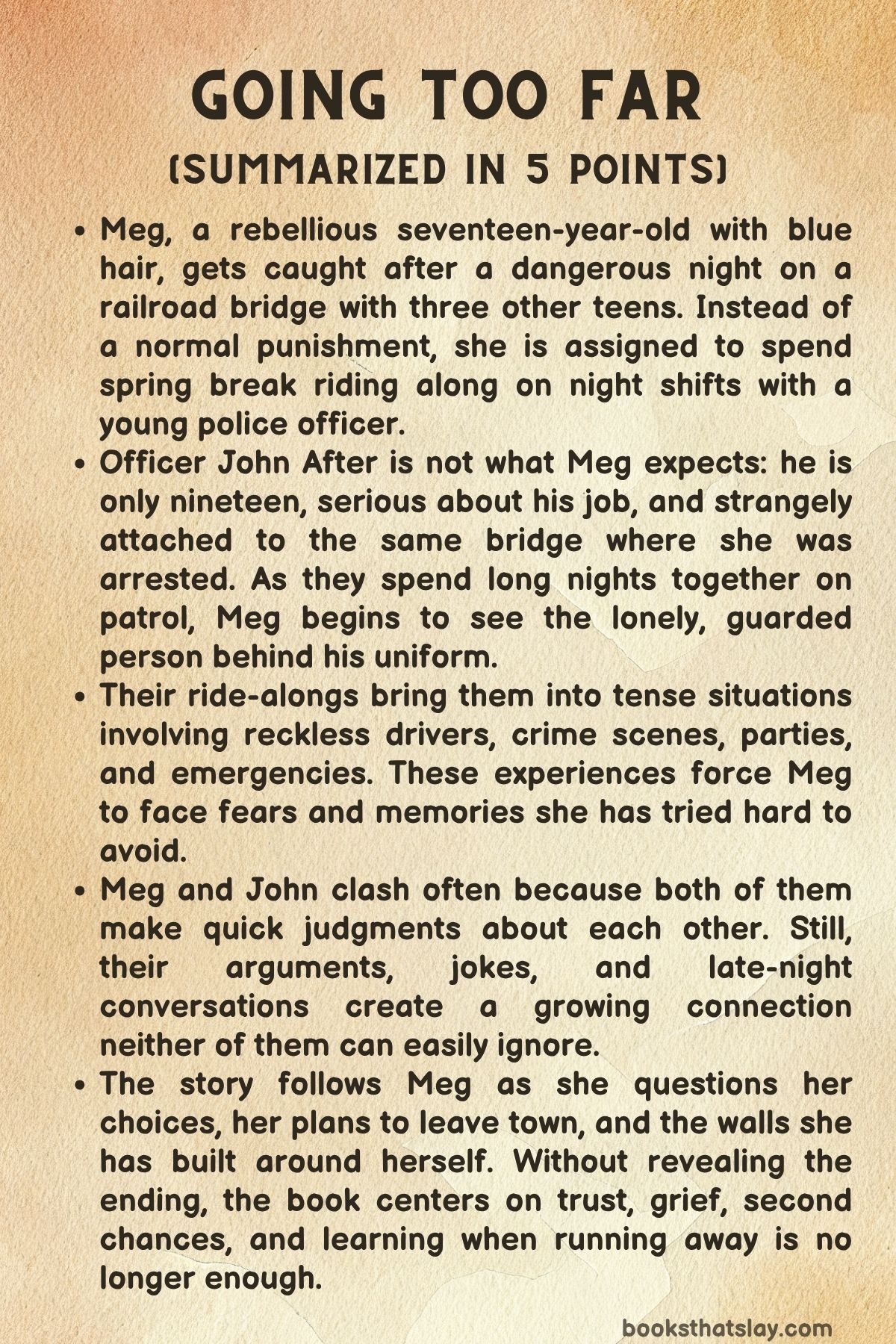
Going Too Far by Jennifer Echols is a young adult contemporary romance about Meg, a rebellious high school senior whose reckless choices bring her into the orbit of John After, a nineteen-year-old police officer with wounds of his own. The story begins with a dangerous stunt on a railroad bridge and grows into a tense, emotional look at fear, grief, control, love, and the urge to escape.
Meg wants to run from her town and her past, while John seems unable to leave either behind. Their connection forces both of them to face what they have been avoiding.
Summary
Meg is a seventeen-year-old senior known for her blue hair, sharp attitude, and habit of chasing trouble before it can catch her first. One night, she goes out drinking with Eric, an older boy she has been casually seeing, along with Tiffany and Brian, two ambitious classmates who are not used to breaking rules.
Their night turns dangerous when they trespass onto a railroad bridge tied to a local tragedy about two teenagers killed there by a train. What begins as flirting and showing off quickly becomes life-threatening.
They walk barefoot onto the bridge, drink, and joke around, unaware that a train is coming. Meg senses something wrong just before police lights flash at one end of the bridge.
Officer John After orders them off the tracks, and moments later a train tears across the bridge. The danger becomes undeniable.
John treats the situation seriously, handcuffing and searching the boys and placing Tiffany in the police car. When he nearly handcuffs Meg, she reacts with intense fear.
At the station, the others are collected by their parents, but Meg’s parents do not come right away. John tries to scare her by putting her in a jail cell, but Meg panics, hyperventilates, and faints.
Dispatcher Lois steps in and keeps Meg from being locked up. Instead of regular punishment, the teenagers are assigned spring-break ride-alongs with emergency workers and must write a proposal to prevent other teens from copying their mistake.
Meg is assigned to John’s night police shift, destroying her planned trip to Miami.
At home, Meg’s parents run their diner, Eggstra! Eggstra!, and her father tells her she will work mornings and ride with John at night while they go to Graceland.
Meg expects Officer After to be an older, married policeman, but her first ride-along shocks her. John is nineteen, only a little older than she is, and a recent graduate of her own high school.
He is serious, controlled, and determined to keep her safe, but he also seems strangely tied to the bridge. He patrols it again and again, making it clear that the place matters to him in a way he does not explain.
As Meg spends long nights in John’s patrol car, she begins to see more of the world he inhabits. They stop cars, respond to calls, search for suspects, break up disturbances, and visit dangerous areas around town.
John keeps her in the car when situations might turn risky, which frustrates her. He believes Meg courts danger by chasing boys like Eric, and he admits that she reminds him of the girl who died on the bridge years earlier.
Meg resents his judgment and hates that he thinks he understands her. Still, the more time they spend together, the more she sees his loneliness, discipline, and hidden pain.
Their arguments often carry an attraction neither of them can fully ignore.
Meg also reconnects with Tiffany, who is riding with paramedics and is upset by Brian’s cold behavior after their arrest. Meanwhile, John’s old track friends, Will, Rashad, and Skip, appear at McDonald’s and tease him, showing Meg that John is not only a strict officer but also a young man who used to have friends, jokes, and ordinary teenage experiences.
They warn her that Eric is trouble. When Will flirts with Meg, John’s jealousy becomes obvious, and Meg realizes his feelings may be stronger than he wants to admit.
At the diner and during patrol, Meg and John talk more openly about their futures. Meg plans to leave town for UAB and eventually go far away.
John insists he wants to stay, remain a cop, and keep working in the same place. Their different dreams become a central tension between them.
One night at Martini’s, John breaks up a bar fight and finds Eric drunk with Angie, John’s ex-girlfriend. John prevents them from driving and makes them call their parents.
Afterward, Meg and John laugh, flirt, and discuss what may happen once her punishment ends. John finally agrees to meet her at 6:01 a.m.
on Thursday, the minute he no longer has authority over her.
A stormy night brings them to a stranded car at Birmingham Junction. While helping push the car free, John notices Meg’s tattoo and becomes distracted.
After he gets covered in mud, he takes her to his apartment to change. There Meg sees a private side of him: drawings from Europe and Birmingham, including a striking drawing of the railroad bridge.
She notices a family photo and asks about his brother, but John only says that he “left.” Their attraction grows as John lends her clothes and teaches her basic gun safety. Then a call comes through about a fatal accident.
At the crash site, Meg sees Tiffany and Brian working with emergency crews. A car has smashed into an interstate pillar, and firefighters are cutting it open.
John insists Meg look inside, even when Brian tries to stop him. Seeing the dead woman in the wreck triggers Meg’s deepest trauma.
She faints and wakes in an ambulance, furious at John for forcing her to confront the body. In her anger, she screams that she had cancer.
This reveals the source of her fear of confinement and restraint. As a child, she refused treatment, ran from the hospital, was caught by police, restrained, sedated, and forced into chemotherapy.
Her rebelliousness is tied not only to teenage defiance but to a past in which her body and choices were taken from her.
Hurt and angry, Meg tries to pull away from John. Eric calls for a hookup, and she agrees, partly to prove to herself that John does not matter.
Eric takes her back to the bridge and pressures her toward sex. Meg realizes she does not want him.
When Eric smokes pot and prepares to drive, Officer Leroy and John arrive. John is wounded, believing Meg meant to sleep with Eric to punish him.
In the police car, they argue, but Meg admits she stopped because of John, and John admits he cares about her.
Their connection deepens as John asks about her cancer and listens to what she survived. Soon after, they witness an armed robbery at a convenience store.
John waits for backup, Meg kisses him for luck, and he helps arrest the suspects. Watching him face danger and live through it makes Meg realize she has fallen in love with him.
But when 6:01 a.m. arrives, John does not act on their earlier plan.
Meg leaves angry and embarrassed.
John later comes to the diner and invites her to the beach. They drive to Florida, walk in the surf, eat seafood, meet Will at a beach club, dance, and return to John’s apartment.
Their physical relationship intensifies, but John stops before sex because Meg cannot fully undress or trust him. They argue.
He says he loves her, and she says she loves him, but they separate badly, both hurt and afraid.
Meg then tries to fix John’s fixation on the bridge by arranging for a police camera there and calling him while standing on the bridge before a scheduled train. John rushes to her, discovers the camera, crosses the bridge, and angrily handcuffs her.
Meg panics again. Officer Leroy reveals the truth: John’s brother died on that bridge with his girlfriend.
Meg realizes that John’s obsession is not simple control or arrogance. It is grief.
After this, Meg begins making changes. She cries, helps Purcell by offering to teach him to read, calls Tiffany, and dyes her blue hair brown.
She goes with Tiffany to Rashad’s college party, where Will helps explain the misunderstanding between her and John. Eric admits he used the bridge to hurt John.
John runs to the Devil fountain, and Meg follows him. There, they finally speak honestly.
John admits the bridge has shaped him into someone he no longer wants to be. He plans to move to Birmingham, join the university track team, and maybe travel Europe with Meg.
They reconcile, choosing a future that is not ruled by fear. By the next night, John is openly her boyfriend at the diner, and Meg has begun to believe that leaving the past behind does not have to mean running away alone.
Characters
Meg
Meg is the emotional center of Going Too Far, and her character is built around a fierce tension between rebellion and vulnerability. On the surface, she appears reckless, sarcastic, impulsive, and determined to push against rules.
Her blue hair, her casual involvement with Eric, and her eagerness to escape town all make her seem like someone who wants to be seen as fearless. However, the book gradually reveals that her recklessness is not simply immaturity.
It is connected to trauma, fear, and a desperate need to feel in control of her own life after surviving cancer and being forced through treatment against her will. Her fear of handcuffs, enclosed spaces, hospitals, and restraint shows that much of her behavior comes from a deep wound rather than simple defiance.
Meg’s relationship with John forces her to confront the difference between freedom and self-destruction. At first, she sees him as another authority figure trying to control her, especially because he is a police officer and because he repeatedly pushes her into situations that make her feel exposed.
Yet she also begins to recognize that John is not only strict or judgmental; he is wounded in his own way. This recognition allows Meg to become more emotionally honest.
She begins the story trying to escape pain by running toward danger, but she slowly learns that real courage is not the same as pretending not to care. Her love for John becomes important not because it “fixes” her, but because it challenges her to stop hiding behind sarcasm, rebellion, and impulsive choices.
Meg’s growth is especially clear in the way she begins to care for others more openly. Her conversations with Tiffany show that she has protective instincts and emotional wisdom, even when she does not always apply that wisdom to herself.
Her offer to help Purcell learn to read also shows that she is becoming less focused only on escape and more aware of the people around her. By the end of the story, Meg has not lost her sharpness or independence, but she has begun to understand herself better.
She becomes a character who still wants freedom, but no longer sees danger, emotional distance, or self-sabotage as the only ways to prove she owns her life.
John After
John After is one of the most layered characters in the book because he appears controlled, mature, and authoritative while actually being driven by unresolved grief. At nineteen, he is barely older than Meg, but his uniform and behavior make him seem much older at first.
He is strict, disciplined, serious, and deeply committed to his work as a police officer. His attachment to the railroad bridge initially seems excessive and even obsessive, but later it becomes clear that the bridge is tied to the death of his brother and his brother’s girlfriend.
His constant patrols are not just professional duty; they are an attempt to manage guilt, grief, and helplessness.
John’s character is shaped by contradiction. He wants to protect people, but his need to protect sometimes becomes controlling.
He cares about Meg, but he often expresses that care in ways that frighten or anger her. His decision to make her look at the fatal crash is especially painful because he believes he is forcing her to face reality, while Meg experiences it as another violation of her emotional boundaries.
This makes him morally complex: he is not cruel, but he is capable of causing harm when he lets his own trauma decide what someone else needs. His authority gives him power, and the book shows that even well-intentioned power can become dangerous when mixed with grief and fear.
At the same time, John is not only the stern police officer Meg first imagines. His friends, his drawings, his jealousy, his awkward humor, and his dreams of travel reveal a young man who has buried his ordinary teenage self beneath responsibility.
His art suggests sensitivity and imagination, while his desire to remain in town as a cop shows how deeply trapped he is by the past. His eventual decision to leave the bridge behind and consider Birmingham, track, and Europe marks a major turning point.
John’s growth comes from realizing that honoring the dead does not mean sacrificing his own future. By the end, he becomes more than a symbol of law and control; he becomes a young man choosing life after grief.
Eric
Eric is a reckless and manipulative figure whose charm hides selfishness and emotional carelessness. He begins as the older boy Meg is casually involved with, and he represents the kind of danger she uses to distance herself from deeper feelings.
He is not simply rebellious; he repeatedly shows that he is willing to put others at risk. His behavior on the railroad bridge, his drinking, his drug use, and his willingness to drive while impaired all reveal a person who treats consequences as someone else’s problem.
Unlike Meg, whose recklessness is tied to trauma, Eric’s recklessness often feels careless, entitled, and exploitative.
Eric’s role in the story is important because he exposes the difference between thrill and genuine connection. He is attractive to Meg partly because he seems easy, temporary, and emotionally uncomplicated.
However, when he takes her back to the bridge and tries to pressure her into sex, she realizes that what once looked like freedom is actually another form of danger. Eric does not truly see Meg; he sees her as someone he can use to satisfy his own desires or to provoke John.
His later admission that he used the bridge to hurt John makes him seem even more deliberately cruel.
Eric also functions as a contrast to John. Both boys are connected to danger, but in very different ways.
John’s danger comes from overprotection, grief, and emotional intensity, while Eric’s comes from selfishness and irresponsibility. Eric does not undergo meaningful growth in the story.
Instead, he helps reveal Meg’s growth, because her rejection of him shows that she is beginning to value herself more. By stepping away from Eric, Meg steps away from a version of herself that confused recklessness with independence.
Tiffany
Tiffany is a high-achieving, inexperienced girl whose arrest forces her into a painful emotional awakening. At first, she appears to be one of the “good” students who has wandered into trouble almost accidentally.
Her presence on the bridge shows that even responsible teenagers can make dangerous choices when they are curious, pressured, or trying to step outside their usual identity. Unlike Meg, Tiffany is not used to trouble, and the consequences of the night shake her deeply.
Tiffany’s main emotional conflict centers on Brian. After the arrest, she is hurt by his coldness and becomes desperate to understand how to win back his attention.
Her question to Meg about whether she should offer Brian sex is one of the clearest signs of her insecurity. She is intelligent, but she is emotionally inexperienced, and she briefly considers sacrificing her comfort and dignity to keep a boy who is not treating her with care.
This makes Tiffany sympathetic because her weakness is not foolishness; it is the very human desire to be wanted.
Her friendship with Meg becomes one of the quieter but meaningful relationships in the story. Meg, who often presents herself as wild and careless, becomes protective and honest with Tiffany.
Through Tiffany, the book shows Meg’s capacity for empathy. Tiffany also gives Meg a different kind of mirror: while Meg hides pain behind rebellion, Tiffany hides insecurity behind achievement.
By the end, Tiffany is not as fully transformed as Meg, but she becomes part of Meg’s movement toward healthier friendships and emotional honesty.
Brian
Brian is a high-achieving student whose polished exterior weakens under pressure. He is involved in the bridge incident with Meg, Eric, and Tiffany, but unlike Eric, he does not seem naturally reckless.
His trouble comes from inexperience, poor judgment, and passivity. He goes along with the dangerous situation rather than actively leading it, which makes him a believable example of someone who can make a life-threatening mistake without thinking of himself as irresponsible.
Brian’s most important role is in his treatment of Tiffany. After the arrest, he becomes emotionally distant, leaving Tiffany confused and hurt.
His coldness suggests immaturity and discomfort with consequences. Rather than openly facing what happened or caring for Tiffany’s feelings, he retreats.
This makes him less villainous than Eric but still disappointing. He is not deliberately cruel in the same way Eric can be, but he lacks the courage and emotional generosity Tiffany needs from him.
At the crash scene, Brian tries to stop John from forcing Meg to look inside the wrecked car. This moment complicates him slightly because it shows that he is not without compassion.
He recognizes, at least in that moment, that John is going too far. Brian therefore remains a secondary but realistic character: flawed, uncertain, sometimes weak, but not entirely heartless.
His presence helps show different forms of teenage immaturity, from passive conformity to emotional avoidance.
Lois
Lois is a practical, protective adult figure who provides a necessary contrast to John’s harshness. As the dispatcher, she understands the system, the consequences of the teenagers’ actions, and the need for discipline.
However, she also recognizes when punishment becomes harmful. When John tries to scare Meg with the jail cell and Meg panics, Lois intervenes.
This moment is important because Lois sees Meg’s fear not as attitude or manipulation, but as genuine distress.
Lois represents common sense and humane authority. She does not excuse what Meg and the others did, but she also does not believe that fear alone is the right answer.
Her explanation of the ride-along punishment shows that she believes consequences should teach rather than simply humiliate. In a story filled with young people making dangerous choices and adults reacting with anger or control, Lois stands out as calm and balanced.
Although she is not one of the central emotional characters, Lois plays an important stabilizing role. She helps create the conditions that place Meg and John together, but she also serves as a reminder that authority can be firm without being cruel.
Her presence softens the world of the police station and prevents John from being the only model of law enforcement in the story.
Officer Leroy
Officer Leroy is a steady supporting character who helps reveal truths that others avoid saying directly. He works within the same police world as John, but he appears more grounded and less emotionally consumed.
When he arrives at the bridge and later reveals that John’s brother died there with his girlfriend, he gives Meg the information she needs to understand John’s obsession. His role is therefore partly explanatory, but it is also moral: he helps expose the pain beneath John’s behavior.
Leroy’s importance comes from his calmness. Unlike John, he is not shown as being controlled by the bridge.
He sees the situation with more distance and helps the reader understand that John’s actions are connected to grief, not simply arrogance or control. This does not erase John’s mistakes, but it gives them context.
Leroy becomes a bridge between Meg’s misunderstanding and the truth of John’s past.
As a character, Leroy represents experienced authority. He is not as emotionally central as John or Meg, but he provides balance in scenes where emotions are intense.
His presence suggests that maturity is not just about having a badge or responsibility; it is about knowing when to intervene, when to explain, and when to let painful truths come into the open.
Will
Will is one of John’s old track friends and serves as a reminder that John is still a young man with a past outside the police uniform. His teasing, flirting, and easy social energy contrast sharply with John’s guarded seriousness.
When Will interacts with Meg, he brings out John’s jealousy, which helps Meg realize that John’s feelings for her are stronger than he wants to admit. In this way, Will acts as a catalyst in their romantic tension.
Will also gives Meg access to a version of John that John himself tries to hide. Through Will and the other track friends, John becomes less distant and less defined by authority.
The nickname “Johnafter,” the jokes, and the casual memories show that John once belonged to a normal teenage world of friends, sports, and teasing. This makes his current life seem even more constrained by grief and duty.
At the college party, Will also helps clarify misunderstandings. He is not just comic relief or a flirtatious obstacle; he contributes to Meg’s understanding of what has really happened between her and John.
Will’s character is light in tone, but he plays an important role in revealing John’s humanity and moving the romantic conflict toward honesty.
Rashad
Rashad is another of John’s former track friends, and his main function is to connect John and Meg to the wider social world they have both partly stepped away from. His upcoming college party becomes an important setting because it gives Meg a chance to move outside the intense pattern of patrol cars, bridges, punishment, and arguments.
Rashad represents ordinary youth, social life, and the possibility of transition beyond the town’s painful routines.
Although Rashad is not deeply developed, his presence matters because the party connected to him becomes part of Meg’s emotional turning point. By going there with Tiffany, Meg tries to re-enter a more normal teenage environment.
The party also becomes the place where misunderstandings begin to untangle and where Meg learns more about Eric’s manipulation and John’s reaction.
Rashad’s role is therefore social rather than psychological. He helps widen the world of the story, reminding the reader that John has peers and that Meg has choices beyond danger or isolation.
His character supports the theme that growing up involves moving into new spaces, new friendships, and new possibilities.
Skip
Skip, like Will and Rashad, belongs to John’s old track circle and helps reveal the side of John that existed before police work became his identity. He participates in the teasing and social energy that make John seem less like a distant authority figure and more like a nineteen-year-old who has taken on too much too soon.
Skip’s presence helps break the illusion that John is fully separate from Meg’s world.
While Skip is not a major individual force in the plot, he contributes to the group dynamic that surrounds John. The track friends show that John once had a more ordinary teenage life, and this makes his current seriousness feel like a kind of emotional armor.
Through them, the reader sees that John’s strictness is not his whole personality.
Skip’s character is best understood as part of the background that humanizes John. He helps create a contrast between who John might have been and who he has forced himself to become.
This contrast is important because John’s eventual choice to return to track and imagine a future beyond the bridge depends on remembering that he is more than his grief.
Angie
Angie, John’s ex-girlfriend, appears briefly but meaningfully because she reveals something about John’s past romantic life and emotional limitations. When John finds her drunk with Eric, the scene brings together several sources of tension: John’s old relationship, Meg’s involvement with Eric, and the danger of reckless behavior.
Angie’s presence makes John’s jealousy and discomfort more visible, even though he tries to remain professional.
Angie also helps Meg and John move into more open flirtation afterward. Their conversation following the incident allows them to laugh, test boundaries, and acknowledge the attraction between them more directly.
In that sense, Angie functions less as a rival and more as a trigger for honesty. She reminds Meg that John has a romantic history and that he is not as untouched or distant as his uniform makes him seem.
As a character, Angie is not explored deeply, but she contributes to the emotional texture of the story. She belongs to John’s past, while Meg increasingly represents a possible future.
Angie’s scene also reinforces the book’s concern with alcohol, poor judgment, and the thin line between ordinary teenage mistakes and serious danger.
Meg’s Father
Meg’s father is a practical and somewhat stern figure whose role reflects the strained relationship between Meg and her family. He expects her to work at the diner and face the consequences of her actions, but he does not always seem emotionally equipped to understand the deeper reasons behind her behavior.
His refusal, along with Meg’s mother, to immediately come for her after the arrest contributes to Meg’s sense of abandonment and anger.
At the same time, he is not presented as a villain. His response comes from frustration, worry, and perhaps exhaustion after everything the family has already endured during Meg’s illness.
The family diner, Eggstra! Eggstra!, symbolizes a life Meg wants to escape, but it also represents the ordinary family world that still holds her.
Her father’s insistence that she work there keeps her tied to responsibility, even when she wants to run.
His character helps show that Meg’s conflict is not only romantic or personal; it is also familial. She wants distance from her parents because she associates them with control, illness, and the loss of bodily autonomy.
Her father’s presence keeps that unresolved family tension in the background, shaping her desire to leave town and define herself on her own terms.
Meg’s Mother
Meg’s mother remains more in the background, but she is part of the family structure Meg resists. Along with Meg’s father, she does not immediately rescue Meg from the police station, which deepens Meg’s feeling that her parents respond to her through punishment rather than understanding.
Her absence from many of the central scenes is itself meaningful because Meg often seems emotionally isolated from her family.
Meg’s mother can be understood through the larger history of Meg’s cancer treatment. Although the provided events focus more on Meg’s experience than her parents’ perspective, it is clear that Meg associates her family with the decisions that took control away from her during her illness.
This makes her relationship with her mother emotionally complicated. Love, fear, resentment, and survival are all tangled together.
As a supporting character, Meg’s mother helps explain why Meg is so determined to leave. Meg does not simply want adventure; she wants distance from a home that reminds her of being trapped, watched, and controlled.
Her mother’s role in the book is quiet, but she remains part of the emotional pressure that has shaped Meg’s rebellious identity.
Purcell
Purcell is a minor but meaningful character because Meg’s interaction with him shows her growing compassion and maturity. When Meg offers to teach him to read, it marks a shift in her attention.
Earlier, she is often focused on escape, anger, and emotional defense. By helping Purcell, she begins to act from care rather than fear or rebellion.
Purcell’s role is important because he gives Meg an opportunity to become useful to someone else in a sincere way. This is different from her intense relationship with John or her protective friendship with Tiffany.
With Purcell, Meg is not trying to prove herself, flirt, fight, or escape. She is simply offering help.
That makes the moment quietly powerful.
As a character, Purcell also broadens the story’s view of struggle. Not every difficulty in the book is dramatic, romantic, or life-threatening.
Some struggles are ordinary and private, like difficulty reading. Meg’s willingness to notice and respond to that struggle shows that she is becoming more open to the world around her.
Themes
Trauma and the Fear of Losing Control
Meg’s boldness often looks like simple rebellion, but much of it grows from fear. Her panic around handcuffs, cells, hospitals, and enclosed spaces shows that her past illness did not end when her treatment ended.
She survived cancer, but she was also left with memories of being restrained, forced into treatment, and denied control over her own body. This makes her react strongly whenever someone tries to confine her or decide what is best for her.
Her risk-taking becomes a way to prove that no one can control her again, even when her choices place her in danger. In Going Too Far, trauma is shown not only through flashbacks or fear, but through behavior that other people misread.
John first sees Meg as reckless, while Meg sees John as controlling, yet both are responding to pain they have not fully faced. The theme becomes powerful because healing does not come from pretending the past is over.
It begins when Meg finally explains what happened to her and allows someone to see the fear underneath her attitude.
Grief, Guilt, and the Need to Move Forward
John’s life is shaped by grief that has hardened into duty. His attachment to the bridge is not just professional concern; it is his way of staying close to the brother he lost and punishing himself for surviving.
By returning there again and again, he tries to prevent another death, but he also keeps himself trapped in the same emotional place. His uniform gives him purpose, yet it also becomes a shield that separates him from normal youth, friendship, love, and change.
Meg mistakes his behavior for obsession with authority, while he mistakes her recklessness for indifference to life. Their conflict reveals how grief can distort judgment, making a person treat protection as control and responsibility as punishment.
John’s growth comes when he understands that honoring the dead does not mean sacrificing his future. Choosing Birmingham, track, travel, and a life beyond the bridge shows that moving forward is not betrayal.
It is the first real sign that he is ready to live for himself.
Risk, Rebellion, and the Value of Life
Danger appears throughout the story as something thrilling, careless, and sometimes deeply misunderstood. Meg’s drinking, trespassing, casual involvement with Eric, and attraction to escape all suggest a girl testing how close she can come to disaster without admitting that she is scared.
Eric treats danger as a game and uses it to manipulate people, while Meg slowly learns that freedom is not the same as self-destruction. The train, the car accident, the robbery, and the bridge all force her to confront how quickly life can change.
These moments do not simply scare her into obedience; they make her question what kind of life she wants after surviving illness. The theme is especially strong because Meg has already fought to live, yet she often acts as though her survival has no value.
Her journey is not about becoming perfectly cautious. It is about understanding that courage can mean choosing safety, honesty, and love instead of chasing danger to feel powerful.
Love, Trust, and Emotional Honesty
The relationship between Meg and John develops through conflict because both of them are guarded. Their attraction is obvious, but trust is much harder for them than desire.
Meg uses sarcasm, flirting, and defiance to keep people from seeing her fear, while John hides behind rules, authority, and emotional distance. Their arguments matter because they expose the parts of themselves they would rather keep hidden.
Love in Going Too Far is not presented as an instant cure. It challenges both characters to stop making assumptions and to speak honestly about pain, guilt, fear, and need.
John has to learn that protecting Meg does not give him the right to control her, and Meg has to learn that trusting someone does not mean surrendering herself. Their failed moments are as important as their romantic ones because they show how easily love can become fear when honesty is missing.
By the end, their reconciliation feels earned because it depends on truth, not just attraction.