Fragile Eternity Summary, Characters and Themes
Fragile Eternity by Melissa Marr is a young adult fantasy novel set in the world of the Wicked Lovely series. The story follows Seth as he tries to hold on to his relationship with Aislinn, who is no longer simply the mortal girl he loves but the Summer Queen.
Their bond is tested by faery politics, immortal desire, and the growing threat of war. Around them, Keenan, Donia, Niall, Sorcha, and Bananach each pull the courts toward danger in different ways. At its center, the book asks what love can survive when power changes everything. It’s the 3rd book of the Wicked Lovely series.
Summary
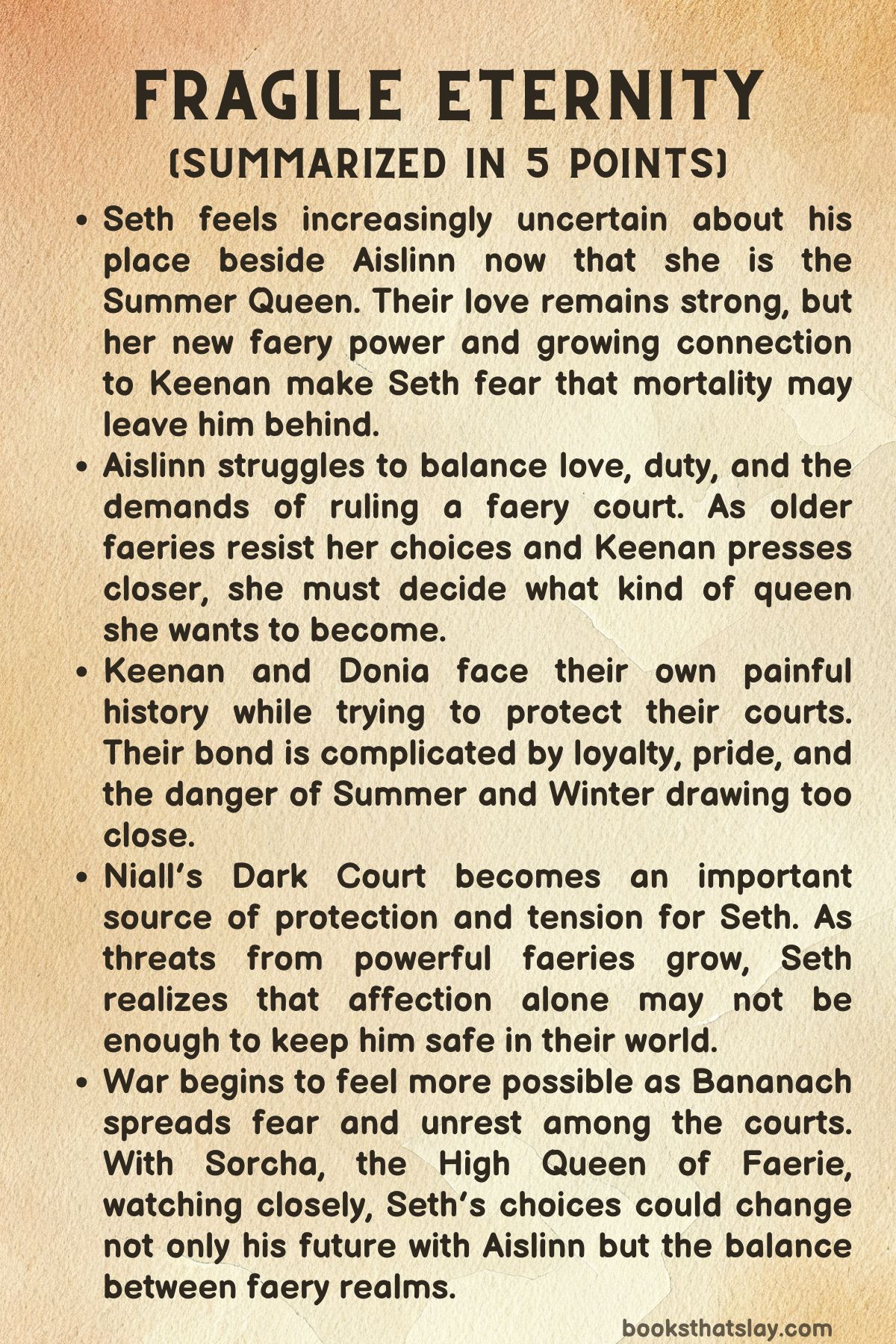
Seth Morgan is struggling to understand where he belongs in Aislinn’s life now that she has become the Summer Queen. He still loves her, and she still loves him, but her new faery nature has made their relationship dangerous in ways neither of them can ignore.
When she comes to him after the Summer revels, she is filled with intense sunlight and power. In moments of passion or carelessness, she burns and bruises him without meaning to.
Seth hides the injuries because he is afraid that if Aislinn realizes how much she hurts him, she will pull away. Worse, he fears that the space she leaves behind will be filled by Keenan, the Summer King.
Aislinn is trying to learn how to rule. She has ideas for changing the Summer Court, but the older advisers resist her.
Seth watches her from the edges and sees that she is becoming more confident as queen. He also sees Keenan drawing closer to her.
Keenan understands the court, understands her new role, and shares a faery bond with her that Seth cannot match. Seth begins to feel fragile and temporary among immortal beings.
He wants to be Aislinn’s future, but he fears he is only a human part of her past.
Far from the mortal world, Sorcha, the High Queen of Faerie, receives a warning from her chaotic twin, Bananach. Bananach, who feeds on war and disorder, tells Sorcha that Seth is more important than he appears.
He is loved by Aislinn, trusted by Niall, and known to Donia, giving him a connection to several courts. Bananach suggests that this mortal could disturb the balance of power.
Sorcha is troubled and sends Devlin, her loyal brother and enforcer, to watch him.
The tensions between the courts continue to rise. Keenan and Aislinn visit Donia, the Winter Queen, after learning that Bananach has been near her.
Donia resents Keenan’s interference and refuses to let Summer control Winter. Later, Keenan goes to Donia privately, and the old love between them nearly overwhelms both of them.
Their opposing natures hurt each other, burning and freezing at once, and Donia forces Keenan to face the unfairness of what he wants. He keeps reaching for Aislinn as queen while also using Donia as his emotional refuge.
Donia tells him he must choose a real place for her in his life or let her go.
Niall, now the Dark King, becomes another powerful force around Seth. At the Crow’s Nest, Bananach arrives with Ly Ergs and provokes violence.
Devlin appears afterward and warns Niall that trouble is coming. Niall makes it clear that Seth is under his protection.
When Aislinn and Keenan later arrive while Seth is with Niall, the confrontation turns dangerous. Niall accuses Keenan of manipulating Aislinn and endangering Seth.
He offers Seth the protection and friendship of the Dark Court without demanding his loyalty. To seal the agreement, Niall punches Keenan instead of taking Seth’s blood.
Aislinn reacts with fury, but Niall traps her inside a wall of shadows and shows her how dangerous the Dark Court can be. She tries to answer with Summer power, but Niall overpowers her and warns her that Seth must be protected from Keenan’s games.
When the shadows fall, Seth sees Aislinn cradling Keenan after Niall’s attack. The sight makes his fears sharper.
He realizes how powerless he is among rulers who can wound, heal, command, and threaten with forces beyond mortal reach.
Aislinn heals Keenan with a kiss, and the intimacy of it unsettles everyone. Keenan blames Seth for Niall’s violence, but Aislinn defends Seth.
Seth notices that the Dark Court’s power stirred desire in Aislinn, and that the desire was directed toward Keenan. Though hurt, he stays controlled.
Later, he warns Keenan not to use the faery bond to manipulate Aislinn. Keenan admits that Seth’s mortality weakens Summer and that his death has been discussed, but he also knows killing Seth would drive Aislinn away.
For now, Keenan waits.
Seth and Aislinn finally speak honestly. She admits Keenan kissed her, but insists she wants Seth.
Seth tells her he wants forever with her and begins to consider becoming faery. Aislinn is frightened by the idea because faery transformation has ruined lives before.
She thinks of the Summer Girls and Donia, both marked by Keenan’s long search for his queen. Still, Seth cannot ignore the gap between them.
He wants a way to stand beside her without being breakable.
Bananach continues pushing the courts toward conflict. She shows Donia violent possible futures filled with pain, jealousy, and war.
Donia resists the temptation, but the visions disturb her. Aislinn later speaks with Keenan about the harm he caused by choosing mortal girls over centuries in his search for the Summer Queen.
Keenan says he never wanted to hurt them but believed there was no other way to save Summer. When Aislinn asks him to help make Seth faery, he refuses, warning that such a change would be a curse rather than a gift.
Aislinn then goes to Donia, hoping to persuade her to reconcile with Keenan. The meeting turns hostile.
Donia refuses to serve as Aislinn’s shield and resents Summer’s influence in Winter affairs. Their argument escalates until Donia wounds Aislinn with ice.
Aislinn calls Keenan, who rescues her and heals her in his bed at the loft. The healing is intimate and charged, forcing both of them to face their attraction.
Keenan admits he wants both Donia and Aislinn, though he agrees to stop pressing Aislinn while Seth remains in her life. When Seth learns that Aislinn called Keenan instead of him and that Keenan healed her so privately, he is devastated and leaves.
Seth’s sense of helplessness deepens when the Summer Girls try to keep him from leaving by stealing his charm and using glamour on him. A water faery helps him call Niall, who rescues him.
The incident convinces Seth that he cannot remain mortal. He asks Niall for help becoming faery, but Niall refuses.
Only a curse between courts or Sorcha’s power might change him, and both paths are dangerous. Seth decides he must find Sorcha himself.
Keenan and Donia eventually confront their own conflict. They argue over Summer’s arrogance, Winter’s independence, and Aislinn’s place between them.
Beneath the anger, they admit they love each other. Keenan promises to stop pursuing Aislinn for now and to respect Donia’s court, while Donia agrees not to attack Summer.
Bananach then visits Aislinn and shows her visions of Summer destroyed by war. She warns that Aislinn’s choices are helping bring that war closer.
Soon after, Bananach approaches Seth and offers to take him to Sorcha. Seth leaves Aislinn only a vague voice mail and follows Bananach through a hidden veil into Faerie.
Sorcha objects to Bananach bringing him, but she allows Seth to stay, saving him from whatever Bananach might have done next.
Seth asks Sorcha to make him faery so he can remain with Aislinn forever. Sorcha is cautious but interested.
After Devlin violently subdues Seth, she keeps him in Faerie while she considers his request. In the mortal world, Aislinn suffers through his disappearance.
Her grief weakens the Summer Court, so Keenan keeps her occupied and stays near her, though he does not tell her what he suspects. Niall confronts Aislinn, thinking she may be hiding Seth, but realizes she truly does not know where he is.
In Faerie, Seth learns that Sorcha’s realm obeys her will. She offers to transform him in exchange for one month of service in Faerie every year.
Seth questions the terms and accepts. When Sorcha asks for a kiss to seal the bargain, he cleverly kisses her palm rather than her mouth, but the agreement still binds them.
Sorcha begins changing him and uses glamour to ease his pain.
Time moves differently in Faerie. Seth’s month there equals about six months outside.
During that time, Aislinn grows closer to Keenan. She lets him comfort her, spends nights at the loft, and tries to imagine a future with him, though Seth’s absence remains unresolved in her heart.
Meanwhile, Seth awakens changed. Sorcha tells him he will be mortal during his yearly month in Faerie but powerful outside it.
She also reveals that she remade him with part of herself, making him like her son and binding him closely to her.
Niall visits Seth and urges him to return, warning that Keenan has hidden the truth from Aislinn. Seth is troubled, but Sorcha’s control limits what he can do.
At last, Seth returns to the mortal world as a faery. He reunites with Aislinn, while Keenan leaves in anger.
Seth then goes to Niall and the Dark Court, asking to train with Gabriel’s Hounds so he can protect himself and fight if war comes. By the end, Seth has gained the immortality he wanted, but the cost is clear: he is no longer simply Aislinn’s mortal love.
He now belongs partly to Sorcha, partly to Faerie, and stands closer than ever to the war Bananach has been trying to bring.
Characters
Seth Morgan
Seth Morgan is the emotional center of Fragile Eternity, and his character is shaped by the painful awareness that love alone may not be enough to keep him beside Aislinn. He begins as a mortal who is deeply loved but increasingly displaced by the immortal world around him.
His relationship with Aislinn is sincere, tender, and powerful, yet it is also marked by danger because her Summer Queen nature can physically harm him. Seth’s choice to hide his injuries shows both his devotion and his fear.
He does not want Aislinn to pull away from him, even if staying close to her means suffering quietly. This makes him a sympathetic figure, but also one whose love pushes him toward risky decisions.
Seth’s insecurity is not simple jealousy. It comes from the real imbalance between him and the faeries who surround Aislinn.
Keenan is immortal, powerful, and magically tied to her, while Seth is human, breakable, and temporary. His growing connection to Niall and the Dark Court reveals that he is not passive, even when he feels powerless.
He accepts Niall’s friendship and protection without surrendering his independence, which shows his strength of character. Seth wants help, but he does not want to become anyone’s possession.
His decision to become faery is one of the most important choices in the story. It is driven by love for Aislinn, but also by his need for agency.
He is tired of being protected, manipulated, threatened, and treated as a weakness in court politics. By going to Sorcha, Seth chooses transformation over helplessness.
However, this choice comes with a cost: he becomes bound to the High Queen and remade partly through her power. His transformation gives him strength, but it also places him under a new kind of control.
Seth’s arc is therefore not simply about becoming stronger; it is about discovering that power always comes with obligations, bargains, and losses. By the end, he is no longer just Aislinn’s mortal love.
He becomes a faery with connections to Summer, Dark, Winter, and High Court politics, making him far more important and far more vulnerable than before.
Aislinn
Aislinn is a conflicted and evolving queen who is caught between love, duty, desire, and fear. As the Summer Queen, she is trying to understand how to rule, but she is still emotionally attached to her mortal life and to Seth.
Her struggle comes from having power before she fully knows how to carry it. She wants to be a good queen, but the older members of the Summer Court resist her ideas, and Keenan constantly pulls her toward the role he wants her to accept.
Aislinn is powerful, but she is still learning how to define herself within that power.
Her relationship with Seth reveals her human longing for stability and chosen love. She wants him, trusts him, and is frightened by the idea of losing him.
At the same time, her faery nature connects her to Keenan in ways she cannot fully control. This creates one of her central conflicts: she loves Seth by choice, but she is tied to Keenan by court, magic, and shared Summer power.
Her discomfort after healing Keenan and her awareness of the attraction between them show that she is not emotionally simple. She is loyal to Seth, but loyalty does not erase the pull of her new identity.
Aislinn’s grief after Seth disappears shows how deeply he anchors her. His absence weakens not only her personally but also her court, proving that her emotional state and her political role are now inseparable.
She tries to continue functioning, but her sadness affects the Summer Court around her. This makes her a tragic figure in a different way from Seth: she cannot suffer privately because her pain has public consequences.
Aislinn is also a character learning the harsh realities of faery politics. Niall traps and overpowers her, Donia wounds her, Keenan pressures her, and Bananach manipulates her with visions.
Each encounter forces Aislinn to recognize that being queen does not make her untouchable. Her arc is about learning that power must be controlled, guarded, and defined by her own choices rather than by the desires of those around her.
In the book, Aislinn stands at the center of emotional and political tension because everyone wants something from her: Seth wants a future, Keenan wants unity, the Summer Court wants strength, and war itself seems to demand a side.
Keenan
Keenan is one of the most complicated figures in the story because his actions are often manipulative, but his motives are not entirely selfish. As the Summer King, he has spent centuries making cruel choices in the name of saving his court.
His history with the mortal girls he chose before finding Aislinn weighs heavily over him, and Aislinn’s confrontation forces him to face the damage caused by his long search for a queen. He insists that he never wanted to hurt anyone, but the story does not let him escape responsibility for the harm his choices created.
Keenan’s greatest flaw is his belief that love, politics, and destiny can be managed through pressure. He loves Donia, desires Aislinn, and wants the Summer Court to be strong, but he tries to arrange these truths in a way that serves his needs.
He pushes Aislinn toward him because their bond strengthens Summer, yet he also turns to Donia for emotional comfort. This makes him appear selfish, especially when Donia refuses to remain his hidden refuge while he continues drawing Aislinn closer.
His treatment of Seth reveals his colder political side. Keenan sees Seth’s mortality as a weakness for the Summer Court, and although he does not kill him, he admits that Seth’s death has been discussed.
This moment shows how dangerous Keenan can be when he thinks in terms of court survival rather than individual love. He does care for Aislinn, but he often evaluates Seth as a political obstacle instead of as the person she loves.
Yet Keenan is not heartless. His love for Donia is real, and his eventual promise to stop pursuing Aislinn while Seth is in her life shows a degree of restraint and growth.
He also heals Aislinn after Donia wounds her, and although the scene is emotionally charged, it reveals genuine concern. Keenan’s tragedy lies in the way duty has distorted his understanding of love.
He wants to protect Summer, to keep Donia, and to claim his full bond with Aislinn, but he cannot have all of these without hurting someone. His character represents the danger of believing that political necessity can excuse emotional manipulation.
Donia
Donia, the Winter Queen, is proud, wounded, controlled, and deeply aware of the cost of loving Keenan. Her character is defined by strength and pain.
She has survived the consequences of Keenan’s past choices, and she refuses to let Summer treat Winter as secondary. When Keenan and Aislinn visit her court, Donia resents the interference because she understands sovereignty.
She is not merely Keenan’s former love or emotional refuge; she is a queen with her own court, boundaries, and authority.
Her relationship with Keenan is intense because love and danger exist together between them. Their opposing natures make physical closeness harmful, and their emotional history makes distance equally painful.
Donia wants honesty from him. She does not want to be his secret comfort while he continues binding Aislinn closer to him.
This demand gives her dignity. She is willing to love Keenan, but not at the cost of her self-respect or her court’s independence.
Donia’s attack on Aislinn is one of her harshest actions. By stabbing Aislinn with ice-tipped fingers, she proves Winter’s strength and asserts that she will not be used as a shield for Summer’s emotional problems.
The act is violent and cruel, but it comes from accumulated resentment, fear, and the pressure of being drawn into Summer’s conflicts. Donia is not innocent, but her anger is understandable within the story’s political and emotional landscape.
Her resistance to Bananach is important because it shows that pain does not fully control her. Bananach tries to weaponize Donia’s jealousy and grief by showing her visions of violence and war, yet Donia does not simply surrender to those impulses.
Later, her conversation with Niall reveals her strategic mind. She is willing to ally Winter with the Dark Court if war comes, which shows that she sees clearly where power is shifting.
Donia is a character of cold restraint, deep feeling, and hard-won authority. She loves Keenan, but she refuses to disappear into his needs.
Niall
Niall is the Dark King, and his character brings danger, loyalty, and moral complexity into the story. He is fiercely protective of Seth, and this protection is one of his most defining traits.
Unlike Keenan, who sees Seth partly as a political weakness, Niall sees him as a friend. His offer of Dark Court protection without requiring Seth’s fealty shows that Niall respects Seth’s independence.
He is dangerous, but his loyalty is real.
Niall’s confrontation with Keenan exposes his anger at Summer’s manipulation and recklessness. By punching Keenan instead of taking Seth’s blood to seal the agreement, he makes a symbolic choice: he rejects the usual kind of faery bargain and turns his violence toward the person he believes deserves blame.
His later overpowering of Aislinn is frightening, but it also shows the full force of the Dark Court. Niall wants Aislinn to understand that Seth’s safety is not a small matter and that the Dark Court will not remain passive if Seth is harmed.
His power is emotionally charged. When Aislinn experiences fear, anger, and lust under the force of his court’s influence, it reveals how unsettling and invasive Dark Court power can be.
Niall is not a gentle protector. He protects through threat, intimidation, and force when necessary.
This makes him both valuable and dangerous to those he cares about.
Niall also becomes one of the few characters who treats Seth’s transformation with serious concern. He refuses to help Seth become faery because he understands the risks of curses, bargains, and Sorcha’s power.
Later, when Seth has changed, Niall urges him to return and warns him about Keenan hiding the truth from Aislinn. His role is not only that of a powerful king but also of a guardian figure who understands the cost of entering faery politics.
Niall represents a darker form of loyalty: fierce, possessive, sometimes frightening, but grounded in genuine attachment.
Sorcha
Sorcha, the High Queen of Faerie, is a figure of order, distance, and immense power. She is introduced as a ruler disturbed by imbalance, especially after Bananach warns her about Seth’s influence across multiple courts.
Sorcha’s concern is not emotional in the ordinary sense; she thinks in terms of structure, balance, and control. Seth interests her because he is a mortal connected to Summer, Dark, and Winter, which makes him politically unusual and potentially disruptive.
Her realm reflects her nature. It is strange, orderly, and shaped by her will, suggesting that Sorcha’s power is not merely political but deeply woven into reality itself.
When Seth comes to her, she does not immediately grant his wish. She studies him, tests him, and considers the consequences.
Her bargain with him is precise: she will change him, but he must give her one month of fealty in Faerie every year. This reveals her intelligence and her need to bind what she transforms.
Sorcha’s relationship with Seth becomes increasingly complex after she remakes him. She tells him that she used part of herself in his transformation, making him like her son.
This makes her both creator and ruler in his new life. Her affection is not simple warmth; it is possessive, divine, and controlling.
She gives Seth power and a kind of peace, but she also gains authority over him. His attachment to her and her realm shows how seductive her order can be.
Sorcha is not openly malicious like Bananach, but she is dangerous because her control can feel calm, reasonable, and beautiful. She prevents Bananach from taking Seth away, likely saving him, yet she also binds him to herself.
Her character shows that order can be as dangerous as chaos when it denies freedom. In Fragile Eternity, Sorcha stands above the other courts as a force that can reshape lives while appearing almost detached from ordinary emotion.
Bananach
Bananach is the embodiment of war, chaos, and violent possibility. She is one of the most openly dangerous characters in the story because she does not merely predict conflict; she encourages it.
Her visits to Sorcha, Donia, Aislinn, Niall, and Seth are all designed to unsettle the balance among the courts. She understands each character’s weakness and presses on it with precision.
With Sorcha, she raises fear about Seth’s influence. With Donia, she uses jealousy and visions of bloodshed.
With Aislinn, she shows the destruction of Summer. With Seth, she offers the path to Sorcha while concealing the danger.
Her power lies in provocation. She rarely needs to force anyone directly because she knows how to make them act from fear, grief, pride, or longing.
When she brings Ly Ergs and provokes Niall into violence, she feeds the instability she wants. She is not simply a messenger of war; she is a catalyst.
Her presence makes existing tensions sharper and more dangerous.
Bananach’s relationship with Sorcha is especially significant because they are twins and opposites. Sorcha represents order, while Bananach represents chaos and war.
Their conflict is not merely personal; it reflects a larger cosmic tension within Faerie. Bananach wants movement, blood, rupture, and escalation.
Sorcha wants control, balance, and containment. Seth becomes important partly because he stands at a point where Bananach can disturb several courts at once.
Bananach is terrifying because she sees possible futures and uses them as weapons. Her visions do not simply warn characters; they tempt them into becoming the worst versions of themselves.
She thrives on emotional vulnerability and political instability. As a character, she represents the way war begins before open battle: through suspicion, manipulation, resentment, and fear.
Devlin
Devlin is Sorcha’s loyal brother and enforcer, and his character is defined by obedience, precision, and controlled violence. He acts as an extension of the High Queen’s will, carrying out her commands with little visible hesitation.
When Sorcha sends him to observe Seth, Devlin becomes part of the High Court’s quiet intervention in mortal and faery affairs. His presence signals that Seth is no longer merely a private concern for Aislinn and Niall; he has become important enough for the High Court to watch.
His execution of the Ly Ergs shows the severity of High Court justice. Devlin kills three as punishment and sends the last back with a warning, making him both executioner and messenger.
He does not need theatrical cruelty because his power is disciplined and official. This makes him different from Bananach, whose violence is chaotic and provocative.
Devlin’s violence is sanctioned, purposeful, and cold.
When he subdues Seth in Faerie, Devlin again reveals his role as protector of Sorcha’s authority. He does not treat Seth’s request romantically or sympathetically; he treats him as a mortal intruder who must be controlled.
Yet Devlin is not portrayed as mindless. His loyalty gives him identity, but it also limits him.
He represents the High Court’s ability to enforce order physically and politically.
Devlin’s importance lies in the fact that he makes Sorcha’s power practical. She rules and reshapes, but Devlin acts.
He is the blade behind the throne, the figure who ensures that the High Queen’s commands are not merely symbolic. His controlled presence adds weight to the High Court and reminds the reader that order in Faerie is maintained through force.
Grams
Grams represents Aislinn’s human roots, family wisdom, and emotional grounding. While much of the story is dominated by faery rulers and court politics, Grams gives Aislinn a connection to ordinary human concern.
Her warning that Keenan will push for what he wants shows that she understands manipulation even without belonging fully to the faery world. She may not possess faery power, but she sees people clearly.
Her role is important because Aislinn is struggling not only with romance but with identity. As Aislinn learns more about her mother, Moira, and wonders whether she was ever fully mortal, Grams becomes part of the fragile human framework that still supports her.
She reminds Aislinn of the life she came from, even as Aislinn’s queenly nature pulls her further away from it.
Grams also represents a kind of practical love that contrasts with the intense, possessive forms of love among the faeries. She does not try to bind Aislinn to a court or use her power.
Instead, she gives warnings, context, and care. In a story full of bargains and political pressure, Grams offers emotional honesty.
Her presence helps show what Aislinn risks losing as she becomes more deeply absorbed into Summer and faery politics.
Moira
Moira, Aislinn’s mother, is not physically present in the main action, but her story has a strong emotional impact on Aislinn. She chose death rather than remaining faery, and that choice forces Aislinn to think more deeply about identity, inheritance, and freedom.
Moira’s decision suggests that becoming or remaining faery can feel like a loss of self, not simply an elevation into power.
For Aislinn, Moira becomes a haunting question. If her mother rejected faery existence, what does that mean for Aislinn’s own nature?
Was Aislinn ever fully mortal, or was she always tied to something other than ordinary human life? These questions intensify Aislinn’s uncertainty about her role as Summer Queen and about Seth’s desire to become faery.
Moira’s significance lies in the way her absence shapes Aislinn’s fears. She becomes a warning about transformation and choice.
Her fate also affects how Aislinn views Seth’s wish to change. Aislinn is afraid of cursing him because she knows that faery transformation can destroy as much as it grants.
Moira’s unseen presence deepens the story’s exploration of whether immortality is a gift, a duty, or a trap.
Siobhan
Siobhan is a member of the Summer Court who helps reveal the consequences of Aislinn’s grief. Her role becomes especially important after Seth disappears.
She tells Aislinn that her sadness is harming the Summer Court, which forces Aislinn to confront the fact that her emotions now affect more than herself. Siobhan’s words are not cruel; they are practical and court-minded.
She understands that a queen cannot collapse without weakening the people tied to her.
She also reveals that Seth had a charm stone protecting him from faery glamour, likely given by Niall. This information complicates Aislinn’s understanding of Seth because it suggests that he had fears, protections, and alliances she did not fully know about.
Siobhan therefore becomes a source of uncomfortable truth. She helps move Aislinn from helpless grief toward awareness.
As a character, Siobhan represents the voice of Summer’s internal needs. She is not central romantically or politically in the way Aislinn, Keenan, or Seth are, but she matters because she reflects the court’s dependence on its queen.
Through her, the story shows that leadership requires emotional discipline, especially when private pain has public consequences.
Gabriel
Gabriel is connected to the Hounds and represents training, ferocity, and martial strength within the Dark Court’s world. Although he is not as central as Seth or Niall, his importance grows through Seth’s decision to train with Gabriel’s Hounds after becoming faery.
Seth’s request shows that he no longer wants merely to survive under the protection of others. He wants to learn how to defend himself and, if necessary, hunt.
Gabriel’s presence therefore symbolizes the next stage of Seth’s development. Seth’s transformation gives him power, but power without training is not enough.
By turning toward Gabriel’s Hounds, Seth accepts that the coming conflict may require violence and discipline. Gabriel represents a harsher education, one tied to the Dark Court’s strength rather than Summer’s warmth or Sorcha’s order.
Even when he remains more in the background, Gabriel’s role expands the world of the story. He is associated with a form of loyalty and combat readiness that Seth now needs.
Through Gabriel, the book suggests that Seth’s new life as a faery will not be peaceful simply because he has gained immortality. He must learn how to exist in a world where war is approaching.
Aobheall
Aobheall is a water faery who helps Seth when the Summer Girls try to trap him in enchanted dancing. Her role is brief but meaningful because she gives Seth a way to call Niall at a moment when he is vulnerable.
This act makes her one of the few faeries who directly helps Seth without trying to control his larger future.
Her intervention also highlights Seth’s helplessness as a mortal among faeries. The Summer Girls are able to steal his charm and glamour him, showing how easily he can be manipulated by faery power.
Aobheall’s help allows him to escape, but the experience leaves a lasting mark on him. It strengthens his conviction that he cannot remain mortal and survive safely in Aislinn’s world.
Aobheall’s character matters because she appears at a turning point. Her assistance prevents Seth from being completely trapped, yet the incident she helps him escape from pushes him closer to the dangerous decision to seek Sorcha.
She functions as a small but important reminder that not every faery interaction is predatory, even in a world full of manipulation.
Carla
Carla represents Aislinn’s attempt to reconnect with ordinary human life. When Aislinn spends time playing pool with Carla, Denny, and Grace, she is trying to step away from the pressure of Keenan, court politics, and her own faery identity.
Carla’s presence helps create a contrast between Aislinn’s former world and the dangerous immortal world that now claims her.
Carla is not central to the court conflicts, but that is precisely why she matters. She belongs to the human social space Aislinn is afraid of losing.
Through characters like Carla, the story reminds the reader that Aislinn’s transformation is not only about gaining power; it is also about drifting away from ordinary friendships, routines, and moments of ease.
Her role is subtle but emotionally important. Carla helps show what normal life looks like for Aislinn, even if that normalcy can only be temporary.
She represents the kind of simple companionship that is increasingly difficult for Aislinn to access as queen.
Denny
Denny, like Carla and Grace, is part of Aislinn’s human circle and helps ground the story outside the courts. His presence during the pool-playing scene shows Aislinn reaching toward a life where she can be more than a queen, more than Keenan’s counterpart, and more than the center of supernatural conflict.
Around friends like Denny, Aislinn can briefly pretend that her life still contains ordinary choices.
Denny’s importance comes from contrast rather than direct action. He represents a world where relationships are not shaped by fealty, glamour, court alliances, or immortal bargains.
This makes his presence valuable, even if he does not drive the main plot. He helps show the distance between Aislinn’s human past and her faery present.
Through Denny, the story emphasizes that Aislinn’s losses are not always dramatic wounds or betrayals. Some losses are quieter: the fading ability to simply spend time with friends without danger following her.
His character contributes to that sense of ordinary life slipping away.
Grace
Grace is another figure from Aislinn’s human social world, and her role supports the theme of Aislinn’s divided identity. Along with Carla and Denny, she belongs to the part of Aislinn’s life that is not governed by Summer power or faery politics.
Her presence allows Aislinn a brief emotional pause from the intensity of court conflict.
Grace matters because she helps represent the life Aislinn still wants access to but can no longer fully inhabit. The simplicity of spending time with human friends becomes meaningful precisely because Aislinn’s existence has become so complicated.
Grace is part of a human setting that offers comfort, but it cannot protect Aislinn from the demands of being queen.
Her character may be minor, but she contributes to the emotional texture of the story. She helps show that Aislinn is not only choosing between Seth and Keenan; she is also caught between human normalcy and faery responsibility.
Boomer
Boomer, Seth’s companion, has a small but emotionally meaningful role. When Aislinn finds Seth’s train empty and Boomer gone, the absence becomes part of the evidence that Seth has truly left.
Boomer’s disappearance intensifies the emotional impact of Seth’s departure because it makes the space feel abandoned rather than merely empty.
Boomer is important less as an active character and more as part of Seth’s personal world. His absence signals disruption in the life Seth built for himself.
For Aislinn, noticing that Boomer is gone helps confirm that Seth’s disappearance is deliberate and serious, not just a temporary absence.
Through Boomer, the story uses a quiet detail to deepen the sense of loss. Seth’s leaving is not abstract; it affects the physical signs of his life, his home, and the small attachments that make him feel human and grounded.
Themes
Love Under Unequal Power
In Fragile Eternity, love is tested by the gap between mortal vulnerability and faery power. Seth and Aislinn love each other, but her transformation into the Summer Queen changes the terms of their relationship.
Her touch can injure him, her court needs her, and her bond with Keenan pulls her toward a world Seth cannot fully enter. Seth’s pain is not only physical; it comes from feeling temporary beside immortal beings who can shape politics, desire, and survival.
His decision to become faery grows from love, but also from fear of being left behind. Aislinn’s love is equally strained because she wants Seth while carrying responsibilities and instincts that pull her elsewhere.
The theme shows that love cannot remain simple when one person’s identity changes so drastically. Affection alone is not enough; the relationship must survive secrecy, jealousy, power imbalance, and the danger of sacrifice.
Identity and Transformation
Seth’s desire to become faery is not presented as a simple wish for immortality. It comes from a deep need to belong in a world where everyone around him has more strength, status, and permanence.
His mortality makes him feel powerless, especially when faeries threaten him, charm him, or use him in political games. Aislinn also faces an identity crisis because she is no longer fully the girl she was before becoming queen.
Her human memories, her family history, and her role in the Summer Court pull her in different directions. Sorcha’s transformation of Seth complicates identity even further because he becomes powerful, but not entirely free.
He gains what he wanted, yet becomes bound to the High Queen and partly shaped by her will. The theme suggests that transformation always has a cost.
Becoming stronger may solve one weakness, but it can also create new forms of dependence, confusion, and loss.
Court Politics and Personal Choice
The faery courts treat personal relationships as political threats. Seth is not dangerous because he seeks power, but because he is loved by Aislinn, protected by Niall, known to Donia, and noticed by Sorcha.
His emotional connections make him politically important, turning private love into a matter of balance among courts. Keenan’s choices are also shaped by politics: he wants Aislinn for Summer, Donia for love, and control over events for his court’s survival.
Aislinn tries to rule with fairness, but older advisers resist her, and others attempt to guide or pressure her. Niall’s protection of Seth is personal, yet it becomes a challenge to Summer and the High Court.
The theme shows that in this world, choice is rarely private. Every bond carries consequences, and every act of loyalty can be read as a political move.
Personal freedom becomes difficult when courts measure love in terms of power.
War, Fear, and Manipulation
Bananach’s presence turns private insecurity into public danger. She does not always force violence directly; instead, she encourages fear, jealousy, suspicion, and anger until characters begin making choices that serve her desire for war.
She unsettles Sorcha by naming Seth as a threat, torments Donia with visions, frightens Aislinn with images of destruction, and leads Seth toward Faerie. Her power lies in making each person believe that disaster is already coming and that desperate action is necessary.
This theme is powerful because the coming war is not only about armies or courts. It grows from emotional wounds: Donia’s pain, Keenan’s divided desire, Aislinn’s grief, Niall’s rage, and Seth’s fear of weakness.
Fragile Eternity presents war as something that begins long before open battle. It starts when fear replaces trust, when leaders hide truths, and when wounded people are pushed into choices they might not otherwise make.