Uncomfortable Conversations with a Jew Summary and Analysis
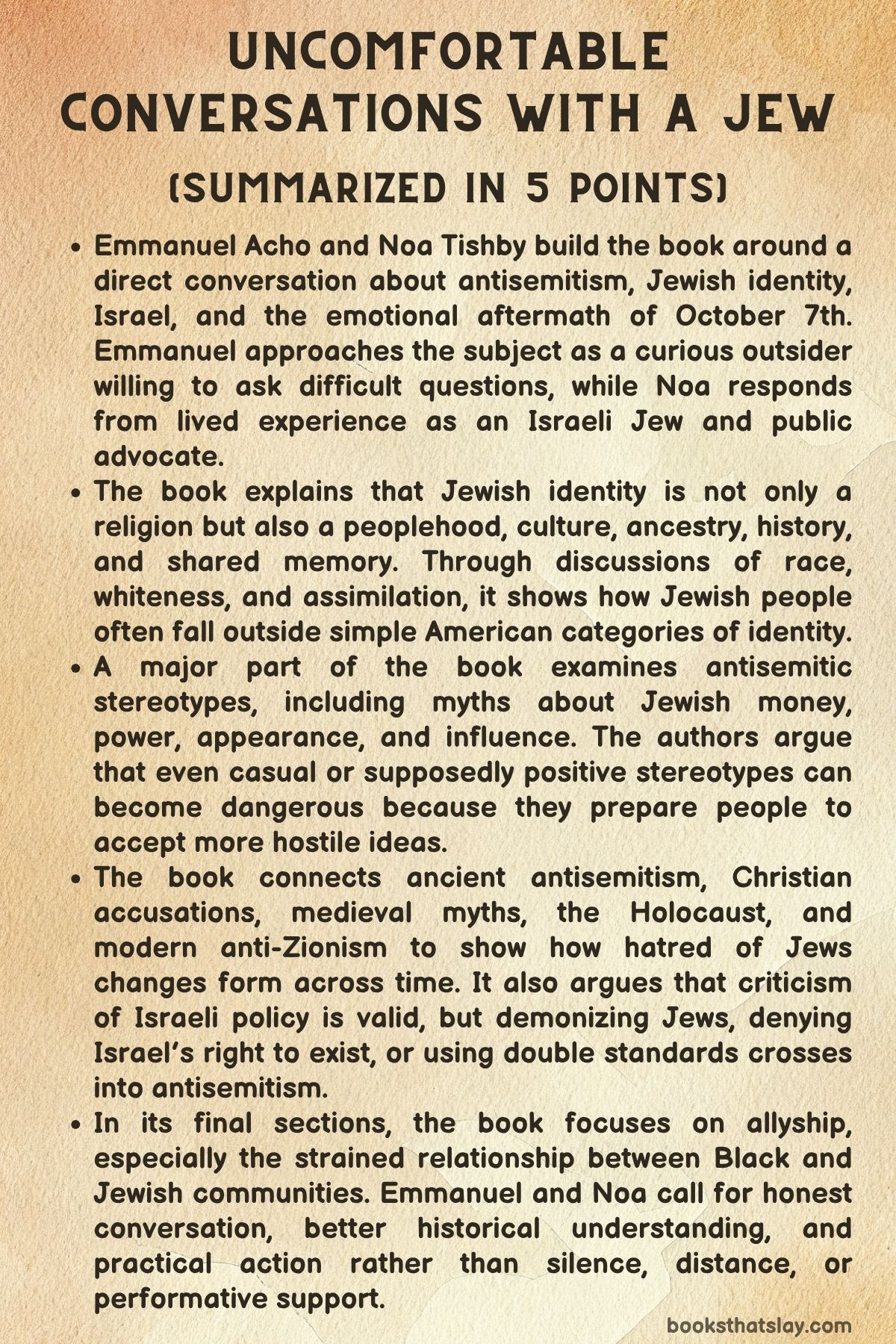
Uncomfortable Conversations with a Jew is a conversational work of nonfiction by Emmanuel Acho and Noa Tishby that examines antisemitism, Jewish identity, Israel, and allyship through direct questions and personal exchange. Built around discomfort rather than easy agreement, the book pairs Emmanuel’s role as an outsider willing to ask difficult questions with Noa’s lived experience as an Israeli Jew and public advocate against antisemitism.
It moves from identity and stereotypes to history, the Holocaust, October 7th, Zionism, Black-Jewish relations, and practical responsibility. Its purpose is not to settle every political argument, but to make ignorance harder to excuse.
Summary
The book begins in the immediate aftermath of October 7th, as Emmanuel Acho and Noa Tishby respond to the Hamas attacks on Israel from sharply different emotional positions. Emmanuel first notices Noa broadcasting live online and senses that something serious is happening, though he cannot yet understand the scale of it.
Noa, meanwhile, is awake through the night, receiving reports, messages, and testimony that connect the present violence to inherited memories of Jewish persecution. Their public conversation soon after becomes both an act of solidarity and a turning point in a collaboration they had already been developing for more than a year.
The advice that emerges from that moment is simple and urgent: people should check on their Jewish friends.
Emmanuel explains that he did not enter the project lightly. He is known for public conversations about race, especially the Black American experience, and he sees this work as part of the same moral practice: listening closely enough to understand another community’s pain without requiring total agreement on every issue.
He is aware that speaking on behalf of Jewish people may be seen by some as a betrayal, especially during a time of intense tension between Black and Jewish communities. Still, he argues that discomfort is necessary if people want to reach truth rather than remain inside inherited suspicion.
Noa begins from a more personal place. She is troubled by the fact that Jewish people still have to defend their right to be upset by antisemitism.
She places modern antisemitism inside a long history, reaching back to ancient anti-Jewish hatred and continuing into physical attacks, online neo-Nazi slogans, synagogue desecrations, and public reactions to October 7th that seemed to excuse or celebrate Jewish suffering. She also introduces herself as an Israeli-born, secular, liberal Jewish woman, an actress and producer, and a former envoy against antisemitism who was dismissed after criticizing Israeli government policy.
Her presence in the book is not that of an academic historian, but of someone trying to explain what Jewish fear feels like from inside Jewish life.
The collaboration begins with curiosity. Emmanuel and Noa meet after a chain of coincidences involving Emmanuel’s interest in Noa’s earlier work and a conversation with his Israeli aesthetician.
At their first dinner, Emmanuel asks questions about Jewish identity, religion, Hollywood, and October 7th. Noa’s willingness to answer without defensiveness sets the tone for the project.
They also discuss the word “Jew,” which Noa argues should not be avoided simply because bigots have used it as an insult. For her, reclaiming the word matters because it names a people.
The early part of the book focuses on what it means to be Jewish. Noa explains that Judaism cannot be reduced to religion alone.
It is an ethno-religion: a peoplehood, a culture, a faith tradition, a shared lineage, and a connection to nationhood. Emmanuel’s Christian frame of reference leads him to assume that belief and practice define identity, but Noa corrects that view.
A Jewish atheist remains Jewish, just as a religious Jew remains Jewish. Judaism is not missionary because it is not built around converting the world.
It is carried by descent, culture, law, memory, and choice.
The book then turns to Jewish culture. Jewish identity continues even among those who do not practice religion because holidays, food, storytelling, family memory, ethics, language, and collective history preserve it.
Noa describes Jewish storytelling as a survival method. A people repeatedly exiled and threatened had to carry its identity in words, rituals, and memory.
Emmanuel connects this distinction between race and culture to his own experience as the son of Nigerian immigrants navigating Black American identity.
The discussion of race becomes one of the book’s central threads. Noa rejects the claim that Jews are a biological race, pointing out that racialized thinking about Jews helped make the Holocaust possible.
Jews around the world look different: Ethiopian Jews, Asian Jews, Russian Jews, Middle Eastern Jews, and many others cannot be reduced to one physical type. Yet Jewish people share ancestry, culture, history, and peoplehood.
This complexity makes American racial categories especially inadequate.
The question of whether Jews are white receives an extended answer. Noa argues that many Jews in America may be white-passing, but that is not the same as simply being white in a stable or unconditional way.
Eastern European Jews were not always accepted as white in the United States. They faced quotas, housing restrictions, social exclusion, and pressure to assimilate.
Over time, some were admitted into whiteness, but only by minimizing visible Jewish difference. Emmanuel pushes back by noting that Jewish Americans do not usually face the same daily racial danger as Black Americans.
Noa accepts that distinction while still stressing that Jews occupy an unstable position: too white for some progressive frameworks to recognize as vulnerable, but never white enough for white nationalists.
From there, the book examines stereotypes. Emmanuel admits that he grew up with assumptions about Jewish wealth and influence.
Noa explains that even apparently positive stereotypes are dangerous because they prepare people to believe more hostile claims. The myths about Jewish horns, hooked noses, demonic traits, greed, and secret control all have long histories.
Many began in mistranslation, propaganda, religious prejudice, economic resentment, or political manipulation. The association between Jews and money, for example, came from medieval restrictions that barred Jews from land ownership and many trades while pushing them into moneylending roles that Christian rulers needed but publicly stigmatized.
Later, when Jews built success in fields like law, medicine, and entertainment after being excluded elsewhere, their success was recast as evidence of conspiracy.
The book also asks who gets to joke about Jewish people. Emmanuel compares Jewish stereotypes to anti-Black language that may seem harmless to outsiders but carries a history of degradation.
Noa argues that the injured group gets to define what hurts. Jewish comedians may joke about Jewish life as a form of self-recognition and survival, but outsiders repeating the same stereotypes can reinforce old hostility, even when they intend no harm.
The middle section widens into Christian history, antisemitism, and the Holocaust. The authors address the accusation that Jews killed Jesus.
Noa explains that the Romans carried out the crucifixion under Pontius Pilate’s authority, even though some Jewish religious leaders were involved in bringing charges. Emmanuel adds that Christian theology itself treats Jesus’s death as central to salvation, making revenge against Jews morally and theologically incoherent.
The book then traces antisemitism as an accumulation of accusations: demographic fear, religious hatred, blood libel, plague conspiracies, dual-loyalty claims, forged world-domination plots, and modern political forms. Each era adds a new layer rather than replacing the old one.
The Holocaust is presented not as an isolated horror, but as the result of a process. Noa and Emmanuel recount survivor testimony, family trauma, legal exclusion, Nazi propaganda, the Nuremberg laws, Kristallnacht, property seizure, closed escape routes, and industrial murder.
Emmanuel’s meeting with survivor Tova Friedman makes the history immediate, while Noa’s account of her relatives shows how genocide marks families for generations. The aftermath matters too.
The book discusses complicity, denial, inherited trauma, and the way severe persecution can alter how later generations experience threat. Noa connects her family’s Holocaust history to survivor testimony from October 7th, suggesting that Jewish trauma is not ancient memory but a recurring fear.
A major rupture occurs when Emmanuel interviews a Palestinian activist soon after October 7th. He sees himself as listening to all sides of pain.
Noa experiences the choice as a betrayal because the timing and the guest seem to demand immediate context for Jewish suffering before grief has even been recognized. Emmanuel eventually understands the analogy she offers: he would not have platformed a Blue Lives Matter advocate days after George Floyd’s murder.
Their conflict nearly ends the project, but they return to the conversation because the difficulty proves why the work matters.
The later sections focus on Zionism, Israel, and modern antisemitism. Noa defines Zionism as the Jewish right to self-determination in the ancestral homeland.
She traces Jewish connection to the land through ancient kingdoms, exile, continuous presence, foreign rule, and modern political Zionism. Theodor Herzl becomes important because his belief in assimilation collapses after the Dreyfus Affair, leading him to conclude that Jews need a state to survive.
The book describes the UN partition plan, Israel’s declaration of statehood, surrounding Arab rejection, wars, refugee crises, failed negotiations, and later peace agreements. Noa argues that criticism of Israeli policy is legitimate, but denying Israel’s right to exist is not.
The book sharply criticizes anti-Zionism when it becomes a socially acceptable way to express anti-Jewish ideas. Noa argues that modern antisemitism often turns Israel into the collective Jew: blamed for the world’s worst evils, held to double standards, demonized, or marked for elimination.
Emmanuel asks how people can criticize Israel without being antisemitic. Noa points to demonization, double standards, and delegitimization as warning signs.
The issue is not disagreement with a government. It is collective blame, conspiracy thinking, and the refusal to allow one country, among all countries, to exist.
The final movement turns to Black-Jewish relations and allyship. Noa grieves what she sees as a weakening of historic solidarity, while Emmanuel acknowledges antisemitism in parts of Black public life without allowing it to define the whole community.
Both recognize that outside forces, resentment, and different relationships to American whiteness have damaged trust. Emmanuel frames allyship as practical action: learn, ask better questions, attend Jewish community spaces, challenge harmful language, and show up before crisis becomes catastrophe.
Noa urges Jews not to disappear into silence because hiding has never kept them safe for long. The book ends by asking readers to move from awareness to action, treating understanding not as a feeling but as a responsibility.
Key Figures
Emmanuel Acho
Emmanuel Acho functions as the curious outsider, the bridge-builder, and the moral risk-taker in Uncomfortable Conversations with a Jew. His role is important because he does not pretend to have perfect knowledge about Jewish identity, antisemitism, Zionism, or Israel.
Instead, he asks the kinds of direct questions that many readers may privately have but may be afraid to voice. This makes him an effective stand-in for the audience, especially for people approaching Jewish history and antisemitism from outside the Jewish community.
Emmanuel’s background in conversations about race also shapes his perspective. He understands how prejudice can become normalized through language, stereotypes, silence, and selective empathy.
At the same time, he is not simply a passive listener. He challenges Noa when he feels her arguments need clarification, especially around whiteness, power, Israel, and criticism of Israeli policy.
Emmanuel’s most revealing moment comes after October 7th, when he chooses to interview a Palestinian activist in the name of hearing all sides. His intention is not cruelty, but the decision exposes a gap between his ideal of balanced listening and Noa’s experience of Jewish grief.
Through that conflict, Emmanuel becomes more than a polite questioner. He becomes a person forced to examine how timing, platform, and context can change the meaning of an action.
His growth lies in recognizing that empathy cannot always be distributed in equal portions at the same instant. Sometimes one community’s dead have not even been mourned before the world asks them to defend why they are mourning.
Emmanuel’s strength in the book is his willingness to stay in the room after making a mistake. He does not retreat into pride.
He listens, reconsiders, and continues the conversation with more humility.
Noa Tishby
Noa Tishby is the emotional, historical, and argumentative center of Uncomfortable Conversations with a Jew. She brings lived experience as an Israeli Jew, family memory shaped by persecution, professional advocacy against antisemitism, and a public record of criticizing Israeli leadership when she believes criticism is warranted.
This combination makes her more complex than a simple defender of Israel or a general spokesperson for Jewish pain. She is forceful because she believes Jewish fear is often dismissed, minimized, or made conditional.
She is also careful to distinguish between Jewish identity, Israeli politics, Zionism, and antisemitic hatred, even when she argues that those categories are often unfairly collapsed by others.
Noa’s voice carries urgency because October 7th is not abstract to her. It reaches her through messages, friends, funerals, history, and family trauma.
Her interpretation of the event is inseparable from stories she grew up hearing about the Holocaust and Jewish vulnerability. Yet she is not presented only as wounded.
She is intellectually sharp, confrontational when necessary, and deeply invested in language. Her explanations of Jewish peoplehood, stereotypes, whiteness, Zionism, and allyship show that she wants readers to understand systems, not simply sympathize with emotion.
Her conflict with Emmanuel is one of her most important moments because it reveals her boundary: she can accept disagreement, questions, and criticism, but she cannot accept a response to Jewish massacre that immediately shifts attention away from Jewish victims. Noa’s character is defined by testimony, anger, grief, clarity, and a fierce refusal to let Jewish identity be misrepresented.
Tova Friedman
Tova Friedman represents living memory. As a Holocaust survivor who was taken to Auschwitz as a child, she gives the book’s historical discussion a human face.
Her story prevents the Holocaust from becoming only a set of numbers, dates, and political explanations. Emmanuel’s encounter with her is especially significant because it moves him from intellectual awareness to embodied recognition.
The tattoo that replaced her name becomes a symbol of Nazi dehumanization, but her survival also becomes an act of resistance against the system that tried to erase her.
Tova’s presence in the book matters because she carries the authority of witness. She does not function as a distant historical reference but as proof that the Holocaust remains close enough to touch.
Through her, the reader sees how genocide reaches into childhood, identity, memory, and the body. Her story also strengthens one of the book’s central warnings: mass violence does not begin at the point of murder.
It begins earlier, when stereotypes harden, laws change, neighbors look away, and a targeted group is slowly removed from the circle of human concern. Tova’s survival is not used to create comfort.
It is used to create responsibility.
Dina
Dina, Noa’s grandmother, is important because she represents the family line that survived before the worst machinery of the Holocaust closed in. Her escape from Poland before the war gives Noa’s family story both relief and sorrow.
Relief, because Dina lives and makes Noa’s later life possible. Sorrow, because survival in such a context is never clean.
It is shadowed by the knowledge of those who could not leave, those who were trapped, and those whose lives were destroyed because the world gave them no safe exit.
Dina’s role is also generational. She is part of the memory Noa inherits, and that inheritance shapes how Noa understands danger in the present.
Dina does not need a large dramatic arc to matter. Her significance lies in what she passes down: awareness, caution, identity, and the knowledge that Jewish safety can disappear quickly.
Through her, the book shows that historical trauma is not stored only in archives. It lives in families, in warnings, in stories told to children, and in the fear that what happened once can happen again.
Gita
Gita, Noa’s great-aunt, is one of the most devastating figures in the book because her survival is inseparable from unbearable loss. Rounded up with her husband and children, she survives a shooting by hiding beneath the bodies of her murdered family.
Her story captures the extremity of Holocaust violence without turning it into abstraction. She lives, but the life that remains is permanently marked by what she had to witness and endure.
Gita’s character also creates one of the book’s strongest links between past and present. When Noa later hears of people surviving October 7th by hiding under or among the dead, Gita’s story no longer belongs only to an earlier generation.
It repeats in a new form. That repetition is central to Noa’s worldview.
For her, Jewish trauma is not an old wound that outsiders can safely file away as history. It is a fear with modern evidence.
Gita’s survival therefore carries two meanings at once: the miracle of endurance and the horror of a world where such endurance was required. Her presence deepens the book’s insistence that antisemitism must be recognized before it reaches its most violent form.
Noam Ben-David
Noam Ben-David appears as a survivor of October 7th whose experience echoes Holocaust testimony in a way that shocks Noa. Her survival after hiding among dead friends makes the attack feel not merely like a political event or an act of war, but like a reactivation of Jewish nightmare.
She becomes a contemporary witness, someone whose story collapses the comfortable distance between past atrocity and present danger.
Noam’s significance is not only in what happened to her but in what her story does to the book’s moral argument. She challenges the reader to understand why Jewish people heard October 7th through the memory of earlier massacres.
For those outside the community, the attack may seem like one event in a long regional conflict. For Noa, and for many Jews in the book, Noam’s testimony carries a different meaning: Jewish bodies again hidden among Jewish dead, Jewish families again waiting for news, Jewish grief again questioned or politicized almost immediately.
Noam stands for the living evidence that history’s worst patterns can return in forms that feel terrifyingly familiar.
Ari
Ari, Noa’s young son, has a brief but meaningful role. His importance comes from the clarity with which he names his mother’s purpose.
When he tells Noa that her life’s work is to tell the story of the Jewish people, he gives childlike expression to something the entire book has been building toward. His statement moves Noa because it strips away professional titles, political arguments, and public controversy.
What remains is a mission of testimony.
Ari also represents the future for which the book is written. He belongs to the next generation, the one that will inherit either a clearer understanding of antisemitism or the same dangerous confusions.
His presence reminds readers that conversations about Jewish identity are not only about the dead, the persecuted, or the historically wronged. They are about children who must grow up in a world where being visibly Jewish can still carry fear.
Ari’s role is tender without being sentimental. He gives the book a forward-facing purpose: memory must be carried not to remain trapped in the past, but to protect those who come next.
Theodor Herzl
Theodor Herzl is presented as a central figure in the development of modern Zionism. His importance lies partly in the irony of his transformation.
He did not begin as someone convinced that Jewish survival required a Jewish state. Like many assimilated European Jews, he initially believed that acceptance into broader society was possible.
The Dreyfus Affair changed that belief. Watching a Jewish officer publicly humiliated in France convinced Herzl that antisemitism was not a passing prejudice that education or assimilation could easily cure.
Herzl’s role in the book is to make Zionism understandable as a response to danger rather than as an abstract ideology of domination. Noa presents his vision as one rooted in self-determination, safety, and a progressive idea of a state that could protect Jews while granting equality across lines of gender, race, and religion.
Through Herzl, the book argues that Zionism emerged from historical pressure: repeated expulsion, accusation, exclusion, and violence. He is not treated as a flawless hero, but as a man who recognized that Jewish survival required political power in a world where dependence on host societies had repeatedly failed.
Pontius Pilate
Pontius Pilate matters because he stands at the center of one of history’s most damaging accusations against Jews. As the Roman governor with legal authority over Jesus’s execution, he represents the political reality often obscured by later claims of collective Jewish guilt.
The book uses him to correct a moral and historical distortion: some Jewish religious leaders may have played a role in bringing accusations against Jesus, but the Roman state carried out the crucifixion.
Pilate’s significance is less about his personal psychology and more about how his role has been minimized or displaced in later anti-Jewish narratives. By shifting blame from Roman authority to all Jews across all generations, Christian antisemitism created a transferable guilt that justified centuries of persecution.
Pilate therefore functions as a reminder that historical events can be retold in ways that serve hatred. His presence helps the book expose the danger of turning limited actions by particular people in a specific ancient context into an accusation against an entire people forever.
Haj Amin Al-Husseini
Haj Amin Al-Husseini appears as a historical figure whose politics sharpen the book’s argument about anti-Zionism, antisemitism, and rejection of Jewish statehood. As Grand Mufti of Jerusalem, he is described as a fierce opponent of Zionism who sought support from Nazi Germany and rejected the partition plan that would have created two states.
His presence in the book gives Noa a way to argue that hostility toward Jewish self-determination did not arise only from later wars or occupation, but was present before Israel’s founding.
His role is controversial and charged because he stands at the intersection of Palestinian nationalism, regional politics, and explicit antisemitism. In the book’s framing, Al-Husseini is not merely a political opponent of Zionism.
He represents a form of opposition that viewed Jewish sovereignty itself as intolerable. His meeting with Hitler becomes a symbol of how anti-Jewish hatred and anti-Zionist politics could align in dangerous ways.
The book uses him to challenge the idea that the region was peaceful until Israel’s creation and to argue that Jewish-Muslim and Arab-Jewish tensions had older and more complex roots.
Natan Sharansky
Natan Sharansky is important because his framework gives the book a practical tool for distinguishing criticism of Israel from antisemitism. His test focuses on demonization, double standards, and delegitimization.
This makes him less a narrative character than an intellectual guide whose ideas help Emmanuel and Noa answer one of the book’s most difficult questions: how can people discuss Israel honestly without either excusing antisemitism or silencing legitimate criticism?
Sharansky’s significance lies in the balance his framework offers. It does not say that Israel is above criticism.
In fact, the book repeatedly makes room for criticism of Israeli leaders and policies. What Sharansky’s test does is identify when criticism becomes something more hostile: when Israel is described as uniquely evil, when it is judged by standards applied to no other country, or when its right to exist is denied altogether.
Through him, the book gives readers a way to examine their language and assumptions rather than relying only on emotional reaction.
Benjamin Netanyahu
Benjamin Netanyahu appears mainly through Noa’s professional history and her criticism of Israeli policy. His role in the book is significant because it helps establish that Noa’s defense of Jewish identity and Israel’s right to exist is not the same as loyalty to every Israeli government or leader.
Her dismissal from an envoy role after criticizing some of his policies shows that she is willing to challenge power within Israel even while arguing strongly against antisemitism outside it.
Netanyahu’s presence therefore complicates the political conversation. Without him, readers might wrongly assume that Noa’s position is simply national defensiveness.
Instead, the book uses her conflict with his government to show that support for Jewish self-determination can coexist with public disagreement over policy. Netanyahu functions as a marker of that distinction.
He is not explored as fully as Emmanuel or Noa, but his role matters because he helps separate three ideas that are often confused: Jewish identity, the State of Israel, and the actions of a particular Israeli administration.
Rashida Tlaib
Rashida Tlaib appears in the book as an example of post-October 7th political language that Noa sees as threatening or dismissive of Jewish grief. Her use of a phrase associated by many Jews with the elimination of Israel becomes part of the book’s broader argument about how slogans can carry different meanings depending on history, audience, and context.
Her presence reflects the tension between pro-Palestinian advocacy and Jewish fears of delegitimization.
Tlaib’s role is not developed as a full personal portrait. Rather, she functions as a public figure whose words become evidence in Noa’s case that progressive spaces often fail to recognize antisemitism when it appears in the language of anti-Israel activism.
The book’s treatment of her also shows how difficult this territory is. A phrase that some may frame as liberationist can be heard by many Jews as a call for erasure.
Through Tlaib, the book raises a larger question: who gets to define the meaning and impact of political language when one group’s rallying cry sounds to another group like a threat?
Louis Farrakhan
Louis Farrakhan appears as a figure associated with antisemitic influence within parts of Black public life. His role matters because the book is deeply invested in the damaged relationship between Black and Jewish communities.
By referencing him, the authors point to one source of rhetoric that has contributed to mistrust, resentment, and conspiracy thinking. Emmanuel acknowledges that antisemitism exists in Black spaces, but he also resists allowing figures like Farrakhan to define the entire Black community.
Farrakhan’s presence helps the book make a distinction between accountability and collective blame. Just as Jewish people should not be reduced to the actions of particular Jews or Israeli leaders, Black people should not be reduced to the most antisemitic voices that claim influence among them.
Still, the book does not excuse the harm such voices cause. Farrakhan functions as an example of how charismatic leadership can normalize prejudice when grievance is directed toward the wrong target.
His role supports the book’s larger call for Black-Jewish repair through honesty rather than denial.
Themes
Jewish Identity as Peoplehood, Not Just Religion
Jewish identity in Uncomfortable Conversations with a Jew is presented as something larger than religious belief. This is one of the book’s most important clarifications because many outsiders approach Judaism through a Christian or Muslim framework, assuming that faith practice is the main marker of belonging.
Noa challenges that assumption by explaining Judaism as an ethno-religion, meaning that it includes religion, ancestry, culture, law, collective memory, and peoplehood. This helps explain why an atheist Jew can still be fully Jewish, why Jewish holidays remain culturally powerful even for secular families, and why Jewish belonging cannot be measured only by synagogue attendance or belief in God.
The theme also matters because misunderstanding Jewish identity often leads to misunderstanding antisemitism. If Jews are seen only as a religious group, then racialized hatred against them seems confusing.
If they are seen only as white, then their history of exclusion disappears. If they are seen only through Israel, then Jewish diversity is erased.
The book’s treatment of Jewish identity asks readers to accept complexity rather than forcing Jews into categories built for other groups.
The Danger of Stereotypes and Selective Sympathy
Stereotypes in the book are not treated as harmless exaggerations. They are shown as the early language of dehumanization.
Claims about Jewish wealth, power, physical features, media control, or secret influence may appear casual, but the book argues that these ideas have long histories and deadly consequences. A joke about Jews and money can seem mild on the surface, yet it draws from centuries of forced occupational roles, economic resentment, and conspiracy thinking.
A claim that Jews control Hollywood ignores the exclusions that pushed Jewish entrepreneurs to build their own institutions in industries where they were allowed to work. Physical caricatures such as horns or hooked noses show how visual culture can train people to see a minority as strange, dangerous, or less human.
The theme becomes even more serious when the book connects stereotype to selective sympathy. Jewish suffering is often questioned, contextualized, or minimized in ways that other forms of hatred may not be.
The book suggests that this hesitation is itself a symptom of antisemitism: people have absorbed enough suspicion about Jews that even Jewish victimhood is treated as something needing proof.
Memory, Trauma, and the Fear of Repetition
The book repeatedly shows that Jewish memory is not a passive record of the past. It is an active force shaping how danger is recognized in the present.
Holocaust testimony, family stories, survivor accounts, and the events of October 7th all sit close together in Noa’s understanding of Jewish life. When she hears modern stories of people hiding among the dead, she connects them to family stories from the Holocaust, not because the events are identical in every detail, but because the emotional pattern feels terrifyingly familiar.
This theme also appears in the discussion of inherited trauma. The book suggests that persecution can leave marks not only in memory and culture, but in bodies, behavior, and generational fear.
Emmanuel’s reflections on Black trauma create a bridge between communities, showing that groups shaped by repeated threat may carry vigilance long after outsiders think the danger has passed. Memory in the book is therefore both burden and protection.
It can produce fear, but it also warns people against complacency. The central warning is that atrocity does not arrive suddenly.
It is prepared by language, exclusion, public indifference, and the refusal to believe targeted people when they say they are afraid.
Allyship as Action, Proximity, and Responsibility
Allyship in the book is practical rather than performative. It is not presented as a slogan, a social media identity, or a vague statement of support.
Emmanuel frames it as noticing a need and filling it, while Noa insists that Jewish people need allies who will show up before hatred reaches a crisis point. This theme is especially important because much of the book is built around the failure of expected allies after October 7th.
Noa’s grief is intensified by the silence or hostility of communities that Jewish people had often supported in their own struggles. The book does not ask readers to agree with every Israeli policy, nor does it demand that they abandon concern for Palestinians.
It asks for moral clarity: the ability to condemn antisemitism, reject the murder of Jews, criticize governments with precision, and resist language that assigns collective guilt. Proximity is offered as one answer to fear.
Attend a Shabbat dinner, know Jewish people personally, ask questions without contempt, and learn enough history to recognize old hatred in new language. Responsibility begins when readers stop treating antisemitism as someone else’s issue and understand it as a warning about the health of society itself.