The King of the Golden River Summary, Characters and Themes
The King of the Golden River is a Victorian fairy tale by John Ruskin that uses fantasy to teach a clear moral lesson about kindness, greed, and the true meaning of wealth. Set in the fictional Treasure Valley in Styria, the story follows three brothers whose choices decide their fate.
The two elder brothers are selfish and cruel, while the youngest, Gluck, remains gentle despite mistreatment. Through magical visitors, tests of mercy, and a river said to turn into gold, the book shows that prosperity belongs not to those who chase riches, but to those who act with compassion.
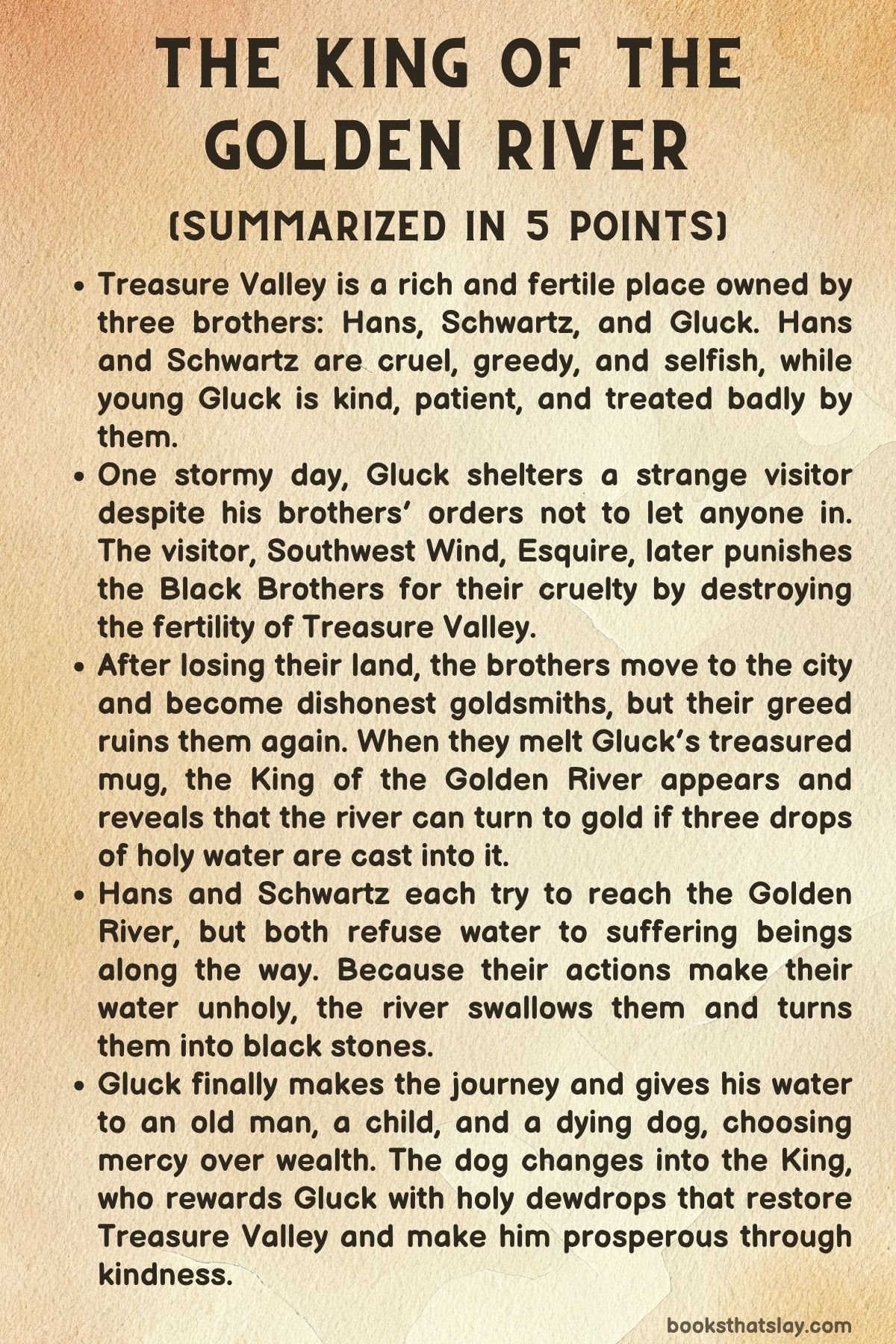
Summary
Treasure Valley is a beautiful and fertile place hidden among the mountains of Styria. While the surrounding regions often suffer from drought and poor harvests, this valley remains green, rich, and productive.
Its fields grow corn in abundance, and its streams and waterfalls give life to the land. One waterfall, lit by the setting sun, shines with such a golden glow that people call it the Golden River.
The land is owned by three brothers. The two elder brothers, Hans and Schwartz, are harsh, selfish, and greedy men, known as the Black Brothers.
They do not treat their land as a gift or a responsibility. Instead, they use it as a way to gather more money and power.
Hans and Schwartz are cruel landlords and dishonest farmers. They underpay laborers, refuse help to the poor, store their grain until prices rise, and take advantage of the hunger of others.
They kill animals on their property and show no kindness to anyone weaker than themselves. Their youngest brother, Gluck, is very different.
He is only a boy, gentle by nature, and treated almost like a servant by his brothers. He works hard in their house, obeys their orders, and receives little love or respect in return.
Though he lives with greedy men, his own heart remains generous.
One wet and stormy day, Hans and Schwartz leave home, ordering Gluck to roast mutton and to let no one inside. The weather is cold and wild, and Gluck is alone by the fire when a strange visitor arrives.
The man is short, oddly dressed, and covered by a large black cloak dripping with rain. His face and manner seem unusual, yet he looks cold and hungry.
Gluck remembers his brothers’ orders, but his pity is stronger than his fear. He lets the stranger in and allows him to warm himself by the fire.
When the visitor says he is hungry, Gluck offers him the small portion of mutton that had been promised to him.
When Hans and Schwartz return, they are furious to find the stranger inside. They refuse to give him food, insult him, and try to throw him out.
Their violence quickly turns against them. The visitor proves to be no ordinary man.
He sends them spinning across the room and warns them that he will return at midnight. After he leaves, the storm grows fiercer.
The brothers blame Gluck, punish him, and then drink heavily. At midnight, the visitor returns amid wind and rain.
The roof has been torn away, and the house is being ruined by the storm. The visitor tells the brothers to go to Gluck’s room, where the ceiling still remains safe.
By morning, Treasure Valley has changed completely. The fertile fields are gone, replaced by red sand and gray mud.
The corn, money, and goods of the brothers have been swept away. The mysterious visitor leaves behind only a card identifying himself as Southwest Wind, Esquire.
His visit marks the punishment of the Black Brothers’ cruelty. Because they had abused the blessings of the valley and refused even basic kindness, the forces of nature turn against them.
The rich land that once supported them becomes barren, while the lower plains continue to flourish.
With their farm destroyed, Hans, Schwartz, and Gluck move to a city and try to make a living as goldsmiths. Their dishonesty continues.
They mix copper into gold and cheat their customers, but people soon discover the fraud. Their business fails, and Hans and Schwartz waste what little money they earn on drinking.
Eventually, they are left with almost nothing. One of their last possessions is a large drinking mug that had been given to Gluck by his uncle.
The mug has a strange fierce face on it, with golden hair and beard. Gluck values it deeply, but his brothers decide to melt it down.
While Hans and Schwartz go to the tavern, Gluck watches the mug melt. As the metal heats, he hears a voice coming from the crucible.
When he tips it, a tiny golden figure appears. The figure is the King of the Golden River.
He explains that he had been trapped in the form of the mug by a stronger power and that Gluck has freed him. In return, he tells Gluck the secret of the Golden River.
Anyone who climbs to its source and throws three drops of holy water into it will have the river turned into gold for that person alone. However, each person has only one chance.
Anyone who throws unholy water into the river will be swallowed by it and turned into a black stone.
When Hans and Schwartz return and learn that the mug is gone, they beat Gluck and demand an explanation. He tells them what happened, but they do not believe him at first.
The next morning, after hearing the same account again, they begin to think the story may be true. Their greed is immediately awakened.
Instead of considering the danger or the moral meaning of the King’s words, they begin arguing over which of them should go first. Their quarrel becomes violent, and Schwartz is arrested after neighbors call for help.
Hans escapes and decides to go to the Golden River before his brother can stop him.
Hans cannot obtain holy water honestly because his reputation is so bad that a priest refuses him. Rather than repent or change his conduct, he steals holy water during a church service.
He then sets out with food, wine, and the stolen water. His journey is hard from the beginning.
He crosses a dangerous glacier and must abandon his provisions. He climbs under a burning sun and grows terribly thirsty.
Along the way, he meets a dying dog that needs water, but he refuses to help. Later, he finds a child near death from thirst, and then an old man begging for water.
Hans denies them all. He cares only about reaching the Golden River and gaining wealth.
When Hans reaches the river, the sky darkens and the place seems filled with warning. He throws the stolen water into the current, but it is unholy because it has been taken through deceit and guarded with selfishness.
The river does not become gold for him. Instead, he feels a deadly chill, staggers, falls, and is swallowed by the water.
In his place, the river flows over a black stone. Hans’s fate shows that greed cannot be disguised by religious objects or outward signs.
A stolen sacred thing cannot become holy in the hands of a selfish person.
Gluck waits anxiously for Hans, but Hans never returns. When Gluck tells Schwartz what he believes has happened, Schwartz is not saddened.
He is pleased, thinking that Hans has failed and that the treasure may now belong to him. Gluck, though poor and mistreated, works hard for another goldsmith until he earns enough money to pay Schwartz’s fine and free him from prison.
Schwartz then prepares for his own journey. He learns from Hans’s mistake only in the shallowest way.
He believes that Hans failed because the water was stolen, so he obtains holy water properly from a priest. Yet his heart remains as greedy and merciless as before.
Schwartz sets out with provisions and holy water. His journey, like Hans’s, tests what kind of man he truly is.
As he climbs, thirst weakens him. He meets the same suffering figures: a child begging for water, an old man in need, and finally what seems to be Hans lying helpless and pleading.
Schwartz refuses each one. He even mocks the figure that appears to be his brother.
He is driven not by faith or courage, but by the hope of owning gold. When he reaches the river, a violent storm breaks around him.
He throws the water into the stream, but it too has become unholy because he refused mercy to the dying. The ground collapses, the river swallows him, and a second black stone appears beside the first.
Gluck is left alone. He continues to work for the goldsmith, but he is paid poorly and lives with hardship.
After some time, he decides to try the journey himself. His reason is not simple greed.
He remembers that the King of the Golden River had seemed kind, and he hopes that the promise may still hold true. Unlike his brothers, Gluck asks a priest for holy water and receives it without difficulty.
He begins his journey with bread and water, but the glacier is especially hard for him, and he loses his food while crossing it.
As Gluck climbs, he faces the same tests that destroyed his brothers. First, he meets a weak old man who begs for water.
Gluck gives him some, even though he has little. After this act, the path becomes easier and signs of life appear around him.
Later, he finds a thirsty child lying by the roadside. Gluck gives the child nearly all the water he has left.
The landscape grows more beautiful, with flowers and butterflies appearing along the way. Finally, when only a few drops remain, he sees the dying dog.
Gluck knows that he needs three drops for the Golden River, and he remembers that each person has only one chance. Still, he cannot leave the animal to suffer.
He pours out the last of his water for the dog.
The dog transforms into the King of the Golden River. The King explains the true meaning of holiness.
Water refused to the dying becomes unholy, no matter where it came from. Water offered in mercy is holy, even if it is not from a church vessel.
Gluck has passed the test because he chose compassion over reward. The King plucks a lily, shakes three drops of dew into Gluck’s flask, and tells him to cast them into the river.
Gluck obeys. The Golden River vanishes into the earth and then reappears as a living stream that flows down toward Treasure Valley.
As Gluck descends, the barren land begins to change. Water springs from the rocks, the valley becomes fertile again, and the waste created by greed is restored through kindness.
Gluck settles there and becomes prosperous, but he does not become like his brothers. He uses his wealth generously and treats the poor with care.
For him, the river truly becomes a river of gold, not only because it brings prosperity, but because it brings life, growth, and blessing. The two black stones remain near the cataract as a warning.
Hans and Schwartz are remembered as the Black Brothers, while Gluck’s goodness restores the valley and proves that mercy is richer than gold.
Characters
Gluck
Gluck is the moral center of the book, a young boy whose goodness survives in a household ruled by greed and cruelty. He is treated unfairly by Hans and Schwartz, who use him as a servant rather than loving him as a brother, yet he does not copy their harshness.
His first important act is letting the strange visitor inside, even though he has been ordered not to admit anyone. This choice shows that Gluck’s conscience is stronger than his fear.
He gives away his own portion of food because he recognizes another person’s suffering. In The King of the Golden River, Gluck’s kindness is not presented as weakness.
It becomes the source of his strength and the reason he succeeds where his brothers fail. His journey to the Golden River proves that his compassion is instinctive, not calculated.
He helps the old man, the child, and the dog even when each act seems to reduce his chance of success. By the end, Gluck becomes prosperous, but the story makes clear that his true worth existed before he gained anything.
His wealth is the result of mercy, patience, and moral courage.
Hans
Hans is one of the clearest examples of selfishness in the book. As one of the elder Black Brothers, he uses power without responsibility and sees other people mainly as tools or obstacles.
His treatment of workers, the poor, animals, and Gluck reveals a personality shaped by greed and pride. Hans does not simply desire wealth; he believes he has the right to take advantage of anyone weaker than himself.
When he hears about the Golden River, he thinks only of personal gain. Even his attempt to obtain holy water shows his corruption.
Since the priest refuses him because of his bad reputation, Hans steals it instead of correcting himself. His journey exposes the emptiness of his character.
Faced with a dying dog, a thirsty child, and an old man, he refuses every plea because he values his own ambition more than life itself. In The King of the Golden River, Hans’s punishment is not random magic but a direct result of what he has become.
The water he carries cannot save him because his choices have already made it unholy.
Schwartz
Schwartz resembles Hans in greed and cruelty, but his character has a colder and more calculating quality. He is violent, dishonest, and selfish, yet he also watches what happens to Hans and tries to profit from it.
When Hans disappears, Schwartz does not grieve for his brother. Instead, he feels pleased because he thinks one rival for the treasure has been removed.
This reaction reveals how completely greed has damaged his family bonds. Schwartz believes he is wiser than Hans because he obtains holy water from a priest rather than stealing it, but he misunderstands the lesson.
He treats holiness as a technical condition rather than a moral one. His journey proves that he has not changed at all.
He refuses water to the child, the old man, and the figure that appears to be Hans. His mocking response to the helpless figure shows that his cruelty includes even those closest to him.
Schwartz’s fate in the book confirms that outward correctness means nothing without mercy. He follows a proper religious procedure, but his heart remains selfish, so the water he carries becomes unholy.
The King of the Golden River
The King of the Golden River is both a magical ruler and a moral judge. He first appears through the melted mug, a strange and memorable image that connects ordinary household poverty with the hidden world of fairy-tale justice.
Though small in size, he carries great authority. His promise about the Golden River seems at first like a chance to gain wealth, but it is really a test of character.
The King does not reward cleverness, force, or ambition. He rewards mercy.
His rules are strict, but they are not unfair. Hans and Schwartz are warned that unholy water will destroy them, yet neither understands what holiness means.
The King later reveals himself through the suffering figures on the mountain, especially the dog that Gluck saves at the cost of his own hope. This shows that he tests people not through grand speeches, but through ordinary moments of need.
In The King of the Golden River, the King represents the idea that moral value is measured by how one treats the weak, the thirsty, and the helpless.
Southwest Wind, Esquire
Southwest Wind, Esquire is the first supernatural force to confront the Black Brothers, and his role is to expose and punish their lack of hospitality. His appearance is comic and strange, but behind the odd clothing and unusual manners is real power.
When Gluck welcomes him, the visitor responds to kindness with protection. When Hans and Schwartz insult and attack him, he turns their violence back on them.
He is closely connected with nature, especially weather, rain, and storm. His punishment of Treasure Valley is severe, but it fits the brothers’ conduct.
They had used the fertility of the land to exploit others, so the natural blessing they abused is taken away. Southwest Wind is not merely angry because he was personally offended.
He acts as a force of moral correction. Through him, the story suggests that nature is not separate from ethics.
Land, rain, harvest, and prosperity are tied to human conduct. When people become cruel stewards of abundance, the abundance itself can be lost.
The Priest
The priest plays a smaller role, but he is important because he helps distinguish outward religion from genuine goodness. When Hans asks for holy water, the priest refuses him because Hans’s reputation is known to be immoral.
This refusal shows that sacred things are not meant to be used casually by those who have no respect for virtue. Hans responds by stealing the water, proving that the priest’s judgment was correct.
Later, Schwartz obtains holy water properly, and Gluck receives it without difficulty. These different moments show that the priest functions as a representative of formal religious order, but the book does not stop there.
The final lesson goes beyond the priest’s control. The King explains that water becomes unholy when it is denied to the dying and that mercy can make water holy.
The priest therefore helps set up the moral contrast. Formal blessing matters, but it cannot replace compassion.
True goodness must be lived in action, especially when another being is in need.
The Old Man, the Child, and the Dog
The old man, the child, and the dog are the central tests on the road to the Golden River. They appear weak, thirsty, and near death, and each asks for the simplest form of help: water.
Their importance lies in how they reveal the true nature of each brother. Hans sees them as interruptions.
Schwartz sees them as threats to his reward. Gluck sees them as suffering beings who need help immediately.
These figures also represent different forms of vulnerability. The old man suggests age and frailty, the child suggests innocence and dependence, and the dog suggests helpless life beyond human society.
By including all three, the story broadens the meaning of mercy. Compassion is not limited to people who can repay kindness or improve one’s social position.
The dog’s transformation into the King makes the lesson unmistakable. The lowest and most easily dismissed creature on the path becomes the highest authority in disguise.
The characters therefore show that moral tests often arrive in humble forms, and the response to them reveals the truth of the heart.
The Goldsmith
The goldsmith is a practical figure connected to the brothers’ decline after they lose Treasure Valley. Hans and Schwartz become goldsmiths themselves, but they cheat by mixing copper into gold, which leads to failure and disgrace.
Later, Gluck works for another goldsmith after his brothers are gone or imprisoned. This employer pays him poorly, so he is not shown as especially generous, yet the work gives Gluck a way to survive through honest labor.
The goldsmith’s presence also strengthens the book’s concern with false and true value. Hans and Schwartz handle gold dishonestly, corrupting it for profit.
Gluck, by contrast, works hard even when the reward is small. Gold in the story is never simply bad, but the desire for it becomes destructive when separated from honesty and mercy.
The goldsmith’s world of metal, wages, and trade offers a realistic contrast to the magical Golden River. It shows that the same material can represent greed in one person’s hands and honest effort in another’s.
Themes
Greed as Self-Destruction
Greed in the story does not merely make Hans and Schwartz unpleasant; it steadily destroys their home, their work, their family bond, and finally their lives. At the beginning, the Black Brothers possess a fertile valley, steady harvests, and social power, but they use every advantage selfishly.
They exploit hunger by raising grain prices, refuse charity, mistreat Gluck, and kill creatures that