Real Tigers by Mick Herron Summary, Characters and Themes
Real Tigers is the third novel in Mick Herron’s Slough House series, a sharp British spy story about disgraced MI5 agents who are supposed to be finished but keep finding themselves near the center of national crises. The book follows Jackson Lamb’s team after Catherine Standish is kidnapped and River Cartwright is forced into a dangerous theft inside MI5 headquarters.
What begins as a supposed security test soon exposes political scheming, personal revenge, hidden state crimes, and rival ambitions inside the intelligence service. Herron combines dark humor, bureaucratic cruelty, moral compromise, and fast-moving espionage to show how broken people can still be dangerous, loyal, and useful.
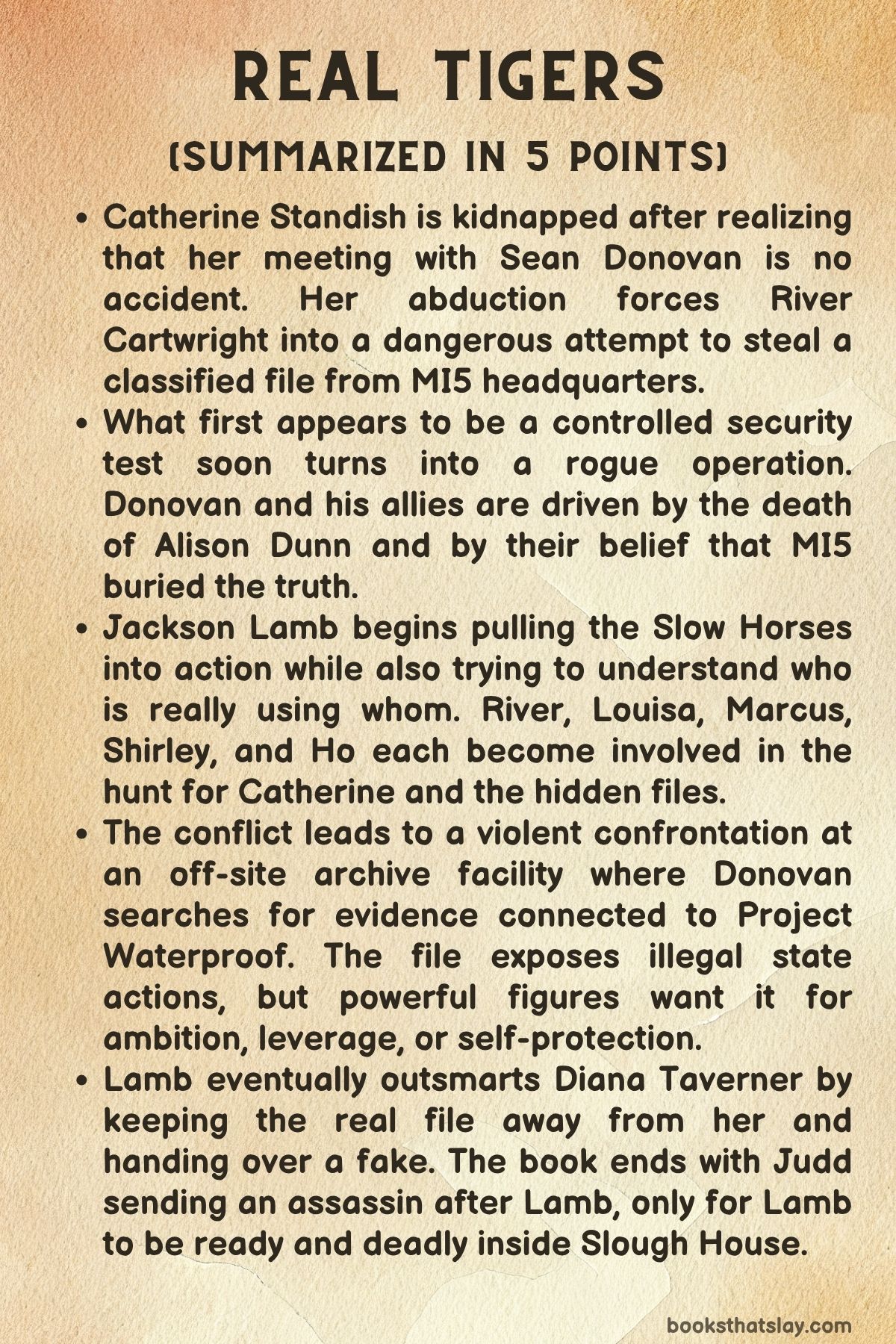
Summary
On a hot August evening in London, Catherine Standish leaves Slough House, the shabby office where MI5 sends agents whose careers have collapsed. Catherine is sober, disciplined, and careful, and she immediately senses danger when she runs into Sean Donovan, a former soldier and former lover from the time when she was struggling with alcohol addiction.
Donovan’s appearance is not accidental. He invites her for a drink, but she refuses, recognizing both the emotional trap and the professional threat.
As she moves through the city, she notices signs of surveillance and tries to alert Jackson Lamb, her boss, but cannot reach him.
At Slough House, the rest of Lamb’s team is scattered across dull assignments and private problems. Roderick Ho is being obnoxious about his interest in Louisa Guy.
Marcus Longridge and Shirley Dander are caught in mutual blackmail, with Marcus hiding his gambling and Shirley hiding her cocaine use. Louisa is still carrying the grief of Min Harper’s death and is working through a lifeless data-checking task.
River Cartwright, still resentful over his exile to Slough House, visits his comatose rival James Webb and talks through his own boring assignment. Their lives seem directionless until Catherine disappears.
Catherine tries to lose the people following her, but a black van cuts her off. Donovan abducts her and takes her to a remote farmhouse, where she is restrained, photographed, and held by his associates.
He later asks her which colleague she would trust with her life. Thinking that her captors may be targeting Lamb, she names River.
The next morning, when Catherine fails to appear at work, Lamb becomes unusually serious. River receives a photo of her tied up and instructions to go to a nearby bridge.
There, a man connected to Black Arrow Security tells him that Catherine will be harmed unless he steals a file from MI5 headquarters.
River goes to Regent’s Park and attempts to enter the archive under false pretenses. He lies to Diana Taverner, saying he needs access to James Webb’s personal records for a matter involving life support.
Taverner is suspicious but allows him some room. River creates a distraction by reporting a fake armed threat outside the building, then goes to the records archive and asks Molly Doran for a specific file.
The file concerns the prime minister, making the request extremely serious. Before he can get it, security arrests him.
Nick Duffy, the head of MI5’s internal security force, interrogates River brutally and dismisses his claim that Catherine has been kidnapped.
Lamb learns that River was arrested while Catherine is missing. He calls Taverner and begins pressing for answers.
Meanwhile, the political layer of the scheme becomes clearer. Home Secretary Peter Judd has hired a tiger team through Black Arrow Security to test MI5’s weaknesses and embarrass the Service.
The plan was organized by Sylvester Monteith, an old school acquaintance of Judd’s. Judd wants leverage over MI5 because he hopes to reshape the service and advance his own political ambitions.
The file River was told to steal would give him pressure over the prime minister. Judd orders Dame Ingrid Tearney, the head of MI5, to shut down Slough House and dismiss its agents, believing he can control her.
The plan soon goes wrong. Donovan has already taken control from Monteith.
He murders Paul Lowell, another Black Arrow operative, allowing him to move into a position of authority, and then later kills Monteith as well. Donovan’s motives are not just professional.
He is driven by the death of Captain Alison Dunn, who died in the drunk-driving incident that ruined his military career. Benjamin Traynor, Donovan’s close associate, was Alison’s fiancé.
Both men believe there is a hidden truth behind Alison’s death and that MI5 covered it up. Their supposed security test becomes a private mission for revenge and exposure.
Tearney meets Lamb and explains that the rogue team now wants access to the Grey Books, a strange MI5 archive filled with conspiracy theories and fringe intelligence. She wants Lamb’s team to help control the situation and retrieve the material.
Lamb understands that Tearney is not telling him everything and that Slough House is being used as expendable labor. Still, Catherine’s life is at stake, so he moves.
Ho traces Black Arrow’s properties and finds the farmhouse where Catherine may be held. River and Louisa identify Donovan and discover his past.
Shirley locates the off-site storage facility where the Grey Books are kept.
Lamb assigns the team, but he also tests them. When he discovers Marcus has been gambling and Shirley has been taking drugs, he fires them in front of everyone, saying he cannot rely on compromised agents during a rescue.
River and Louisa object, but Lamb is firm. In reality, his move also pushes Marcus and Shirley to act independently, with something to prove.
River and Louisa are then contacted by Donovan, who instructs them to help retrieve the archive files in exchange for Catherine’s release.
River and Louisa meet Donovan and Traynor near a derelict industrial site that hides the storage facility. Lamb tells them not to interfere too soon and warns River that Tearney is playing her own game.
Inside the site, River and Louisa find a hidden entrance leading underground. They bluff their way past security checks and meet Douglas, a lonely employee who has spent years guarding the facility through cameras and protocols.
They convince him to admit Donovan and Traynor.
At the farmhouse, Catherine faces a different kind of battle. One of her guards, Craig Dunn, leaves her a bottle of wine.
Catherine’s addiction history makes the temptation dangerous, especially under fear and isolation. She opens the bottle but ultimately pours the wine away and replaces it with water so she can use it as a weapon if needed.
Her resistance shows how much control she has rebuilt in her life, even when frightened and alone.
Lamb and Ho drive to the farmhouse. Lamb approaches alone and gains entry by pretending to be harmless, then quickly overpowers Craig.
He frees Catherine, and they discover Craig is Alison Dunn’s brother. Then Ho crashes a double-decker bus through the farmhouse entrance, turning Lamb’s quiet rescue into chaos.
Catherine is physically safe, but the emotional damage is not over. During the drive back, Lamb tells her that Charles Partner, the former boss she credited with helping her become sober, was actually a Russian mole who kept her close because her addiction made her less observant.
The revelation destroys a central belief Catherine had about her recovery, and she quits Slough House.
At the storage facility, the situation becomes violent. Donovan is not truly after the Grey Books.
He is searching for Virgil-level records connected to Alison Dunn and a hidden MI5 operation. Taverner had manipulated him by suggesting Tearney was responsible for the cover-up.
At the same time, Tearney has ordered Duffy to handle the rogue team, and Duffy brings Black Arrow operatives and his own Dogs to the site. His orders grow harsher: eliminate Donovan, the Black Arrow men, and even the Slough House agents if necessary.
Black Arrow attacks the archive. Traynor defends the barricade while Donovan searches for the file.
River and Louisa are caught in the middle. Louisa takes Traynor’s gun and proves deadly under pressure, shooting attackers to protect herself and River.
Traynor is killed, Donovan is wounded, and the archive battle breaks into confusion. Marcus and Shirley arrive separately, having followed the operation despite being fired.
Shirley fights with savage determination, while Marcus gets captured and nearly executed by Duffy. Shirley saves him, and River later knocks Duffy unconscious with a metal pipe.
Donovan finds the file and gives it to River and Louisa, insisting they escape with it and deliver it to Catherine. The file concerns Project Waterproof, a secret program involving illegal black prisons and extraordinary rendition.
Taverner had wanted the material not for justice, but to destroy Tearney and take her place as first desk. Judd wanted leverage for political power.
Tearney wanted to contain the damage. Everyone above Slough House has been moving pieces around the board, while Lamb’s agents bleed for truths that their superiors would rather bury or weaponize.
The next day, Lamb meets Taverner in a park. She admits much of her scheme: she used Donovan’s grief and rage to target Tearney, expecting that Tearney had hidden incriminating documents rather than destroying them.
Lamb threatens to leak the file, which would damage Tearney, Judd, and Taverner’s ambitions. He then hands Taverner a folder.
After he leaves, she opens it and finds only a copy of Angling Times. Lamb has kept the real file out of her hands.
Judd responds by sending a man named Seb to kill Lamb and retrieve the true file. Seb enters Slough House at night and finds Lamb apparently asleep in his office.
Lamb is waiting for him. He reveals he is armed and shoots Seb dead.
The novel ends with Lamb reaching for his phone to summon his Slow Horses to help deal with the body, making clear that Slough House may be dirty, damaged, and unwanted, but it is far from powerless.
Characters
Jackson Lamb
Jackson Lamb is the foul-mouthed, deliberately unpleasant leader of Slough House, and in Real Tigers he remains both grotesque and deeply effective. He insults his staff, violates every normal standard of office behavior, and appears lazy or indifferent until danger reaches one of his people.
Catherine’s abduction reveals the real shape of his loyalty. Lamb does not express concern in warm language, but his actions show that he values his team more than he admits.
He understands the intelligence world as a place built on betrayal, leverage, secrets, and institutional cowardice, which is why he is rarely fooled by official explanations. His methods are manipulative, as seen when he fires Marcus and Shirley in a way that pushes them toward proving themselves, but his manipulation is often aimed at survival rather than advancement.
Lamb’s confrontation with Taverner also shows his strategic patience. He lets others believe they are using him, then turns the situation back on them.
He is crude, cynical, and morally stained, yet he protects the people whom the Service has thrown away.
Catherine Standish
Catherine Standish is one of the most emotionally important characters in the book because her captivity is not only a physical ordeal but also a test of the life she has rebuilt after addiction. She is organized, restrained, and careful because sobriety has required structure from her.
Her first meeting with Donovan shows her intelligence and caution; she senses that the encounter has been arranged and refuses the drink that would reconnect her to a destructive past. While imprisoned, her struggle with the bottle of wine becomes one of the story’s strongest private conflicts.
The danger is quiet but severe, because Catherine’s enemy in that moment is not only her captors but also the part of herself that once depended on alcohol. Her choice to pour the wine away proves her strength.
Yet Lamb’s later revelation about Charles Partner wounds her deeply. She had believed Partner helped save her, only to learn that he exploited her weakness.
Her resignation comes from pain, betrayal, and the sudden collapse of a story she had told herself about survival.
River Cartwright
River Cartwright remains restless, impulsive, and eager to prove that he belongs in real intelligence work rather than in Slough House. His response to Catherine’s kidnapping shows both courage and immaturity.
He rushes to follow the captors’ instructions without telling Lamb, which makes him vulnerable and allows the trap at Regent’s Park to close around him. His attempt to steal the file shows technical skill and nerve, but it also shows how easily his loyalty can be used against him.
River carries resentment over his career’s sabotage, and his visit to the comatose James Webb shows that he still measures himself against the professional life he lost. During the archive operation, however, River grows more grounded.
He listens, adapts, and survives situations that are far beyond routine fieldwork. He is not the smooth agent he wants to be, but he is brave, quick-thinking, and loyal.
His flaws make him dangerous to himself, yet those same qualities make him useful when ordinary procedures fail.
Louisa Guy
Louisa Guy is marked by grief, anger, and professionalism. She is still living with the loss of Min Harper, and that grief has hardened rather than softened her.
At the beginning of the novel, her behavior at the bar suggests emotional exhaustion and a risky disregard for her own safety, but when Catherine disappears, Louisa becomes focused and capable. She reads Catherine’s life with care, understanding that Catherine’s orderliness is not evidence of relapse but protection against it.
In the field with River, Louisa is sharp, skeptical, and practical. She sees threats River may miss and challenges weak explanations.
At the storage facility, her combat instincts become crucial when she takes up Traynor’s weapon and fights off attackers. Louisa is not presented as healed; the book allows her grief to remain part of her.
But she is also not defined only by loss. She is decisive under pressure, emotionally perceptive, and far more dangerous than many of the official players would assume.
Roderick Ho
Roderick Ho is socially crude, self-important, and often absurd, but he is also technically valuable. His behavior toward Louisa and his general lack of self-awareness make him one of the most irritating members of the team.
He talks as though he is superior to everyone around him, even when he has little understanding of how badly he is being received. Yet the book does not make him useless.
Ho’s digital abilities help trace leads, identify properties, and uncover connections that the others need. His role in the rescue of Catherine is comic and chaotic, especially when he crashes a bus into the farmhouse, but the act also shows that he is willing to move beyond his screen when pushed.
Ho often wants recognition without earning respect, and he mistakes cleverness for judgment. Still, within Slough House, even his ridiculousness has a function.
He belongs among people whose failures are obvious but whose talents have not vanished.
Marcus Longridge
Marcus Longridge is a capable former field agent whose gambling addiction threatens his reliability. He presents himself as calmer and more controlled than Ho or Shirley, but his own weakness is severe.
His blackmail of Shirley shows a manipulative streak, and his attempts to manage Ho show that he can be pragmatic when needed. Yet his trip to the shooting gallery and his return to the bookmaker reveal how quickly his discipline can collapse.
Lamb’s decision to fire him exposes the danger Marcus poses to a mission when his compulsions are active. However, Marcus’s later actions show that he still wants to be worthy of the work.
By following River and Louisa, he risks himself to support the team, and when captured by Duffy, he becomes part of the violent cost of the operation. Marcus is neither redeemed completely nor dismissed as a failure.
He is a skilled man fighting a weakness that can undo him at any time.
Shirley Dander
Shirley Dander is volatile, aggressive, and damaged, but also fiercely capable when violence arrives. Her cocaine use makes her unreliable, and Lamb is right to see it as a danger during a rescue mission.
At the same time, Shirley’s instincts in the field are remarkable. She can read a threat quickly and respond with force.
Her partnership with Marcus is full of friction, blackmail, irritation, and grudging dependence, but they also function as a unit when pressure rises. Shirley’s fights at the storage facility show her physical courage and refusal to fold under attack.
She is not polished or stable, and the book does not pretend otherwise. Her personal life is messy, and her anger often arrives before thought.
Yet she is loyal in action, if not always in manner. Like many characters in Real Tigers, she is both compromised and useful, a person whose worst traits do not erase her courage.
Diana Taverner
Diana Taverner is one of the most calculating figures in the novel, driven by ambition and a cold understanding of institutional weakness. She sees people as instruments, and Donovan’s grief becomes a tool she can aim at Tearney.
Her plan depends on several layers of manipulation: allowing Judd to believe he has leverage, pushing Donovan toward hidden evidence, and positioning herself to benefit from Tearney’s fall. Taverner is not reckless in the ordinary sense; she is patient, strategic, and skilled at surviving inside a bureaucracy built on secrets.
But her confidence has limits. She underestimates Lamb, misjudges the uncontrollable nature of Donovan’s revenge, and assumes she can manage the damage once the file is found.
Her meeting with Judd also reveals the ugliness of political power, as she answers intimidation with intimidation of her own. In Real Tigers, Taverner is not seeking truth or justice.
She wants control, and the exposure of wrongdoing matters to her mainly because it can be used as a weapon.
Dame Ingrid Tearney
Dame Ingrid Tearney is the head of MI5, and her authority rests on secrecy, procedure, and the careful burial of scandal. She is intelligent and disciplined, but she is also part of the same corrupt structure that the novel exposes.
Tearney understands Judd’s political threat and initially tries to use Lamb and Slough House as a disposable solution to a dangerous problem. Her mistake lies in believing she can manage every layer of the crisis through hierarchy and controlled information.
As the operation develops, she realizes that Taverner has maneuvered around her and that the Grey Books may only be a cover for something far more damaging. Tearney’s connection to the hidden records around Alison Dunn and Project Waterproof shows how institutional power protects itself.
She does not behave like a simple villain; she is a guardian of the Service as she understands it. But that loyalty to the institution makes her willing to conceal moral crimes.
Peter Judd
Peter Judd is ambitious, smug, and politically dangerous. He treats MI5 as both an obstacle and an opportunity, hiring a tiger team not out of public duty but to gather leverage for his own rise.
His hostility toward the intelligence service is tied to his hunger for power, and his plan to place political oversight above senior MI5 officers reveals his desire to control the machinery of the state. Judd’s behavior toward Taverner shows his entitlement and cruelty.
He enjoys intimidation and believes status protects him from consequences. Yet he is not as clever as he thinks.
He understands leverage but fails to understand the people he is using. Donovan, Tearney, Taverner, and Lamb all have their own agendas, and Judd’s attempt to exploit the Service creates a crisis he cannot fully command.
In Real Tigers, Judd represents politics at its most selfish: image, ambition, and domination dressed up as reform.
Sean Donovan
Sean Donovan is a tragic and dangerous figure in the book. A former soldier disgraced by a fatal drunk-driving incident, he appears at first to be a hired operative running a kidnapping and coercion scheme.
Gradually, his deeper motive becomes clear. He believes that Alison Dunn’s death and his own downfall were tied to hidden Service crimes, and he has allowed revenge to consume him.
Donovan is brutal, as shown by his murders of Lowell and Monteith, but he is not acting from greed alone. He has been manipulated by Taverner, who understands how to turn his grief and rage toward her own target.
His fake conspiracy-theorist persona shows his discipline and planning, while his violence shows how far he has moved from ordinary moral restraint. Donovan’s final actions suggest that he wants the truth to survive even if he does not.
He is guilty, used, and wounded, and the book refuses to make those facts cancel one another out.
Benjamin Traynor
Benjamin Traynor is driven by grief over Alison Dunn, his fiancée, and by loyalty to Donovan’s mission. Unlike Donovan, he seems less interested in wider strategy and more fixed on the emotional debt he believes must be paid.
His calm treatment of Catherine at the farmhouse suggests that he does not see himself as a monster, even while he participates in her imprisonment. That contradiction defines him.
He can show basic decency in one moment and continue a criminal operation in the next because he has convinced himself that the cause justifies the harm. At the storage facility, Traynor becomes a defender, trying to hold the line while Donovan searches for the file.
His death is part of the mission’s tragic waste. He is a man whose love for Alison has been transformed into obedience to revenge.
The story presents him as less calculating than Donovan but no less trapped by the past.
Craig Dunn
Craig Dunn, first known to Catherine as Bailey, is Alison Dunn’s brother and one of her captors. His presence at the farmhouse gives the revenge plot a more personal dimension.
He is not merely hired muscle; he has a direct family connection to the woman whose death lies behind Donovan and Traynor’s actions. Craig’s treatment of Catherine is threatening, especially when he leaves her wine, whether through cruelty, ignorance, or an attempt to weaken her.
Yet Catherine still insists that an ambulance be called for him after Lamb overpowers him, which shows the moral difference between her and the people holding her. Craig seems younger, rougher, and less fully aware of the larger political game than the major planners.
He is pulled into violence by grief, loyalty, and anger, but he does not control the forces around him. His role shows how institutional secrets damage not only direct victims but also the families left behind.
Nick Duffy
Nick Duffy is the head of MI5’s internal security force, the Dogs, and he embodies the cruelty of power when it is protected by procedure. His interrogation of River is not just professional skepticism; it is physical humiliation and dominance.
Duffy enjoys having authority over weaker or trapped people, and his later conduct at the storage facility confirms his capacity for lethal abuse. When Tearney authorizes stronger action, Duffy interprets the mission in the most violent possible way.
He kills Douglas after extracting information from him, showing that he can murder a frightened civilian employee without hesitation when he believes the situation permits it. Duffy also sees the crisis as a chance to restore his own standing.
This makes him especially dangerous: he combines obedience, resentment, ambition, and brutality. His defeat by River and the others is satisfying because he represents the official violence that Slough House’s discarded agents are forced to survive.
Douglas
Douglas is a minor but memorable character because he shows the human cost of secret systems. He has spent years alone in the off-site facility, maintaining procedures and watching monitors in isolation.
His nervousness and eagerness to follow rules make him seem comic at first, but his situation is also sad. He is a small functionary inside a much larger machine, trusted with routines but not with the truth of what he protects.
River and Louisa manipulate him to gain access, and Duffy later manipulates him more cruelly. Douglas believes Duffy because Duffy represents official authority.
That trust kills him. His death is one of the clearest signs that the intelligence service’s internal conflicts do not only harm agents and politicians.
They also destroy ordinary people who happen to stand near a secret at the wrong time.
Sylvester Monteith
Sylvester Monteith is the Black Arrow Security figure who helps create the original tiger-team operation for Judd. He represents the private security world that feeds off government access, old school connections, and political favors.
Monteith’s relationship with Judd is rooted in privilege and convenience, and he expects the operation to serve as a controlled demonstration rather than a true crisis. His mistake is assuming that the men under him will remain manageable.
Donovan’s takeover exposes Monteith’s weakness. He is useful enough to set events in motion but not strong enough to survive them.
His death marks the moment when the staged security test becomes an uncontrolled revenge operation. Monteith is not the deepest schemer in the story, but without his willingness to serve Judd’s ambition, the disaster could not begin.
James “Spider” Webb
James “Spider” Webb is physically absent from the action because he is comatose, but his presence matters to River’s sense of failure and resentment. Webb helped sabotage River’s career, and River’s visit to him shows how unresolved that injury remains.
River speaks to him partly because Webb cannot answer, which allows River to rehearse his bitterness without challenge. In the plot, Webb’s records become part of River’s cover story for entering Regent’s Park.
Symbolically, Webb represents the polished, careerist side of MI5 that pushed River into Slough House. Even unconscious, he remains tied to River’s exile and to the professional world River still wants to rejoin.
Webb’s limited role is useful because it shows that old rivalries and institutional betrayals continue to shape the characters long after the original damage is done.
Charles Partner
Charles Partner is dead before the main events, yet his influence over Catherine and Lamb is powerful. Catherine remembers him as the man who helped her recover from alcohol addiction, making him central to her personal history.
Lamb’s revelation that Partner was actually a Russian mole changes the meaning of that memory. According to Lamb, Partner kept Catherine as his assistant because her addiction made her less observant, not because he cared for her.
This information is devastating because it contaminates one of Catherine’s foundations of recovery. Partner’s role shows how espionage can corrupt memory itself.
Even acts that once seemed kind may later appear exploitative when hidden motives are revealed. For Lamb, Partner is part of the ugly truth of the Service.
For Catherine, he becomes a symbol of betrayal so intimate that it forces her to walk away.
Themes
Institutional Corruption and the Protection of Power
The intelligence service in the novel is less concerned with truth than with containment. Senior figures know that secrets can destroy careers, governments, and institutions, so they treat information as a weapon rather than a public responsibility.
Project Waterproof is the clearest example of this moral decay. The records point toward illegal black prisons and extraordinary rendition, but the people fighting over the file are not united by a desire for justice.
Taverner wants it to remove Tearney and advance herself. Tearney wants to prevent the damage from spreading.
Judd wants leverage for political control. Even Donovan’s search for the truth is mixed with murder and revenge.
This makes corruption feel systemic rather than individual. The problem is not only that a few powerful people have done wrong; it is that the whole structure rewards concealment, manipulation, and strategic betrayal.
Slough House sits outside the official center of power, yet its rejected agents are the ones who end up closest to the buried truth. Real Tigers uses espionage to show how institutions protect themselves even when that protection requires sacrificing people.
Loyalty Among the Discarded
Slough House is designed as a place of punishment, where failed agents are buried under pointless work until they resign. Yet the crisis reveals that the office has created a strange form of loyalty.
Lamb mocks his team, insults them, and often treats them as disposable, but when Catherine is taken, he acts with urgency and precision. River risks himself because Catherine’s life is threatened.
Louisa joins the operation despite her own grief and exhaustion. Marcus and Shirley, even after being fired, follow the mission and help save the others.
This loyalty is not sentimental. It is rough, angry, and often expressed through sarcasm or defiance.
That makes it feel more convincing. These characters do not become noble heroes in a simple sense; they remain damaged, addicted, arrogant, volatile, and bitter.
Still, they show up when it matters. Their bond is built less on affection than on shared exile and mutual recognition.
They know what it means to be written off, and that knowledge makes them unwilling to abandon one another when the powerful treat them as expendable.
Addiction, Recovery, and the Fragility of Self-Control
Catherine’s struggle with alcohol gives the book one of its strongest inner conflicts. Her recovery is not shown as a completed transformation but as a continuing discipline.
She avoids Donovan’s invitation for a drink because she understands the danger of old patterns. Her ordered life, which others might see as rigid, is actually a system of survival.
At the farmhouse, the bottle of wine left for her becomes a direct attack on that system. The scene is tense because the danger is intimate and quiet.
Catherine is not fighting an enemy with a gun in that moment; she is fighting memory, craving, fear, and despair. Her decision to pour the wine away shows strength, but the later revelation about Charles Partner complicates her recovery story.
If someone she trusted exploited her addiction, then part of the narrative she used to understand her survival becomes unstable. The theme also extends to Marcus and Shirley, whose gambling and drug use threaten their field reliability.
Addiction in the story is not decoration. It affects judgment, trust, work, and identity.
Revenge and Manipulation
Revenge drives much of the action, but the novel treats it as something easily redirected by smarter and colder people. Donovan, Traynor, and Craig Dunn are bound to Alison Dunn’s death by grief and anger.
Their desire for answers is understandable, especially because the Service appears to have hidden the truth. Yet their pain makes them vulnerable to Taverner, who guides Donovan toward her own political goal.
She does not need to invent his rage; she only needs to aim it. That is what makes the theme so harsh.
Personal loss becomes raw material for institutional ambition. Donovan believes he is reclaiming agency, but for much of the plot he is also serving someone else’s plan.
Judd similarly believes he can use the tiger team to pressure MI5, only to find that the operation has escaped its original purpose. The revenge plot creates violence, but it does not produce clean justice.
Traynor dies, Donovan is wounded, innocent Douglas is killed, and the truth remains contested by people who want to use it. The story suggests that revenge may reveal hidden crimes, but it can also become another tool in the hands of the powerful.