All the World Can Hold Summary, Characters and Themes
All the World Can Hold by Jung Yun is a novel set in the stunned aftermath of September 11, 2001, when a cruise ship leaves Boston for Bermuda with passengers who are trying, and failing, to act as though life can continue normally. The story follows Franny, Doug, and Lucy, three very different travelers carrying private fears, regrets, and secrets.
Cut off from news and steady communication, they move through forced celebration, nostalgia, family obligation, ambition, and guilt. The book examines how public catastrophe presses against ordinary lives, revealing the strain already present in marriages, families, careers, and memories.
Summary
All the World Can Hold begins on Sunday, September 16, 2001, only five days after the attacks on the World Trade Center and the Pentagon. The cruise ship Sonata is leaving Boston for Bermuda after its original departure from New York has been changed.
The timing makes the trip feel strange and even wrong, but many passengers board anyway, unsure what else to do with the vacation they planned before the world shifted.
Franny and her husband, Tom, are among them. They are traveling with Franny’s mother, Ma, her brother Jae, and Jae’s girlfriend, Esther, for Ma’s seventieth birthday.
Franny feels trapped between grief, duty, and family expectation. She knows the birthday trip matters to her mother in ways that Tom does not fully understand.
Honoring Ma is tied to culture, family debt, and the painful distance that has always existed between mother and daughter. Canceling would feel like another failure.
Tom, however, thinks the cruise is a mistake. He wants access to television, phones, the internet, and constant news, but the ship’s satellite connection is down.
Once the Sonata is at sea, the passengers are largely cut off from the unfolding national trauma.
Franny is also keeping a serious truth from Tom. She was near the World Trade Center when the towers fell, but she has not told him the full story.
Her silence adds to the strain already present in their marriage. Tom senses that something is wrong, yet he has his own secrets and grief.
Their conversations become tense and bitter. Meals with Franny’s family only increase the pressure, especially as everyone is expected to behave politely in a setting that now feels artificial.
Another passenger, Doug Clayton, boards the ship with his nephew Gideon. Doug was once an actor on Starlight Voyages, an old television show filmed on the Sonata.
The cruise has been arranged partly as a reunion event for fans of the show, and Doug is expected to attend signings, dinners, karaoke, dance sessions, and other appearances. He arrives unsettled and ashamed, because the ship reminds him of his worst years: fame, drinking, drugs, selfishness, and harm he only partly remembers.
His agent has booked him for far more than he expected, and Doug quickly feels trapped by the role he is supposed to play for aging fans who still see him as a beloved television figure.
Doug reunites with Renee, a former co-star. At first, she greets him warmly, but their shared history is complicated.
Later, she reminds him that she once told him never to come near her again. This warning points to painful events from Doug’s past that he has avoided facing.
Gideon, who is younger and more innocent about Doug’s fame, watches his uncle move between charm, panic, embarrassment, and regret. Doug tries to perform the old version of himself for fans, but the effort becomes harder as memories return.
Lucy, an MIT graduate student, joins the cruise at the last minute with her roommate, Mariah. Mariah’s grandmother was supposed to come but refused to fly after the attacks, leaving Lucy to take her place.
Lucy has just begun interviewing for technology jobs and is anxious about missing important calls. Google and other companies are potential opportunities, and she worries that being unreachable will damage her future.
Her suitcase is lost, forcing her to buy replacement clothes on the ship. Surrounded mostly by older passengers and people focused on leisure, Lucy feels out of place.
Mariah, by contrast, wants to enjoy herself. She drinks, flirts with crew members, and treats the trip as an escape.
As the Sonata moves toward Bermuda, the passengers try to behave like tourists. They attend dinners, performances, group events, and formal nights.
Yet 9/11 is always present beneath the surface. People speak of it awkwardly or avoid it altogether.
The ship becomes a suspended space between the world before and the world after, where no one knows exactly how to mourn, celebrate, or return to ordinary behavior.
Franny’s family gatherings reveal old wounds. Ma is difficult, proud, and emotionally guarded.
Franny wants to honor her but also resents the pressure of being a dutiful daughter. Jae and Esther add their own tensions to the family group, while Tom’s drinking worsens the mood.
Eventually, Tom reveals that a woman he cared about is missing after the attacks. This confession wounds Franny because it shows how much of Tom’s emotional life has been kept apart from her.
It also forces her to recognize the distance between them. Both husband and wife are grieving, but not together.
In Bermuda, the passengers briefly regain contact with the outside world. Lucy checks her messages and discovers that she has missed many calls and second-interview requests, including an important opportunity with Google.
What should feel exciting instead fills her with panic. She realizes how quickly life on land has continued without her and how much she may have lost by being unreachable.
Other passengers explore the island, but pleasure feels muted. The beauty of Bermuda cannot erase the guilt and fear they brought with them.
Back on the ship, Franny’s planned birthday celebration for Ma does not go smoothly at first. The event carries too much expectation, and Franny fears that she has failed again.
But she gradually learns that Ma and Jae had been terrified for her on September 11 and had tried to reach her. Their fear reveals a love that Franny has often doubted because it has rarely been expressed in easy or tender ways.
Franny gives Ma an expensive Cartier watch, a gift meant to show devotion, respect, and apology all at once. Later, mother and daughter share an awkward but meaningful embrace while helping each other stand.
The moment is physically clumsy, but emotionally important. It suggests that their relationship may never become simple, yet love exists inside its difficulty.
Doug’s reunion events continue to unravel. He disappoints and angers a fan, then is confronted by the fan’s husband and punched during formal night.
The incident strips away more of the false glamour surrounding him. He is no longer safely protected by celebrity or memory.
He must face how people remember him and how he remembers himself. As the cruise nears its end, Doug begins to open up to Gideon about someone from his past, hinting at deeper guilt and a need to be known honestly rather than preserved as a television fantasy.
Lucy finally completes her phone interview with Google, but the moment is disrupted by Mariah. The two roommates fight, exposing the difference between their needs.
Mariah wants freedom and fun; Lucy wants control, achievement, and reassurance that her future has not slipped away. Mariah kicks Lucy out of their suite, leaving Lucy to wander the ship on the final night with her suitcase.
Alone, Lucy sees the distant New York skyline from the water. The absence of the towers, along with the lingering smoke, makes the scale of the loss newly visible.
For Lucy, the sight connects private anxiety to public disaster. Her career fears are real, but they exist inside something much larger.
On Friday, the Sonata returns to Boston and the passengers disembark. The ship’s officers wave goodbye from the upper deck in a scene that resembles the ending of Starlight Voyages, but the gesture now carries a sad and uneasy meaning.
The cruise is over, but no one is returning to the same world they left. The story looks ahead to the years after 9/11: wars, suspicion, surveillance, memorials, grief, political change, and lasting fear.
The passengers step back onto land with memories of a strange week at sea, when they were cut off from history while still being shaped by it.
In All the World Can Hold, the cruise becomes a temporary shelter and a pressure chamber. Franny, Doug, and Lucy each board with private concerns, but the voyage forces them to confront what has been hidden or postponed.
Franny faces the fractures in her marriage and family. Doug faces the damage of his past and the emptiness of old fame.
Lucy faces the uncertainty of adulthood and ambition in a suddenly unstable world. Around them, the aftermath of 9/11 changes the meaning of every conversation, celebration, and silence.
The novel shows people suspended between denial and recognition, trying to return to normal life before understanding that normal life has already changed.
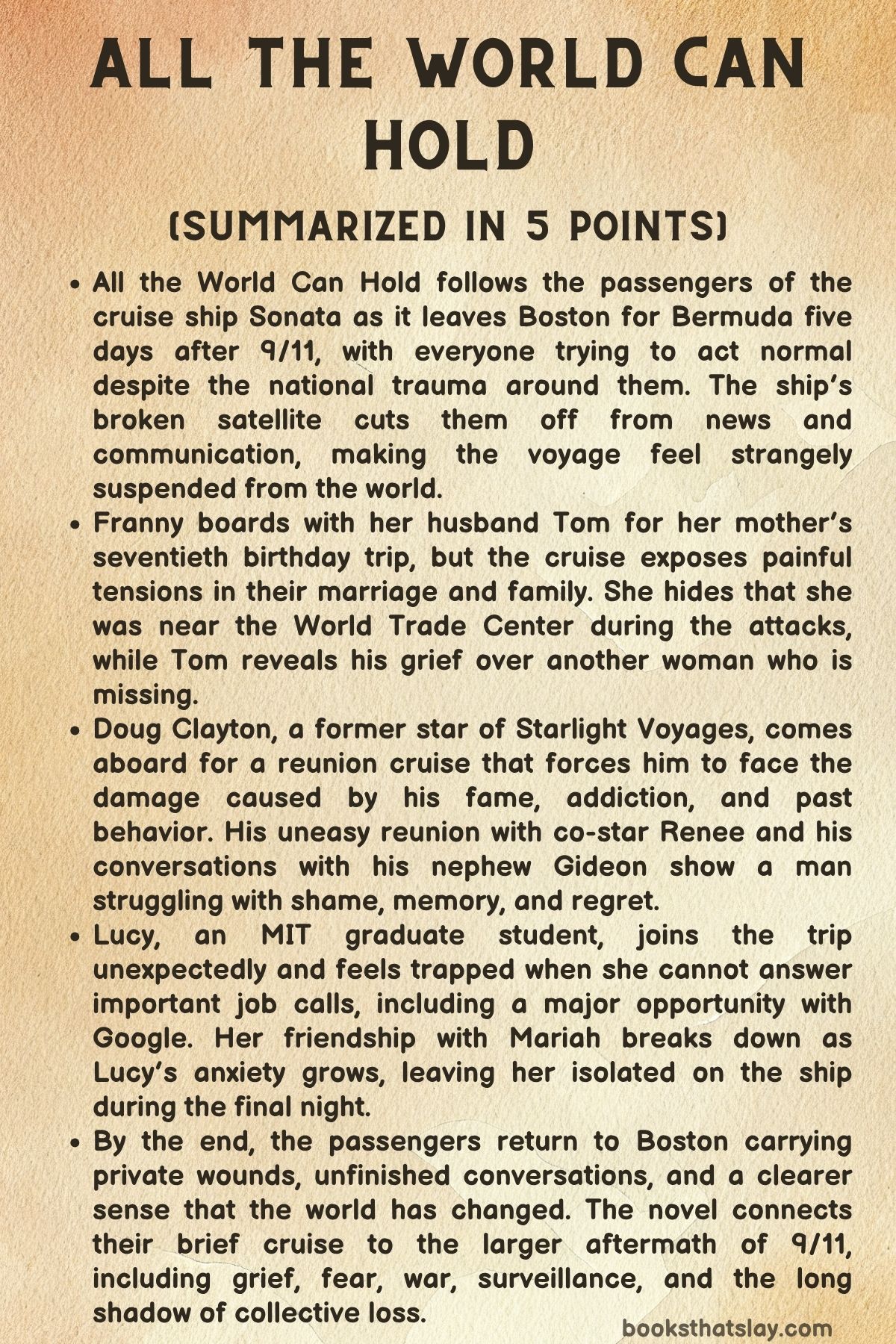
Characters
Franny
Franny is one of the central emotional figures in All the World Can Hold, and her character is shaped by silence, guilt, family duty, and an inability to fully explain her own fear. She boards the cruise not because she is carefree, but because honoring her mother’s seventieth birthday matters deeply to her, especially within the cultural and family expectations surrounding the trip.
At the same time, she is carrying a private trauma: she was near the World Trade Center when the towers fell, but she has not told Tom the full truth. This secrecy makes her seem distant and controlled, yet it also reveals how overwhelmed she is by an experience she cannot easily speak about.
Franny’s strained marriage, tense family meals, and awkward attempts to celebrate her mother all show a woman trying to hold together appearances while inwardly breaking down. Her gift of the Cartier watch to Ma reflects both love and pressure; it is an attempt to make the birthday meaningful, but also a way of expressing what she struggles to say directly.
By the end of the story, Franny becomes more vulnerable, especially in the moment when she and her mother physically support each other. Her character represents the difficulty of surviving a public catastrophe while also managing private wounds, family obligations, and emotional distance.
Tom
Tom is a tense, frustrated, and emotionally unsettled character whose reaction to the cruise is shaped by the shock of 9/11 and by his own hidden grief. From the beginning, he does not want to be on the ship.
His desire for television, phones, internet, and constant news shows that he wants connection to the outside world, not escape from it. He views the cruise as inappropriate so soon after the attacks, which puts him in direct conflict with Franny, who feels bound to honor her mother’s birthday.
Tom’s drinking and anger reveal that his moral objections are mixed with personal turmoil. When he admits that a woman he cared about is missing after 9/11, his character becomes more complicated.
He is not only a husband criticizing his wife’s decision; he is also a man carrying grief, guilt, and emotional confusion that he has not processed. His distance from Franny is intensified by the fact that both of them are hiding painful truths.
Tom’s role in the book shows how tragedy can expose the cracks in a marriage rather than create them from nothing.
Ma
Ma is a powerful presence in the family storyline, even when she is not openly expressive. Her seventieth birthday is the reason Franny insists on staying aboard the cruise, making Ma a symbol of family duty, cultural respect, and generational expectation.
She can seem difficult to please or emotionally reserved, but the later revelation that she and Jae were frightened for Franny after 9/11 gives her character greater tenderness. Ma’s love is not always spoken plainly, and this makes her relationship with Franny awkward but deeply meaningful.
The birthday celebration does not unfold smoothly, which reflects the family’s larger inability to communicate directly. Yet the embrace between Ma and Franny becomes one of the most important emotional moments in the story.
In that scene, Ma is not simply a demanding mother or a birthday figure; she is a frightened parent who almost lost her daughter and does not know how to express the full weight of that fear. Her character reflects the quiet, complicated love that can exist beneath family tension.
Jae
Jae serves as an important part of Franny’s family world and helps reveal the fear and concern that Franny has failed to recognize. As Franny’s brother, he is connected to the family obligations surrounding Ma’s birthday, but he also becomes significant because he and Ma tried to reach Franny after the attacks.
This detail changes the emotional meaning of his character. He is not merely present at family meals; he represents the family’s hidden panic and their wounded response to Franny’s silence.
Jae’s presence also helps show how family members can be close in obligation but distant in communication. Through him, the book explores how fear can become resentment, how concern can appear as judgment, and how a family crisis can remain unspoken until it finally surfaces.
Esther
Esther, Jae’s girlfriend, appears as a quieter supporting character within Franny’s family circle. Her role is important because she adds to the social pressure and awkwardness of the family meals.
As someone connected to the family but not fully at its emotional center, she helps create the feeling of strained politeness that surrounds Franny, Tom, Ma, and Jae. Esther’s presence also highlights how family gatherings often include people who witness tension without fully understanding its history.
She does not carry the main emotional burden of the story, but she helps shape the atmosphere around Franny’s family: formal, uncomfortable, and filled with things left unsaid.
Doug Clayton
Doug Clayton is one of the most tragic and morally complex figures in the book. A faded actor from the old television show Starlight Voyages, he boards the Sonata for a reunion cruise that forces him to confront the gap between his former fame and his damaged present self.
The ship is not just a setting for him; it is a place filled with memories of drinking, drug use, celebrity excess, and harm he does not fully remember or has tried not to face. Doug’s panic shows that he is not simply nostalgic about his past.
He is haunted by it. His forced schedule of signings, dances, dinners, karaoke, and appearances turns him into a performer trapped inside an outdated version of himself.
He is expected to entertain fans, but he can barely manage his own shame and anxiety. His reunion with Renee deepens his character because it suggests that his past behavior caused real pain, especially when she reminds him that she once told him never to come near her again.
Doug’s public humiliation, including the angry fan and the punch during formal night, strips away what remains of his celebrity image. Through Doug, the story examines fame, regret, addiction, memory, and the painful consequences of a life lived without accountability.
Gideon
Gideon, Doug’s nephew, functions as both companion and witness. He accompanies Doug on the cruise and becomes the person closest to Doug as the older man begins unraveling under the pressure of the reunion events.
Gideon’s importance lies in the fact that he sees Doug not only as a former star, but as a frightened, damaged relative. His presence creates space for Doug to begin opening up about the past.
Gideon is younger and less tied to the old celebrity world of Starlight Voyages, which makes him a bridge between Doug’s former public identity and his present need for honesty. Through Gideon, the book shows how confession often requires a listener who is close enough to care but distant enough from the original harm to receive the truth.
He helps reveal Doug’s vulnerability without excusing his past.
Renee
Renee is a former co-star from Starlight Voyages, and her character brings Doug’s buried past into the present. At first, her warm greeting may suggest nostalgia or reconciliation, but her later reminder that she once told Doug never to come near her again changes the meaning of their reunion.
Renee represents memory from the perspective of someone who may have been hurt by Doug’s behavior, not from the perspective of fans who romanticize the old show. She complicates Doug’s storyline by refusing to let the past remain charming or harmless.
Her character shows that fame can create different versions of memory: fans remember entertainment, Doug remembers fragments and shame, while Renee remembers harm. She is important because she challenges the fantasy of reunion and forces the story to confront what lies beneath celebrity nostalgia.
Lucy
Lucy is one of the clearest representations of anxiety, ambition, and dislocation in All the World Can Hold. As an MIT graduate student who joins the cruise at the last minute, she is not emotionally prepared to be cut off from the world.
Her job interviews, especially the possibility of an opportunity with Google, make the ship feel less like a vacation and more like a trap. The loss of her suitcase intensifies her discomfort because it strips her of control and makes her feel visibly out of place among the other passengers.
Lucy’s anxiety is not superficial; it reflects the pressure of being at a crucial point in her career while the world outside is unstable and unreachable. Her conflict with Mariah shows the difference between someone trying to escape responsibility and someone who feels crushed by it.
When Lucy finally sees the distant New York skyline and the absence of the towers, her personal worries connect to the larger historical trauma surrounding the cruise. Her character shows how ambition, fear, and grief can exist at the same time.
Mariah
Mariah is Lucy’s roommate and serves as a contrast to Lucy’s anxious, career-focused personality. She treats the cruise as an opportunity for fun, flirtation, drinking, and escape, while Lucy remains preoccupied with missed calls and professional consequences.
Mariah’s carefree attitude can seem insensitive, especially when she interrupts Lucy’s phone interview and later kicks her out of the suite. However, her character also reflects one possible response to crisis: avoidance through pleasure and distraction.
She does not want the cruise to become a space of worry and responsibility, so she pushes toward enjoyment even when others cannot do the same. Mariah’s conflict with Lucy reveals how differently people respond to uncertainty.
For Lucy, being unreachable is terrifying; for Mariah, it is part of the freedom of the trip. Their friendship breaks under the pressure of these opposing needs.
The Fan
The fan who becomes angry with Doug represents the complicated relationship between celebrity and audience. To fans, Doug is not only a flawed person but also a symbol of a beloved show and a past they want to preserve.
When Doug fails to meet expectations, the fan’s disappointment turns into anger. This character is important because the reunion cruise depends on nostalgia, but nostalgia becomes unstable when the real person behind the famous role cannot live up to the fantasy.
The fan’s reaction shows how audiences can feel ownership over performers, especially those connected to formative memories. Through this figure, the story reveals the pressure placed on aging celebrities who are expected to remain charming, grateful, and unchanged.
The Fan’s Husband
The fan’s husband plays a small but forceful role in Doug’s storyline. By confronting Doug and eventually punching him during formal night, he turns private disappointment into public violence.
His character exposes the tension beneath the cruise’s polished social rituals. Formal night should represent elegance and celebration, but the confrontation disrupts that surface completely.
He also becomes a physical expression of the resentment Doug inspires in others. While he is not deeply developed, his action matters because it publicly breaks the illusion that Doug can simply perform his way through the reunion without facing consequences.
The Ship’s Officers
The ship’s officers appear most memorably at the end, waving goodbye from the upper deck in a way that echoes the ending of Starlight Voyages. They are not central psychological characters, but they help frame the cruise as a strange suspended world between catastrophe and return.
Their final gesture gives the disembarkation a theatrical quality, as though the passengers are leaving both an actual ship and a temporary performance of normal life. The officers represent order, ritual, and continuity at a time when the world outside the ship has changed permanently.
Their calm farewell contrasts with the fear, grief, guilt, and confusion carried by the passengers stepping back onto land.
Themes
Grief and Historical Shock
The passengers aboard the Sonata are surrounded by comfort, entertainment, and celebration, yet the world outside has just changed in a way none of them can understand. In All the World Can Hold, the cruise becomes a strange space where people are physically removed from the disaster but emotionally trapped inside it.
Tom’s need for news shows how grief can become a demand for constant confirmation, while Franny’s silence about being near the towers shows the opposite response: hiding pain because speaking it aloud would make it more real. The ship’s broken communication systems intensify this helplessness, making the passengers feel cut off from history as it is happening.
Their vacation routines become uncomfortable because pleasure now feels almost disrespectful. Bermuda offers temporary beauty, but even that beauty carries guilt.
The theme shows that after a public tragedy, private lives do not pause neatly. People still argue, eat, dress up, celebrate birthdays, and make phone calls, but everything is shadowed by loss.
Family, Duty, and Emotional Distance
Franny’s relationship with her mother reveals how family duty can be both an act of love and a source of pressure. She stays on the cruise because honoring her mother’s seventieth birthday matters deeply within their family and culture, even though the timing feels painful and morally uncertain.
Her decision is not simple obedience; it comes from guilt, respect, resentment, and longing for approval all at once. The expensive watch she gives Ma becomes more than a gift.
It is Franny’s attempt to express care when direct emotional honesty feels difficult. The awkward embrace between mother and daughter is powerful because it does not suddenly fix their relationship.
Instead, it shows love as something imperfect, physical, and uncomfortable. Jae and Ma’s fear for Franny after the attacks also reveals that emotional distance does not mean absence of love.
The family may struggle to speak openly, but their concern remains strong beneath silence, pride, and misunderstanding.
Guilt, Secrecy, and Unspoken Truths
Many characters carry private knowledge that separates them from the people around them. Franny hides where she was during the attacks, creating a quiet barrier between herself and Tom.
Tom, meanwhile, reveals that a woman he cared about is missing, which changes the meaning of his anger and grief. His reaction to the cruise is not only moral outrage; it is also personal fear and unresolved attachment.
Doug’s panic comes from another kind of hidden past. The ship reminds him of fame, addiction, careless behavior, and harm he has tried not to face.
Renee’s cold reminder that she once wanted him to stay away forces him to confront the fact that his memories are incomplete and possibly self-protective. Lucy’s anxiety is also shaped by secrecy, though in a different form: she hides the scale of her ambition and fear behind frustration with Mariah.
Across the story, secrecy protects people temporarily, but it also isolates them and delays the difficult work of honesty.
Suspension Between the Past and the Future
The cruise places the characters in a brief pause between the world before September 11 and the world that will follow. The Sonata is moving forward physically, yet its passengers feel emotionally stuck.
Doug is trapped by his old television identity and the consequences of his younger life. Lucy stands between student life and a career in technology, worried that being unreachable will cost her future.
Franny is caught between daughter, wife, and survivor, unsure which role demands the most from her. The ship itself becomes a floating waiting room where normal time feels distorted.
By the end, the distant New York skyline makes this suspension impossible to ignore, especially because absence has become visible. The missing towers represent not only destruction but also the start of a changed future marked by fear, war, surveillance, and memorials.
When the passengers return to land, they are not transformed in a neat or heroic way. They simply re-enter history carrying memories they cannot fully explain.