The Fountain Summary, Characters and Themes | Casey Scieszka
The Fountain by Casey Scieszka is a speculative novel about immortality, grief, secrecy, and the cost of surviving too long. The story follows Vera Van Valkenburgh, a woman who looks young but has lived for nearly two centuries, as she returns to the Catskills valley where her strange life began.
Haunted by trauma and tired of endless survival, Vera searches for the source of her condition and a way to end it. What she finds instead is family conflict, dangerous science, old betrayals, and a fragile chance at belonging in a place she once fled.
Summary
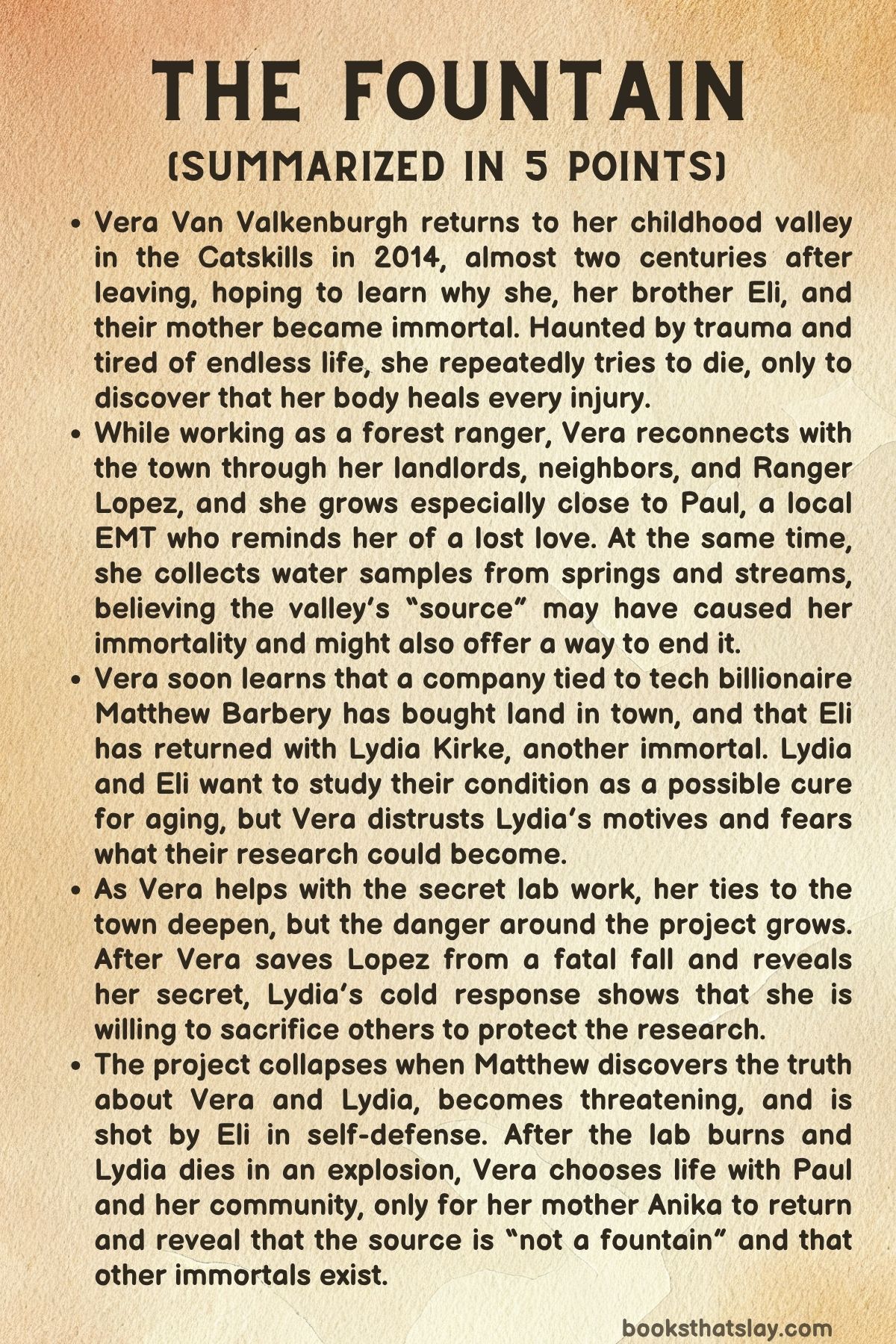
Vera Van Valkenburgh returns to the Catskills in April 2014 after nearly two hundred years away from the valley where she grew up. She has taken a job as a forest ranger and rented a cottage beside the house that once belonged to her family.
Her official reason for coming back is work, but her true purpose is far more desperate. Vera wants to find out what made her, her brother Eli, and their mother Anika immortal.
More than that, she wants to know whether the same force that changed them can be used to undo what happened.
Vera is not returning with hope. She is exhausted by survival.
A recent landslide in Joshua Tree left her trapped in darkness, badly injured, and forced to confront the terrible truth that even extreme harm may not kill her. Since then, she has become suicidal.
Soon after arriving in the valley, she makes repeated attempts to die, but each time her body repairs itself. Wounds close, bones heal, and pain fades.
Her immortality is not a gift to her. It is a prison she has carried through generations.
The valley is familiar and unfamiliar at the same time. Vera’s old family home is now owned by Cate and Brian, who rent her the nearby cottage.
They plan to turn the family barn into a cidery, bringing new life to a place filled with Vera’s memories. Vera slowly begins forming connections with people in town.
She works with Ranger Lopez, becomes close to Cate, and meets Paul, a local EMT and fisherman. Paul reminds her of Jacob, a man she once loved in Wyoming and lost in a riding accident.
Vera is drawn to Paul, but she also knows the danger of becoming attached to someone who will age while she does not.
As Vera begins her work, she gathers samples from streams, springs, and other local water sources. She hopes that something in the valley caused her family’s condition.
The old idea of a “source” becomes central to her search. She wonders whether the water, the land, or some hidden natural force gave them eternal life.
If she can identify it, perhaps she can reverse it. Her scientific search is mixed with personal despair, because every sample represents one more chance to end a life she no longer wants.
At the same time, strange developments in town catch her attention. A company called Fountain of Eternal Youth LLC has bought the old general store and other nearby parcels.
The name is too pointed to ignore. Vera soon learns that the company is connected to Matthew Barbery, a wealthy tech billionaire, and Lydia Kirke, a mysterious woman whose name matches someone from Vera’s family past.
Lydia appears in an old photograph with Lotte, the wife Eli abandoned long ago. This connection unsettles Vera and raises questions about how much Lydia knows.
At a planning-board meeting, Vera discovers something even more shocking. Lydia has come to town with Eli.
Vera and Eli had made a pact never to return to the valley, but Eli has broken it. He is involved with Lydia, who is also immortal.
Eli believes their condition should be studied and understood. He sees the possibility of using it to cure aging and help humanity.
Vera sees danger, arrogance, and betrayal. Their reunion brings old wounds to the surface, including Eli’s abandonment of Lotte and the different ways the siblings have endured their endless lives.
Despite her distrust, Vera becomes involved in Eli and Lydia’s secret research. The work is hidden behind the appearance of a botany project.
Lydia studies their blood, tissue, and local water samples while also researching the valley’s history. She runs experiments on mice that age rapidly, hoping to discover what makes the immortals’ bodies repair themselves.
Vera wants answers, but she does not trust Lydia’s motives. Her unease grows when she finds Lydia’s old diary and learns more about Lydia’s past connection to Lotte.
While the research continues, Vera’s daily life in the valley becomes richer than she expected. She helps with the apple harvest and the restoration of the barn.
Cate and Brian’s cidery project gives the old property a new purpose. Vera grows closer to Cate, Lopez, and Paul.
Her romance with Paul develops slowly, shaped by attraction, fear, and the knowledge that any future between them is built on a secret. Vera has lived through enough loss to know how dangerous love can be for someone who cannot age.
Still, she begins to feel rooted in the community in a way she has not felt for a long time.
The secret research grows more troubling as Lydia becomes more aggressive. She pushes the experiments forward without respecting Vera’s consent.
Vera and Eli argue over Lydia, over the past, and over what immortality means. Eli believes Lydia’s work could lead to a breakthrough that changes human life.
Vera believes Lydia is willing to sacrifice too much. Their conflict is not only scientific but moral.
Vera has suffered under immortality, while Eli has turned toward purpose and possibility. They are bound by the same condition but divided by what they think it means.
One winter day, Vera’s secret is exposed in a moment of crisis. Ranger Lopez falls from a fire tower, and Vera jumps after him to save him.
She cushions his fall and survives injuries that should have killed her. Lopez realizes that Vera cannot die.
Terrified by what he has seen and what it could mean, Vera goes to Eli and Lydia. Lydia’s reaction is chilling.
Rather than showing concern for Lopez, she says it would be easier if he died. This reveals the full coldness of her priorities.
Protecting the project matters more to her than protecting an innocent person.
The danger increases when Matthew Barbery visits. Lydia reveals more about the progress of the research than she should, and Vera learns that Lydia secretly gave Matthew one of Vera’s cell cultures.
Vera confronts Lydia in the lab, but Matthew overhears enough to understand the truth: Vera and Lydia are both immortal. His curiosity turns quickly into control.
He becomes possessive and threatening, making it clear that he does not intend to let them leave his sight. To him, they are no longer people.
They are the key to power, profit, and perhaps eternal life.
In the chaos that follows, Eli shoots Matthew to protect Vera and Lydia. The killing forces the three immortals into a desperate cover-up.
They decide to burn the lab, hoping to hide the gunshot and destroy the evidence of their research. The fire is meant to erase the danger Matthew represented, but it leads to another tragedy.
Lydia runs back inside to retrieve her diary, convinced that it contains crucial information about the source of their immortality. An explosion tears through the lab and kills her in a way that suggests total destruction may be one of the only ways an immortal can truly die.
Lydia’s death devastates Eli. After her funeral, he leaves the valley, broken by the loss.
Vera is left to face the consequences of everything that happened. Paul tells her he knows the fire was arson and suspects she was involved, but he will not expose her.
He also admits that he is falling in love with her. Rather than running away from him, Vera decides to tell him the truth.
This marks a turning point. For once, she chooses honesty and connection over secrecy and escape.
By September 2015, Vera has built a life in the valley. She has bought the cottage, lives with Paul, and remains close to the community.
Cate and Brian’s cidery is thriving, turning the old family barn into a place of growth rather than decay. Most importantly, Vera has stopped trying to die.
She has not found a cure for immortality, but she has found reasons to keep living. Her life is still uncertain, but it is no longer defined only by pain.
Then Anika, Vera’s mother, reappears. She reveals that she has been returning to the valley for decades, searching for her children.
She also tells Vera that there are other immortals, expanding the mystery far beyond Vera, Eli, Lydia, and Anika. In a final strange image, Anika feeds an impossible surviving buck from the old apple tree.
She tells Vera that the source is “not a fountain.” The statement changes the meaning of everything Vera has been searching for. The mystery remains open, but Vera is no longer facing it as a woman who wants only an end.
She is alive, connected, and finally willing to keep asking what her existence means.
Characters
This character analysis of The Fountain focuses on the major and supporting figures in the book, showing how each person contributes to the story’s ideas of immortality, grief, secrecy, love, fear, and the search for meaning.
Vera Van Valkenburgh
Vera Van Valkenburgh is the emotional center of the book and one of its most layered characters. She returns to her childhood valley not as someone seeking peace, but as someone who has reached the edge of despair.
Her immortality, which might seem like a gift from the outside, has become a terrible burden because it has forced her to survive loss, trauma, loneliness, and the repeated collapse of ordinary human life. Vera’s repeated attempts to die show how deeply exhausted she is by endless survival.
She is not simply afraid of living forever; she is tired of being unable to choose an ending for herself.
At the beginning of the story, Vera is isolated, suspicious, and emotionally guarded. Her experience in Joshua Tree has made her fear her own body because she realizes that even extreme injury may not free her.
This makes her return to the Catskills feel less like a homecoming and more like a desperate investigation into the mystery of her existence. She wants to understand the source of her immortality because understanding it might give her control over it.
Her work as a forest ranger gives her a practical reason to move through the landscape, but her deeper purpose is personal, painful, and almost spiritual.
Vera’s relationship with the valley reveals the conflict within her. The place holds memories of childhood, family, love, abandonment, and mystery.
She is drawn to it because it may contain the truth, but she is also unsettled by how much the past still lives there. As she reconnects with the land, gathers water samples, and studies the springs and streams, she begins to shift from someone who only wants to escape life into someone who is slowly forced to notice life again.
Her growing bonds with Cate, Lopez, Paul, and the wider community give her a sense of belonging that she has avoided for a long time.
Vera’s romance with Paul is especially important because it exposes both her longing and her fear. She wants love, tenderness, and ordinary companionship, but she knows that her immortality makes ordinary intimacy dangerous.
She has lived long enough to understand that attachment can lead to grief, secrecy, and eventual disappearance. Paul reminds her of Jacob, which makes the relationship both comforting and painful.
Through Paul, Vera begins to imagine a future that is not built only around escape, but around honesty, risk, and emotional connection.
Vera’s moral strength becomes clearer as the book progresses. She is suspicious of Lydia not because she rejects science or knowledge, but because she senses that Lydia treats people as tools for discovery.
Vera’s anger when Lydia uses her biological material without consent shows her need to protect her own body and identity after centuries of having no control over her condition. Vera is also deeply protective, as seen when she saves Lopez at great personal risk.
That act reveals that even though she is tired of living, she still values the lives of others.
By the end of the story, Vera has changed in a quiet but powerful way. She has not solved the entire mystery of immortality, and she has not been freed from her condition, but she has stopped trying to die.
This does not mean her pain disappears. Instead, it means she begins to choose life despite pain.
Her decision to stay with Paul, buy the cottage, and remain connected to the community shows that she has moved from despair toward fragile acceptance. Vera’s journey is not about becoming happy in a simple way; it is about finding enough meaning to continue.
Eli Van Valkenburgh
Eli Van Valkenburgh is Vera’s immortal brother and one of the most emotionally conflicted characters in the book. Like Vera, he carries the weight of centuries, but he responds to immortality very differently.
While Vera sees their condition as a curse that has trapped them in endless loss, Eli is more willing to believe that immortality can be studied, understood, and perhaps used for the benefit of others. This difference creates much of the tension between the siblings.
Their conflict is not only about science or secrecy; it is about two opposing ways of surviving the same impossible fate.
Eli’s return to the valley is a major betrayal in Vera’s eyes because it breaks the family pact never to go back. For Vera, the pact represents caution, survival, and respect for the dangers of being discovered.
For Eli, returning seems to represent hope, love, and the possibility of progress. His involvement with Lydia makes his motives even more complicated.
He is not merely helping a scientific project; he is emotionally invested in a woman whose ambition may blind him to danger. His love for Lydia softens him, but it also weakens his judgment.
Eli’s character is marked by guilt and longing. His past with Lotte, the wife he abandoned, hangs over him even when he tries to move forward.
Vera’s anger about Lotte suggests that Eli has a history of leaving emotional damage behind him. His immortality has not made him wiser in every way; in some ways, it has allowed him to avoid consequences by moving on while others are left behind.
This makes him sympathetic but flawed. He is not cruel by nature, but he can be selfish when he believes love or hope justifies his actions.
His relationship with Vera is filled with old affection and old wounds. They share a bond no ordinary people can understand, but their shared condition does not make them united.
Instead, it exposes how differently they have interpreted their endless lives. Eli wants to believe there is purpose in what happened to them, while Vera fears that the search for purpose can become dangerous.
Their arguments over Lydia, Lotte, and the research show that sibling love can survive for centuries while still being strained by resentment and mistrust.
Eli’s most dramatic moral choice comes when he shoots Matthew to protect Vera, Lydia, and their secret. This act reveals both his loyalty and his desperation.
He is capable of violence when cornered, especially when the people he loves are threatened. The shooting also shows how quickly the scientific dream collapses into fear and survival.
Eli wanted the research to help humanity, but he becomes part of a cover-up that destroys evidence and ends in catastrophe.
After Lydia’s death, Eli is devastated. His grief reveals that beneath his optimism and determination, he is still vulnerable to the same human pain that immortality cannot prevent.
In many ways, Eli represents the danger of hope when it becomes tangled with obsession. He wants immortality to mean something larger than suffering, but his faith in Lydia and the project helps unleash consequences he cannot control.
His departure after the funeral shows a man once again left wandering under the weight of endless life.
Anika Van Valkenburgh
Anika Van Valkenburgh, Vera and Eli’s mother, is a mysterious and powerful figure whose reappearance changes the meaning of the entire story. For much of the book, she exists as part of the family’s buried past, connected to the original mystery of immortality and to the childhood valley Vera returns to investigate.
When Anika finally appears, she reveals that the story is much larger than Vera, Eli, and Lydia understood. Her presence expands the mystery from a private family curse into a broader hidden reality.
Anika is important because she represents knowledge withheld. She has been returning to the valley for decades, searching for her children, which suggests both maternal devotion and secrecy.
Her absence has shaped Vera and Eli’s lives, but her return shows that she has not simply abandoned them. She has been moving through time in her own way, carrying information that her children do not have.
This makes her both comforting and unsettling. She is a mother, but she is also someone who knows far more than she has explained.
Her revelation that there are other immortals changes the emotional and philosophical stakes of the book. Vera has believed her condition to be rare and perhaps limited to her immediate family and Lydia, but Anika’s words suggest a hidden community or pattern.
This makes Vera’s suffering feel less isolated, but it also raises new fears. If there are others like them, then immortality is not just a strange accident; it may be part of a larger natural, historical, or supernatural truth.
Anika’s connection to the impossible surviving buck and the old apple tree gives her character an almost mythic quality. She seems to understand that the source of immortality is not the simple “fountain” people imagine.
Her statement that the source is “not a fountain” challenges the assumptions that have guided Vera’s search. Anika appears near the end not to solve everything neatly, but to open a deeper mystery.
She functions as a bridge between family history, the natural world, and the unknown forces shaping the characters’ lives.
As a character, Anika embodies both love and distance. Her search for her children suggests enduring attachment, but her long absence also leaves emotional questions unanswered.
She is not presented as a simple rescuer. Instead, she complicates the story by showing that survival across centuries creates secrecy, separation, and strange forms of care.
Her return leaves Vera with the possibility that immortality may have meanings she has not yet understood.
Lydia Kirke
Lydia Kirke is one of the most fascinating and morally troubling figures in the book. She is intelligent, driven, secretive, and ambitious, and her immortality has shaped her into someone who sees ordinary ethical boundaries as obstacles.
Like Vera and Eli, she has lived beyond a normal human lifespan, but unlike Vera, she does not seem crushed by the condition in the same way. Instead, Lydia turns immortality into a project.
She wants to study it, explain it, control it, and perhaps use it to transform the future of humanity.
Lydia’s scientific brilliance makes her compelling, but her lack of emotional restraint makes her dangerous. She studies blood, tissue, water, history, and animal experiments with intense focus.
Her work with rapidly aging mice shows her capacity for discovery, but it also reflects the coldness with which she approaches living beings. She is not interested in immortality as a personal tragedy in the way Vera is.
She sees it as a biological key, and this makes her willing to cross boundaries that Vera finds unforgivable.
Her past connection to Lotte adds another layer of suspicion and emotional complexity. Lydia is not simply a scientist who enters Vera and Eli’s lives in the present; she is tied to old wounds and old betrayals.
Her diary becomes a symbol of hidden knowledge, memory, and obsession. Vera’s discovery of Lydia’s past makes it harder to trust her, because Lydia’s motives are never entirely transparent.
She seems to know more than she says, and she often acts as though her intelligence gives her the right to decide what others should know.
Lydia’s relationship with Eli reveals her power over him. Eli loves her and believes in her work, which allows her to pull him into choices he might otherwise question.
Their bond is not without real feeling, but it is unbalanced by Lydia’s ambition. Eli wants to believe they are working toward something meaningful, while Lydia often appears more focused on the research than on the people involved.
Her willingness to use Vera’s cell culture without consent shows how easily she reduces others to material for experimentation.
One of Lydia’s most chilling moments comes after Lopez learns Vera’s secret. Her cold suggestion that it would be easier if Lopez died reveals the severity of her moral decline.
This is the moment when her commitment to secrecy and research becomes clearly inhuman. Lydia is not evil in a simple way; she believes the work matters.
But the more she believes in the importance of the project, the more willing she becomes to sacrifice individual lives, consent, and trust.
Lydia’s death is horrifying and symbolically fitting. She runs back into the burning lab for her diary, the object that represents her obsession with the source and her need to preserve knowledge.
Her destruction suggests that even immortality has limits, and that total physical annihilation may be one of the few ways an immortal can die. Lydia’s end is tragic because her intelligence and determination could have led to discovery, but her obsession makes her unable to let go.
She dies reaching for the record of what she believes matters most.
Matthew Barbery
Matthew Barbery is the book’s clearest representation of wealth, power, and possessive ambition. As a tech billionaire connected to Fountain of Eternal Youth LLC, he approaches immortality not as a spiritual mystery or personal curse, but as a resource to be acquired.
His interest in biotechnology and curing aging might sound noble on the surface, but his behavior reveals a desire for control. He does not treat Vera and Lydia as people with autonomy; once he realizes what they are, he begins to see them as priceless assets.
Matthew’s role in the story exposes the danger of powerful people gaining access to intimate biological secrets. His company’s purchase of local property already suggests intrusion into the valley, but his later actions make that intrusion personal and threatening.
He represents the outside world entering a hidden, fragile place with money, development plans, and scientific ambition. Through him, the book shows how easily discovery can become exploitation when it is backed by wealth.
His reaction after overhearing the truth about Vera and Lydia reveals his true character. Rather than responding with awe, compassion, or caution, he becomes possessive.
His statement that they cannot leave his sight shows that he immediately imagines ownership and containment. In that moment, Matthew stops being merely a sponsor or investor and becomes a direct threat.
His desire to control immortality strips Vera and Lydia of personhood.
Matthew is also important because he forces the other characters into irreversible action. Eli’s shooting of him is not planned, but it emerges from the danger Matthew creates.
This moment collapses the boundary between scientific secrecy and violence. Matthew’s presence turns the lab from a place of research into a place of fear, coercion, and survival.
His death sets off the fire, the cover-up, and Lydia’s final fatal choice.
As a character, Matthew does not need the same emotional depth as Vera or Eli to be effective. His function is to show what immortality becomes when viewed through the lens of capitalism, technology, and ownership.
He is frightening because his response to the miraculous is not wonder but possession. Through Matthew, the story warns that some discoveries may become dangerous not because of what they are, but because of who tries to control them.
Paul
Paul is one of the most emotionally grounding characters in the book. As a local EMT and fisherman, he is connected to ordinary life, practical care, and the rhythms of the valley.
He stands in contrast to the immortals, scientists, and wealthy outsiders because his life is rooted in human limits. He understands injury, emergency, mortality, and community through direct experience.
This makes his relationship with Vera especially meaningful, because he represents the kind of mortal life she both desires and fears.
Paul reminds Vera of Jacob, a man she once loved and lost, which gives him emotional significance before their romance fully develops. This resemblance is not just about memory; it shows how Vera’s past continues to shape her present.
Being drawn to Paul forces Vera to confront the possibility of repeating old grief. Loving a mortal person means accepting that time will move differently for them.
For Vera, this is terrifying because she knows she may have to watch him age, lose him, or leave before he discovers the truth.
Paul’s kindness is steady rather than dramatic. He helps Vera reconnect with ordinary intimacy, trust, and companionship.
His presence in her life offers a different answer to her despair. He cannot solve the mystery of immortality, but he gives her reasons to remain present.
Through Paul, Vera begins to experience the valley not only as a site of trauma and investigation, but as a home where love may still be possible.
His suspicion after the fire shows that he is not naive. Paul understands enough to realize that something is wrong, and he recognizes that Vera may be involved in the arson.
However, he chooses not to expose her. This decision reveals both love and moral complexity.
He is willing to protect Vera, but his protection is not blind ignorance. He sees danger and secrecy around her, yet he still moves closer rather than turning away.
Paul’s willingness to love Vera after sensing the truth makes him vital to her transformation. When he tells her he is falling in love with her, he gives her the opportunity to choose honesty instead of disappearance.
Vera’s decision to tell him the truth marks a major turning point in her emotional life. Paul represents the possibility that love can survive revelation, even when the truth is impossible.
He helps Vera move from hiding toward connection.
Ranger Lopez
Ranger Lopez is an important supporting character because he represents friendship, trust, and the real-world consequences of Vera’s secret. As a fellow ranger, he is part of Vera’s new life in the valley and helps place her within a community of work, responsibility, and care for the land.
His presence makes Vera’s return feel less solitary, even though she continues to hide the most important truth about herself.
Lopez’s relationship with Vera is built through ordinary closeness rather than dramatic romance. He becomes someone she can work with, speak to, and gradually care about.
This matters because Vera has spent so much of her long life keeping distance from others. Lopez’s friendship helps show that her healing is not limited to her relationship with Paul.
She is slowly becoming part of a wider human network.
The fire tower accident is the defining moment for Lopez’s role in the story. When he falls, Vera jumps after him and uses her own immortal body to save him.
This act reveals Vera’s instinctive selflessness and forces her secret into the open. Lopez becomes the person who witnesses the impossible not through research, rumor, or confession, but through being saved by it.
His survival comes at the cost of Vera’s secrecy.
Lopez’s importance also lies in how others react to him knowing the truth. Lydia’s suggestion that it would be easier if he died makes Lopez a moral test for the other characters.
To Vera, he is a person whose life matters. To Lydia, he becomes a risk to be managed.
This contrast helps define the ethical divide between Vera and Lydia. Lopez may not dominate the story, but his accident exposes the true values of the people around him.
As a character, Lopez represents the ordinary human life that Vera still wants to protect. He is mortal, vulnerable, and unaware of the larger forces around him until the accident changes everything.
Through him, the book shows that secrets are never abstract. They affect real people, and the choice to protect or sacrifice those people reveals character more clearly than any theory or experiment.
Cate
Cate is one of the characters who helps Vera reconnect with community, domestic life, and the possibility of belonging. As one of Vera’s landlords, she lives in Vera’s former family home, which makes her presence emotionally complicated from the beginning.
Cate occupies a space that once belonged to Vera’s childhood, yet she is not an enemy or intruder. Instead, she becomes part of the new life Vera slowly builds in the valley.
Cate’s plans with Brian to turn the old family barn into a cidery connect her to renewal and transformation. The barn is part of Vera’s past, but Cate and Brian give it a future.
This could have been painful for Vera, and in some ways it is, but it also allows the old family property to become alive again rather than remaining frozen in memory. Cate’s work with the cidery reflects one of the book’s quiet themes: places can hold history while still changing.
Cate’s friendship with Vera is significant because it draws Vera into ordinary activities and shared labor. Helping with the apple harvest and restoring the barn gives Vera a way to participate in life rather than merely observe it.
Cate’s warmth makes the valley feel less haunted and more habitable. Through her, Vera experiences a form of connection that is not based on immortality, romance, or secrecy, but on neighborly trust.
Cate also represents the mortal world’s ability to create meaning through limited time. She does not need eternal life to build something lasting.
Her cidery, her home, and her relationships are all examples of ordinary human hope. This contrasts with the immortals’ obsession with survival, origin, and control.
Cate’s life suggests that meaning may come not from escaping time, but from investing deeply in the time one has.
By the end of the story, Cate remains part of Vera’s chosen community. Her thriving cidery reflects a future rooted in continuity and care.
Cate may not know the full truth of Vera’s existence, but she helps make Vera’s continued life feel possible. Her importance lies in the gentle but powerful way she makes home feel real again.
Brian
Brian is a quieter supporting character, but he plays an important role in shaping the atmosphere of renewal around Vera’s old family property. As Cate’s partner and co-landlord, he is connected to the practical transformation of the old house and barn.
His presence helps show that Vera’s childhood home has become part of other people’s lives, dreams, and work. This is emotionally important because it forces Vera to confront the fact that the past has not remained untouched in her absence.
Brian’s role in the cidery project links him to growth, labor, and local enterprise. Alongside Cate, he helps turn a place filled with Vera’s memories into something active and communal.
The cidery is not just a business; it is a symbol of how the valley continues to evolve. Brian’s practical involvement in this transformation gives him a grounded quality.
He belongs to the world of building, repairing, harvesting, and planning, which contrasts with the secretive experiments happening elsewhere.
Although Brian is not as emotionally central to Vera as Paul, Cate, Eli, or Lydia, he contributes to the book’s sense of community. His presence makes the valley feel populated by real people with ordinary hopes.
This matters because Vera’s story could otherwise become entirely consumed by immortality and trauma. Brian helps anchor the book in everyday life, where people make plans, restore buildings, and create futures without knowing how fragile those futures may be.
Brian also helps show Vera what ordinary partnership looks like. His life with Cate is based on shared work and shared goals, not secrecy or impossible biology.
In this way, he becomes part of the background against which Vera’s own longing for stability develops. He is not a character of dramatic conflict, but he strengthens the story’s emotional world by representing continuity, cooperation, and rootedness.
Lotte
Lotte is a haunting figure in the book because her importance comes largely through memory, absence, and the pain left behind by others’ choices. She was Eli’s abandoned wife, and her connection to Lydia’s past makes her central to the emotional history Vera uncovers.
Even though she is not present in the same active way as Vera, Eli, or Lydia, Lotte’s story shapes the moral judgment of the living characters.
Lotte represents the human cost of immortality. Eli could move through time, begin again, and attach himself to new hopes, but Lotte was left behind.
Her abandonment shows how immortality can make ordinary human commitments unstable. Marriage, loyalty, and shared aging depend on time moving equally for both people.
When one person is immortal and the other is not, love can become distorted by secrecy and disappearance.
Vera’s anger over Lotte reveals Vera’s moral memory. She has not forgotten what Eli did, and she refuses to let the past be erased simply because centuries have passed.
This makes Lotte more than a sad figure from history. She becomes a measure of accountability.
Through Lotte, the book asks whether immortals can ever truly escape the consequences of the lives they leave behind.
Lotte’s connection to Lydia also deepens the suspicion around Lydia’s motives. The old photograph and diary suggest that Lydia’s involvement with Eli and Vera is not random.
She is tied to earlier wounds, and that history makes her presence in the present more unsettling. Lotte therefore functions as a bridge between personal betrayal and the larger mystery surrounding the immortals.
As a character, Lotte embodies the pain of those who do not get to continue forever. She is remembered because she was hurt, abandoned, and entangled in secrets she may not have fully understood.
Her role reminds the reader that the story of immortality is also a story of mortals who are loved, used, left, or lost.
Jacob
Jacob is another character whose power comes through memory rather than direct action in the present. He was a man Vera once loved in Wyoming, and his death in a riding accident left a deep emotional mark on her.
Jacob’s importance lies in what he reveals about Vera’s long history of love and grief. He shows that Vera has not always been completely closed off, but every meaningful attachment has carried the possibility of devastating loss.
Jacob’s death helps explain Vera’s fear of loving Paul. Paul reminds her of Jacob, which makes the new relationship emotionally dangerous from the beginning.
Vera is not simply attracted to Paul as an individual; she is also confronting the memory of someone she could not save and could not keep. Jacob’s absence therefore shapes Vera’s present choices.
He becomes part of the emotional shadow behind her hesitation.
Through Jacob, the book explores one of the cruelest parts of Vera’s immortality. She can heal from physical wounds, but emotional wounds remain.
The body’s refusal to die does not protect the heart from grief. In fact, immortality may make grief worse because it gives Vera endless time to remember.
Jacob’s death is one of the experiences that teaches her how painful mortal love can be for someone who cannot age or die normally.
Jacob also represents a life Vera might have wanted but could not sustain. His memory carries the possibility of ordinary happiness, partnership, and rootedness, all of which were taken from her.
When Paul enters her life, the memory of Jacob makes Vera’s choice more difficult but also more meaningful. Choosing Paul means accepting the risk of grief again.
Jacob’s role, then, is not only tragic; he also helps define the courage it takes for Vera to love after loss.
Themes
Immortality as a Burden Rather Than a Gift
In The Fountain, immortality is shown not as a dream of endless youth, but as a painful condition that separates Vera from ordinary human life. Her return to the valley is shaped by exhaustion, trauma, and the fear that she may be trapped in life forever.
The repeated healing of her body does not bring comfort; instead, it makes her feel imprisoned by her own survival. Her experience after the landslide proves that even extreme suffering may not free her, which turns immortality into a source of horror.
The same condition affects Eli differently, as he sees it as something that could serve science and humanity. This contrast shows that immortality does not have one simple meaning.
For Vera, it steals the natural shape of life, including aging, loss, and death. Her struggle suggests that endless life without emotional peace can become unbearable, especially when the body survives wounds that the mind cannot easily recover from.
The Search for Belonging and Home
Vera’s return to the Catskills is not only a search for the cause of her immortality, but also a return to the place where her identity first formed. At first, the valley feels dangerous because it holds old memories, family secrets, and the possibility of discovery.
Yet as Vera spends time with Cate, Brian, Lopez, Paul, and the wider community, the place slowly becomes more than a site of investigation. She begins to take part in everyday life through work, friendship, harvest, restoration, and love.
These ordinary connections challenge her belief that she must always remain apart from others. The rented cottage, the old family home, and the barn all become symbols of the difficult relationship between past and present.
Vera cannot fully erase what happened before, but she can begin to build something new within the same landscape. Her eventual decision to stay suggests that home is not simply where one begins, but where one chooses to risk attachment again.
Science, Power, and Moral Responsibility
The research into immortality raises serious questions about who should control knowledge and how far people should go in the name of progress. Lydia and Matthew treat the condition as a discovery that can be studied, owned, and possibly turned into a cure for aging.
Eli is drawn to this possibility because he believes their suffering might have a larger purpose. Vera, however, remains cautious because the research depends on secrecy, consent, and trust, all of which become unstable.
Lydia’s decision to use Vera’s cell culture without permission shows how scientific ambition can cross ethical boundaries when people become subjects rather than persons. Matthew’s reaction is even more dangerous because he sees immortality as something to possess.
The lab becomes a space where curiosity shifts into control. This theme shows that knowledge itself is not evil, but it becomes destructive when separated from compassion, consent, and humility.
The desire to cure human limits can easily become a desire to dominate them.
Healing Through Truth, Love, and Community
Vera’s emotional healing does not come from solving the mystery of immortality. It comes from slowly allowing herself to be known by others.
At the beginning, she is isolated, secretive, and drawn toward death because she believes her future can only repeat loss. Her relationships with Lopez, Cate, and Paul gradually challenge that belief.
Saving Lopez forces her secret into the open, but it also proves that her condition can connect her to others through protection rather than only fear. Paul’s response is especially important because he sees enough to understand that Vera is hiding something serious, yet he chooses care over punishment.
Her decision to tell him the truth marks a turning point because honesty replaces escape. By the end, Vera has not become free from immortality, but she has become less alone within it.
The reappearance of her mother expands the mystery, yet Vera’s life is no longer defined only by despair. Love and community give her a reason to continue.