The Moonshine Women Summary, Characters and Themes
The Moonshine Women by Michelle Collins Anderson is a historical novel set in the Ozarks during the harsh years of Prohibition. It follows the Strong family, especially Shine, a girl born into grief and raised in a world shaped by poverty, secrecy, and survival.
The novel explores women who are pushed to the edge by loss, lawlessness, family duty, and men’s expectations, yet keep finding ways to endure. Through moonshining, motherhood, violence, love, and reinvention, the story shows how Shine and the women around her claim power in a world that rarely offers them safety or choice.
Summary
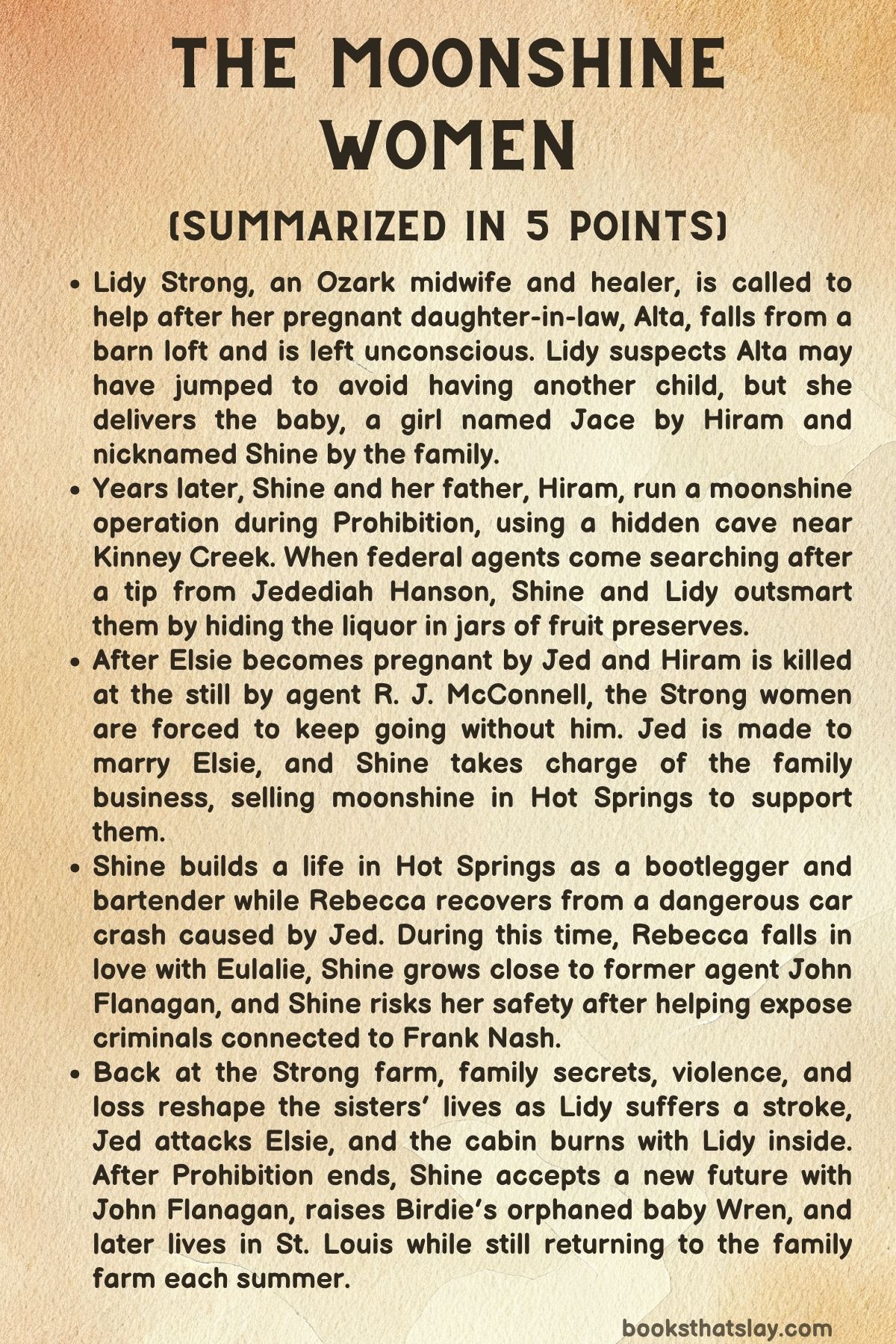
The Moonshine Women begins with Lidy Strong, an Ozark midwife and healer, being called to help her pregnant daughter-in-law, Alta, after a terrible fall from the barn loft. Alta is unconscious, and the family fears for both her life and the child she carries.
Lidy suspects the fall may not have been an accident. She believes Alta might have jumped because she did not want to bear another child, but she puts that thought aside and focuses on saving the baby.
Using her knowledge of herbs and birth, she gives Alta cedar berry tea to bring on labor.
Alta’s young daughters, Rebecca and Elsie, help Lidy through the difficult delivery. The family expects a boy, especially Hiram, Alta’s husband, who has built his hopes around having a son.
Instead, the baby is a girl. Hiram is crushed by Alta’s condition and by the loss of the son he imagined.
He names the baby Jace, though the family comes to call her Shine. From the start, Shine’s life is marked by disappointment that was never hers to carry, but she grows into a child with unusual strength, skill, and determination.
Years pass, and the Ozarks are changed by Prohibition. With alcohol banned, illegal liquor becomes a way for poor families to survive.
Hiram and Shine run a hidden moonshine operation in a cave near Kinney Creek. Shine has inherited Hiram’s gift for distilling and proves herself capable, sharp, and brave.
Rebecca helps cover their tracks and protect the family’s secrets. Elsie, meanwhile, longs for a life that is prettier and easier than the hard farm existence she has always known.
Their danger increases when federal agents John Flanagan and R. J. McConnell arrive in the region to destroy illegal stills. The Strong family’s operation is exposed after Jedediah Hanson tips off the agents.
When the men search the farm, Shine and Lidy outsmart them by hiding the liquor in plain sight inside jars of fruit preserves. The agents leave without finding the evidence they need, but the family knows the threat has only grown.
Elsie then becomes pregnant by Jed. Lidy, seeing the hardship ahead, secretly tries to end the pregnancy with herbs, but Elsie refuses to give up the baby.
Her decision forces the family closer to Jed, a man who will bring more trouble than comfort. Soon after, tragedy strikes when Hiram is shot and killed at the still by McConnell.
Shine, furious and broken by the loss, rushes into town demanding justice. Hiram’s death leaves the Strong women without their main provider, and grief quickly turns into the practical need to survive.
The family forces Jed to marry Elsie, partly to protect her reputation and partly because of the child she carries. Shine decides that the women will continue making and selling moonshine.
They have few choices, and she understands that stopping would mean losing the fragile security Hiram built. Jed’s car becomes part of their bootlegging operation, allowing them to transport liquor farther away, especially to Hot Springs, Arkansas.
Shine proves successful in Hot Springs. She sells Strong liquor to powerful men and earns work as a bartender at the Southern Club.
Her confidence grows in this new world, where danger and opportunity stand side by side. Yet the risks remain high.
Rebecca and Jed attempt a major delivery, but Jed drives recklessly when headlights appear behind them on a mountain road. The car crashes, injuring Rebecca badly and destroying much of the liquor they were carrying.
The accident leaves the family in debt and Rebecca in need of care.
Shine stays in Hot Springs to earn money and settle what the family owes. Rebecca first recovers in the hospital and later at the Buckstaff baths.
There, she meets Eulalie, a bathhouse attendant, and the two women fall in love. Their relationship offers Rebecca comfort and a sense of self that had been missing from her life on the farm.
Shine continues to carry the weight of Hiram’s death. She confronts Flanagan because she believes he killed her father, but he shows her that McConnell was responsible.
Flanagan has separated himself from McConnell, who is now ill and declining. Over time, Shine and Flanagan grow closer.
Their bond is complicated by the law, by Hiram’s death, and by Shine’s distrust, but Flanagan proves to be different from the man she first imagined.
In Hot Springs, Shine also becomes close to Birdie, a prostitute at the Southern Club. Birdie’s life is dangerous, and that danger becomes clear when gangsters connected to Frank Nash brutally assault her.
Shine secretly gives information to Flanagan, helping bring Nash to arrest. Nash is later killed in the Kansas City Massacre, and Shine fears revenge from the men connected to him.
To escape, she disguises herself as a man and leaves Hot Springs by train.
Back at the Strong farm, the family faces another blow. Lidy suffers a stroke and becomes trapped in her own body, able to communicate only by blinking.
The woman who once commanded births, herbs, secrets, and family decisions is reduced to silence. Around this time, Elsie discovers a hidden letter suggesting that Alta may have conceived Shine with a preacher named Robert Smythe, not Hiram.
The discovery changes what the sisters understand about their family, but it does not undo the life Hiram gave Shine or the loyalty she still feels toward him.
Elsie’s marriage to Jed grows worse. He drinks, cheats, and becomes violent.
Eventually, he tries to strangle her. Shine responds with fierce anger and nearly forces Jed to hang himself.
Rebecca stops the killing by shooting the rope and saving him. Elsie then sends Jed away for good, using a false farewell note to his parents to cut him out of their lives.
The Strong women choose survival over obedience to a cruel marriage.
Soon after, the family cabin burns with Lidy trapped inside. Her death marks the end of an era for the Strong family.
Neighbors help the sisters rebuild, and Lidy is buried beside Hiram and Alta. The women have lost nearly everything that once defined their home, yet they continue.
When Prohibition ends, Shine is left unsure of who she is without moonshine. The work that made her powerful and necessary is no longer the same kind of lifeline.
Then Flanagan returns, alive after surviving the Kansas City Massacre. He brings Eulalie with him, along with Birdie’s orphaned baby, Wren.
Shine chooses to raise Wren and accepts Flanagan’s love, allowing herself a future beyond fear and survival.
By 1941, Shine and John Flanagan are married and raising Wren in St. Louis. Each summer, they return to the Strong farm, keeping ties to the land, the dead, and the women who shaped them.
Shine’s life has moved far from the cave stills and dangerous roads of Prohibition, but her past remains part of her. The novel ends with a sense of hard-won peace, showing how Shine and her sisters survive loss, violence, secrecy, and change by building a life on their own terms.
Characters
In The Moonshine Women by Michelle Collins Anderson, the characters are shaped by hardship, secrecy, family duty, violence, survival, and the struggle for independence. Each character contributes to the emotional and moral complexity of the book, especially through the Strong women’s efforts to endure loss while protecting one another.
Lidy Strong
Lidy Strong is one of the most powerful and complicated figures in the book because she represents both care and control. As a midwife and healer, she is deeply connected to women’s bodies, birth, pain, and survival, but her knowledge also gives her a frightening kind of authority.
When Alta falls from the barn loft, Lidy’s first response is practical rather than emotional; she suspects a painful truth about Alta’s despair, yet she focuses on saving the unborn child. This shows how Lidy has learned to survive by acting instead of breaking down.
Her use of cedar berry tea and later herbs for Elsie’s pregnancy reveals that she understands the private suffering of women in a world where they often have little power over their own lives. At the same time, Lidy can be harsh, secretive, and morally unsettling because she makes decisions that affect others without fully allowing them a voice.
Her stroke later strips her of the control she once possessed, trapping her inside her own body and turning her into a silent witness to the family’s unraveling. Her death in the cabin fire gives her character a tragic ending, but her influence remains strong because she helped shape the courage, secrecy, and toughness of the Strong sisters.
Alta Strong
Alta is a tragic character whose presence is felt even after she is no longer active in the story. Her fall from the barn loft suggests deep despair, especially because Lidy believes she may have jumped rather than fallen.
Alta’s possible attempt to escape another pregnancy makes her a symbol of the emotional and physical burden placed on women who are expected to keep bearing children regardless of their own suffering. She is unconscious during Shine’s birth, which makes her motherhood painfully silent and incomplete.
Alta’s condition also affects the entire family, especially Hiram, who is devastated not only by her suffering but also by the fact that the baby is not the son he expected. Later, the hidden letter suggesting that Shine may have been conceived with Robert Smythe adds another layer to Alta’s character.
It suggests that her life contained secrets, desires, or vulnerabilities that the family never fully understood. Alta is important because she represents the hidden pain behind the family’s survival story.
Hiram Strong
Hiram Strong is a flawed but important father figure whose dreams and disappointments shape the lives of his daughters. His reaction to Shine’s birth reveals his attachment to traditional expectations, especially his longing for a son.
By naming the baby Jace despite the fact that she is a girl, Hiram projects his own desire onto her from the beginning. Yet his later relationship with Shine is not simply cold or rejecting.
He teaches her the craft of distilling, and she inherits his talent for making moonshine, which becomes central to her identity and survival. Hiram’s death at the still is a turning point in the book because it removes the family’s male provider and forces Shine and the other women to take control of their own future.
His killing also exposes the danger of Prohibition-era moonshining and the violence behind the law’s enforcement. Hiram is significant because his expectations wound Shine, but his skills also become part of her strength.
Jace “Shine” Strong
Shine is the central force of the book and one of its most complex characters. Born into disappointment because she is not the boy Hiram wanted, she grows into a fierce, capable, and independent woman who refuses to accept the limits placed on her.
Her nickname, Shine, connects her both to moonshine and to her unusual brightness within a harsh world. She is practical, daring, and often ruthless when survival demands it.
After Hiram’s death, she does not collapse into helplessness; instead, she decides the family will keep making and selling liquor because survival matters more than obedience to the law. Her success in Hot Springs shows her intelligence and adaptability, especially as she moves from hidden Ozark stills into a larger world of powerful men, clubs, crime, and danger.
Shine’s relationship with Flanagan reveals her capacity for trust and tenderness, though she is slow to soften because grief and responsibility have made her guarded. Her friendship with Birdie also shows her loyalty to vulnerable women, while her decision to raise Wren shows how much she has changed by the end of the story.
In The Moonshine Women, Shine becomes a figure of female resilience because she turns rejection, danger, and loss into self-determination.
Rebecca Strong
Rebecca is a steady and self-sacrificing character who often carries the practical burdens of the family. As one of Alta’s daughters, she is present during Shine’s birth and grows into a woman who helps protect the family’s moonshine operation.
Her skill in hiding tracks shows that she is observant, disciplined, and willing to do dangerous work without seeking attention. Rebecca’s attempted delivery with Jed marks one of her most painful moments because Jed’s recklessness leads to a crash that badly injures her.
Her recovery in Hot Springs becomes more than physical healing; it opens a path toward emotional awakening through her relationship with Eulalie. Rebecca’s love for Eulalie reveals a private longing for tenderness and a life beyond the harsh expectations of the farm.
She is also morally important in the scene where Shine nearly forces Jed to hang himself, because Rebecca shoots the rope and saves him. This act shows that although Rebecca understands Jed’s cruelty, she refuses to let Shine cross fully into vengeance.
Rebecca represents quiet strength, conscience, and the possibility of love in a life shaped by violence.
Elsie Strong
Elsie is a restless and vulnerable character who longs for beauty, romance, and escape from the roughness of farm life. Her desire for a prettier life makes her different from Shine and Rebecca, who are more closely tied to labor, survival, and responsibility.
Elsie’s pregnancy by Jed exposes both her innocence and her need to believe in love, even when the man involved is clearly weak and dangerous. When Lidy tries to end the pregnancy with herbs, Elsie refuses, showing that she has her own stubborn will despite often appearing softer than her sisters.
Her forced marriage to Jed traps her in the very kind of life she wanted to escape. As Jed drinks, cheats, and eventually becomes violent, Elsie’s romantic hopes are destroyed.
However, her decision to send him away with a fake farewell note reveals growth and courage. She may not be as outwardly fierce as Shine, but she learns to protect herself and her child in her own way.
Elsie’s character shows the painful movement from fantasy to hard-won independence.
John Flanagan
John Flanagan begins as a threat to the Strong family because he arrives as a federal agent determined to destroy illegal stills. At first, Shine sees him through the lens of grief and anger, believing he may be responsible for Hiram’s death.
However, Flanagan becomes more complicated as the truth emerges. His separation from McConnell, the actual killer, marks him as a man with a conscience.
Unlike McConnell, he is not simply cruel or power-hungry; he is capable of reflection, guilt, affection, and change. His growing closeness with Shine is important because he represents a form of love that does not require her to become weaker.
He sees her strength rather than trying to erase it. His survival after the Kansas City Massacre and his arrival with Eulalie and Wren connect him to the future Shine chooses.
Flanagan’s character matters because he moves from lawman and outsider to partner and protector, without completely removing the moral tension of his original role.
R. J. McConnell
R. J. McConnell is one of the darker characters in the book because he represents the violence and corruption that can exist behind official authority. As a federal agent, he is supposed to enforce the law, but his killing of Hiram shows brutality rather than justice.
His later illness and decline make him a physically decaying figure, as though his moral corruption is reflected in his body. McConnell’s presence is important because he complicates the idea of law and crime.
The Strongs are technically breaking the law by making moonshine, yet McConnell’s actions reveal that the legal side is not automatically righteous. He functions as a force of destruction in the family’s life, and his contrast with Flanagan helps reveal the difference between duty guided by conscience and authority driven by cruelty.
Jedediah “Jed” Hanson
Jed Hanson is a weak, selfish, and destructive character whose choices repeatedly harm the Strong women. His first major betrayal comes when he tips off the federal agents about the Strongs’ moonshine operation, setting in motion the raid that leads to Hiram’s death.
His relationship with Elsie shows his irresponsibility, as he gets her pregnant but does not become a loving or dependable partner. After being forced to marry her, he continues to reveal his cowardice through drinking, cheating, reckless behavior, and violence.
The car crash that injures Rebecca shows how his carelessness endangers others, while his later attempt to strangle Elsie exposes his cruelty more directly. Shine’s near-hanging of Jed reflects the family’s rage toward him, but Rebecca’s intervention prevents that vengeance from becoming murder.
Elsie’s final removal of Jed through the fake farewell note is fitting because he is not defeated by strength alone, but by the sisters’ intelligence and unity. Jed represents betrayal, failed masculinity, and the danger of men who demand power without accepting responsibility.
Eulalie
Eulalie is a gentle but significant character because she brings tenderness and emotional possibility into Rebecca’s life. As a bathhouse attendant, she appears during Rebecca’s period of recovery, when Rebecca is physically vulnerable and separated from the farm’s usual demands.
Their relationship gives Rebecca a glimpse of a different kind of life, one based not on survival, secrecy, or duty, but on care and mutual affection. Eulalie’s role may be quieter than Shine’s or Lidy’s, but she is important because she helps reveal Rebecca’s inner life.
Her later arrival with Flanagan and Wren suggests that she remains connected to the Strong family’s future. Eulalie represents healing, intimacy, and the possibility of chosen bonds beyond blood.
Birdie
Birdie is a vulnerable and sympathetic character whose life exposes the dangers faced by women on the margins. As a prostitute at the Southern Club, she lives in a world controlled by powerful men, gangsters, and violence.
Shine’s friendship with Birdie is important because it shows Shine’s compassion for women who are judged or exploited by society. Birdie’s brutal assault by men connected to Frank Nash becomes a turning point because it pushes Shine to secretly help Flanagan bring Nash down.
Birdie’s suffering also expands the story beyond the Strong family, showing that the same world that profits from women’s labor and bodies can also destroy them. Her orphaned baby, Wren, becomes part of Shine’s future, which gives Birdie’s life a lasting emotional impact.
Birdie represents vulnerability, survival, and the cost of living without protection in a violent world.
Frank Nash
Frank Nash is a dangerous background figure whose influence brings organized crime into the story. He is not emotionally central in the way the Strong family members are, but his presence matters because he represents the larger criminal world surrounding Hot Springs.
Through Nash, the danger of moonshine and club life becomes much broader than local survival or Ozark poverty. His connection to the gangsters who assault Birdie shows the cruelty of men who use power without mercy.
His arrest and later death in the Kansas City Massacre also connect Shine’s personal choices to wider historical violence. Nash functions as a symbol of organized brutality and the risks Shine faces when she enters a world controlled by men with money, weapons, and influence.
Wren
Wren is Birdie’s orphaned baby and a symbol of renewal near the end of the book. Though Wren is too young to act as an independent character, her importance is emotional and symbolic.
When Shine decides to raise her, Shine chooses motherhood in a way that contrasts sharply with the pain surrounding Alta’s pregnancy and the burdens placed on earlier generations of women. Wren gives Shine a future that is not only built around survival, liquor, or grief.
She also connects Birdie’s tragic story to a new beginning, allowing something innocent to come out of a violent past. Wren represents hope, chosen family, and the possibility that the next generation may inherit love rather than only hardship.
Robert Smythe
Robert Smythe is a minor but important figure because the hidden letter suggests he may be Shine’s biological father. Even though he does not dominate the action, his possible connection to Alta changes the way the family history can be understood.
If Shine was conceived with him rather than Hiram, then her identity is tied to secrecy from the beginning. Smythe’s role also deepens Alta’s character, suggesting that her life held emotional or moral complications the family never fully confronted.
For Shine, the revelation raises questions of belonging, inheritance, and truth. However, the discovery does not erase the fact that Hiram shaped her life through his expectations, skills, and death.
Smythe represents hidden history and the uncertainty beneath family identity.
Themes
Women’s Survival in a Harsh World
The women in The Moonshine Women survive in a world where comfort, safety, and fairness are rarely given to them. Lidy, Shine, Rebecca, Elsie, Birdie, and Eulalie each face different forms of pressure, but they respond with strength rather than surrender.
Lidy uses her knowledge of healing and childbirth to protect her family, even when her choices are morally difficult. Shine steps into the dangerous business of moonshine after Hiram’s death because survival leaves her little room for hesitation.
Rebecca quietly carries responsibility, even when her own desires are pushed aside. Elsie suffers through a forced marriage and domestic violence, but she eventually finds the courage to remove Jed from her life.
Birdie’s suffering also shows how women are harmed by men who use power without mercy. The theme becomes powerful because survival is not shown as graceful or easy.
It is painful, risky, and often lonely, but it also becomes a form of resistance.
Family, Duty, and Burden
Family is shown as both a source of protection and a heavy burden. The Strong women depend on one another to survive grief, poverty, danger, and social judgment, yet their loyalty often demands sacrifice.
Shine feels responsible for keeping the household alive after Hiram’s death, even though that responsibility pulls her into crime and danger. Rebecca gives her labor and care to the family, but her own emotional life remains hidden for a long time.
Elsie wants beauty, freedom, and romance, yet family expectations trap her in a marriage that becomes violent and humiliating. Lidy’s devotion to the family is fierce, but it also leads her to make choices that others might see as controlling or cruel.
The family bond is therefore not simple. It gives the women strength, shelter, and identity, but it also limits their choices.
The story shows that love inside a family can be sincere while still being complicated by duty, resentment, secrecy, and pain.
Power, Violence, and Justice
Violence appears in many forms, from federal raids and criminal intimidation to domestic abuse and sexual assault. Hiram’s death shows how official power can be cruel and unjust when men with authority act without accountability.
Shine’s demand for justice after his killing reveals her refusal to accept that poor mountain families can be harmed and forgotten. Yet the story also shows that legal justice is often incomplete.
Frank Nash’s world of gangsters, Birdie’s assault, and Jed’s violence toward Elsie all reveal systems where powerful men expect to escape consequences. Shine’s response to Jed is especially important because it shows how rage can grow when formal justice fails.
She comes close to becoming violent herself, which makes the theme morally complex. The novel does not present justice as clean or simple.
Instead, it shows people caught between law, revenge, protection, and survival. True justice often depends not on institutions, but on courage, witness, and women defending one another.
Identity, Freedom, and Self-Determination
Shine’s identity is shaped by expectations she never fully fits. She is given a masculine name because Hiram expected a son, and throughout her life she moves through spaces usually controlled by men: distilling liquor, selling in Hot Springs, working in bars, and escaping danger in disguise.
Her journey questions fixed ideas about womanhood, family roles, and respectability. Rebecca’s love for Eulalie also expands the theme of identity, showing a private truth that cannot easily exist within the limits of her society.
Elsie’s story reflects a different struggle for freedom, as she must break away from the fantasy of romance and face the reality of Jed’s cruelty. Even Lidy’s hidden knowledge about Alta and Shine’s parentage suggests that identity is shaped by secrets as much as by blood.
By the end, freedom does not mean leaving the past behind completely. It means choosing what kind of life to build from pain, memory, love, and hard-earned truth.