Bloom and Blood Summary, Characters and Themes
Bloom and Blood by Eva Chase is a paranormal romance fantasy about identity, guilt, power, and the strange pull of fate across realities. The story follows Elodie after a violent magical event tears her away from her own world and drops her into another version of her life, one where her dead mate is alive, her family history is different, and someone has already murdered her alternate self.
Forced to impersonate a wealthier, colder version of herself, Elodie must solve the killing while resisting bonds that feel both familiar and dangerous. It’s the 1st book of the Second Fate of Elodie Devine series.
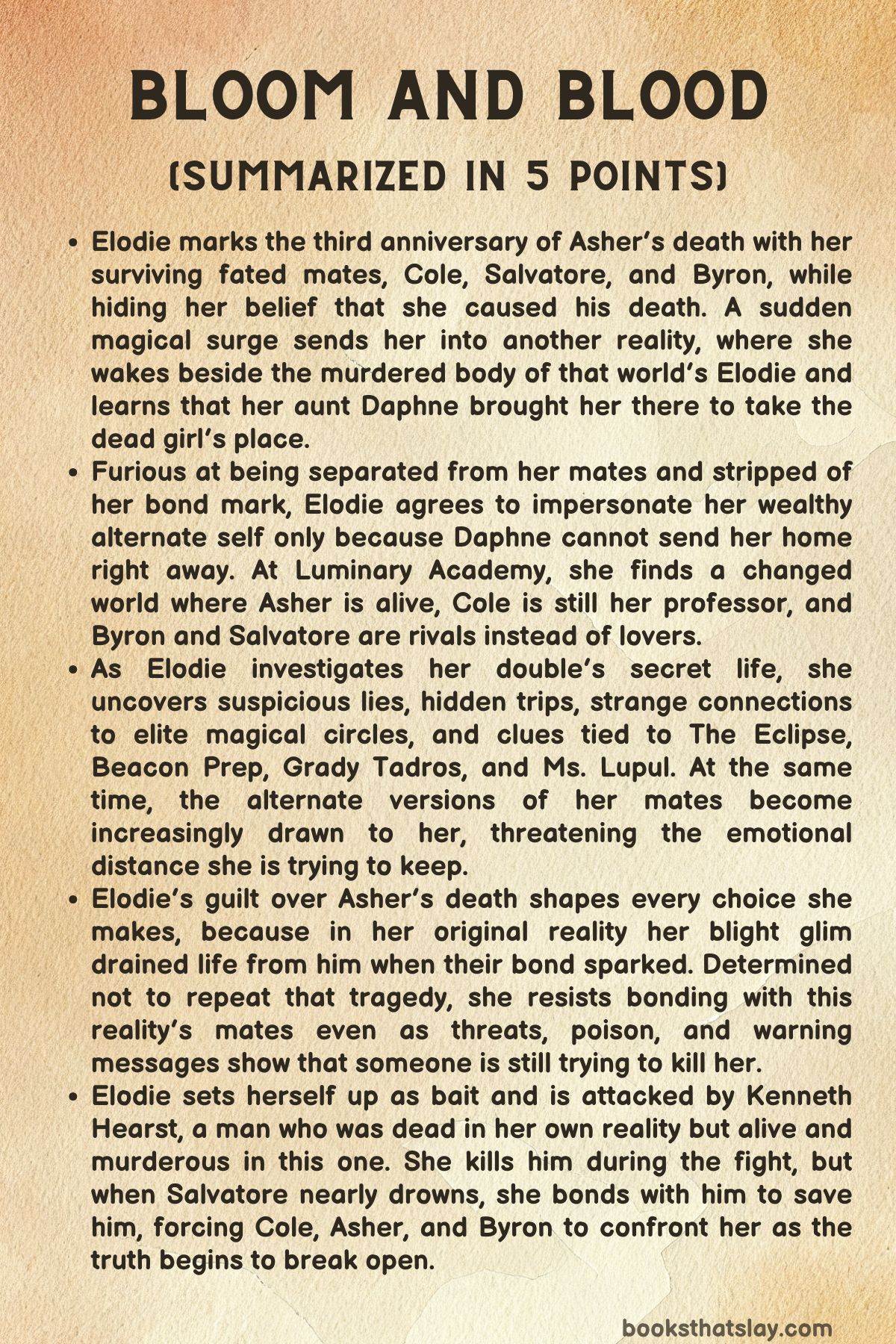
Summary
Elodie is still living with the pain of Asher’s death three years after losing him. In her original world, Asher was not only her first fated mate but also her closest friend, the person whose loss left a wound she has never fully healed from.
She marks the anniversary with her three surviving mates, Cole, Salvatore, and Byron, but the dinner is heavy with grief and with Elodie’s private guilt. She has never been able to shake the belief that Asher died because of her, and that belief shapes everything she does.
During the memorial, a powerful magical surge hits her without warning. The force overwhelms her, and she blacks out.
When she wakes, she is no longer in the world she knows. She is in a strange house, beside the mutilated body of another Elodie.
This version of her has been killed, and Elodie quickly learns that she has been pulled into a parallel reality. A woman named Daphne, who claims to be her aunt, explains that the dead woman is Elodie Devine, the powerful heir of the Devine family in this world.
Daphne used magic to bring Elodie across realities so she could take the murdered woman’s place.
Elodie is horrified and furious. Daphne has stolen her from the mates she loves and from the life she was trying to survive, however painful it was.
Worse, the magical transfer has severed her from her mates, erasing the bond mark that connected her to them. Daphne insists that the Devine family needs Elodie to pretend to be the dead heir long enough to protect the family’s position and uncover who killed her.
She also says she cannot send Elodie back right away.
This new world is both familiar and deeply wrong. Elodie’s father, Julien, is alive here, while her mother died many years earlier.
Instead of the life she remembers, this Elodie was raised as a wealthy, powerful daughter of the Devine family, surrounded by status, expectation, and enemies. Though Elodie wants nothing more than to return home, she understands that refusing Daphne will not get her back faster.
She agrees to pose as the dead Elodie while looking for the killer and searching for a way home.
To survive the deception, Elodie studies her double’s life. She goes through the dead woman’s phone, clothing, contacts, routines, and social habits, trying to understand how to act like someone who shared her face but not her history.
She learns that this Elodie was privileged, polished, and often distant. The role feels unnatural, but Elodie has little choice.
If anyone discovers the truth, she could lose the fragile protection Daphne’s plan gives her.
Her return to Luminary Academy makes the differences in this reality even sharper. Asher is alive.
Cole is still Professor Raith, but he is not her mate here. Byron and Salvatore are not her lovers either; they are her academic rivals.
Seeing them alive, close, and yet emotionally out of reach shakes Elodie badly. She is drawn to them because of everything they mean to her in her own world, but she knows they are not the same men who loved her.
She also fears what could happen if the same bonds begin forming again.
At the academy, Elodie tries to behave like the Devine heir everyone expects while secretly investigating the murder. She soon discovers that her alternate self was hiding important parts of her life.
The dead Elodie had lied to her friends, claimed to attend violin lessons she was not attending, visited unexplained locations, and seemed to be looking into secretive circles among the magical elite. These clues suggest that her murder was not random.
She had found something dangerous, and someone wanted her silenced.
Elodie follows the trail to a men’s club called The Eclipse, a place tied to the wealthy magical community. She watches people connected to the club and begins noticing links between several suspicious figures, including Grady Tadros, students from Beacon Prep, and a consultant named Ms. Lupul.
Each lead raises more questions. It becomes clear that the dead Elodie had been circling something much larger than a personal grudge.
While Elodie searches for answers, the alternate versions of her mates complicate everything. Salvatore becomes increasingly interested in her, sensing something beneath her changed behavior.
Byron notices details that do not fit and begins questioning who she really is. Asher tries to help her, and his kindness hurts because it reminds her of the man she lost.
Cole starts out hostile and suspicious, but the tension between them grows into a dangerous attraction that neither of them can fully ignore.
Elodie’s fear of bonding with them comes from the darkest part of her past. In her original world, her Uncle Nik trained and controlled her, using her as a weapon.
He pushed her into violent missions because of her rare and terrifying blight glim, a magical ability that can heal her by draining life, injury, or harm into someone else. This power has always felt like a curse.
When she was attacked in her own reality and Asher touched her, their bond sparked. Her glim activated, saving her by sacrificing him.
That memory still defines her. She cannot bear the thought of hurting another version of Asher, or any of the men connected to her fate.
The danger around her grows more direct. Elodie receives threatening messages warning her to stay away from “her own kind.” The phrase suggests that the people behind the threats know more about her or the dead Elodie than they should.
She considers several possible suspects, including Simone, whose jealousy over Salvatore’s attention makes her seem capable of cruelty. Then Elodie is poisoned at school and barely survives.
The attack proves that the killer or their allies are still watching her.
Cole investigates the poisoning and challenges Elodie not to retreat. His support is rough-edged, but it strengthens her resolve.
Elodie decides she cannot simply wait for another attack. She publicly provokes the people she suspects may be involved, hoping to draw out whoever is behind the threats.
It is a reckless plan, but she knows the killer has already acted more than once. Waiting will only give them another chance to strike on their own terms.
That night, Elodie sneaks out and uses herself as bait. A cloaked figure follows her to a riverside park and attacks with a knife.
The attacker is Kenneth Hearst, a man who was dead in Elodie’s original world but is alive in this one. He is prepared with magical weapons and speaks as if he has already tried to kill her before.
His presence confirms that the murder is linked to deeper differences between the realities, not just to the dead Elodie’s private life.
Salvatore has followed Elodie and intervenes during the attack. The fight moves onto a bridge, where the situation turns deadly.
Elodie manages to kill Kenneth with his own knife, but before the danger ends, Kenneth knocks Salvatore into the flooded river. Salvatore is swept away, drowning, and Elodie is forced into the exact kind of choice she has feared since arriving in this world.
She tries to save him without triggering a bond, exhausting herself in the process. When it becomes clear that Salvatore will die unless she takes the risk, Elodie finally touches him skin-to-skin.
Their bond sparks. Her blight glim awakens, threatening to repeat the nightmare that killed Asher in her own world by healing her at Salvatore’s expense.
But Salvatore’s own alchemical glim rises in response, reshaping the riverbank and saving them both from the flood.
The bond between them takes hold, powerful and undeniable. In the aftermath, Elodie and Salvatore are drawn into a kiss, shaken by what has happened and by the new connection between them.
Before Elodie can fully process the consequences, Cole, Asher, and Byron arrive. They have been pulled there by the force of the new bond, and they demand to know what is going on.
Elodie is left standing between two lives: the one she was torn from and the one closing around her in this alternate reality. She has survived another attack, uncovered one killer, and bonded with a man she tried desperately to keep at a distance.
But Kenneth’s death does not solve the larger mystery. Someone murdered the other Elodie, someone knows more than they should, and the bonds Elodie feared may now be impossible to stop.
Characters
Elodie Devine
Elodie is the central character of Bloom and Blood, and her journey is shaped by grief, guilt, displacement, and survival. At the beginning of the book, she is still emotionally trapped by Asher’s death, even though three years have passed.
Her bond with Cole, Salvatore, and Byron gives her a sense of belonging, but it does not erase the private belief that she caused Asher’s death. This guilt defines much of her emotional behavior.
She does not simply mourn Asher; she sees his death as proof that intimacy with her can destroy the people she loves. Because of this, her arrival in the alternate reality is not only frightening but also emotionally cruel, since she is forced to face living versions of the people connected to her deepest wounds.
Elodie’s strength comes from her ability to adapt under pressure. When she wakes beside the corpse of her alternate self, she is horrified, angry, and disoriented, but she does not collapse completely.
She studies the other Elodie’s life, learns her habits, examines her belongings, and enters Luminary Academy with enough control to impersonate someone she barely understands. This shows her intelligence and discipline.
However, her performance is never perfect because she is not cold or detached by nature. She reacts emotionally to the alternate versions of her mates, especially because they are familiar and unfamiliar at the same time.
Their presence constantly threatens the wall she has built around herself.
Her blight glim is one of the most important parts of her character because it represents both power and trauma. Elodie’s magic can heal her by transferring harm to others, which makes her dangerous even when she is trying to survive.
This ability has been shaped by abuse and manipulation, especially through Uncle Nik’s training. Elodie is not simply afraid of her power because it is destructive; she is afraid because it has been tied to coercion, violence, and the death of someone she loved.
Her fear of bonding with the alternate Salvatore, Asher, Cole, and Byron comes from the belief that her love carries a cost.
By the end of the book, Elodie begins to act with more agency. She does not wait passively for Daphne to solve the mystery or for her enemies to reveal themselves.
She sets a trap, risks herself as bait, and confronts Kenneth when he attacks. Her decision to bond with Salvatore in the river is especially important because it forces her to choose love and survival over fear.
She knows the danger, but she also refuses to let him die. This moment does not erase her guilt, but it shows that she is beginning to resist the idea that she is only a weapon or a curse.
Salvatore
Salvatore is one of the alternate versions of Elodie’s fated mates, but in this reality he begins as an academic rival rather than her lover. His role in the book is built around fascination, emotional tension, and instinctive loyalty.
Even without their original romantic history, he is drawn to Elodie in a way that feels stronger than ordinary attraction. His interest grows as he notices that she is different from the person everyone thinks she is.
This makes him important not only as a romantic figure but also as someone who senses the truth before he fully understands it.
Salvatore’s character is marked by intensity. He watches Elodie closely, responds to her changes, and becomes increasingly involved in her orbit.
His jealousy, curiosity, and attraction all blend together, creating a dangerous emotional charge between them. Unlike someone who simply admires her from a distance, Salvatore acts.
When Elodie sneaks out as bait, he follows her, which shows both concern and possessiveness. His decision to intervene during Kenneth’s attack proves that his connection to her is not superficial.
He risks himself before he has all the answers.
His alchemical glim becomes crucial during the river scene. After Kenneth knocks him into the flooded water, Salvatore is physically vulnerable, but he is not helpless.
When Elodie bonds with him and her own glim awakens, his power responds by reshaping the riverbank and helping save them both. This moment makes Salvatore more than a victim of Elodie’s dangerous magic.
He becomes her counterpart, someone whose power can meet hers and alter the outcome. Their bond is frightening because of Elodie’s past, but it is also hopeful because Salvatore survives it.
Salvatore’s importance lies in the way he challenges Elodie’s belief that love must end in destruction. He is drawn into danger because of her, yet his connection with her also helps save both of them.
His kiss with Elodie after the bond forms is not merely romantic; it represents the return of a bond she had been resisting out of terror. Through Salvatore, the book suggests that Elodie’s past does not have to fully control her future.
Cole Raith
Cole appears in the alternate reality as Professor Raith, which changes the dynamic between him and Elodie. In her original reality, he is one of her surviving fated mates, but in this world he begins from a place of hostility and suspicion.
This makes his relationship with Elodie tense and complicated. He is not immediately comforting, and his authority at Luminary Academy places him in a position where he can observe, challenge, and confront her.
His guarded attitude makes him seem dangerous, but it also shows that he is perceptive.
Cole’s hostility toward Elodie gradually shifts into attraction, which creates one of the book’s most charged emotional conflicts. He notices inconsistencies in her behavior, and his suspicion is not baseless.
Elodie is pretending to be someone else, hiding the truth of her origin, and investigating a murder while surrounded by people who think they know her. Cole’s sharpness makes him threatening to her disguise, but it also makes him valuable.
He does not accept easy explanations, and this gives his character a strong investigative edge.
His response to Elodie’s poisoning reveals a more protective side. Instead of dismissing her danger or treating her as merely troublesome, Cole investigates what happened and pushes her not to give up.
This moment matters because it shows that his harshness is not the same as cruelty. He may be suspicious, but he is also capable of concern and action.
His care emerges through pressure rather than softness, which fits his role as a difficult but important figure in Elodie’s life.
Cole’s arrival after Elodie bonds with Salvatore adds another layer to his character. He is drawn by the new bond, along with Asher and Byron, and demands an explanation.
This reaction shows that even in the alternate reality, the connection among the fated mates has force. Cole represents resistance, discipline, and dangerous attraction.
His relationship with Elodie is not easy, but it is powerful because it is built on tension, recognition, and the sense that he sees more than she wants him to see.
Byron
Byron is another alternate version of Elodie’s fated mates, but in this reality he is positioned as an academic rival rather than a lover. This shift allows the book to show a different side of his connection with Elodie.
He does not begin with open devotion, but he does notice her. His attention is significant because Elodie is trying to impersonate her dead alternate self, and Byron’s awareness of inconsistencies makes him a threat to that disguise.
Byron’s intelligence is one of his defining qualities. He observes details, questions behavior, and seems capable of recognizing when something is wrong beneath the surface.
In a school environment full of status, rivalry, and secrecy, his sharp perception gives him power. He is not simply another student competing with Elodie.
He becomes one of the people most likely to detect that the Elodie before him is not the same person he thought he knew.
His role also deepens the emotional pressure on Elodie. Because Byron was one of her mates in her original reality, seeing him as a rival forces her to experience loss in a different form.
He is alive and near her, but he does not share the same history. This makes their interactions painful and unstable.
Elodie must guard herself not only from suspicion but from the longing created by his presence. Byron’s alternate self becomes proof that familiar souls can exist in unfamiliar arrangements.
Byron’s arrival after Salvatore’s bond forms suggests that his connection to Elodie remains active even if it has not fully awakened in the same way. He represents the unfinished emotional consequences of Elodie’s displacement.
His character adds tension because he combines rivalry, intelligence, and latent intimacy. He is not yet the lover Elodie remembers, but he is not simply a stranger either.
Asher
Asher is one of the most emotionally important characters in the book because he exists as both a memory and a living person. In Elodie’s original reality, he was her first match, her best friend, and the person whose death shaped her entire sense of herself.
His loss is not just a tragic event in her past; it becomes the foundation of her guilt. Elodie believes that her blight glim caused his death when their bond sparked after he touched her while she was injured.
This makes Asher a symbol of love, safety, and unbearable consequence.
The alternate reality makes Asher’s role even more painful because he is alive there. For Elodie, seeing him alive is not simple relief.
It forces her to confront everything she lost and everything she fears repeating. His presence tempts her toward comfort, but it also terrifies her because she believes closeness to him could lead to the same kind of disaster.
This creates a painful emotional contradiction: Asher is someone she longs for, but he is also someone she feels she must avoid protecting.
Asher’s behavior in the alternate reality shows kindness and helpfulness. He tries to support Elodie, which reflects the qualities that made him so important to her in the first place.
Even without the exact same shared past, he still carries an instinctive warmth toward her. His presence suggests that some emotional bonds may exist beyond circumstance, even when reality itself has changed.
Asher’s importance is not limited to romance. He represents Elodie’s unresolved grief and the possibility of healing from it.
His living alternate self forces her to question whether she is doomed to repeat the past or whether she can make different choices. Because of this, Asher remains central to Elodie’s emotional development even when he is not the main driver of the murder investigation.
Daphne
Daphne is the character who pulls Elodie into the alternate reality, making her responsible for the central disruption of the story. She presents herself as Elodie’s aunt in this world and explains that the other Elodie Devine was murdered in a hit-and-run.
Her decision to bring another version of Elodie across realities is practical from her perspective, but it is also deeply manipulative. She treats Elodie as a solution to a family and political crisis, not as a person whose life has been violently uprooted.
Daphne’s motives are tied to the stability of the Devine family. She wants Elodie to take the dead girl’s place, preserve appearances, and uncover the killer.
This makes her a complicated figure. She is not presented as purely evil, because there is a real murder to solve and real danger surrounding the family.
However, her willingness to sever Elodie from her mates and trap her in another life shows a ruthless streak. Daphne’s actions suggest that power and family legacy matter greatly to her.
Her relationship with Elodie is built on tension rather than trust. Elodie is furious with her, and rightly so, because Daphne has taken control of her life without consent.
At the same time, Elodie has to rely on Daphne for information about this reality and any possibility of returning home. This imbalance gives Daphne power over Elodie.
She becomes both guide and captor, helper and exploiter.
Daphne’s character adds moral ambiguity to Bloom and Blood because she is trying to solve a murder while committing a violation of her own. Her actions raise questions about whether protecting a powerful family justifies sacrificing an individual’s freedom.
She is useful, knowledgeable, and determined, but she is also controlling. This makes her one of the book’s most ethically complicated supporting characters.
The Other Elodie Devine
The other Elodie Devine is dead before the main investigation truly begins, but her presence shapes the entire book. She was the wealthy heir of the powerful Devine family, raised in a very different life from the Elodie who replaces her.
Even though she is absent, her habits, secrets, clothes, phone, social connections, and reputation become clues. The living Elodie must reconstruct her identity in order to survive.
This version of Elodie appears to have been more secretive than people realized. She lied about violin lessons, visited strange locations, and may have been investigating hidden lucent circles.
These actions suggest that she was not simply the privileged girl others assumed her to be. Beneath the surface of wealth and status, she seems to have been pursuing dangerous knowledge.
Her secrecy makes her both mysterious and sympathetic because it implies that she may have been isolated while trying to uncover something important.
The other Elodie also functions as a mirror for the protagonist. They share a name and face, but their lives are dramatically different.
One grew up with certain family losses and fated bonds, while the other lived as a Devine heiress with a living father and a dead mother. This contrast helps reveal how identity is shaped by circumstance.
The protagonist is forced to ask how much of herself belongs to her soul and how much belongs to the world that formed her.
Although she is a murder victim, the other Elodie is not passive in the story’s structure. Her hidden actions drive the investigation, and her choices continue to affect everyone around her.
The more the protagonist learns about her, the more it becomes clear that the dead Elodie had her own agency, secrets, and courage. Her absence is therefore active rather than empty.
Julien Devine
Julien is Elodie’s father in the alternate reality, and his existence is one of the first major differences she must absorb. In her original life, her family situation was different, but in this world Julien is alive and connected to the powerful Devine name.
His presence reinforces the strange emotional dislocation Elodie experiences. She is not simply pretending to be a student; she is pretending to be a daughter within a family structure she did not truly live.
Julien represents status, inheritance, and the weight of the Devine family. Even when he is not at the center of the action, his role matters because the murder of his daughter threatens more than private grief.
It threatens the stability and image of a powerful magical family. This is part of why Daphne takes such extreme action.
Julien’s continued existence gives the alternate reality a social and emotional framework that Elodie must navigate carefully.
As a character, Julien also highlights the loneliness of impersonation. Elodie has to move through a world where people may have emotional claims on her, but those claims belong to the dead girl whose place she has taken.
Any interaction with Julien carries the possibility of exposure, guilt, and emotional confusion. He is a father, but not truly her father in lived experience.
Julien’s importance lies in what he reveals about the alternate Elodie’s life. Through him, the protagonist sees the privilege and expectations attached to the Devine family.
His role strengthens the book’s exploration of identity, family duty, and the danger of being trapped inside someone else’s life.
Elodie’s Mother
Elodie’s mother in the alternate reality is important because her death helped shape the life of the other Elodie Devine. Although she does not appear as an active figure, her absence is part of the emotional background of the Devine family.
The protagonist learns that in this world her mother died long ago, which immediately tells her that the alternate Elodie grew up under a different pattern of loss.
This absence matters because it adds another layer to the contrast between realities. Elodie is constantly comparing what she knows from her own life with what exists in this world.
The death of the alternate mother reminds her that every reality carries its own grief. The fact that Julien is alive but the mother is dead creates a family structure that feels familiar and unfamiliar at once.
The mother’s role is also symbolic. She represents the missing pieces in the life Elodie is forced to impersonate.
Because the protagonist does not have the dead girl’s memories, she cannot fully understand what this loss meant to her alternate self. That gap makes her disguise more difficult and emotionally uncomfortable.
Even though Elodie’s mother is not a major active character, her absence contributes to the book’s atmosphere of fractured identity. The protagonist is surrounded by relationships that look like they should belong to her but do not.
The dead mother is one of those invisible forces shaping the life Elodie has been forced to enter.
Uncle Nik
Uncle Nik is one of the most disturbing figures in Elodie’s past because he shaped her relationship with violence and power. He trained and coerced her into carrying out violent missions, using her blight glim as a weapon.
His influence explains why Elodie does not view her magic as a gift. To her, it is tied to manipulation, pain, and the fear that she can only survive by harming others.
Nik’s role is important because he represents abuse disguised as training. He did not simply teach Elodie how to use her power; he pushed her into situations that damaged her morally and emotionally.
This makes him central to understanding her trauma. Elodie’s fear of herself did not come from nowhere.
It was cultivated by someone who treated her abilities as useful tools rather than parts of a living person.
His impact is especially visible in Elodie’s guilt over Asher. Because her glim can transfer harm, and because Nik trained her in violent contexts, Elodie has learned to associate survival with the suffering of others.
When Asher died after their bond sparked, that belief became even stronger. Nik’s earlier coercion therefore continues to affect her choices long after she is outside his immediate control.
Uncle Nik’s character helps explain why Elodie is so determined not to bond with the alternate versions of her mates. Her fear is not only romantic anxiety; it is the result of being conditioned to see intimacy, magic, and danger as inseparable.
Nik is a shadow over the story because his damage lives inside Elodie’s decisions.
Kenneth Hearst
Kenneth Hearst becomes one of the most direct threats in the book. His identity is especially striking because he was a murder victim in Elodie’s original reality but is alive in the alternate one.
This reversal makes him unsettling before his motives are even fully understood. He embodies the danger of assuming that people will occupy the same moral or narrative role across realities.
Kenneth is revealed as the cloaked attacker who follows Elodie into the riverside park. His use of prepared magical weapons shows planning and determination.
He is not acting on impulse alone; he has equipped himself to kill her. His words make it clear that he has tried to kill her before, which connects him to the earlier hit-and-run and confirms that Elodie’s danger is immediate and personal.
His attack also exposes the larger hostility surrounding Elodie. The threatening texts warning her to stay away from “her own kind” suggest that Kenneth’s violence may be tied to deeper social or magical divisions.
Even if his personal motives are not fully explained, his language places him within a broader atmosphere of prejudice, secrecy, and fear. He is not just a random killer; he appears connected to the hidden tensions Elodie has been investigating.
Kenneth’s death is a turning point because it forces Elodie into open violence in this reality. She kills him with his own knife, which shows both her survival instinct and the brutal consequences of the mystery she has entered.
His attack also leads directly to Salvatore’s near-drowning and the formation of their bond. Kenneth therefore functions as both antagonist and catalyst, pushing Elodie into the emotional choice she had been resisting.
Simone
Simone is a supporting character whose role is tied to jealousy, suspicion, and social tension. Elodie considers her a possible enemy because Simone is jealous of Salvatore’s attention.
This makes Simone part of the web of suspects surrounding the attempted murder and later threats. In a world where status and relationships matter, jealousy can appear dangerous enough to make her seem capable of harming Elodie.
Simone’s importance comes from the way she reflects the competitive environment around Elodie. Luminary Academy is not just a school; it is a place where power, attraction, reputation, and rivalry overlap.
Simone’s jealousy shows how quickly Elodie’s changed behavior disrupts existing social dynamics. Because Elodie is not truly the same person everyone remembers, she draws attention in new ways, and Simone reacts to that shift.
However, Simone also appears to function as a possible misdirection. Elodie suspects multiple enemies, and Simone’s resentment makes her look suspicious, but the actual knife attacker is Kenneth.
This does not make Simone irrelevant. Instead, it shows how difficult Elodie’s investigation is.
Personal jealousy, family secrets, magical politics, and murder all blur together, making it hard to separate ordinary hostility from lethal intent.
As a character, Simone represents the dangers of social rivalry in a high-pressure magical world. She may not be the central villain, but her jealousy contributes to the atmosphere of threat around Elodie.
Her presence reminds the reader that Elodie is being watched, judged, and resented from many directions.
Grady Tadros
Grady Tadros is one of the figures connected to the suspicious clues Elodie follows during her investigation. His importance lies less in direct confrontation and more in the sense of hidden networks surrounding the murder.
Elodie notices odd links involving him, Beacon Prep students, and Ms. Lupul, which suggests that Grady may be tied to the secretive social or magical structures she is trying to understand.
As a character, Grady represents the uncertainty of the investigation. Elodie does not enter this reality with a clear list of enemies.
She has to assemble meaning from fragments, and Grady is one of those fragments. His name appears in connection with suspicious movements and possible lucent circles, making him part of the broader mystery.
Grady’s role also helps widen the world beyond Luminary Academy. Through him, the story hints at connections between students, elite institutions, and adult magical society.
This matters because the murder of the other Elodie does not seem like an isolated act. It appears connected to class, secrecy, and hidden affiliations.
Grady therefore helps create the sense that Elodie is moving through a dangerous network rather than chasing one obvious culprit.
Although the provided events do not show Grady as a fully revealed antagonist, his presence is meaningful because he deepens the atmosphere of suspicion. He is one of the people whose connections make Elodie question what the dead Elodie had discovered and why someone wanted her silenced.
Ms. Lupul
Ms. Lupul is a consultant connected to the suspicious pattern Elodie investigates. Her role suggests that the danger surrounding the other Elodie may involve adults and professional figures, not only students.
This expands the scope of the mystery and makes the world feel more controlled and secretive. If a consultant is linked to the same strange circles as students and elite families, then the conspiracy may be more organized than it first appears.
Her character carries an air of authority and ambiguity. Because she is not simply a peer at school, she represents a different kind of threat.
Students may act out of rivalry or jealousy, but adults with influence can hide behind institutions, reputation, and access. Ms. Lupul’s connection to the clues therefore adds weight to Elodie’s suspicions.
Ms. Lupul also reflects the book’s interest in polished surfaces hiding dangerous truths. A consultant can appear respectable while being connected to darker networks.
Elodie’s investigation depends on recognizing that appearances in this world are unreliable. Ms. Lupul fits that pattern because her role sounds ordinary, but the context around her makes her suspicious.
Even without a full revelation, Ms. Lupul matters because she helps establish the possibility of a larger hidden structure. Her presence makes Elodie’s search more complex and suggests that the dead Elodie may have been following a trail that reached beyond school politics.
Beacon Prep Students
The Beacon Prep students function as a group rather than as individually developed characters, but they are still important to the mystery. Their connection to Grady Tadros, Ms. Lupul, and the strange clues Elodie follows suggests that they may be part of a wider social circle or hidden magical network.
They help show that the danger is not confined to Luminary Academy.
As a group, they represent the privileged and secretive world Elodie is trying to penetrate. Beacon Prep appears connected to the same upper-class magical community that surrounds The Eclipse and the Devine family.
This makes the students part of the larger atmosphere of elite secrecy. Their significance comes from what they imply about power being passed through social circles, schools, and family connections.
They also help reinforce Elodie’s outsider position. Although she is impersonating a wealthy Devine heir, she does not truly know the codes and histories of this reality.
Groups like the Beacon Prep students remind her that the other Elodie had access to networks she must now reconstruct from clues. Every unfamiliar connection increases the risk of exposure.
The Beacon Prep students are not presented as a single villain, but they contribute to the book’s sense of organized hidden danger. Their role is to widen the investigation and suggest that the murder may be connected to a larger pattern of elite magical activity.
The Devine Family
The Devine family functions almost like a collective character because its power, reputation, and stability shape many of the choices in the book. Daphne’s decision to bring Elodie across realities is motivated partly by the need to preserve the family’s position after the murder of the other Elodie.
This shows that the family is not merely a private household. It is a public institution with influence and expectations.
The family’s wealth and status create both protection and danger. Being a Devine gives Elodie access to privilege, but it also places her at the center of hidden conflicts.
The other Elodie’s murder suggests that the family’s power has made her a target or connected her to dangerous knowledge. The protagonist inherits not only the dead girl’s name but also the risks attached to that name.
The Devine family also deepens the theme of identity. Elodie must perform belonging to a family whose emotional history she does not truly share.
She has to act like an heir, a daughter, and a familiar social figure while privately grieving the loss of her real bonds. The family’s expectations become part of the prison she is trapped inside.
As a force in the story, the Devine family represents legacy, control, and the burden of appearances. Its stability matters so much that Daphne is willing to violate reality itself.
That makes the family one of the major pressures shaping Elodie’s actions, even when individual family members are not always present.
Themes
Grief, Guilt, and the Weight of Survival
In Bloom and Blood, Elodie’s grief is not limited to missing Asher; it has become a private punishment she carries into every choice she makes. She believes her own power caused his death, so her mourning is tied to self-blame rather than simple loss.
This guilt shapes her fear of intimacy, especially when she meets living versions of the men she once loved. Instead of feeling comfort, she feels danger, because affection might awaken the same destructive force that once took Asher from her.
Her survival has never felt innocent to her, and that makes her emotionally guarded even when others offer care. The theme becomes stronger when she is placed in a reality where Asher is alive, because the story forces her to face the impossible temptation of reclaiming what she lost.
Elodie’s grief is therefore active, not passive: it controls her decisions, limits her trust, and makes love feel like a risk she has no right to take.
Identity and the Pressure of Performing Someone Else’s Life
Elodie is forced to live inside another version of herself, but the role is far more complicated than copying clothes, habits, and social behavior. She has to perform wealth, confidence, family loyalty, and privilege while privately remaining someone shaped by loss, violence, and survival.
This creates a constant tension between appearance and truth. The other Elodie had secrets of her own, so the disguise is unstable from the beginning; every clue reveals that the life Elodie is imitating was already full of hidden motives and contradictions.
The theme explores how identity is built from memory, relationships, power, and reputation. Elodie’s body and name may fit this reality, but her emotional history does not.
Her mistakes expose the limits of pretending, especially around Asher, Cole, Salvatore, and Byron, who sense that something about her has changed. Through this conflict, the story shows that identity cannot be reduced to social position or family name; it is shaped by lived pain, personal choices, and the people who truly know us.
Power, Control, and Moral Responsibility
Elodie’s blight glim represents power that is both protective and terrifying. It saves her, but it does so by harming or draining others, which makes every use of it morally complicated.
Her past with Uncle Nik deepens this theme because her power was not simply discovered; it was trained, shaped, and used through coercion. She has learned to associate her abilities with violence, manipulation, and guilt, so she fears herself as much as she fears her enemies.
This makes her refusal to bond with the alternate versions of her mates more than emotional caution; it is an ethical choice. She does not want anyone else to suffer because of what her magic might do.
Yet the story also shows that refusing power entirely is not always possible. When Salvatore is drowning, Elodie must act, even though action may cause harm.
Her decision reveals that responsibility does not mean perfect safety. It means choosing with awareness, accepting consequences, and refusing to let fear become an excuse for abandoning someone in need.
Love, Fate, and the Fear of Repeating the Past
The bonds between Elodie and her mates are powerful because they are tied to fate, but the story treats fate as emotionally dangerous rather than purely romantic. Elodie already knows what love can cost, so attraction in this new reality feels like a threat to the people she wants to protect.
Salvatore’s fascination, Byron’s suspicion, Asher’s kindness, and Cole’s hostility turning into desire all pressure her carefully built distance. Each connection reminds her of the life she lost, but also forces her to question whether avoiding love is truly the same as protecting others.
The theme becomes most intense when she bonds with Salvatore to save him. That moment shows that fate is not only something that happens to Elodie; it is something she must answer through choice.
She cannot fully control who is drawn to her, but she can decide whether fear will rule her actions. Love in the story is therefore not presented as easy healing.
It is frightening, risky, and tied to sacrifice, but it also becomes a force that pulls Elodie back toward courage.