The Duke by Anna Cowan Summary, Characters and Themes
The Duke by Anna Cowan is a historical romance about power, survival, class, and the dangerous cost of needing love from the one person who can destroy you. Set between revolutionary France and aristocratic England, the novel follows Celine Genet, a French courtesan fighting for respectability, and Kate Howard, a powerful female duke haunted by a childhood act of treason.
Their bond begins in desire and betrayal, but it grows into a fierce contest between fear and trust. The book is rich in political pressure, social ambition, old family rivalries, and the painful question of whether love can survive truth.
Summary
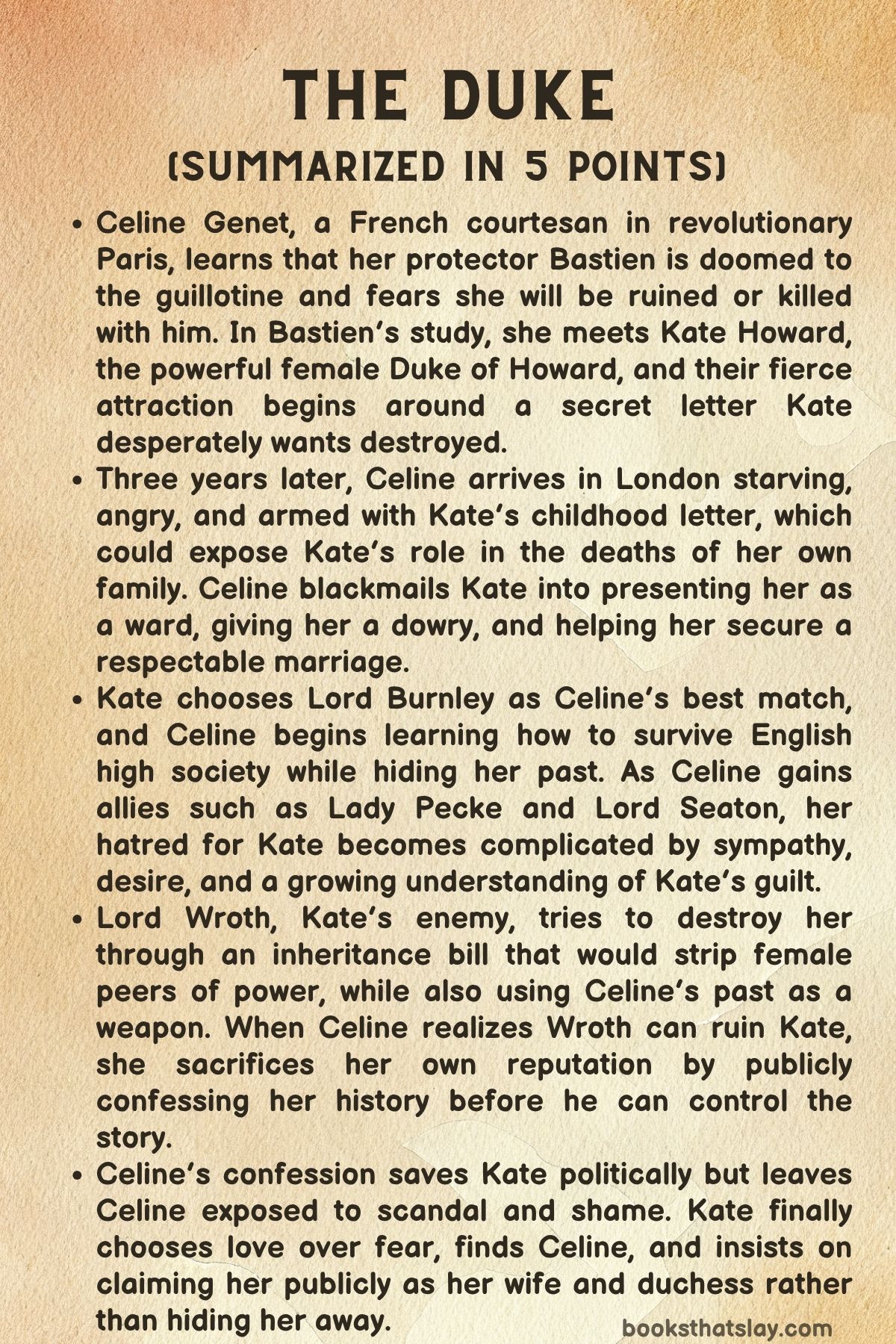
The Duke begins in Paris during the French Revolution, where Celine Genet is living as the protected mistress of Bastien du Ponte. Celine is beautiful, sharp, and socially ambitious, but her world is already collapsing around her.
At one of Bastien’s parties, she learns that he has drawn dangerous political attention and will soon be sent to the guillotine. His death threatens not only his life but hers as well, because association with him could ruin her reputation, cut off her livelihood, and possibly mark her for execution.
In a panic, Celine searches Bastien’s study for anything that might help her survive. There she finds a stranger: an elegant, commanding English aristocrat who first appears to be a man.
The stranger is searching for an old letter. Celine quickly realizes that this person is Kate Howard, the Duke of Howard, a legendary female peer Celine has admired and fantasized about since girlhood.
Kate has come secretly to Paris to retrieve a letter she once sent Bastien, a letter tied to the darkest event of her life.
The attraction between Celine and Kate is immediate and overwhelming. Celine hopes Kate might take her away from France, while Kate is drawn to Celine with a force that unsettles her disciplined control.
They spend the night together, but by morning Kate leaves. She gives Celine a sapphire ring but does not rescue her.
Kate believes Bastien will die with the secret of the letter, and she returns to England convinced the threat has been ended. For Celine, the abandonment becomes a wound that hardens into hatred.
The novel then reveals the burden Kate carries. When she was twelve, she wrote to Bastien with instructions for a malicious “prank” against her aunt Anne Howard, who was then the Duke of Howard.
Kate wanted attention and proof of her own cleverness, but the scheme made Anne appear treasonous. The consequences were catastrophic: Anne and most of Kate’s family died, leaving Kate to inherit the title.
Kate has spent her life building power as a shield against guilt, enemies, and weakness. Above all, she fears the letter because it could expose her as the cause of her family’s destruction.
Three years later, Celine arrives at Kate’s London home destitute, starving, and furious. She has found the very letter Kate thought destroyed.
Rather than ask for charity, Celine blackmails her. She demands that Kate present her as her ward, give her a dowry, and launch her into society so she can make an excellent marriage.
Kate offers a vast sum of money instead, but Celine refuses. What she wants is not wealth alone; she wants social legitimacy, safety, a home, and people who will mourn her when she dies.
Kate has no choice but to agree.
Kate chooses Lord Burnley, heir to the Pecke earldom, as Celine’s most suitable husband. He is respectable, kind, connected, and willing to marry.
Celine begins the difficult process of entering English high society under Kate’s protection. Her transformation is dramatic: with proper clothes, servants, language lessons, and careful presentation, she becomes almost impossible for society to dismiss.
Yet her background, accent, and instincts constantly threaten to reveal the truth.
Celine’s first experiences in Kate’s world are not simple. She meets Lady Pecke and likes her warmth.
She meets Lord Burnley and sees in him a possible route to a secure, decent life. She also meets Royce, the Marquess of Royston, Kate’s estranged cousin.
Kate warns Celine away from Royce, but Celine senses pain beneath Royce’s scandalous surface and begins to question Kate’s harsh judgments. Through Margot Everett, Kate’s loyal valet, and through the behavior of Kate’s household, Celine slowly sees that Kate is not merely cruel.
She is damaged, disciplined, and often kinder than she allows herself to appear.
Meanwhile, Kate’s political life is under attack. Her old enemy, Lord Wroth, is fighting her over mines he took from her family, and he introduces an Inheritance Bill that would disinherit female peers and heirs.
If passed, it would strip Kate and women like Lord Seaton of their titles and power. The danger becomes more personal when Richard Howard, Kate’s cousin and closest friend, is revealed to have been working with Wroth in hopes of benefiting from the new succession.
His betrayal cuts Kate deeply because she had trusted him in a way she trusts almost no one.
Celine proves her value far beyond blackmail. When Richard tries to expose her publicly through Lord Seaton, Celine turns the situation around.
She tells Lord Seaton about Wroth’s bill and helps transform a potential social disaster into a political alliance. Lord Seaton, a formidable female peer and society leader, accepts Celine as a supposed relation and takes her under her wing.
This protects Celine’s reputation and strengthens opposition to Wroth’s attack on women’s inheritance.
As Celine becomes more successful in society, the emotional bond between her and Kate grows more dangerous. Kate tries to keep the arrangement practical, but she is increasingly drawn to Celine’s courage, intelligence, and hunger for life.
Celine, who came to London filled with hatred, begins to understand Kate’s loneliness and guilt. When Celine falls ill after pushing herself too hard, Kate cares for her.
Their intimacy deepens during quiet moments, arguments, dancing lessons, and a country outing. Celine realizes she has not come to London only for safety or status.
She has come back for Kate.
The old letter changes meaning between them. At first, it is Celine’s weapon.
Later, after Kate shares her memories and pain, Celine sees it as Kate’s deepest wound. Kate admits that having the secret in Celine’s keeping feels strangely right.
Celine plans to offer the original letter back to Kate as a kind of dowry and to ask for a life with her instead of Lord Burnley. She begins to believe love may be possible, if she can persuade Kate that Celine belongs beside her.
But Lord Wroth’s illegitimate daughter, Markham, discovers Louise Durant, one of Celine’s former companions from Paris. Markham uses Louise and Celine’s past to pressure Celine into surrendering the letter.
Celine realizes that if Wroth exposes her before she controls the story, he can ruin her, destroy Kate’s political standing, and pass the Inheritance Bill. She agrees to deliver the letter after Lord Seaton’s great ball, but privately creates a different plan.
At the ball, Celine becomes the center of society’s attention, admired for her beauty and charm. Lord Burnley is ready to propose, but Kate can no longer bear the idea of losing her.
She follows Celine, confesses her love, and asks her to become her wife. Celine accepts emotionally, though she knows the coming morning may destroy everything.
They leave the ball together and spend the night as lovers, briefly imagining a future that is already under threat.
The next morning, Kate wakes alone and believes Celine has betrayed her when she learns the letter has gone to Wroth. She rushes to the House of Lords, where Wroth publicly accuses her of treason and murder.
He expects to read Kate’s childhood letter aloud and ruin her forever. Instead, the letter has been replaced.
What he reads is Celine’s own public confession: the story of her poverty, prostitution, survival, and deception. Pamphlets carrying the same confession spread through the chamber.
Celine has exposed herself to save Kate.
The effect is devastating but brilliant. Wroth’s attack collapses because Celine’s confession makes him look manipulative and cruel, especially when Louise’s testimony supports the idea that his household coerced the situation.
Lord Seaton defends Celine’s honesty, and Wroth’s Inheritance Bill is rejected. Kate is saved, but Celine’s reputation is destroyed.
Celine retreats to a church, expecting she has lost any chance of marriage, respectability, or a future with Kate. Kate finds her there, humbled and desperate.
She admits she thought the worst of Celine and recognizes the sacrifice Celine made. Celine tries to argue that marriage to her would damage Kate’s power, but Kate refuses to accept a future in which Celine is hidden as a mistress or cast aside.
She insists Celine will be her wife, her equal, and her duchess. Kate believes society can be won again, especially with Lord Seaton’s support and Celine’s own brilliance.
The book ends with Kate promising Celine not only love, but public belonging: in private she will call Celine her darling, and before the world she will call her duchess.
Characters
Celine Genet
Celine Genet is the emotional and strategic center of The Duke, a woman shaped by hunger, abandonment, poverty, sexual labor, and an unyielding desire to live. She begins the book as a Parisian courtesan who understands beauty, performance, and social appetite as tools of survival.
Her ambition is not shallow; it grows from deprivation. She wants a home, protection, respect, and a place in the world where she cannot be thrown away.
Her decision to blackmail Kate is morally compromised, but the novel never treats it as simple villainy. Celine acts from desperation, anger, and the knowledge that people with no respectable protection must sometimes create power by ugly means.
Her greatest strength is her ability to read people quickly and respond with charm, wit, or cruelty as the moment demands. Yet beneath her brilliance is a deep longing to be chosen without having to manipulate anyone.
Her arc moves from using Kate’s secret as a weapon to using her own truth as a shield for Kate. By the end, Celine’s courage lies not in hiding her past, but in claiming it publicly and refusing to let shame define the value of her life.
Kate Howard, Duke of Howard
Kate Howard is one of the most formidable and wounded figures in the book. As the Duke of Howard, she has made herself into a figure of authority so complete that even friends and enemies respond to her presence as force.
Her power, however, is built over a childhood crime she has never emotionally survived. As a girl, she caused the exposure and death of her aunt and family through a reckless act of treasonous manipulation, and everything she becomes afterward is shaped by that guilt.
Kate believes control is the only defense against destruction. She punishes betrayal, refuses dependence, and treats tenderness as a weakness that enemies can use.
Her attraction to Celine frightens her because it breaks through the discipline she has spent years perfecting. Kate’s emotional journey is not from cruelty to goodness, but from isolation to trust.
She already has the capacity for care, as seen in her household, her protection of servants, and her political concern for exploited mine workers. What she lacks is the ability to believe she can love without ruining what she loves.
Celine forces her to confront that fear and finally choose vulnerability.
Royce Howard, Marquess of Royston
Royce Howard, the Marquess of Royston, first appears as the scandalous cousin Kate refuses to see, a rakish, debt-ridden, dangerous woman whose presence seems to threaten Celine’s reputation. Yet Royce is far more than a social liability.
She is one of the living remnants of Kate’s childhood disaster, and her bitterness comes from being left inside a family wound that Kate tried to master by turning cold. Royce’s dissipation, theatrical charm, and flirtatious cruelty conceal a person who has been grieving for years.
She resents Kate, but she also still wants to be recognized by her. Celine’s willingness to speak with Royce gives Royce a place in the story beyond disgrace.
Royce also proves politically and emotionally important when she warns Kate about Richard’s betrayal and later speaks in Parliament against Wroth’s Inheritance Bill. Her arc shows that the people Kate labels as ruin may still be capable of loyalty, courage, and clarity.
Royce is damaged, but not empty; reckless, but not without honor.
Richard Howard
Richard Howard is Kate’s cousin, friend, and one of the book’s sharpest examples of respectable betrayal. At first, he appears principled, polished, and socially useful.
He supports reforms, helps Kate gather evidence about the mines, and seems to represent the moral conscience Kate has trained herself to ignore. His betrayal is painful because it is not born from cartoonish malice.
Richard wants power, influence, and advancement, and he convinces himself that his ambitions justify siding with Lord Wroth. He resents the way loyalty to Kate demands submission to her priorities, and he sees Wroth’s offer as a route toward political greatness.
That makes him dangerous: he understands Kate, knows her trust, and uses proximity as leverage. Richard’s fall exposes how morality can become vanity when it is not anchored by loyalty or humility.
He wants to do good in public, but he is willing to sacrifice people close to him for the chance to become important. In that sense, he mirrors Kate’s childhood ambition without sharing her later remorse.
Lord Wroth
Lord Wroth is the central external antagonist, a man who represents inherited power at its most vindictive and self-protective. His feud with the Howards is political, financial, and personal, and he pursues Kate with the patience of someone who believes history itself is on his side.
He is not merely trying to defeat Kate in a private quarrel; he tries to reshape the law so women like Kate and Lord Seaton can be stripped of titles and inheritance. This makes him a direct embodiment of patriarchal backlash.
His cruelty is cold rather than impulsive. He uses mines, bills, family alliances, illegitimate children, reputation, and sexual shame as instruments of pressure.
His willingness to weaponize Celine’s past shows how little he values truth beyond its usefulness. Wroth’s downfall is fitting because he underestimates the women he tries to use.
He assumes shame will silence Celine, that lineage will protect him, and that public authority belongs naturally to men like him. The novel defeats him by turning public spectacle against him.
Markham
Markham, known as the Wroth bastard, is one of the most intimidating figures in the story. She operates as Lord Wroth’s enforcer, appearing where threats need to be delivered and where fear needs to be made physical.
Her scarred presence, rough voice, and capacity for violence make her feel like the shadow side of aristocratic power: the part polite society pretends not to see but depends on when genteel manipulation is not enough. Markham is not simply a brute.
She is observant, strategic, and personally invested in hurting Kate. Her pressure on Celine reveals her skill at finding the weakest point in a person’s defenses.
She understands that Louise, Celine’s past, and the letter together can be used to force a choice between love and self-preservation. Markham’s role is important because she brings hidden conflicts into the open.
She turns emotional secrets into public weapons, but she also misjudges Celine’s willingness to sacrifice herself. Like Wroth, she sees vulnerability as leverage and fails to imagine it can become power.
Lord Burnley
Lord Burnley is the respectable future Celine believes she wants when she arrives in London. He is kind, attentive, principled, and connected to a family that offers warmth, structure, and moral purpose.
His suitability is never really in doubt. He would give Celine what she has long imagined as safety: a title, a household, a legitimate place in society, and a family capable of affection.
This makes him more than a convenient obstacle to the central romance. He represents the life Celine might choose if survival were her only goal.
His kindness matters because it forces Celine to confront the difference between being safe and being fully known. With Burnley, she could become respectable by hiding the most difficult parts of herself.
With Kate, she faces danger, scandal, and uncertainty, but also the possibility of being loved with her whole past intact. Burnley’s decency makes the choice harder and therefore more meaningful.
He is not rejected because he is cruel, but because he is not the person Celine truly wants.
Lord Seaton
Lord Seaton is a magnificent social and political force, one of the few people capable of meeting Kate on something close to equal ground. As a female lord, she has a personal stake in the fight against Wroth’s Inheritance Bill, but she is also an arbiter of reputation.
Her acceptance of Celine changes the balance of the story. At first, she appears to be a potential threat, someone who could expose Celine’s falsehoods and ruin her.
Instead, Celine’s intelligence, nerve, and honesty win her interest. Lord Seaton’s power lies in her ability to make society follow her lead.
She understands both gossip and government, both drawing rooms and Parliament. Her support proves that public belonging is not only inherited; it can be granted, performed, defended, and negotiated.
She also recognizes Kate’s desire for Celine with amused sharpness. By the end, Lord Seaton becomes essential to the possibility of Celine’s future, because her approval can help transform scandal into legend.
Bastien du Ponte
Bastien du Ponte is careless, charming, doomed, and central to the chain of events that binds Celine and Kate. As Celine’s protector in Paris, he gives her temporary status but not real safety.
His loose tongue and political danger expose the fragility of the world Celine has built around him. Bastien’s old connection to Kate is even more important: he possesses the secret letter that can destroy her.
His role in Kate’s childhood plot is foolish rather than deeply malicious, but the consequences are deadly. He stands for the recklessness of youth, privilege, and men who treat dangerous matters as games until others pay the price.
His death at the guillotine removes him from the living action of the novel, yet his absence drives everything that follows. Celine survives him, Kate fears what he knew, and the letter he kept becomes the instrument by which both women are forced back into each other’s lives.
Louise Durant
Louise Durant belongs to Celine’s past and carries with her the smell of poverty, illness, shared rooms, and the harsh world Celine is trying to escape. She is not polished, gentle, or easy to romanticize.
That is precisely why she matters. Louise reminds Celine that survival does not always look noble, grateful, or beautiful.
When Markham finds Louise and brings her to England, Louise becomes the pressure point Wroth uses to force Celine’s hand. Celine’s fear for Louise shows that she has not simply abandoned her old world, even though she is ashamed of it and frightened of what it might cost her.
Louise’s later testimony helps support Celine’s public counterattack, even if Louise does not fully understand the scale of the political game around her. She represents the life Celine might have continued living, and also the human ties that cannot be erased by new gowns, new manners, or new names.
Margot Everett
Margot Everett, Kate’s valet, is one of the quiet stabilizing presences in the novel. She knows Kate’s habits, wounds, and household better than almost anyone, and she understands the difference between Kate’s reputation and her private conduct.
Margot’s treatment of Celine is practical and unsentimental, but not cruel. She helps transform Celine’s appearance for society, yet her more important role is interpretive: she gives Celine glimpses of the Kate hidden beneath public myth.
Through Margot, Celine learns that many rumors about Kate are false or incomplete, and that Kate has shown kindness where no audience could reward her. Margot’s loyalty is not blind worship.
It is the loyalty of someone who has seen enough to make a judgment. She also represents the household’s own moral community, where Kate’s authority is softened by trust, routine, and care.
In a novel filled with public performance, Margot is linked to private truth.
Adele
Adele, the maid assigned to Celine, brings warmth, humor, and ordinary kindness into a story dominated by strategy and high stakes. Her cheerful French, social guidance, and uncomplicated affection help Celine feel human again after deprivation.
Celine’s first morning in Kate’s house is filled with food, bathing, clean linen, and attention, and Adele is central to that restoration of the body. She also helps Celine learn English manners and navigate the smaller rituals of her new role.
Adele matters because she responds to Celine not as a scandal or weapon, but as a person. Her kindness gives Celine a fragile sense of belonging within the household before society can offer it.
When Celine later lies to leave the house without raising suspicion, the cost includes hurting Adele’s trust. That detail is important because it shows how even necessary survival choices can wound innocent people.
Adele is a reminder that gentleness has stakes too.
Lady Pecke
Lady Pecke represents the respectable domestic world Celine longs to enter. She is elegant, kind, and socially proper without being emotionally cold.
Her early acceptance of Celine gives Celine a taste of family warmth and makes Lord Burnley’s courtship seem genuinely attractive. Lady Pecke’s concern for Celine’s health and comfort contrasts with the harsher judgments Celine expects from society.
She is not a revolutionary figure like Lord Seaton, nor a dominating force like Kate, but her importance lies in the emotional safety she offers. Through Lady Pecke, the novel shows why respectability is so tempting to Celine: it is not only about status, but about rooms where one is offered tea, cake, concern, and a place to sit without fear.
Lady Pecke’s household becomes the image of a gentler life. That Celine ultimately does not choose it does not make it false.
It simply means her deepest need is not safety alone.
Lord Pecke
Lord Pecke is comic, earnest, and politically significant. His obsessive reforming zeal makes him socially exhausting, especially to Kate, but his concerns are sincere.
He speaks about poverty, public welfare, workhouses, and the needs of vulnerable people in a way that irritates those who prefer politics without inconvenience. His son Burnley inherits much of this moral seriousness.
Lord Pecke’s presence helps place the romance within a broader social world where questions of labor, inheritance, poverty, and law matter. He also creates some of the book’s lighter social scenes, particularly because Kate, who can terrify most rooms into silence, is trapped by his unstoppable moral lectures.
Yet he is not merely a joke. His reformist concerns echo the novel’s interest in who society protects and who it sacrifices.
Lord Pecke may be ridiculous in manner, but he is often right in substance.
Shaw
Shaw, Kate’s secretary, is blunt, observant, and loyal in a way that gives Kate practical support without flattering her. He is not afraid to tell her when a plan is foolish, and he sees the risks of passing Celine into society more clearly than many others.
His rough honesty makes him valuable because Kate’s world is full of people who fear her too much to speak plainly. Shaw also becomes part of the machinery through which Celine’s public counterattack succeeds, even though he later recognizes how fully she has used the situation to create an audience.
His loyalty is not romanticized; it is professional, sharp-edged, and occasionally exasperated. In a household ruled by a terrifying duke, Shaw’s willingness to mutter, object, and still act effectively makes him one of the most grounded supporting characters.
Mr. Hill
Mr. Hill, Kate’s steward, serves as the gatekeeper of Howard House and a guardian of its order. His role may seem modest, but he is crucial in recognizing the importance of Celine’s arrival.
When she appears with Kate’s sapphire ring, Hill understands that the matter requires discretion and brings it to Kate rather than dismissing her entirely. He represents the long memory of a great house, the kind of servant who knows which objects matter, which visitors are dangerous, and which disturbances must be treated seriously.
His presence adds weight to Howard House as an institution. The house is not only Kate’s private home; it is a system of servants, rituals, loyalties, and histories.
Hill helps maintain that system, even when Celine’s arrival threatens to overturn it.
Mathilde
Mathilde appears most strongly through Celine’s memories of poverty, illness, and life among women trying to survive in brutal conditions. Her death marks the extremity of what Celine has escaped and the reality she fears returning to.
Mathilde is important because she gives shape to Celine’s hunger and terror. The reader understands Celine’s demands more clearly when placed against memories of women lying ill, rooms filled with deprivation, and the constant threat of being forgotten by the world.
Mathilde is not a major actor in the present plot, but she deepens the emotional history of Celine’s choices. She represents the dead who do not get rescued, the women whose lives end without ceremony, and the fate Celine is determined to avoid.
Her memory makes Celine’s pursuit of warmth, food, security, and love feel urgent rather than vain.
Themes
Survival and the Price of Respectability
Celine’s pursuit of respectability in The Duke is born from fear, not vanity. She wants gowns, rank, marriage, and acceptance because she knows what happens to women who have none of them.
Her past has taught her that beauty can be rented, desire can become a transaction, and hunger can strip a person of choice. This makes her demand for a proper marriage deeply practical.
She is not asking merely to be admired; she is asking for the legal and social armor that might keep her alive. Yet the book also shows how expensive respectability can be.
To enter society, Celine must conceal her history, perform innocence, and allow others to believe a polished lie. The more successful she becomes, the more fragile her position feels, because one exposed truth could undo everything.
Her final act changes the terms of survival. Instead of letting Wroth use her past against her, she publishes it herself.
That decision costs her the respectable future she planned, but it gives her a different kind of power: the right to name her own life before others can name it for her.
Power, Inheritance, and Public Legitimacy
Political power in the novel is never abstract. It lives in titles, mines, bills, marriages, money, drawing rooms, gossip, and who is allowed to speak without being laughed out of the room.
Kate’s dukedom gives her authority, but it also makes her a target for men who resent female inheritance. Lord Wroth’s Inheritance Bill exposes the violence beneath polite legal language.
By trying to disinherit female peers and heirs, he attempts to make patriarchy look like order. The bill also reveals how personal revenge can disguise itself as national principle.
Kate’s fight against Wroth is therefore both private and structural. She is defending her own title, but also the legitimacy of women’s public authority.
Lord Seaton’s involvement expands this fight beyond one family feud. She understands that status is collective: if one female lord can be stripped of power, all are threatened.
Celine’s role complicates the theme because she begins outside legitimate society entirely, yet she becomes crucial to saving women who possess inherited rank. The novel argues that legitimacy is often controlled by institutions, but it can be challenged by intelligence, courage, and public narrative.
Love as Risk, Not Rescue
Love in the story does not arrive as an easy cure for loneliness or trauma. It frightens both central characters because it exposes exactly what they have worked hardest to protect.
Celine fears being abandoned again, especially by a woman whose earlier departure helped turn desire into humiliation. Kate fears that loving Celine will create a weakness her enemies can exploit.
Their romance therefore grows through resistance, anger, bargaining, and misjudgment. Neither woman is rescued by the other in a simple way.
Kate gives Celine food, shelter, status, and protection, but she also tries to control the terms of Celine’s future. Celine forces Kate into action through blackmail, then later protects Kate by sacrificing her own reputation.
Their love becomes real only when it stops being a transaction. Kate must offer marriage not as damage control, but as equal devotion.
Celine must accept that being loved does not require making herself smaller or less dangerous. The novel’s most satisfying emotional movement comes from watching two people trained by fear learn that love is not safety from risk.
It is choosing the risk together.
Shame, Truth, and Self-Reinvention
Shame is one of the main weapons used against women in the novel. Kate is haunted by a childhood crime that, if revealed, could destroy her title and moral authority.
Celine is haunted by poverty, prostitution, and the lies she tells to enter society. Wroth’s strategy depends on the assumption that exposure will break them.
He believes hidden truth is useful because people will do almost anything to keep it hidden. Celine’s final counterattack rejects that logic.
By publishing her own history, she turns confession into control. The act does not magically erase scandal, and the book does not pretend truth is painless.
Celine expects loss, judgment, and uncertainty. Still, the decision frees her from Wroth’s ability to define her.
Kate’s arc follows a related path. She must face the possibility that her worst secret can be known and that she can still choose love, action, and life afterward.
Reinvention in the novel is not a clean escape from the past. It is the harder work of carrying the past openly enough that it can no longer be used as a chain.