The Take Summary, Characters and Themes | Kelly Yang
The Take by Kelly Yang is a sharp contemporary story about ambition, creative ownership, and the cost of being seen by the wrong people. Maggie Wang begins as a young writer who wants validation from the literary world, but her desperation makes her vulnerable to Ingrid Parker, a fading Hollywood producer with money, influence, and a dangerous need to stay powerful.
What starts as an outrageous medical arrangement becomes a story of artistic theft, bodily exploitation, and a young woman learning that approval from gatekeepers can come at a brutal price. The book follows Maggie as she loses, fights, and finally reclaims her own voice.
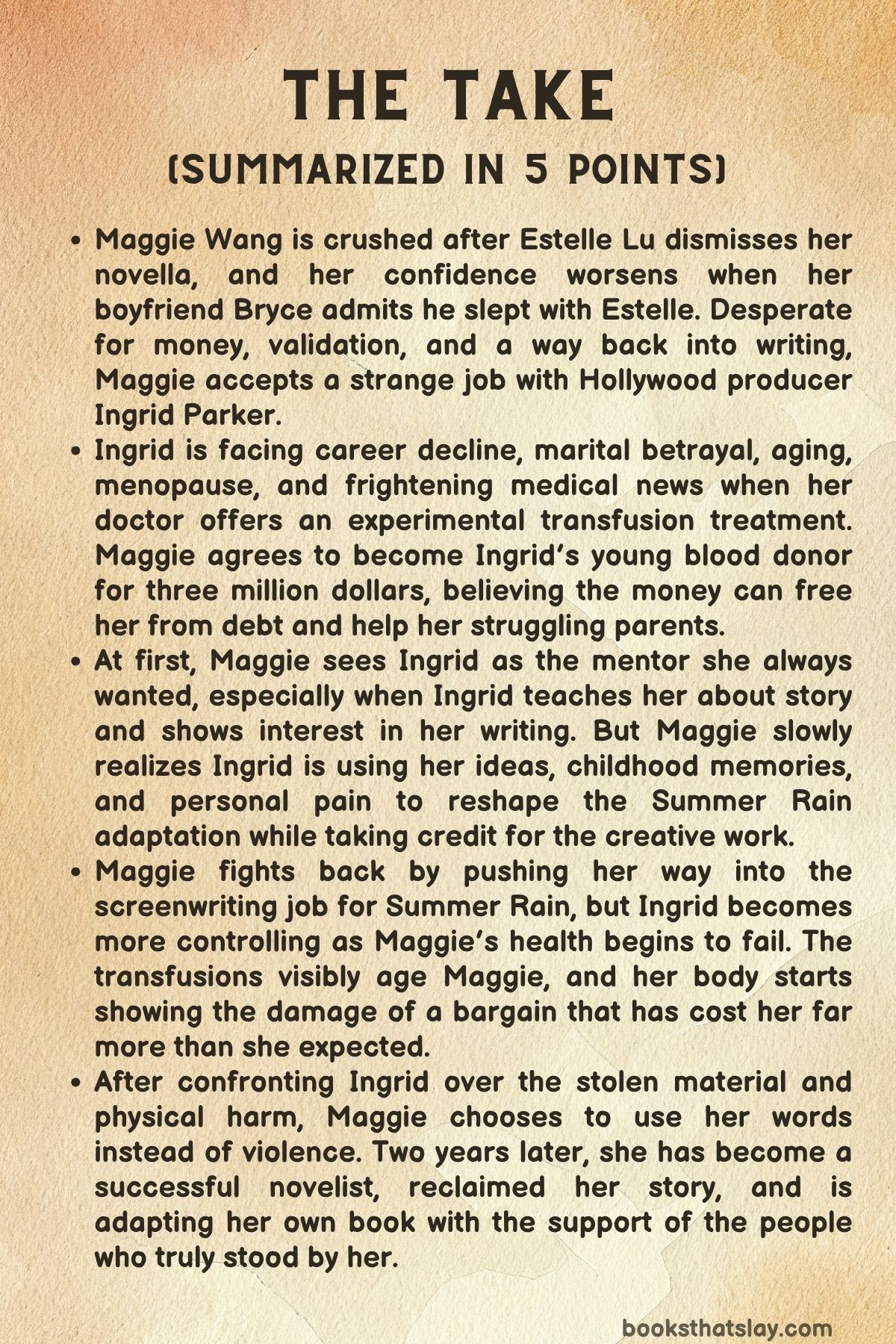
Summary
Maggie Wang is already emotionally fragile when the story begins. She has been fired from her job at a passport agency after volunteering at a literary festival mainly so she could get close to Estelle Lu, a respected Chinese American novelist and the head of Maggie’s MFA program.
Maggie has invested years of hope, debt, and self-worth into becoming a writer. Her novella, based on her childhood in Las Vegas, feels to her like proof that her life has meaning and that she belongs in the literary world.
She expects Estelle’s response to be encouraging, or at least useful. Instead, Estelle dismisses the work as hollow and tells Maggie that she has not lived or loved deeply enough to write with real force.
Estelle also suggests that Maggie might be better suited to journalism or broadcast work because of her looks, reducing Maggie’s dream to a “pretty advantage.”
The rejection breaks Maggie’s confidence. Her parents are already anxious about the debt she has taken on for her MFA and about her unstable future.
Her roommate Willa tries to support her, but Maggie feels exposed and ashamed. She turns to her boyfriend Bryce, another writer in the program, hoping he will understand the particular pain of being dismissed by someone she admired.
At first, Bryce comforts her, but he later takes her to Estelle’s book launch, where Estelle publicly praises him and invites him into the spotlight. Maggie feels invisible again, especially beside a boyfriend who seems to be gaining the approval she wanted.
The relationship collapses when Bryce admits during an argument that he slept with Estelle. He claims it was “for research” for his novel, but the excuse only makes his betrayal more insulting.
Maggie throws him out and blocks him, losing both romantic stability and the illusion that her writing community is safe. Around this time, Willa sends her a strange job listing for an executive assistant role connected to a confidential special project with a prominent producer.
Maggie, desperate for money and direction, applies.
The producer is Ingrid Parker, a powerful fifty-three-year-old Hollywood figure whose career is beginning to weaken. Ingrid has spent years building influence, but she now fears she is being pushed aside by younger, more current women in the industry, especially Tasha Collins.
Her passion project is an adaptation of Rebecca Thomas’s feminist novel Summer Rain, but Charlie Cooper at FYC Studios has rejected it as dated. At home, Ingrid is dealing with her husband Kyle’s infidelity, a marriage counselor she resents, menopause, and the humiliation of no longer feeling desirable or in control.
Then her concierge doctor, Dr. Hayes, tells her that a preventive test has found precancer signals. He proposes an experimental transfusion therapy popular among wealthy tech figures.
Through repeated blood exchanges with a younger donor, Ingrid may be able to reverse her biological age by ten years. The risk is that the donor may age forward.
Ingrid and Kyle originally plan to hire an assistant who can help find a donor. When Maggie interviews, however, Ingrid is drawn to her eagerness, humility, and literary ambitions.
Maggie learns that the donor will receive three million dollars, plus medical care, and volunteers herself. Dr. Samuels explains that the risks are serious.
Maggie could age ten years, experience earlier menopause, and suffer long-term effects no one can fully predict. Still, Maggie agrees.
The money could pay off her MFA debt, help her parents escape dental problems and poor housing, and give her the time to write without financial panic. Ingrid does not fully tell Maggie about the precancer signals and frames the arrangement mostly as an anti-aging treatment.
Maggie signs a strict contract that penalizes her heavily if she misses transfusions.
At first, the arrangement feels intimate and almost meaningful. Ingrid becomes energized and visibly younger.
Maggie sees her as the mentor Estelle failed to be. Ingrid talks to her about story, career, and how life can become material.
Maggie begins to believe that her own experiences have literary value after all. With her first payment, she helps her parents move out of their moldy apartment.
She lies and tells them she sold her book, allowing them to celebrate her as a successful writer even though she knows that is not yet true. Their pride makes her feel both loved and guilty.
Maggie travels with Ingrid to New York as Ingrid tries to rescue Summer Rain. During the creative process, Maggie offers a new interpretation of the story.
Instead of centering the adaptation on a woman’s romantic affair, she suggests focusing on female companionship, honesty, and the emotional truth between women. Ingrid uses the idea while pitching to Rebecca Thomas and the studio, presenting it as her own.
Rebecca responds strongly to the concept, and Charlie praises Ingrid’s new direction. Maggie is excited that her instincts were right, but she is hurt that her contribution remains invisible.
Ingrid then offers to help Maggie expand her novella and possibly option it, giving Maggie hope that the arrangement may lead to a real creative future. Acting too quickly, Maggie queries literary agents using Ingrid’s interest as leverage.
Ingrid becomes angry and orders her to cancel the calls, telling her to trust the process.
As Maggie works on her book, she begins opening up about Vivian, a wealthy church woman from her childhood who took her in while Maggie’s parents worked long hours. Vivian’s home seemed like a place of privilege and care, but she often humiliated Maggie and made her feel small, poor, and inferior.
Ingrid encourages Maggie to use that pain in her writing. She interviews Maggie’s parents and options Maggie’s book cheaply, positioning herself as the person who can bring Maggie’s story to the screen.
Maggie’s mother senses danger and warns her that Ingrid has her own agenda. Maggie later discovers that parts of her private life and emotional history are appearing in Ingrid’s Summer Rain pitch.
Ingrid insists it is only inspiration, but Maggie recognizes that her story is being taken from her.
Maggie decides that the only way to protect her material is to become the screenwriter for Summer Rain herself. She pressures Ingrid by connecting several uncomfortable facts: the transfusions, the stolen personal material, and her mother’s growing suspicion.
Ingrid still needs Maggie’s blood, so she reluctantly supports her. Maggie gets representation at ICA and meets Charlie, who gives her the writing job.
For a moment, it seems Maggie has turned exploitation into opportunity. But Ingrid soon becomes more controlling.
She criticizes Maggie’s drafts, demands obedience, and tries to force Maggie’s vision into her own preferred shape. At one point, she even makes Maggie write during a transfusion, treating her body and talent as resources to be drained.
Maggie’s health declines as the treatments continue. Her hair begins to gray, her skin changes, she faints, and medical tests show that her organs resemble those of someone in her late forties.
The cost of the agreement becomes impossible to ignore. Kyle, who has become increasingly disturbed by Ingrid’s behavior, shows sympathy toward Maggie.
He tells her that her writing is strong and encourages her to send her script directly to Charlie instead of letting Ingrid control everything. Maggie follows his advice.
Ingrid is furious and sees Kyle’s support as betrayal. Charlie later tells Ingrid that Maggie’s script is not good enough, but when he asks if Ingrid truly worked with her, Ingrid protects herself and effectively blames Maggie rather than admitting how she sabotaged and controlled the process.
Ingrid’s personal life also begins to unravel. Her daughter Cassie grows close to Maggie and sees through the artificial world of Hollywood favors and image management.
Cassie rejects Charlie’s direct offer and instead applies to Tasha’s incubator, choosing a path outside her mother’s control. Maggie’s parents finally learn the truth about the transfusions after Maggie collapses, and they rush to her side.
She tells them more fully about Vivian and the childhood wounds she had carried in silence. Willa also returns to Maggie after an earlier conflict over Maggie secretly sending her gift cards, and their friendship begins to heal.
The confrontation between Maggie and Ingrid reaches its peak at an ICA Women in Hollywood party. Maggie accuses Ingrid of poisoning her body and stealing her story.
Ingrid reveals that she had impersonated Prisha online to test whether Maggie would believe accusations against her, showing just how far she was willing to go to manipulate Maggie’s trust. Their argument moves into a stairwell, where Ingrid attacks Maggie’s writing and says her words were never good enough.
Maggie shoves her and briefly imagines pushing her down the stairs, ending the abuse in one violent act. But she realizes she has a better weapon: her words.
Two years later, Maggie has become a successful novelist. She reads from a book based on the transfusions, Ingrid’s exploitation, and the theft of her story.
Her parents, Willa, Cassie, Tasha, and Charlie attend the reading. Summer Rain has fallen apart, Ingrid has lost influence in Hollywood, and Maggie’s own book is being adapted with Maggie as executive producer and Cassie writing the script.
Ingrid appears at the reading and tries to give one last note, saying Maggie should have had the younger woman push the older woman down the stairs. Maggie calmly rejects the suggestion.
She no longer needs Ingrid’s approval, permission, or interpretation. She claims her words, sweat, and blood as her own.
Characters
Maggie Wang
Maggie Wang is the emotional and creative center of the book, beginning as a young writer who badly wants someone powerful to confirm that her life and work matter. Her vulnerability comes from more than career disappointment; it is tied to class anxiety, immigrant family pressure, debt, romantic betrayal, and a childhood marked by shame.
When Estelle dismisses her writing and Bryce betrays her, Maggie becomes especially open to Ingrid’s attention because Ingrid appears to offer everything Maggie lacks: money, access, mentorship, and belief. In The Take, Maggie’s decision to sell her blood is not treated as simple greed but as a desperate calculation shaped by debt, filial love, and the fear that she may never get another chance.
Her journey is painful because she slowly realizes that Ingrid values her youth, body, memories, and ideas only when they can be used. Maggie’s growth comes from learning that visibility granted by powerful people is fragile and conditional.
By the end, she no longer waits for permission to be a writer. She turns the damage done to her into her own work, not by pretending it did not hurt, but by refusing to let Ingrid own the story.
Ingrid Parker
Ingrid Parker is a powerful producer whose fear of aging, illness, and professional irrelevance drives much of the novel’s conflict. She is not presented only as a villain from the outside; her anxieties are specific and recognizable.
Her marriage is strained, her body is changing, her industry is moving on, and the project she hoped would restore her reputation has been rejected as out of touch. These pressures make her hungry for renewal in every possible sense.
The transfusion treatment promises youth, but Maggie offers something even more valuable: fresh experience, emotional material, and a voice Ingrid can absorb into her own career. Ingrid’s cruelty lies in the way she recasts exploitation as mentorship.
She tells herself she is shaping Maggie, helping her, and giving her opportunities, even as she steals her ideas and drains her health. Her relationship with Maggie becomes a distorted version of artistic inheritance, where the older woman does not guide the younger one but consumes her.
Ingrid’s final attempt to correct Maggie’s ending shows that she still wants control even after losing power. She cannot accept that Maggie’s story is no longer hers to revise.
Willa
Willa functions as Maggie’s friend, roommate, and connection to a more grounded version of care. She is the person who first sends Maggie the job listing, not realizing how dangerous the opportunity will become.
Her role in the story is important because she represents support that is not based on status or extraction. Willa comforts Maggie after Estelle’s rejection and remains part of her life even when Maggie’s choices become secretive and strained.
The conflict over Maggie sending her gift cards shows how money complicates even loving relationships. Maggie thinks she is helping, but Willa senses the dishonesty and imbalance behind the gesture.
Their eventual reconciliation matters because Maggie needs relationships that are not built on performance, industry access, or transactional exchange. Willa’s friendship contrasts sharply with Ingrid’s false mentorship.
While Ingrid offers opportunity at a terrible cost, Willa offers flawed but real loyalty. Her presence helps show that Maggie’s recovery is not only professional; it is also personal, requiring her to rebuild trust with the people who cared about her before Hollywood noticed her.
Bryce
Bryce represents the selfishness and entitlement of the literary world that first wounds Maggie. As Maggie’s boyfriend and fellow MFA writer, he should understand her insecurity and artistic hopes, but he repeatedly benefits from the same systems that exclude or diminish her.
His affair with Estelle is especially damaging because it mixes romantic betrayal with professional humiliation. By claiming he slept with Estelle “for research,” Bryce turns betrayal into artistic excuse-making, suggesting that his creative ambition justifies hurting Maggie.
His presence early in the book helps explain why Maggie is so hungry for validation when Ingrid appears. Bryce’s success at Estelle’s event makes Maggie feel erased, as if even in spaces where she should belong, men like him are more easily praised and welcomed.
He is not the central antagonist, but his actions prepare the emotional ground for Ingrid’s manipulation. Through Bryce, the story shows how artistic circles can reward confidence, access, and selfishness while leaving more uncertain writers to doubt themselves.
Estelle Lu
Estelle Lu is the admired novelist whose rejection devastates Maggie at the beginning of the story. For Maggie, Estelle represents the kind of literary authority she longs to be recognized by: Chinese American, successful, respected, and close enough to seem like a possible model for her own future.
That is why Estelle’s criticism cuts so deeply. She does not merely say that Maggie’s work needs improvement; she frames Maggie herself as inexperienced, emotionally insufficient, and perhaps better suited to a career based on appearance.
Estelle’s later praise of Bryce adds another layer of humiliation, making Maggie feel that the mentor she sought has chosen someone else. Her affair with Bryce further stains her authority and reveals the personal compromises beneath the polished literary image.
Estelle’s role is brief but decisive because she helps break Maggie’s trust in the institutions that were supposed to nurture her. She is the first gatekeeper to make Maggie feel that her story is not enough, and that wound makes Maggie vulnerable to the next gatekeeper who promises to see her.
Kyle Parker
Kyle Parker begins as Ingrid’s unfaithful husband, but his role becomes more complicated as he witnesses the damage Ingrid inflicts on Maggie. His marriage to Ingrid is marked by betrayal, resentment, and emotional distance, and he initially belongs to the same privileged world that makes the transfusion arrangement possible.
Yet as the story progresses, Kyle becomes one of the few people inside Ingrid’s household who recognizes Maggie’s humanity. He sees how Ingrid treats Maggie not as an assistant or collaborator but as a resource.
His encouragement of Maggie’s writing matters because it gives her a small but important push toward bypassing Ingrid’s control. However, Kyle’s sympathy does not erase his own flaws or privilege.
He helps Maggie in part because he is disillusioned with Ingrid and perhaps guilty about the world he has helped maintain. In the book, Kyle serves as a witness to Ingrid’s moral decline and as a reminder that recognizing exploitation is not the same as being free from complicity.
Maggie’s Parents
Maggie’s parents are central to understanding why Maggie accepts the transfusion deal. Their dental problems, poor housing, and financial strain are not background details; they are part of the pressure Maggie carries.
She wants to write, but she also wants to rescue them from the conditions that have worn them down. Their pride in her supposed book sale gives Maggie a brief sense of triumph, but it also deepens her guilt because the money comes from a dangerous bargain rather than literary success.
Maggie’s mother is especially perceptive about Ingrid, warning that the producer has her own agenda before Maggie fully admits it to herself. The parents’ eventual discovery of the transfusions brings the emotional truth of the story into the open.
They learn not only what Maggie has done to her body, but also how much childhood pain she has hidden, especially around Vivian. Their presence grounds Maggie’s ambition in family love, sacrifice, and shame.
They remind the reader that Maggie is not chasing success only for vanity; she is trying to transform the life her family has endured.
Cassie Parker
Cassie Parker, Ingrid’s daughter, becomes an important counterpoint to both Ingrid and Maggie. As someone born into Hollywood access, Cassie could easily accept the shortcuts and favors available to her.
Instead, she grows closer to Maggie and begins choosing a path that resists her mother’s control. Her rejection of Charlie’s direct offer shows that she does not want her career handed to her through the same networks that have protected Ingrid.
By applying to Tasha’s incubator, Cassie seeks a space where she can develop outside her mother’s shadow. Her bond with Maggie also complicates the Parker household.
Maggie is not only Ingrid’s donor or assistant; she becomes someone Cassie respects and connects with. By the end, Cassie writing the adaptation of Maggie’s book suggests a healthier creative partnership between women of different backgrounds and generations.
Unlike Ingrid, Cassie does not need to steal Maggie’s story to participate in it. She represents the possibility of collaboration that does not require domination.
Tasha Collins
Tasha Collins is significant because she embodies the future Ingrid fears. To Ingrid, Tasha is not just another woman in the industry; she is a sign that Hollywood’s language, priorities, and power structures are changing without her permission.
Ingrid experiences Tasha’s rise as a threat, which exposes how fragile her own feminism has become. Instead of supporting younger women, Ingrid resents them when they seem capable of replacing her.
Tasha’s incubator becomes meaningful because Cassie chooses it over an easier opportunity from Charlie, suggesting that Tasha’s influence is not merely symbolic. She offers a model of industry power that is not controlled by Ingrid’s insecurity.
While Tasha is not explored as deeply as Maggie or Ingrid, her presence helps define the generational conflict at the center of The Take. She shows that the fight is not simply between youth and age, but between different ways of using influence.
Ingrid tries to preserve power by consuming others; Tasha represents a newer route that may create room for emerging voices.
Charlie Cooper
Charlie Cooper is a studio figure whose approval can make or break projects, and his role shows how Hollywood power often operates through taste, timing, and self-protection. He initially rejects Summer Rain as dated, forcing Ingrid into a panic about her relevance.
Later, he responds positively to the fresher angle Maggie originates, though Ingrid takes credit for it. Charlie is not shown as purely malicious, but he belongs to a system that rewards whoever can package an idea most effectively, regardless of where it came from.
His decision to give Maggie the screenwriting job appears to open a door for her, yet his later response to her draft reminds the reader how unstable such opportunities can be. When he asks Ingrid whether she truly worked with Maggie, he gives Ingrid a chance to take responsibility, but he also participates in a structure where blame can easily fall on the less powerful writer.
His presence highlights the impersonal nature of industry judgment. Maggie’s later success matters partly because she no longer depends entirely on someone like Charlie to define her worth.
Vivian
Vivian is a figure from Maggie’s childhood whose influence continues to shape Maggie’s shame and artistic material. As a wealthy church woman who cared for Maggie while her parents worked, Vivian appears at first to be generous.
But her care comes with humiliation, comparison, and class judgment. She makes Maggie feel lesser, turning charity into a form of control.
This childhood experience becomes one of the emotional cores of Maggie’s writing because it captures the pain of being welcomed into a privileged space while constantly being reminded that one does not belong there. Ingrid’s use of these memories is especially violating because Vivian’s treatment already taught Maggie how easily powerful women can disguise dominance as kindness.
By encouraging Maggie to reveal this material and then feeding it into Summer Rain, Ingrid repeats the same pattern in another form. Vivian matters because she explains why Maggie’s hunger for recognition is tied to old wounds.
Maggie does not simply want fame; she wants to undo the feeling of being small in someone else’s house.
Rebecca Thomas
Rebecca Thomas is the author of Summer Rain, the feminist novel Ingrid is trying to adapt. Her approval gives Ingrid’s project renewed life after Charlie’s rejection, especially when she responds to the revised angle that Maggie secretly provides.
Rebecca’s role shows how original authors can become part of Hollywood’s chain of validation, even when they do not know the true source of an idea. She is not positioned as Maggie’s enemy, but her enthusiasm for Ingrid’s pitch helps intensify Maggie’s invisibility.
Maggie has the insight that saves the adaptation’s direction, yet Ingrid receives the credit in front of Rebecca and the studio. Rebecca therefore becomes part of the painful moment when Maggie sees that having good ideas is not enough if someone more powerful can claim them first.
Her character also helps frame the contrast between older feminist narratives and the newer emotional honesty Maggie brings. Through Rebecca, the story asks who gets to update a woman’s story, who gets credit for that update, and whose lived experience is quietly absorbed into the final product.
Themes
Creative Ownership and the Theft of Voice
Maggie’s central struggle is not only to become a writer, but to prove that her memories, language, and emotional history belong to her. The novel repeatedly shows how easily a young artist’s work can be taken when she lacks power.
Ingrid does not steal Maggie’s story all at once; she first praises her, advises her, interviews her family, encourages painful honesty, and options her book cheaply. This slow process makes the theft more disturbing because it looks like mentorship from the outside.
Maggie’s ideas reshape Summer Rain, but Ingrid presents them as her own because she has the status to do so. The book draws attention to a brutal truth about creative industries: originality often comes from the vulnerable, while credit often goes to those with access.
Maggie’s final success matters because she does not simply expose Ingrid; she transforms the exploitation itself into art under her own name. The Take treats authorship as a fight for ownership over pain, memory, and interpretation.
Maggie’s victory is the right to tell the story without letting Ingrid revise its meaning.
The Cost of Ambition
Maggie and Ingrid are both ambitious, but the story separates ambition rooted in survival from ambition rooted in control. Maggie wants money, recognition, and time to write, yet her ambition is tied to family debt, immigrant pressure, and the fear of wasting her one chance.
Ingrid’s ambition is shaped by fear of aging, illness, and professional disappearance. She wants to remain powerful in an industry that is already looking past her.
The transfusion arrangement brings these ambitions into direct contact, turning Maggie’s youth into Ingrid’s resource. What makes the theme compelling is that the book does not portray ambition as inherently wrong.
Maggie’s desire to succeed is understandable, and Ingrid’s fear of being discarded is also human. The moral difference lies in what each woman is willing to sacrifice and whom each woman is willing to harm.
Maggie risks herself; Ingrid risks Maggie. As the treatments continue, ambition becomes physical, visible in Maggie’s gray hair, failing body, and exhaustion.
The story asks how much success is worth when the price is paid in health, dignity, and trust.
Exploitation Disguised as Mentorship
The relationship between Ingrid and Maggie is built on the language of guidance, but its structure is exploitative from the beginning. Ingrid presents herself as someone who can teach Maggie about story, access, and the business of adaptation.
For Maggie, this is intoxicating because she has just been rejected by Estelle and betrayed by Bryce. Ingrid seems to offer recognition at the exact moment Maggie needs it most.
Yet Ingrid’s mentorship always depends on Maggie staying useful and obedient. She encourages Maggie’s writing only when she can benefit from it, and she supports Maggie’s screenwriting role only after being cornered.
Her advice becomes control, her edits become domination, and her interest in Maggie’s life becomes a way to harvest material. The transfusions make the metaphor literal: Ingrid is not just borrowing Maggie’s ideas but drawing from her body.
This theme is powerful because it reflects real professional dynamics where powerful people call exploitation “opportunity.” Maggie’s eventual rejection of Ingrid’s notes is more than a personal boundary. It is a refusal to mistake control for care.
Age, Power, and Female Competition
Ingrid’s fear of becoming older in Hollywood shapes her choices and her cruelty. The story does not ignore the sexism of an industry that treats aging women as disposable while allowing powerful men to endure.
Ingrid’s panic is rooted in real pressures: menopause, illness, her husband’s infidelity, and younger producers gaining influence. But the novel also shows how being harmed by a system does not excuse harming someone with less power.
Rather than supporting Maggie or Tasha, Ingrid sees younger women as threats or resources. Maggie’s youth becomes something to extract, Cassie’s independence becomes something to manage, and Tasha’s rise becomes something to resent.
This creates a tense portrait of female competition under patriarchal conditions, where scarcity encourages women to fight for limited space instead of changing the structure itself. Maggie’s final position offers a different model.
Her adaptation involves Cassie, and her support system includes Willa, Tasha, and her family. The ending does not deny conflict between women, but it suggests that power becomes less destructive when it is shared rather than guarded through fear.