These Familiar Walls Summary, Characters and Themes
These Familiar Walls by C. J. Dotson is a horror novel about a woman returning to the house where her parents were murdered, only to find that the home remembers far more than she wants it to.
Amber Hughes appears to be a stressed wife and mother trying to survive grief, pandemic life, and the pressure of old family wounds. But as the house turns hostile through whispers, mirrors, fire, and restless shadows, the story exposes the rot beneath her version of events. It is a novel about guilt, rivalry, inheritance, and the terrifying cost of refusing to face what you have done.
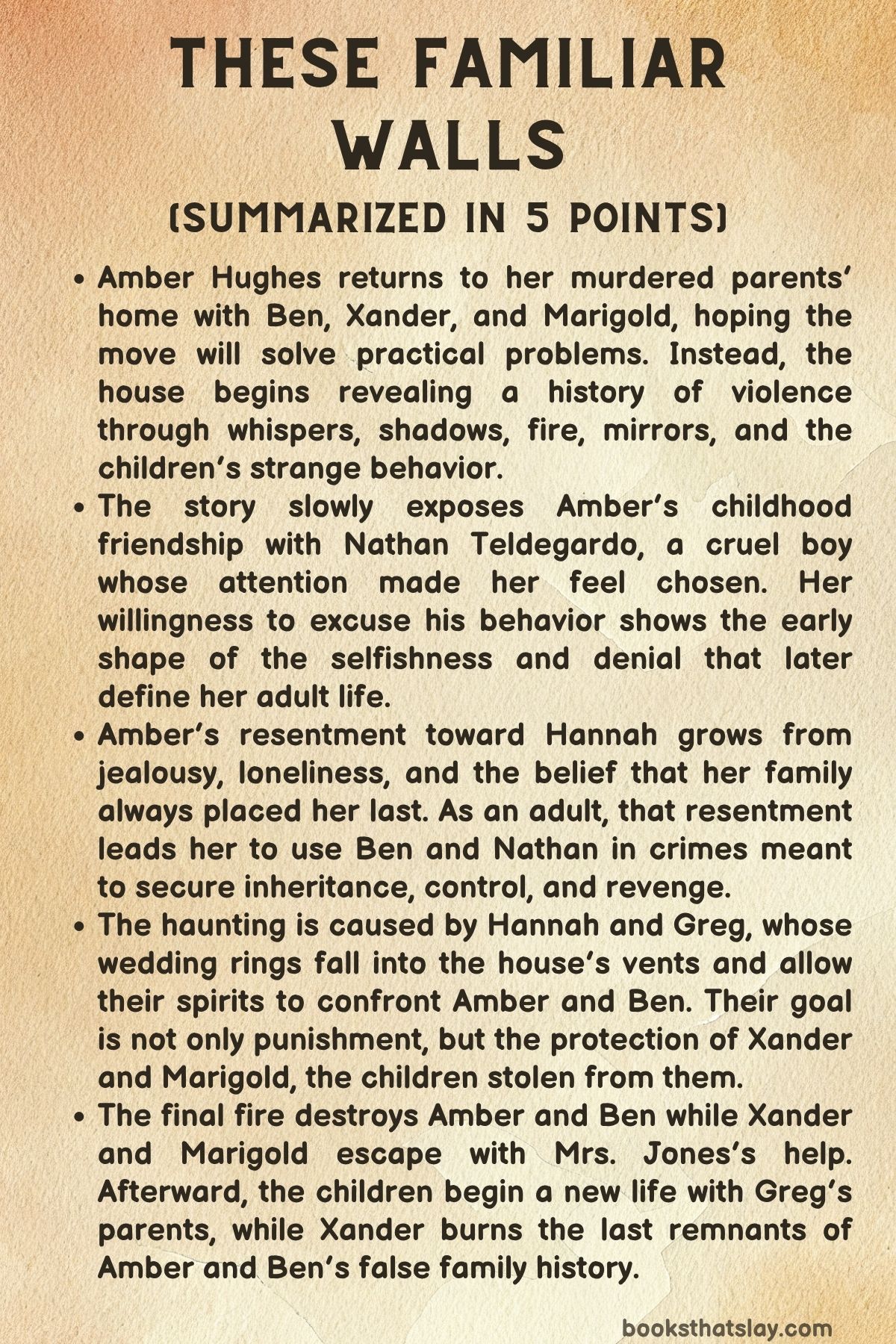
Summary
The story opens with the violent deaths of Dave and Theresa Hughes inside their suburban home. Two masked intruders enter during a snowy night, attack the couple, and leave the house soaked in blood.
Dave recognizes one of the attackers as Nathan Teldegardo, a troubled boy from the neighborhood’s past. Before the night ends, Nathan is also shot dead by his own accomplice, leaving the police with one dead killer and one unidentified murderer.
Months later, Amber Hughes moves into the same house with her husband Ben and their children, Xander and Marigold. Amber is Dave and Theresa’s surviving daughter, and she tells herself that moving into the property is practical, especially during a difficult year marked by financial uncertainty, legal complications, and the pandemic.
The house is familiar to Amber, but it does not feel welcoming. She remembers her childhood there, her dead sister Hannah, and her strained relationship with her parents, yet she keeps pushing away grief whenever it rises.
Almost immediately, strange things begin to happen. Amber hears whispers, senses figures in closets, sees shadows where no person should be, and notices Marigold speaking as if someone else lives in the house.
At first, Amber explains everything away as stress. She is tired, overwhelmed by parenting, frustrated by the move, and determined not to look weak in front of Ben or the children.
The house continues to focus on fire, reflection, and hidden spaces. Amber becomes uneasy around mirrors because her reflection does not always behave correctly, and later it appears with its eyes closed, then with no eyes at all.
Candles and flames also draw Amber in with an unnatural pull. She lights too many candles without realizing what she is doing, and during intimate moments with Ben, fire becomes linked with desire, danger, and a loss of control.
The children are affected too. Xander and Marigold seem to enter trancelike states, stare into secret corners of the yard, and interact with unseen presences.
Ben gradually notices that Amber is not simply imagining things. He sees enough of the strange activity to fear the house, though Amber resists any real emotional discussion and tries to control the situation instead.
The present-day haunting is broken up by Amber’s memories of childhood, where the roots of the horror become clearer. As a lonely, unpopular girl, Amber meets Nathan Teldegardo when his family moves into the neighborhood.
Amber badly wants a friend before starting middle school, and Nathan’s attention makes her feel chosen. He is rude, intense, and unpredictable, but she accepts him because being connected to someone feels better than being alone.
Nathan soon reveals a cruel streak. He plays with fire, burns Hannah’s hair, pressures the girls into drinking wine, and later shows Amber a trapped mouse just so he can hurt it and make her listen to its cries.
Hannah sees Nathan more clearly than Amber does. She is frightened by him, but Amber is often more irritated by Hannah’s caution than by Nathan’s behavior.
Amber’s need to be Nathan’s special friend becomes tangled with her jealousy of Hannah. When Nathan insults Amber by comparing her to her prettier younger sister, the wound stays with her and feeds her sense that Hannah always gets more love, more attention, and more ease.
Nathan’s cruelty worsens. He humiliates Hannah, attacks Amber when challenged, and stalks the Hughes house.
Amber sometimes protects Hannah, but she also covers for Nathan, twists events, and threatens to lie about Hannah when Hannah wants to tell the truth. Her sense of justice is already warped by the belief that anything threatening her place must be fought, denied, or controlled.
The neighborhood finally turns against Nathan after he attacks other children, breaks windows, and tries to hurt a family dog with fire. His family is forced to move away, but the damage he leaves in Amber’s mind is lasting.
Amber overhears her parents discussing her after Nathan leaves. Theresa thinks Amber will return to normal now that Nathan is gone, while Dave fears there is something wrong with her.
Amber treats those words as proof that her family never truly loved or understood her. Over the following years, she withdraws from them, resents their attempts to reconnect, and eventually sees their concern as control.
When Amber turns eighteen, she leaves home and builds an adult life away from her family. Her parents later change their will, putting Hannah ahead of Amber, which Amber experiences as a final betrayal.
As an adult, Amber reconnects with Nathan online. She is disappointed that he seems less dangerous than she remembered, but she also realizes that his devotion and violence may still be useful.
By then, Hannah has married Greg Edwards and has children, Xander and Marigold. Greg had once been close to Ben, and Hannah’s life again seems to Amber like another example of her sister taking the future Amber believed should have belonged to her first.
Hannah and Greg later die in a house fire, and Ben, a firefighter, is among the first responders. The full truth emerges gradually: Amber wanted them dead, but she made Ben carry out the act because she could not bring herself to kill Hannah directly.
After Hannah and Greg die, Amber and Ben raise Xander and Marigold as their own. The children grow up believing Amber and Ben are their parents, while Greg’s parents are pushed out of their lives.
Years later, Dave and Theresa threaten Amber’s control by discussing inheritance, trusts, and possible rights involving the children. Amber decides that her parents are trying to take everything from her again.
She recruits Nathan to help murder them, using his old obsession and appetite for violence. During the attack, she kills Theresa, helps kill Dave, and then shoots Nathan so he can take the blame as the dead intruder.
Ben waits nearby and helps her escape. He believes the murders are about inheritance, but Amber’s private satisfaction reveals a deeper motive: she wants revenge for being placed last.
Back in the present, the haunting intensifies because Hannah and Greg’s wedding rings, salvaged from their fire, have fallen into the house’s vents. Their spirits are bound to the home and have been tormenting Amber through fire, mirrors, whispers, sleeplessness, and the children’s trances.
Amber and Ben become increasingly frightened, but Amber is also planning another crime. She discovers that her parents left much of their estate in trust for Xander and Marigold, placing the children ahead of her.
Amber decides to stage the children’s deaths as an accident so she and Ben can gain control. Ben panics, regrets their past actions, and tries to stop her.
Before Amber can act, the children burn her legal documents while under ghostly influence. A fire erupts in the kitchen, trapping the family inside as Hannah and Greg finally reveal themselves.
Hannah confronts Amber for killing her and stealing her children. Amber admits that she wanted Hannah dead, though Ben carried out the actual murder.
Ben tries to save Xander and Marigold. Greg’s ghost confronts him as the former friend who murdered him, and Ben dies in the supernatural fire.
Amber tries to use the children to escape, believing Hannah and Greg will not let their own children burn. The children reach the roof, where Mrs. Jones, the watchful neighbor, helps them down to safety.
Xander sees Hannah’s ghost and recognizes her as his real mother, even if only faintly. Once both children are safe, Hannah turns on Amber.
Amber dies in the fire, forced to face the truth she spent her life denying. The ghosts leave behind their wedding rings as the house burns.
In the aftermath, Xander and Marigold go to live with Greg’s parents, Linda and Tim. Xander overhears adults discussing evidence that Amber and Ben had been isolating the children and may have intended to harm them.
Xander quietly burns the last papers and remnants from Amber and Ben’s life. To him, destroying those remains is a way of making sure the old danger cannot follow them.
Characters
Amber Hughes
Amber is the central figure in the book and one of its most disturbing character studies. In These Familiar Walls, she begins as a seemingly exhausted mother returning to a painful family home, but the story slowly reveals that her stress, grief, and defensiveness hide a long history of resentment, manipulation, and murder.
Her deepest wound is the belief that she has always been placed second. As a child, she feels overshadowed by Hannah, rejected by classmates, judged by her parents, and desperate for anyone who will choose her first.
That need makes Nathan’s attention powerful, even when his behavior is cruel. Amber knows he is dangerous, but she repeatedly reframes his actions because admitting the truth would mean losing the only friendship that makes her feel special.
As an adult, Amber turns every relationship into a contest for control. She sees her parents’ concern as domination, Hannah’s happiness as theft, Ben’s hesitation as betrayal, and the children’s inheritance as an attack on her future.
What makes Amber frightening is not only what she does, but how quickly she justifies it. She can stab her mother, arrange her father’s murder, sacrifice Nathan, manipulate Ben, steal her sister’s children, and plan another killing while still presenting herself as the wronged party.
The haunting attacks the exact places Amber refuses to look: mirrors, sleep, fire, and the children. Her fear is real, but it never becomes repentance, because even at the end she is more offended by exposure than broken by guilt.
Ben Hughes
Ben is Amber’s husband, a firefighter, and a man whose weakness makes him dangerous long before he becomes openly guilty. He is not as coldly self-directed as Amber, but his desire to please her and remain close to her allows him to cross moral lines that should have stopped him.
His past friendship with Greg makes his role in Greg and Hannah’s deaths especially ugly. Ben is not merely a hired accomplice; he betrays someone who trusted him, then helps Amber raise the dead couple’s children as if the lie can become truth through repetition.
In daily life, Ben often seems gentler than Amber. He comforts her, tries to talk about fear and grief, and shows genuine affection for Xander and Marigold.
That softness does not absolve him. The book presents him as a man who still knows right from wrong but keeps letting Amber push him past the point of return.
His late attempt to protect the children matters because it shows that some part of him survives Amber’s influence. Yet the ghosts do not forgive him, because regret after years of silence cannot undo murder.
Hannah Edwards
Hannah is Amber’s younger sister, Greg’s wife, and the true mother of Xander and Marigold. In childhood, she often sees danger more clearly than Amber, especially where Nathan is concerned.
To Amber, Hannah represents everything unfair: beauty, likability, parental affection, social ease, marriage, motherhood, and later the inheritance that Amber thinks should have been hers. The tragedy is that Hannah’s actual behavior is far less malicious than Amber imagines.
Hannah is not flawless. She can be bossy, frightened, and judgmental, but much of what Amber interprets as betrayal is really Hannah trying to survive or tell the truth.
Her ghost is terrifying because it is born from rage, but that rage is rooted in love. She has lost her life, her husband, her children, and the chance to raise them, and her haunting becomes a form of delayed protection.
In the end, Hannah is both avenger and mother. Her fury burns Amber down, but her most human moment comes when Xander sees her and recognizes, however faintly, the mother stolen from him.
Greg Edwards
Greg is Hannah’s husband, Xander and Marigold’s father, and Ben’s former friend. Though he has less space in the early action, his role becomes central once the truth about the earlier fire is revealed.
Greg’s importance lies partly in what his death exposes about Ben. Ben’s betrayal is personal, not abstract, because Greg once trusted him and had a life tied to the same social circle.
As a ghost, Greg is protective, furious, and direct. He has none of Amber’s evasive language and none of Ben’s hesitation; he names the crime plainly and holds Ben responsible for becoming the kind of person who could murder him.
Greg also expands the haunting beyond sibling rivalry. Amber may see the conflict as mainly between herself and Hannah, but Greg forces the story to remember that Hannah was not the only victim.
His anger is parental as much as personal. He fights not only for justice for himself and Hannah, but for the children who were stolen, lied to, isolated, and nearly killed.
Xander Edwards
Xander is Hannah and Greg’s son, though he grows up believing Amber and Ben are his parents. His existence threatens Amber because he is both a child under her care and a legal obstacle between her and the inheritance she wants.
At the start, Xander appears as an ordinary child under pandemic stress: restless, noisy, sometimes defiant, and protective of Marigold. Amber often treats these normal behaviors as personal failures or public embarrassments.
As the haunting grows, Xander becomes a point of contact between the dead and the living. He enters strange trances, follows unseen guidance, and later helps destroy the papers that would support Amber’s plans.
His ending is one of the saddest parts of the story because he has to rebuild his identity after learning that the people he called parents were not his parents at all. He does not fully remember Hannah and Greg, but he senses enough truth to understand that Amber and Ben were false guardians.
His act of burning the remaining papers is both practical and symbolic. He is a child trying to cleanse his life of danger, yet the use of fire also suggests how trauma can pass into the next generation.
Marigold Edwards
Marigold is Xander’s younger sister and Hannah and Greg’s daughter. She is young enough to speak about the unseen presences with a matter-of-fact innocence that makes her scenes especially unsettling.
Her comments about someone hiding in the house are among the earliest signs that the haunting is not simply Amber’s stress. Because Marigold does not yet filter fear through adult denial, she often seems closer to the truth than the grown-ups.
Amber sees Marigold as needy, disruptive, and inconvenient, yet the book makes clear that Mari is a vulnerable child reacting to forces she cannot understand. Her sleepwalking, nighttime movement, and trance states are not misbehavior; they are signs that the house and the ghosts are reaching through her.
Her bond with Xander is crucial. He protects her instinctively, and their survival depends partly on that sibling closeness, which stands in contrast to Amber’s corrupted relationship with Hannah.
By the end, Marigold is rescued from the burning house and placed with her real grandparents. She may not understand everything that happened, but her removal from Amber’s control gives her a chance at safety.
Nathan Teldegardo
Nathan is the dangerous childhood friend whose violence first gives Amber a model for cruelty without remorse. In These Familiar Walls, he is both a real threat and a tool Amber later uses because she recognizes how easily his rage can be directed.
As a boy, Nathan is charming in flashes but deeply cruel. He plays with fire, hurts animals, terrorizes children, assaults Hannah, and stalks Amber’s home while still managing to perform innocence when adults are watching.
His household helps explain him without excusing him. His father’s anger and his mother’s evasiveness create an atmosphere where Nathan’s behavior is minimized or displaced onto other people.
Amber’s relationship with him is complex because she is frightened by him, attracted to his attention, and resentful when he humiliates her. She learns from him, but she also learns how to control him.
As an adult, Nathan is less impressive than Amber expected, but he remains useful. She recruits him for the murder of her parents, lets him believe they are partners, and kills him once his role is complete.
Dave Hughes
Dave is Amber and Hannah’s father, a man who appears ordinary, practical, and protective. His past includes mistakes, including a youthful arrest, and Amber’s discovery of that history gives her a private sense of power over him.
As a parent, Dave worries about Amber but does not always understand her. His fear that something is wrong with her proves more accurate than he may realize, but overhearing that fear hardens Amber rather than helping her.
Dave’s changed will becomes one of the central facts Amber uses to justify her hatred. To her, being placed behind Hannah is not a consequence of damaged trust but proof that her family has always rejected her.
His murder is especially cruel because Amber takes satisfaction in seeing him afraid. The father whose authority once frightened her becomes, in her mind, someone she can finally dominate.
Dave also represents the danger of seeing a problem too late. By the time he and Theresa recognize the scale of Amber’s bitterness, she has already turned family grievance into a motive for killing.
Theresa Hughes
Theresa is Amber and Hannah’s mother, a woman whose attempts at concern are filtered through Amber’s hostile interpretation. She is anxious, emotionally insistent, and sometimes controlling, but Amber magnifies those traits into evidence of persecution.
Her relationship with Amber is one of failed repair. Theresa tries to reconnect, warns about the children, and pushes legal measures when she believes Amber is keeping Xander and Marigold away for troubling reasons.
Amber sees every email and warning as a threat. Theresa’s concern for the children becomes, in Amber’s mind, proof that her mother is trying to take power again.
Theresa’s death shows Amber’s final rejection of maternal authority. Amber attacks not just a person, but the woman she believes has always judged, limited, and belittled her.
After death, Theresa is not the major haunting force, but her murder remains one of the buried crimes that the house refuses to let Amber outrun. Her absence creates the inheritance dispute that exposes Amber’s next planned violence.
Samantha Jones
Samantha Jones is the watchful neighbor who initially appears as a nosy, judgmental presence. Amber dislikes being observed by her because Mrs. Jones threatens the image of control Amber tries to project.
Her role grows more important because observation becomes a moral force in the story. Amber wants privacy not only because she is stressed, but because secrecy has always allowed her to reshape events.
Mrs. Jones is present around the edges of both past and present. She notices things, comments on dangerous behavior, and later becomes the person who helps Xander and Marigold escape the fire.
Her final action reframes her nosiness as vigilance. The neighbor Amber resents is one of the only living adults outside the family who proves useful when the children need help.
She also stands as a contrast to Amber. Amber watches others to control them, while Mrs. Jones watches closely enough to intervene.
Steph Nowak
Steph Nowak is Hannah’s childhood friend and one of the neighborhood children affected by Nathan’s violence. She matters because her friendship with Hannah deepens Amber’s jealousy and reminds Amber that Hannah has social connections Amber lacks.
Steph’s yard and family become part of the battleground where Nathan’s cruelty escalates. When Nathan attacks from the edges of the neighborhood, Steph and her family help bring adult attention to his behavior.
Through Steph, the story shows how Amber’s private choices affect people beyond her own home. Amber’s willingness to minimize Nathan’s actions puts other children and even a pet in danger.
Steph also helps mark the difference between Hannah’s fear and Amber’s denial. Hannah reacts to Nathan as a danger to be reported, while Amber keeps calculating how events affect her own position.
Linda and Tim Edwards
Linda and Tim Edwards are Greg’s parents and the biological grandparents of Xander and Marigold. They are mostly kept at a distance because Amber and Ben need the children isolated from anyone who might question their story.
Their grief is quiet but important. They lost a son and daughter-in-law, then were slowly pushed away from the grandchildren who should have remained connected to them.
In the end, their home becomes the children’s refuge. The shift from Amber and Ben’s house to the Edwards home marks a movement away from lies and toward a family history the children were denied.
Tim’s suspicion of Amber and Ben gives voice to what the living adults failed to confront earlier. Linda’s disbelief is understandable because the truth is almost too terrible to accept, but Tim is more willing to imagine that something was deeply wrong.
Together, they represent the life Xander and Marigold might still have. They cannot undo the murders, but they can give the children a place beyond Amber’s control.
Nathan’s Parents
Nathan’s parents explain part of the environment that shaped him. His father is harsh, impatient, and angry, while his mother appears passive, fragile, and unwilling to accept what her son is becoming.
Their failure is not that they create every part of Nathan’s cruelty, but that they refuse to confront it honestly. They move from place to place, treating other people’s alarm as unfairness rather than asking why the same pattern keeps repeating.
Mary, Nathan’s mother, is especially revealing when she complains that no one welcomes them. Her sadness may be real, but it is tied to denial.
Nathan’s father uses anger as control, and Nathan seems to absorb that lesson early. Yet Nathan also exceeds ordinary bad behavior, moving into sadism that his parents either cannot or will not stop.
Glenn, Luke, and Travis
Glenn, Luke, and Travis function as Nathan’s audience and social shield during his school years. They help him turn cruelty into performance, especially when he humiliates or attacks Amber and Hannah.
Their presence matters because Nathan becomes more dangerous when he has witnesses who reward him. He wants status, and the boys around him encourage the version of himself that mocks weakness and treats violence as entertainment.
They also expose Amber’s vulnerability. She wants badly to be accepted, and watching Nathan choose public cruelty over private friendship wounds her pride.
Even though they are not as central as Nathan, they help create the social pressure that pushes Amber into sharper manipulation. Around them, she learns that reputation can be weaponized as effectively as physical force.
Themes
Resentment and the Stories People Tell Themselves
Amber’s life is shaped by a private mythology in which she is always the neglected one, the overlooked one, the daughter pushed behind everyone else. These Familiar Walls makes that self-image terrifying because Amber uses it not to understand pain, but to excuse harm.
Every grievance becomes proof that the world has wronged her. Hannah’s friendships, Hannah’s marriage, Hannah’s children, the rewritten will, her parents’ concern, and Ben’s hesitation are all forced into the same story: Amber is being denied what she deserves.
This theme is powerful because the book does not deny that Amber has been lonely or wounded. Her childhood isolation, her insecurity, and her strained family life are real, but the horror lies in what she does with those feelings.
Instead of questioning her own bitterness, Amber protects it. She feeds it until it becomes more important than truth, love, or human life.
The result is a character who can commit monstrous acts while still thinking of herself as the injured party. The book suggests that resentment becomes most dangerous when it stops being an emotion and becomes an identity.
Control Disguised as Protection
Amber often frames control as care. She manages Ben’s moods, polices the children’s behavior, edits family history, monitors appearances, and insists that her choices are practical responses to difficult situations.
This need for control becomes especially clear in the way she treats Xander and Marigold. She claims authority over them as their mother, but her love is conditional, brittle, and tied to whether they support the life she wants.
The same pattern appears in her marriage. Ben is useful to Amber because he can be soothed, redirected, flattered, and shamed into doing what she needs, at least until the plan to kill the children forces him to confront what he has become.
The book also shows how control depends on isolation. Amber and Ben cut the children off from Greg’s parents, avoid honest conversations, hide documents, and try to keep the outside world from seeing too much.
When the ghosts interfere, they are not simply frightening Amber; they are breaking her control. The haunting opens doors, moves objects, alters reflections, and uses the children to expose secrets Amber has spent years arranging into silence.
The Past as an Active Presence
The past in the story is not background. It behaves like something alive, stored in the house, in the yard, in old relationships, in repeated gestures, and in the objects Amber fails to notice.
Amber thinks she can use the past selectively. She remembers insults, exclusions, and betrayals, but she edits out her own choices, her lies, and the moments when she protected cruelty because it benefited her.
The haunting refuses that selective memory. The mirrors make Amber face herself, the fires recall the deaths she caused, and the whispers turn buried guilt into a physical presence she cannot ignore.
The house matters because it holds the geography of Amber’s self-deception. The stairs, closets, vents, yard, bedrooms, and windows all connect adult crimes to childhood patterns.
This theme also gives the ghosts moral force. Hannah and Greg are not random spirits; they are the return of what Amber buried under practical language and inheritance plans.
The past becomes active because Amber never resolved it. She only renamed it, blamed others for it, and carried it forward until it demanded an answer.
Fire, Mirrors, and Accountability
Fire and mirrors are the book’s strongest symbols of judgment. Fire is tied to Nathan’s childhood cruelty, Hannah and Greg’s murder, Ben’s guilt, and Amber’s final punishment.
For Amber, fire is both attraction and threat. She is drawn to flame, soothed by it, excited by it, and finally destroyed by it, which makes fire a sign of the violence she has tried to master but never truly controls.
Mirrors work differently. They do not lure Amber with warmth; they accuse her by refusing to reflect the version of herself she wants to believe in.
Her eyeless reflection suggests a person who cannot look honestly at her own life. The image becomes more frightening as the story moves closer to confession, because accountability requires sight, and Amber’s entire survival strategy depends on not seeing.
Together, fire and mirrors form a moral trap. Fire exposes the crime through repetition, while mirrors expose the criminal through self-recognition.
By the end, Amber is forced to look outward at the children escaping and inward at what she has done. Her death is not random revenge; it is the collapse of every lie that protected her.