To Steal a Throne Summary, Characters and Themes
To Steal a Throne by Gabi Burton is a fantasy novel built around ambition, deception, political survival, and the cost of being underestimated. Its central figure, Remira Kyler, lives in a world where power is guarded by bloodline, title, prejudice, and magic, but she has learned to move through that world by mastering secrets.
The story follows her as she protects her half brother’s claim to power, fights a dangerous rival in Kaidren Vale, and slowly realizes that serving someone else’s throne will never be enough. It is a story about lies used as weapons, loyalty pushed past its limit, and a girl who decides that influence is not the same as freedom.
Summary
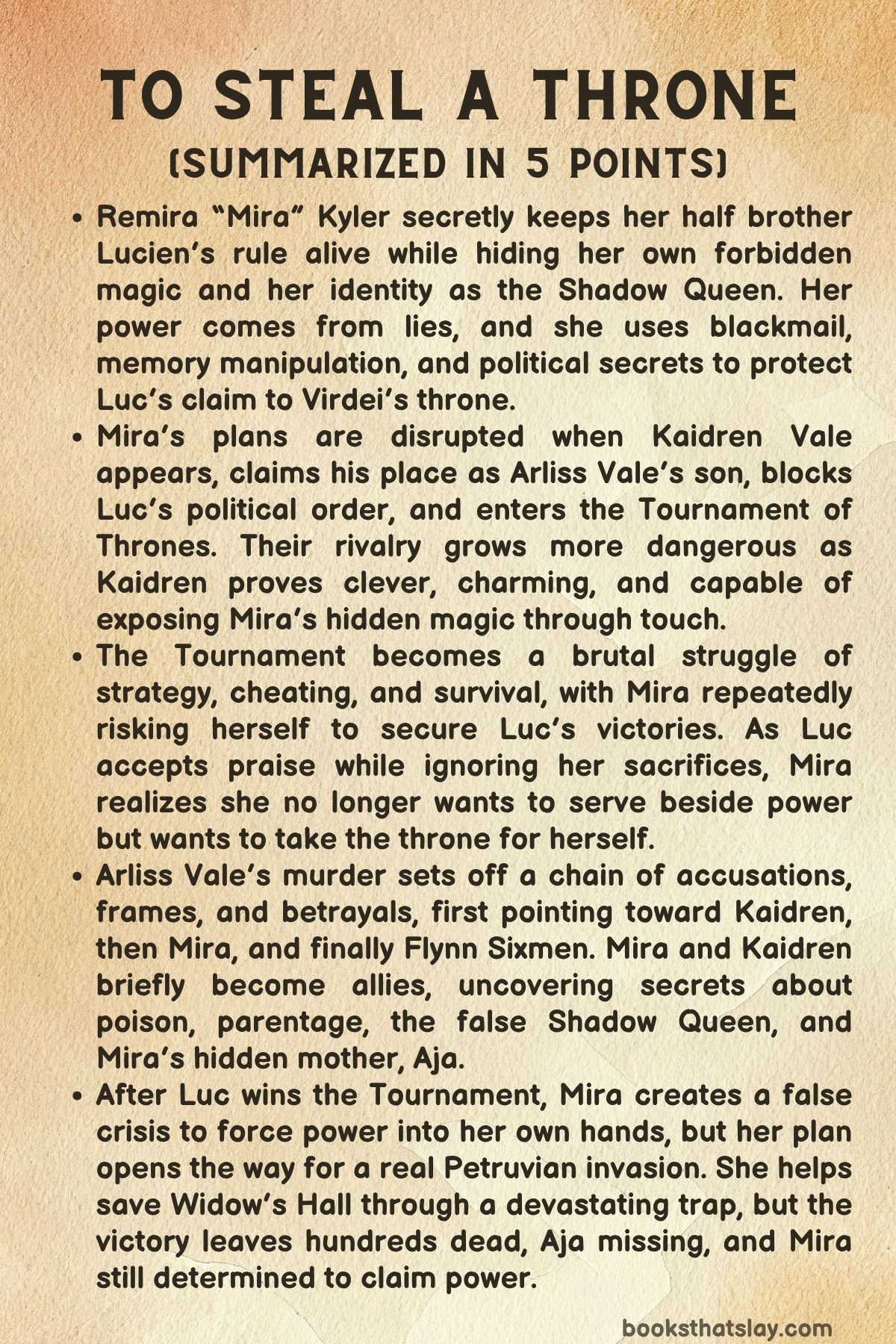
Remira Kyler, known as Mira, lives in Widow’s Hall, the political center of Virdei, where status is everything and secrets decide the fate of rulers. She is the half sister of Lucien Kyler, the Praeceptor of Virdei, and although Luc holds the public title, Mira is the hidden mind behind much of his power.
Mira is also an unregistered aikkari, someone with magic, and her ability is fueled by lies. She can sense falsehoods as heat, draw strength from them, and use tshira, a magical stone, to perform dangerous feats such as entering minds and altering memories.
Her public position is weak because she is Opheran, marked by a golden tattoo that makes Virdeian society treat her as lesser. Her private position is far stronger: she is secretly the Shadow Queen, a feared anonymous writer who exposes, sells, and weaponizes the secrets of the powerful.
At the beginning of the story, Mira is working to secure Luc’s political future. His first term is nearly over, and he needs the Honorate to pass an order allowing him to run again without competing in a Tournament of Thrones.
Mira blackmails Honorate Jasper Nox and manipulates the council vote so Luc can retain power. Her plan nearly succeeds until a stranger arrives at the council and identifies himself as Kaidren Vale, the long-hidden son of the sick Honorate Arliss Vale.
Kaidren claims his right to vote in his father’s place and blocks Luc’s order, creating a deadlock. Mira is shaken because her magic confirms Kaidren is telling the truth, and she knows nothing about him.
Kaidren soon proves himself dangerous. He presents himself with charm and confidence, insults Luc’s legitimacy, and treats Mira as if she is a servant after noticing her Opheran tattoo.
Mira begins investigating him with her closest companion, Sef. She learns that Kaidren’s mother was Opheran, though he has no visible tattoo, and she also discovers that someone else has begun writing letters under the Shadow Queen’s name.
The situation becomes more dangerous when Mira exposes Kaidren’s Opheran heritage in a column, causing him to be mocked at the revote. Luc’s order passes, but Kaidren immediately announces that he is an isha, someone who can identify aikkari through touch.
This terrifies Mira because one touch from him could reveal her unregistered magic. Kaidren then declares he will run for Praeceptor against Luc in the Tournament of Thrones, turning the political struggle into a public contest.
Mira continues trying to destroy Kaidren while protecting Luc. At a family dinner, her father Mathson and stepmother Yelina threaten her, making it clear that if Luc fails, Mira will be the one punished.
Luc promises to protect her but fails to stand up for her when it matters. This pattern repeats throughout the book: Luc cares for Mira, but he often lets power, fear, and family pressure silence him.
The Tournament begins with Petruvian guests watching Virdei closely. Petruvia’s delegation insults Luc, and Mira worries that any weakness will be used against Virdei in future negotiations.
At the opening ceremony, a deadly challenge forces both candidates to choose soldiers to fight. Kaidren’s soldier kills Luc’s, and Mira is horrified by how easily Opheran lives are treated as disposable entertainment.
Mira investigates Kaidren further and visits the Vale manor in disguise. There she learns from a servant that Arliss knew of Kaidren years earlier but only officially claimed him after becoming ill.
Soon after, Mira finds Arliss dead in his bed. She publicly accuses Kaidren of poisoning him, but when Kaidren confronts her and insists he did not kill his father, her magic confirms he is telling the truth.
Still, Mira continues fighting him. She trains with Flynn Sixmen, a young decurio and the son of Honorate Selva Sixmen, while searching for the imposter Shadow Queen.
She discovers that Selva has been blackmailed for months by the false Shadow Queen. The letters demand that he block attempts to protect Ophera and eventually resign from the Honorate.
One letter reveals that Arliss died from kishori poison and threatens Selva with the same fate. Mira realizes the imposter is not merely imitating her but shaping Virdei’s politics and possibly killing people.
During the first official Tournament trial, Mira disguises herself as a decurio and joins Luc’s team. She notices that Kaidren’s side has chosen tshira weapons, which can be manipulated by aikkari, and she convinces Luc to switch to stone weapons.
Her strategy works, and Luc’s team gains the advantage. Mira risks her life by crossing the battlefield and forcing the decisive moment that gives Luc victory.
Yet after the win, Luc accepts the praise while Mira is ignored. Watching Mathson, Yelina, and Luc bask in a victory she created, Mira realizes that no matter how much she wins for Luc, he will never truly give her power.
She decides that after securing Luc’s victory, she will take the throne for herself.
Mira next traps Kaidren during Eteria, a public demonstration meant to prove his ability as an isha. She plants a list of aikkari and their sources in his robes and manipulates a test so it appears he has cheated.
Kaidren is humiliated, but he recovers by speaking publicly to the people below the Collar. He criticizes corruption and inequality in Widow’s Hall, and although Mira knows some of his promises are lies, she also knows his criticisms are true.
Meanwhile, Mira uncovers more about Selva Sixmen’s secrets. She questions Eduma, a former Sixmen maid imprisoned after being falsely accused of theft, and learns that Eduma believes Selva may have killed his wife, Neveah.
This gives Mira a possible explanation for Selva’s blackmail, but the mystery becomes even more complicated.
The second trial is a race down the mountain. Mira tries to cheat Luc to victory using a makeshift tshira sled, but she falls into an ice pit.
Kaidren helps rescue her, showing genuine concern, then outplays both her and Luc by setting off Luc’s emergency flare. This makes it appear Luc forfeited, giving Kaidren the second trial.
The loss pushes Mira into desperation. She reflects on the first Widow Queen, who temporarily handed power to the Honorate during a crisis and never got it back.
Mira decides to reverse that history. She plans to create a crisis so Luc will temporarily transfer authority to her, allowing her to force the Honorate into obedience through the secrets she controls.
Her relationship with Kaidren grows more complicated. He offers to make her his right hand if he wins, but Mira rejects him because she does not want to stand beside someone else’s power.
She later breaks into his childhood home in Ophera and finds a vial of purple liquid that looks like kishori. She believes she has finally found proof that Kaidren poisoned Arliss.
At a masquerade ball, Mira plans to expose him. The evening turns violent when Selva insults and grabs her, and Kaidren defends her.
After Mira is injured, Kaidren helps her privately, and the tension between them finally becomes a kiss. But the kiss exposes her secret: as an isha, Kaidren realizes she is aikkari and pieces together that she is the Shadow Queen.
Mira panics, but Kaidren promises not to expose her, and her magic confirms he is telling the truth. Still, she cannot afford trust, so she moves forward with her plan to accuse him.
Papers fall across the ballroom, accusing Kaidren of murdering Arliss. The decurio search the Vale manor and find the poison Mira planted, but they also find evidence she did not place.
Then a new fake Shadow Queen letter sends them to Mira’s room, where another vial is discovered. Mira realizes the real imposter has anticipated her plan and turned it against her.
Because she cannot give her true alibi without revealing that her mother Aja is alive, Mira is arrested for Arliss’s murder.
In prison, Mira and Kaidren are locked across from each other. Kaidren admits that he did not kill Arliss, but he had been slowly poisoning him for two years to make him ill as revenge for abandoning him and his mother.
Mira breaks them both out using her magic, and they flee to Ophera. There, she takes Kaidren to her greatest secret: Ajalique Selane, her mother, is alive.
Years earlier, Mira erased Aja’s memory of her to protect her and then lied to the Kylers, claiming her mother was dead. Since then, Mira has visited Aja in secret, maintaining the lie and suppressing her memories.
Kaidren learns this and does not condemn her, which unsettles Mira. Their alliance deepens as they investigate the poison.
They find the illegal shop where Kaidren bought kishori and learn that another recent buyer matches Flynn Sixmen. Mira and Kaidren realize Flynn may be Arliss’s real son through Neveah, giving him a motive to kill Arliss, hide his parentage, impersonate the Shadow Queen, and frame them.
Mira returns to Virdei and publishes the accusation. Flynn is arrested, and Kaidren is cleared enough for the Tournament to continue.
The final trial is a crossbow contest supported by decurio teams. Mira again fights secretly for Luc, preparing special tshira-cored bolts so she can guide Luc’s shot.
Luc performs badly, while Kaidren gains points quickly. Mira exploits Kaidren’s feelings for her, lets herself appear vulnerable, and breaks his crossbow.
When Luc fires the modified bolt, Mira secretly guides it into the highest target. Luc wins the Tournament, but Kaidren understands what she has done and leaves her wounded in the snow.
On the morning of Luc’s coronation, Mira enacts her own plan to seize power. She tricks the guards at the Sulen gatepost into abandoning their post and stages evidence suggesting a Petruvian attack.
She expects this false crisis to force Luc to transfer temporary authority to her. But before the coronation, Aja appears, having regained her memories.
The reunion nearly breaks Mira, but she sends Aja away because the coronation and her plan cannot be delayed. During the ceremony, the beacons go out, and Widow’s Hall falls into panic.
Mira first believes this is her staged emergency, but she soon learns Petruvian soldiers have truly breached the Sulen gatepost. Someone used the opening she created to launch a real invasion.
Yelina’s involvement is exposed. She helped the wider scheme because she wanted Luc secure as Praeceptor and was willing to use Petruvia’s attack for her own ends.
Mira realizes her ambition has endangered the entire Republic. To stop Petruvia, she creates a new plan: lure the invaders into the arena by making them believe Luc and the Honorate have been moved there.
Mira, Kaidren, Luc, and others work together under siege. Mira and Kaidren carry powdered tshira through the battlefield, help seal the Petruvian soldiers inside the arena, and ignite the tshira.
The plan succeeds, but the cost is horrifying. Hundreds of trapped soldiers burn alive, and Mira is sickened by the violence she has caused.
Afterward, Petruvia retreats, taking hostages, and war looms. Mira searches for Aja and discovers her mother is missing, likely taken or killed during the invasion.
Luc finally learns that Aja was alive all along. Mira blames him for too much and too little, refusing to accept that her mother is gone.
Even after the disaster, Mira has not abandoned her hunger for power. When Luc asks if she trusts him, she answers with their private code, but it is a lie.
The story ends with Mira still determined to find Aja, confront Petruvia, and take the throne she believes no one will ever willingly give her.
Characters
Remira Kyler / Mira
At the center of To Steal a Throne, Remira Kyler is a heroine shaped by rejection, intelligence, anger, and survival. She is Opheran in a society that treats Opherans as lesser, a hidden aikkari in a state that registers and controls magic, and a young woman whose labor keeps her brother’s rule alive while he receives the credit.
Mira’s power comes from lies, which makes her magic a direct reflection of the life she has built. She lies to protect herself, to control others, to keep her mother safe, to strengthen Luc, and eventually to chase the throne for herself.
Her most defining trait is not simply ambition but the belief that power is the only reliable form of safety. She has seen kindness fail, family fail, promises fail, and law fail, so she chooses secrets as weapons and manipulation as armor.
Mira can be cruel, and the book does not soften that cruelty. She frames Kaidren, uses people’s weaknesses, exploits Kaidren’s feelings in the final trial, and creates a false crisis that opens the way for real invasion.
Yet her cruelty comes from a world that has repeatedly taught her that softness is dangerous. Her love for Aja, loyalty to Sef, and anger over Opheran suffering reveal that she is not empty of compassion; she is terrified of what compassion can cost.
By the end, Mira has won victories and caused disaster in equal measure. She remains one of the most complex figures in the novel because she is both victim and architect, protector and destroyer, girl and political force.
Kaidren Vale
Kaidren Vale begins as Mira’s perfect enemy: charming, secretive, politically inconvenient, and almost impossible to read. His arrival destroys Mira’s carefully arranged vote, and his claim as Arliss Vale’s son immediately turns him into a threat to Luc’s rule.
Kaidren is skilled at performance. He knows how to appear polished before the Honorate, sympathetic before ordinary people, and wounded when it serves him, but he is not only a mask.
His history in Ophera, his abandonment by Arliss, and his long revenge through poison reveal a man formed by shame, poverty, and rage. Like Mira, he has learned that the powerful rarely give justice unless forced.
His role as an isha makes him uniquely dangerous to Mira because he can expose the truth of her magic through touch. This creates fear between them before it creates intimacy.
The romance between Mira and Kaidren works because they recognize each other’s hunger and damage. Both lie constantly, both want power, both claim to be fighting for people ignored by Widow’s Hall, and both are capable of hurting each other when victory demands it.
Kaidren’s greatest strength is that he sees Mira more clearly than most people do. His greatest weakness is that seeing her does not stop him from wanting her, and Mira eventually uses that weakness against him.
By the end, Kaidren has been enemy, ally, rival, and almost beloved. He remains morally flawed, but his flaws make him feel like Mira’s equal rather than a simple romantic opposite.
Lucien Kyler
In To Steal a Throne, Lucien Kyler is the public ruler whose authority depends heavily on Mira’s invisible work. He is Praeceptor, heir of privilege, and the person Mira has spent years protecting, yet he often lacks the courage to protect her in return.
Luc is not heartless. He loves Mira in his own limited way, trusts her intelligence, and repeatedly depends on their private code, but his love is passive when action is needed.
He fails her at dinners, public events, family confrontations, and political turning points because he is too conditioned by Mathson, Yelina, and the expectations of Virdeian power. His weakness lies less in open betrayal than in hesitation.
Luc also represents the difference between having a title and having command. He wears the crown, gives speeches, and stands before the Honorate, but Mira often understands politics, danger, and strategy more quickly than he does.
His victory in the Tournament is largely Mira’s achievement, and the fact that he receives the glory while she bleeds in secret is central to her decision to take power for herself. Luc’s failure is not that he never cares, but that he never risks enough for the person who has risked everything for him.
Sef
Sef is Mira’s closest ally and one of the few people who knows how much of Virdei’s politics rests on hidden movement, disguise, and careful deception. She helps Mira deliver blackmail, impersonate the Shadow Queen, manage secrets, and move through dangerous spaces without being noticed.
Her loyalty is practical rather than ornamental. Sef understands the risks of Mira’s schemes and still stands beside her, offering quick thinking, cover stories, and emotional steadiness when Mira begins to fracture.
Sef’s importance also lies in the way she reflects Mira’s dependence on women whose work is ignored by official power. Like Mira, she operates behind the scenes, and her contributions are crucial even when no one outside their circle sees them.
She is not as politically hungry as Mira, but she understands enough to support the machinery of rebellion. Her friendship gives Mira a rare space where she can be frightened, furious, or vulnerable without immediately becoming prey.
Ajalique Selane / Aja
Aja is Mira’s mother and the living secret at the heart of the story. For much of the book, she is believed to be dead, but the truth is far more painful: Mira erased Aja’s memories of her and hid her in Ophera for years.
Aja represents both love and guilt for Mira. Mira’s decision to erase herself from her mother’s mind was meant as protection, but it also became the most intimate violation Mira ever committed.
The monthly visits, money, gifts, and maintained falsehood show how deeply Mira loves Aja, but they also show how control has replaced trust in Mira’s emotional life. She would rather manage her mother’s reality than risk losing her.
When Aja regains her memories and appears before Luc’s coronation, the moment exposes the human cost of every political lie Mira has told. For a brief instant, Mira is not the Shadow Queen, strategist, or would-be ruler; she is a daughter who wants her mother back.
Aja’s later disappearance turns the ending into a personal crisis as much as a political one. Mira’s ambition survives, but it is sharpened by grief and fear for the one person she has spent years trying to save.
Mathson Kyler
Mathson Kyler is Mira and Luc’s father, and he embodies the cruelty of family power without tenderness. He uses threats, shame, and control to keep Mira in place, making it clear that her usefulness matters more to him than her safety.
His attitude toward Mira is shaped by prejudice, patriarchy, and political convenience. He is willing to use her abilities when they benefit Luc but ready to expose or discard her if she becomes a liability.
Mathson’s presence helps explain Mira’s distrust of fathers, rulers, and official structures. He teaches her that family can behave like a state: demanding obedience, punishing weakness, and hiding cruelty behind respectability.
He is not the most active villain in the book, but his influence is constant. Every time Mira chooses secrecy over trust, part of that choice has been trained into her by Mathson’s treatment.
Yelina Kyler
Yelina is one of the book’s coldest political operators. As Mira’s stepmother, she humiliates Mira in public, removes her from spaces of honor, and repeatedly reminds her that she does not fully belong in the Kyler family.
Unlike Mathson, Yelina’s cruelty often wears the shape of elegance and social order. She understands seating, presentation, reputation, and public embarrassment as tools of control.
Her later connection to the wider conspiracy shows that her ambition is not confined to domestic cruelty. She is willing to use invasion, violence, and manipulation if it secures Luc’s position and preserves the political future she wants.
Yelina is a dark mirror of Mira in some ways. Both understand that power often belongs to the person who controls appearances, but Yelina uses that knowledge to preserve a corrupt system, while Mira wants to seize and remake it for herself.
Flynn Sixmen
Flynn Sixmen first appears as a useful ally: a capable decurio, a trainer for Mira, and someone who seems more honorable than many of the men surrounding the Honorate. His lessons help Mira survive physically, and his conversations offer clues about Selva’s fear.
As the story progresses, Flynn’s image fractures. His father’s secrets, Neveah’s death, the imprisoned maid Eduma, and the kishori poison all point toward a hidden connection between Flynn and Arliss Vale.
Flynn’s possible parentage gives him motive to protect his reputation at any cost. If he is Arliss’s son, the truth would destroy the identity he has built as a respected decurio and newly elevated Honorate.
His betrayal matters because he once seemed safer than most of the powerful men around Mira. By making him the likely poison buyer and imposter Shadow Queen, the novel shows how honor can become a costume used to hide fear, shame, and violence.
Selva Sixmen
Selva Sixmen is a corrupt Honorate whose past sins return to trap him. His affairs, bribes, false testimony, and treatment of servants make him an ideal target for blackmail.
He is important not because he is powerful in a grand way, but because he represents ordinary political rot. Men like Selva maintain the system through lies, favors, intimidation, and the destruction of people too powerless to defend themselves.
His treatment of Eduma is especially revealing. By sending an innocent maid to prison to protect himself, he shows how easily the elite convert private guilt into public punishment for the poor.
Selva’s fear under the imposter Shadow Queen’s threats exposes how many foundations of Widow’s Hall are built on buried crimes. His downfall clears the way for Flynn, but it also helps reveal that corruption does not disappear when one man resigns.
Arliss Vale
Arliss Vale is dead for much of the story, but his choices shape the conflict long before his murder. His abandonment of Kaidren and Zara creates the resentment that drives Kaidren’s slow poisoning and his later claim to power.
Arliss represents the cruelty of aristocratic convenience. He can produce a child with an Opheran woman, ignore that child, and later claim him when illness and political necessity make it useful.
His death becomes the mystery around which several schemes gather. Mira uses it to attack Kaidren, the imposter Shadow Queen uses it to frame others, and the truth about his relationships threatens multiple reputations.
Even in death, Arliss exposes how the powerful create damage and leave others to fight over the consequences. Kaidren, Flynn, Mira, and the Honorate are all pulled into a conflict rooted partly in what Arliss refused to acknowledge.
Julissa
Julissa, Kaidren’s aunt, offers a rare sense of warmth in a book dominated by calculation. Her home in Ophera is modest, but it gives Mira something she almost never receives in Widow’s Hall: a meal that feels honest.
Julissa sees more than people say. She recognizes the tension between Mira and Kaidren and understands that Mira is difficult because she has had to become difficult.
Her presence humanizes Kaidren by showing the home and family that shaped him outside Virdeian politics. Through Julissa, Mira sees that Kaidren is not only a rival in fine clothes but someone connected to poverty, family, and survival below the mountain.
Julissa also helps contrast Ophera with Widow’s Hall. Ophera has hardship and danger, but it also has forms of care that Virdei’s elite spaces lack.
Eduma
Eduma is a minor character with major moral weight. As the former Sixmen maid falsely imprisoned after Neveah’s death, she reveals how easily powerful households destroy servants to bury inconvenient truths.
Her fear during Mira’s visit is understandable because the system has already punished her once for knowing too much. Even speaking the truth could cost her more.
Through Eduma, the book makes clear that political crimes do not only hurt rivals and rulers. They crush ordinary people who lack titles, guards, or influence.
Her belief that Selva may have killed Neveah helps Mira uncover the deeper secret behind the blackmail. Eduma’s role is brief, but she becomes a witness to the hidden violence beneath respectable power.
Taelon and Lorwen Night
Taelon and Lorwen Night represent Petruvia’s arrogant interest in Virdei’s instability. Their arrival at Widow’s Hall is both diplomatic and insulting because they come without a royal family member and immediately test Luc’s weakness.
Taelon’s mockery of Luc shows how foreign powers read political insecurity. He understands that Luc’s lack of Tournament victory makes him vulnerable, and he uses that weakness publicly.
Lorwen’s confrontation with Kaidren and the rumors surrounding her private life add another layer of political performance. Both she and Taelon live in the same world of appearances, scandal, and leverage that Mira manipulates as the Shadow Queen.
The Petruvian delegation prepares the way for the later invasion. They are not only observers; they are signs that Virdei’s internal disorder has invited outside danger.
General Fain
General Fain stands for military authority during Virdei’s crisis. He investigates the murder accusations, oversees searches, and later faces the reality of Petruvia’s attack.
His role shows the limits of formal order in a world ruled by hidden manipulation. The decurio can search rooms, arrest suspects, and fight battles, but they are often reacting to lies already planted by others.
Fain is not portrayed as foolish, but he is limited by the evidence presented to him. This makes him vulnerable to Mira’s frame, the imposter’s counterframe, and the political schemes around Widow’s Hall.
During the invasion, his presence adds urgency because even trained command struggles against the damage caused by treachery inside the walls.
Themes
Power Taken from the Shadows
Power in To Steal a Throne rarely belongs only to the person wearing a crown. Luc has the title of Praeceptor, but Mira writes the threats, gathers the secrets, reads the lies, plans the votes, shapes the Tournament, and repeatedly saves his rule from collapse.
This creates a sharp divide between visible authority and actual control. Mira understands the machinery of power better than most men in official positions, but because she is Opheran, female, illegitimate in status, and magically unregistered, the system expects her to remain useful but unseen.
Her decision to steal the throne is not sudden greed. It grows from years of being asked to build someone else’s rule while receiving humiliation instead of recognition.
The theme becomes more complicated because Mira’s hunger for power is both justified and dangerous. She wants authority because she has been denied safety, but her methods create harm beyond what she intends.
The staged Sulen gatepost crisis is the clearest example. Mira tries to manufacture danger in order to claim emergency power, but the false opening becomes a real invasion.
The story treats shadow power as both necessary and unstable. When a person is denied legitimate authority long enough, she may learn to control events from the dark, but darkness also makes it easier to misjudge the cost.
Lies as Protection and Poison
Lies are not only a political tool in the story; they are the source of Mira’s magic and the structure of her life. She survives by sensing deception, gathering secrets, and shaping reality through falsehood, yet every lie she uses to protect herself becomes another trap.
Mira’s biggest lie is that Aja is dead. That lie saves her mother from Mathson and the Kylers, but it also steals Aja’s memories, isolates Mira, and prevents her from having an honest relationship with the person she loves most.
The Shadow Queen identity works the same way. It gives Mira power in a society that refuses her public authority, but it also makes her dependent on fear, blackmail, and public ruin.
Kaidren’s lies mirror hers. He claims moral purpose while hiding revenge, poisons Arliss without killing him, and performs sincerity until real feeling begins to break through.
Even the imposter Shadow Queen shows how lies can escape their original owner. Mira builds a weapon out of secrecy, and someone else learns to use that same weapon against her.
The book does not treat truth as simple rescue. Truth can expose, punish, and endanger. But it shows that a life built entirely on controlled falsehood eventually becomes impossible to control.
Prejudice, Class, and Disposable Lives
The divide between Virdei and Ophera shapes nearly every conflict in the novel. Mira’s Opheran tattoo marks her body as inferior in the eyes of Virdeian elites, even though her intelligence and labor sustain their politics.
Kaidren faces a different version of the same prejudice. Because he lacks a visible tattoo and enters as Arliss Vale’s son, he can move through certain elite spaces more easily, but his Opheran mother and poor upbringing still make him a target once exposed.
The Tournament makes this inequality brutal. Opheran soldiers are chosen for deadly demonstrations because their lives are treated as expendable, and the crowd cheers violence that powerful people frame as spectacle.
Servants and workers also carry the cost of elite corruption. Eduma is imprisoned for a crime she did not commit because Selva needs someone powerless to absorb the consequences of his secrets.
Ophera itself is endangered by Petruvian soldiers and political delay, yet Luc and the Honorate move too slowly because the people at risk are not central to their comfort.
The story repeatedly shows that prejudice is not only insult or exclusion. It is policy, military neglect, false imprisonment, public humiliation, and death treated as acceptable when the victims are poor or Opheran.
Love, Loyalty, and Betrayal
Nearly every important relationship in the novel is shaped by loyalty under pressure. Mira loves Luc, Aja, and Sef, and she comes to care for Kaidren, but none of these bonds remain untouched by ambition, fear, or betrayal.
Luc and Mira’s relationship is especially painful because it contains real affection but unequal sacrifice. Mira protects him again and again, while Luc often fails to defend her when she is humiliated or threatened.
This makes her eventual betrayal feel both cruel and understandable. She does not stop loving Luc, but she stops believing that love should require her to disappear behind him.
Her bond with Aja is even more complicated. Mira erases her mother’s memories to protect her, which turns love into control and care into violation.
With Kaidren, love becomes dangerous because he sees too much. Their attraction grows through rivalry and recognition, but both remain willing to wound the other when power is at stake.
Sef offers the cleanest form of loyalty, yet even that friendship exists inside Mira’s dangerous world of secrets.
The novel presents love as real but not automatically redeeming. Loyalty can comfort, but it can also excuse silence, demand sacrifice, and become another form of captivity when power is uneven.