Broken Dove Summary, Characters and Themes
Broken Dove by Dani Francis is a dystopian fantasy romance centered on Wren, a powerful Modified woman caught between political rebellion, inherited guilt, and two emotionally significant relationships.
Living within the Uprising’s mountain stronghold, Wren tries to build a future among people who fear both the ruling Company and the extraordinary abilities carried by certain Mods. Her search for belonging becomes increasingly dangerous as secret alliances, betrayals, hidden identities, and competing visions of liberation divide the resistance. The novel examines whether noble goals can survive ruthless methods while placing Wren’s personal choices at the center of a rapidly collapsing political order. It’s the 2nd book of the Silver Elite series by the author.
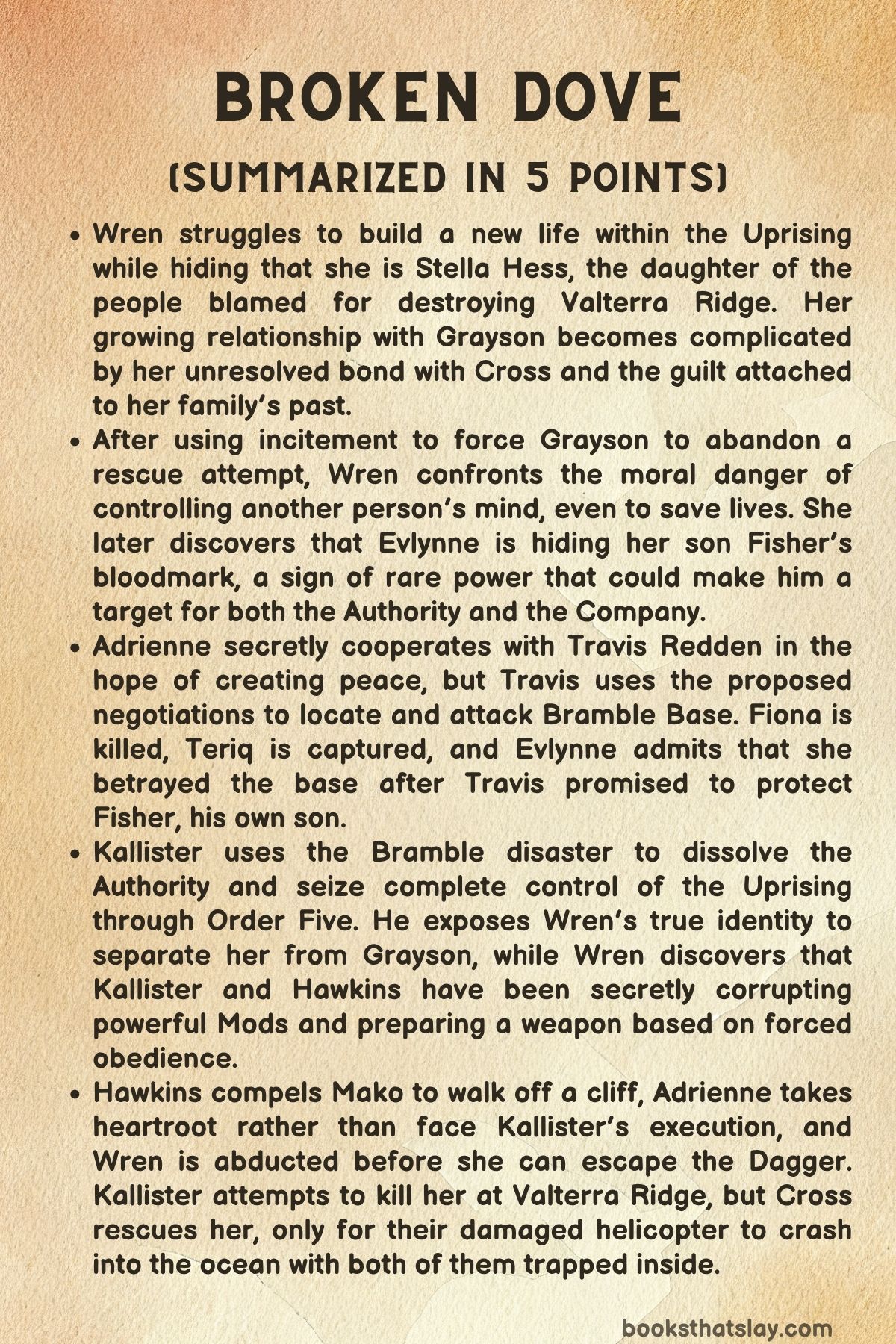
Summary
Wren joins Grayson and Evlynne on a mission near the border of Tierra Fe, where they are supposed to support Adrienne’s ground team while remaining hidden from enemy radar. The operation is exposed, forcing Wren and Evlynne to escape through the jungle as Tierran forces pursue them.
Wren falls into a ditch and badly injures her leg, leaving her unable to reach the aircraft. Grayson refuses to abandon her even though landing would endanger everyone, so Wren uses her power of incitement to command him to fly away.
Her decision saves Grayson and the rest of the team, but it also violates his control over his own mind. Wren loses consciousness and awakens as a prisoner of Commander Vásquez, a Tierran officer who views the Continent’s people and their Modified abilities with religious suspicion.
While imprisoned, Wren meets Vásquez’s daughter Valeria, who secretly possesses a powerful healing ability. Valeria repairs Wren’s leg and explains that she cannot openly persuade her father to support the Uprising, although she may convince him to overlook limited violations of Tierran borders and shipping routes.
After her release, Wren returns to the Dagger and faces Grayson’s anger. He understands that she commanded him to leave because she wanted him to survive, but he insists that she must never again enter his mind without permission.
Their confrontation strengthens their emotional connection, yet it also forces Wren to acknowledge the danger of her gift. She remembers compelling Jayde to die and recognizes that even a loving reason cannot make the removal of another person’s choice harmless.
Wren soon discovers that Evlynne is hiding the appearance of a bloodmark on her young son Fisher. The mark suggests that Fisher may develop exceptional powers, making him vulnerable to recruitment, confinement, or exploitation by either side of the conflict.
Wren agrees to keep Fisher’s secret, identifying with Evlynne’s fear because Julian once concealed Wren’s own abilities and identity. Their shared concern creates a cautious understanding between them, although Wren does not realize how far Evlynne will eventually go to protect her child.
During Mako’s birthday celebration, Wren finally feels accepted as part of the Dagger community. She dances with Grayson and enjoys a rare peaceful evening until heartroot poison causes her heart to stop.
Fiona heals Wren, but no trace of poison remains in her blood. Wren and Grayson quietly investigate because they believe someone within the Dagger deliberately targeted her, yet the number of people who handled her drink makes identifying the attacker impossible.
Wren also continues examining recordings of her mother Marina’s interrogation. Marina’s descriptions of her daughter reveal genuine love beneath her controlled answers, challenging Kallister’s claim that Marina was motivated only by selfishness and betrayal.
Months pass without a solution to the poisoning. Xavier and Jasper visit from the Hollow, and Jasper shows Wren a projected memory of Cross half dressed in a room with another woman, making Wren believe that Cross may have moved on from their relationship.
Her emotional pain is interrupted when Adrienne takes her on a secret assignment. From her sniper position, Wren sees Adrienne meeting Travis Redden, the General who publicly persecutes Mods and has been presented as the Uprising’s enemy.
Kallister later explains that Travis secretly helped the Authority remove his father, Merrick Redden. Travis gave Adrienne access to the Command base so that she could corrupt Merrick during the Jubilee, allowing Travis to assume power afterward.
Adrienne believed that assisting Travis might create an opportunity for peace, while Kallister considered their cooperation no more than a temporary exchange. Wren becomes alarmed that the Authority helped Travis seize power and concealed the arrangement from most of its own operatives.
Grayson takes Wren to the ruins of Valterra Ridge, a community destroyed by bombing and earthquakes. He reveals that he was born there and survived the massacre only because Beatriz and Seth rescued him.
Afterward, Grayson was raised by an uncle who abused him and an aunt who failed to protect him. His humor, recklessness, and resistance to emotional vulnerability developed partly as defenses against the violence and abandonment that defined his childhood.
Wren comforts him but cannot admit that she is Stella Hess, the daughter of Jakob Hess and Marina Serrano, whose actions caused the destruction of Valterra Ridge. Their relationship becomes physically intimate, making her silence even more dangerous because Grayson has trusted her with his deepest trauma.
For a brief period, Wren and Grayson create a peaceful routine involving training, flying, visits with friends, and private time together. At the same time, the Authority becomes increasingly divided over whether Travis can be trusted.
Adrienne arranges a peace meeting with Travis at Bramble Base despite Kallister’s objections. Wren joins the mission alongside Evlynne, Mako, Karra, Declan, Orin, Teriq, and others, while Grayson remains at the Dagger.
Travis delays sending the final meeting coordinates, and the silence around the bunker becomes suspicious. Before Adrienne can cancel the operation, Command forces attack Bramble Base, revealing that the proposed negotiation was a trap intended to gather Uprising leaders and civilians in one vulnerable location.
Wren and Mako help Fiona evacuate civilians through a secondary passage. Fiona is shot during the escape and orders them to leave her behind so they can protect Poppy, forcing Wren to abandon the healer as she dies.
Outside the bunker, Evlynne admits that she gave Bramble’s location to Travis. She reveals that Travis is Fisher’s father and that she contacted him after Wren suggested seeking help from the boy’s other parent.
Evlynne disclosed Fisher’s bloodmark because she believed Travis could protect their son from both the Authority and the Company. Travis instead used her fear to obtain the base’s location, causing Fiona’s death, Teriq’s capture, and the destruction of a major Uprising refuge.
Back at the Dagger, Poppy reveals that she can manipulate nerve endings and inflict severe pain. Her dangerous ability explains Fiona’s constant protectiveness, although Fiona’s attempts to shelter her daughter also prevented Poppy from learning independence.
Kallister blames Adrienne for the Bramble disaster and invokes Order Five. The provision allows the Authority to be dissolved and replaced by a single leader if the remaining council members and mission leaders approve the change.
Wren warns that frightened people are likely to surrender their political voice in exchange for the promise of safety. Kallister insists that peace is impossible and argues that the enemy must be eliminated before the Mods can build a secure society.
To weaken Wren’s influence over Grayson, Kallister exposes her true identity. Grayson is devastated to discover that Wren is Stella Hess and that her parents were responsible for destroying Valterra Ridge.
Although Wren did not participate in her parents’ crimes and learned the truth only recently, Grayson feels betrayed by her silence. She allowed him to describe the loss of his family and the abuse that followed without revealing her connection to the event.
Wren later overhears Kallister speaking with Hawkins inside the daggerstone cave. She discovers that Kallister has been secretly directing Hawkins to corrupt powerful Mods and plans to use mass corruption as the Uprising’s ultimate weapon.
Hawkins finds Wren and reveals that he is both a corrupter and an inciter. When Mako arrives, Hawkins takes control of his body and commands him to walk toward the cliff and jump.
Wren tries to counter Hawkins’s command, but she cannot break his control. She nearly catches Mako before he falls, losing a friend whose humor and kindness had helped her feel at home within the Dagger.
A ridgehowler attacks Hawkins before he can kill Wren. Saint helps her create a false explanation for the confrontation, using his own ability to implant ideas so that Kallister will not immediately discover that his secret program has been exposed.
Order Five passes, making Kallister the sole leader of the Uprising. He immediately detains Adrienne, declares her guilty of treason, and announces that she will be executed for the Bramble disaster.
Adrienne requests a final visit from Wren and admits that her faith in Travis caused terrible losses. Overwhelmed by guilt, exhaustion, and the consequences of her own corruption ability, she consumes heartroot before Wren can stop her.
After Adrienne dies, Wren recognizes that the Dagger has become a dictatorship and prepares to leave with Grayson. Before she can reach safety, she is struck with a tranquilizer dart and abducted by Kallister.
Kallister takes her to Valterra Ridge and explains that his precognition allowed him to foresee the events surrounding Mako’s death. He knowingly permitted Mako to be killed because he believed the outcome would help him establish the future he desired.
Kallister prepares to execute Wren at the site destroyed by her parents, but the arrival of a Command helicopter creates an opportunity for her to resist. He escapes, leaving Wren hanging from the edge of a cliff above the ocean.
Cross suddenly appears and pulls her to safety. He explains that he felt compelled to travel to Valterra Ridge after becoming unable to sense Wren’s familiar telepathic presence, suggesting that their connection reaches beyond their understood abilities.
Wren and Cross board the damaged helicopter, but its engines begin failing over the ocean. With no time to resolve their separation, Wren’s relationship with Grayson, or the political collapse of the Uprising, Cross holds Wren as the aircraft crashes into the water and sinks beneath the waves.
Characters
Wren Cross, also known as Stella Hess
Broken Dove presents Wren as a woman attempting to define herself independently of her parents, her abilities, and the people who repeatedly try to control her future. She is courageous and compassionate, but her instinct to protect others often pushes her toward secrecy, self-sacrifice, and decisions that remove other people’s choices.
Her power of incitement makes questions of consent central to her development. Commanding Grayson to abandon her saves several lives, yet Wren recognizes that entering his mind without permission is a violation even when motivated by love.
Wren’s secrecy about her identity is similarly complicated. She is not responsible for the destruction caused by Jakob and Marina, but concealing the truth from Grayson allows their relationship to deepen on incomplete terms.
Her willingness to challenge both Adrienne and Kallister demonstrates her political independence. She refuses to accept that peace requires blind trust, but she also rejects Kallister’s belief that liberation can be created through mass violence and dictatorship.
Wren’s relationships with Cross and Grayson represent different parts of her emotional life. Cross is connected to her history, identity, and an almost supernatural mental bond, while Grayson offers companionship, vulnerability, and the possibility of building a new home.
Grayson
Grayson initially appears lighthearted, reckless, and confident, but these traits conceal severe childhood trauma. The destruction of Valterra Ridge took his family and community, while the abuse he suffered afterward taught him to disguise vulnerability with humor and daring behavior.
His relationship with Wren reveals his capacity for patience, trust, and emotional honesty. He supports her independence and does not prevent her from participating in dangerous missions, even when his fear for her is intense.
Grayson’s response to being incited establishes an important boundary between love and control. He understands why Wren commanded him to fly away, but he refuses to accept that a protective motive gives her ownership over his mind.
The revelation of Wren’s identity wounds him because it follows his complete disclosure of the trauma caused by her parents. His anger is not based on the belief that she inherited their guilt but on the feeling that she accepted his trust without offering equal honesty.
Grayson also possesses a stronger moral independence than Kallister expects. Although he respects Kallister’s experience, he questions authoritarian thinking and understands that destroying democratic structures during a crisis may permanently damage the cause they are supposed to protect.
Cross
Cross remains physically absent through much of the story, but his emotional presence shapes Wren’s choices and relationships. She continues to measure intimacy, loyalty, and loss against the connection they once shared.
His apparent involvement with another woman causes Wren considerable pain because their separation has never produced genuine emotional closure. Even while building a relationship with Grayson, she cannot simply remove Cross from her heart.
Cross’s return at Valterra Ridge confirms that his bond with Wren is more than ordinary attraction. He senses the absence of her familiar mental presence and travels to her location without understanding exactly what is guiding him.
His decision to pull her from the cliff and hold her during the helicopter crash reflects the steadiness of his devotion. Cross cannot solve the political crisis or the romantic uncertainty in that moment, but he refuses to abandon Wren when survival becomes doubtful.
Kallister
Within Broken Dove, Kallister represents the danger of allowing certainty to replace accountability. He believes his ability to see possible futures gives him the authority to decide which lives may be sacrificed for a larger outcome.
His criticism of Adrienne is partly justified because she repeatedly trusts Travis despite clear warning signs. However, Kallister uses the Bramble disaster not merely to correct her mistakes but to dissolve shared leadership and secure complete control.
Kallister’s decision to expose Wren’s identity demonstrates his talent for turning personal pain into a political weapon. He reveals the truth when it will most effectively damage her credibility, manipulate Grayson, and weaken opposition to Order Five.
His secret partnership with Hawkins exposes the contradiction at the center of his ideology. He condemns the Company for exploiting Modified people while privately developing corruption as a weapon that will strip other Mods of autonomy.
Kallister eventually resembles the rulers he claims to oppose. His belief that history will excuse his actions allows him to tolerate Mako’s death, arrange Adrienne’s removal, abduct Wren, and prepare an execution without moral hesitation.
Adrienne
Adrienne is an idealistic but deeply compromised leader who believes negotiation may prevent endless war. Her desire for peace is sincere, yet it repeatedly causes her to underestimate Travis and conceal dangerous arrangements from the people affected by them.
Her corruption of Merrick helps end one violent regime but allows Travis to take power. Adrienne convinces herself that cooperation with him may produce future negotiations, even after his behavior gives little reason to trust him.
The Bramble disaster exposes the weakness of hope without sufficient caution. Adrienne ignores Teriq’s growing concern and waits too long to cancel the meeting, leaving civilians and Uprising leaders gathered inside a vulnerable base.
Her final actions reflect both guilt and despair. Rather than permit Kallister to stage her execution, she chooses her own death with heartroot, but she also leaves Wren to witness a traumatic event she is powerless to prevent.
Adrienne is neither a simple traitor nor an innocent victim. She is a leader whose humane goal becomes dangerous because secrecy, pride, and personal conviction prevent her from fully confronting the risks of her decisions.
Travis Redden
Travis is calculating, patient, and highly skilled at turning other people’s hopes and fears into political advantages. He first uses the Authority’s desire to remove Merrick and later exploits Adrienne’s desire for peace.
His treatment of Evlynne is particularly revealing. He promises to protect Fisher after learning that the boy is his son, but he uses the information to obtain Bramble’s location and strengthen his control over the Uprising.
Travis’s relationship to Fisher introduces a personal connection that could have humanized him. Instead, he treats fatherhood as another opportunity for manipulation, placing both the child and Evlynne in greater danger.
His public persecution of Mods stands in sharp contrast to his secret dealings with powerful Modified individuals. Travis is willing to cooperate with the people he condemns whenever their abilities can help him gain or preserve authority.
Evlynne
Evlynne is shaped by fierce loyalty to Fisher and growing fear of what others will do if they discover his bloodmark. Her protective instincts are understandable because both the Authority and the Company have histories of controlling unusually powerful Mods.
Her bond with Wren begins when Wren agrees to hide Fisher’s mark. Wren sees Evlynne as another parent-like figure forced to break rules in order to protect a gifted child, just as Julian once protected her.
Evlynne’s eventual betrayal demonstrates how fear can destroy moral judgment. She contacts Travis believing that Fisher’s father will place the boy above political strategy, but she gives him information that results in Bramble’s destruction.
She does not intend for Fiona or the civilians to die, yet intention cannot erase her responsibility. Evlynne becomes a tragic example of protection turning into complicity when desperation makes a dangerous promise appear trustworthy.
Mako
Mako brings humor, affection, and ordinary friendship into an environment dominated by war. His excitement over golden chocolate and his exaggerated suspicion of Raven Persimmons show his ability to create joy even within the confined life of the Dagger.
His friendship helps Wren believe that she is becoming part of a genuine community. He treats her as a companion rather than merely a powerful asset, a suspected traitor, or a political problem.
Mako also proves dependable during the assault on Bramble, providing cover while Wren and Fiona evacuate civilians. His courage is practical and immediate, based on protecting the people beside him rather than pursuing recognition.
His death reveals the cruelty of incitement more clearly than any abstract debate could. Hawkins forces Mako’s body toward the cliff while his mind resists, turning a loyal friend into an unwilling instrument of his own destruction.
Fiona
Fiona is a gifted healer whose identity is closely connected to preserving life. She saves Wren after the heartroot poisoning and continues caring for others despite the personal dangers surrounding the Uprising.
Her relationship with Poppy is loving but restrictive. Fiona understands how dangerous her daughter’s ability could appear to others, so she tries to protect Poppy by limiting her freedom and exposure.
The assault on Bramble shows Fiona’s courage and selflessness. After being shot, she accepts that she cannot save herself and orders Wren and Mako to protect Poppy rather than remain beside her.
Fiona’s death leaves Poppy without the person who had controlled nearly every part of her life. Her sacrifice therefore protects her daughter physically while forcing Poppy into the independence Fiona had always feared granting her.
Poppy
Poppy is a young woman struggling against the limits created by her mother’s fear. She wants freedom, experience, and the opportunity to make decisions instead of being treated as permanently helpless.
Her ability to manipulate nerve endings explains why Fiona believed secrecy was necessary. Poppy can inflict extreme pain without causing a visible injury, making her power both effective and frightening.
During the escape from Bramble, Poppy uses her gift against a soldier and discovers that she is capable of defending herself. The moment gives her agency but also confronts her with the disturbing effect her ability can have on another person.
After Fiona’s death, Poppy must live without the protection she once resented. Her grief is complicated because she loses both a beloved mother and the restrictive structure that had shaped her identity.
Fisher
Fisher is still a child, yet his bloodmark places him at the center of adult political struggles. His potential power makes him vulnerable before he is old enough to understand why others might fear or exploit him.
Evlynne’s choices are driven by the belief that no institution can be trusted with her son. Her secrecy protects Fisher for a time, but contacting Travis exposes him to a father who treats personal relationships as strategic tools.
Fisher represents the future both sides claim to be fighting for. The willingness of adults to control, hide, recruit, or bargain over him suggests that a new generation may inherit the same systems of exploitation unless the conflict changes fundamentally.
Hawkins
Hawkins is a hidden corrupter and inciter whose abilities make him one of the most dangerous people within the Uprising. Unlike Wren, who struggles with the moral burden of mental control, Hawkins uses domination without visible remorse.
His partnership with Kallister gives him protection and purpose. He secretly corrupts Primes so that Kallister can develop a weapon beyond the Authority’s supervision.
Hawkins’s treatment of Mako reveals his complete disregard for individual humanity. He does not merely kill Mako but forces him to participate consciously in his own death, demonstrating how power becomes cruelty when separated from empathy.
His survival leaves Wren in immediate danger because he can expose what she witnessed. He also remains the central instrument of Kallister’s plan to replace political resistance with enforced obedience.
Saint
Saint possesses the ability to place ideas in other people’s minds, making him another character whose power threatens personal autonomy. Unlike Hawkins, he uses this ability to protect Wren and conceal the truth from Kallister’s allies.
His quick construction of a false account after Mako’s fall demonstrates strategic intelligence. Saint understands that openly accusing Kallister without evidence would lead to Wren’s death and the destruction of any possible resistance.
His assistance carries its own moral uncertainty because protecting the truth requires manipulating what others believe. Saint therefore occupies a difficult position between necessary deception and the same invasive methods used by the people he opposes.
Valeria
Valeria lives under the authority of a father who condemns the very abilities she secretly possesses. Her healing gift makes her existence evidence that Modified people cannot be confined to the political and religious categories created by Tierra Fe.
She helps Wren despite the personal risk of exposure. By healing the injury while preserving the appearance of a broken leg, Valeria demonstrates both compassion and careful judgment.
Valeria’s proposed cooperation offers a quieter form of political change. She cannot openly transform her father’s beliefs, but she may persuade him to overlook limited Uprising activity and create space for lives to be saved.
Commander Vásquez
Commander Vásquez views the Continental conflict through a combination of national interest, religion, and prejudice. He considers Modified abilities evidence of corruption and believes Tierra Fe must protect itself from the Continent’s cycles of violence.
His distrust is not entirely disconnected from reality because Travis’s rise threatens regional stability. However, his rigid beliefs prevent him from recognizing that Mods such as his own daughter already exist within the society he considers separate and pure.
Vásquez represents the limits of isolation. Tierra Fe may refuse formal involvement in the war, but political violence and human difference cannot be permanently contained behind national borders.
Marina Serrano
Marina is remembered publicly as one of the Tin Block Traitors responsible for Valterra Ridge. Her service to Merrick and participation in the betrayal make her part of a historical crime that continues shaping Wren and Grayson.
The interrogation recordings reveal a more personal side of her identity. Marina carefully denies that Stella displayed abilities while remembering her daughter as wise, brave, and capable of extraordinary things.
Her refusal to say Stella’s name may be an attempt to create emotional distance under questioning. It may also indicate that she is protecting Wren by refusing to provide information that could expose her.
Marina’s love does not erase the harm connected to her actions. Instead, it complicates Wren’s attempt to decide whether her mother was a selfish traitor, a protective parent, or a person capable of being both.
Julian
Julian’s protection of Wren shapes her understanding of secrecy and parental responsibility. He concealed her bloodmark and identity because he believed discovery would lead to exploitation or death.
His actions help Wren sympathize with Evlynne’s decision to hide Fisher’s mark. Both adults violate institutional rules because they believe the institutions involved cannot be trusted with powerful children.
Kallister interprets Julian’s protection as selfish interference, but Wren recognizes it as one of the reasons she survived. Julian’s influence therefore remains present whenever she considers whether obedience is morally required in an unjust system.
Teriq
Teriq is a cautious member of the Authority who distrusts Travis and questions Adrienne’s approach to negotiation. At Bramble, he recognizes the lack of coordinates and unusual silence as warning signs and recommends abandoning the meeting.
His judgment proves correct, but Adrienne delays action until the attack begins. Teriq’s subsequent capture weakens the Authority and contributes to the fear that makes Order Five possible.
He represents the value of institutional disagreement. His absence removes one of the people capable of challenging both Adrienne’s optimism and Kallister’s extremism, leaving the Uprising more vulnerable to centralized control.
Merrick Redden
Merrick is an absent but politically significant figure whose violent rule shaped the conflict inherited by the other characters. His persecution of Mods made removing him a shared goal for both Travis and the Authority.
Adrienne’s corruption of Merrick demonstrates the moral compromises accepted in the name of ending his regime. His removal does not create freedom because Travis uses the transition to gain power and continue exploiting fear.
Merrick’s legacy shows that eliminating one ruler does not necessarily eliminate the system supporting oppression. The methods used against him also prepare the Uprising to justify similar abuses against future enemies.
Jakob Hess
Jakob Hess is Wren’s father and one of the figures blamed for the destruction of Valterra Ridge. Although he does not act directly within the present narrative, his choices determine how others interpret Wren’s identity.
His surname becomes a burden she never chose. Kallister uses it to imply that political guilt can pass from parent to child, even though Wren had no role in the massacre.
Jakob’s legacy places Wren and Grayson on opposite sides of the same historical wound. Their relationship tests whether descendants and survivors can build trust without denying the truth of what came before.
Xavier and Jasper
Xavier provides Wren with a connection to the Hollow and to the period of her life associated with Cross. His admission that Cross has also stopped communicating with him suggests that Cross’s withdrawal is broader than a simple rejection of Wren.
Jasper’s projection of Cross with another woman becomes emotionally powerful because it presents a visible memory rather than a rumor. However, the scene lacks enough context to prove what Cross was doing or what relationship existed between them.
Together, Xavier and Jasper reopen a part of Wren’s life she has tried to place at a distance. Their visit reminds her that emotional separation cannot be completed merely by entering a new home or beginning another relationship.
Karra, Declan, and Orin
Karra, Declan, and Orin represent the trained operatives who sustain the Uprising through practical service. They participate in dangerous assignments without possessing the political authority of figures such as Adrienne or Kallister.
Declan accompanies Wren through Bramble, while Karra later reports that Command forces seemed more interested in capturing leaders than conducting indiscriminate slaughter. This observation helps the survivors understand that the attack was designed to weaken the Uprising’s command structure.
Their roles show how leadership decisions are carried out by people who may not know the full political truth. They face the consequences of secret alliances and strategic failures while having limited power to influence either.
Themes
Consent, Autonomy, and the Morality of Power
Abilities that control minds, bodies, beliefs, or emotions turn personal autonomy into a constant moral concern. Wren’s incitement can save lives, but commanding Grayson to leave her demonstrates that a protective purpose does not automatically make mental control acceptable.
Grayson’s response establishes consent as a necessary part of trust. He can forgive Wren’s fear and understand her reasoning while still insisting that she never again remove his ability to choose.
The same power becomes openly horrifying when Hawkins controls Mako. Mako remains conscious and resists internally, yet his body obeys the command to approach the cliff, showing the cruelty of separating a person’s mind from control of the self.
Broken Dove also extends this issue beyond incitement. Corruption, Saint’s implanted ideas, Fiona’s restrictions on Poppy, institutional plans for bloodmarked children, and Kallister’s political takeover all involve one person deciding what another should be allowed to think, do, or become.
The moral difference between characters is therefore determined less by the abilities they possess than by the limits they place upon themselves. Wren feels guilt and accepts boundaries, while Hawkins and Kallister treat autonomy as an obstacle to their desired results.
Protection That Becomes Control
Nearly every major relationship contains someone attempting to protect another person. Wren commands Grayson to escape, Fiona limits Poppy’s freedom, Evlynne hides Fisher’s bloodmark, Julian conceals Wren’s identity, and Grayson struggles with the desire to keep Wren away from danger.
These actions arise from genuine love, but they often prevent the protected person from participating in decisions about their own life. Poppy accurately recognizes that constant protection can become a prison, even when the person constructing that prison believes it is necessary.
Evlynne demonstrates the most destructive version of this pattern. Her fear for Fisher leads her to trust Travis, and her attempt to secure one child’s safety exposes an entire base filled with civilians and Uprising leaders.
Wren’s development requires her to distinguish sacrifice from control. She willingly risks herself for others, yet she must learn that love does not give her the right to decide whether Grayson should share that risk.
The story does not argue that protection is always wrong. Julian and Valeria save lives through secrecy, but their actions remain more defensible because they preserve possibilities rather than demanding obedience for personal or political advantage.
Inherited Guilt, Historical Trauma, and Identity
Wren’s discovery that she is Stella Hess connects her identity to a crime committed before she could choose who she wanted to become. Kallister treats her parentage as proof that she is morally suspect, using collective memory to turn her into a symbol of Valterra Ridge’s destruction.
Grayson embodies the continuing human cost of that event. He loses his family and community, experiences abuse afterward, and builds an adult personality partly around concealing the vulnerability produced by those experiences.
The conflict between them is not based on Wren’s responsibility for the massacre. It develops because she withholds information while Grayson shares the most painful part of his past, creating an imbalance in trust at the moment their relationship becomes most intimate.
Marina’s interrogation further complicates inherited identity. She is capable of loving and protecting her daughter while remaining connected to actions that caused enormous suffering, preventing Wren from dividing her family history neatly into innocence and evil.
Valterra Ridge becomes both a physical ruin and a moral inheritance. Wren must face what her parents did without accepting the claim that their choices determine her nature, while Grayson must decide whether loving her betrays the people he lost.
Revolution, Leadership, and the Reproduction of Tyranny
The Uprising begins as a resistance to oppression, yet its leaders gradually adopt the secrecy, manipulation, and concentration of power associated with their enemies. Adrienne corrupts Merrick through a hidden alliance, while Kallister secretly develops Hawkins as a weapon against powerful Mods.
Adrienne’s failure comes from believing that peace can be created through personal trust with Travis despite repeated evidence of his dishonesty. Kallister responds to that failure by claiming that negotiation itself is impossible and that survival requires one unquestioned leader.
Order Five demonstrates how fear can destroy democratic structures. After Bramble, frightened operatives accept centralized authority because Kallister promises certainty, speed, and security at a moment when collective leadership appears weak.
His rise shows that revolutionary language does not prevent authoritarian behavior. Kallister permits Mako’s death, eliminates Adrienne, plans mass corruption, and attempts to execute Wren while insisting that every sacrifice serves liberation.
Travis and Kallister ultimately resemble one another despite standing on opposing sides. Both exploit personal relationships, withhold essential information, and treat individuals as pieces in a larger political design.
The collapse of the Authority suggests that defeating an oppressive ruler is not enough. A successful revolution must also preserve accountability, consent, and shared power, or it may reproduce the same tyranny under a new name.