The Library After Dark Summary, Characters and Themes
The Library After Dark by Ande Pliego is a locked-library mystery that combines family secrets, literary history, romance, and carefully staged murders.
Set inside the neo-Gothic Daedalus Library during an exclusive nighttime tour, the book follows several guests whose private connections to the institution gradually come to light. At the center is Aria Stokes, a young woman returning to the place where she spent part of her childhood and committed an act that has controlled her life ever since. As the exits close and guests begin dying, the library becomes both a crime scene and a physical record of truths that powerful families have concealed for generations.
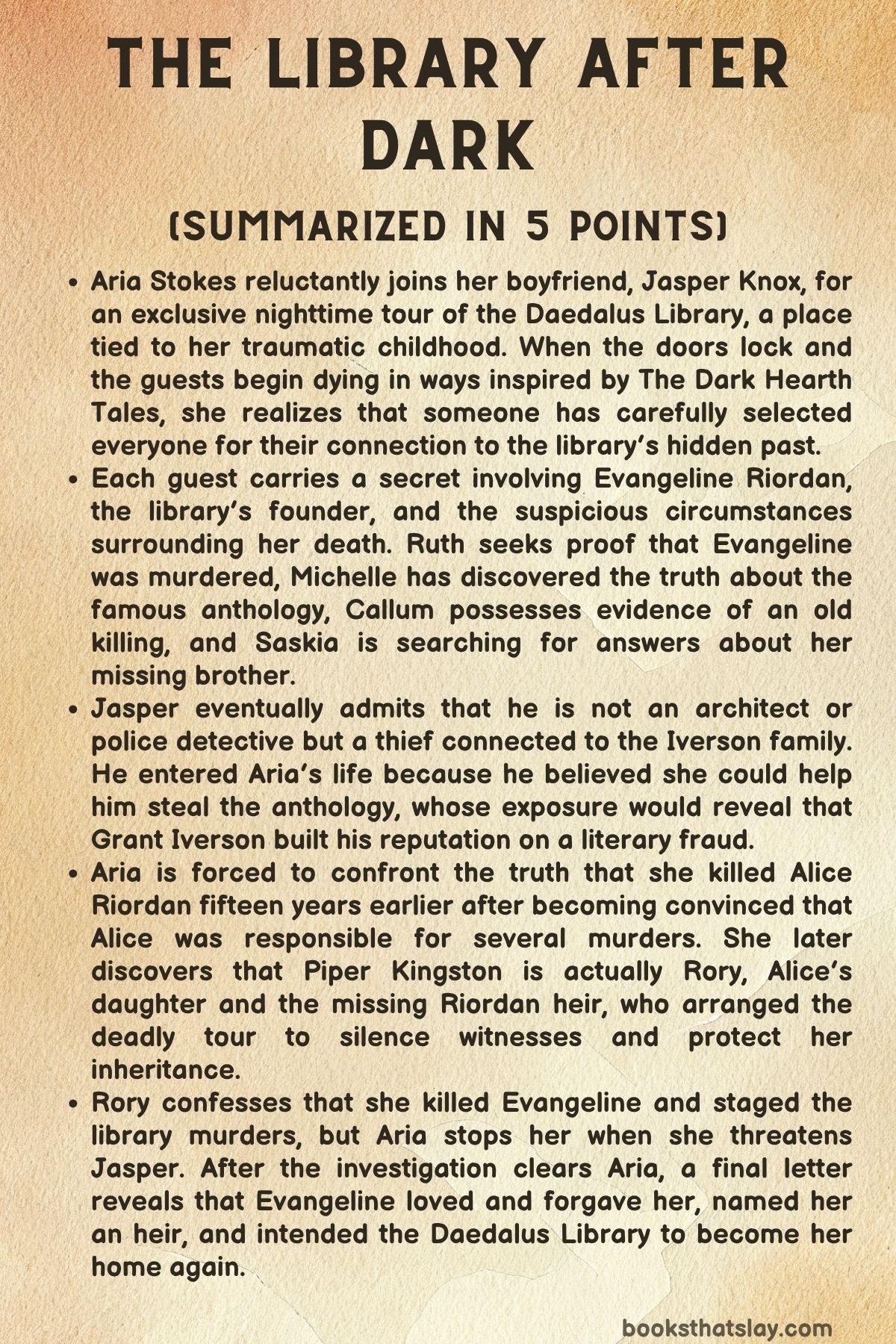
Summary
Aria Stokes is waiting at the Read Albatross bookstore for Jasper Knox, the man she has been dating for four months. Although she usually avoids emotional commitment, she has begun to care about him and worries that his recent business trip may have changed their relationship.
Jasper surprises her with a rare special edition of The Dark Hearth Tales and tickets for an exclusive Valentine’s night tour of the Daedalus Library. The gift awakens painful memories because Aria once lived inside the building and has been legally forbidden from returning.
The Daedalus, popularly called the Library of Death, was created by wealthy collector Evangeline Riordan inside a former psychiatric hospital. Aria conceals the fact that Evangeline raised her after her mother’s death and that Aria left the library fifteen years earlier after causing someone’s death.
Other guests arrive for the tour, including librarian Saskia Voss, professor Callum Greene, author Michelle Baudelaire, teacher Wes Martinez, journalist Piper Kingston, and retired nurse Ruth Howard. Aria quickly senses that several of them may know more about Evangeline and the building than they admit.
Ruth has entered the library with a private mission. She was Evangeline’s hospice nurse and was blamed when the older woman died from an apparent overdose, destroying Ruth’s career and damaging her relationship with her son, Sam.
Believing Evangeline was murdered, Ruth plans to search the library’s records for proof that her patient intended to confess something before her death. She steals Saskia’s key card and reaches a restricted corridor, but she suddenly develops a violent reaction and collapses.
Before Ruth dies, she tells Jasper that someone visited Evangeline shortly before her death. She insists that the fatal overdose was deliberate and that she did not administer it.
Ruth then coughs up a dark substance and dies in a manner resembling one of the punishments described in The Dark Hearth Tales. Her death convinces the guests that someone may be using the anthology as a guide for murder.
The group discovers that the doors have locked, the phones are unavailable, the lights are failing, and the security guards are not responding. A hidden doorway opens by itself, forcing the survivors deeper into the library rather than toward safety.
Aria admits to Jasper that she has been inside the Daedalus before and that an agreement with the Riordan family prohibits her from returning. She still refuses to explain what she did, but Jasper promises to help her leave without being identified.
That promise becomes doubtful when Aria finds what appears to be an NYPD badge in Jasper’s clothing. He allows everyone to believe he is a detective investigating Evangeline’s death, although his authority raises as many questions as it answers.
The survivors enter the subterranean stacks and discover that nearly everyone has concealed a connection to Evangeline, the anthology, or an earlier death. Their suspicions increase as they pass through dangerous collections filled with poisonous books, hidden passages, mechanical displays, and preserved objects.
Michelle realizes that Ruth’s death matches a story from the anthology and that several historical accidents inside the Daedalus may have been staged in the same manner. She also remembers seeing a frightened, bloodstained child in the library fifteen years earlier, a figure she publicly described as a ghost called Dorothy.
When the group reaches a working guillotine, they must pass beneath its blade to continue. Jasper, Aria, Saskia, and Callum cross safely, but the mechanism activates while Michelle is beneath it, killing her and separating the group.
Callum is devastated because he loved Michelle and had concealed information from her. He confesses that sixteen years earlier he photographed Evangeline beside a bloodied body that was about to be hidden in a rug.
Instead of reporting what he saw, Callum blackmailed Evangeline for money and scholarly access. He cannot prove whether Evangeline or her daughter Alice committed the killing, but his photograph confirms that a body was concealed inside the library.
Trying to redeem himself, Callum climbs a sharp metal gate and opens a path for the others. During the attempt, someone drives a bone-like spike into his back, and he dies from the injury after acknowledging his cowardice and choosing to help the group.
Meanwhile, Piper and Wes remain trapped on the opposite side of the guillotine. Piper begins to suspect that Wes is connected to the Iverson family and knows far too much about the library’s secret architecture.
Wes is secretly Grant Iverson’s grandson and Jasper’s cousin. He admits only to himself that he helped disable the building’s electricity so Jasper could steal the original copy of The Dark Hearth Tales.
Piper locks Wes inside a glass preservation room and questions him, but she eventually releases him. Wes later attacks her, destroys her camera, and leaves her inside a sealed rare-books chamber because he fears that her photographs could expose his family and the planned theft.
Aria and Jasper reach the room containing the original anthology, where Aria catches him opening its display case. Jasper finally admits that he is a professional thief rather than a detective.
He targeted Aria because he believed she was Evangeline’s missing biological granddaughter and could guide him through the library. Their relationship began as part of his effort to gain access, although his feelings for her became genuine.
Jasper explains that The Dark Hearth Tales is a modern forgery presented as an eighteenth-century manuscript. If its true origin is exposed, members of the Iverson family, including his sister Jenna, could face legal and financial destruction.
A scream leads Jasper to Piper, who appears unconscious inside the sealed rare-books room as a fire-suppression countdown begins. The system releases what seems to be a deadly oxygen-removing gas, and Aria and Jasper believe they have watched Piper die.
Saskia then confronts Aria with an antique firearm disguised as a book and takes the original anthology. She tears away its restored binding and reveals dried blood beneath the green cover.
Saskia explains that her real name and professional history were constructed so she could investigate the disappearance of her brother, Ansel Kaufmann. Ansel was a book conservator hired for a secret job at the Daedalus fifteen years earlier, after which he vanished.
She believes Ansel discovered the forgery or the blood on the anthology and was killed to prevent him from exposing it. The bloodstained cover is the first physical evidence she has found after years of searching.
Aria and Jasper pursue Saskia through Evangeline’s private office toward the subterranean vault. Along the way, Aria remembers the truth about her childhood and the person she killed.
After Aria’s mother died, Evangeline welcomed her into the Riordan household, where she lived alongside Alice and Alice’s daughter, Rory. Aria eventually became convinced that Alice was responsible for several killings and that Alice intended to murder her as well.
At fifteen, Aria lured Alice into an airtight conservation chamber and locked the door. She watched Alice die from lack of oxygen because she believed no adult would stop Alice and that killing her was the only means of survival.
Evangeline discovered the body and sent Aria away the following morning. Lawyers created an agreement requiring Aria to abandon the Riordan name, avoid the Daedalus, and remain silent about Alice’s death.
Before Aria can confess this to Jasper, they find Wes hanging from museum wire in a mirrored corridor. Jasper is crushed by his cousin’s death and recognizes that the theft intended to protect his family has instead contributed to Wes’s destruction.
Aria, Jasper, and Saskia eventually confront one another inside the vault. Saskia wants to use the anthology’s bloodstained cover to prove what happened to Ansel, while Jasper wants to remove or destroy it before the Iverson fraud becomes public.
Their argument is interrupted by gunfire. Jasper is grazed, Saskia collapses, and Piper appears with the weapon, revealing that her apparent death was staged.
Aria recognizes Piper as Rory, whose legal name is Eden Riordan. Rory is Alice’s biological daughter, Evangeline’s missing granddaughter, and the true heir Jasper mistakenly believed Aria to be.
Rory explains that she altered the rare-books suppression system so that it released water instead of deadly gas. Her supposed death allowed her to move through the library without being suspected.
She organized the tour and selected guests who threatened the Riordan estate or knew pieces of the family’s history. Ruth knew about Evangeline’s last visitor, Michelle had discovered the anthology’s secret, Callum possessed the photograph, Saskia sought evidence of Ansel’s death, and the Iversons could expose the forgery.
Rory used the library’s mechanisms and collections to stage murders resembling punishments from the anthology. She hoped the deaths would appear to be supernatural manifestations of the library’s curse while also generating publicity for its anniversary.
Rory reveals that Evangeline had written letters naming both Rory and Aria as co-heirs. Rory viewed Aria’s inclusion as another betrayal because Aria was not biologically related to the Riordans but had still received Evangeline’s love and protection.
Rory also admits that she killed Evangeline. After receiving a confession in which Evangeline claimed responsibility for Alice’s death and the other murders, Rory suffocated her grandmother and staged the death as an overdose.
Aria knows Evangeline’s confession was false because Aria herself killed Alice. She finally admits what she did, ending fifteen years of secrecy and destroying Rory’s belief that Evangeline murdered her mother.
Aria explains that Alice killed Grant Iverson and eliminated other people who threatened to reveal the truth. Evangeline concealed Alice’s crimes, staged Grant’s death as a suicide, and falsely accepted responsibility in an attempt to protect the surviving members of the family.
Rory realizes she murdered Evangeline for a crime Evangeline did not commit, but she refuses to surrender. She decides that Jasper and the remaining witnesses must die so she can maintain control of the estate and the official account of the night.
When Rory points the gun at Jasper, Aria attacks her with a sharp bone folder and stabs her in the neck. Rory dies, and Jasper argues that Aria acted in self-defense to prevent another murder.
Five weeks later, the investigation accepts Rory as the person responsible for Evangeline’s death and the library massacre. Aria spends nine days in jail, but surveillance footage, Jasper’s testimony, Callum’s photograph, and Evangeline’s letters support her account.
Jasper visits Aria after Wes’s funeral, and they speak honestly about their guilt, grief, deception, and continued feelings for one another. Aria admits that she would make the same choice again to save Jasper, while he accepts her without asking her to disguise the darker parts of herself.
Evangeline’s lawyer then gives Aria a letter that was believed to have been destroyed. Evangeline admits that Alice was a murderer, apologizes for refusing to believe Aria, and explains that sending her away was an attempt to protect her from prosecution rather than an act of hatred.
The letter confirms that Aria was named co-heir to the entire estate and was always intended to return to the Daedalus. Learning that Evangeline believed, loved, and forgave her allows Aria to see the library as a home again rather than only the scene of her crime.
The final revelation explains the true origin of The Dark Hearth Tales. Michelle had discovered that Evangeline possessed a tattoo inspired by one of its stories decades before Grant supposedly found the manuscript.
Evangeline admitted that she wrote the tales herself as autobiographical messages to Grant, her childhood companion, lover, criminal partner, and abuser. Grant later presented the manuscript as an eighteenth-century discovery and built his reputation on the fraud.
Alice killed Grant during a confrontation over the book, and Evangeline concealed the crime. The anthology was therefore never cursed; it was a private record of abuse and survival that other people transformed into scholarly prestige, financial power, and a reason for murder.
Characters
Aria Stokes
At the center of The Library After Dark, Aria Stokes is defined by the tension between her desire for belonging and her conviction that she is dangerous. Her jokes, flirtation, emotional distance, and unusual lack of fear function as defenses developed after years of guilt and isolation.
Aria’s childhood shaped her understanding of violence in complicated ways. After losing her mother, she briefly found safety and affection with Evangeline, but the Riordan household later became a place where she believed no adult would protect her from Alice.
Her killing of Alice was planned, which prevents Aria from dismissing it as an accident. At the same time, she was a terrified fifteen-year-old who believed that waiting would lead to her own death or someone else’s.
Aria’s greatest conflict is not simply whether others will learn the truth. She fears that honesty will prove she is incapable of love, morality, or ordinary human connection.
Returning to the library forces her to confront evidence that her memories were incomplete. Evangeline’s exile was not pure rejection, the household contained genuine affection alongside cruelty, and Aria’s capacity for violence does not erase her ability to protect others.
Her relationship with Jasper tests whether she can remain emotionally present after betrayal. She saves him despite knowing that he targeted and manipulated her, but she does not pretend that his motives excuse the harm he caused.
Aria’s killing of Rory deliberately echoes her earlier action against Alice. The difference is that adult Aria names what she has done, accepts responsibility, and refuses to let another person construct a false account on her behalf.
By the end, she does not become conventionally innocent. Her growth lies in accepting that she can be loving, morally responsible, frightened, violent, and worthy of a home at the same time.
Jasper Knox
Jasper Knox initially presents himself as a thoughtful architect and attentive romantic partner, but almost every element of that identity is calculated. He studies Aria, dates her, arranges the library tour, and encourages her attraction because he believes she can lead him to a valuable manuscript.
His methods reveal intelligence, patience, and a strong need for control. Even before the murders begin, he is comfortable lying, impersonating a police officer, stealing access cards, and using emotional intimacy as an investigative tool.
The relationship becomes complicated because Jasper’s feelings stop being part of the performance. His alarm after kissing Aria reflects the realization that she has become more important than the operation for which he approached her.
Jasper is motivated primarily by family obligation. He believes stealing the anthology is necessary to protect Jenna and other Iverson descendants from consequences created by Grant’s fraud.
This loyalty does not make his actions harmless. His plan requires Wes to disable the library’s power, removing safeguards that Rory later uses to carry out the murders.
Wes’s death forces Jasper to see that his version of protection can produce the very harm it was intended to prevent. He cannot continue treating manipulation, theft, and secrecy as acceptable simply because his motives are connected to family.
Jasper’s mistaken belief that Aria is the missing Riordan heir also exposes the limits of his confidence. He correctly discovers her connection to the library but builds his entire operation on an assumption that turns out to be false.
His later honesty does not erase the betrayal, yet it gives Aria the ability to decide whether she wants him in her life. By the conclusion, their connection is no longer based on his control of information but on a mutual awareness of what each has done.
Rory Riordan, Also Known as Piper Kingston
Rory is introduced as Piper Kingston, an observant journalist who appears eager to document the library’s anniversary. Her questions, photographs, curiosity, and apparent vulnerability allow her to examine the other guests without attracting serious suspicion.
As Rory, she is revealed as the principal architect of the massacre. She understands the Daedalus’s mechanisms, stories, surveillance systems, and legends well enough to transform the building into a controlled murder environment.
Her actions grow from abandonment, resentment, and a distorted belief in inheritance. Alice disappeared, Aria vanished, and Evangeline refused to provide an honest explanation, leaving Rory to build her identity around unanswered loss.
Evangeline’s false confession convinces Rory that her grandmother murdered Alice. Rory responds by killing Evangeline, staging the death as an overdose, and later targeting everyone who might expose the family’s history.
Her sense of justice is inseparable from ownership. Rory believes the Riordan estate, library, and public narrative belong to her because she is the biological heir.
The discovery that Evangeline also named Aria as an heir intensifies Rory’s resentment. Aria represents chosen love, suggesting that family status cannot be secured solely through blood.
Rory is not simply an emotionless killer. She cannot immediately shoot Aria, showing that part of her still remembers their childhood attachment and desires recognition from the person she believes abandoned her.
However, she repeatedly chooses control over truth. Even after learning that Evangeline did not kill Alice, Rory refuses accountability because acknowledging her error would force her to face the meaninglessness of the deaths she caused.
Evangeline Riordan
Within The Library After Dark, Evangeline Riordan is both a source of protection and the person whose secrecy allows violence to continue. Her public identity as a wealthy collector and founder conceals a life shaped by abuse, fear, guilt, and repeated moral compromises.
She gives Aria a home after the death of Aria’s mother and offers her books, stability, and belonging. Yet she later ignores Aria’s warnings about Alice, allowing loyalty to her daughter to override her responsibility to investigate.
Evangeline’s greatest failure is her habit of treating concealment as protection. She hides Grant’s murder, protects Alice’s reputation, forces Aria into silence, misleads Rory, and accepts blame for crimes she did not commit.
Each decision is intended to shield someone, but the accumulated lies separate the family and enable new violence. Aria grows up believing she was hated, while Rory becomes convinced that Evangeline murdered Alice.
The anthology reveals another side of Evangeline. She originally writes the stories as an intensely personal account of her relationship with Grant and her effort to explain why she left him.
Grant’s decision to turn that private writing into a fraudulent literary discovery continues the exploitation Evangeline experienced in their relationship. Her own words become the foundation of another person’s reputation and a source of conflict she cannot fully control.
Her final letters show that she eventually understands the damage caused by her silence. She acknowledges Alice’s guilt, apologizes to Aria, and attempts to return the Daedalus to both young women.
The apology arrives too late to save Ruth, Michelle, Callum, Wes, Rory, or Evangeline herself. Nevertheless, it gives Aria the knowledge that she was loved and believed, allowing at least one part of the family’s history to be corrected.
Alice Riordan
Alice is physically absent from the present-day action, but her decisions form the central source of the library’s hidden history. She is Evangeline’s daughter, Rory’s mother, Aria’s feared guardian figure, and the person responsible for the earlier killings.
Alice’s violence begins with Grant Iverson’s death during a confrontation concerning the anthology. Rather than accepting the consequences, she continues eliminating people who might discover the truth or connect her to the bloodstained manuscript.
Her behavior toward Aria is threatening enough that the girl becomes convinced she will eventually be killed. The failure of adults to take Aria seriously gives Alice greater power and leaves Aria believing that she must stop the danger herself.
The book never turns Alice into a misunderstood victim of Aria’s imagination. Later revelations confirm that Aria was correct about her involvement in multiple deaths.
Even so, Alice’s murder raises difficult moral questions because Aria does not act through legal or protective institutions. She imprisons Alice in an airtight room and watches her die.
Alice’s significance also rests in how others reshape her memory. Evangeline protects her, Rory idealizes her, and Aria fears that killing her proves she is equally monstrous.
The truth breaks each of those narratives. Alice was dangerous, but protecting her reputation only transferred the consequences of her actions to younger people.
Ruth Howard
Ruth Howard enters the Daedalus as one of the most sympathetic characters in the book. She has lost her career, social standing, and much of her son’s trust because Evangeline’s death was interpreted as a failure of care.
Her decision to search the records is courageous because she understands the personal consequences of being caught. She could be arrested, publicly humiliated, or permanently separated from the life she hopes to rebuild with Sam.
Ruth’s relationship with Evangeline developed through ordinary acts of care. She listened to her, encouraged her to make peace with the past, and came to regard her as a friend rather than merely a patient.
This connection makes Ruth especially dangerous to Rory. Ruth knows Evangeline planned to disclose something and remembers that a visitor arrived shortly before the apparent overdose.
Ruth’s death establishes the seriousness of the threat and the killer’s method. Rory turns the symptoms of a fictional punishment into a physical murder, using Ruth’s death to suggest that the anthology’s curse is real.
Although Ruth dies early, her conviction guides the later investigation. She is the first person to openly state that Evangeline was murdered, and the truth eventually confirms that her professional judgment was correct.
Michelle Baudelaire
Michelle Baudelaire is a celebrated fantasy-horror author whose career is closely associated with the atmosphere and legends of the Daedalus. Her warmth toward readers and her emotional response to Wes show that she values the personal impact of storytelling more than status alone.
Her earlier sighting of a bloodstained child became part of the library’s supernatural mythology. She called the figure Dorothy and interpreted the encounter as a ghost story rather than evidence of a living child in distress.
As the night continues, Michelle realizes that the child was probably Aria. This forces her to question how easily trauma can be transformed into entertainment when witnesses misunderstand what they see.
Michelle also discovers the truth about the anthology’s origin. By noticing that Evangeline possessed a story-inspired tattoo before Grant’s supposed discovery, she concludes that Evangeline wrote the tales.
Her knowledge makes her a threat to both the Riordan and Iverson narratives. Exposing Evangeline’s authorship would undermine Grant’s reputation and reveal that the manuscript’s accepted history was false.
Michelle’s death occurs just as she begins combining the group’s separate clues. The guillotine attack silences the person most capable of explaining how the staged deaths connect to the anthology.
Her final conversation with Evangeline gives her character lasting importance. Michelle understands that the stories’ power comes not from age or supernatural origin but from their honesty about abuse, fear, and survival.
Professor Callum Greene
Callum Greene initially appears to be a respected scholar whose main interest is the history of The Dark Hearth Tales. His learning gives him authority, but his later confession reveals that his career was partly built through blackmail.
When Callum photographs Evangeline beside a body, he has the opportunity to report a possible murder. Instead, he uses the image to obtain funding and access for his research.
He tells himself that maintaining leverage over Evangeline might prevent further killings. In reality, professional ambition and fear play significant roles in his silence.
Callum’s relationship with Michelle exposes his capacity for tenderness and regret. He loves her but continually postpones full honesty, assuming there will be a safer time to explain what he knows.
Michelle’s death ends that possibility and forces him to confront the cost of withholding information. His confession is not enough to undo the past, but it prevents Rory from permanently erasing the photograph’s meaning.
His decision to climb the dangerous gate provides a final act of redemption. He chooses the survival of others over his reputation, safety, and professional interests.
Callum dies as a morally mixed person rather than a simple coward or villain. Aria’s recognition of his courage helps her understand that a person’s worst action does not necessarily describe the whole of that person’s character.
Wes Martinez
Wes presents himself as an enthusiastic teacher and devoted reader of Michelle’s novels. His emotional account of how her work helped him survive adolescence appears sincere, even though much of his identity is hidden.
He is actually connected to the Iverson family through his mother and is Jasper’s cousin. He helps Jasper disable the library’s power so they can steal the anthology and protect their relatives from the consequences of Grant’s fraud.
Wes differs from Jasper because he has tried to distance himself from the family legacy. Becoming a teacher allows him to build an identity separate from inherited schemes and expectations.
Nevertheless, loyalty brings him back into the Iverson conflict. His decision to assist Jasper shows that physical distance from a family does not necessarily free a person from its emotional demands.
His attack on Piper represents his most serious moral failure. Although he does not intend to kill her, he traps her in a sealed room, destroys evidence, and leaves her vulnerable to what he believes is a lethal environment.
Wes is both an accomplice and a victim. His sabotage enables Rory’s murders, but he does not design or support the massacre and becomes one of its targets.
His death transforms Jasper’s abstract language about protecting family into a direct personal loss. The scheme meant to save the Iversons contributes to the death of one of their own.
Saskia Voss
Saskia initially appears to be a professional librarian responsible for guiding the tour and maintaining order. Her familiarity with the building gives her authority, yet her reactions often suggest that she is concealing a personal interest in the restricted collections.
Her identity is shaped by the disappearance of her brother, Ansel Kaufmann. After institutions fail to provide answers, she changes her name, enters the Daedalus staff, and patiently searches for evidence.
Saskia’s willingness to threaten Aria and steal the anthology makes her appear dangerous. However, her objective is not wealth or control of the estate but proof that her brother’s disappearance involved violence.
The dried blood beneath the restored cover offers the first physical confirmation that Ansel’s work may have brought him into contact with a murder. Saskia therefore treats the anthology as forensic evidence rather than a literary treasure.
Her conflict with Jasper presents two competing forms of family loyalty. Jasper wants to hide the book to protect living relatives, while Saskia wants to expose it to obtain justice for a dead brother.
Neither person’s claim is trivial, and their attempted negotiation suggests that cooperation might have been possible. Rory’s gunfire prevents that solution, showing how continued violence destroys the possibility of balancing truth, mercy, and responsibility.
Grant Iverson
Grant Iverson is central to the anthology’s public history even though he belongs to an earlier generation. He is remembered as the person who discovered an eighteenth-century literary masterpiece, but that reputation rests on deliberate fraud.
In reality, Evangeline wrote the stories as personal messages about their relationship. Grant takes her work, disguises its origin, and uses it to secure cultural authority and financial success.
Their relationship includes companionship, criminal cooperation, intimacy, and abuse. This history gives the stories their emotional power while also explaining Evangeline’s need to leave him.
Grant’s fabrication traps later generations of the Iverson family. Jasper, Wes, Jenna, and others inherit benefits from the fraud but also face the possibility of punishment for maintaining it.
His death at Alice’s hands becomes the starting point for the later concealments. Evangeline stages the murder as a suicide, the blood remains hidden on the anthology, and Alice begins eliminating anyone who might expose what happened.
Grant therefore represents the way exploitation can continue long after an individual dies. His theft of Evangeline’s authorship affects families, careers, murders, and identities across generations.
Ansel Kaufmann
Ansel Kaufmann never appears alive in the present narrative, but his disappearance motivates Saskia’s entire investigation. As a skilled conservator, he is secretly hired to work on the anthology and apparently discovers something that makes him a threat.
His professional knowledge may have allowed him to identify the replaced binding, the hidden blood, or the manuscript’s modern construction. Any of those discoveries could have exposed Alice’s crimes and the Iverson fraud.
Ansel’s disappearance demonstrates how completely the Daedalus can erase people who lack wealth or institutional power. For fifteen years, his family receives no satisfying explanation and possesses no evidence strong enough to force an investigation.
Saskia’s persistence keeps his memory from being reduced to an unsolved absence. Her pursuit of the bloodstained book gives his death a place within the larger account of the Riordan crimes.
Sam Howard
Sam is Ruth’s son and represents the personal future she hopes to recover by proving her innocence. The suspicion surrounding Evangeline’s death has weakened his trust in his mother and threatens to separate them permanently.
Although he remains outside the library, his importance shapes Ruth’s decisions. She risks arrest and physical danger because clearing her name is also a means of preserving their relationship.
Sam demonstrates that public accusations can damage more than careers. They alter the way family members interpret one another, even when no formal conviction has occurred.
Jenna Iverson
Jenna is one of the relatives Jasper is most determined to protect from the exposure of the Iverson fraud. She does not create the false history of the anthology, yet she may suffer severe consequences because her family continued benefiting from it.
Her position helps explain why Jasper refuses to treat the book as a simple historical artifact. To him, it is a threat capable of destroying people who inherited a lie rather than inventing it.
Jenna’s indirect presence complicates the question of justice. Revealing the truth may correct Evangeline’s stolen authorship while also punishing descendants whose degree of responsibility is uncertain.
Themes
The Destructive Power of Concealed Truth
Secrets inside the Daedalus rarely remain passive. Every concealed fact changes relationships, directs suspicion toward innocent people, and gives someone else the opportunity to create a more useful version of events.
Evangeline’s silence about Alice separates Aria and Rory for fifteen years. Aria believes she was exiled because she was hated, while Rory believes her mother disappeared and was later killed by Evangeline.
Jasper’s secrecy turns romance into manipulation. Even when his feelings become genuine, Aria cannot determine which memories belong to their actual connection and which were constructed to gain access to the library.
Callum’s hidden photograph allows him to advance his career but leaves possible murders unreported. Michelle’s silence about the anthology’s origin gives Rory more time to remove witnesses, while Ruth’s inability to prove her suspicions destroys her reputation.
The novel does not suggest that every truth should be disclosed without compassion. Instead, it shows that concealment presented as protection often transfers suffering to people who were never allowed to make informed choices.
Confession becomes meaningful because it returns control to those affected by the secret. When Aria admits that she killed Alice, she risks punishment but prevents Evangeline’s false confession from continuing to direct Rory’s violence.
Inherited Guilt and Family Obligation
In The Library After Dark, younger characters repeatedly pay for decisions made before they had any power. Aria, Rory, Jasper, Wes, Jenna, and Saskia inherit crimes, losses, expectations, and obligations created by older generations.
Jasper believes he must steal the anthology because the Iverson family’s future depends on maintaining Grant’s fraud. Wes assists him despite spending much of his life trying to escape the family identity.
Rory treats the Riordan estate as proof of her rightful place in the family. Because she connects blood with ownership, Aria’s inclusion in the inheritance feels like an attack on Rory’s identity.
Aria carries a different inheritance. She receives no public status but absorbs the Riordans’ violence, secrecy, emotional neglect, and distorted ideas about protection.
The story continually questions how much responsibility descendants should bear for inherited wrongdoing. Jasper’s relatives did not create the forgery, yet continuing to benefit from it makes complete innocence difficult to claim.
Family loyalty becomes dangerous when it removes moral limits. Jasper deceives Aria, Wes attacks Piper, Evangeline hides murders, and Rory kills witnesses because each believes protecting family justifies controlling other people’s lives.
Stories as Truth, Evidence, and Weapons
The Dark Hearth Tales operates simultaneously as literature, evidence, inheritance, and a murder plan. Its changing meaning demonstrates that stories are shaped not only by their authors but also by the people who publish, interpret, sell, conceal, and imitate them.
Evangeline writes the tales as a private account of abuse and survival. Grant removes that personal history and presents them as an old discovery, taking control of both their authorship and their financial value.
Readers such as Wes find genuine comfort in Michelle’s writing and in the wider literary tradition influenced by the anthology. This shows that a work can help people even when its public history is false.
Rory uses the same stories differently. She turns fictional punishments into murder scenes, relying on the library’s reputation to make deliberate crimes appear supernatural.
Michelle’s interpretation restores the tales to their human origin. She recognizes that their power comes from emotional honesty rather than age, rarity, or a curse.
The book therefore separates a story’s value from the systems built around it. The tales themselves are not evil, but fraud, ownership, secrecy, and violence transform them into tools for controlling reputations and lives.
Fear, Violence, and Moral Responsibility
Aria’s relationship with fear challenges the idea that courage always means waiting, enduring, or trusting authority. As a child, she asks adults to recognize Alice’s danger, but their refusal convinces her that survival requires direct action.
Her decision to kill Alice is neither presented as uncomplicated heroism nor separated from the terror that produced it. Aria acts deliberately, yet she does so after concluding that no responsible adult will intervene.
Rory develops an opposite but related response to fear. Rather than striking against one immediate threat, she constructs an elaborate system in which she controls the building, the guests, the evidence, and the official explanation.
Both women use violence to prevent anticipated loss. Aria fears being killed by Alice and later fears Jasper will be killed by Rory, while Rory fears losing the estate, the family name, and the identity she built around inheritance.
The difference lies in their willingness to face responsibility. Aria eventually confesses, accepts the possibility of punishment, and refuses to let Evangeline continue carrying blame for Alice’s death.
Rory refuses to stop even after learning that her revenge was based on a lie. Her violence becomes morally indefensible because preserving control matters more to her than responding honestly to new knowledge.