Credence Summary, Characters and Themes
Credence by Penelope Douglas is a dark contemporary romance centered on grief, abandonment, desire, and the difficult process of learning how to belong. After losing the emotionally distant parents who excluded her throughout childhood, Tiernan de Haas leaves privileged Los Angeles for an isolated Colorado mountain community, where she enters the turbulent household of Jake Van der Berg and his sons, Noah and Kaleb.
The novel follows Tiernan as she searches for connection among three complicated men whose affection often crosses emotional, familial, and ethical boundaries. Her journey combines self-discovery with disturbing power struggles, asking whether love can survive without communication, personal freedom, accountability, and the courage to confront past trauma.
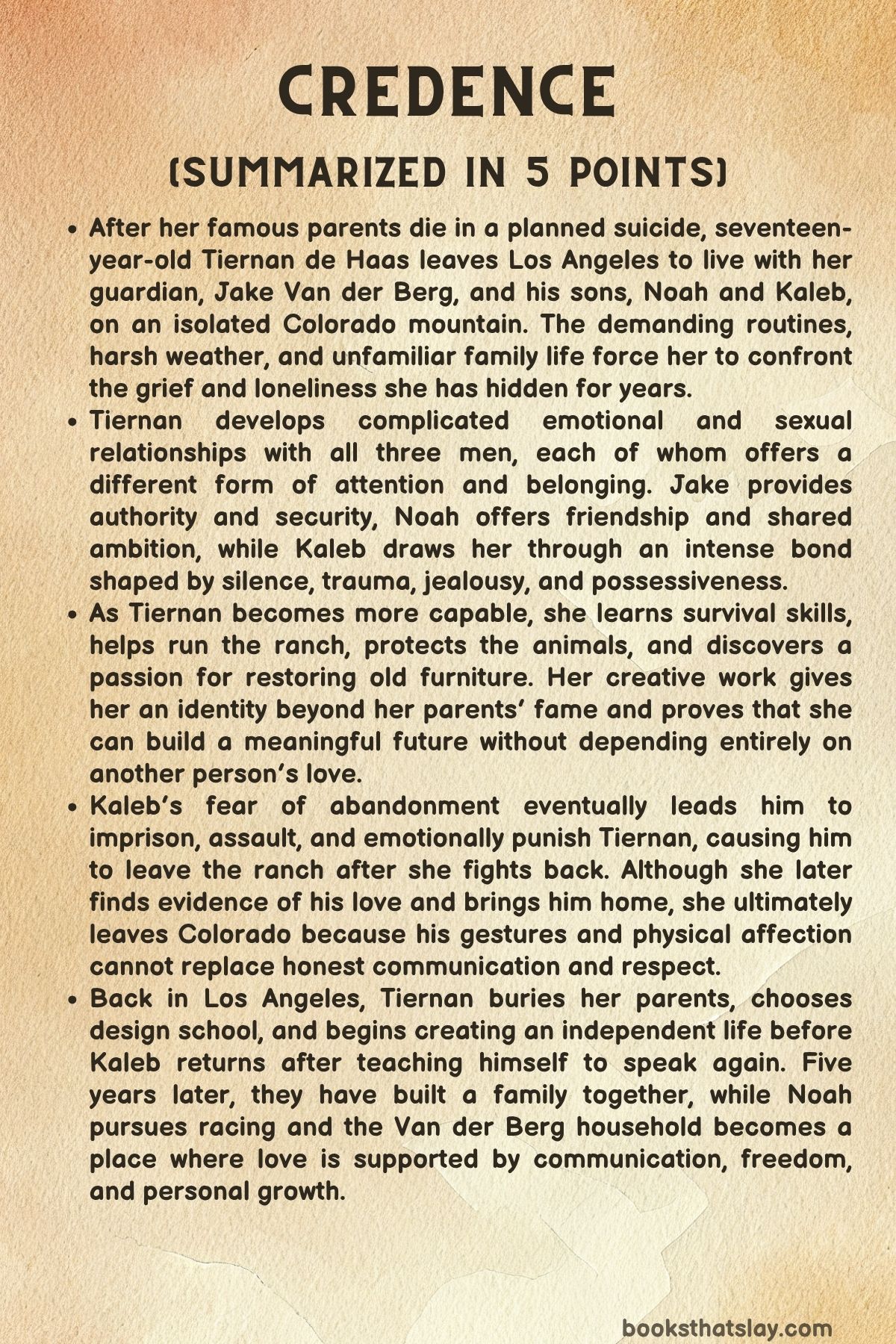
Summary
Seventeen-year-old Tiernan de Haas discovers her famous parents, filmmaker Hannes and actress Amelia, dead together in their bedroom. Hannes had terminal cancer, and Amelia apparently chose suicide rather than face life without him, leaving Tiernan to confront not only their deaths but also the painful knowledge that their devotion to each other had always mattered more than their daughter.
Raised primarily by nannies, boarding schools, and Amelia’s assistant, Mirai, Tiernan has learned to suppress nearly every emotion. She remains numb while police, reporters, and strangers discuss the tragedy, yet the removal of the tire swing her parents once shared causes her to cry because it symbolizes the private happiness from which she was always excluded.
Jake Van der Berg, Hannes’s estranged stepbrother and Tiernan’s appointed guardian, invites her to live at his isolated Colorado property. Desperate to escape celebrity attention and the empty Los Angeles mansion, Tiernan accepts and travels to Chapel Peak, where severe winter weather will soon cut the household off from town.
Jake is rugged, authoritative, and openly resentful of the privileged life Hannes once represented. He lives with his two sons: Noah, an outgoing motocross racer who dreams of leaving the mountain, and Kaleb, an intimidating young man who disappeared into silence after experiencing severe childhood neglect.
Tiernan initially struggles with the household’s rough lifestyle, strict routines, and expectation that everyone contribute. She learns to care for animals, repair equipment, cook, ride through the wilderness, shoot, and perform physically demanding chores, gradually discovering that she is far more capable than her parents ever allowed her to believe.
Jake frequently criticizes her withdrawal, while Tiernan resents his attempts to control her. Their arguments become the first honest emotional exchanges she has experienced in years, and Jake begins to understand that her apparent coldness is not arrogance but a defense created by lifelong neglect.
Noah offers companionship through teasing, playful arguments, and shared frustration with Jake’s authority. He wants a professional racing career but fears confronting his father, whose protectiveness has become a barrier against independence.
Kaleb’s first interaction with Tiernan is aggressive and frightening. He corners her and ignores her attempts to stop him until she fights back, establishing a dangerous pattern in which his attraction, possessiveness, and inability to communicate repeatedly threaten her boundaries.
Despite this beginning, Tiernan becomes increasingly fascinated by him. Kaleb communicates through gestures, looks, handmade gifts, acts of protection, and physical touch, leaving Tiernan to interpret feelings he refuses or is unable to express directly.
The three men become intensely protective when Tiernan attracts attention from local racer Terrance Holcomb. Tiernan challenges their possessiveness by arguing that they cannot demand she reject other men while offering her no affection, intimacy, or emotional honesty themselves.
Her grief finally begins breaking through in the form of night terrors. During one episode, Jake comforts her, and their suppressed attraction leads to a kiss and a highly physical encounter that he stops before intercourse, believing Tiernan is seeking sensation to escape emotional numbness.
Tiernan later returns to California for her parents’ funeral. Listening to speakers celebrate Hannes and Amelia’s achievements and devotion forces her to recognize how completely their public identities erased the lonely child they left behind.
She cries for the relationship they never gave her and accepts that they can no longer provide explanations or apologies. At the same time, she acknowledges that her fear of rejection kept her silent, and she decides she must begin choosing relationships rather than waiting to be chosen.
Tiernan returns to Colorado and begins treating the ranch as her home. Her eighteenth birthday strengthens this sense of belonging when Jake gives her a bow, Noah gives her clothing connected to the family business, and Kaleb gives her a handmade belt engraved with images representing her new life.
At a local celebration, Terrance and Cici attempt to convince Tiernan that the Van der Bergs want her only for her wealth and body. Kaleb attacks Terrance, and the family escapes into heavy snowfall, after which the mountain becomes inaccessible until spring.
Isolation increases the sexual pressure inside the household. Tiernan, Noah, and Kaleb participate in an intimate encounter near the fire, but Jake interrupts, claiming that his sons are treating Tiernan’s emotional and sexual awakening too casually.
Jake’s intervention is complicated by his own jealousy. After another confrontation, he and Tiernan have sex, beginning a secret relationship that offers her physical security and focused attention but places Jake in direct rivalry with his sons.
Jake tries to convince himself that he has protected Tiernan by providing a careful first experience. However, his position as guardian, his age, his emotional loneliness, and his knowledge of Tiernan’s vulnerability make the relationship ethically unstable.
Tiernan soon recognizes that Jake is not as controlled as she once believed. His authority hides jealousy, desire, and fear, while his attempts to guide her sometimes serve his own emotional needs as much as hers.
Noah openly resents Tiernan’s relationship with his father. He believes they would make more natural partners because they share friendship, youth, ambition, and the desire to experience a wider world, but Tiernan refuses to let him redefine her choice as helplessness.
Tiernan also discovers old furniture stored in the barn and begins restoring it. The work gives her an identity separate from her parents’ fame and the men’s attention, allowing her to imagine a future based on creativity and personal accomplishment.
When a barn fire breaks out, Tiernan risks her life to save the animals and suffers a severe injury. Kaleb stitches her wound while Noah comforts her, and the crisis eventually leads to a consensual intimate encounter involving Tiernan and both brothers.
The experience temporarily turns the brothers’ rivalry into cooperation, but it does not resolve their competing claims on Tiernan. Kaleb secretly keeps her hair ribbon, revealing the tenderness beneath his frightening intensity, while Noah continues to hope that emotional openness will eventually draw her toward him.
Jake returns and realizes what happened, deepening the household’s jealousy and resentment. Tiernan continues seeking closeness with Kaleb, whose vulnerability affects her deeply, but his inability to verbalize fear or affection prevents them from creating a stable relationship.
After a newspaper publishes claims that Hannes abused Amelia and forced her into suicide, Tiernan defends her parents through legal action. She does not excuse their failures as parents, but she refuses to let outsiders distort their relationship for profit.
Tiernan decorates the house for Christmas and creates the warmth she never experienced growing up. Yet Kaleb’s jealousy soon turns controlling when he locks her inside her bedroom, proving that his fear of abandonment can make him treat affection as ownership.
Kaleb later enters the room while Tiernan is asleep and uses sexual denial to punish her for sharing intimacy with Jake and Noah. His behavior escalates into assault when he restrains her and continues despite her repeated demands that he stop.
Tiernan escapes into Noah’s bedroom, where he explains the childhood event behind Kaleb’s silence. Kaleb’s drug-addicted mother left him locked in a car for four days, and after Jake rescued him, he stopped speaking because silence had become the only control he possessed.
Understanding the trauma does not erase the harm Kaleb caused. Tiernan attempts to approach him gently, but when she discovers that he has burned the first piece of furniture she restored, she experiences his destruction as another rejection of something she valued.
Kaleb leaves the property during the storm, and Tiernan initially returns to emotional numbness. She then realizes that she has repeated the pattern established by her parents, allowing her sense of worth to depend on whether another person chooses her.
Rather than waiting helplessly for Kaleb, Tiernan resumes restoring furniture. Her work becomes proof that she can care about something, lose something, and still continue creating.
Months later, Tiernan discovers private notes Kaleb has written inside books. The writing reveals an intelligent and frightened inner life filled with love for her, distrust of happiness, and terror that anyone he needs will eventually abandon him.
Tiernan and Noah travel through dangerous winter weather to find Kaleb at a remote fishing cabin. When he returns, Tiernan confronts him and admits that she loves him, but she also explains that complete isolation protects him from betrayal only by preventing him from experiencing happiness.
They bring Kaleb home, but the central problem remains. Tiernan and Kaleb become physically inseparable, yet she increasingly understands that touch cannot permanently replace conversation, shared plans, accountability, and emotional participation.
As winter ends, Noah prepares to leave the mountain and pursue professional racing. He encourages Tiernan to come with him, arguing that she needs education, travel, and opportunities beyond Chapel Peak.
Tiernan asks Kaleb to leave with her or communicate clearly enough to show that he is willing to build a future together. When he cannot speak or write a response, she rides away with Noah, interpreting Kaleb’s silence as a choice to remain trapped by fear.
Cici’s pregnancy creates another crisis when Tiernan suspects Kaleb may be the father. Although the timing eventually proves he cannot be responsible, his refusal to explain himself reinforces Tiernan’s belief that love based on guesses and possessive gestures cannot meet her emotional needs.
Tiernan writes Kaleb a farewell message, explaining that the powerful highs of their relationship cannot compensate for the lows that make her feel like the neglected child she once was. She prepares to leave with Mirai, but Terrance and several accomplices invade the property while she is alone.
Terrance attempts to blackmail Tiernan into financing his racing career and submitting to him. His men admit they started the earlier barn fire and intend to steal motorcycles, destroy the property, and assault her.
Using the bow Jake gave her, Tiernan defends herself and the ranch. She wounds the attackers and shoots Terrance in the shoulder before Jake, Noah, and Kaleb return, demonstrating that she no longer waits passively for others to save her.
Despite learning that Cici’s child cannot be his, Kaleb places Tiernan’s suitcase in Mirai’s car and allows her to leave. Tiernan returns to Los Angeles devastated that he would rather lose her than use his voice.
In California, she buries her parents’ ashes beneath the tree where their tire swing once hung. She auctions their possessions for charity, redesigns her living space, restores furniture, and chooses a design school in Seattle, creating a future that belongs to her rather than to her parents’ legacy.
Noah arrives after securing a professional racing sponsor and admits that racing, not Tiernan, was the life he truly needed to pursue. Jake also comes to Los Angeles, where his argumentative attraction to Mirai brings energy and conflict into the previously silent mansion.
Tiernan then discovers a new tire swing outside and finds Kaleb waiting beside it. By replacing the symbol of her childhood exclusion, he shows that he understands both the pain she carried and the experience she always wanted.
Kaleb finally speaks, explaining that he spent six weeks reading aloud at the cabin until he could reclaim his voice. He apologizes, declares that home is wherever Tiernan is, and agrees to follow her into a wider life rather than demanding that she disappear into his isolation.
Five years later, Tiernan and Kaleb have travelled, lived in Seattle, returned to Chapel Peak, and become parents to a son named Griffin. Tiernan has completed her education, Kaleb speaks openly, Noah has his own career, and the family has learned to remain connected without preventing one another from growing.
Kaleb also begins releasing his hatred toward his mother after learning of her death in prison. Surrounded by Tiernan, Griffin, Jake, Noah, and Mirai, he recognizes that his past still shapes him but no longer controls the family and future he has chosen to build.
Characters
Tiernan de Haas
Tiernan is the emotional center of Credence, beginning as a withdrawn teenager whose silence has been shaped by years of parental neglect. Her apparent coldness conceals deep loneliness, anger, shame, and a fear that asking for affection will only confirm that she is unwanted.
Her parents taught her that love belongs to other people and that she should make herself small enough not to disturb them. Consequently, she enters Colorado unable to identify or express what she needs, relying on numbness as protection against disappointment.
Life on the mountain forces Tiernan to become physically and emotionally active. She works with animals, repairs machinery, learns survival skills, faces danger, and discovers that competence can give her a sense of worth that does not depend on beauty, wealth, or celebrity.
Her sexual choices form a controversial part of her search for identity. She repeatedly insists that inexperience does not make her incapable of consent, yet several relationships involve unequal power, emotional pressure, possessiveness, and moments when her boundaries are ignored or violated.
Tiernan’s attraction to Jake reflects her desire for adult attention and security, while her closeness with Noah grows from friendship and shared restlessness. Her attachment to Kaleb is more consuming because she recognizes in him another person shaped by abandonment, silence, and the belief that love can disappear without warning.
Her restoration work becomes one of the clearest signs of genuine growth. By repairing damaged furniture, she creates beauty from neglected objects and gradually learns that destruction does not have to end her willingness to value, build, or hope.
Tiernan’s strongest development occurs when she refuses to remain with Kaleb under conditions that reproduce her childhood loneliness. She loves him but decides that she cannot keep guessing what he feels, accepting fragments of affection, or treating emotional deprivation as proof of passion.
By leaving Colorado, burying her parents, choosing design school, and building an independent future, Tiernan proves that love is no longer her only source of identity. Her eventual reunion with Kaleb succeeds because she meets him as someone with plans and boundaries rather than as a neglected girl waiting to be claimed.
Kaleb Van der Berg
Kaleb is the most psychologically troubled and morally difficult figure in Credence. His silence, isolation, violence, possessiveness, tenderness, and fear all originate in childhood trauma, but the novel repeatedly demonstrates that an explanation for harmful behavior is not the same as an excuse.
Being abandoned in a car for four days taught Kaleb that dependence is dangerous and that the people he loves can forget him. Silence becomes his method of control because speaking would require vulnerability, trust, and participation in relationships whose outcome he cannot determine.
Kaleb communicates through physical actions, handmade objects, written notes, gifts, protection, destruction, and sexual contact. These methods allow him to express attachment without fully exposing himself, but they force others, especially Tiernan, to interpret his intentions without certainty.
His feelings for Tiernan combine genuine recognition with an unhealthy desire for possession. He understands her loneliness because it resembles his own, yet he reacts to the possibility of losing her by controlling her movements, punishing her emotionally, and treating her independent relationships as betrayals.
The assault marks the point at which Kaleb’s fear becomes indefensible violence. His trauma clarifies why abandonment terrifies him, but Tiernan’s repeated demands that he stop make him responsible for choosing control over her autonomy.
Burning Tiernan’s restored chest further reveals his destructive response to vulnerability. Rather than admitting that he feels unwanted, he attacks something she values, reproducing the same emotional injury her parents inflicted whenever they dismissed her efforts.
Kaleb’s private writing shows that his silence does not reflect an empty mind or an inability to understand consequences. He possesses insight, intelligence, and emotional awareness, but he keeps these qualities hidden because withholding communication protects him from immediate exposure.
His final decision to practice speaking is meaningful because it requires sustained effort outside Tiernan’s presence. Instead of demanding that she return and accept him unchanged, he works to become capable of meeting her in the life she has chosen.
As a partner and father in the epilogue, Kaleb appears more communicative, socially connected, and willing to release old hatred. His development does not erase his earlier actions, but it shows that trauma need not remain a permanent justification for silence, isolation, or control.
Jake Van der Berg
Jake is introduced as the household’s dominant authority, a hardworking father who believes protection requires strict rules and constant control. His rugged competence initially offers Tiernan a sense of safety, structure, and attention that she never received from her parents.
His hostility toward Hannes is rooted in class resentment, family betrayal, and the loss of the woman he loved. Because Tiernan arrives carrying the name, wealth, and appearance associated with that history, Jake struggles to separate his responsibility toward her from unresolved anger toward her parents.
Jake genuinely helps Tiernan become more capable. He teaches her practical skills, provides comfort during her night terrors, challenges her emotional withdrawal, and treats her as someone whose decisions and efforts matter.
However, his relationship with her is defined by a serious imbalance of age, authority, and experience. As her guardian, he understands her grief and vulnerability, yet he eventually pursues his own desire while continuing to describe himself as her protector.
Jake often rationalizes his behavior by claiming that he can give Tiernan a safer experience than another man. This reasoning allows him to avoid confronting the fact that he is using his knowledge of her needs while competing with his own sons for her affection.
His apparent self-control also weakens as jealousy grows. Tiernan eventually recognizes that the stability she associates with him is partly an image, since he is as influenced by loneliness, possessiveness, and fear as Noah and Kaleb.
Jake’s parenting contains a similar contradiction. He loves Noah and Kaleb fiercely but attempts to prevent pain by limiting their independence, particularly when refusing to support Noah’s racing ambitions.
His willingness to let Noah leave represents important growth. By accepting that protection cannot mean permanent confinement, Jake begins treating his adult children as people whose mistakes and ambitions belong to them.
Jake’s developing relationship with Mirai also offers the possibility of a more equal partnership. Unlike Tiernan, Mirai openly challenges him, understands his weaknesses, and is not dependent on his authority for security or belonging.
Noah Van der Berg
Noah uses humor, flirtation, sexual activity, and reckless confidence to conceal dissatisfaction with his life. He appears more socially comfortable than Kaleb, yet he is also trapped by fear, family loyalty, and Jake’s refusal to support his departure.
His desire to race professionally represents more than a career goal. Racing offers movement, recognition, risk, and a world beyond the repetitive work of the mountain, making it an expression of the freedom he has been unable to demand directly.
Noah becomes Tiernan’s first approachable companion in Colorado. Their teasing, practical work, arguments, and shared frustration create a friendship that often feels more balanced than her relationships with Jake or Kaleb.
His attraction to Tiernan complicates this friendship. Although he is usually more communicative than the other men, he sometimes dismisses her refusals by insisting that he understands her desire better than she does.
Noah’s jealousy toward Jake exposes longstanding resentment between father and son. He believes Jake controls the household by defining everyone’s needs, and Tiernan’s relationship with Jake appears to confirm that his father will always claim what Noah wants before Noah can act.
At his best, Noah provides tenderness without demanding immediate explanations. When Tiernan escapes from Kaleb, Noah allows her to seek comfort and tells her the truth about Kaleb’s childhood without insisting that trauma should automatically produce forgiveness.
Noah also becomes capable of recognizing that his future does not depend on winning Tiernan. Securing a racing sponsor allows him to separate romantic desire from his deeper need for purpose and independence.
His continued presence in Tiernan, Kaleb, and Griffin’s lives shows that rejection does not have to destroy family affection. Noah matures when he stops treating departure as abandonment and begins seeing independence as a way to preserve connection without surrendering identity.
Mirai
Mirai is the closest figure Tiernan has to a dependable parent before Colorado. She managed the practical responsibilities that Amelia neglected and offered Tiernan affection without requiring her to compete for attention.
Her concern about Jake’s guardianship is justified by the household’s unstable boundaries. She recognizes Tiernan’s habit of suppressing distress and understands that outward calm cannot be treated as evidence that she is emotionally safe.
Mirai is protective without being entirely controlling. Although she disapproves of much that happens in Colorado, she continues listening to Tiernan and eventually accepts that Tiernan views the Van der Bergs as family.
Her direct embrace after the attack by Terrance gives Tiernan the uncomplicated comfort the men often fail to provide. Mirai does not make Tiernan explain herself before offering care, and she does not confuse love with sexual possession.
Her arguments with Jake suggest strong similarities beneath their differences. Both are stubborn, protective, capable, and devoted to Tiernan, but Mirai confronts Jake as an equal rather than responding to his authority.
The later relationship between them implies that Jake may finally be capable of intimacy with someone who cannot be controlled through age, guardianship, or dependence. Mirai’s presence also ensures that Tiernan’s future includes continuity with her old life rather than a complete rejection of everything connected to California.
Hannes de Haas
Hannes is present primarily through his death, reputation, and the emotional damage he left behind. A celebrated filmmaker and devoted husband, he invested his identity in Amelia while treating Tiernan as an interruption to their private partnership.
His terminal illness leads to the planned death at the beginning of the story. Although he carefully arranges practical matters, his failure to leave Tiernan a personal explanation confirms the emotional distance that defined their relationship.
Jake remembers Hannes through resentment and family conflict, particularly the incident involving Flora. This history complicates Hannes’s public image by suggesting that privilege allowed him to participate in actions whose consequences others were forced to carry.
Tiernan’s defense of him against false abuse allegations does not represent forgiveness. Instead, it shows that she can distinguish between his genuine failures and invented accusations created for public entertainment.
Hannes’s greatest influence lies in the pattern Tiernan must reject. His relationship teaches her that intense love can become selfish when two people build a private world that treats everyone outside it as unnecessary.
Amelia de Haas
Amelia is remembered as a talented actress whose devotion to Hannes dominated every other relationship. Her decision to die beside him demonstrates the intensity of that attachment, but it also becomes her final abandonment of Tiernan.
She offers her daughter beauty, status, material privilege, and occasional advice but little sustained emotional attention. Tiernan even abandons small pleasures, such as eating candy, in unsuccessful attempts to become the daughter Amelia might notice.
Amelia’s relationship advice about lust, learning, and love influences how Tiernan interprets the men in Colorado. However, Tiernan eventually recognizes that life cannot be reduced to a predetermined sequence of partners or lessons.
The novel does not portray Amelia simply as a victim of Hannes. Tiernan strongly rejects that public interpretation because she knows her mother possessed agency and willingly chose her husband over every other attachment.
Amelia’s failures continue influencing Tiernan long after the funeral. Tiernan repeatedly fears that she must earn love, tolerate emotional absence, or remain desirable enough to prevent someone from leaving.
Burying Amelia’s ashes allows Tiernan to mourn both the mother who died and the mother she never had. The act acknowledges pain without requiring Tiernan to idealize her parents or carry their possessions as substitutes for memories they never created.
Terrance Holcomb
Terrance represents entitlement without emotional complexity or genuine affection. He views Tiernan as an attractive outsider whose wealth and association with the Van der Bergs can be exploited for status, money, and power.
His early flirtation appears uncomplicated only because Tiernan has not yet recognized his hostility. He quickly reveals his willingness to sexualize her publicly and provoke violence for entertainment.
Terrance’s resentment toward Noah and Kaleb grows from competitive humiliation. Rather than accepting defeat in racing or conflict, he retaliates through sabotage, theft, arson, blackmail, and planned sexual violence.
His invasion of the ranch transforms him from a local antagonist into an immediate physical threat. By defending herself with the bow, Tiernan rejects both Terrance’s attempt to dominate her and the assumption that she exists merely as someone the Van der Berg men must rescue.
Terrance’s defeat also exposes the difference between protection and possession. The men often claim Tiernan in controlling ways, but Terrance sees her as an object with no independent desires at all.
Cici Diggins
Cici functions as Tiernan’s local rival, particularly in connection with Noah and Kaleb. Her hostility reflects jealousy, territorial competition, and an awareness that Tiernan’s arrival has changed the social balance around the Van der Berg family.
She attempts to undermine Tiernan by suggesting that the men are interested only in wealth and sex. The claim is deliberately cruel, but it succeeds because it targets Tiernan’s deepest fear that affection is temporary and conditional.
Cici’s pregnancy later becomes a test of Tiernan’s trust in Kaleb. Because Kaleb refuses to communicate, Tiernan is forced to imagine the worst, demonstrating how silence allows suspicion to become more powerful than evidence.
Once the timing proves that Kaleb cannot be the father, Cici’s role in the central conflict diminishes. Her presence nevertheless shows how easily rivalry between women can be encouraged when men refuse to communicate honestly about their relationships.
Anna Leigh
Anna Leigh, also referred to through the family’s memories of Kaleb and Noah’s mother, is the source of the brothers’ deepest childhood injuries. Her addiction, neglect, imprisonment, and demands for money create different forms of pain in each son.
For Kaleb, being left inside the car produces trauma so severe that he stops speaking. For Noah, her continued contact keeps the wound active because she appears when she needs something but does not provide dependable maternal love.
Her death in prison forces the brothers to decide whether letting go of hatred means excusing what she did. Noah argues that they can acknowledge the person addiction prevented her from becoming without denying the harm she caused.
Kaleb’s decision to scatter part of her ashes represents release rather than reconciliation. By then, he has built a family capable of giving Griffin the security that he and Noah never received.
Flora
Flora is Jake’s former partner and the mother whose loss shaped the Van der Berg household. Her relationship with Jake was damaged by manipulation, money, guilt, addiction, and the influence of Jake’s wealthy family.
Although she appears mainly through recollection, her absence affects every major relationship on the mountain. Jake becomes controlling because he fears another loss, Noah hides his pain behind humor, and Kaleb associates love with abandonment.
Tiernan initially risks becoming a substitute through whom the men replay unresolved feelings about Flora. Her eventual insistence on being heard as an individual prevents her from remaining only a replacement for someone they could not save.
Griffin Van der Berg
Griffin appears in the epilogue as Tiernan and Kaleb’s young son. His secure place within the extended family represents the clearest contrast with the childhoods of both parents.
Tiernan was emotionally excluded, while Kaleb was physically abandoned and traumatized. Griffin receives attention, playfulness, safety, and relationships with parents, grandparents, and an uncle who openly enjoy his presence.
His existence does not serve merely as proof of romantic happiness. He symbolizes the couple’s responsibility to transform their painful histories into a family structure that does not repeat neglect, silence, or emotional isolation.
Themes
Abandonment, Silence, and the Fear of Being Forgotten
Abandonment shapes nearly every important relationship in Credence. Tiernan’s parents remain physically present throughout her childhood but exclude her emotionally, teaching her that a person can live in the same house and still be treated as though she does not matter.
Kaleb experiences abandonment in a more visibly traumatic form when his mother leaves him trapped inside a car. His silence begins as a survival strategy, allowing him to retain a sense of control after discovering that crying and calling for help do not guarantee rescue.
Tiernan and Kaleb therefore recognize the loneliness in each other, but they respond to it differently. Tiernan makes herself emotionally invisible to avoid rejection, while Kaleb attempts to prevent rejection by controlling the person he fears losing.
Their relationship demonstrates that shared trauma does not automatically create healthy understanding. Without communication and accountability, the fear of being forgotten can produce the very behavior that drives loved ones away.
Noah also carries abandonment anxiety, though he disguises it through humor and casual relationships. His mother contacts him primarily for money, while Jake’s refusal to let him leave suggests that even protective love can feel like distrust.
The characters begin healing only when they stop defining departure as permanent rejection. Tiernan leaves Colorado without ceasing to love the family, Noah pursues racing without abandoning his brother, and Kaleb eventually leaves the mountain to join Tiernan.
Their progress suggests that secure love does not require constant physical possession. It requires trust that connection can survive distance, change, independence, and the possibility that another person may choose a path one cannot control.
Consent, Possession, and Unequal Power
The novel repeatedly places desire beside questions of control, consent, age, authority, and emotional vulnerability. Tiernan insists that she is capable of making sexual decisions, yet her legal dependence, grief, inexperience, and need for affection create conditions in which consent cannot be separated from power.
Jake understands Tiernan’s history and recognizes that she sometimes seeks intense sensation to escape numbness. His initial refusal appears protective, but his later decision to become her sexual partner exposes the contradiction between claiming responsibility for someone and pursuing personal satisfaction through that authority.
Noah’s behavior is less structurally unequal, yet he sometimes treats Tiernan’s refusal as temporary confusion. By insisting that she must secretly want him, he risks replacing her stated choice with his preferred interpretation.
Kaleb presents the clearest danger because he repeatedly confuses love with possession. Locking Tiernan in her room, punishing her through sexual control, restraining her, and ignoring her demands to stop transform his fear of abandonment into assault.
The story distinguishes between desire and permission through Tiernan’s reactions. She may desire a person intensely in one moment, but that desire does not create permanent access to her body or cancel her right to withdraw consent.
Tiernan’s development therefore depends on learning to say no without disappearing afterward. She rejects Noah’s attempt to redefine her choices, leaves Kaleb when he cannot communicate, and fights Terrance when he attempts complete domination.
Her independence becomes meaningful when she no longer mistakes being wanted for being respected. Love becomes sustainable only after Kaleb accepts that he must follow freely rather than imprison, punish, or prevent Tiernan from leaving.
Identity Beyond Family, Wealth, and Romantic Attention
Tiernan begins the story with an identity constructed almost entirely by other people. To the public, she is the daughter of two celebrities; to her parents, she is an interruption; and to strangers, her grief is evidence to be judged through photographs and gossip.
Her wealth gives her material freedom but does not teach her how to make decisions, form relationships, or understand her own preferences. Even simple pleasures have been abandoned because she spent years trying to become someone her mother might approve of.
Colorado initially offers Tiernan a place where her name and money have less immediate importance. Physical labor, practical responsibility, and survival require effort that cannot be replaced by status.
The restoration of furniture becomes central because it allows her to produce rather than inherit. Each damaged object gives her an opportunity to imagine, repair, and create something whose value depends on her judgment.
Kaleb’s destruction of the chest is therefore especially painful. He does not merely burn a possession; he attacks one of the first things Tiernan valued because it represented her emerging self.
Her decision to continue working marks a turning point. She understands that protecting herself by valuing nothing would only allow every rejection to dictate who she becomes.
Returning to Los Angeles further tests this independence. Instead of retreating into her parents’ mansion and legacy, she buries their ashes, sells their possessions for charity, redesigns her room, and applies to design school.
Tiernan’s eventual reunion with Kaleb occurs after she has established goals beyond the relationship. She can love him without making him responsible for her entire identity because she has education, creative ambition, family connections, and confidence in her ability to survive alone.
Healing Through Communication and Chosen Family
The Van der Berg household gives Tiernan the conflict, noise, responsibility, and attention missing from her childhood. Its members argue, tease, work, eat, celebrate, and protect one another, creating a sense of participation that contrasts with the polished emptiness of her parents’ home.
However, chosen family is not automatically healthy simply because it provides belonging. Jake’s control, Noah’s jealousy, Kaleb’s violence, and Tiernan’s emotional dependence show that affection can reproduce harm when people refuse to communicate honestly.
Tiernan’s funeral realization establishes communication as a personal responsibility. She acknowledges that her parents failed her, but she also recognizes that silence kept her from seeking other relationships or clearly expressing how lonely she felt.
Noah’s eventual departure demonstrates healthier family connection. He can pursue racing, build an independent life, and remain emotionally close to Jake, Kaleb, Tiernan, and Griffin.
Kaleb’s recovery depends most clearly on communication. Physical gestures and written notes reveal genuine feeling, but they cannot give Tiernan the conversations, apologies, plans, and reassurance required for partnership.
His choice to practice reading aloud matters because he begins the work while Tiernan is absent. Speaking becomes an act of responsibility rather than a performance intended to stop her from leaving in the moment.
The new tire swing symbolizes the possibility of revising painful memories without pretending they never occurred. Kaleb cannot give Tiernan the childhood her parents denied her, but he can understand what the symbol meant and create a new experience based on inclusion.
By the epilogue, family is presented as an ongoing practice rather than a fixed biological arrangement. Tiernan, Kaleb, Griffin, Noah, Jake, and Mirai remain connected because they communicate, allow movement, share responsibility, and repeatedly choose participation over isolation.