Obstetrix by Naomi Kritzer Summary, Characters and Themes
Obstetrix by Naomi Kritzer is a psychological suspense novel about medical duty, religious extremism, captivity, and the struggle for personal freedom.
It follows Dr. Elizabeth “Liz” Gwinn, an obstetrician abducted by an isolated fundamentalist community that needs her professional skills but refuses to respect her autonomy. Forced to care for pregnant women under dangerous conditions, Liz must balance her desire to escape with her responsibility toward patients who have little control over their bodies or futures. The story presents survival not as a single heroic act but as a combination of patience, observation, moral courage, and carefully chosen resistance.
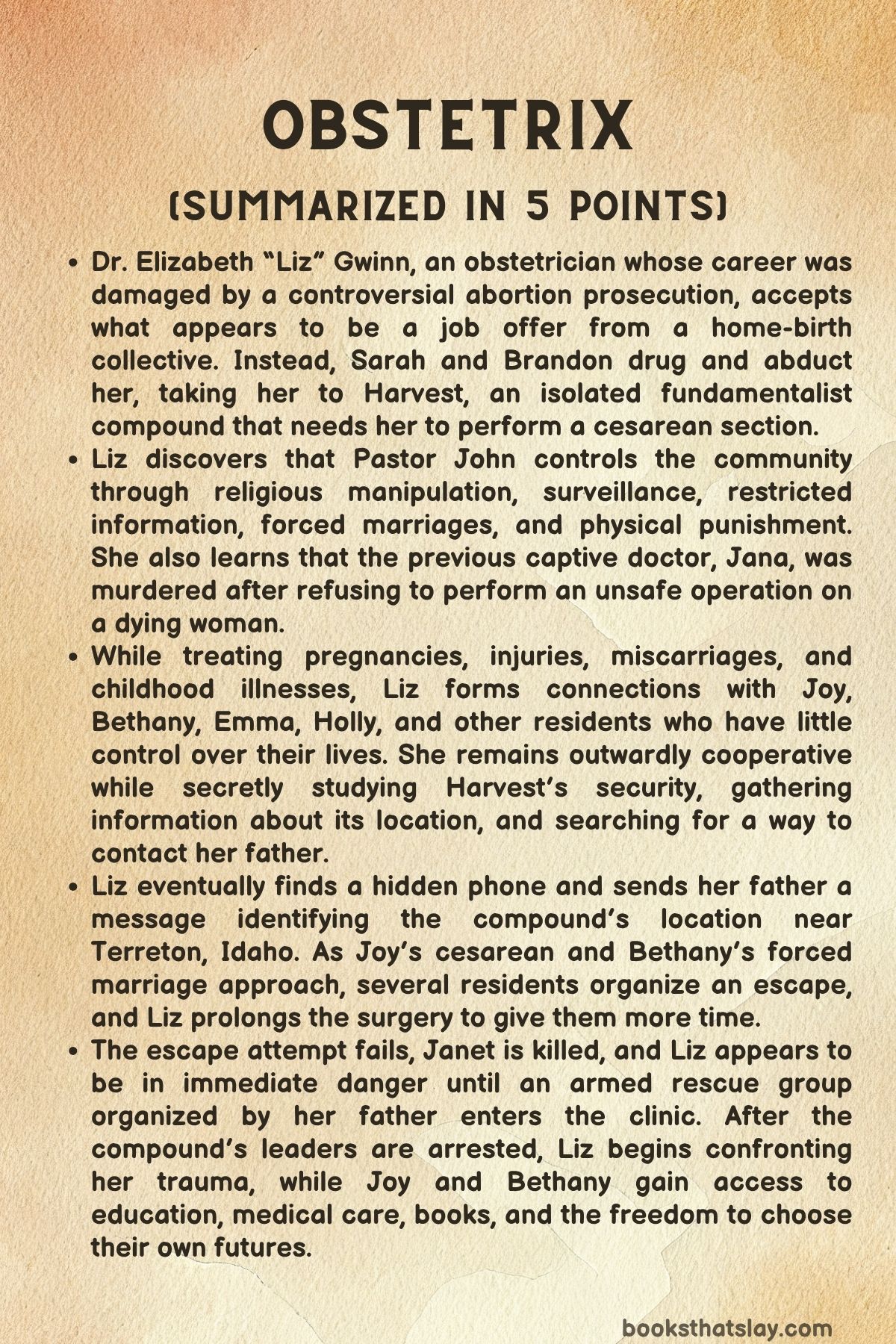
Summary
Dr. Elizabeth “Liz” Gwinn is an experienced obstetrician whose professional life has been damaged by a highly publicized criminal prosecution. She performed an abortion for Maddy, a patient suffering from severe hyperemesis gravidarum, dangerous weight loss, and kidney failure, but North Dakota authorities accused her of acting unlawfully.
Although Liz was acquitted, the case continues to follow her. Prospective employers regard her as a potential source of controversy, and an interview at a Minnesota maternity practice ends without any real promise of employment.
Financial pressure leaves Liz vulnerable when Sarah Smith contacts her with an unusual offer. Sarah claims to represent a home-birth collective looking for a physician willing to provide medical assistance to women outside the conventional hospital system.
Liz agrees to meet Sarah, believing the conversation may lead to badly needed work. Instead, Sarah drugs her drink, and Liz awakens while being transported in a minivan by Sarah and a man named Brandon.
Liz manages to escape briefly at a gas station and attempts to alert people nearby. Her kidnappers calmly tell the bystanders that she is an addict being taken to a rehabilitation facility, and the explanation is accepted without serious questioning.
She is forced back into the vehicle and taken to Harvest, an isolated religious compound occupied by large families, pregnant women, and children. The residents have prepared a cabin for her, gathered medical equipment and drugs, and created a crude clinic that they expect her to operate.
Liz soon learns why she has been abducted. Joy, the twenty-year-old daughter of Harvest’s leader, Pastor John, has a serious uterine abnormality and will probably require a cesarean section.
Even while terrified, Liz cannot ignore the medical needs around her. When a woman named Grace Lynn suffers a severe tear during childbirth, Liz repairs the injury properly because her professional ethics will not allow her to provide careless treatment.
The compound’s preparations show that Liz’s abduction was carefully planned. She becomes even more frightened when she realizes that Harvest previously held another physician and that the doctor was probably killed rather than released.
Pastor John controls Harvest through religious authority, surveillance, punishment, and fear. He describes the outside world as corrupt and dangerous, presenting the compound as a place of divine protection rather than a prison.
Books, personal Bibles, telephones, and Internet access are forbidden. Pastor John alone determines what information residents may receive, allowing him to interpret scripture in ways that support complete obedience to his leadership.
Liz notices signs of physical punishment on children and adults. She also begins distinguishing between residents who willingly joined Harvest and younger people who were born or raised there and have never experienced genuine freedom.
Joy’s medical condition is more dangerous than Liz initially understood. She has a severely bicornate uterus, and the baby lies sideways, making a vaginal delivery nearly impossible.
Joy also reveals that her husband, David, was unable to father a child. Pastor John therefore ordered her to have sex with David’s brother Calum so that she could become pregnant, treating her body as communal property rather than her own.
Liz insists that Joy should deliver in a properly equipped hospital. Joy responds that the community will never allow that and that Liz is the only doctor she is going to receive.
Sarah punishes Liz for resisting Harvest’s decisions by withholding food. Liz is then taken to the compound graveyard, where Calum and Elmo show her the unmarked grave of Dr. Jana, the previous captive physician.
Jana had refused to operate under unsafe conditions on Ginny, Ethan’s dying wife. Ethan shot her, establishing that Liz will also be killed if she refuses to cooperate or becomes unnecessary.
Liz decides that open defiance will not save her. Remembering her father Sam’s experiences during the Vietnam War, she resolves to conserve her strength, appear cooperative, observe everything around her, and wait for a real opportunity.
She mentally revisits scenes from her favorite fantasy novel, The Onyx Dagger, whose imprisoned heroine survives through patience. The story becomes a private source of discipline whenever fear or hopelessness threatens her judgment.
As Liz becomes familiar with Harvest’s routines, she meets women such as Emma, Janet, Heather, Holly, and Natalie. Their conversations reveal that some adults were recruited through infertility support groups, religious communities, or Pastor John’s revival meetings.
Liz also meets Emma’s thirteen-year-old daughter, Bethany. The girl is intelligent, curious, and eager to learn, but every question she asks is redirected toward submission and obedience.
Ordinary activities are reshaped to fit Harvest’s ideology. Yoga is permitted only after its movements are given Christian names, while Bible lessons are used to teach that obedience to Pastor John is equal to obedience to God.
Bethany wonders whether hiding from the outside world is truly moral. Instead of answering honestly, the adults urge her to silence her doubts and trust the pastor’s decisions.
The community’s brutality becomes clearer when a man admits that he viewed pornography. He is taken away for a “thrashing,” revealing that Harvest relies on violence to punish even private acts of disobedience.
Liz begins taking short nighttime walks, claiming that hot flashes make it difficult for her to sleep. She hopes that repeated harmless movements will eventually make the guards less attentive, giving her greater freedom later.
She also learns that Joy secretly includes forbidden secular stories in lessons for the children. Bethany confesses that Pastor John may have banned books partly because she loved reading so much that she sometimes neglected her chores.
Pastor John eventually discovers the marks Liz has been making to count the days of her captivity. He forces her to erase them, reframes her kidnapping as a rescue from evil, and warns her that resistance could lead to physical punishment.
He gives her a calendar only because she needs dates for medical purposes. His calculated gesture shows how apparently generous decisions at Harvest remain tools of control.
Weeks pass, and Liz continues treating illnesses, infections, injuries, pregnancies, and complications. She resents nearly every adult involved in her imprisonment, but she refuses to take that anger out on vulnerable patients.
A frightened newlywed named Chloe comes to Liz because she has not become pregnant. Chloe fears Pastor John will remove her from her gentle husband, Nick, and assign her to Ethan.
Liz learns that Chloe is only fifteen. Her older sister Ginny died during childbirth while married to Ethan, and the possibility that Chloe could share the same fate terrifies both her and Nick.
Ginny suffered a placental abruption that required emergency hospital treatment. Dr. Jana begged the community to call an ambulance, but Sarah attempted to induce delivery herself, and Ethan murdered Jana when she refused to perform an unsafe operation.
The history confirms that Harvest’s leaders repeatedly place ideology above human life. It also shows Liz that medical failure will be blamed on the doctor, even when the community has prevented her from providing proper care.
Liz quietly searches for a way to send information outside. She prepares hidden notes containing her name and her father’s telephone number, hoping one might reach a delivery driver or visitor.
While unloading groceries with Emma and Jason, she steals a receipt and discovers that Harvest is near Terreton, Idaho. The receipt also shows a request for cash back, making Liz suspect that Emma may be secretly gathering money for an escape.
During Holly’s miscarriage, Liz discovers a forbidden romance novel hidden in a bathroom. She later finds an unlocked cell phone taped behind a dresser drawer.
Using the phone, Liz texts Sam. She identifies herself, explains that she has been kidnapped, gives the location and minivan licence plate, and warns that the previous captive doctor was murdered.
Liz deletes the messages and carefully replaces the phone. She waits for rescue, but no authorities arrive, leaving her uncertain whether the message was delivered or taken seriously.
Bethany asks to become an apprentice to Liz and Sarah. The request gives the girl access to medical knowledge, but Liz is horrified to learn that Bethany is betrothed to Ethan and expected to marry him when she turns fourteen.
The hidden novel and phone are eventually discovered after Holly’s son reveals the book. Pastor John blames Holly’s miscarriage on her disobedience, burns the novel, destroys the phone, and orders the Elders to beat her.
The residents sing “Amazing Grace” while Holly is punished. Liz remains silent because intervention would probably make the beating worse, but afterward she feels deep guilt for having witnessed the violence without stopping it.
Following the punishment, residents surrender other hidden books and phones during an offer of temporary forgiveness. Liz recognizes that Harvest survives because residents monitor one another and because almost nobody feels safe enough to trust another person completely.
She secretly tells Joy that she will help her escape, but the conversation is interrupted. Liz considers stealing a gun, creating a medical emergency, setting a fire, damaging machinery, or escaping on foot.
Each option carries a serious risk to patients, children, or potential allies. Liz also doubts that she could deliberately shoot someone, even Pastor John, unless she faced an immediate threat.
Bethany begins assisting at births and watches Liz resolve a dangerous shoulder dystocia. Her admiration for Liz grows, but so does Liz’s fear that the leaders may punish Bethany whenever they cannot safely punish the doctor.
One night, Liz sees an agricultural drone and flashes an SOS with her flashlight. Nothing happens, and she assumes once again that her attempt has failed.
March approaches, bringing two urgent deadlines. Joy will soon need surgery, and Bethany will be forced to marry Ethan.
A sudden warm wind melts much of the snow, making escape on foot seem possible. Sarah anticipates Liz’s thinking, watches her closely, and has the window of Liz’s cabin nailed shut.
Joy later creates an argument over spoiled canned corn, apparently helping Emma and Jason attempt an escape. Their effort fails, but Liz discovers that the minivan key is stored inside a locked kitchen cabinet.
Liz tries another form of resistance by claiming that Bethany’s pelvis is too immature for pregnancy. Sarah dismisses the warning because Harvest’s ideology requires Bethany to marry and produce children regardless of the medical danger.
Joy eventually goes into labor and gives Liz a secret note. An escape will take place during the cesarean section, and Liz must prolong the operation without placing Joy or the baby in unnecessary danger.
Liz performs the surgery in the crude clinic with Sarah and Mike, a veterinary assistant. She works slowly, explains each procedure in detail, repeatedly counts instruments, and uses every safe excuse to gain time.
The child, a healthy boy, is delivered successfully. Janet carries him away while Jason, Emma, Bethany, JJ, and Janet flee in a slow utility vehicle.
David and Ethan pursue them. Janet is shot and killed, while the others are captured and brought back.
David then tries to remove Liz from the clinic, apparently intending to kill her now that the operation is complete. Bethany screams for help as armed strangers suddenly enter the building.
The newcomers are members of a rescue group organized by Sam. He embraces Liz and explains that he received her message but needed assistance locating the isolated compound.
Liz refuses to leave until the rescuers also secure Joy, her baby, Emma, Jason, Bethany, and JJ. Even at the moment of her own rescue, she remains responsible for the people whose lives have become connected to hers.
Sam explains that the FBI responded slowly despite the seriousness of Liz’s text. Several of his friends from the Veterans of Foreign Wars had experience operating military drones, so they formed an unofficial task force and travelled to Idaho.
They used aerial searches to locate possible compounds. Their original plan was simply to find Liz and contact authorities, but after hearing the gunshot that killed Janet, they decided immediate intervention was necessary.
Janet’s body is found beside the road with a fatal gunshot wound. Pastor John, Ethan, David, Sarah, and Brandon are arrested, and Dr. Jana’s remains are exhumed.
Investigators face the difficult task of separating people who actively committed crimes from residents who participated under coercion. Liz gives a formal statement with a lawyer present and undergoes a medical examination.
Although she is physically safe, she continues experiencing nightmares, guilt, and distress. Her inability to stop Holly’s beating troubles her almost as deeply as the danger she personally faced.
Sam describes this suffering as moral injury. Drawing on his own wartime experiences, he helps Liz understand that surviving an impossible situation does not mean she was responsible for every harm she could not prevent.
Before leaving Idaho, Liz visits Joy, who is living in a shelter with her son, Charlie. Joy has begun reading library books with enthusiasm, discovering ideas and possibilities that Harvest denied her.
Liz also visits Bethany, who has received proper glasses and dental treatment. She explains that becoming an obstetrician will require school, college, medical training, and years of work, but emphasizes that Bethany now has the right to choose her own future.
As a final gift, Liz gives Bethany her treasured copy of The Onyx Dagger. The book that helped Liz endure captivity becomes a symbol of education, imagination, independence, and the possibility of building a life based on personal choice.
Characters
Dr. Elizabeth “Liz” Gwinn
Liz is the central character of Obstetrix, and her identity as a physician shapes nearly every decision she makes. Her captors view her medical knowledge as a resource they can own, but she continues treating that knowledge as a responsibility toward individual patients.
Her greatest strength is controlled patience rather than physical power. She studies Harvest’s routines, learns who can be trusted, tests the guards’ reactions, collects geographical information, and waits for circumstances in which resistance might succeed.
Liz’s professionalism also creates painful moral conflicts. She cannot abandon Joy, Chloe, Bethany, Holly, or the other women, even though caring for them helps the compound continue functioning.
She understands that refusing treatment could lead to preventable deaths, yet providing treatment may strengthen the authority of the people holding her captive. Her choices therefore involve constant calculations between immediate safety and long-term liberation.
Her guilt after Holly’s beating reveals the depth of her conscience. Although intervening would probably have worsened the punishment, Liz judges herself for remaining silent because she instinctively believes a doctor should protect vulnerable people.
Her recovery begins when Sam names this distress as moral injury. Liz gradually recognizes that captivity deprived her of ordinary choices and that responsibility belongs primarily to the people who created the violent system.
Sarah Smith
Sarah is one of the most complicated figures in the novel because she is both a participant in Harvest’s oppression and a person shaped by its control. She drugs Liz, helps abduct her, withholds food, monitors her movements, and assists Pastor John in enforcing obedience.
Her medical role gives her authority over women without the training required to manage serious complications safely. Her attempt to handle Ginny’s placental abruption without hospital care contributed to a preventable death and exposed the danger of confidence unsupported by expertise.
Yet Sarah occasionally reveals traces of the person she might have been outside Harvest. Her emotional reaction to discussions about books suggests that she once valued reading and may understand more about the compound’s deprivation than she admits.
Her marriage to Brandon was ordered after their previous spouses escaped together, showing that she also lives under Pastor John’s power. This does not excuse her actions, but it explains how a victim can become an active enforcer when obedience offers status and protection.
Pastor John
Pastor John is the architect of Harvest’s social order. He controls access to scripture, information, marriage, sexuality, medical care, punishment, and contact with the outside world.
He presents his decisions as divine commands, making resistance appear sinful rather than merely disobedient. By claiming exclusive knowledge of God’s will, he prevents residents from developing moral judgments independent of his authority.
His greatest weapon is not physical force alone but the creation of a closed reality. Residents are taught that the outside world is controlled by evil, while kidnapping, forced marriage, assault, and medical neglect are described as protection or spiritual discipline.
His treatment of Liz demonstrates his calculated style. He alternates intimidation with limited privileges, such as allowing her a calendar, so that basic necessities appear to be gifts granted by his generosity.
Pastor John also encourages residents to monitor one another. This system reduces the need for constant direct supervision because fear and suspicion turn families, spouses, and children into extensions of his authority.
Joy
Joy is Pastor John’s daughter, but her position does not protect her from exploitation. Her marriage, sexual relationships, pregnancy, and medical care are all controlled by the community.
She has been ordered to conceive with Calum because David is infertile. The arrangement shows how Harvest treats women’s bodies as instruments for producing children rather than as bodies belonging to autonomous individuals.
Joy understands the danger of her pregnancy and quietly accepts Liz’s medical judgment. Her statement that Liz is the only doctor she will receive is not genuine consent but a recognition that the compound has eliminated every safer option.
She gradually becomes an important participant in the escape effort. Her argument over the spoiled corn and her secret note during labor show that she can observe, plan, and take risks despite living under her father’s control.
After her rescue, Joy begins reading freely and caring for Charlie in a shelter. Her enthusiasm for books suggests an intellectual hunger that had been suppressed rather than destroyed.
Bethany
Bethany represents the future that Harvest intends to control and the future that may still be reclaimed. In Obstetrix, her curiosity repeatedly challenges a culture that demands obedience before understanding.
She asks whether hiding from the world is morally right, wants access to books, and eagerly studies medicine. These impulses show that independent thought continues to develop even when adults attempt to suppress it.
Her engagement to Ethan reveals the extreme vulnerability of girls raised inside the compound. At thirteen, she is treated as old enough for marriage and pregnancy but not old enough to choose what she reads, where she lives, or what she believes.
Her apprenticeship with Liz becomes an alternative education. By watching competent medical care, she encounters a model of female authority based on knowledge, discipline, and service rather than submission.
After her rescue, proper glasses and dental treatment restore basic forms of care Harvest denied her. Liz’s explanation of medical training gives Bethany a realistic path forward while making clear that the decision belongs to her.
Sam Gwinn
Sam is Liz’s father and an important emotional influence even before he physically appears. His experience surviving war teaches Liz that endurance may depend on patience, observation, and conserving strength.
Once he receives her message, he refuses to accept institutional delay as a reason for inaction. He recruits friends with military and drone experience, searches the Idaho countryside, and organizes the effort that ultimately reaches Harvest.
His rescue is not presented as effortless heroism. He initially intends to locate Liz and contact law enforcement, changing his plan only when the situation becomes immediately lethal.
Sam’s most valuable contribution after the rescue is emotional understanding. By identifying Liz’s moral injury and sharing his own trauma, he helps her interpret guilt without dismissing the suffering behind it.
Ethan
Ethan embodies Harvest’s most direct physical violence. He murdered Dr. Jana after she refused to perform an unsafe operation on Ginny, converting his grief and entitlement into lethal punishment.
His authority depends on the community’s willingness to excuse or sanctify brutality. Rather than treating him as a murderer, Harvest continues allowing him to guard the compound and prepares to give him another young wife.
His planned marriage to Bethany is especially disturbing because it shows that his past violence has not reduced his status. The leadership instead offers him access to another vulnerable girl.
Ethan’s role in pursuing the escapees and the violence surrounding Janet’s death confirm that he remains committed to preserving Harvest through force. He represents the endpoint of a culture that teaches men they are entitled to control women’s bodies and punish resistance.
Dr. Jana
Dr. Jana never appears alive, but her fate defines the danger surrounding Liz. Like Liz, she was brought to Harvest because the community needed professional medical care without accepting the ethical standards attached to it.
Her refusal to operate on Ginny under unsafe conditions shows professional judgment and moral courage. She understood that a makeshift procedure could not replace emergency hospital treatment.
Her murder demonstrates that Harvest wants obedience rather than medical expertise. The leaders value a physician only while she confirms their decisions and accepts responsibility for risks they have created.
Jana’s grave also warns Liz against impulsive resistance. Her death becomes both a source of fear and a reason Liz is determined to expose the compound’s crimes.
Emma
Emma is a mother living within Harvest who gradually appears willing to challenge the system. The cash-back entry on the grocery receipt suggests that she may be secretly collecting money, using a method often employed by people preparing to leave controlling partners.
Her participation in the escape attempt confirms that her apparent obedience conceals resistance. She understands the dangers to herself, Jason, Bethany, and JJ but decides that remaining at Harvest is even more dangerous.
Emma’s character illustrates how resistance inside a coercive community may remain invisible for a long time. Open rebellion would expose her immediately, so survival requires ordinary routines, hidden planning, and careful cooperation.
Jason
Jason appears uncomfortable with several of Harvest’s practices, particularly Bethany’s engagement to Ethan. However, discomfort does not initially lead him to oppose Pastor John openly.
His position shows how passive compliance allows abusive systems to continue. Even people who recognize injustice may remain obedient when resistance threatens their family or social position.
By joining Emma and the children in the escape attempt, Jason eventually moves from private unease to action. The failed effort demonstrates both his courage and how difficult escape becomes when surveillance, weapons, transportation, and information are controlled by the same leadership.
Janet
Janet participates in the escape and carries Joy’s newborn away from the clinic. Her role indicates that she is willing to risk her own safety to help both the fleeing family and a child who would otherwise remain under Pastor John’s authority.
Her death is one of the clearest demonstrations of Harvest’s brutality. She is not killed during an unavoidable accident but is pursued and shot because she tries to leave.
Janet’s sacrifice also changes the rescue team’s response. After hearing the gunshot, Sam and his companions recognize that waiting for formal intervention could cost more lives.
Holly
Holly is a vulnerable woman whose miscarriage becomes an excuse for public punishment. Pastor John claims that her hidden romance novel caused the loss, turning a medical event into proof of spiritual disobedience.
Her possession of a book and phone shows that she maintains a secret inner life despite the compound’s restrictions. These objects connect her to imagination, privacy, and the outside world.
The beating inflicted on her is intended to discipline the entire community. Her suffering warns others that private resistance can be discovered and punished collectively.
Holly also becomes central to Liz’s moral injury. Liz knows that direct intervention might intensify the violence, but her inability to protect Holly continues to trouble her after rescue.
Chloe
Chloe is a fifteen-year-old girl whose marriage is treated as normal within Harvest. Her fear of infertility is not based simply on a desire for children but on the possibility that Pastor John will transfer her to Ethan.
Her anxiety reveals how reproduction functions as a measure of female worth in the compound. A girl who does not become pregnant may lose even the limited security of a relatively gentle husband.
Chloe is also haunted by the death of her older sister Ginny. Her situation shows how Harvest reproduces trauma by placing younger girls into the same conditions that killed the women before them.
Nick
Nick initially appears suspicious to Liz because of his difficulties having sex with Chloe. She soon discovers that his hesitation comes largely from fear and trauma rather than rejection.
Ginny’s death has shown him what pregnancy can mean under Harvest’s medical restrictions. He cares about Chloe and is terrified that intercourse could lead to a pregnancy the community will manage recklessly.
Nick is not presented as a powerful opponent of Pastor John, but his gentleness contrasts with men such as Ethan. His fear also demonstrates that Harvest’s rigid expectations harm men who do not want to exercise the authority assigned to them.
David
David is Joy’s husband and participates in a system that denies her bodily autonomy. His infertility leads the community to order Joy to conceive with Calum, but Joy’s wishes remain irrelevant throughout the arrangement.
During the escape, David joins the pursuit and later attempts to remove Liz from the clinic. His behavior suggests that he is prepared to defend Harvest’s authority even when doing so places Liz’s life in danger.
David illustrates how personal insecurity can become loyalty to an abusive institution. Instead of rejecting the system that humiliates him and exploits his wife, he supports it because it preserves his status as her husband.
Calum
Calum is required to impregnate Joy because David cannot father a child. Although the arrangement is presented as a communal solution, it reduces everyone involved to roles assigned by Pastor John.
His participation makes him complicit in the violation of Joy’s autonomy. At the same time, the command-driven structure suggests that his sexual and family relationships are also regulated by the compound.
Calum’s role in showing Liz Dr. Jana’s grave places him close to Harvest’s enforcement system. Whether motivated by obedience, fear, or belief, he helps communicate the threat that keeps Liz cooperative.
Brandon
Brandon assists Sarah in abducting Liz and transporting her to Harvest. His calm participation shows that the kidnapping is an organized community operation rather than an impulsive act by one person.
His marriage to Sarah was imposed after their former spouses escaped together. This background reveals that even adults who hold authority within Harvest are subject to Pastor John’s control.
However, Brandon’s own victimization does not erase his responsibility. He actively helps imprison Liz and contributes to the system that denies others the freedom he himself has lost.
Maddy
Maddy appears primarily through Liz’s professional history, but her case is essential to understanding Liz’s vulnerability. Severe illness made continuing the pregnancy dangerous, and Liz performed an abortion to protect her health.
The prosecution that followed damaged Liz’s career even though she was acquitted. That social and financial isolation made Sarah’s false employment offer more persuasive.
Maddy’s situation also establishes the novel’s larger conflict over reproductive decision-making. Liz’s commitment to patient welfare stands against institutions that treat pregnancy as more important than the person experiencing it.
Ginny
Ginny’s death reveals the deadly consequences of Harvest’s refusal to use outside medical care. A placental abruption required emergency treatment, but the community delayed proper intervention.
Sarah attempted to induce delivery while Dr. Jana urged them to call an ambulance. Ginny’s death was therefore not merely an unavoidable tragedy but the result of ideological control and medical recklessness.
Her fate continues affecting Ethan, Nick, Chloe, Sarah, and Liz. Harvest does not learn from the death, instead protecting Ethan, blaming Jana, and preparing to place Chloe in similar danger.
Mike
Mike assists during Joy’s cesarean section because his veterinary experience gives him more practical knowledge than most residents. His presence emphasizes the inadequacy of the makeshift clinic and the risks imposed on Joy.
He follows Liz’s instructions while she deliberately extends the operation. Although he is part of the Harvest system, his ability to cooperate becomes necessary for Joy and the baby to survive.
Natalie
Natalie functions as a watchful presence among the women. Her behavior reflects Harvest’s culture of mutual surveillance, in which residents can never know who may report a private conversation or forbidden action.
She represents the social pressure that supports Pastor John’s rule even when he is absent. Constant observation prevents trust, isolates possible resisters, and makes coordinated escape extremely difficult.
Grace Lynn
Grace Lynn is one of the first patients Liz treats at Harvest. Her serious tear during delivery forces Liz to choose between withholding her skills from her captors and protecting a woman in immediate need.
Liz repairs the injury correctly, establishing that her anger toward the compound will not determine the quality of her medical care. Grace Lynn’s treatment marks the beginning of Liz’s difficult role as both captive and physician.
Themes
Bodily Autonomy and Reproductive Control
Pregnancy in Obstetrix becomes a central field of conflict between individual choice and institutional authority. The medical needs of women are repeatedly subordinated to laws, religious commands, marital arrangements, and male leadership.
Liz’s prosecution for treating Maddy shows that reproductive control exists outside Harvest as well as within it. Although the legal system and the compound operate differently, both create conditions in which other people claim the right to determine what care a pregnant patient may receive.
Inside Harvest, the violation becomes more extreme. Joy is ordered to conceive with Calum, Chloe fears reassignment if she does not become pregnant, Bethany is expected to marry at fourteen, and hospital treatment is rejected even when lives are in danger.
The women are praised as mothers while being denied meaningful control over motherhood. Their reproductive capacity gives them symbolic importance, but it does not give them authority over their bodies.
Liz’s practice offers a competing model. She considers the patient’s health, informed choice, future, fear, and personal circumstances rather than treating pregnancy as an abstract moral object.
Her insistence on proper care challenges Harvest’s belief that women exist to produce children under male supervision. The book therefore presents bodily autonomy as a foundation of human dignity rather than a secondary preference.
Information, Education, and Intellectual Freedom
The banning of books, phones, personal Bibles, and Internet access allows Pastor John to control not only behavior but imagination. Residents cannot compare his teachings with other interpretations, learn about legal rights, or discover practical methods of leaving.
The single controlled Bible gives Pastor John exclusive authority over religious meaning. By limiting access to scripture itself, he ensures that faith cannot become a source of independent judgment.
Books carry special importance for Liz, Sarah, Joy, Bethany, and Holly. Liz survives by remembering The Onyx Dagger, while Holly risks punishment to hide a romance novel and Sarah reveals suppressed affection for historical fiction.
Bethany’s desire to read is treated as a threat because reading encourages attention beyond assigned duties. Her curiosity demonstrates why authoritarian systems fear education: knowledge gives a person language for imagining alternatives.
Joy’s secret use of secular stories in children’s lessons is a quiet form of rebellion. She keeps imagination alive even while outwardly following the compound’s rules.
After the rescue, library books, glasses, dental care, schooling, and Liz’s gift to Bethany all represent restored possibility. Intellectual freedom does more than provide information; it gives Joy and Bethany the ability to develop identities beyond the roles Harvest assigned them.
Survival, Patience, and Strategic Resistance
Liz’s survival depends on resisting the belief that courage must always be immediate or dramatic. She recognizes that impulsive action could lead to her death, another captive doctor’s murder, or punishment directed at vulnerable residents.
Her medical understanding of waiting becomes a survival method. Just as an obstetrician must observe carefully and intervene at the correct moment, Liz studies the compound until opportunity and preparation meet.
This strategy includes counting days, learning routines, creating harmless patterns of nighttime movement, stealing a receipt, hiding notes, using a secret phone, and testing whether guards respond to signals. Each action seems small, but together they create the possibility of rescue.
Strategic resistance also requires moral restraint. Liz considers guns, fire, sabotage, false emergencies, and escape on foot, but rejects plans likely to harm children or patients.
Other characters resist in similarly concealed ways. Emma saves money, Joy hides stories inside lessons, Holly keeps forbidden objects, and several residents coordinate the escape during the surgery.
The failed escape does not make their resistance meaningless. It reveals the courage required to act when failure may bring death, while the eventual rescue shows that patient preparation can produce consequences long after a message appears to have vanished.
Coercion, Complicity, and Moral Responsibility
Harvest does not divide neatly into innocent captives and freely acting villains. Many adults are controlled by Pastor John while also helping him control others, creating difficult questions about responsibility under coercion.
Sarah is forced into a new marriage and deprived of intellectual freedom, yet she kidnaps Liz, punishes resistance, and provides unsafe medical care. Brandon is also subject to arranged relationships, but he actively participates in abduction.
Jason disapproves of Bethany’s marriage without initially stopping it. Joy has status as the pastor’s daughter but no authority over her own pregnancy, while children are encouraged to report violations committed by parents or siblings.
These examples show how abusive systems turn fear into participation. Obedience may protect a person temporarily, but it also transfers danger to someone with less power.
Liz experiences the moral burden from another direction. She feels responsible for Holly’s beating because she remained silent, even though intervention might have increased the violence and endangered others.
Sam’s explanation of moral injury helps distinguish guilt from actual control. People can suffer because they were unable to act according to their values, even when circumstances made meaningful action impossible.
The arrests after the rescue create a final problem: authorities must separate active perpetrators from residents acting under pressure. The story refuses to erase personal responsibility, but it also recognizes that judgment must consider power, knowledge, alternatives, and the consequences of refusing to obey.