Sublimation by Isabel J. Kim Summary, Characters and Themes
Sublimation, written by Isabel J. Kim, is a speculative science-fiction novel about identity, migration, memory, and the difficult question of what makes a person remain themselves.
In its world, crossing a national border with the intention of leaving permanently can create an “instance,” a second version of the traveler who continues living in the country of departure. Through Soyoung and Rose, two versions of the same woman raised in Korea and America, the novel examines whether shared memories create obligation, whether reunion requires sacrifice, and whether technology can repair violations of personal choice without producing new forms of control.
Summary
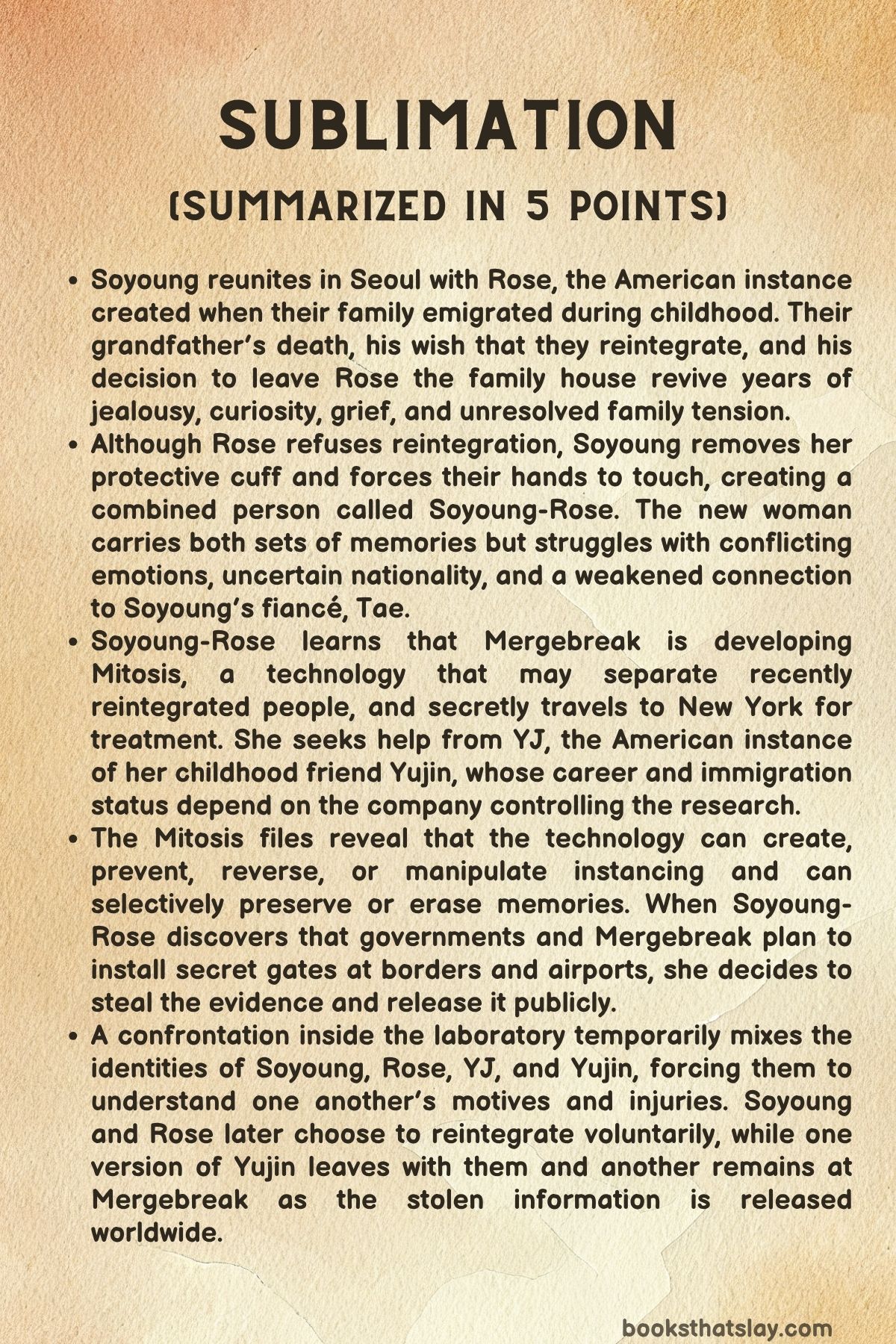
Soyoung waits in the basement of a Seoul department store for Rose, the American version of herself who was created when their family emigrated during childhood. The two women share the same early memories and physical appearance, but twenty years of separate experiences have turned them into distinct people.
Their reunion follows the death of their grandfather, whose final request was that they reintegrate and become one person again. Soyoung secretly wants this outcome, while Rose has returned mainly for the funeral, family closure, and answers about a Korean life from which she has remained distant.
Both women wear MERGEBREAK cuffs because direct skin contact between instances causes immediate reintegration. Soyoung treats the devices as necessary precautions, but she is hurt by Rose’s eagerness to wear hers because it confirms that Rose sees physical union as a threat rather than a desired reunion.
Rose is introduced to Soyoung’s fiancé Tae, their cousin Minsoo, and Minsoo’s daughter Jangmi. During dinner, Minsoo tells Rose about their grandfather’s final wish and gives her an envelope containing personal writings, legal documents, and the deed to the family house.
The house has been left to Rose or to a future person created through Rose and Soyoung’s reintegration. Soyoung feels rejected and manipulated because she received the responsibility of persuading Rose to merge while Rose received a valuable connection to the family’s past.
Rose does not want to claim property that seems more closely connected to Soyoung’s life. However, her visit to the house and her conversation with Soyoung’s mother make her recognize that the division between the person who stayed and the person who left is less simple than she had believed.
Soyoung becomes increasingly consumed by the possibility of reintegration. She envies Rose’s confidence, independence, American memories, and emotional distance from Korean family expectations, yet she also wants Rose to recognize the value of the life Soyoung has built with Tae, friends, work, language, and family.
At their grandfather’s burial, grief and resentment overwhelm Soyoung. She removes her MERGEBREAK cuff and finally admits that she has always wanted to become one person with Rose.
Rose refuses, explaining that reintegration would not allow them to possess two complete lives at once. A new person might contain both sets of memories, but Soyoung and Rose would no longer exist in their present forms or value those memories in the same ways.
Soyoung appears to accept Rose’s decision, but she then reaches for her. Their uncovered hands touch, and Rose is forced into reintegration without consent.
The resulting woman, Soyoung-Rose, contains both histories but does not experience them as two orderly internal voices. Every memory arrives with conflicting emotional meanings, making familiar people, places, desires, and obligations feel unstable.
Soyoung-Rose remembers loving Tae, but Rose’s lack of attachment changes the emotional force of that love. Tae wants to recover the woman he knew, while Soyoung-Rose cannot promise that Soyoung’s feelings will ever return in their original form.
She is equally uncertain about nationality and residence. Choosing Korea feels like abandoning Rose’s life, while choosing America feels like rejecting Soyoung’s relationships, family, and responsibilities.
Meanwhile, YJ, the American instance of Soyoung’s childhood friend Yujin, works for Mergebreak in New York. He is promoted and made the public representative of Project Mitosis, an experimental technology presented as a way to reverse recent reintegrations.
YJ’s employment, visa, and path toward citizenship depend on the company. His superior, Drew Thorsson, uses that vulnerability to keep him cooperative while giving him the appearance of influence without full access to the project.
YJ and Yujin once planned to reintegrate after living separate lives for several years. Yujin still treats that promise as binding, but YJ has developed an American career, relationships, ambitions, and identity that he no longer wants to surrender.
Instead of telling Yujin the truth, YJ repeatedly delays the conversation. His silence allows Yujin to organize his future around a reunion that may never occur.
When Soyoung-Rose learns that Mitosis may separate her back into Soyoung and Rose, she travels secretly to New York. Her combined identity does not create another instance during the journey because she does not regard America as a permanent destination.
She contacts YJ through Yujin and asks to enter a trial before the six-month eligibility period expires. YJ initially refuses because adding an undocumented participant could cost him his job, visa sponsorship, and future citizenship, but he later agrees to investigate the possibility.
Soyoung-Rose and YJ grow close because each understands the emotional and political consequences of being connected to another version of oneself. Their conversations expose YJ’s reluctance to reunite with Yujin and Soyoung-Rose’s fear that neither Soyoung nor Rose will survive in recognizable form.
YJ eventually places her in a trial, even though he lacks complete information about the laboratory. The sessions subject Soyoung-Rose to painful memories from both lives and repeatedly separate and recombine their emotional associations.
The machine does not simply recover the original selves. It appears to be altering the balance between them, changing which memories feel dominant and which relationships carry the strongest emotional weight.
At the same time, Megan Taylor, a former Mergebreak executive, sends Yujin encrypted files concerning Mitosis. He passes them to Soyoung-Rose, who reads them before delivering them to YJ.
The documents reveal that Mitosis can do far more than reverse reintegration. It can deliberately create instances, prevent instancing, force distant instances to reunite, separate merged people, and recombine identities in carefully selected proportions.
It can also preserve one person’s memories while erasing most of another’s. When used through linked gates at airports, checkpoints, or borders, it could allow corporations and governments to decide whether travelers remain singular, divide, reunite, or retain control over their own experiences.
YJ and Soyoung-Rose respond differently to this discovery. She believes the information must be released immediately, while YJ fears that publishing technical details could spread the technology to dangerous groups and destroy his legal and professional future.
Megan reveals that Mergebreak and a government institute intend to deploy full-capacity gates secretly before the public understands what they can do. She wants YJ to wait until the system is established, expose Drew, and eventually replace him as the leader of the company.
YJ negotiates with Drew instead. In exchange for temporary cooperation, he secures legal protection and dual citizenship for Soyoung and Rose after separation, as well as greater access to the project.
Soyoung-Rose is furious when she learns what he has done. Although YJ believes he has protected her, he has revealed her existence and negotiated her future without permission, repeating the same pattern of benevolent control that shaped her grandfather’s inheritance and Soyoung’s forced reintegration.
Concluding that YJ will not stop the secret rollout, Soyoung-Rose plans to enter Mergebreak, steal evidence, use the prototype to separate herself, and release the files publicly. She pretends to reconcile with YJ, removes his access cards from his wallet, and leaves for the laboratory.
Before carrying out the plan, she tells Yujin that YJ no longer wants reintegration. Yujin feels betrayed because his life has been organized around their agreement, and he travels to New York intending to force YJ to merge with him.
Yujin enters YJ’s apartment and touches him before he can escape. The resulting YJ-Yujin contains both men’s anger, fear, ambition, loneliness, and memories, and immediately understands that Soyoung-Rose has used the confrontation as a distraction.
Soyoung-Rose enters the restricted laboratory, copies the records, and begins operating the Mitosis gate. YJ-Yujin reaches the building and tries to stop her, but the machine separates his recently merged identity and pulls Soyoung-Rose into the same uncontrolled field.
The memories of Soyoung, Rose, YJ, and Yujin temporarily lose their boundaries. Each person directly experiences motives and injuries that the others had previously failed to understand.
Within a mental reconstruction of their grandfather’s house, Soyoung and Rose appear as separate selves. Soyoung apologizes for forcing the original reintegration, while Rose acknowledges the violation without denying that their shared existence answered questions neither could have resolved alone.
YJ and Yujin remain combined. After debating the dangers of both secrecy and unrestricted release, the merged man admits that he does not truly support the government’s hidden border program.
He agrees to give Soyoung and Rose time to escape with the evidence. When the women return to their bodies, they are physically separate and retain only faint impressions of the other’s earlier life.
Rose and Soyoung decide to keep their grandfather’s house together. For the first time, the property becomes a connection chosen by both women rather than an inheritance designed to influence their decisions.
Soyoung then offers Rose her hand and waits for an answer. Rose voluntarily accepts, and they reintegrate again as Soyoung-Rose, transforming the same physical act from a violation into a shared decision.
YJ-Yujin allows Soyoung-Rose to leave with the copied information and steals the Mitosis prototype from the laboratory. He later asks her to use the machine to create one version who can remain at Mergebreak and another who can leave with her.
In the final scene, Soyoung-Rose and one version of Yujin board a plane with the dismantled machine, their luggage, and Rose’s cat. Another version of Yujin remains inside Mergebreak to handle the response.
Once the plane is airborne, the Mitosis files, government agreements, warnings, and evidence are distributed across the world. The technology can no longer be controlled through secrecy, and every future border crossing now occurs in a world where personal division, reunion, memory, and identity may be deliberately manipulated.
Characters
Soyoung
Within Sublimation, Soyoung is driven by a longing that she does not fully understand until it becomes destructive. She envies Rose’s American life, yet her desire for reintegration is not based only on wanting what Rose possesses.
Soyoung wants relief from the limitations of her own perspective. She hopes that Rose’s memories will allow her to see her family, grief, country, relationship, and personality through different eyes.
Her interest in Rose contains love, resentment, curiosity, admiration, and possessiveness. Because they began as the same child, Soyoung assumes a degree of emotional access to Rose that their years of separation no longer justify.
This assumption leads to her central moral failure. She tells herself that she respects Rose’s autonomy, but when Rose refuses reintegration, Soyoung places her own emotional need above Rose’s clearly expressed decision.
Her forced contact with Rose demonstrates the danger of confusing understanding with entitlement. Soyoung believes that sharing an origin gives her the right to recover unity, even when the person standing before her has become an independent human being.
After being separated again, Soyoung finally offers a genuine apology. She no longer asks Rose to accept her intention as an excuse and instead recognizes that her action caused a form of death and displacement.
Her final offer of reintegration is fundamentally different because she extends her hand and waits. That pause shows that Soyoung has learned that love cannot become ethical unless the other person remains free to refuse it.
Rose
Rose begins the book by treating her Korean childhood as a closed part of her life. She has accepted a practical division in which Soyoung received Korea and the surrounding family, while Rose received America, independence, and a separate future.
Her return reveals that this arrangement has never been emotionally complete. Familiar streets, food, relatives, and the family house produce recognition without full belonging, leaving Rose both connected to Korea and uncertain of her right to claim it.
Rose’s caution around Soyoung is reasonable rather than cold. Her MERGEBREAK cuff protects a selfhood formed through twenty years of choices, relationships, routines, and memories that Soyoung did not experience.
Her refusal to reintegrate is one of the clearest ethical positions in the story. She understands that merging would not restore childhood or allow both women to continue living two complete lives.
After Soyoung violates that refusal, Rose does not simply become a victim without development. Her existence within Soyoung-Rose gives her direct access to Soyoung’s pain, jealousy, family love, and emotional pressures.
This understanding does not make the original coercion acceptable. Instead, it allows Rose to separate forgiveness from approval and to decide that she does not want resentment to control the rest of her life.
Her final choice to reunite with Soyoung is therefore not a reversal of her earlier position. The conditions have changed because she is informed, experienced, and free to say no.
Soyoung-Rose
Soyoung-Rose is not merely a container carrying two preserved personalities. She is a new person whose thoughts contain memories from Soyoung and Rose but whose emotions, desires, and decisions belong to the combined identity.
Her early suffering comes from discovering that possession of two histories does not create double certainty. A memory of loving Tae exists beside the absence of Rose’s attachment, while affection for America exists beside Soyoung’s responsibilities in Korea.
She becomes increasingly frustrated when others treat her as a damaged route back to the original women. Tae searches for Soyoung inside her, YJ imagines a future relationship with Rose, and the Mitosis researchers regard her as material that can be separated, measured, and rearranged.
Her attraction to YJ allows her to experience being desired as Soyoung-Rose rather than as someone else’s continuation. However, the relationship also reveals her capacity for manipulation, especially when she uses YJ’s feelings to steal his access cards.
Her political actions arise from the same quality that makes her personally dangerous: once she believes an action is necessary, she is willing to place other people inside consequences they did not choose. This connects her to Soyoung even as she condemns Soyoung’s violation of Rose.
Unlike Soyoung, she directs that decisiveness toward an institution capable of controlling millions of lives. Her willingness to expose Mitosis gives public importance to a self who had expected to exist only temporarily.
When Soyoung and Rose voluntarily recreate her, they acknowledge that the combined person possesses value beyond being a mistake. Soyoung-Rose becomes the chosen continuation of two lives rather than the result of one person overpowering another.
YJ
YJ has built his identity around survival in America. His career, visa, citizenship hopes, apartment, relationships, and professional ambitions represent years of effort that Yujin continues to regard as a temporary collection of experiences.
His refusal to reintegrate is understandable because he no longer sees himself as a traveler gathering material for a future combined person. He has become an individual who wants his present life to continue.
His greatest weakness is not ambition itself but postponement. YJ avoids telling Yujin that his wishes have changed because he wants to preserve both his independence and his image as a loyal instance.
This avoidance gives circumstances and powerful people control over him. Drew uses his immigration status, Megan uses his desire for influence, and Yujin continues planning a reunion because YJ will not state an honest refusal.
YJ repeatedly makes decisions for Soyoung-Rose while presenting them as protection. His agreement with Drew secures valuable legal safeguards, but it also exposes her existence and treats her future as something he may negotiate.
His relationship with Soyoung-Rose gives him a temporary space in which he can act outside Yujin’s expectations. Nevertheless, he sometimes imagines Rose after separation rather than accepting that Soyoung-Rose’s disappearance would be a genuine loss.
YJ is intelligent enough to understand institutional danger but cautious enough to become complicit in it. His development requires him to recognize that self-protection may be reasonable while still carrying moral consequences for people with less power.
Yujin
Yujin treats his separation from YJ as an interrupted condition rather than the beginning of a permanent independent life. His plans, relationships, and emotional expectations remain organized around eventual reintegration.
His certainty initially appears loyal and patient, but it prevents him from recognizing that YJ may have become a different person. He believes their old agreement should remain binding even though both men have changed.
Yujin also shows greater openness than YJ in ordinary relationships. His rapid, unfinished conversations with his instance suggest that he is comfortable exposing his thoughts, yet even this communication fails when both men avoid the one subject that could destroy their shared plan.
After learning the truth, Yujin experiences YJ’s independence as abandonment. His jealousy over Soyoung-Rose is largely existential because YJ has gained a connection, experience, and possible future from which Yujin is excluded.
His decision to force reintegration repeats Soyoung’s central violation. He treats Mitosis as a future remedy and therefore convinces himself that temporary coercion is acceptable.
The resulting combined identity proves that direct access to another person’s feelings does not automatically excuse harmful behavior. Yujin must live with the knowledge that he tried to replace conversation with physical control.
YJ-Yujin
YJ-Yujin contains the caution and professional knowledge of YJ together with the emotional directness and willingness to act found in Yujin. This combination makes him more decisive than either man was separately.
In Sublimation, his existence demonstrates that reintegration does not merely settle a disagreement by allowing both sides to understand one another. The new person may inherit the conflict while developing priorities that neither original version predicted.
He immediately recognizes the selfishness on both sides. YJ concealed his changed desires, while Yujin treated an old promise as permission to seize another person’s body.
The merged man’s decision to help Soyoung-Rose release the information comes from seeing that his support for secrecy depended heavily on fear. When asked what he would choose without consequences, he cannot honestly defend the existing border program.
His theft of the prototype shows an ability to move beyond debate. However, his later request that Soyoung-Rose divide him still transfers a dangerous decision to someone else.
The final arrangement preserves one version inside Mergebreak and allows another to leave. Rather than choosing which life deserves to survive, the separation creates two futures that can respond to the crisis differently.
Grandfather
Grandfather remains influential even after his death because his requests, property, silences, and history shape the choices of nearly every major character. He loved Soyoung and Rose, but his methods confused care with control.
His own migration from North Korea helps explain his behavior. He lived with the permanent knowledge that crossing a border could separate a person from family, property, history, and every life that might have existed on the other side.
The decision not to return to his hometown appears to have produced lasting regret. Leaving the Seoul house to Rose may have been an attempt to give a descendant the reason to return that he himself never accepted.
His wish for Soyoung and Rose to reintegrate may also have been an attempt to repair a family division he viewed as unnatural. Yet he placed the burden of that repair on two women whose independence he did not fully respect.
Grandfather avoids direct conversation and instead uses inheritance and dying wishes to guide the living. The result is confusion, rivalry, guilt, and coercion rather than reconciliation.
His house eventually gains a healthier meaning only when Soyoung and Rose choose to share it. Their decision preserves his legacy without allowing his intentions to determine their identities.
Tae
Tae represents the emotional cost paid by people who are not instances but whose relationships depend on them. He loves Soyoung and expects their engagement to lead toward a shared future.
After reintegration, he faces a person who remembers loving him but does not experience that love with the same force. This places him in the painful position of being recognized intellectually while feeling emotionally abandoned.
Tae often hopes that patience will allow the original Soyoung to return. His hope is understandable, but it sometimes prevents him from seeing Soyoung-Rose as a person rather than a temporary disruption.
He is not responsible for the forced reintegration, yet he must live with its consequences. No technical solution can restore the relationship exactly because even a separated Soyoung will remember what happened while combined.
Soyoung-Rose’s affair with YJ deepens the harm done to him. Her belief that her temporary identity has no future does not erase Tae’s future or the betrayal he will eventually have to process.
Minsoo
Minsoo acts as a practical connection between Rose and the Korean family. He welcomes her, gives her Grandfather’s envelope, and communicates information that Soyoung is unable to express directly.
His warmth makes Rose briefly feel that returning to Korea might restore something familiar. At the same time, his acceptance of Grandfather’s wishes shows how family obligations can be passed along without sufficient examination.
Minsoo does not appear to intend harm when he reveals the reintegration request. Nevertheless, his directness forces Soyoung and Rose into a confrontation before Soyoung has decided how to explain her feelings.
His role in clearing the family house also grounds the inheritance in ordinary labor. While others debate what the property represents, Minsoo deals with its furniture, documents, objects, and accumulated history.
Soyoung’s Mother
Soyoung’s mother complicates the assumption that the Korean branch of the family remained unchanged after the migration. She may have stayed physically in Korea, but another version of her also departed for America.
Her conversation with Rose shows both curiosity and restraint. She asks whether Rose is happy but does not insist that Rose treat her as a replacement mother.
She recognizes that Rose already has a maternal relationship with her American instance. This awareness allows her to respect emotional boundaries even while acknowledging the biological and historical connection between them.
Her handling of the family separation is not entirely transparent, however. Like Grandfather, she has participated in a structure where the two branches know about each other but rarely communicate honestly.
Rose’s Mother
Rose’s mother has spent years protecting the American life she built for herself and her daughter. Her resistance to Korea is connected to family conflict, migration, and the need to justify a permanent departure.
She challenges Soyoung-Rose’s tendency to blame parents and circumstances for Rose’s long absence. Rose became an adult and continued choosing not to return, even when she possessed the practical ability to do so.
Her revelation that she asked young Soyoung whether she wanted to move raises difficult questions about childhood consent. A child may answer a question sincerely without understanding the lifelong consequences attached to it.
She also provides important insight into Grandfather’s history and regret. Her advice that Soyoung-Rose must make her own decision rather than obey the dead helps free the combined woman from inherited expectations.
Megan Taylor
Megan recognizes the danger of Mitosis but responds through institutional strategy rather than immediate disclosure. She wants to prevent Drew from controlling the technology, yet she is willing to preserve secrecy until it can strengthen her preferred leadership structure.
Her selection of YJ is both practical and exploitative. She considers him trustworthy, capable, and underestimated, but she also knows his immigration status makes him vulnerable.
Megan views political compromise as unavoidable. By joining the Institute for Instancing Studies, she hopes to influence a system that she believes will proceed with or without her.
Her plan to expose Drew years later reveals the limits of this reasoning. She opposes one person’s control while accepting government deployment that will affect travelers before they understand the technology.
Drew Thorsson
Drew represents corporate power without meaningful ethical restraint. He views Mitosis as a product that can standardize identity, migration, and border administration.
He selects YJ as a public representative partly because YJ is an immigrant with an instance. The choice allows Mergebreak to present a sympathetic image while Drew keeps actual authority elsewhere.
Drew openly uses visa sponsorship and citizenship as tools of control. His willingness to grant protections as soon as YJ negotiates shows that legal security is being treated as a corporate reward rather than a basic condition of personal freedom.
He does not deny the possibility of abuse. Instead, he dismisses it as a problem to be managed after commercial and governmental systems are already established.
Clarissa
Clarissa connects Soyoung-Rose to Rose’s ordinary American life. Her presence at the airport, care for Dr. Crouton, and friendship with Rose remind the combined woman that Rose’s identity consists of daily relationships rather than only nationality.
Soyoung-Rose avoids telling Clarissa the truth because she fears being recognized as different. This concealment reveals how reintegration isolates a person even among friends whose memories should provide comfort.
Clarissa also represents the broader uncertainty surrounding voluntary reintegration. Her German instance is considering reunion, demonstrating that each pair of instances may interpret separation differently.
Petra
Petra appears mainly through the emotional absence she leaves in YJ’s life. Their failed relationship exposes his tendency to postpone commitment until the other person makes the decision he has avoided.
When YJ asks what he could have changed, Petra explains that the necessary change would have had to occur much earlier. Her answer clarifies that some losses are not caused by one dramatic mistake but by years of emotional hesitation.
Her departure also shapes YJ’s connection with Soyoung-Rose. He is lonely, newly unattached, and drawn to someone whose expected disappearance allows him to experience intimacy without imagining a stable future.
Gerry
Gerry is the technician who supervises Soyoung-Rose’s Mitosis sessions. His calm, procedural behavior helps make dangerous experimentation appear routine.
He withholds clear information about the study and avoids confirming what the machine is actually doing. Whether he understands the full purpose or merely follows instructions, his conduct supports a system in which participants cannot give informed consent.
Gerry demonstrates how institutional harm can be carried out by ordinary employees who treat technical compliance as sufficient. His professionalism does not reduce the danger created by secrecy and unequal knowledge.
Jangmi
Jangmi offers a view of family life that is not completely dominated by the conflict between instances. Her presence at meals and outings reminds Rose of the relationships that continued developing in Korea without her.
For Soyoung, Jangmi belongs to a network of affection, duty, and familiarity that she wants Rose to value. For Rose, the child represents both an inviting family connection and evidence of how much time has passed.
Yujin’s Mother
Yujin’s mother believes that an instance of a child remains part of the same family. Her position challenges the stricter separation maintained by Soyoung and Rose’s mothers.
Her view is compassionate, but it also risks overlooking the independent identities created after instancing. Treating both versions as one’s child may preserve love while still producing expectations that neither adult has chosen.
Youngmi
Youngmi’s relationship with Yujin ends because she senses that he is distracted and unable to commit fully to the present. His emotional life remains directed toward YJ and their promised reunion.
Her decision shows that waiting for reintegration affects relationships beyond the two instances involved. Yujin cannot build a stable future while continuing to regard his Korean life as temporary.
Dr. Crouton
Dr. Crouton, Rose’s cat, serves as a small but meaningful connection to Rose’s independent American existence. Caring for the animal is one of the practical responsibilities Soyoung-Rose inherits after returning to New York.
The cat’s presence also prevents the story’s questions of identity from remaining entirely abstract. Whatever form Rose takes, another living creature depends on the continuity of her habits, home, and care.
Themes
Consent, Autonomy, and the Right to Remain Separate
Consent determines the moral difference between nearly identical physical actions in Sublimation. A touch between instances can create one body in a moment, but the meaning of that touch depends on whether both people had the freedom to choose it.
Soyoung’s forced reintegration with Rose is presented as a serious violation even though Soyoung acts from love, grief, and the desire for understanding. Her motives explain the action but do not grant her authority over Rose’s body or identity.
Yujin repeats the violation when he forces YJ to merge, believing that Mitosis can reverse the result later. His reasoning shows how the promise of technological repair can make coercion appear temporary, even though the combined person may develop new desires and refuse separation.
Grandfather, YJ, Megan, and Drew exercise less direct forms of control. They use inheritance, legal protection, employment, citizenship, information, and institutional secrecy to shape decisions while claiming to act for someone else’s benefit.
The voluntary reunion of Soyoung and Rose offers a moral contrast. Soyoung extends her hand, waits, and allows Rose to decide, transforming reintegration into a mutual act.
The book therefore defines autonomy as more than receiving a desirable outcome. A person must be allowed to participate in deciding what will happen, even when others believe they already know what choice would be best.
Migration, Borders, and the Politics of Belonging
Instancing turns the emotional consequences of migration into a physical reality. A person who leaves permanently creates another self who continues living in the country, family, and culture that the traveler has abandoned.
Soyoung and Rose expose the limits of describing one version as the person who stayed and the other as the person who left. Both carry the same childhood, but each becomes attached to a different language, social environment, family structure, and understanding of home.
Their grandfather’s history extends this conflict across generations. His departure from North Korea saves one future while permanently closing access to parents, siblings, property, and an earlier identity.
Mitosis changes migration by giving governments and corporations the power to control the conditions that produce instances. A border can become a machine that determines whether travelers divide, remain singular, reunite, or lose parts of their memories.
This authority would not be distributed equally. Wealthy travelers might purchase choice, while refugees, migrants, and people with insecure legal status could be subjected to decisions made by institutions.
The proposed gates therefore function as more than advanced passport systems. They turn belonging into a technical permission granted by whoever controls the machine.
By releasing the information, Soyoung-Rose forces the public to confront a question institutions wanted to settle privately: whether any government should possess the power to decide what version of a person is allowed to cross a border.
Memory, Continuity, and the Construction of Identity
Memory is necessary to identity but cannot fully define it. Soyoung and Rose begin with the same childhood memories, yet their separate environments transform those shared experiences into different emotional foundations.
After reintegration, Soyoung-Rose possesses both histories without becoming two people speaking inside one body. The memories exist together, but their meanings conflict, causing love, grief, nostalgia, language, and desire to feel unstable.
Her relationship with Tae illustrates the difference between remembering an emotion and continuing to experience it. Soyoung-Rose knows why Soyoung loved him, but knowledge alone cannot reproduce the original force of that attachment.
The Mitosis trials make memory even less reliable. Each session retrieves, separates, compares, and recombines experiences, raising the possibility that recalling a memory changes its emotional weight.
Selective recombination creates a deeper threat because it allows one version of a person to retain useful information while erasing the rest. Identity becomes something that can be edited according to corporate, governmental, or personal priorities.
The temporary fusion of four selves demonstrates the opposite extreme. Complete access to another person’s memories produces understanding, but it also destroys the boundaries required for independent identity.
The novel ultimately presents the self as a continuing relationship among memory, emotion, choice, body, and circumstance. None of these elements alone can guarantee that a person remains who they were.
Family Inheritance, Grief, and the Meaning of Home
Grandfather’s house carries emotional meanings that no legal deed can settle. It represents childhood safety, family conflict, migration, war, regret, cultural belonging, and the possibility of returning to a life that no longer exists.
Grandfather uses the property to influence Rose and Soyoung after his death. By leaving it to Rose or their reintegrated form, he turns inheritance into an unfinished instruction.
Soyoung feels overlooked because she remained close to the family but was not given the house. Rose feels undeserving because she stayed away and does not know whether accepting it would represent belonging, guilt, greed, or reconciliation.
Their conflict shows that grief does not follow a fair measurement of closeness. Rose mourns a relationship she had considered finished, while Soyoung experiences anger and relief alongside love for the grandfather who raised her.
The house becomes healthier as a symbol only when the women stop asking what Grandfather wanted them to do. Their decision to keep it together allows them to acknowledge his influence without surrendering control of their future.
Home is therefore not defined solely by birthplace, property, nationality, or uninterrupted residence. It becomes meaningful when people choose how to enter, share, preserve, or leave it.
Soyoung-Rose’s final image of opening the gate and walking willingly into the house completes this transformation. Returning no longer means selecting Korea over America because the home can hold both histories without requiring either one to be denied.