Tell Your Friends Summary, Characters and Themes
Tell Your Friends by Lauren Wilson is a psychological thriller about family vlogging, online fame, obsession, and the dangerous distance between a public image and private reality.
The novel follows Crystal Shaw, a young woman attempting to escape the influential family channel that controlled her childhood, and Alyssa Hayes, a lonely journalism student who has secretly worshipped the Shaws for years. As Crystal searches for a way to expose her parents, Alyssa becomes increasingly determined to protect the family she idealizes. Their friendship develops into a conflict involving deception, exploitation, identity, violence, and the addictive power of public attention.
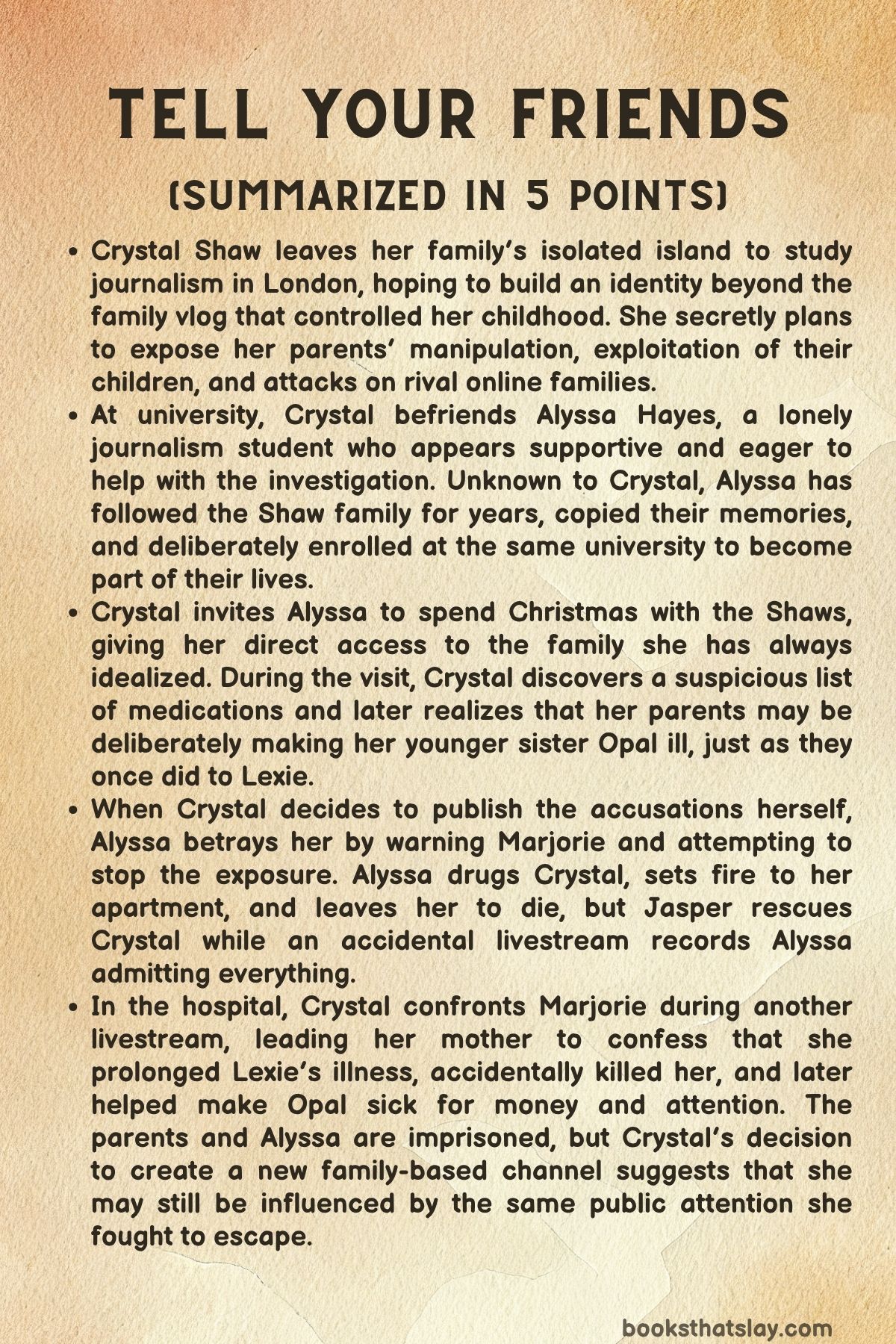
Summary
In 2009, seven-year-old Alexis “Lexie” Shaw dies after suffering from a mysterious illness that doctors were unable to explain. Her mother, Marjorie, had documented the illness through the popular family channel At Home with the Shaws, turning Lexie’s treatments, suffering, and death into public events followed by hundreds of thousands of viewers.
Years later, Lexie’s younger sister Crystal leaves the family’s isolated island home to study journalism at Cradlewell University in London. Although she is eighteen, her mother chooses her apartment, monitors her location, controls her spending, and expects her to continue filming content for the family channel.
Crystal hopes university will allow her to discover who she is outside the Shaw brand. She loves her younger siblings, Oliver and Opal, but feels that her childhood was shaped by cameras, sponsorships, staged experiences, repeated reactions, and constant concern about how the family appeared online.
At university, Crystal meets Alyssa Hayes through the Journalism Society. Alyssa appears welcoming, ambitious, and unusually interested in Crystal’s life, while Crystal sees her as a possible friend who understands journalism and might eventually help her reveal the truth about her parents.
Alyssa is completing an unpaid placement at the Local Times, where she hopes to prove herself as a serious journalist. Her colleagues, however, have become disturbed by her habit of copying other women’s clothing, hairstyles, makeup, accessories, and behavior.
After receiving a formal warning, Alyssa is eventually dismissed from the placement. Rather than accepting responsibility, she believes that Bradley, Davina, and the rest of the staff have rejected her unfairly and failed to recognize her talent.
Crystal and Alyssa grow closer through university classes, radio training, interviews, nights out, and private conversations. Crystal explains how her mother demands carefully designed university videos, sometimes instructing her to look lonely and homesick because visible independence would damage the family’s image of island life.
Alyssa struggles to understand Crystal’s resentment. Having grown up with wealthy but emotionally absent parents, she interprets Marjorie’s constant calls and control as signs of love and believes Crystal is ungrateful for the attention, wealth, siblings, fame, and beautiful home she possesses.
It gradually becomes clear that Alyssa did not meet Crystal by chance. She has watched the Shaw family channel since childhood, selected the same university after learning Crystal would attend, and invented personal memories based on scenes from old family videos.
Alyssa has imagined Marjorie and James as her parents, Crystal as her sister, and the Shaw home as the place where she truly belongs. Her stories about an estranged sister and happy family experiences are lies created from the life she has watched online.
Crystal’s interest in journalism has a secret purpose. She wants to publish an exposé revealing how her parents exploited their children, manipulated reality for content, and attacked rival family vloggers through false anonymous accusations that caused investigations and damaged innocent families.
She considers approaching Dominic, a lecturer and former tabloid journalist, but worries that he would sensationalize her experiences. She also doubts Jasper after he proposes using dramatic crimes for an entertaining radio program, so she decides that Alyssa is the only person she can trust.
Crystal tells Alyssa everything and asks for help approaching journalists. Alyssa agrees, but privately decides to sabotage the investigation because destroying the channel would also destroy her fantasy of becoming part of the Shaw family.
Alyssa delays the pitches, invents updates, and persuades Crystal that progress is being made. At the same time, she becomes jealous of Jasper, lies about Hayley insulting Crystal, withholds information that could repair Crystal’s relationships, and encourages Crystal to depend on her alone.
Before Christmas, Crystal invites Alyssa to the island. Alyssa sees the invitation as the fulfillment of a lifelong dream, especially after another painful encounter with her own parents brings up the boarding-school fire she caused years earlier.
At school, Alyssa had become intensely attached to her roommate Rachel. When Rachel formed another friendship, Alyssa set fire to Rachel’s belongings and bed, even though Rachel was still inside it, and the resulting blaze damaged much of the building.
At the Shaw home, Alyssa eagerly participates in filming, repeated scenes, sponsored celebrations, and carefully directed family moments. Marjorie praises her, introduces her as Crystal’s best friend, and gives her the attention she has always wanted.
Crystal experiences the holiday differently. She enjoys genuine moments with her parents and siblings, but she also sees every reunion and tradition being altered for the camera, including the family’s annual memorial to Lexie.
Crystal overhears her parents arguing about falling engagement, unpaid debts, exhausted credit cards, and overdue mortgage payments. James suggests that the channel may have to end, but Marjorie refuses to abandon the business that has defined their lives.
During the holiday, Opal repeatedly appears pale, nauseated, and weak. Crystal initially assumes that she is experiencing an ordinary illness, although the symptoms remind her of Lexie.
On New Year’s Day, Crystal discovers a note in Marjorie’s handwriting listing medications according to their side effects. The dosages appear dangerously high, and one amount of iron could potentially be fatal.
After returning to London, Crystal learns that Opal has become seriously ill and that doctors suspect the same unexplained condition that affected Lexie. Crystal researches the medications and discovers that their side effects correspond closely with both girls’ symptoms.
She concludes that Marjorie and James may be poisoning Opal to revive the attention and income created by Lexie’s illness. This possibility also forces Crystal to reconsider Lexie’s death and wonder whether her sister’s condition was manufactured for the channel.
Crystal shows the evidence to Alyssa and explains that Lexie may have died from an excessive dose. Alyssa refuses to accept that the family she admires could be responsible, but she pretends to support Crystal while continuing to block the exposé.
Alyssa’s own life becomes increasingly unstable. Her flatmates discover that she has been entering their rooms and stealing food, clothes, flowers, and personal objects, just as she secretly collected belongings from members of the Shaw family during Christmas.
When her flatmates force her to leave, Alyssa treats the confrontation as another betrayal. She becomes even more dependent on the belief that the Shaws will provide the permanent family and identity that everyone else has denied her.
Alyssa also takes revenge against Bradley. Having earlier hidden stolen cocaine in his desk, she impersonates Davina during an anonymous call to the police and watches as Bradley is arrested for possessing drugs he never knew were there.
Crystal eventually decides that waiting for newspapers is too dangerous while Opal remains at risk. She changes her passwords, prepares a video explaining her allegations, and plans to release it directly to the large online audience her parents helped create.
Alyssa realizes that she cannot delay the exposure any longer. Her detailed knowledge of Lexie’s old videos, her repeated lies about journalists, and her imitation of Crystal are also becoming harder to conceal.
At the university radio studio, Rowan tells Crystal the truth about Alyssa’s dismissal. Rowan explains that Alyssa repeatedly copied women at the newspaper and points out that she is now copying Crystal’s clothes, makeup, mannerisms, and identity.
Crystal begins questioning everything about their friendship. She recognizes that Alyssa’s interest in her family may not be affection and that the person she trusted with her evidence may have been working against her.
Alyssa contacts Marjorie and warns her about Crystal’s accusations and planned video. Marjorie tells Alyssa to keep Crystal occupied until she reaches London and reassures her that she is like a member of the family.
Believing that Marjorie has finally accepted her, Alyssa decides that Crystal must die before she can destroy the Shaws. During a Journalism Society night out, Alyssa secretly gives Crystal stronger drinks than she requested and later takes her back to her apartment.
Alyssa dissolves a stolen sedative in Crystal’s water. When Crystal confronts her, Alyssa admits that she informed Marjorie and explains that she intends to take Crystal’s place within the family.
After Crystal appears to lose consciousness, Alyssa burns food on the hob and places a towel near the heat to create an accidental kitchen fire. She tells Crystal to join Lexie and calmly leaves the building, believing the evidence will suggest that Crystal passed out while cooking.
Crystal had noticed the drug and only pretended to become unconscious. She forces herself to vomit but remains weak as the fire blocks the apartment door and an exploding bottle spreads flames across her escape route.
Unable to reach the corridor, Crystal tries breaking a window so she can climb outside. Before she has to risk the fall, Jasper enters with a fire extinguisher after Rowan becomes suspicious of messages sent from Crystal’s phone and asks him to check on her.
Jasper clears a route through the doorway and helps Crystal reach the firefighters and paramedics. Crystal survives with burns, cuts, smoke inhalation, and lasting physical injuries.
Alyssa returns home convinced that her plan has succeeded. She cleans herself and her clothes, then imagines comforting the grieving Shaws and becoming the devoted daughter who supports them after Crystal’s death.
Her confidence collapses when she discovers that Crystal’s phone had been broadcasting from the apartment. The livestream recorded Alyssa admitting her obsession, betraying Crystal, starting the fire, and expressing her desire to replace her.
In the hospital, Crystal awakens to find Marjorie livestreaming beside her bed. Rather than comforting her injured daughter privately, Marjorie immediately asks her to greet the channel’s followers.
Crystal refuses to participate and publicly accuses Marjorie of exploiting the children, poisoning Opal, and killing Lexie. Under pressure, Marjorie admits that Lexie was originally sick but began recovering just as the channel’s income and audience were growing.
Marjorie prolonged Lexie’s illness with medications and accidentally killed her with a fatal dose. Years later, when the family faced bankruptcy, James suggested making Opal sick to restore the channel’s popularity, and Marjorie agreed while attempting to control the dosage more carefully.
Marjorie does not realize that her confession is still being livestreamed. Crystal calls for medical staff and police officers, while her own pre-recorded exposé is released online and attracts enormous public attention.
A year later, Alyssa is serving a lengthy prison sentence, and both Marjorie and James have also been imprisoned. Oliver and Opal live with their grandparents, while Crystal receives therapy and becomes a public campaigner against the dangers of family vlogging.
When Marjorie arrives at the same prison, Alyssa expects them to become close, but Marjorie rejects her and says she will never belong to the Shaw family. Alyssa remains obsessed with Crystal and takes satisfaction in knowing that the fire left permanent scars.
Crystal appears to have built an independent and successful life, yet the ending complicates that success. She has created a new channel called Crystal Clear, where she documents her siblings’ recovery, promotes her social accounts, discusses a possible book deal, and repeats the familiar request for viewers to like, share, and tell their friends.
Characters
Crystal Shaw
Crystal is the central moral and emotional perspective of Tell Your Friends, and her development is shaped by the conflict between independence and belonging. She understands that her parents exploited her childhood, yet she still loves them and often longs for the comfort, beauty, and familiarity of the island.
Her difficulty leaving the family is not weakness but evidence of how thoroughly control has been disguised as care. Marjorie controls her housing, money, location, clothes, public image, and access to her siblings, making resistance emotionally and practically dangerous.
Crystal’s decision to study journalism represents an attempt to regain ownership of her life. She wants to transform the skills she learned through family content into tools for truth, accountability, and protection.
Her concern for Oliver and Opal provides the strongest motivation for exposing her parents. She knows that speaking publicly could destroy the family’s reputation and finances, but silence would allow the younger children to remain products within the same system.
Crystal is perceptive about media ethics but less perceptive about personal relationships. She recognizes Dominic’s ambition and Jasper’s early insensitivity, yet she overlooks Alyssa’s imitation, possessiveness, lies, and concealed knowledge because she desperately wants a trustworthy friend.
Her final position is deliberately uncertain. She escapes her parents’ control and exposes serious crimes, but her new channel suggests that she remains vulnerable to the validation, influence, and financial opportunities that made the original family business so destructive.
Alyssa Hayes
Alyssa is the principal antagonist of Tell Your Friends, although her behavior grows from loneliness, unstable identity, entitlement, and an extreme fear of rejection. She does not simply admire other people; she studies them, copies them, collects their belongings, and attempts to absorb the qualities she believes will make her lovable.
Her obsession with the Shaws began as an emotional survival strategy. Their videos supplied the warmth, routine, attention, and family intimacy that she lacked, but repeated viewing caused her to treat a commercial performance as a private relationship.
Alyssa cannot recognize that the family channel has been carefully constructed. Because she needs the Shaws to represent perfect love, she dismisses Crystal’s experiences and interprets resistance as ingratitude.
Her relationships follow a consistent pattern of idealization, possession, jealousy, punishment, and destruction. Rachel, the women at the newspaper, her flatmates, Crystal, Bradley, and Marjorie all become targets once they fail to support the identity Alyssa has imagined.
Alyssa frequently describes herself as rejected, but she refuses to examine how her own behavior makes others feel unsafe. She transforms consequences into proof of persecution and uses perceived humiliation to justify retaliation.
Her desire to become Crystal is more than envy. Crystal possesses the family identity, public recognition, appearance, friendships, and emotional importance Alyssa believes should have belonged to her, so eliminating Crystal seems to Alyssa like removing an undeserving obstacle rather than killing a separate human being.
Marjorie Shaw
Marjorie is controlling, commercially intelligent, emotionally manipulative, and frighteningly capable of converting private suffering into profitable material. She presents herself as a devoted mother, but her understanding of motherhood has become inseparable from audience growth, sponsorships, and brand management.
Her instructions to Crystal reveal how thoroughly she manipulates reality. Crystal must appear happy or unhappy according to the family’s current marketing needs, even when the required performance contradicts her actual experience.
Marjorie uses financial dependence and access to the younger children as instruments of control. She rarely needs to threaten Crystal openly because Crystal understands that disobedience could cost her home, education, income, and relationship with Oliver and Opal.
Her treatment of Lexie represents the most extreme form of exploitation. Once genuine illness attracted attention, Marjorie chose to continue the symptoms rather than allow her daughter to recover and eventually administered the dose that killed her.
Marjorie does not stop after Lexie’s death because she has learned to interpret attention as both survival and personal worth. When the channel begins failing financially, she accepts the idea of making Opal ill and attempts to manage the danger more carefully rather than recognizing the act as unforgivable.
Even in Crystal’s hospital room, Marjorie reaches for a camera before offering private comfort. Her instincts have been so shaped by online performance that she cannot separate her daughter’s pain from its potential value as content.
James Shaw
James initially appears less domineering than Marjorie and sometimes offers Crystal mild protection during family disagreements. His calmer manner, however, should not be mistaken for innocence or moral courage.
The channel was apparently his original idea, and he continued participating even as filming consumed the children’s privacy. He benefits from the money, lifestyle, recognition, and authority created by the family business while allowing Marjorie to perform most of its visible control.
James’s passivity makes him an important example of enabling behavior. He may not direct every staged reaction or every manipulative conversation, but he repeatedly chooses comfort, family unity, and financial preservation over the safety of his children.
His role becomes much darker when the family faces bankruptcy. James proposes making Opal ill to restore the attention once generated by Lexie, demonstrating that he has accepted the use of a child’s body as a commercial resource.
Whether he knew the complete truth about Lexie at the time of her death remains less clear. His later suggestion indicates that he suspected more than he admitted and was prepared to reproduce the conditions that killed her.
James represents the danger of the apparently reasonable accomplice. Marjorie commits the most visible acts, but James helps create, sustain, and repeat the system in which those acts become possible.
Alexis “Lexie” Shaw
Lexie is absent from the main timeline, yet her death shapes nearly every major decision in the story. She exists through memories, archived footage, family rituals, public sympathy, and the unresolved guilt carried by Crystal.
To the online audience, Lexie became the brave child fighting a mysterious illness. Her personality and suffering were edited into a continuing narrative that strengthened the channel’s popularity and encouraged viewers to feel personally connected to the family.
Within the family, Lexie remains both a loved child and a commercial turning point. Her illness increased attention, established the Shaws as major family influencers, and taught Marjorie that suffering could produce financial security.
Crystal remembers Lexie as a real sister whose desire to travel and experience the world was never fulfilled. Her determination to build an independent life partly comes from the belief that she must live on behalf of the sister who lost that opportunity.
The discovery that Lexie was deliberately kept ill transforms her from a tragic symbol into the victim of sustained parental abuse. Her death becomes the clearest evidence of what happens when children lose control over their bodies, stories, privacy, and public representation.
Opal Shaw
Opal represents the immediate danger Crystal is trying to stop. She is still young enough to remain under her parents’ control but old enough to recognize that public exposure is affecting her relationships, school life, and sense of dignity.
Her admission that classmates tease her and that a teacher embarrassed her by mentioning the channel shows how online content follows children into spaces where they should be able to form independent identities. The family’s audience knows personal details that Opal never meaningfully chose to share.
Opal’s illness changes Crystal’s investigation from a long-term plan into an emergency. Her nausea, weakness, and pallor repeat the pattern associated with Lexie and reveal that the family’s financial crisis is placing another child in physical danger.
Unlike Lexie, Opal has Crystal working to interpret the evidence and challenge the official family narrative. Her survival therefore depends on someone who understands both the public performance and the private manipulation behind it.
Opal also complicates the ending because Crystal begins placing her and Oliver on a new recovery channel. The claim that the siblings enjoy filming resembles Marjorie’s old justifications, suggesting that Opal may still lack full authority over how her experiences are shared.
Oliver Shaw
Oliver receives less individual attention than his sisters, but his position is important because he shows that exploitation does not need to produce an immediate visible crisis to be harmful. He is being raised within a household where filming, sponsorships, rehearsed emotions, and audience expectations are treated as ordinary parts of family life.
Crystal’s affection for Oliver contributes to her emotional dependence on her parents. Because the younger children do not have unrestricted communication devices, Marjorie can limit Crystal’s access to them and use that separation to discourage resistance.
Oliver’s warmth toward Alyssa strengthens her fantasy of becoming an older sister within the family. His innocent acceptance has no understanding of Alyssa’s history or intentions, yet she treats it as proof that the entire family is prepared to welcome her permanently.
After the parents’ imprisonment, Oliver moves in with his grandparents and appears on Crystal’s new channel. His future therefore remains connected to the central question of whether children can genuinely consent to having their recovery, family trauma, and personal development presented to a large audience.
Jasper
Jasper initially appears enthusiastic, sociable, and somewhat careless about the ethical responsibilities of journalism. His proposal for a dramatic true-crime radio program makes Crystal fear that he values entertainment over the dignity of victims.
His mistake is rooted more in immaturity than cruelty. When Crystal challenges him, he eventually listens, apologizes, and demonstrates a willingness to reconsider how stories should be told.
Alyssa sees Jasper as a threat because his friendship with Crystal could reduce Crystal’s dependence on her. She therefore withholds information, exaggerates conflict, and lies about other people’s opinions to prevent their reconciliation.
Jasper’s rescue of Crystal reveals his strongest qualities. After Rowan raises concerns, he does not dismiss the warning or wait for certainty; he goes to Crystal’s apartment, enters a dangerous building, suppresses the fire, and helps her escape.
His actions contrast with the performative concern that surrounds Crystal elsewhere. Jasper does not rescue her for an audience, career advantage, or emotional ownership, but because he believes she may be in danger and chooses to act.
Rowan
Rowan functions as an observant and responsible truth-teller. While Crystal and Jasper are caught in misunderstanding and Alyssa is actively manipulating their relationships, Rowan notices inconsistencies and is willing to communicate uncomfortable information.
Their work with the Local Times gives them access to the real circumstances of Alyssa’s dismissal. By explaining the scale of Alyssa’s copying, Rowan helps Crystal understand that the behavior was not an isolated misunderstanding.
Rowan’s question about who Alyssa is copying now is especially important because it gives language to something Crystal has sensed but not recognized. The clothes, makeup, personal stories, emotional dependence, and fascination with the Shaw family suddenly become parts of a single pattern.
Rowan also responds quickly when messages from Crystal’s phone appear suspicious. Their decision to contact Jasper leads directly to Crystal’s rescue and demonstrates how responsible intervention can disrupt manipulation and violence.
Dominic
Dominic represents the complicated relationship between investigative journalism, public interest, and personal ambition. His previous exposé proves that journalism can reveal wrongdoing, but his excitement about professional success makes Crystal question whether he would treat her family’s abuse responsibly.
He understands that serious allegations require documents, sources, legal preparation, and possibly police involvement. His advice is professionally useful and shows that exposing powerful people requires more than a convincing personal story.
At the same time, Dominic’s history as a paparazzo and tabloid reporter makes him associated with the same media culture that has treated private pain as material for public consumption. Crystal fears that he might expose her parents while also exploiting her experiences.
Dominic is therefore not presented as clearly corrupt or clearly trustworthy. He demonstrates that truth can be published for mixed reasons and that a journalist’s accurate investigation may still cause harm when ambition becomes more important than the people involved.
Bradley
Bradley is initially seen through Alyssa’s resentful perspective, which makes him appear dismissive, impatient, and determined to prevent her progress. A wider view suggests that he is dealing with repeated complaints from employees who feel disturbed by Alyssa’s behavior.
He gives Alyssa opportunities despite his concerns, including the chance to find an independent story after formally warning her about copying coworkers. When she produces a usable local report, he acknowledges its value even though he does not treat it as an extraordinary achievement.
His decision to terminate the placement follows continued misconduct rather than a single minor incident. Alyssa nevertheless rewrites the event as personal persecution because accepting his explanation would require her to confront her own behavior.
Bradley later becomes the victim of Alyssa’s calculated revenge. By planting cocaine in his desk and making a false police report, she converts professional criticism into a life-altering accusation.
His fate also reflects the novel’s wider interest in manufactured narratives. Just as family content can make staged emotions appear real, Alyssa creates evidence that causes an innocent person to look guilty.
Davina
Davina initially treats Alyssa with greater generosity than most of the newspaper staff. She supports Alyssa during an editorial meeting, argues that inexperienced journalists need opportunities, and invites her for coffee.
Alyssa interprets these ordinary acts of professional kindness as evidence of a deeper bond. She begins copying Davina’s clothes, makeup, hair, and accessories, attempting to become the woman whose confidence and career she admires.
When Davina becomes uncomfortable and creates distance, Alyssa treats the boundary as rejection. She cannot understand that kindness does not grant her access to another person’s identity, attention, or friendship.
Davina later writes the magazine feature about Crystal, linking her to both sides of Alyssa’s story. She becomes professionally associated with the successful public figure Crystal creates after surviving the fire, while Alyssa reads the article from prison and continues experiencing Crystal’s life through media.
Hayley
Hayley is Crystal’s neighbor and one of the first people to recognize her from the family channel. Her immediate reference to “the girl who died” shows how strangers reduce Crystal’s personal grief to a familiar piece of online history.
Although Hayley is sometimes awkward, there is little evidence that she intends to harm Crystal. She brings brownies, interacts with Jasper, and becomes involved in Crystal’s social world without displaying Alyssa’s possessiveness.
Alyssa uses Hayley as a convenient target for manipulation. She falsely claims that Hayley described Crystal as arrogant and unpleasant, knowing that the lie will damage Crystal’s confidence and isolate her from both Hayley and Jasper.
Hayley therefore demonstrates how easily relationships can be controlled through false private information. Crystal accepts Alyssa’s account because she trusts the messenger, while Hayley is judged for words she never said.
Alyssa’s Parents
Alyssa’s parents are materially generous but emotionally distant, judgmental, and unable to communicate with their daughter without returning to fear and resentment. Their expensive home provides comfort without affection, reinforcing Alyssa’s belief that wealth cannot replace emotional belonging.
Their response to the boarding-school fire reveals the depth of the family’s damage. Alyssa’s father used money and influence to manage the consequences, but neither parent appears to have helped her understand the seriousness of what she did or develop healthier ways of forming relationships.
They are right to fear Alyssa’s behavior, yet their coldness deepens the abandonment she already feels. Their interactions involve accusation, disgust, financial control, and avoidance rather than meaningful accountability or rehabilitation.
Alyssa uses their failures to excuse her own choices. Although emotional neglect helps explain why she attached herself to an online family, it does not make her stalking, theft, manipulation, false accusations, arson, or attempted murder unavoidable.
Rachel
Rachel appears primarily through the account of the boarding-school fire, but she is essential to understanding Alyssa’s established pattern. She was once Alyssa’s roommate and the object of the same intense attachment later directed toward Crystal.
When Rachel formed another friendship, Alyssa experienced the change as replacement and betrayal. Instead of tolerating Rachel’s independence, she burned her books, bedding, and photograph of the other girl.
The fact that Rachel was still in the bed makes Alyssa’s continuing denial particularly disturbing. Alyssa insists that she intended to burn the bed rather than Rachel, as though setting fire to an occupied sleeping space can be separated from the danger to the person inside it.
Rachel proves that Crystal is not the first person Alyssa has tried to punish for refusing exclusive loyalty. The later apartment fire is an escalation of behavior Alyssa has already minimized, survived, and failed to confront.
Themes
The Commercialization of Family Life
Private family experiences become products once cameras, sponsorships, audience expectations, and financial dependence determine how those experiences are presented. In Tell Your Friends, birthdays, meals, illnesses, Christmas traditions, university life, grief, and recovery are valuable because they can attract attention and income.
The children are expected to repeat greetings, reactions, and emotional moments until the footage appears natural. This process removes spontaneity while preserving the illusion that viewers are witnessing authentic family life.
Lexie’s illness demonstrates the most destructive form of commercialization. Her suffering produces sympathy, engagement, and money, encouraging Marjorie to prolong symptoms rather than allow her daughter to recover.
Financial pressure does not merely motivate ordinary dishonesty. It changes the parents’ understanding of their children, allowing them to treat Opal’s body as a method of restoring a failing business.
Crystal’s rebellion shows how difficult it is to separate identity from a profitable public image. Even after exposing her parents, she creates another channel based on healing, siblings, and personal trauma.
The ending does not state that Crystal has become identical to Marjorie, but it shows how familiar justifications can return in more acceptable language. Content about recovery may still require children to surrender private experiences for adult success.
Obsession, Imitation, and the Loss of Identity
Alyssa’s imitation begins with appearance but extends into memory, relationships, possessions, and personal history. She copies clothing and makeup because she believes identity can be acquired by reproducing the visible qualities of people who receive admiration.
Her false memories demonstrate how completely she has absorbed the Shaw videos. Experiences created for public entertainment become substitutes for her own childhood, allowing her to describe another family’s beach trip as though it happened to her.
Alyssa’s theft of personal objects serves a similar purpose. Lipstick, clothing, flowers, and small belongings become physical evidence that she has entered lives from which she otherwise feels excluded.
Her obsession with Crystal combines affection, envy, dependency, and hostility. She wants Crystal’s attention but also wants Crystal’s family position, public significance, appearance, and emotional importance.
Imitation becomes violent when the original person refuses to disappear. Crystal’s independent desires threaten Alyssa’s fantasy, so Alyssa begins to believe that killing her would create an empty role she could occupy.
The story distinguishes admiration from possession by emphasizing boundaries. Healthy affection accepts that another person has separate relationships and choices, while Alyssa experiences independence as rejection and responds by trying to control, punish, or replace the person she claims to love.
Truth, Storytelling, and Journalistic Responsibility
Facts gain public meaning through the way they are selected, framed, edited, and distributed. Marjorie presents control as care, poisoning as illness, exploitation as family togetherness, and commercial decisions as natural moments from domestic life.
Crystal studies journalism because she wants to correct that false record. Her challenge is not simply proving that something happened but finding a method that protects victims, survives legal scrutiny, and resists becoming another form of entertainment.
Dominic and Jasper initially represent her concerns about irresponsible storytelling. Dominic’s professional pride makes her fear sensational treatment, while Jasper’s true-crime idea appears to value dramatic material over the people harmed by it.
Alyssa demonstrates how journalistic tools can be corrupted. She invents contacts, fabricates professional progress, impersonates Davina, plants evidence against Bradley, and creates narratives that encourage others to accept false conclusions.
The livestreams expose the unstable boundary between evidence and entertainment. Alyssa and Marjorie are caught because they speak in front of active cameras, but the same broadcasts turn violence, confession, and family trauma into material consumed by an enormous audience.
Truth ultimately protects Crystal and Opal, yet public truth also carries commercial value. The novel therefore questions whether ethical storytelling depends only on accuracy or also on who controls the story, who benefits from it, and whether the people involved have meaningful consent.
The Addictive Power of Attention
Attention offers reassurance, status, money, belonging, and the feeling that one’s experiences matter. These rewards affect nearly every major character, even when they understand that public approval is unstable and potentially destructive.
Marjorie becomes dependent on views because they support both the family’s finances and her identity as an admired mother. Declining engagement therefore feels like economic failure, personal rejection, and the disappearance of everything she has built.
Alyssa wants a different form of attention. She longs to be selected, included, copied into photographs, called a best friend, and recognized as a daughter within the family she watches.
Crystal initially rejects this system because she has experienced its costs. However, after publishing her exposé, she notices the excitement created by supportive messages, followers, interviews, and professional offers.
That reaction prevents the ending from becoming a simple story of escape. Crystal may use her platform for advocacy, but she also begins organizing recovery into public content and promoting a new personal brand.
Attention itself is not presented as entirely harmful. It helps expose crimes, supports Crystal’s activism, and gives neglected experiences public recognition.
The danger begins when attention becomes necessary for identity, income, emotional security, or family survival. At that point, people may alter reality, violate boundaries, repeat trauma, or harm others rather than return to an ordinary life outside the public gaze.