The Shampoo Effect Summary, Characters and Themes
The Shampoo Effect by Jenny Jackson is a contemporary novel about friendship, love, parenthood, marriage, ambition, and the old feelings that continue to influence adult relationships.
Set largely in the close-knit Massachusetts community of Greenhead, the story follows four women whose personal lives become connected through romance, family history, secrets, and creative ambition. Caroline arrives hoping to establish herself as a writer independent of her famous mother, only to become involved with a man whose past remains very present. Around her, Bailey, Augusta, and Fran face their own questions about relationships, responsibility, identity, loyalty, and what it really means to build a life with other people.
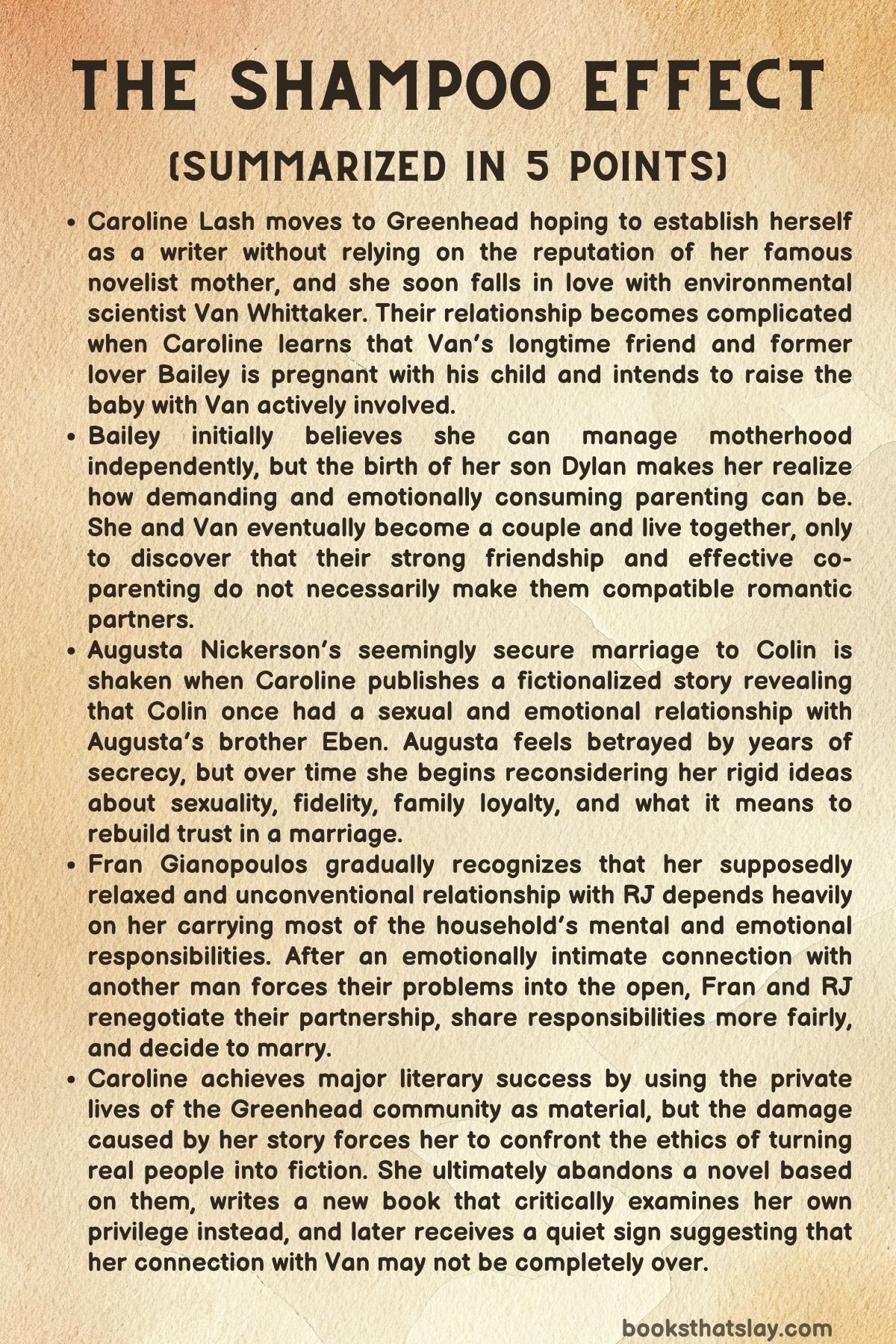
Summary
Caroline Lash arrives in Greenhead, Massachusetts, hoping the move will allow her to establish herself as a writer without being defined by her mother, Gwendolyn Lash, a highly successful novelist. Although Caroline has already achieved an impressive literary milestone by publishing a story in The New Yorker, she worries that every success will be attributed to her family connections rather than her ability.
During her journey to Greenhead, an embarrassing encounter involving a jelly donut introduces Caroline to Van Whittaker, a local environmental scientist. Van is sincere, practical, intelligent, and almost aggressively unpretentious, and Caroline quickly becomes attracted to the stability and goodness he seems to represent.
Their relationship develops rapidly, but Caroline soon learns that Van’s life is far less uncomplicated than she imagined. His longtime friend and former sexual partner, Bailey Newmarch, is pregnant with his child after the two slept together shortly before Caroline entered his life.
Bailey intends to raise the baby but has no interest in marrying Van or creating a traditional relationship with him. Van nevertheless wants to be an active father, forcing Caroline to decide whether she can accept a future in which Bailey will always remain closely connected to the man she loves.
Bailey initially approaches pregnancy with the same independence that governs much of her life. She and Van have known each other since childhood and have repeatedly drifted into physical intimacy, yet she has never considered their relationship the great romance that others around them seem determined to imagine.
Her confidence begins to weaken when the realities of pregnancy and parenthood become harder to dismiss. Medical scares and practical concerns reveal how deeply she already cares about the unborn child, even while she continues resisting the idea that needing help should automatically lead to marriage or conventional domestic life.
Meanwhile, Augusta Nickerson is convinced that Bailey and Van belong together. Augusta is married to Colin, the former best friend of her estranged brother Eben, and she views her own marriage as the stable family structure she always wanted after her father’s affair destroyed her parents’ relationship.
Augusta therefore treats Caroline as an outsider and initially tries to encourage Bailey and Van toward each other. Her confidence in her own marriage is shaken when she discovers unfamiliar blue underwear hidden in her sofa and becomes convinced that Colin may be having an affair.
Rather than confront him directly, Augusta quietly investigates and imagines increasingly painful possibilities. The underwear eventually turns out to belong to the girlfriend of Augusta’s teenage babysitter, temporarily reassuring Augusta that Colin has remained faithful.
Fran Gianopoulos has built a different kind of family life with her partner RJ. They have two sons, remain unmarried, keep much of their money separate, and pride themselves on maintaining a relaxed arrangement in which neither person is restricted by conventional expectations.
Yet Fran gradually recognizes that the freedom she celebrates depends heavily on her own labor. RJ can behave spontaneously because Fran remains responsible for remembering appointments, organizing the children, managing household logistics, and solving the problems everyone else leaves behind.
Her frustration is intensified by her birth family. Fran’s father loses a large amount of money through gambling despite already having serious financial problems, while her brothers expect the responsible members of the family to repair the damage.
The novel’s central idea emerges through Fran’s explanation of the “shampoo effect,” an old expression suggesting that something produces a stronger reaction when it acts upon what is already present. The same principle describes the relationships in Greenhead, where new arguments, attractions, and betrayals gain their force from years of unresolved history.
Caroline increasingly experiences this dynamic while trying to fit into Van’s social world. A trip with his childhood friends makes her painfully aware that Bailey shares memories, habits, jokes, and knowledge of Van that Caroline can never reproduce.
Van repeatedly reassures her that his relationship with Bailey is not romantic. Caroline chooses to trust him, but the emotional structure surrounding Van becomes even more complicated when Bailey gives birth to their son, Dylan.
Childbirth changes Bailey’s understanding of herself almost immediately. Her attachment to Dylan is enormous, and the loneliness of caring for him makes her aware that independence can become exhausting when there is no second adult available to share the constant responsibility.
Van becomes deeply committed to fatherhood. Caroline initially imagines that she may someday have children with him, but she slowly realizes that Dylan is not simply another responsibility Van can schedule around their relationship.
Van eventually tells Caroline that he loves her but cannot be the father he wants to be while also giving her the relationship she deserves. Caroline had always feared losing him to Bailey, but instead she loses him because his commitment to Dylan becomes the central obligation of his life.
After the breakup, Bailey and Van begin relying on each other more heavily. Their familiar attraction returns during a trip with friends, and they eventually resume a sexual relationship and begin living together while raising Dylan.
At first, the arrangement seems to confirm everyone’s belief that they were always meant to become a couple. Bailey quickly discovers, however, that excellent co-parenting does not necessarily mean romantic compatibility.
Van’s seriousness about environmental ethics, consumption, food, beauty products, and ordinary consumer habits begins to make Bailey feel constantly judged. Bailey enjoys shopping, cosmetics, alcohol, television, convenience, and other pleasures that Van frequently criticizes as part of larger harmful systems.
She eventually realizes that she may love Van deeply without actually wanting him as a romantic partner. After secretly sleeping with an old lover named Mac, she also accepts that conventional monogamy may not suit the life she wants.
Their relationship ends without destroying their partnership as parents. Bailey and Van recognize that caring for each other and raising Dylan together may work better when they stop trying to force their lifelong connection into a romantic form.
Caroline, meanwhile, turns her pain into fiction. After learning that Van and Bailey are together, she begins looking at the Greenhead community as possible literary material and becomes especially interested in its buried secrets.
One of those secrets concerns Augusta’s husband Colin and her brother Eben. Caroline learns that Colin and Eben had once shared a sexual and emotional relationship, and she incorporates a recognizable version of that history into a new story.
The piece is accepted by The New Yorker and becomes an immediate success. Caroline initially sees the publication as proof that she has achieved something independently, but her fictionalized portraits are recognizable enough that the people of Greenhead know exactly whom she has used.
The consequences are severe. Augusta learns publicly that her husband and brother had once been involved, while Bailey and Fran see exaggerated versions of themselves transformed into entertainment.
Colin confirms the relationship with Eben, leaving Augusta devastated less by Colin’s bisexuality than by the fact that so many people allowed her to remain unaware of an important part of her own family history. Colin moves out, Augusta turns against Fran for accidentally giving Caroline the information, and the social circle begins to fracture.
Augusta’s own behavior becomes increasingly unstable. During one drunken night she brings another man home and wakes with incomplete memories, forcing her to confront the uncomfortable reality that betrayal and moral failure are more complicated than the categories she has spent much of her life defending.
Fran is confronting similar complications in her relationship with RJ. During a work conference in Hawaii, she meets an engineer named Cal and experiences an ease and emotional connection that sharply contrasts with the burden she feels at home.
Fran and Cal do not have sex, but they share a bed and develop an intimacy strong enough to frighten her. When RJ later discovers photographs of Cal, Fran finally admits that the experience exposed how unhappy she has become with the imbalance in their relationship.
The confrontation forces Fran and RJ to say what they have avoided for years. Fran explains that she carries the mental and emotional responsibilities of parenting, while RJ argues that he has committed his life to her and never understood the depth of her resentment.
Instead of ending the relationship, they renegotiate it. RJ agrees to reduce his drinking and assume greater responsibility for their children, while Fran finally agrees to marry him.
Fran also begins setting limits with her birth family rather than automatically protecting them from the consequences of their behavior. Her father receives financial help under strict conditions, and her brothers are told that continued disrespect will no longer be tolerated.
Augusta gradually begins rebuilding her own marriage. Her reconciliation with Fran helps her reconsider how much of her anger comes from the original relationship between Colin and Eben and how much comes from the secrecy surrounding it.
A conversation with her babysitter also forces Augusta to question her rigid understanding of betrayal. She begins recognizing that marriages survive not because the people inside them never make mistakes, but because they may consciously choose to rebuild trust after those mistakes.
A mundane crisis involving head lice becomes unexpectedly important when Colin deliberately shares Augusta’s discomfort rather than leaving her to manage it alone. His willingness to join the unpleasant work of caring for their family reminds Augusta of the everyday partnership beneath the larger conflict.
Colin eventually returns home, and he and Augusta begin replacing secrecy and assumption with direct conversation. Augusta also reconciles with Eben, who explains that he remained silent because he did not believe he had the right to reveal Colin’s sexuality before Colin was ready.
The wider group slowly repairs itself as well. Eben and his partner Max adopt a baby girl named Issa, giving the friends a reason to gather and help one another again.
Bailey and Van discover that separate co-parenting suits them better than romantic partnership. Fran and RJ move toward marriage under more honest terms, while Augusta begins accepting that people and relationships cannot always fit the categories she once trusted.
Caroline experiences professional success after her story becomes popular, but public criticism forces her to confront the ethics of using recognizable people as fictional material. Encounters with the people she hurt make it impossible for her to continue insisting that changing names and details removed her responsibility.
Ned Clark, a literary agent connected to Caroline’s past, also helps clarify two insecurities that have followed her throughout the story. He reveals that he did not arrange her fellowship, meaning she genuinely earned it, but also admits that his earlier professional decisions were influenced by his desire to maintain a relationship with her famous mother.
Caroline finally accepts that she wrote the Greenhead story partly from anger and that literary success does not erase the damage caused by exposing other people’s lives. She leaves Greenhead, abandons the novel contract based on the same group, returns her advance, and begins reconsidering what kind of writer she wants to become.
Instead of making friends and acquaintances the targets of her fiction, Caroline writes a novel centered on a privileged daughter of a famous writer who refuses to acknowledge the advantages that helped her succeed. By directing her critical attention toward a character modeled on herself, she begins developing an artistic identity built on self-examination rather than appropriation.
A year later, Caroline appears at a literary festival and discovers that readers have come specifically to hear her rather than because of her mother. The achievement finally gives her some of the independent recognition she sought when she first arrived in Greenhead.
Her professional transformation does not completely resolve her feelings for Van. She has apologized to the people she harmed and received signs that at least some of them may be willing to forgive her, but she continues wondering whether Van remains somewhere in her future.
After the festival, Caroline finds a white paper bag sitting on the roof of her car. Inside is a sugar-covered jelly donut, recalling the embarrassing accident connected to her first meeting with Van and quietly suggesting that their relationship may not be completely finished.
Characters
Caroline Lash
Caroline is one of the central figures in The Shampoo Effect, and much of her conflict comes from the gap between how strongly she wants independence and how deeply she remains shaped by privilege. She is talented enough to achieve genuine literary success, yet she cannot fully enjoy that success because she constantly suspects that her mother’s fame has opened doors for her.
Her relationship with Van initially appears to offer a separate life far removed from the New York publishing world. Van’s lack of interest in status and literary prestige attracts Caroline because he seems untouched by the environment in which she has spent her adult life.
Caroline’s insecurity becomes more visible when she enters Van’s old social circle. Bailey possesses decades of shared history with him, and Caroline cannot compete with memories, friendships, habits, and private knowledge that existed long before she arrived.
Her fear of being temporary makes her increasingly sensitive to every sign of closeness between Bailey and Van. Ironically, Van does not initially leave Caroline because he chooses Bailey but because fatherhood changes what he can realistically offer another person.
The breakup exposes another important side of Caroline: her tendency to convert lived experience into artistic material. She has always borrowed from real people, but Greenhead becomes the moment when that habit produces serious consequences.
Writing about Colin and Eben allows Caroline to reclaim a sense of professional power after personal rejection. Her literary success therefore becomes morally complicated because the work that proves her talent also violates the trust and privacy of people who never agreed to become material.
Her growth comes through accepting responsibility rather than defending artistic freedom at any cost. By abandoning the novel built from Greenhead’s private lives and writing about a privileged young woman resembling herself, Caroline finally begins directing the same sharp observational instinct inward.
The jelly donut at the end connects her transformed life to the relationship that first drew her into Greenhead. It leaves Caroline with possibility rather than certainty, which suits a character who spends much of the book learning that neither love nor professional identity can be controlled through a carefully planned narrative.
Bailey Newmarch
Bailey is independent, sexually confident, humorous, practical, and resistant to conventional expectations. In The Shampoo Effect, her journey repeatedly challenges the assumption that emotional maturity requires marriage, monogamy, or a traditional household.
Her history with Van initially seems simple to Bailey because familiarity has made him almost impossible for her to romanticize. They have been emotionally and physically close since adolescence, but she has always regarded him as someone who belongs permanently in her life rather than as the man around whom she should organize it.
Pregnancy changes that confidence without completely replacing it. Bailey wants Dylan from the beginning, yet she gradually learns that wanting a child and understanding the emotional reality of parenthood are very different experiences.
Medical scares and childbirth reveal how strongly she can love something she previously treated with deliberate casualness. Her growing attachment to Dylan also exposes a recurring pattern in her personality: she often recognizes the value of a person or possibility most clearly when losing it becomes imaginable.
Bailey’s reunion with Van is therefore understandable without being inevitable. Sharing a child intensifies their already powerful connection, and living together makes parenting dramatically easier.
Their romantic incompatibility becomes clearer precisely because domestic life works so efficiently. Van’s constant moral seriousness clashes with Bailey’s pleasure in consumer products, beauty rituals, alcohol, convenience, entertainment, and other ordinary indulgences.
Bailey eventually understands that being cared for by someone does not automatically mean feeling accepted by that person. Her complaint that Van may love her without truly liking who she is identifies the deeper weakness in their relationship.
Her affair with Mac is ethically questionable because she lies to Van, but it also forces Bailey to acknowledge something she has tried to suppress. Sexual freedom matters to her, and pretending otherwise simply to preserve a socially satisfying family structure would eventually make everyone involved unhappy.
Bailey ends the story with a more precise understanding of commitment. She can love Van, raise Dylan with him, and depend on him without forcing those bonds into a romantic arrangement that repeatedly proves unsuitable.
Augusta Nickerson
Augusta builds her adult identity around stability because instability defined her childhood. Her father’s affair destroyed her parents’ marriage, and the experience left her determined to create the reliable family structure she believes her mother was denied.
That history explains both Augusta’s devotion to Colin and the intensity of her reaction to suspected betrayal. Finding unfamiliar underwear in her home does not merely raise questions about her husband; it activates an old fear that the family she has carefully constructed may be as vulnerable as the one she grew up in.
Augusta’s suspicion also reveals her preference for certainty. She wants relationships to have clear categories, loyalty to have clear rules, and marriage to function as a protected space in which those rules can be trusted.
The revelation about Colin and Eben shatters that certainty. Augusta is deeply hurt by the sexual history itself, but the greater wound is discovering that people closest to her participated in a reality from which she was excluded.
Her reaction is therefore partly about sexuality and partly about control over her own understanding of the past. Augusta realizes that years of family estrangement were shaped by information she never possessed.
Her own drunken encounter with Stavros complicates her moral position. Having spent years fearing that she might become the betrayed wife, she suddenly finds herself capable of the kind of behavior she has always condemned.
Augusta’s development depends on learning to separate discomfort from injury. Colin’s bisexuality is not the same thing as deception, and Eben’s refusal to expose Colin before he was ready is not identical to malicious betrayal.
The head-lice episode becomes significant because it reduces marriage to its least glamorous but most revealing form. Colin willingly joins Augusta in inconvenience, embarrassment, childcare, laundry, and physical discomfort, reminding her that partnership is built through repeated acts of participation.
By reconciling with Colin and Eben, Augusta does not decide that secrecy was harmless. Instead, she becomes willing to build relationships in which difficult truths can be spoken directly rather than forced into the rigid categories she once relied upon.
Fran Gianopoulos
Fran initially appears to possess one of the story’s most relaxed approaches to adulthood. She and RJ remain unmarried, maintain financial independence, use alcohol and marijuana without much moral concern, divide parenting into shifts, and reject the idea that commitment must follow conventional rules.
Within The Shampoo Effect, however, Fran becomes the clearest example of how apparent freedom can conceal unequal responsibility. The flexibility of her household works partly because she is always prepared to become the responsible person when something goes wrong.
Her upbringing helps explain this instinct. Fran grows up around male relatives whose gambling, teasing, financial recklessness, and immaturity are repeatedly absorbed by other people, teaching her that competence is both a survival strategy and an expectation placed upon her.
That same pattern quietly develops with RJ. He can enjoy spontaneous adventures because Fran remains aware of appointments, school communication, meals, supplies, schedules, and the countless details necessary to keep a household functioning.
Her trip to Hawaii is transformative because distance allows Fran to experience life without constant responsibility. Cal does not initially tempt her because he represents dramatic romance; he attracts her because being with him feels easy.
The emotional intimacy between them frightens Fran precisely because it exposes a need she has refused to name. She wants to be with another adult without automatically becoming that person’s organizer, safety system, and source of practical stability.
When RJ discovers the photographs, their conflict finally becomes productive. Fran stops presenting herself as someone completely satisfied with their unconventional arrangement and admits that she has been resentful for years.
RJ’s response complicates her interpretation of him. He points out that he has repeatedly offered marriage, moved for her, built a family with her, and believed their arrangement was mutually chosen, showing that Fran’s silence has also contributed to the problem.
Their reconciliation is therefore based on renegotiation rather than a return to the old arrangement. Fran demands more practical responsibility from RJ while also allowing herself to accept a more formal commitment.
Her confrontation with her parents and brothers extends the same lesson beyond romance. Love no longer means absorbing everyone’s consequences; it can also mean conditions, limits, accountability, and refusing to keep rescuing people who will not change.
Van Whittaker
Van is defined by sincerity, competence, responsibility, and a strong ethical framework. Caroline initially sees these qualities as evidence that he represents an unusually uncomplicated kind of goodness, but the story gradually shows that goodness can create difficulties when principles become inflexible.
His decision to be actively involved in Dylan’s life is central to his characterization. Van never treats Bailey’s pregnancy as an inconvenience he can solve financially or emotionally distance himself from.
His love for Caroline is genuine, which makes their breakup more significant. Van does not leave because his feelings disappear; he leaves because he recognizes that fatherhood requires more of him than he anticipated and that Caroline deserves a partner who can fully participate in the future she wants.
Van’s return to Bailey is equally understandable because their shared history makes co-parenting natural. He already knows her habits, family, personality, and social world, while their longstanding attraction makes romance seem like a logical extension of parenting.
The failure of that relationship reveals Van’s limitations more clearly. His environmental and ethical commitments are admirable, but he frequently expresses them in ways that make Bailey feel morally inferior for enjoying ordinary pleasures.
Van therefore has to confront the difference between loving someone and accepting the way that person actually lives. His compatibility with Bailey as a parent and friend proves far stronger than his compatibility with her as a romantic partner.
His continued devotion to Dylan remains consistent regardless of the romantic outcome. The final gesture involving the jelly donut also suggests that Caroline has remained emotionally important to him even after their painful separation.
Colin Nickerson
Colin initially appears to embody the stable husband Augusta believes she has always wanted. He is attentive, established within the family, and apparently different from the unfaithful father whose behavior shaped Augusta’s deepest fears.
The revelation of his past relationship with Eben changes how Augusta understands him without necessarily changing the fundamental nature of his love for her. Colin’s sexuality is not presented as proof that his marriage is false; the conflict comes from the secrecy surrounding an important part of his history.
Colin appears to have concealed his bisexuality partly because he anticipated the judgment and rigidity that Augusta later recognizes in herself. His silence is still damaging, but the book allows fear, privacy, shame, and social pressure to exist beside the hurt created by withholding the truth.
His eventual reconciliation with Augusta depends on direct communication. When Augusta awkwardly attempts to understand his sexuality through pornography, Colin rejects the idea that strangers can explain what she actually wants to know about him.
That response marks an important shift in their marriage. Colin insists that Augusta ask him questions rather than constructing theories about him, just as Augusta must learn to say what she fears rather than silently investigate.
The lice episode further shows Colin’s understanding of partnership. He chooses inconvenience because he refuses to let Augusta carry another family problem alone, demonstrating commitment through action rather than argument.
Eben
Eben is essential to Augusta and Colin’s story even though he remains outside much of the central action. As Augusta’s brother and Colin’s former closest friend and romantic partner, he occupies the hidden point around which years of family conflict have developed.
His estrangement from Augusta initially appears connected to family disagreements involving their father. The later revelation shows that Eben has also been carrying knowledge that he believed he could not ethically share.
Eben’s refusal to reveal Colin’s sexuality without permission demonstrates a clear moral principle. From his perspective, protecting Colin’s right to disclose his own identity takes priority over satisfying Augusta’s need to understand every aspect of their shared history.
Augusta experiences that choice differently because the secret directly affected her marriage and her relationship with her brother. Their eventual reconciliation becomes possible only when both can recognize the legitimacy of the other’s hurt and reasoning.
Eben’s relationship with Max and their adoption of Issa provide an important counterpoint to the surrounding romantic crises. Their new family becomes a reason for the larger group to cooperate again and represents a future built through deliberate commitment rather than inherited assumptions.
RJ
RJ is energetic, playful, spontaneous, and initially attractive to Fran for many of the same qualities that later frustrate her. His relaxed attitude makes life exciting, but it also allows him to underestimate the amount of invisible labor necessary to maintain their household.
RJ does not appear consciously committed to exploiting Fran. His central failure is that he accepts a division of responsibility that benefits him without recognizing how much mental and practical work Fran continues to perform.
His reaction to learning about Cal is therefore complicated. RJ feels betrayed, but he also discovers that the relationship he believed was functioning well has contained years of resentment he never fully noticed.
Rather than treating Fran’s unhappiness solely as her failure, RJ eventually listens to what she requires. Agreeing to stop drinking temporarily and take responsibility for the children’s medical appointments gives their reconciliation practical substance.
His proposal during their basketball game captures the playful quality that has always connected them. Fran’s deliberate acceptance suggests that marriage becomes possible only after they begin replacing assumed freedom with consciously negotiated responsibility.
RJ also demonstrates generosity toward Fran’s family by helping stabilize their finances. Importantly, that help occurs alongside Fran’s new conditions, making assistance part of a broader demand for accountability rather than another unconditional rescue.
Gwendolyn Lash
Gwendolyn is both Caroline’s mother and the standard against which Caroline measures her professional identity. Her enormous literary success creates opportunities for Caroline while simultaneously making it difficult for Caroline to believe that her own achievements belong entirely to her.
Caroline’s anxiety about nepotism is therefore inseparable from Gwendolyn’s presence. Even when Gwendolyn does nothing directly to interfere, her reputation shapes how Caroline interprets fellowships, publishing opportunities, agents, and praise.
Their relationship becomes particularly important when Caroline’s professional triumph begins producing moral consequences. Caroline eventually has to distinguish between proving that she has talent and proving that every success occurred without privilege.
The vulnerable conversation between mother and daughter helps Caroline move toward accountability. Gwendolyn’s role is therefore not merely that of an intimidatingly successful parent; she becomes part of Caroline’s eventual acceptance that independence cannot be achieved simply by denying the advantages surrounding her.
Ned Clark
Ned occupies an uncomfortable position between Caroline’s past ambitions and her later professional transformation. He is associated with the publishing world Caroline tries to escape, and his earlier behavior contributes to her suspicion that her career has always been shaped by people interested in her mother.
His mockery of Van at the New York event also highlights the cultural difference between Caroline’s literary world and Van’s life in Greenhead. Ned represents a professional environment in which status, taste, reputation, and personal relationships frequently overlap.
Later, however, Ned becomes unexpectedly useful to Caroline’s moral development. He explains that the fellowship was genuinely hers, finally resolving one of her deepest insecurities.
At the same time, he admits that his earlier conduct toward Caroline was influenced by his desire to represent Gwendolyn. The confession gives Caroline neither complete vindication nor complete defeat because it confirms both her ability and the reality of the privilege she has spent years resisting.
Ned’s warning about the damage caused by turning communities into fictional material helps Caroline reconsider her career. By eventually becoming her agent and friend after she changes direction, he participates in a healthier version of the professional life she once abandoned.
Zoey
Zoey initially enters Augusta’s life as a babysitter whose private relationship accidentally creates a major misunderstanding. The blue underwear Augusta interprets as evidence of Colin’s affair actually belongs to Zoey’s girlfriend.
The incident provides comic relief, but Zoey later becomes surprisingly important to Augusta’s changing understanding of relationships. Her comments about sexuality challenge Augusta’s instinct to place people into fixed categories.
Zoey also describes a family in which infidelity did not automatically lead to permanent separation. That perspective helps Augusta recognize that a relationship does not have to be defined forever by its worst moment if the people involved consciously choose to repair it.
Cal
Cal appears during Fran’s work trip to Hawaii and represents an alternative emotional experience rather than a fully developed romantic future. He shares Fran’s technical interests and offers companionship that feels uncomplicated because Fran is temporarily free from the responsibilities that define her daily life.
Their connection matters because it exposes what Fran is missing at home. She is able to talk, wander, relax, and exist beside another adult without feeling responsible for keeping an entire household functioning.
Although they do not have sex, sleeping in the same bed crosses an emotional boundary for Fran. The experience makes Cal less important as a possible partner than as a catalyst who forces Fran to acknowledge dissatisfaction she can no longer dismiss.
Mac Maker
Mac represents Bailey’s continuing desire for sexual autonomy. He first reappears while she is pregnant, and their encounter is followed by a frightening medical scare that deepens Bailey’s emotional attachment to her unborn child.
Later, Mac becomes part of the crisis in Bailey’s relationship with Van. Bailey secretly meets him and sleeps with him, violating the expectations of her relationship even though the experience itself carries little romantic significance.
Mac’s revelation that he participates in an open relationship becomes important because Bailey recognizes that the arrangement sounds closer to her own desires than the monogamous structure she has been attempting to maintain. He therefore functions primarily as a catalyst for Bailey’s acceptance of something she already suspects about herself.
George
George, Augusta’s father, influences her long before he appears as an active figure in her adult life. His affair destroys the marriage Augusta grew up observing and creates the emotional template against which she later judges fidelity and family stability.
His later return through financial generosity complicates Augusta’s feelings. Accepting his support, including money connected to her wedding, contributes to her estrangement from Eben and demonstrates how unresolved childhood relationships can continue shaping adult loyalties.
George’s greatest importance lies in Augusta’s fear of repetition. When she suspects Colin of cheating, she is not responding only to present evidence; she is reacting to the possibility that her husband may become another version of the father whose choices permanently altered her childhood.
Max
Max is Eben’s partner and part of one of the book’s quieter examples of deliberate family building. Although he receives less individual attention than the central characters, his relationship with Eben provides stability during a period when many other couples are confronting serious conflict.
Their adoption of Issa becomes socially important as well as personally meaningful. Preparing for the baby’s arrival brings the fractured friend group back into shared activity and creates an opportunity for cooperation after months of resentment.
Max therefore helps represent a form of partnership grounded less in inherited expectation than in conscious commitment. His family with Eben also broadens the novel’s exploration of what parenthood and domestic life can look like.
Themes
Old Feelings and the Return of Unresolved History
The idea behind The Shampoo Effect suggests that present emotions rarely begin entirely in the present. New experiences gain unusual force when they react with memories, attractions, resentments, insecurities, and loyalties that have never completely disappeared.
Van and Bailey provide the clearest romantic example. Their attraction repeatedly returns because their connection has accumulated across adolescence, friendship, sex, family familiarity, and eventually parenthood.
Yet the same pattern affects nearly everyone. Colin and Eben’s adolescent relationship continues influencing Augusta’s marriage years after their romantic feelings have ended, while Augusta’s reaction to suspected infidelity is intensified by memories of her father’s affair.
Fran’s anger toward irresponsible men is similarly strengthened by a lifetime of watching her father and brothers create problems that other people must solve. Her frustration with RJ becomes larger than individual arguments because each incident connects with a much older pattern.
Caroline also carries unresolved experiences into Greenhead. Her fear of nepotism, her history with Ned, and her insecurity about living in Gwendolyn’s shadow shape how she interprets both professional opportunities and personal rejection.
The theme suggests that people cannot simply declare the past finished because circumstances have changed. Old relationships continue influencing behavior until the people involved understand what remains unresolved and decide how it should affect their present lives.
Reconciliation therefore requires more than forgetting. Augusta, Fran, Bailey, Caroline, Van, Colin, and Eben move forward only when they become willing to identify the older emotions operating underneath current conflicts.
Love, Compatibility, and the Limits of Romantic Ideals
Several relationships challenge the belief that loving someone automatically means being able to build a satisfying romantic partnership with that person. Bailey and Van care deeply for each other, share a child, understand each other’s histories, and function extremely well as co-parents, yet those qualities do not make them compatible lovers.
Their differences become clearer once they begin living together. Van’s ethical seriousness and Bailey’s enjoyment of consumption, beauty, convenience, entertainment, and sexual independence leave both of them feeling misunderstood.
Bailey eventually recognizes that love cannot compensate for feeling judged. Van, meanwhile, must accept that caring about Bailey does not give him the ability to redesign the values through which she experiences everyday life.
Caroline and Van face a different form of incompatibility. Their relationship is emotionally genuine, but Van’s commitment to Dylan changes the amount of time, freedom, and attention he can give Caroline.
Fran and RJ demonstrate that incompatibility is not always permanent. Their relationship survives because they finally identify the imbalance in their household and actively renegotiate the responsibilities that had produced resentment.
Augusta and Colin also choose repair, but only after abandoning the assumption that a successful marriage must contain a perfectly tidy past. Across these relationships, romantic success becomes less about finding an ideal person and more about understanding which differences can be negotiated, which truths can be accepted, and which incompatibilities should not be forced into permanence.
Responsibility, Parenting, and Invisible Labor
Parenthood repeatedly transforms characters who initially believe they understand the lives they have chosen. Bailey approaches pregnancy with confidence in her independence, but Dylan’s arrival reveals the relentless emotional and practical demands hidden inside everyday care.
Van experiences a parallel transformation. Becoming a father changes his priorities so completely that he ends a relationship he values because he cannot imagine being absent from his son’s life.
Fran’s story examines responsibility from another direction. She has already been parenting for years, but only gradually recognizes that the supposedly equal arrangement she shares with RJ leaves her permanently responsible for the mental load of family life.
The problem is not simply the number of chores she performs. Fran must remember what needs to happen, anticipate problems, organize other people, remain reachable, regulate her own behavior, and provide the invisible structure that allows everyone else to appear relaxed.
Her resentment reveals how easily freedom for one family member can depend upon another person’s constant preparedness. RJ experiences their household as flexible partly because Fran has ensured that flexibility does not become chaos.
Augusta and Colin’s reconciliation also emphasizes ordinary labor over romantic symbolism. Colin’s willingness to participate in the unpleasant work of treating lice matters because it demonstrates that family commitment often appears through mundane acts rather than dramatic declarations.
Across the story, parenting is presented as both profound attachment and repetitive responsibility. Love matters enormously, but love becomes meaningful in practice through presence, reliability, shared labor, sacrifice, and the willingness to remain accountable when daily life becomes inconvenient.
Privacy, Storytelling, and the Ethics of Using Other People’s Lives
Caroline’s literary career raises difficult questions about where observation ends and exploitation begins. She genuinely possesses talent, but much of her creative process depends on transforming private experiences belonging to friends, acquaintances, relatives, and lovers into fiction.
At first, Caroline treats changing names and details as sufficient protection. She focuses on the artistic transformation rather than the possibility that recognizable emotional truths may expose people even when factual details have been altered.
Her Greenhead story exposes the weakness in that defense. The fictional characters may not reproduce the real people perfectly, but the community recognizes them easily enough for private information to become public gossip.
Colin and Eben’s past is especially serious because publication removes Colin’s control over the disclosure of his sexuality. Augusta is simultaneously forced to learn important information about her marriage through a public literary work rather than through the people she trusted.
Caroline’s motives also complicate the ethical question. She writes partly from observation and artistic ambition, but rejection, loneliness, resentment, and jealousy influence the decision to turn the group into material.
Professional success therefore cannot provide moral justification by itself. The story’s popularity proves Caroline’s ability to capture readers, but it also amplifies the harm by increasing the number of people discussing lives that were never voluntarily offered for public interpretation.
Her eventual change in direction represents more than an improvement in manners. By making herself the object of criticism, Caroline discovers a form of storytelling that preserves her sharp observational voice while forcing her to accept the vulnerability she previously demanded from other people.