Daybreak Summary, Characters and Themes
Daybreak by Autumn Woods is a romance-centered suspense story about
two young people trying to build a future after violence, betrayal, family abuse, grief, and revenge have shaped much of their lives.
Ophelia Winters and Alex Corbeau-Green remain bound by love, but trust between them has been badly damaged, while a new threat turns their separation into something far more dangerous. Around them, family illness, depression, guilt, fear, and the consequences of earlier choices refuse to disappear. The book ultimately asks whether surviving trauma is enough, or whether real recovery requires choosing relationships, purpose, independence, and hope even when pain remains. It’s the 2nd book of the Sorrowsong University series.
Summary
The story opens with an unnamed person living in miserable conditions and holding a photograph that shows Ophelia Winters and Alex Corbeau-Green beside the dying Bancroft. Consumed by resentment and convinced that Ophelia abandoned them, this person has hired a hacker to track her and intends to use the photograph to force a confrontation.
Meanwhile, Alex has become the twenty-three-year-old CEO of Green Aviation after his abusive father, Cain Green, disappeared while facing arrest. Alex never wanted the position, but he feels responsible for protecting his sick mother Elise, his six younger sisters, and the company from the corrupt legacy Cain left behind.
His personal life is equally troubled because he still loves Ophelia while believing that an article she wrote about Cain caused enormous damage to his family. He writes messages to her but never sends them, unable to reconcile his anger with the suspicion that she may not have been responsible for leaking the article.
Alex begins trying to change Green Aviation by ending some of the criminal arrangements Cain had allowed. When Rocco Morello confronts him over the danger faced by Rocco’s daughter Belladonna, Alex uses Green’s ownership of a cybersecurity company to force Rocco into accepting new limits.
Although Alex appears decisive professionally, his mental health is deteriorating. During therapy with Robert Harwood, he admits feeling isolated, trapped by responsibility, frightened by Cain’s disappearance, and dependent on the knowledge that his sisters need him.
At Sorrowsong University, Ophelia is attempting to rebuild a life of her own. Divya, Colette, and Magda have become genuine friends, supporting her through trauma linked to thunderstorms, her parents’ deaths in a helicopter crash, and the public hostility caused by the leaked article.
Her relationship with swimming has also become complicated because it reminds her of her mother, whose affair with Bancroft has changed the way Ophelia views parts of her childhood. At the same time, Belladonna remains hostile toward her because she believes Ophelia hurt Alex.
The greater danger comes from anonymous messages. Ophelia receives the photograph connected to Bancroft’s death and later receives a recent photograph of herself leaving the swimming pool, proving that the person threatening her is physically watching her at Sorrowsong.
When Alex learns what is happening, his investigators initially consider whether Cain could be responsible. One investigator even suggests that if the Bancroft photograph became public, Ophelia might be made the sole suspect, but Alex immediately refuses to protect himself by sacrificing her.
After another photograph confirms that the stalker is close to Ophelia, Alex travels to Scotland under the cover of attending an aviation event. Their reunion is tense because Ophelia is furious that he disappeared when she needed him most, especially after everything they experienced together.
Alex admits that legal advice influenced his silence but finally recognizes that this does not excuse abandoning her emotionally. Ophelia explains that she wrote the article because she wanted to destroy Cain, but she insists that she never leaked it, and Alex finally believes her.
They also confront the deepest wound between them: they were both involved in Bancroft’s death, yet Ophelia was left to deal with the psychological consequences alone. Although both admit they remain in love, Ophelia fears Alex will disappear again whenever his family needs him, so she asks him to leave.
Their separation does not last emotionally. They begin texting again, and Alex later appears at Sorrowsong’s Winter Ball, where their attraction and unresolved feelings become impossible to deny.
After dancing and arguing, they spend several hours together and become intimate. Their fragile happiness ends when Ophelia receives photographs showing them together and a threat that Alex will die if she refuses to leave him, so she pushes him away without fully explaining why.
They continue maintaining a long-distance connection that both pretend is casual. Phone calls, messages, bedtime conversations, and emotional dependence make it increasingly clear that neither has truly accepted the idea of living without the other.
Ophelia’s stalker becomes more aggressive, while online criticism begins damaging her confidence. After a public trauma response triggered by a helicopter, she isolates herself until Colette persuades her to take a trip to London.
During the trip, a drunken Ophelia agrees to pose as a life model for an art class, partly as an attempt to reclaim confidence in her body after strangers have repeatedly attacked her appearance. Alex learns about the class, becomes jealous, buys every available ticket, and travels to London.
When Ophelia arrives to model, Alex is the only person who enters. Instead of treating the moment as a joke, he tells her that he loves her and refuses to continue predicting the failure of their relationship before they have even seriously tried.
Ophelia lists the problems standing between them, including distance, family obligations, her fear of flying, his depression, Cain, publicity, and the stalker. Alex does not deny any of them; he simply tells her that losing her permanently frightens him more than facing those difficulties.
She finally chooses the relationship. Their reconciliation becomes a decision to face uncertainty together rather than continue protecting themselves through separation.
Their peace is quickly disrupted when someone breaks into Cain’s London property while Alex and Ophelia are staying there. The intruder escapes, but a recovered glove suggests that the stalker is probably not Cain.
Believing her relationship with Alex places him in danger, Ophelia once again tries to distance herself. Eventually, frustrated by the continuing threats, she answers the stalker directly and agrees to meet them near Lochinver while asking Belladonna to accompany her and remain nearby.
The stalker is revealed to be Laura, a woman whose family was also destroyed by Cain’s corruption. Laura once believed she and Ophelia shared the same mission of revenge, but when Ophelia fell in love with Alex and stopped communicating with her, Laura interpreted that change as betrayal.
Laura admits paying the hacker who leaked Ophelia’s article and explains that she later followed Ophelia to Sorrowsong. Ophelia recognizes in Laura a possible version of herself: someone who allowed revenge and isolation to consume everything else.
Ophelia attempts to calm Laura instead of hurting her, but Laura suddenly moves toward Belladonna. Belladonna shoots her, and Laura dies while Ophelia holds her, leaving Ophelia overwhelmed by guilt rather than relieved that the stalking has ended.
Ophelia retreats to her parents’ abandoned home, realizing that solving the mysteries surrounding her life has not restored anything she lost. Alex follows and refuses to let her punish herself by accepting responsibility for Laura’s entire fate.
Their conversation turns toward the future. Ophelia tells Alex that loving him means accepting his family, his depression, his uncertainty, and all the difficult parts of his life, while Alex admits that what he wants most is an ordinary home untouched by the fear that defined his childhood.
Their calm ends when Cain is seen near the Green family’s New York home. Alex returns immediately, while Ophelia remains in Scotland until news arrives that Elise has collapsed and may be critically ill.
Knowing Alex will be emotionally devastated, Ophelia decides to fly to New York despite the severe fear created by her parents’ fatal crash. With support from Belladonna, Jack, and Vincenzo, she boards the plane and survives the journey.
At the hospital, Alex finally collapses emotionally in front of her. When he says he is exhausted from constantly struggling to remain afloat, Ophelia tells him that she will carry some of that burden for him until he can manage it again.
Elise survives the immediate crisis and warmly welcomes Ophelia into the family. She makes clear that wealth, status, and public judgment do not determine Ophelia’s worth, while also acknowledging that Alex may eventually carry major responsibilities for his younger sisters.
Ophelia spends time in the family brownstone and gradually becomes close to Alex’s sisters. Fleur remains wary because she associates Ophelia with the scandal surrounding the article, but even she begins moving toward a more civil relationship.
Alex’s birthday becomes a quiet celebration of survival. He begins seriously considering returning to architecture, the career he wanted before Cain convinced him that Green Aviation was his unavoidable destiny.
Alex eventually identifies Luis as the person he would prefer to succeed him as CEO. Just as he seems close to escaping the company, Mike attacks him at Green headquarters and helps Cain abduct him.
When Alex fails to return home, Ophelia and Fleur go looking for him. Ophelia enters the building, finds evidence of a struggle, and eventually discovers Alex tied to a chair while Cain attempts to force him to authorize a Green aircraft for an escape from the United States.
Ophelia creates a diversion and frees Alex, but Cain stops them with a gun. Before he can kill either of them, Fleur shoots Cain in the leg and saves them.
Cain survives and is arrested, but Alex does not experience the moment as a simple victory. He grieves for the father Cain might once have been and recognizes that his real achievement is refusing to become the cruel man Cain tried to create.
With Cain finally imprisoned, Ophelia returns to Scotland rather than abandoning her education, swimming, friendships, and independence for life with Alex in New York. She also begins confronting her fear of flying and successfully completes a commercial flight with the unexpected help of an elderly passenger named Mabel.
Alex makes equally significant changes. He proposes moving his family to Scotland, speaks honestly with Elise about her attempts to stop him from becoming CEO, and visits Cain in prison for a final confrontation.
When Cain tries to tell him that his value depends on wealth, power, and abandoning Ophelia, Alex rejects him. He finally understands that his worth does not depend on Cain’s approval.
Ophelia also begins releasing the guilt connected to her parents’ deaths. While swimming alone, she speaks to them and accepts that the crash was caused by Cain rather than by the innocent request she made as a child for them to come home quickly.
Alex then announces that his family is moving to Scotland and that he intends to resume his architectural education. Soon afterward, he reveals an even greater surprise: Sorrowsong has accepted his previous university credits, allowing him to study there while remaining close to both Ophelia and his family.
Four years later, Alex and Ophelia are married and living in the English countryside. Elise has died, and her death has caused severe grief, but Ophelia has helped Alex and his sisters through the loss while turning her own experiences into a career as a childhood grief counselor.
Alex has founded Raven Architecture and created a professional life separate from Cain’s influence. Their wider circle has also moved forward, with the people around them building careers, relationships, and families of their own.
Neither Alex nor Ophelia has erased the past, and depression, grief, and difficult memories still exist. What has changed is that their lives are no longer organized around revenge, fear, or survival alone; they have friendships, meaningful work, family, ordinary pleasures, and a future they actively choose.
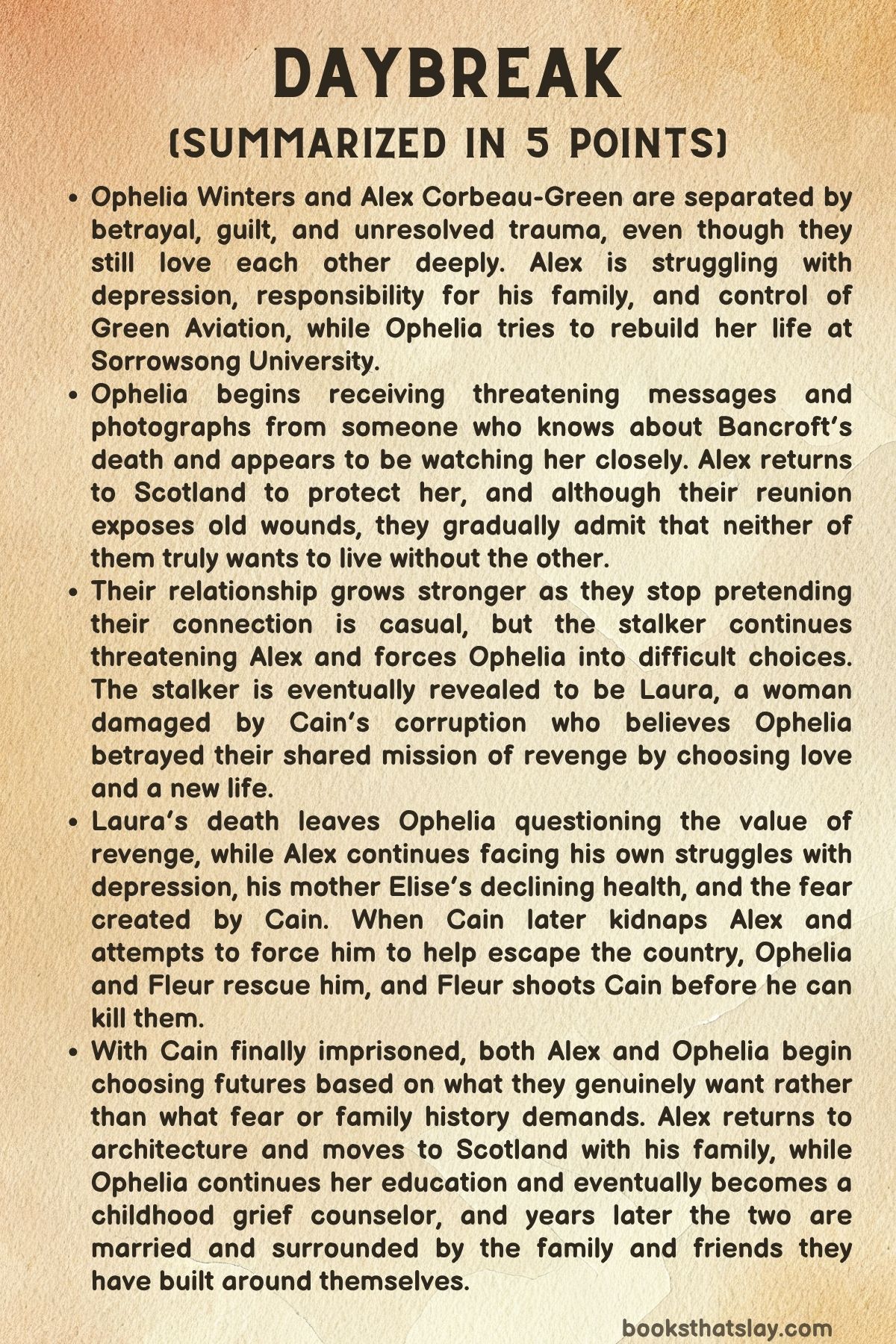
Characters
Ophelia Winters
Ophelia is the emotional center of Daybreak, and much of her development comes from learning that solving the crimes surrounding her past cannot by itself give her peace. She begins the book carrying grief over her parents, guilt over Bancroft, anger toward Cain, suspicion toward almost everyone, and a habit of treating independence as protection against abandonment.
Her greatest contradiction is that she fiercely wants control while repeatedly placing herself in dangerous situations when uncertainty becomes unbearable. Meeting Laura alone, confronting suspected enemies, and trying to manage the stalker without fully involving Alex reveal both courage and recklessness.
Her relationship with revenge is particularly important because she gradually recognizes how completely it has shaped her identity. Laura becomes disturbing to her precisely because she represents what Ophelia might have become if friendship and love had not created alternatives to anger.
Ophelia’s friendships with Colette, Divya, and Magda help teach her that accepting support does not reduce her strength. Their refusal to let her disappear into isolation gives her repeated proof that care can remain present even when she is difficult, frightened, or emotionally withdrawn.
Her relationship with Alex develops in the same direction. At first she sees his abandonment as proof that love cannot be trusted when circumstances become difficult, but she eventually accepts that commitment does not require certainty about the future.
Her fear of flying provides one of the clearest measures of her growth. Boarding an aircraft does not erase the trauma of her parents’ deaths; instead, she discovers that courage can exist alongside terror.
By the end of the novel, Ophelia is no longer defined primarily by who hurt her or what she wants to avenge. Her decision to become a childhood grief counselor shows that she has transformed personal loss into a way of helping others live through pain without allowing it to consume their lives.
Alex Corbeau-Green
Alex’s arc in Daybreak centers on the difference between being needed and believing that one deserves to exist for oneself. He has spent years measuring his value through usefulness, whether protecting his sisters, caring for Elise, running Green Aviation, or trying to repair damage created by Cain.
His depression therefore cannot be separated from his family role. Alex sometimes remains alive because other people depend on him, but therapy forces him to recognize that responsibility alone cannot become a sustainable reason for living.
Cain’s abuse has also left Alex terrified that cruelty may somehow exist inside him. This fear appears whenever he uses power aggressively, makes a hard business decision, or notices anger resembling his father’s, even though his repeated concern about harming others demonstrates how fundamentally different his moral instincts are.
His relationship with Ophelia exposes another weakness: Alex often tries to protect people by making decisions for them. Leaving her without explanation may have been influenced by lawyers and family danger, but it reproduces the same controlling pattern he claims to reject.
His development requires learning to remain present rather than deciding in advance what other people can endure. When he returns to Ophelia, he stops promising an easy future and instead offers consistency despite the problems surrounding them.
Architecture represents the personal identity Cain nearly erased. Leaving Green and returning to the career he once wanted marks Alex’s movement from inherited duty toward genuine choice.
His eventual creation of Raven Architecture carries emotional significance because he builds something connected to his own values rather than his father’s ambitions. The future he imagines is deliberately ordinary because safety, warmth, and affection matter more to him than wealth or public importance.
Laura
Laura is both antagonist and warning. Her life has been damaged by Cain’s corruption, giving her anger a legitimate origin even though the actions that follow become threatening and destructive.
She believes Ophelia once understood her because both were driven by the desire to expose Green and punish those responsible for destroying their families. When Ophelia begins building friendships and loving Alex, Laura interprets that recovery as abandonment rather than change.
Her decision to finance the leak, stalk Ophelia, collect photographs, and threaten Alex shows how completely revenge has narrowed her moral vision. She no longer sees Ophelia as a separate person capable of changing; she sees her as someone who owes loyalty to a shared grievance.
Laura’s physical deterioration reflects the collapse of everything beyond that grievance. By the time Ophelia finds her, she appears to have sacrificed money, security, relationships, and a viable future to one remaining purpose.
Her importance becomes clearest when Ophelia realizes how easily she could have followed the same path. Laura is not simply defeated; she forces Ophelia to understand that revenge without connection can become another form of self-destruction.
Her death therefore produces guilt rather than triumph. Even after recognizing that she cannot control another person’s choices, Ophelia continues remembering Laura, showing that compassion survives after their conflict ends.
Cain Green
Cain represents domination disguised as family authority. His influence extends beyond criminal acts because he has trained Alex to believe that personal desire is weakness and that value comes from power, inheritance, usefulness, and obedience.
His abuse affects every member of the family differently. Alex becomes compulsively responsible, Fleur fears that she may have inherited Cain’s cruelty, Elise lives under the psychological consequences of their marriage, and the younger girls grow up inside a household organized around protection from him.
Cain is particularly dangerous because he understands emotional vulnerabilities as well as financial and criminal power. Even when imprisoned, he tries to control Alex by attacking his relationship with Ophelia and questioning his worth.
His final failure is therefore psychological rather than merely legal. Alex defeats Cain’s deepest influence when he states that he already has value and no longer needs his father’s definition of success.
Cain also functions as a contrast to the kind of man Alex wants to become. Where Cain creates obedience through fear, Alex increasingly learns to create family through trust, choice, and care.
Elise Corbeau-Green
Elise is one of the strongest influences on Alex’s movement toward a life beyond Green Aviation. Although physically ill and dealing with psychiatric difficulties, she often sees her son’s emotional condition more clearly than he does.
She understands that Alex repeatedly sacrifices happiness because happiness creates something he could lose. Her challenge is not simply for him to pursue Ophelia but to accept that avoiding attachment cannot protect him from pain.
Her decision to secretly ask Carmichael to oppose Alex’s appointment as CEO is morally complicated. She removes Alex’s agency while trying to rescue him from a future she knows he never wanted, which creates tension between maternal protection and personal autonomy.
Elise’s warmth toward Ophelia also changes Ophelia’s understanding of family. She welcomes her without demanding wealth, status, social polish, or certainty, giving Ophelia a form of parental acceptance she has been missing.
Her eventual death remains important because recovery does not protect Alex from later grief. The life he creates after losing her demonstrates that love can survive loss without making loss less devastating.
Fleur Corbeau-Green
Fleur begins as one of the characters most openly hostile toward Alex and Ophelia. She resents Alex for leaving the family to deal with Green Aviation and blames Ophelia for helping expose a scandal that caused chaos around them.
Her anger, however, is rooted in responsibility and fear rather than simple cruelty. Fleur has carried a heavy burden protecting her younger sisters, which makes her particularly sensitive to anything she interprets as abandonment.
Her decision to shoot Cain is a major reversal in her relationship with Alex. Earlier she condemns him for failing to protect the family, but she ultimately becomes the person who physically protects both Alex and Ophelia.
The aftermath matters even more than the action itself. Fleur fears that her willingness to imagine Cain’s death proves she has inherited his darkness, allowing Alex to offer her the reassurance he has needed for years himself.
Her development suggests that anger does not determine moral identity. What matters is how a person responds to that anger, whether through cruelty, restraint, accountability, or seeking help.
Mia Corbeau-Green
Mia’s role is closely tied to Alex’s growing understanding of what responsible care should look like. Instead of deciding what respectable future she ought to pursue, he recognizes her passion for cooking and quietly helps her explore it.
Her eventual culinary career confirms the importance of being allowed to choose an identity rather than inherit one. In this sense, her path parallels Alex’s return to architecture.
Mia also shows that the younger generation of the family can build lives outside Cain’s expectations. Her interest in food, foraging, and creativity introduces a domestic, constructive energy into a family history dominated by business, violence, and fear.
Evie Corbeau-Green
Evie is less central individually, but her development contributes to the larger transformation of the Corbeau-Green family. Her adjustment to Scotland and eventual success in the West End suggest a growing freedom to pursue interests unrelated to Green Aviation or Cain’s reputation.
Her presence also reinforces Alex’s parental role toward his sisters. His decisions about work, relocation, and education are repeatedly shaped by his desire to give Evie and the others opportunities he never felt allowed to claim for himself.
Éléanor Corbeau-Green
Éléanor belongs to the younger group of sisters who make Alex’s responsibility both emotionally meaningful and psychologically exhausting. She represents the ordinary childhood Alex is desperate to protect from the instability Cain created.
Although she receives less individual development, her place in the family matters because Alex’s future decisions are never made as though he were responsible only for himself. Moving to Scotland becomes significant precisely because the younger girls are included in the choice rather than treated as obstacles.
Charlotte Corbeau-Green
Charlotte is another of the younger sisters whose presence reinforces the domestic future Alex values. The younger children give the family home its noise, disorder, affection, and sense of ordinary life.
Her role contributes to the contrast between Cain’s model of family and Alex’s. Cain treats family as an extension of power, while Alex increasingly sees family as a responsibility that should eventually allow each person greater freedom.
Josie Corbeau-Green
Josie has one of the most emotionally significant roles among the younger sisters because she accepts Ophelia with uncomplicated affection. Her handmade picture welcoming Ophelia into the family affects Ophelia more deeply than wealth, social approval, or elaborate gestures could.
Josie represents belonging without conditions. Her willingness to sleep beside Alex and Ophelia and treat Ophelia as part of the household helps make the family relationship real long before formal marriage does.
Vincenzo Morello
Vincenzo combines humor, violence, loyalty, and emotional insight. He is capable of physically attacking someone for insulting Ophelia, yet he also recognizes when Alex is surrendering to fear and challenges him to reconsider giving up on their relationship.
His friendship with Alex is especially valuable because he does not treat Alex only as a CEO, heir, or caretaker. Vincenzo speaks to him as a young man who is entitled to have wants beyond duty.
His admission that he still fears gunshots after childhood trauma also becomes important to Ophelia. By revealing that courage can coexist with continuing fear, he helps her reconsider what overcoming her flying phobia actually means.
Belladonna Morello
Belladonna begins from a position of hostility toward Ophelia because her loyalty to Alex makes her deeply suspicious of anyone who has hurt him. She is direct, judgmental, and occasionally severe, but her harshness usually grows from protectiveness rather than indifference.
Her relationship with Ophelia changes through conflict rather than sudden affection. During their journey to confront the stalker, Belladonna criticizes Ophelia’s recklessness while gradually acknowledging that Alex’s love effectively makes Ophelia part of her family.
Her shooting of Laura is morally and emotionally significant. Belladonna acts decisively when she believes Laura poses an immediate threat, but the result leaves Ophelia facing consequences that cannot be simplified into rescue or victory.
She later helps Ophelia confront her fear of flying in the same uncompromising style. Belladonna rarely offers gentle reassurance, yet her loyalty becomes increasingly dependable.
Colette
Colette is one of the people most responsible for preventing Ophelia from retreating completely into isolation. She challenges Ophelia’s negative self-image, pushes her toward social experiences, and refuses to accept the excuses Ophelia creates around her relationship with Alex.
The London trip reveals that Colette has pressures of her own involving wealth, family expectations, and relationships. This prevents her from functioning merely as a cheerful friend whose only purpose is to support the protagonist.
Her encouragement around the life-drawing experience is particularly important because she understands that Ophelia’s confidence has been damaged by public judgment. Colette tries to help her recover ownership over how she sees herself.
Divya
Divya belongs to the small group that gives Ophelia a genuine experience of friendship at Sorrowsong. Her value lies partly in consistency because she remains present when Ophelia’s instinct is to withdraw.
Together with Colette and Magda, she creates a social environment in which Ophelia does not have to earn affection through revenge, achievement, or usefulness. Their persistence gives Ophelia an alternative to the isolation that once defined her life.
Magda
Magda’s role is closely connected to the protective friendship surrounding Ophelia. She participates in the efforts to pull Ophelia back toward ordinary routines when fear and paranoia begin taking control.
Although she receives less individual attention, Magda helps establish the contrast between Ophelia’s old emotional world and her new one. The fact that several people repeatedly choose to remain beside her challenges her long-standing expectation that loss and abandonment are inevitable.
Carmichael
Carmichael is a complicated adult figure because he knows more than he initially reveals. His involvement in obscuring the circumstances surrounding Bancroft’s death places him within the morally ambiguous network of people protecting Alex and Ophelia.
He also has a personal history with Elise, which influences his interest in Alex’s future. Rather than wanting Alex permanently trapped at Green, he supports the possibility that Alex might return to Sorrowsong and architecture.
His willingness to accept Alex’s previous credits eventually provides the practical route through which Alex can reclaim the future Cain discouraged. Carmichael therefore occupies an unusual position between secrecy, protection, institutional authority, and personal loyalty.
Robert Harwood
Harwood is important because he consistently refuses the idea that love, success, or the removal of external threats will automatically cure Alex’s depression. He distinguishes between circumstances that make Alex’s condition worse and the illness itself.
His conversations with Alex repeatedly challenge distorted beliefs without treating Alex as weak. He helps Alex recognize panic, suicidal thinking, guilt, and the long process of grieving the father he emotionally lost long before Cain’s imprisonment.
Harwood’s role also prevents the romance from being presented as a medical solution. Ophelia can support Alex deeply, but therapy remains necessary because affection cannot replace treatment.
Mack
Mack works primarily as an investigator, but his role repeatedly forces both protagonists to confront information they would prefer to avoid. He is involved in tracing Cain, investigating the anonymous messages, and dealing with the dangerous Bancroft photograph.
His willingness to consider strategies that might protect Alex at Ophelia’s expense also reveals the cold logic of professional crisis management. Alex’s rejection of such a strategy becomes meaningful partly because Mack presents it as a realistic option.
Brendan
Brendan operates as investigator, fixer, and practical ally. He works on identifying the stalker, tracing the leaked article, following Cain’s movements, and supporting Alex’s attempts to navigate both personal and corporate crises.
He is also willing to participate in Alex’s more impulsive plans, including the elaborate purchase of every ticket to Ophelia’s life-drawing class. This gives him a slightly lighter function alongside his serious investigative responsibilities.
Rocco Morello
Rocco embodies the criminal world Cain once accommodated through Green Aviation. His confrontation with Alex initially appears threatening because he believes Belladonna has been endangered through events connected to Sorrowsong.
Alex’s negotiation with him becomes a test of whether power inherited from Cain can be used differently. Rocco ultimately accepts limits because Alex is willing to use strategic leverage while refusing to continue some of his father’s criminal arrangements.
Shawn
Shawn functions mainly as a suspect during Ophelia’s growing paranoia. His earlier behavior makes him easy for her to imagine as the person stalking her, especially once the anonymous messages prove that the stalker may be physically nearby.
His denial contributes to the atmosphere of uncertainty. More importantly, Ophelia’s suspicion of him demonstrates how thoroughly the harassment has damaged her ability to feel secure around ordinary people.
Eike
Eike is Colette’s bodyguard and represents calm, practical protection during the London trip. His quiet presence contrasts with Ophelia’s tendency to imagine every possible disaster.
Although he is not central to the emotional conflicts, he helps establish the unusual world of wealth and security surrounding Colette. His restrained support allows the more personal conversations between the friends to remain central.
Clementine
Clementine organizes the life-drawing session that becomes unexpectedly crucial to Alex and Ophelia’s reconciliation. She initially appears as an enthusiastic professional trying to deal with Ophelia’s uncertainty about modeling.
Her willingness to compromise by allowing Ophelia to remain partly covered helps transform the experience from an impulsive drunken decision into something Ophelia can actually face. The session then becomes the setting where Ophelia and Alex finally stop denying what they want.
Jack
Jack is part of the wider friendship and protection network surrounding Alex, Ophelia, and the Morellos. His most important contribution occurs during Ophelia’s flight to New York, when his presence helps her endure the fear she once considered impossible to confront.
He also appears within the group’s later social life, helping establish the sense that the characters have moved from constant crisis toward genuine community.
Ingrid
Ingrid, the Green family housekeeper, contributes strongly to Ophelia’s first impression of the Corbeau-Green home. Her warm welcome helps make the brownstone feel like a lived-in family space rather than an intimidating symbol of wealth.
Her continuing place with the family after the move to Scotland also emphasizes continuity. She belongs to the domestic structure the family chooses to preserve while leaving Cain’s influence behind.
Luis
Luis represents Alex’s attempt to leave Green Aviation responsibly rather than simply abandon it. Alex sees him as a more stable and ethically compatible successor than Mike.
Choosing Luis also demonstrates Alex’s changing leadership style. He begins judging the company’s future according to competence and moral direction rather than loyalty to the hierarchy Cain created.
Mike
Mike embodies the continuing corruption within Green Aviation. His temper and mistakes initially make Alex question his suitability for leadership, but his betrayal reveals that the problem runs much deeper.
By helping Cain abduct Alex, Mike becomes an extension of Cain’s attempt to regain control. His role proves that removing Cain from the executive office does not automatically remove the people, habits, and loyalties created under his rule.
Russell
Russell plays a small but important role during the confrontation at Green headquarters because the gun in his vehicle becomes the weapon Fleur uses to stop Cain. His presence outside the building helps make Fleur’s intervention possible.
He later remains part of the family’s move to Scotland, suggesting that the practical support structure around Elise and the girls continues even as their location changes.
Mabel
Mabel appears relatively late but has considerable emotional impact. An elderly stranger seated beside Ophelia on a commercial flight, she helps transform what could have been another terrifying experience into an unexpectedly funny and human encounter.
Her importance grows beyond that single journey because she eventually becomes an adopted grandmother figure to Ophelia. Mabel demonstrates that meaningful family relationships can emerge through chance rather than blood or obligation.
Bancroft
Bancroft is dead before the central events unfold, yet his influence remains powerful. His death connects Alex and Ophelia through guilt, secrecy, legal danger, and the knowledge that both crossed a moral boundary together.
His earlier relationship with Ophelia’s mother also affects Ophelia’s memories of her parents and swimming. Bancroft therefore remains present as both a source of personal betrayal and a reminder that the consequences of violence continue long after the immediate threat disappears.
Jacqueline
Jacqueline appears only briefly in the later account of the characters’ lives, where she marries Robert. Her limited presence means the book gives little information from which to construct an extensive psychological portrait.
Her inclusion nevertheless contributes to the closing sense that the supporting characters continue developing lives beyond the central romance. The future contains marriages, careers, friendships, deaths, and new forms of family rather than remaining frozen around Alex and Ophelia.
Themes
Survival Versus Actually Living
Survival is treated as necessary but incomplete throughout Daybreak. Alex and Ophelia have both become extremely good at enduring danger, grief, abuse, guilt, and responsibility, yet their ability to survive has also encouraged habits that prevent them from fully participating in life.
Alex’s version of survival is usefulness. He runs a company he hates, parents his sisters, protects his mother, monitors threats, manages crises, and sometimes views remaining alive almost as another obligation he performs for other people.
Ophelia survives differently by depending on control, suspicion, emotional withdrawal, and revenge. She keeps searching for answers because she assumes that enough information about her parents, Bancroft, Cain, and the stalker will eventually make her feel safe.
Both gradually discover that survival cannot become the final purpose of existence. Alex must choose architecture because he wants it, not because anyone depends on him, while Ophelia must swim, study, travel, build friendships, and eventually work with grieving children for reasons unrelated to punishing the past.
The repeated idea of remaining above water captures this distinction. At first, life means exhausting effort simply to avoid sinking, but the characters eventually imagine something different: standing where the water is shallow enough to rest.
Their happier ending does not depend on becoming untouched by depression or grief. It depends on gaining reasons to participate in life even while those difficulties remain.
Love Without the Promise of Rescue
Love between Alex and Ophelia is powerful, but the novel repeatedly rejects the idea that one person can rescue another from every internal struggle. Their relationship becomes healthier only when they stop treating love as either a complete solution or a danger that must be avoided.
Alex initially makes decisions for Ophelia because he believes protecting her means removing himself from her life. His silence demonstrates how protective intentions can become damaging when they deny another person choice.
Ophelia makes a related mistake when she pushes Alex away because the stalker threatens him. Once again, love becomes an excuse for unilateral sacrifice rather than communication.
Their reconciliation works because Alex no longer promises that everything will become easy. Distance, depression, family responsibilities, public attention, trauma, and uncertainty continue to exist, yet they decide that difficulty does not automatically make the relationship impossible.
The treatment of Alex’s depression is especially important. Ophelia supports him during his lowest moments, but Harwood makes clear that romantic happiness cannot cure a mental illness.
This prevents Ophelia from becoming responsible for keeping Alex psychologically stable. She can sit beside him, love him, challenge destructive thinking, and sometimes carry more of the emotional weight, but treatment and personal responsibility remain Alex’s own.
Love therefore becomes companionship rather than rescue. Its value lies not in eliminating suffering but in giving both characters someone beside whom suffering does not have to be faced in complete isolation.
Revenge, Guilt, and the Limits of Justice
Revenge initially gives Ophelia direction because anger feels more manageable than grief. Finding the people responsible for destroying her family offers a goal, but the closer she comes to achieving that goal, the clearer it becomes that punishment cannot restore the life she lost.
Laura provides the darkest expression of this theme. Her family has also been harmed by Cain, and her anger begins from genuine injustice, yet revenge gradually becomes the only structure left in her life.
When Ophelia falls in love, develops friendships, and begins imagining a future, Laura experiences those changes as betrayal. She cannot understand recovery because recovery would require releasing the identity created around shared hatred.
Ophelia’s reaction to Laura’s death reveals her own changing moral position. She does not celebrate defeating an enemy; she sees a person who became trapped inside the same kind of rage that once controlled her.
Cain’s arrest develops the idea further. Neither Alex nor Fleur experiences his defeat as uncomplicated satisfaction because punishment does not erase the fact that Cain is also their father and that parts of their childhood contained memories they cannot neatly classify.
Justice matters because Cain must be prevented from continuing to harm people, yet imprisonment cannot repair Elise’s health, Alex’s childhood, Laura’s life, or Ophelia’s parents. The characters eventually move forward only when accountability is separated from the expectation that revenge will make them emotionally whole.
Family, Belonging, and Chosen Home
Home is repeatedly defined through relationships rather than property. Alex has access to expensive houses, corporate power, and enormous wealth, yet many of the spaces connected to Cain feel emotionally empty because security cannot be purchased through architecture or money alone.
Ophelia experiences the opposite form of emptiness in her parents’ deteriorating house. It contains personal history but no longer contains the people who once made it a home.
The Corbeau-Green brownstone changes her understanding of belonging because its value comes from disorder and ordinary activity. Shoes, children’s drawings, food, arguments, noise, and Ingrid’s welcome affect Ophelia more deeply than luxury does.
Josie’s handmade picture makes this idea explicit. Ophelia has spent years believing herself largely alone, so a child’s uncomplicated declaration that she belongs to the family becomes more powerful than formal approval.
The move to Scotland shows that family can carry home with it. Alex, Elise, the sisters, Ingrid, and Russell leave New York without losing the relationships that matter, while Ophelia learns that she can maintain connections in more than one place.
Chosen family also expands beyond romance. Colette, Divya, Magda, Vincenzo, Belladonna, Jack, Mabel, and others create a community in which Alex and Ophelia are known in different ways.
By the end, home is no longer the place where either character began. It is the network of people who keep choosing to remain present.