Helpless by Jessica Knoll Summary, Characters and Themes
Helpless by Jessica Knoll is a psychological erotic thriller about Faye Heron, a successful Hollywood actor, writer, and director whose return to her former college reawakens memories of ambition, desire, shame, and a relationship she has never fully understood.
What begins as a funeral for a beloved mentor develops into a story about control, consent, storytelling, career survival, and the dangerous gap between the life a person experiences and the version others accept as truth. The novel repeatedly challenges easy distinctions between victimhood and desire, reality and invention, until even the reader must question which parts of Faye’s story belong to memory, fantasy, confession, or art.
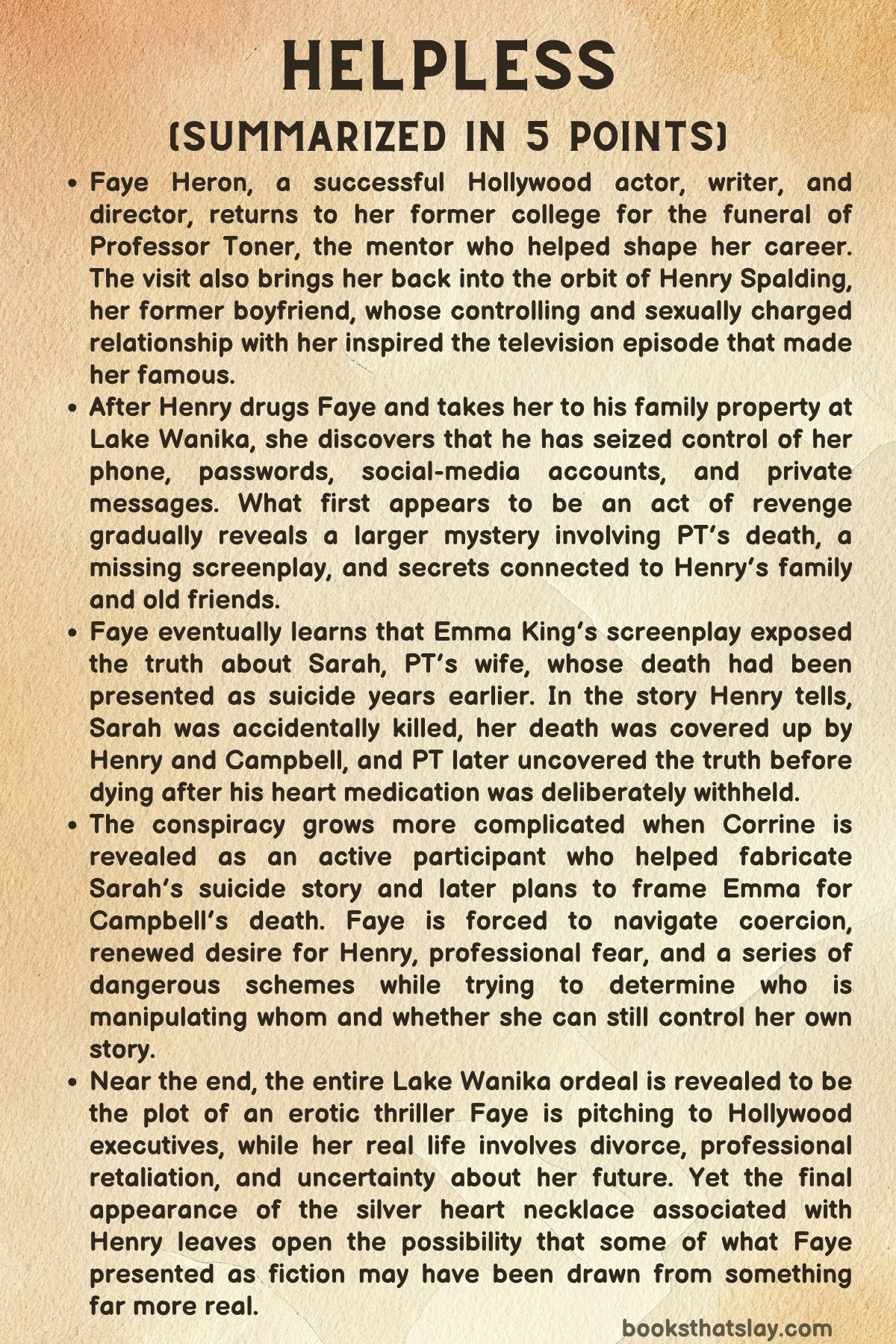
Summary
Faye Heron returns to the college that changed her life for the funeral of Professor Toner, known to everyone as PT. Now a powerful figure in Hollywood, she once arrived there as a scholarship student from a financially limited and emotionally difficult family, and PT was the teacher who recognized her talent before she had learned to trust it herself.
The funeral also forces Faye back into the orbit of Henry Spalding, her former boyfriend. Their college relationship was intense, sexual, controlling, and emotionally difficult, and Faye later transformed part of their breakup into the television episode that established her reputation as a writer.
Faye reconnects with Campbell, Henry’s cousin and one of her closest college friends, and with Campbell’s wife, Corrine. She also meets Emma King, a young screenwriting student who had been mentored by PT and whose screenplay he had sent to Faye before his death.
Emma tells Faye that PT’s supposed heart attack contained suspicious details. He had canceled his classes shortly before dying, summoned Emma urgently, and was later found with Band-Aids covering his hands, leaving Emma convinced that something had happened before his death that no one fully understood.
Faye is initially skeptical, but the questions surrounding PT begin to stay with her. At the same time, her reunion with Henry becomes increasingly charged because twelve years have not erased the attraction, resentment, and emotional dependence that once existed between them.
Their past had been shaped by a particular sexual relationship in which Henry controlled, humiliated, restrained, and cared for Faye in ways that she actively desired. For Faye, temporary helplessness could create relief from responsibility, but the emotional structure of those games was complicated by Henry’s wealth, her economic insecurity, and the instability of their attachment.
After PT’s memorial, Henry arrives at Faye’s hotel claiming that he has brought belongings she left behind years ago. Their conversation becomes hostile when he confronts her about turning their breakup into television and allowing the public to see him through the simplified role of an abusive boyfriend.
Then Faye realizes Henry has drugged her. She loses control of her body while he takes her phone, and when she wakes again, she is inside a detached cabin on Henry’s family property at Lake Wanika, hundreds of miles away.
Henry has removed possible weapons, locked the door from outside, taken control of Faye’s phone, changed her passwords, and read years of private messages. He knows that she deliberately cleared her professional schedule so that she could finish a screenplay, meaning her disappearance may not immediately alarm anyone.
He also creates a scheduled social-media post filled with Faye’s cruelest private comments about colleagues and friends. By threatening to publish it, Henry can damage her career, friendships, and carefully constructed public image whenever she refuses to cooperate.
Faye cannot determine why Henry has gone to such lengths. Although some of his behavior resembles the consensual dominance they once practiced, the absence of choice changes everything, and his threats increasingly appear capable of becoming fatal.
When Faye attempts to escape by boat, Henry dives after her, reaches the vessel, and forces her underwater until she loses consciousness. Before blacking out, however, Faye hears a woman calling her name, suggesting that Henry may be lying when he insists they are alone.
Henry later tells her that what he really needs is access to her email. Faye becomes convinced that the kidnapping is connected not simply to revenge or their old relationship but to something hidden in her messages.
When Henry leaves the island, Faye notices rain leaking around the frame of the cabin window. She works the damaged structure apart with her hands, escapes into the storm, and makes her way to a nearby clubhouse in search of a telephone or computer.
There she finds Campbell. At first Faye believes she has reached safety and tells him that Henry abducted her, but Campbell blocks her exit and pressures her to open her email account.
Once inside the account, Campbell searches for PT’s name, locates the message containing Emma’s screenplay, deletes it, and empties the trash. Faye realizes that Campbell is involved in whatever Henry has been hiding.
A violent struggle follows. Faye injures Campbell with a pen, and when he attempts to kill her with a heavy stone, she uses the same object against him and kills him in self-defense.
Henry finally explains the secret that Campbell had been desperate to destroy. Emma’s screenplay, called “The Accident,” exposed what really happened to Sarah, PT’s wife, whose death years earlier had been accepted as suicide.
Sarah had actually been struck and killed by Henry while he was driving intoxicated and arguing with Campbell. Rather than report the accident, Campbell persuaded Henry to hide the death, place Sarah’s boat in the lake, create the appearance of suicide, and bury her body on PT’s remote property.
Emma learned the truth because she had been having an affair with Campbell. After their relationship deteriorated, she turned his confession into a screenplay, which PT eventually read.
PT investigated the story himself, traveled to Lake Wanika, and found Sarah’s remains. Campbell then removed the heart medication PT relied upon during angina attacks, leaving him vulnerable when the strain of the confrontation triggered a medical crisis.
Henry claims that his original intention was merely to enter Faye’s email and destroy the remaining copy of Emma’s script before it could expose them. Campbell, however, was willing to kill Faye if necessary.
As Faye and Henry move forward after Campbell’s death, their old attraction returns. Faye also reveals the emptiness inside her marriage: her husband has rejected sexual intimacy for years, resisted therapy, and left Faye trapped in a relationship without enough obvious cruelty to make leaving feel simple.
Henry admits that therapy has changed his own understanding of their former relationship. He believes he gave Faye the domination and helplessness she wanted while failing to receive the emotional security he needed, and their renewed intimacy begins to feel less like a repetition of college and more like two adults examining why they once fitted one another so precisely.
Their childhood histories provide part of the explanation. Faye recalls humiliation and punishment from an abusive daycare owner as well as parents who connected discipline with love, while Henry remembers childhood experiences that taught him to associate his own needs with danger and guilt.
The fragile trust between them collapses when Faye discovers PT’s missing heart medication inside Henry’s safe. Henry explains that Campbell stole it, but when he reveals that Corrine found the bottle, Faye realizes Corrine knows the truth and has participated in concealing it.
Faye escapes again and encounters Corrine on the lake. Corrine pretends to need assistance before revealing a gun and forcing Faye back to Henry.
Faye then discovers that Corrine’s involvement is far greater than she imagined. Corrine wrote Sarah’s false suicide note years earlier, using her understanding of infertility and grief to create a believable explanation for Sarah’s supposed decision to die.
Corrine also carries deep resentment toward Campbell. After years of fertility treatment, childbirth, pregnancy loss, and betrayal, she discovered that Campbell was having sex with Emma, and she and Henry had already begun planning Campbell’s death before Faye killed him herself.
Money forms another part of the conspiracy. PT left his valuable Lake Wanika property jointly to Henry and Campbell, and Henry wants to sell the land to the state, while Campbell had opposed the sale.
With Campbell dead, the sale becomes easier, but Sarah’s buried remains must be removed before the property passes into public control. Henry, Corrine, and Faye therefore travel to the grave and recover what remains of Sarah’s body.
Corrine also plans to make Emma responsible for Campbell’s murder. Evidence has already been arranged to connect Emma with Campbell shortly before his death, while Win is supposed to reach Emma, drug her, and leave behind a false confession describing Campbell’s murder as an act of jealous rage.
Faye presents a final problem because she can still tell authorities that Henry kidnapped her and that Campbell died while attacking her. Corrine therefore demands evidence suggesting that Faye came to Lake Wanika voluntarily because she was having an affair with Henry.
The solution is a sex recording. Faye warns Henry that any sexual contact without her consent will constitute rape, forcing both of them to acknowledge the boundary between their old fantasies and genuine coercion.
Instead, they create the recording on their own emotional terms. Their encounter becomes a strange mixture of evidence, performance, desire, resistance, and affection, demonstrating once again how difficult it is to reduce their relationship to a single interpretation.
Before the conspirators can complete their plan, police arrive. Two hikers encountered in the woods found a receipt on which Faye had secretly written a plea for help, allowing authorities to trace the danger back to the property.
Faye immediately understands that survival now depends on controlling the explanation. She improvises a new account in which Corrine killed Campbell, abducted Faye and Henry, forced them through the woods, and locked them inside the cabin.
She and Henry commit themselves to the story and present themselves as fellow victims. Faye uses the same instinct for narrative construction that made her successful in Hollywood, only now storytelling appears capable of determining who goes free and who becomes guilty.
Then the novel abruptly changes the meaning of everything that has happened. Faye announces that the story is over not to police or to Henry, but to a group of Hollywood executives listening to her pitch an erotic thriller.
The kidnapping, Campbell’s death, Corrine’s conspiracy, Sarah’s hidden grave, and Faye’s renewed relationship with Henry are presented as fiction created by Faye. In what she describes as reality, she attended PT’s funeral, saw Henry with his family, and never even spoke to him before he left.
Her actual life nevertheless contains the emotional pressures that shaped the imagined story. Faye and her husband have separated, their production company has dissolved, and a hostile professional campaign seems to be damaging her reputation while she fights to retain ownership and control over her creative work.
She signs with rival agent Caroline Hasser and attempts to sell the erotic thriller as a film. The fictional Henry therefore becomes more than an old lover; he becomes a figure through whom Faye can explore control, humiliation, sexuality, protection, dependency, and the desire to rewrite a past that has been publicly interpreted for her.
As wildfires threaten Los Angeles, Faye encounters executive Claire at a hotel filled with displaced residents. Claire responds strongly to the honesty behind Faye’s project, particularly its refusal to clean up female desire or turn complicated fantasies into socially comfortable explanations.
Claire wants to make the film and sees its controversial sexual material as part of its strength. Faye appears to have found both a creative supporter and a possible route back into professional power.
Yet the novel refuses to let the boundary between invention and experience settle completely. Claire notices that Faye is wearing the same silver heart necklace that belonged to the supposedly fictional Henry storyline, and although Faye insists the captivity story was imagined, her private thoughts suggest that perhaps she and Henry really did change the ending.
Characters
Faye Heron
Faye is the central consciousness of Helpless, and nearly every important question in the book passes through her uncertain relationship with truth, desire, power, and self-definition. She is highly successful, perceptive, ambitious, and professionally disciplined, yet the confidence of her public identity coexists with old insecurities formed by money, family expectations, humiliation, and the fear that love must involve some form of surrender.
Her greatest complexity comes from her refusal to accept a simple description of herself as either victim or fully empowered participant. She recognizes that Henry behaved in controlling and frightening ways, but she also knows that some forms of submission, humiliation, objectification, and dependency genuinely excited her when they took place within a consensual relationship.
That contradiction becomes especially important because the public version of her past does not leave much room for it. Faye’s television success was partly built on a dramatized version of her breakup with Henry, and audiences interpreted the episode through the language of abuse and coercive control.
Faye therefore faces a problem that is both personal and artistic: she benefited from a simplified account while privately believing that the emotional truth was much less comfortable. Her later fictional story allows her to examine the parts of herself that public narratives tend to flatten.
Her profession is essential to understanding her character. Faye does not merely tell stories for a living; she instinctively thinks in terms of structure, performance, motive, dialogue, audience, and interpretation.
The imagined police interrogation demonstrates this ability in its most extreme form, because she survives by constructing a story quickly enough to control how everyone else understands events. Even after the novel reveals that much of what happened was part of a pitch, this moment remains revealing because it shows how Faye imagines power itself: whoever creates the believable narrative may determine the outcome.
Her marriage exposes another part of her conflict. Faye has achieved the wealth and influence she once lacked, yet she finds herself sexually rejected, professionally entangled with her husband, and afraid that leaving him will provoke retaliation capable of damaging everything she has built.
This makes her fascination with helplessness especially paradoxical. The younger Faye wanted to surrender power temporarily because she possessed so little of it elsewhere, while the older Faye has enormous professional authority but still longs for circumstances in which someone else carries the emotional weight.
Faye’s growth does not consist of rejecting these desires. Instead, she becomes more willing to name them without allowing other people to define what they mean.
By the end, her most important act is creative rather than romantic. She takes shame, fantasy, resentment, fear, and uncertainty and converts them into a story that might restore some control over her career, allowing artistic authorship to become a form of survival.
Henry Spalding
Henry is both a character from Faye’s past and a figure shaped by her imagination, which makes him deliberately difficult to judge with certainty. Within Helpless, he can appear loving, threatening, selfish, wounded, sexually perceptive, controlling, protective, and dangerously entitled, sometimes within the same stretch of the story.
His relationship with Faye is built on his unusual ability to understand desires she struggles to state directly. During college, Henry recognizes her interest in submission and develops a sexual language around domination, humiliation, reward, restraint, and care.
What makes the relationship compelling to Faye is that Henry’s control is not initially experienced as emotional absence. He watches her closely, learns what excites her, notices what she wants, and gives her the temporary experience of becoming someone else’s responsibility.
At the same time, Henry’s behavior during their breakup reveals how easily his need for control can become destructive when he fears abandonment. His apparent medical crisis while driving Faye to an important interview places her ambition in direct conflict with his emotional dependence, and his attempt to delay her departure confirms that he cannot easily tolerate losing his role in her life.
The fictional kidnapping magnifies these traits until the difference between consensual domination and actual coercion becomes impossible to ignore. Henry reproduces the language and gestures of their old sexual relationship while removing the very condition that once made those actions acceptable: Faye’s freedom to choose.
Yet Faye’s imagined version of Henry also provides him with emotional development. He has entered therapy, examined his childhood, become a father, and reconsidered both his mother’s treatment of him and the insecurity beneath his controlling behavior.
His account of fatherhood is particularly revealing because caring for his daughters forces him to reconsider experiences he once accepted as normal. The distance between what he would do to his children and what adults did to him exposes old injuries he had never fully named.
Henry also functions as an emotional fantasy for Faye. He represents the possibility that someone might understand the most socially difficult parts of her sexuality without rejecting her, while also loving her intensely enough to make surrender feel safe.
That does not mean he should be reduced to an ideal partner. The final uncertainty over what actually occurred means Henry remains suspended between historical person, fictional lover, dangerous memory, erotic fantasy, and imagined alternative life.
Campbell
Campbell initially occupies the reassuring role of Faye’s old friend, which makes his transformation inside her invented thriller especially effective. His familiarity allows him to represent a form of danger more disturbing than open hostility because Faye approaches him expecting protection.
In the kidnapping narrative, Campbell is more ruthless and pragmatic than Henry. He helps conceal Sarah’s death, manipulates the false suicide story, withholds PT’s medication, attempts to destroy Emma’s screenplay, and appears willing to remove anyone who threatens exposure.
His behavior shows how wrongdoing can expand through repeated decisions rather than a single moment of panic. The original accident may not have been intentional, but every attempt to hide it requires another lie, another betrayal, and eventually the willingness to accept further deaths.
Campbell’s affair with Emma also reveals his arrogance. He confesses dangerous information to her while treating the relationship carelessly enough for resentment and ambition to transform that confession into evidence against him.
His death at Faye’s hands is significant because it marks one of the clearest moments in which she physically rejects helplessness. She does not defeat him through wealth, status, or professional influence, but through desperate improvisation and the refusal to become passive when his violence turns against her.
Because the later revelation places this death inside Faye’s film pitch, Campbell can also be read as a fictional container for betrayal. The trusted male friend becoming a lethal threat reflects Faye’s broader anxiety that people who appear to support her may be privately protecting their own interests.
Corrine
Corrine begins as someone Faye has long disliked and mistrusted, but her role becomes progressively more formidable. She initially seems privileged, cold, socially secure, and judgmental, particularly when viewed through the memories of a younger Faye who already felt inferior around wealthy families.
The fictional conspiracy reveals that Corrine possesses enormous emotional discipline. Where Henry is conflicted and Campbell is careless, Corrine can plan, perform, deceive, threaten, and adapt with frightening efficiency.
Her connection to Sarah’s false suicide note is especially important. Corrine is capable of using genuine knowledge of infertility, loss, and despair to manufacture a believable emotional explanation for another woman’s death.
Her own reproductive history prevents her from becoming a simple villain without context. Years of fertility treatment, the complicated circumstances surrounding Tookie’s birth, a later stillbirth, and Campbell’s affair with Emma create a history of grief and betrayal that helps explain the intensity of her rage.
Explanation, however, does not become moral justification. Corrine converts pain into calculation, becoming willing to kill Campbell, frame Emma, manipulate evidence, threaten Faye, and use other people as expendable pieces in a plan.
She also provides an important contrast with Faye. Both women are intelligent and capable of constructing narratives, but Faye primarily turns experience into art while Corrine turns experience into operational deception.
Professor Toner
PT is one of the most important influences on Faye even though his death occurs before the main action begins. He represents the first adult outside her family who treats her artistic talent as something serious enough to build a life around.
For a scholarship student uncertain about whether creative ambition is practical or respectable, his recognition changes the scale of what Faye believes she can become. His description of her talent as a kind of visible brightness gives her a language for potential before professional success proves him correct.
PT also represents intellectual refuge. His home, movie nights, teaching, and conversations offer Faye an environment in which ideas matter more than inherited wealth or social confidence.
His importance therefore exceeds mentorship. He becomes associated with the version of Faye who first discovered that imagination could provide a future beyond the limitations of her upbringing.
Within the fictional thriller, PT also becomes a moral investigator. Once he learns the truth about Sarah, he returns to Lake Wanika, searches for her body, and confronts the people responsible rather than protecting their reputations.
His death turns the past into an unresolved accusation. Even after the novel reveals the larger story as Faye’s pitch, PT’s importance remains emotionally real because his influence survives through the way Faye understands authorship, courage, and the obligation to write about experiences others would prefer to leave unnamed.
Sarah
Sarah is largely absent as a speaking presence, yet the fictional narrative repeatedly turns around what happened to her. Her supposed suicide becomes a story other people create on her behalf, demonstrating how easily a dead person can lose control over the meaning assigned to her life.
The fabricated explanation relies upon her fertility struggles. Because her pain was real, the conspirators are able to make suicide appear psychologically believable, converting genuine suffering into evidence for an event that never occurred.
This makes Sarah especially important to the novel’s concern with narrative authority. Her private grief is taken from her and reorganized by other people into a convenient public account.
Once her actual death is uncovered, she becomes a reminder that believable stories are not necessarily truthful ones. The facts surrounding her emotional state make the lie stronger rather than weaker.
Sarah also connects PT’s personal loss with the larger moral crisis. His decision to investigate what happened to her transforms grief into action and places him in conflict with those who benefited from silence.
Emma King
Emma represents youth, creative ambition, confidence, and the hunger to be recognized. As the current scholarship student whose screenplay reaches Faye, she also functions as a partial reflection of the younger version of Faye who once needed an established professional to confirm that her work mattered.
Their differences are equally important. Faye remembers having to fight against insecurity, class anxiety, and the fear that she did not belong, while Emma appears to assume that talent should lead quickly to recognition.
This creates an uncomfortable resentment in Faye. She sees qualities in Emma that resemble her younger self, but Emma’s confidence makes the resemblance difficult to embrace without jealousy.
Within the fictional thriller, Emma turns Campbell’s confession into “The Accident.” Her screenplay demonstrates the dangerous potential of art to preserve information that powerful people want erased.
She therefore becomes both writer and witness. Even without physical proof, she can transform secret knowledge into a narrative capable of forcing others to confront what happened.
Her ambition also makes her vulnerable to manipulation. Henry can offer professional opportunity as a method of buying silence, while Corrine can construct a false story in which Emma’s affair with Campbell becomes the motive for murder.
Emma ultimately represents the unstable position of a young artist entering a system where access, recognition, and exploitation can exist very close to one another.
Faye’s Husband
Faye’s husband remains unnamed, which gives him an unusual function in the story. He is personally significant to Faye but is often understood through the roles he occupies: partner, producer, professional collaborator, emotional disappointment, and eventually adversary.
He enters Faye’s life at the exact moment she leaves Henry behind and begins building a Hollywood career. His competence, industry knowledge, and helpfulness initially represent stability and access to the world she wants to enter.
Their relationship eventually produces enormous professional success, but the boundary between marriage and business becomes dangerous. The production company they share makes emotional separation inseparable from questions of ownership, reputation, employment, and money.
Sexual rejection creates another source of pain. Faye spends years attempting to understand why her husband rarely wants intimacy, and the absence of a single dramatic betrayal makes her dissatisfaction harder for her to justify to herself.
His later admission that he was originally drawn to her dependency changes her understanding of the marriage. The attraction to her helplessness was never limited to Henry; it appeared in a quieter form inside the relationship she believed was safer.
After their separation, professional conflict becomes central. Faye fears that her husband and his influential brother can shape public opinion against her, leaving her unable to prove whether the damage to her reputation is accidental, strategic, or retaliatory.
Caroline Hasser
Caroline represents an alternative professional future for Faye. Initially, even speaking with her threatens Faye because changing agents could be interpreted as betrayal and could weaken the network protecting her career.
That makes Caroline important long before she becomes Faye’s representative. She embodies the possibility of stepping outside the professional relationships that have become entangled with Faye’s marriage.
When Faye eventually signs with Caroline, the decision signals movement toward independence. It does not immediately solve Faye’s problems, but it gives her an ally whose interests are not automatically tied to her husband or his family.
Caroline’s role also shows how much professional survival depends upon relationships. Faye may be talented and famous, yet she still needs people willing to advocate for her work when rumor, litigation threats, and institutional caution begin closing doors.
Claire
Claire becomes important near the end because she offers something Faye has been struggling to find: an audience willing to understand the project on its own uncomfortable terms. Rather than demanding that female sexuality be made respectable or morally simple, Claire responds to the ambiguity that gives Faye’s story its power.
Her question about whether the sexual problems in Faye’s marriage are based on reality initially appears intrusive, but it leads to an unusually candid exchange. When Faye answers honestly, Claire does not respond with embarrassment or judgment.
Instead, Claire recognizes commercial and artistic possibility in material involving domination, shame, consent, fantasy, and contradiction. Her reaction matters because Faye has spent years feeling that complicated desire must be translated into language acceptable to other people before it can be publicly discussed.
Claire therefore becomes both potential producer and validating reader. She sees value in precisely the material Faye fears others will simplify.
Her discovery of the silver necklace creates the book’s final uncertainty. By noticing a physical object associated with the supposedly fictional Henry narrative, Claire unintentionally reopens the question of what Faye has actually invented.
Win
Win is a smaller but revealing character whose behavior reflects the entitlement and cruelty surrounding Henry and Campbell’s social world. Early on, he embarrasses Faye by openly referencing the television episode based on Henry and treating her private history as material for public amusement.
That scene establishes him as someone willing to exploit discomfort for entertainment. Henry’s decision to defend Faye against him also helps restore part of the old emotional bond between Faye and Henry.
Within Corrine’s later plan, Win becomes useful as an accomplice sent toward Emma with drugs. His participation shows how the conspiracy depends not only upon one mastermind but upon a social network in which loyalty and shared interests can override ordinary moral boundaries.
Jonathan Granger
Jonathan Granger is important less because of his direct presence than because of the opportunities attached to his name. The scholarship he funds helps make Faye’s education possible, placing him indirectly at the beginning of her artistic development.
Later, PT connects Faye with Jonathan when an assistant position opens in Los Angeles. The interview becomes the opportunity that finally forces Faye to choose between remaining inside Henry’s world and pursuing the career she has spent years preparing for.
Jonathan therefore represents institutional access. Talent matters in Faye’s life, but someone still has to fund the scholarship, recognize the opportunity, offer the position, or open the door.
His role reminds the reader that Faye’s rise is neither purely self-created nor purely dependent on privilege. Her career emerges from talent, effort, mentorship, chance, and access operating together.
Tookie
Tookie, Campbell and Corrine’s son, occupies a relatively small role, but his existence adds emotional context to Corrine’s history. His birth follows years of fertility treatment and the eventual use of an egg donor, making him part of a long struggle that shaped Corrine’s relationship with pregnancy and motherhood.
He also strengthens the contrast between adult conspiracies and family life. Campbell and Corrine can appear to outsiders as parents inside a conventional social unit even while the fictional narrative assigns them secrets, affairs, resentment, and violence.
His asthma becomes useful within Henry’s cover story for Campbell’s sudden disappearance from Emma. Even a child’s medical vulnerability can therefore be transformed into narrative cover by adults attempting to control what others believe.
Themes
Control, Consent, and the Meaning of Helplessness
Power becomes psychologically complicated when the same action can produce radically different meanings depending on choice. Faye’s relationship with submission illustrates this distinction because humiliation, restraint, and domination can be pleasurable when she actively participates in creating the conditions under which they occur.
Once choice disappears, however, the emotional meaning changes. The fictional kidnapping deliberately reproduces behaviors that once excited Faye while removing her ability to stop them, forcing both Faye and the reader to confront the difference between consensual surrender and actual coercion.
This distinction is central to Helpless because Faye resists the idea that enjoying one form of powerlessness means accepting every form of it. Her sexual fantasies do not erase the possibility of abuse, and experiencing abuse does not invalidate the desires she freely chose.
The theme also extends beyond sex. Faye becomes professionally trapped by her marriage, socially threatened by reputation, financially vulnerable to industry power, and psychologically burdened by other people’s interpretations of her past.
Her attraction to temporary helplessness can therefore be understood partly as a response to constant responsibility. Giving control to someone trusted allows her to stop managing outcomes for a limited period.
The novel ultimately treats consent not as a minor technical distinction but as the factor that changes the meaning of power itself. The same language of dependence can describe pleasure, manipulation, comfort, fear, fantasy, or violence depending on who has the freedom to decide.
Storytelling, Truth, and the Power to Define Reality
Faye’s greatest source of power is her ability to construct stories. She turns her breakup with Henry into award-winning television, imagines herself constructing a false statement for police, and later converts private fear, sexual frustration, professional conflict, and unresolved memory into an erotic thriller.
Storytelling is therefore never presented as neutral. A story can reveal truth, hide truth, simplify truth, protect someone, destroy someone, or create an interpretation powerful enough to replace facts in the public imagination.
Sarah’s fictionalized suicide demonstrates the darkest version of this process. Real details about infertility and emotional suffering make the false explanation for her death convincing, showing that effective lies often contain recognizable truths.
Faye faces a related problem after dramatizing Henry. The television episode captures real fear and control but leaves out the consensual desires that made their relationship difficult to classify, and the public interpretation becomes cleaner than her own memory.
Her later film pitch can be read as an attempt to reclaim that lost complexity. Instead of allowing herself to be assigned a single role, she creates a narrative in which she can simultaneously experience desire, fear, agency, surrender, love, resentment, fantasy, and manipulation.
The final necklace prevents the reader from deciding exactly where invention ends. The uncertainty reinforces the idea that fiction may sometimes reveal emotional truths even when its literal events cannot be confirmed.
Ambition, Class, and Professional Survival
Faye’s ambition begins from a position of insecurity. As a scholarship student surrounded by people with inherited wealth, family property, expensive traditions, and effortless social confidence, she develops an intense awareness that talent alone does not eliminate economic or cultural difference.
Her early fascination with luxury is therefore not merely materialism. Objects can represent entry into a world from which she once felt excluded, while professional success becomes evidence that she has escaped the limitations attached to her upbringing.
Henry’s wealth complicates their sexual relationship because his ability to buy things, offer rewards, and treat luxury casually gives financial meaning to their games of possession. Faye’s fantasy of becoming one of his prized objects is inseparable from the fact that he belongs to a class where expensive objects require little effort.
Hollywood changes Faye’s position but does not eliminate vulnerability. She becomes wealthy and influential, yet her career remains dependent upon agents, producers, executives, intellectual property, reputation, institutional relationships, and powerful people willing to support her.
Her marriage intensifies this dependence because personal and professional life become economically fused. Leaving an unsatisfying husband can therefore mean risking not only emotional security but also the company, contacts, projects, and public identity built during the marriage.
The book consequently presents success as real but unstable. Faye gains tremendous power, yet each new level of professional achievement creates new structures capable of limiting how freely she can act.
Desire, Shame, and Self-Knowledge
Faye’s sexuality creates conflict because what she wants does not fit comfortably within simplified ideas about empowerment. She is drawn to submission, humiliation, objectification, dependency, and controlled helplessness, but she also wants professional authority, personal independence, respect, and the freedom to determine the conditions of her own life.
These desires are not treated as mutually exclusive. Instead, the story asks why people often expect sexual desire to behave like a clear political statement about how someone wants to live everywhere else.
Faye’s shame comes partly from knowing that others may misunderstand her fantasies. Once her television episode turns Henry into a public example of coercive control, admitting that she desired parts of their old dynamic becomes increasingly difficult because she fears that complexity could be interpreted as excusing behavior that genuinely frightened her.
Her childhood memories provide possible origins without reducing sexuality to a diagnosis. Experiences in which humiliation, punishment, attention, and love existed close together may have influenced what later felt emotionally familiar, but Faye does not treat explanation as proof that her adult desires are false.
Henry’s childhood wounds similarly suggest that their compatibility came from two personal histories meeting in a specific sexual language. Neither person created the entire dynamic alone.
Faye moves toward self-knowledge when she stops asking whether her desires make her properly empowered and begins asking whether they are freely chosen, honestly understood, and emotionally safe.