Man Overboard Summary, Characters and Themes
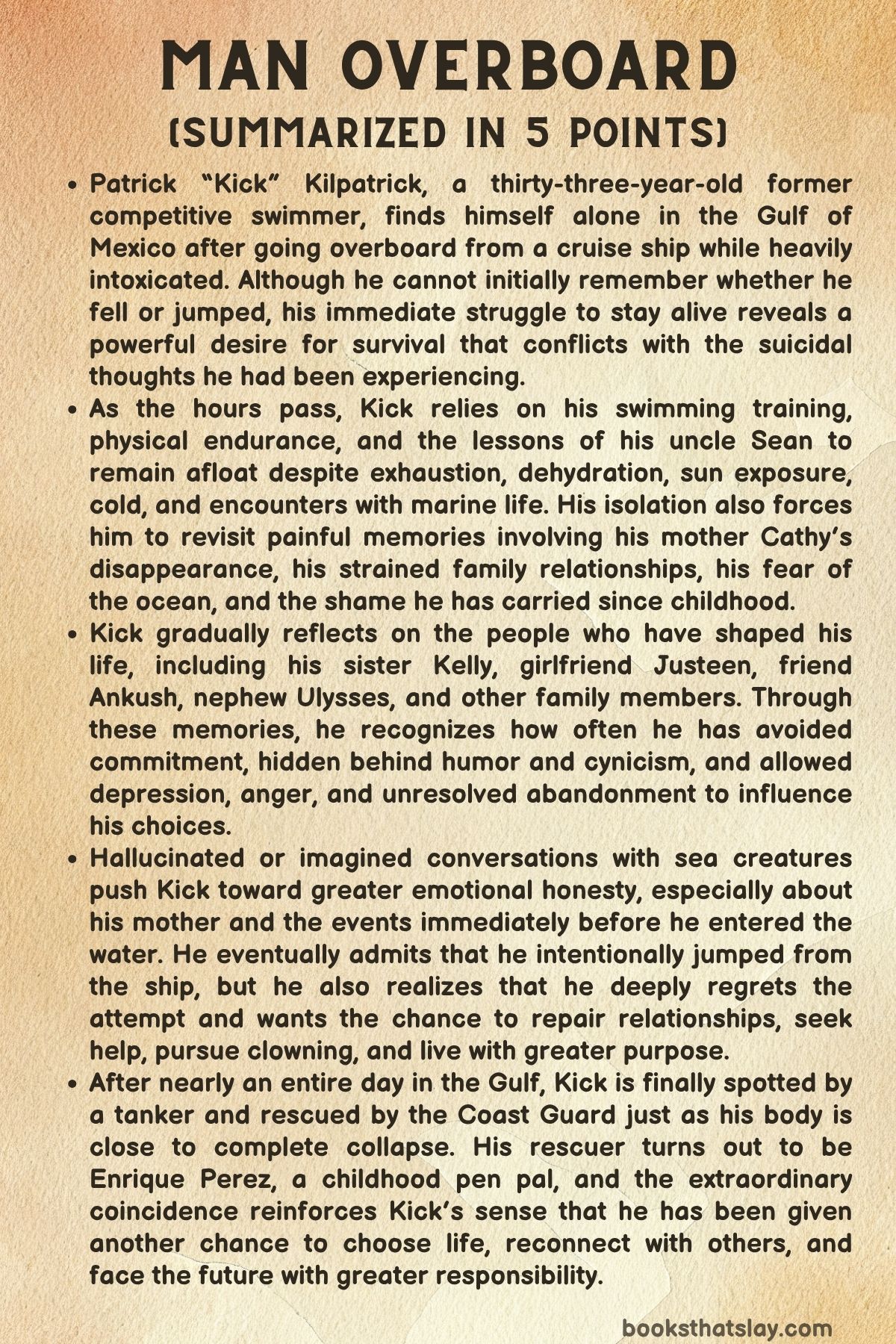
Man Overboard by Kathleen Rooney is a survival novel centered on Patrick “Kick” Kilpatrick, a thirty-three-year-old former competitive swimmer who finds himself alone in the Gulf of Mexico after going overboard from a cruise ship.
What begins as a physical struggle against exhaustion, exposure, dehydration, and the sea gradually becomes an examination of depression, family wounds, shame, commitment, anger, and the difficult choice to remain alive. Through Kick’s memories, imagined conversations, humor, and mounting honesty, the book follows a man who had recently doubted whether life was worth continuing and who discovers, under the most extreme circumstances, how strongly he wants another chance.
Summary
Patrick “Kick” Kilpatrick suddenly surfaces in the Gulf of Mexico late at night, battered, partly injured, and unable to remember exactly how he ended up in the water. A former champion swimmer from Nebraska and now a physical therapist and fitness instructor, he possesses the athletic ability to remain afloat, but his lifelong terror of the open ocean makes the situation especially frightening.
The cruise ship carrying his family is already disappearing into the darkness, and no one appears to know that he is missing. Kick remembers that he had been drinking heavily and that suicide had repeatedly entered his thoughts during the weeks before the trip, leaving him uncertain whether he slipped, fell, or intentionally went over the railing.
The uncertainty becomes immediately less important than his powerful instinct to survive. The man who had recently felt indifferent about whether he continued living suddenly finds himself fighting with everything he has to remain above the surface.
As the first hours pass, Kick thinks about the relatives still aboard the ship, including his father Mike, stepmother Pam, sister Kelly, brother-in-law Jason, nephew Ulysses, Uncle Sean, and other members of his extended family. He fears that because everyone expects him to appear at breakfast or brunch, many hours may pass before anyone realizes that something is wrong.
His memories return to the evening before his disappearance. He had resented being on the cruise and responded by drinking continuously, yet he briefly experienced genuine happiness while performing in an air-guitar contest with Kelly nearby and unexpectedly winning.
That moment of pleasure was followed by more alcohol and greater emotional instability. Alone later in the evening, he moved through the ship carrying the loneliness, resentment, depression, and unresolved family pain that had been building for years.
The open sea also forces Kick to confront the contradiction at the center of his identity. He is an excellent swimmer who has always been terrified of deep ocean water, a fear that became obvious during family snorkeling and scuba trips after his father married Pam.
A frightening encounter with a stingray and a later inability to descend during a scuba excursion left him ashamed. His father treated the fear as cowardice, while Uncle Sean responded with greater understanding and taught him that respecting the sea was reasonable rather than humiliating.
Sean’s lessons become essential as Kick spends hour after hour treading water. His uncle had coached him as a swimmer and taught him that discipline, endurance, repetition, and the ability to continue through boredom mattered more than dramatic displays of talent.
Kick begins applying those principles to survival. Winning no longer means defeating an opponent or achieving an impressive time; it simply means staying alive for another minute and then another.
As exhaustion increases, his thoughts expose the dissatisfaction that existed before the cruise. He had become deeply frustrated with consumerism, technology, environmental decline, politics, social media, his own drinking, his sexual behavior, and what he saw as the emptiness of much contemporary life.
At the same time, he recognizes his own contradictions. He criticizes society while participating in many of the habits he condemns, and his intelligence and humor frequently function as ways to avoid confronting his sadness directly.
During the night, memories of his mother Cathy become increasingly important. When Kick was ten, Cathy developed breast cancer and underwent severe treatment, but even after entering remission she did not return emotionally to the person her children remembered.
She became withdrawn and dissatisfied, struggled with work and family life, and eventually left to stay with her sister. Kick’s father offered little explanation, leaving Kick and Kelly to interpret the disappearance for themselves.
Kelly responded largely through anger, while Kick turned the abandonment inward. Humiliated by classmates and unable to understand why a living mother would leave him, he spent years wondering whether he might have prevented her departure by being a better son.
There was no death, funeral, or final explanation that could give the children a clear ending. Cathy therefore remained present through absence, shaping Kick’s later fear of rejection, resentment, emotional distance, and inability to trust commitment.
As dawn approaches, Kick survives an encounter with a shark by fighting back instinctively. The experience shocks him because it demonstrates how completely his body has chosen survival even after his mind had spent months entertaining death.
His memories then return to childhood experiences with clowning, especially an appearance on a television program in which he played a game for another boy named Enrique Perez. His failure to win the largest prize led him to write Enrique an apology, beginning an unlikely childhood correspondence.
Clowning has recently returned to Kick’s life in a more serious form. He has begun taking classes and considering work as a hospital clown because he senses that comedy, foolishness, vulnerability, and physical failure might offer something that his controlled athletic identity cannot.
Sunrise gives Kick warmth and renewed hope, although dehydration and fatigue continue worsening. He also thinks about his close friend Ankush, whose difficult life, struggle with alcoholism, experience working under harsh conditions on a cruise ship, and fascination with masculine self-help ideas reveal another version of the search for strength.
Kick disagrees with many of the bitter or misogynistic ideologies Ankush encounters, yet he remembers one useful idea: the mind can surrender before the body actually has to. He therefore decides that while he cannot fully control his physical decline, he can continue resisting mental surrender.
As the heat becomes stronger, Kick begins encountering marine animals that appear to speak with him. Whether these encounters are hallucinations, symbols produced by exhaustion, or experiences occurring somewhere between reality and imagination remains uncertain.
A whale shark becomes an informal therapist and pushes Kick toward the subject he has avoided most. After decades of silence, Cathy recently sent him a Facebook friend request and later an email explaining that she had always loved him and had reasons for leaving.
Kick never answered. He repeatedly read the message while remaining caught between anger, curiosity, loyalty to Kelly and his father, fear of rejection, and the possibility that Cathy’s explanation might make his childhood story more complicated.
The sea creatures repeatedly challenge the defenses he has built around that uncertainty. An octopus leads him to recognize that he has spent much of his emotional life remaining near the surface because going deeper might reveal pain he does not know how to manage.
A hawksbill sea turtle questions whether his clowning, sexual freedom, and humor represent genuine freedom or additional forms of avoidance. Through these confrontations, Kick begins distinguishing between things that enrich his life and things that merely distract him from himself.
His memory of the night on the ship gradually becomes clearer. After the air-guitar contest, he had stood near the railing while rereading Cathy’s email, furious that her explanation seemed inadequate and painfully aware that no stranger passing nearby offered even a small acknowledgment that might interrupt his isolation.
Other memories reveal how extensively Cathy’s disappearance shaped the family. Kick recalls Kelly’s determination to build a stable life, her career as a marine biologist, her closeness with Pam, and her decision that forgetting their mother was healthier than reopening the relationship.
Kick respects Kelly’s position but realizes that it cannot determine his own choice. A group of jellyfish drives this realization further by making him imagine that Cathy has suddenly died, and his horrified reaction reveals how desperately he still wants the opportunity to see her.
He finally admits that he wants contact with his mother. The possibility of disappointment no longer seems as frightening as losing the chance forever.
His memories of Granny Sue provide another reason to survive. Granny’s quilts preserved family histories through pieces of old fabric, including the memory of Nora McGee, a girl who died young.
Kick once secretly stole Nora’s unused dress and kept it for years. Now he imagines confessing the theft, asking Granny to help him create a costume for his clown persona, Pillows, and turning something associated with guilt and death into an act of creativity.
Thoughts of Justeen become equally important. Their relationship had grown more serious than Kick’s previous romances because she challenged him intellectually, disagreed with him openly, and refused to accept emotional avoidance as maturity.
Justeen wanted to know whether Kick intended to build a real future with her, while he continually resisted giving an answer. When his depression became severe, he sent her a message suggesting he was unsure whether he could convince himself to remain alive.
She responded with love but also with boundaries, explaining that she could not become responsible for keeping him emotionally stable. Alone in the Gulf, Kick finally understands how unfair it was to place that burden upon her.
A remembered clown-class exercise pushes him toward another realization. His instructor Christoph had taught that clowning depends upon exposure, failure, and bodily honesty rather than cleverness, and one exercise caused Kick to move unexpectedly from uncontrollable laughter into sobbing.
The lesson now becomes personal. He cannot survive emotionally by treating every wound as something to disguise with jokes, intelligence, sexual freedom, physical strength, or contempt.
The returning dolphin finally forces him to acknowledge what happened on the cruise ship. Kick remembers that he did not accidentally fall into the Gulf: he jumped.
The admission brings relief rather than the shame he expects. He attempted to die, survived the attempt, and almost immediately discovered that he desperately wanted to remain alive.
From that point, his thinking shifts toward what survival would require if rescue actually comes. He imagines reducing his dependence on social media, becoming more useful to others, committing himself seriously to clown work, confronting his family history, seeking therapy, and treating Justeen with greater responsibility.
Another imagined marine companion, a pregnant male seahorse named Pringles, encourages him to accept that he may never completely understand what Cathy experienced after cancer. Her departure may still have caused enormous damage, but understanding her requires allowing for a reality beyond the abandoned child’s interpretation.
Kick decides that he does not want to continue living while sustaining hatred toward his mother. He imagines reconnecting with her and returning a necklace of hers that he secretly kept after she disappeared.
A Coast Guard helicopter eventually appears, giving him enormous hope, but passes without seeing him. The missed rescue nearly destroys him because he knows his exhausted body may not survive another night in the water.
Darkness returns, and Kick begins considering acceptance alongside resistance. He remembers ideas from dialectical behavior therapy and recognizes that he has spent the day changing his interpretation of his life even though he cannot control the ocean itself.
Near physical collapse, he eventually notices frightened fish moving beneath him as a large tanker, the Pelican Mariner, approaches. Kick uses his remaining strength to shout, wave his clothing, and declare openly that he does not want to die.
Two crew members notice him and throw a lighted life preserver while contacting the Coast Guard. Kick manages to reach the flotation device, and the tanker remains nearby to illuminate his position while rescue aircraft return.
When the helicopter finally arrives, a rescue swimmer descends and helps lift Kick from the Gulf after nearly an entire day in the water. Inside the aircraft, Kick discovers an extraordinary coincidence: the rescuer is Lieutenant Enrique Perez, the same boy for whom he played the television prize game as a child.
Enrique explains that rescue teams have searched an enormous area and that Kick was dangerously close to death. Wrapped in a thermal blanket and receiving medical treatment, Kick understands his survival not as proof that his future will be painless but as an unexpected second chance.
He plans to contact Cathy, speak honestly with Granny Sue, pursue his Cardio Clown idea with Ankush, seek a more meaningful way of living, and stop keeping Justeen at a distance. His first immediate act is to borrow Enrique’s phone and call her.
Justeen answers, and Kick has no perfect speech or guarantee that his problems have ended. What has changed is his willingness to participate in his own life, accept uncertainty, risk emotional commitment, and continue trying.
Characters
Patrick “Kick” Kilpatrick
Kick is the central consciousness of Man Overboard, and nearly every major question in the book develops through the conflict between the identity he shows others and the emotional reality he avoids confronting. Physically disciplined, intelligent, funny, attractive, and professionally devoted to helping bodies recover, he appears capable and independent, yet beneath that controlled exterior are depression, abandonment trauma, anger, shame, loneliness, and a powerful fear of emotional dependence.
His status as an accomplished swimmer who fears the open ocean reflects this contradiction particularly well. Kick knows how to move through water better than most people, but technical competence cannot eliminate terror, just as his knowledge, humor, and physical strength cannot resolve the wounds created by his mother’s disappearance.
Kick also possesses an unusually active intellectual life. He thinks about literature, history, survival accounts, environmental damage, masculinity, consumer culture, technology, politics, humor, therapy, and human behavior, but his constant thinking often becomes another way to delay decisions.
His treatment of relationships reveals the same tendency. He wants intimacy but resists commitment, loves Justeen but avoids defining their future, longs to contact Cathy but leaves her message unanswered, and values his family while carrying resentments he rarely addresses directly.
The suicide attempt forces him to stop living through indefinite postponement. Once death becomes a physical reality rather than an abstract escape, he discovers that his desire to live is stronger than his desire to disappear.
His development does not depend on becoming permanently cheerful or suddenly free from depression. Instead, he becomes willing to accept responsibility for staying engaged with life, asking for help, choosing relationships, facing uncertainty, and acting on the things he claims to value.
Cathy Kilpatrick
Cathy is physically absent from most of Man Overboard, yet she remains one of its most influential characters because her disappearance shaped Kick’s emotional life long before his crisis at sea. In his childhood memories, she is intelligent, intellectually curious, loving, ambitious, and deeply associated with books, learning, and the encouragement of curiosity.
Her breast cancer changes the direction of the family. Although she survives the disease, the experience appears to leave her psychologically altered, and the book refuses to reduce that transformation to a simple explanation.
From Kick’s childhood perspective, her departure means abandonment. Because he receives little explanation, he assumes that a mother who loved him would have stayed and therefore begins searching for some failure in himself that could explain why she left.
As an adult, he gradually recognizes the limitation of that interpretation. Cathy may have loved her children while also feeling trapped, frightened, emotionally damaged, dissatisfied, or unable to continue living the life she had previously accepted.
Her eventual attempt to contact Kick becomes important because it destabilizes the version of the past that has governed him for decades. Her message cannot undo the damage, but it offers the possibility that abandonment and love may have existed together in a more complicated reality.
Cathy therefore represents both the injury Kick carries and the unanswered question he must finally approach. His growth depends not on declaring her innocent but on becoming willing to hear a story that may challenge his own.
Kelly Kilpatrick
Kelly is Kick’s sister, emotional counterpart, and one of the people he trusts most deeply. She experienced the same maternal disappearance, but her response demonstrates that shared trauma does not produce identical coping mechanisms.
Where Kick internalized Cathy’s departure and continued longing for explanations, Kelly converted much of her pain into anger and distance. When their mother eventually attempted contact, Kelly chose to block her and concluded that forgetting worked better than reopening the relationship.
Her firmness is not presented merely as bitterness. Kelly has built a stable adult life, established herself as a marine biologist, developed a strong bond with Pam, married Jason, and become the mother of Ulysses.
She is also practical, intelligent, and decisive. Kick believes that once she notices he has failed to appear for brunch, she will immediately understand that something is wrong and force others to respond.
Kelly nevertheless avoids controlling Kick’s decision about Cathy. She advises him to determine his own goals and boundaries if he chooses to reconnect, showing that her refusal to resume the relationship does not require him to make the same choice.
Her role highlights the different ways people survive family wounds. Kelly needs separation, while Kick eventually discovers that uncertainty is more painful for him than renewed contact might be.
Justeen
Justeen is one of the strongest forces pushing Kick toward emotional adulthood. Older than Kick, divorced, the mother of two grown children, and completing an education she postponed when she became pregnant, she has already spent years confronting responsibilities that Kick often avoids.
Their attraction is intellectual as well as physical. Kick values the fact that she can challenge his pessimism, disagree with him, and remain hopeful without pretending that social and personal problems do not exist.
Justeen also recognizes the danger of allowing love to become emotional caretaking. When Kick tells her that he is uncertain whether he can persuade himself to remain alive, she responds with concern but refuses to accept responsibility for his survival.
Her statement that she is not his mother directly confronts one of Kick’s deepest patterns. He has carried the unresolved loss of Cathy into adult intimacy, longing for closeness while simultaneously fearing dependence, abandonment, and commitment.
Justeen therefore represents a relationship that can continue only if Kick participates as an equal adult. His decision to call her immediately after rescue suggests that he is finally prepared to stop asking love to protect him from uncertainty and instead risk building something through mutual responsibility.
Uncle Sean
Uncle Sean is one of Kick’s most important mentors because he gives him a model of strength based on discipline rather than humiliation. A former Navy man and swimming coach, Sean teaches endurance through repetition, patience, fundamentals, and respect for difficult conditions.
His response to Kick’s fear of the ocean is especially significant. While Mike treats the fear as cowardice, Sean understands that the sea deserves respect and does not interpret fear as proof of weakness.
Sean’s coaching philosophy later becomes a survival system. Kick repeatedly remembers lessons about finishing strongly, continuing when work becomes boring, and relying on fundamentals when dramatic solutions are unavailable.
He also represents the influence of an adult who recognizes Kick’s potential without pretending that talent alone is enough. When teenage drinking and smoking begin damaging Kick’s swimming, Sean appeals to his sense of responsibility rather than simply punishing him.
In the Gulf, Sean’s voice survives as an internal structure that keeps Kick moving. His importance shows how mentorship can remain active long after the teacher is physically absent.
Mike Kilpatrick
Mike is Kick and Kelly’s father, and his influence is more conflicted than Sean’s. After Cathy leaves, Mike provides continuity for the family, but his refusal to explain what happened leaves the children without the information they need to understand their mother’s disappearance.
His approach to masculinity also contributes to Kick’s shame. When Kick cannot complete a scuba descent, Mike interprets the fear as cowardice and even frames it as disrespect toward Pam.
That reaction teaches Kick that vulnerability can lead to judgment. For a boy already struggling with abandonment, such expectations encourage him to conceal fear instead of examining it.
Mike’s decision to cut ties with Cathy’s extended family after her departure further narrows the children’s access to alternative versions of the past. As a result, Kick grows up largely inside the interpretation established by the parent who remained.
The book does not make Mike solely responsible for Kick’s difficulties, but it shows how silence and rigid expectations can shape a child as powerfully as direct conflict. Kick’s later need to hear Cathy’s perspective partly grows from understanding that his father’s version was never the only possible account.
Pam
Pam enters Kick’s family after Cathy’s disappearance and becomes an energetic presence associated with Florida, cruises, snorkeling, scuba diving, and enthusiasm for ocean life. Her interests help transform the family into regular travelers and introduce both Kick and Kelly to underwater experiences.
Kelly responds enthusiastically and eventually becomes a marine biologist, while Kick struggles with fear. Pam’s enthusiasm therefore becomes part of a family environment in which the siblings move in very different directions.
Her significance is especially clear in Kelly’s life. By the time of Kelly’s wedding, Pam speaks with the pride and familiarity of someone who has become an important maternal figure.
Pam does not erase Cathy, and the story does not suggest that a replacement parent can cancel the wound of abandonment. Instead, she represents the possibility that care can enter a family through new relationships even when an earlier loss remains unresolved.
Jason
Jason is Kelly’s wealthy, competitive, self-assured husband and one of the people who most strongly irritates Kick. He is interested in survivalism, military training, technology, status, and forms of masculine confidence that Kick often sees as exaggerated or performative.
Kick’s hostility is partly personal. Jason’s condescension makes him angry enough to imagine violence, although he recognizes that he would never act on those fantasies.
More importantly, Jason represents a version of masculinity that the novel repeatedly questions. His confidence is accompanied by cruelty, most clearly when he tells a racist and sexist joke and treats offensiveness as humor.
That moment allows Kick to distinguish between laughter that humiliates others and comedy based on absurdity, vulnerability, failure, and shared pleasure. Jason therefore helps clarify the ethical principles behind Kick’s growing interest in clowning.
Kick’s desire to survive partly out of spite toward Jason is deliberately ridiculous but psychologically believable. During an extreme crisis, even resentment becomes usable energy.
Ulysses
Ulysses, Kelly and Jason’s ten-year-old son, represents one of Kick’s clearest connections to the future. Kick admires his intelligence, curiosity, and enthusiasm and looks forward to experiences such as exploring Mayan ruins with him.
This affection matters because Kick often views the future of society pessimistically. Environmental decline, political frustration, technology, and consumer culture frequently convince him that contemporary life is becoming worse.
Ulysses complicates that despair simply by being someone Kick loves and finds worth investing in. His existence gives the future a personal form rather than leaving it as an abstract social problem.
Kick’s relationship with his nephew also reveals his capacity for care. Even when he doubts his own desire to continue living, he remains capable of imagining knowledge, adventure, and companionship that he wants to share with Ulysses.
Ankush
Ankush is Kick’s closest friend and gym boss, and his background gives him a different relationship to endurance. Raised in New Delhi, he lost his father young, worked intensely to support his family, struggled with alcoholism, and eventually came to the United States for college.
His earlier work on a cruise ship exposed him to exhausting labor conditions and the unequal human system supporting cruise tourism. Through Ankush, Kick sees how the leisure of passengers depends upon workers whose experiences differ radically from those of the people they serve.
Ankush is also drawn to self-help, warrior philosophies, and online masculine communities. Kick rejects the misogyny and suspicion contained in much of that material, yet he recognizes that Ankush himself is more compassionate than many of the ideologies he consumes.
The friendship demonstrates Kick’s ability to disagree with someone while continuing to value him. Ankush’s idea that the mind can surrender before the body becomes one of the mental principles that helps Kick survive.
Granny Sue
Granny Sue represents continuity, memory, domestic skill, and family history. Her quilts preserve stories through pieces of clothing and fabric, turning ordinary objects into physical records of people who might otherwise disappear.
Her home becomes especially important after Cathy leaves. For Kick and Kelly, time with their grandparents provides a form of stability during a period when their immediate family has been disrupted.
Kick’s secret theft of Nora McGee’s dress reveals how strongly he is affected by objects associated with loss. He keeps the dress for years, unable either to return it or fully explain why he needed to possess it.
His plan to confess and ask Granny to help create the costume for his clown persona Pillows transforms that old guilt into a future project. Granny therefore becomes connected not only with memory but also with Kick’s desire to create something new from what he has carried for years.
Leo
Leo, the adult son of Sean and Maria, serves as another figure through whom the story examines dissatisfaction and masculinity. Although professionally successful as a software engineer, he lives in his parents’ basement and spends much of his time gaming, following cryptocurrency, playing online poker, and consuming resentful internet ideas about women and men.
Kick compares Leo’s digital pursuits with activities that create connection, skill, service, curiosity, or direct experience. The contrast is not simply between technology and the physical world but between forms of activity that expand a life and those that may become substitutes for it.
Leo also contributes to the novel’s wider concern about male grievance. Alongside Jason and some of Ankush’s online material, he reflects cultural narratives that encourage men to explain dissatisfaction by blaming women or society rather than examining themselves.
Enrique Perez
Enrique Perez first enters Kick’s life indirectly when they are children. Kick plays a television prize game on Enrique’s behalf, fails to win the largest prizes, feels guilty, and writes him an apology that develops into a childhood pen-pal relationship.
His return at the moment of rescue creates one of the story’s strongest connections between past and present. The boy associated with one of Kick’s earliest experiences of empathy becomes the Coast Guard officer who helps save his life decades later.
Enrique therefore represents the lasting consequences of small human gestures. Kick’s childhood decision to write an apology seemed minor at the time, yet it created a relationship whose meaning becomes extraordinary many years later.
The coincidence also gives Kick’s rescue emotional weight without proving that events happen according to a simple plan. For Kick, it feels like an undeserved second chance, which is enough to change how he intends to use the life he has recovered.
Christoph
Christoph, Kick’s clown instructor, helps redefine what performance means to him. Instead of teaching clowning as a method of displaying cleverness, Christoph emphasizes vulnerability, failure, exposure, risk, and physical honesty.
During one exercise, Kick begins by laughing and unexpectedly ends up sobbing. His instinct is to escape the embarrassment, but Christoph encourages him to remain present rather than hiding what has appeared.
The experience becomes a direct challenge to Kick’s lifelong dependence on control. Athletic achievement, intellectual commentary, sexual confidence, and humor all allow him to shape how others see him, while clowning requires him to tolerate being ridiculous, uncertain, and emotionally visible.
Christoph’s teaching therefore prepares Kick for the honesty demanded by the ocean. The lesson that failure and vulnerability can be endured becomes as important psychologically as Sean’s lessons about endurance are physically.
The Marine Guides
The whale shark, octopus, dolphin, hawksbill turtle, jellyfish, and Pringles the seahorse function as unusual conversational partners during Kick’s isolation. Whether they are hallucinations caused by exhaustion and dehydration or imaginative projections of his own mind, they give recognizable voices to questions he has avoided asking directly.
Each pushes him beyond a different defense. They question his shame, his relationship with Cathy, his fear of commitment, his dependence on humor, his understanding of forgiveness, and his tendency to treat uncertainty as a reason for doing nothing.
Their importance lies less in their literal reality than in the honesty they make possible. Alone in the sea, Kick creates a form of dialogue in which he can finally argue with himself instead of repeating the same fixed conclusions.
The dolphin has the most decisive role because it confronts the truth of his suicide attempt. Once Kick accepts that he jumped, the entire meaning of his survival changes from accidental endurance into a conscious decision to choose life after having tried to reject it.
Themes
Survival as a Choice Repeated Moment by Moment
Survival in Man Overboard is not presented as a single heroic decision but as hundreds of small decisions made while the body is exhausted, frightened, injured, dehydrated, and increasingly incapable of continuing. Kick survives by treading water, floating when possible, resisting panic, fighting a shark, protecting himself from the sun, remembering swimming techniques, reaching a flotation device, and forcing himself to remain conscious when every part of him wants rest.
The physical ordeal changes the meaning of determination because Kick cannot guarantee rescue through effort alone. He can do everything correctly and still die if nobody sees him, making survival dependent on both personal endurance and forces outside his control.
That uncertainty is important because Kick begins the story after making a decision that appears to reject life altogether. The instant he experiences death as a physical process rather than an abstract escape from emotional pain, his instinct reverses and he begins choosing continued existence minute by minute.
His changing attitude does not erase the depression that brought him to the railing. Instead, the ordeal teaches him that wanting to disappear during emotional crisis is not necessarily the same as wanting the bodily reality of death.
By the end, survival becomes more than remaining alive long enough for rescue. Kick understands that continuing to live will require repeated choices after the emergency ends: asking for help, changing habits, facing relationships, accepting uncertainty, and choosing meaningful commitments rather than assuming that rescue itself has solved everything.
Abandonment, Memory, and the Need for an Unfinished Past
Cathy’s disappearance shows how an unresolved event can remain psychologically active for decades. Because Kick loses his mother without receiving a satisfying explanation, he cannot place the experience securely in either the category of death or ordinary separation.
He therefore carries the event forward as a question. His childhood mind interprets her departure personally, and the absence of information allows him to imagine that being more lovable, obedient, or worthy might somehow have convinced her to stay.
Adult Kick knows intellectually that childhood self-blame is unreasonable, yet emotional knowledge does not disappear simply because a person can explain why it is irrational. His relationships repeatedly reproduce the same pattern of wanting closeness while protecting himself from the possibility that another person may leave.
Cathy’s later message threatens the stability of the story he has built around the past. If she loved him, suffered in ways he did not understand, or believed leaving was necessary, then the simple division between abandoned child and abandoning mother becomes harder to maintain.
The novel does not require Kick to excuse the damage she caused. What changes is his willingness to accept that understanding another person may involve hearing facts that do not fit comfortably with one’s own pain.
His eventual desire to contact her therefore represents movement away from frozen memory. He cannot change what happened, but he can decide whether an unanswered childhood question will continue controlling every future relationship.
Masculinity, Vulnerability, and Emotional Honesty
Different versions of masculinity surround Kick throughout the story. His father responds to fear with accusations of cowardice, Jason performs confidence through status and aggressive humor, Leo retreats toward resentful online ideologies, and Ankush consumes warrior-style self-help material even though his actual behavior is more compassionate.
Kick himself is not free from masculine performance. He values his muscular body, athletic history, sexual freedom, independence, humor, and ability to appear competent, yet many of these qualities also protect him from admitting how frightened, lonely, angry, and uncertain he actually feels.
Uncle Sean provides an important alternative. His version of strength is based on preparation, discipline, respect, endurance, and the acceptance that fear does not automatically equal weakness.
Clowning offers an even more radical challenge. Christoph teaches Kick that the clown does not preserve dignity at all costs but accepts failure, embarrassment, bodily awkwardness, grief, and exposure.
This idea becomes crucial because Kick’s emotional recovery begins only after he stops trying to look invulnerable. He cries, admits that he jumped, recognizes that he needs therapy, accepts that he wants his mother, acknowledges that he has treated Justeen unfairly, and finally shouts to strangers that he does not want to die.
Strength is therefore redefined as the ability to remain present while vulnerable. The book questions forms of masculinity built around domination or emotional denial and replaces them with endurance that includes honesty, dependence, care, and the courage to be seen.
Commitment, Responsibility, and the Meaning of a Second Chance
Kick spends much of his adult life avoiding decisions that might permanently bind him to people or purposes. He loves Justeen but refuses to define their future, wants contact with Cathy but does not answer her message, dreams about clowning without fully committing to it, criticizes society while remaining politically disengaged, and frequently substitutes commentary for action.
His isolation in the Gulf removes the possibility of endless postponement. With no phone, social media feed, work routine, alcohol, sexual distraction, or ordinary schedule available, he is forced to confront what he actually wants rather than what he can continue delaying.
The answer is not a grand philosophy but a series of concrete attachments. He wants to see his mother, love Justeen more responsibly, spend time with Ulysses, confess to Granny Sue, create Pillows, develop his Cardio Clown idea with Ankush, reduce meaningless habits, and become more useful to other people.
These plans matter because they transform gratitude from an emotion into obligation. Surviving cannot mean simply returning to the exact life from which he attempted to escape.
The rescue therefore functions as a second chance without becoming a promise of permanent happiness. Kick understands that depression may return, relationships may remain difficult, Cathy may disappoint him, and his future choices may still fail.
What has changed is his willingness to participate. A second chance becomes meaningful only when he accepts responsibility for using it, and the final call to Justeen captures that change because he reaches toward another person without knowing exactly what she will say or what their future will become.