Ravenous by Kresley Cole Summary, Characters and Themes
Ravenous by Kresley Cole is a large-scale paranormal fantasy centered on a supernatural world approaching another devastating Accession, where vampires, Berserkers, witches, Lykae, Valkyries, demons, and other immortal factions struggle over territory, loyalty, survival, and power.
At its center are several relationships shaped by fate but complicated by choice: Lia and Arctos, Ditch and Thane, Meera and Lowell, and Nadje and Inkletter. Their personal conflicts unfold alongside political betrayal, resource shortages, hidden armies, old prophecies, and the gradual destabilization of the Skein itself. What begins as several separate struggles eventually reveals a world whose factions are far more dependent on one another than they understand. It’s the 1st book of the Immortals Untold series.
Summary
Princess Emilia “Lia” Vlădescu lives in Bloodreach, a vampire kingdom whose cruelty has become increasingly difficult for her to accept. Her father, King Neculain, intends to imprison her in the Blood Crypt and force her to produce one hundred children whose inherited abilities might create a superior vampire army, while her brother Coștin has spent years claiming that Lia is his destined Bride and threatening her whenever she rejects him.
Lia secretly arranges an escape with the help of her servant and closest companion, Nadje. Rather than simply fleeing, she allows information about Neculain’s plans to reach Inkletter XII, an incubus spy who unknowingly passes it to the Berserkers, leading Shieldchief Arctos to abduct Lia from Bloodreach and bring her to Ravinelun.
Once there, Lia reveals that the supposed kidnapping was part of her design. She reaches the Channeler Stone, invokes an ancient right of sanctuary, proves that she can survive sunlight, and persuades Queen Yrsa to recognize her as a member of the Berserker clan; Yrsa then unexpectedly orders Lia to marry Arctos, a warrior whose family was murdered by vampires and who despises her species.
Their marriage begins with mutual resentment. Arctos intends to make life difficult enough that Lia will eventually leave, but Lia asks him to train her because she wants to become strong enough to survive independently, and her refusal to surrender during exhausting physical training gradually earns his respect.
Lia also tells Arctos that more than a hundred Berserkers are imprisoned beneath Bloodreach and used as blood sources. When Queen Yrsa delays taking action even after learning this, doubts begin to form around a ruler Arctos has trusted since childhood, while his cousin Torben becomes increasingly convinced that Yrsa is deliberately weakening the clan.
Elsewhere, Inkletter discovers that Nadje knowingly manipulated him. Instead of ending their connection, the two become mercenary partners, combining Nadje’s street intelligence and lie-detecting ability with Ink’s scholarship, contacts, and teleportation; one of their assignments requires removing a strange living substance from the Firis River and selling it to the dangerous warlock Baelor the Unraveler.
Their professional partnership becomes emotionally important to both of them, although neither wants to admit it. Ink develops a stronger conscience about their work, while Nadje continues to insist that survival and money must come first, yet her own ability to sense falsehood eventually makes it impossible for her to deny that Ink matters more to her than profit alone.
A separate conflict develops between the witches and Lykae. King Thane, a fifteen-century-old Lykae who has spent years searching for his fated mate, discovers that his mate is Ditch, the aggressive new leader of the witches, precisely when she is threatening war against his people.
Ditch initially views Thane’s attraction as another weakness to exploit, but their confrontations create genuine fascination on both sides. During a full moon, Thane confines himself to prevent his beast from claiming her against her will, and Ditch deliberately visits him; their encounter makes clear that physical attraction is not their main obstacle, because neither is willing to abandon responsibility for an entire faction simply to satisfy fate.
Searching for another answer, Thane travels into the Helter to consult Pemphre, the Queen of Questions, and Ditch follows him. After surviving an attack by ghouls together, they learn that they cannot build a life together while remaining within the Skein’s current political structure, although a temporary portal to Gaia will open on Mount Nothrior during the Hunter’s Moon.
More alarming is the warning that Baelor has damaged something fundamental and that the Skein itself may collapse. Ditch later perceives the realm’s magic as an interconnected system in which the health of every faction affects all the others, making the approaching war far more dangerous than the competing rulers realize.
At the same time, Meera, an enchantress serving Ditch, develops a secret relationship with Thane’s adviser Lowell Nightclaw. Meera possesses the dangerous ability to intensify anger in others when she becomes angry herself, while Lowell increasingly insists that he loves her even though she is apparently not his fated Lykae mate.
Their relationship becomes increasingly destructive because Meera fears that her magic rather than genuine love has caused Lowell’s obsession. Lowell eventually proposes that they use the Hunter’s Moon portal to escape to Gaia together, and Meera sacrifices her own fertility through a magical bargain so that she can choose a future with him despite everything she would be leaving behind.
Meanwhile, Valkyrie sisters Vendela and Eyrun join the fox shifter Chiyo in investigating attacks involving strigoi that should never have been able to enter protected territories. Their search leads them to Bloodreach, where they witness Coștin murder King Neculain and discover that he has secretly rebuilt a massive disciplined Horde of teleporting vampire soldiers.
The investigation confirms that Coștin has been preparing for a coup and for much larger warfare. Nadje independently discovers evidence of thousands of soldiers in his records, but Coștin catches her, reveals his new teleportation ability, and abandons her in Strigoi Gorge among the creatures responsible for her childhood trauma.
The deepest betrayal occurs in Ravinelun. Torben follows Queen Yrsa and discovers that she has secretly aided Coștin for years because she considers him her fated mate; she has protected him even after he helped destroy Berserker families, taught him the hidden routes through Ravinelun, tolerated the imprisonment of her own people, and manipulated Lia’s marriage to Arctos.
When Torben confronts her, Yrsa kills him. Soon afterward Coștin infiltrates Arctos’s home, stabs the still-mortal warrior through the heart, captures Lia, and reveals that he personally participated in the slaughter of Arctos’s family; during Lia’s resistance, her blood finally awakens Coștin’s dormant vampire heart, biologically confirming the Bride bond he has always claimed.
Coștin interprets that bond as permission to possess her, but Lia’s hatred remains unchanged. He returns her to the Blood Crypt and intends to revive Neculain’s reproductive scheme with himself as the father, apparently returning Lia to the fate she spent so long trying to escape.
Arctos, however, may not be dead. Dagny, grieving after learning that Yrsa murdered Torben, gives birth to their son Koda and finds Arctos’s body; after completing the summoning mark he had begun drawing with his own blood, she calls Inkletter, who teleports Dagny, Koda, and Arctos away just as the wounded warrior unexpectedly shows signs of life.
At Mount Nothrior, Meera and Lowell finally choose one another and consummate their relationship, only for Lowell’s true mate recognition to activate moments later when he catches another woman’s scent from Bloodreach. He immediately abandons Meera, deciding that his attachment to her must have resulted from her enchantment, leaving her after she has sacrificed her home, her fertility, and almost every certainty she possessed.
Meera responds by abandoning the fear that once restrained her power and declaring herself the Wrath Mother. When Thane’s beast escapes confinement and carries Ditch toward the portal, Meera refuses Ditch’s command to stop him, while Rosewyn’s coup against Ditch becomes clear and the witch leadership begins collapsing from within.
Rosewyn soon receives a shock of her own when Straegan comes for her. Memories reveal that she is connected to the original girl behind the Red Riding Hood legend and that Straegan killed her in an earlier life, transforming what appeared to be ordinary hatred of Lykae into a deeply personal conflict stretching across lifetimes.
The final danger is larger than any single romance, betrayal, or war. The Firis River awakens as a conscious ancient being and discovers that the living fragment taken by Nadje and Ink has been stolen from it; furious that the inhabitants of the Skein violated something essential to its existence, it prepares to change course and burn the world, while the undead imprisoned behind its fiery boundary respond as though their confinement may soon end.
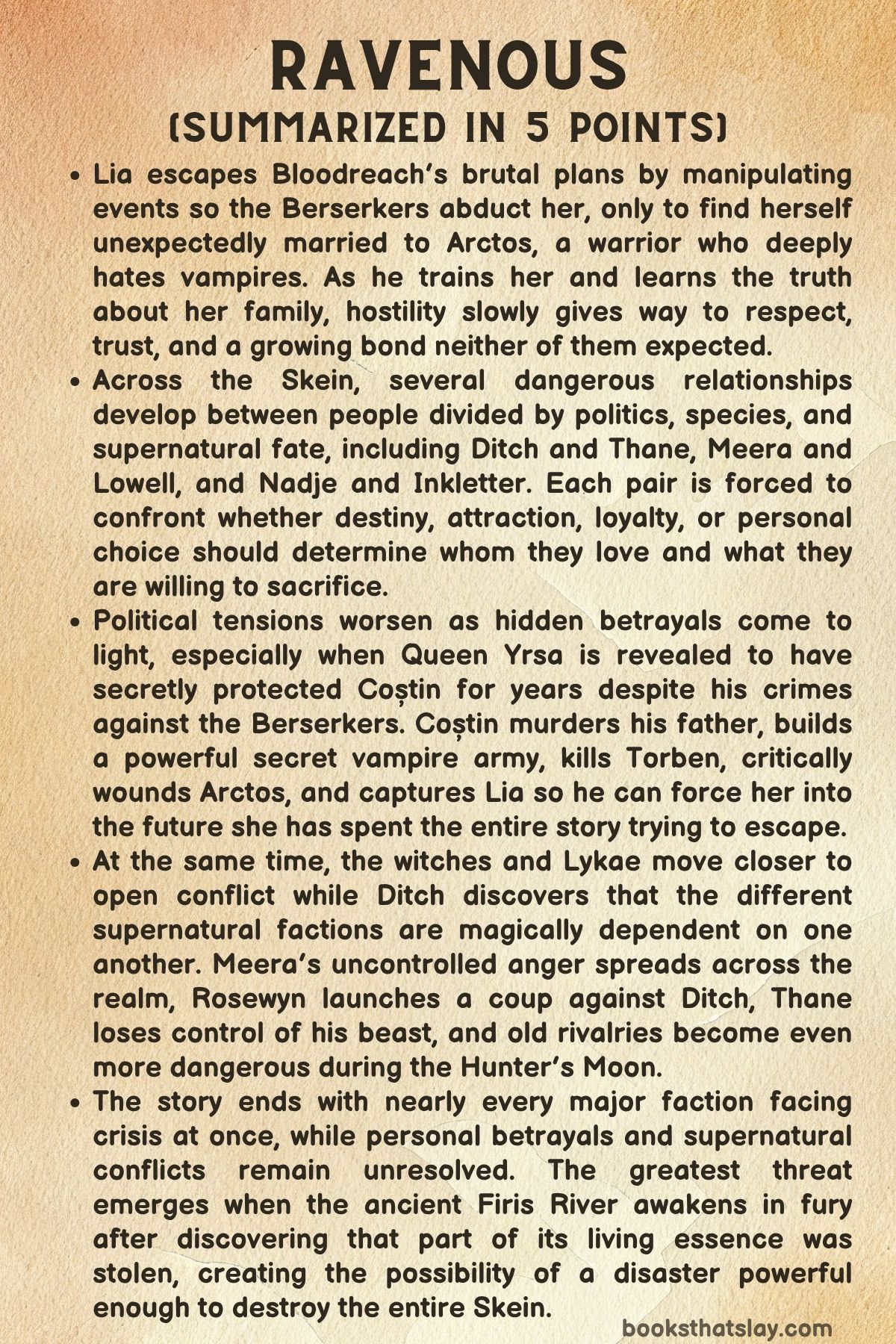
Characters
The characters of Ravenous are defined by conflicts between inherited loyalties and personal choice. Many have been taught that species, destiny, royal authority, or supernatural instinct should determine whom they trust and whom they hate, yet their development repeatedly begins when lived experience contradicts those inherited rules.
Princess Emilia “Lia” Vlădescu
Lia begins as a young woman with very little formal power despite her royal birth. Her family controls nearly every part of her existence, and the proposed imprisonment in the Blood Crypt makes clear that even her body is regarded as a political resource rather than something over which she has authority.
Her greatest early strength is intelligence rather than physical ability. She studies Berserker customs carefully enough to manipulate events toward sanctuary, turning what appears to be an abduction into a carefully calculated escape from Bloodreach.
Lia’s development in Ravenous is largely the process of converting mental courage into physical and emotional independence. Training under Arctos changes her relationship with fear: instead of surviving mainly through secrecy and planning, she begins learning to endure pain, fight back, make decisions under pressure, and trust her own ability to act.
Her emerging attraction to Arctos is complicated by bloodlust, because his blood awakens a hunger she has never experienced with anyone else. That creates an uncomfortable parallel with the idea of supernatural destiny: Lia rejects Coștin even after their biological Bride bond is confirmed, suggesting that instinct may reveal compatibility or attraction but cannot create consent, affection, or moral obligation.
Shieldchief Arctos
Arctos is initially shaped by trauma so completely that he interprets an entire species through the murder of his family. Vampires are not individuals to him but representatives of the creatures who destroyed his childhood, making Lia’s arrival feel like both a personal insult and a betrayal by Queen Yrsa.
His treatment of Lia shows the conflict between prejudice and personal discipline. He pushes her too severely during training and initially hopes she will disappear from his life, yet he refuses to exploit their forced marriage physically and eventually recognizes when his hatred has caused him to treat an innocent person unfairly.
Arctos’s deeper struggle concerns loyalty. Yrsa rescued and raised him, so questioning her feels almost equivalent to betraying a mother, but evidence regarding the captive Berserkers and Lia’s treatment gradually forces him to separate gratitude from obedience.
His growing care for Lia marks that transformation. By hiding her attempted escape, believing her account of Coștin, rejecting an easy annulment, and eventually treating her as a trusted partner, Arctos begins choosing his own moral judgment over inherited hatred and unquestioning allegiance.
Inkletter Scribe XII
Inkletter presents himself as a perfectly controlled professional who regards seduction as simply another method of intelligence gathering. His real identity, however, is closer to that of a scholar forced into morally questionable work to support his obsession with knowledge, history, and books.
Nadje destabilizes this self-image because she defeats him intellectually before she affects him emotionally. Discovering that she recognized his spying and fed him false information attacks his professional pride, but it also forces him to respect someone he initially dismissed as an unsophisticated servant.
His developing conscience becomes equally significant. After helping obtain the living substance from the Firis and selling it to Baelor, Ink can no longer hide behind the argument that another mercenary would have accepted the job.
Ink therefore develops from detached observer toward participant. His desire to recover the Firis substance shows that history is no longer merely something he wants to record after events happen; he is beginning to understand that knowledge creates responsibility when one’s own actions help create the catastrophe.
Nadje
Nadje’s apparent materialism comes from childhood rather than simple greed. Watching her mother die while protecting her from strigoi teaches Nadje that security disappears without warning, so gold becomes a symbol of mobility, preparation, and the ability to escape before danger closes in.
Her lie-detecting talent matches her personality particularly well. Nadje distrusts appearances and assumes that survival depends upon discovering what other people conceal, yet the ability eventually turns inward when she can no longer deny her feelings for Inkletter.
She is also far more compassionate than she wishes others to believe. Her loyalty to Lia, hatred of Bloodreach slavery, decision to free Baelor’s prisoner, and willingness to investigate the captive Berserkers reveal a moral instinct that repeatedly survives beneath her pragmatic exterior.
Her conflict with Ink comes from the difference between surviving the next disaster and preventing the next disaster. Nadje thinks first about immediate security, while Ink increasingly thinks about consequences, but their partnership allows each to challenge the other’s limitations.
Ditch
Ditch builds her identity around independence, aggression, and refusal to be controlled. As a demon-witch who intends to mobilize every Wiccan caste rather than depend on traditional warrior structures, she approaches leadership as an exercise in discovering unused power and turning it into strategic advantage.
Her relationship with Thane threatens that worldview because Lykae matehood represents exactly the sort of predetermined bond she distrusts. She enjoys his desire but resists any interpretation suggesting fate gives him authority over her future.
What gradually changes is not Ditch’s need for independence but her understanding of responsibility. Her developing seer abilities reveal that the survival of witches cannot be separated from the health of other factions, forcing her to reconsider conquest as more than a simple contest for dominance.
Her major flaw remains her tendency to interpret responsibility through control. Even after recognizing the danger of another universal war, she still imagines saving everyone by ruling them, showing that her growth in perception has moved faster than her growth in humility.
King Thane
Thane begins as an exhausted immortal whose pleasures no longer satisfy him. Fifteen centuries without his mate have turned what should be a powerful king into someone increasingly dependent on alcohol, sex, and distraction simply to fill an emotional absence he cannot explain away.
Finding Ditch gives him purpose but also tests whether he can distinguish love from possession. His beast interprets matehood instinctively, yet Thane repeatedly tries to respect restrictions Ditch imposes, even imprisoning himself during the full moon rather than risk taking away her choice.
His conflict becomes more difficult because being Ditch’s mate does not erase being king. The portal to Gaia offers the simplest personal solution, but leaving would mean abandoning Craigdúr during an approaching catastrophe.
Thane therefore represents a more mature form of supernatural attachment than characters such as Coștin. He wants the person fate has chosen for him, but the story repeatedly asks whether wanting someone intensely is enough when love also requires respect, sacrifice, political responsibility, and consent.
Meera Newteye
Meera first appears timid because she has spent years treating her own power as dangerous. Her ability to intensify anger once contributed to circumstances surrounding her mother’s death, so restraint becomes not merely a personality trait but a method of preventing herself from harming others.
Ditch recognizes the military possibilities in that ability, while Lowell recognizes the intelligence and emotional complexity beneath Meera’s nervousness. Their attention slowly gives Meera confidence, but it also creates a dangerous situation in which her self-worth becomes connected to powers and relationships she does not fully understand.
Her romance with Lowell is particularly tragic because she constantly questions its authenticity. She wants to believe that he chooses her freely, yet she knows her magic can alter emotion and therefore can never feel completely secure about the feelings he expresses.
The abandonment at Mount Nothrior destroys the cautious moral identity she has spent years maintaining. By embracing the title Wrath Mother, Meera stops treating anger as something to manage and begins treating it as the foundation of a new self, creating the possibility that pain may turn a fundamentally conscientious woman into a powerful political threat.
Lowell Nightclaw
Lowell defines himself as more rational and less controlled by Lykae instinct than many members of his species. His belief that he can choose love independently of fate makes his relationship with Meera partly romantic and partly philosophical, because loving her becomes proof that personal will can outrank supernatural programming.
That confidence also produces his greatest mistakes. He conceals important information from Meera, repeatedly neglects his responsibilities to Thane, and becomes willing to abandon Craigdúr despite being one of the people most necessary to its political stability.
His decision to leave with Meera initially appears to confirm his belief in chosen love. The instant recognition of his true mate then exposes how little he actually understood the instinct he claimed to have transcended.
What makes Lowell especially complicated is that the story does not conclusively establish that every feeling he had for Meera was false. His immediate reinterpretation of their entire relationship as enchantment may be instinct speaking through him just as powerfully as Meera’s magic once did, leaving the boundary between authentic love and supernatural influence unresolved.
Coștin Vlădescu
Coștin is defined by entitlement. He interprets his belief that Lia is his Bride not as information about a possible bond but as proof that she belongs to him, and years of threats demonstrate that he regards her fear and rejection as obstacles rather than meaningful choices.
His political ambition mirrors his personal behavior. Just as he secretly assumes ownership over Lia, he quietly builds an army, manipulates Yrsa, murders his father, and prepares to reshape Bloodreach before anyone realizes how much power he has accumulated.
The awakening of his heart after contact with Lia’s blood is crucial because it confirms that he was correct about the biological bond but completely wrong about its moral meaning. Destiny validates the supernatural connection without validating his conduct.
Coștin consequently becomes one of the clearest demonstrations that being fated to someone does not make a person worthy of them. His cruelty, possessiveness, strategic intelligence, and ability to exploit other people’s desires make him dangerous precisely because genuine supernatural destiny gives him a language through which to justify behavior that remains abusive.
Queen Yrsa
Yrsa initially appears to represent strength, order, and Berserker tradition. Her history of rescuing Arctos and Torben creates enormous emotional authority over both men, allowing her decisions to remain unquestioned long after they begin conflicting with the welfare of her people.
Her secret relationship with Coștin reveals the destructive extreme of unquestioned mate ideology. She allows devotion to one person to outweigh responsibility to an entire queendom, even killing her own Berserkers, protecting a vampire who preyed upon them, and tolerating the imprisonment of her subjects.
Yrsa is especially disturbing because many of her public decisions remain superficially defensible. Delaying military action, controlling access to ohalla, and making political marriages can all be explained through royal necessity, which allows betrayal to hide inside ordinary governance.
Her character therefore demonstrates how personal obsession becomes institutional corruption when the obsessed person possesses political power. She does not merely betray individuals; she reshapes policy, military strategy, and justice around a private allegiance that no one else is permitted to see.
Torben
Torben functions as the skeptical voice Arctos initially refuses to become. He loves his cousin but gradually notices patterns surrounding Yrsa that devotion prevents Arctos from examining, including the queen’s resistance to war, her refusal to rescue captives, and her unusual treatment of the shieldchief.
His relationship with Dagny reveals another side of him. He is a loving mate and excited father, yet fear encourages secrecy and overprotection, demonstrating that even protective intentions can become disrespectful when they deny another person information affecting her own life.
Torben’s death gives his investigation tragic significance. He discovers that his instincts about Yrsa were correct but learns the truth only moments before she kills him.
His final concern for Dagny and their unborn child reinforces the contrast between healthy devotion and Yrsa’s corrupted version of matehood. Torben’s love makes him fear losing his family, while Yrsa’s love makes her willing to destroy everyone standing between herself and Coștin.
Dagny
Dagny initially represents the stable domestic future several other characters desire. Her marriage to Torben is affectionate and secure, and her pregnancy places her within a functioning model of matehood rather than the coercive or politically impossible relationships surrounding Lia, Ditch, and Meera.
She is nevertheless unwilling to be reduced to the role of protected pregnant wife. When Torben becomes secretive, she reminds him that she remains a warrior capable of facing difficult truths.
Her transformation after Torben’s murder is immediate and severe. Grief does not make her passive; she delivers Koda under catastrophic circumstances, protects him, completes Arctos’s summoning symbol, and escapes Yrsa’s attempt to eliminate the remaining threats to her rule.
Naming her son while simultaneously thinking of vengeance establishes Dagny’s likely future conflict. Motherhood and retaliation become linked, suggesting that the next stage of her life may involve protecting Koda while ensuring that the people responsible for Torben’s death are held accountable.
Rosewyn Banehand
Rosewyn combines ambition, ideological hostility, and personal trauma. Her leadership among the Red Riders initially appears rooted in military conservatism and distrust of Ditch, but her willingness to sabotage protections during the Hunter’s Moon reveals that her political opposition has become an attempted coup.
She understands Meera’s anger better than Meera initially does and immediately recognizes its usefulness. Instead of helping Meera control the gift, Rose encourages the conditions most likely to make it destructive because chaos strengthens her own position.
Her confrontation with Straegan dramatically changes the meaning of her hatred of Lykae. Discovering that she remembers an earlier existence associated with the Red Riding Hood legend and that Straegan murdered her transforms an inherited fear into a recovered personal trauma.
Rose’s response is not reconciliation but intensified vengeance. The revelation removes fear while preserving hatred, making her potentially more dangerous because she now possesses both political ambition and a personal enemy who gives that ambition emotional justification.
Vendela
Vendela combines the Valkyries’ appetite for combat with an increasingly serious investigative role. She initially treats danger with the competitive humor characteristic of her people, but the strigoi attack and growing evidence of deliberate destabilization push her toward a wider responsibility.
Her partnership with Eyrun is strengthened by long familiarity, while Chiyo introduces uncertainty. Ven’s reluctance to trust the fox shifter gradually gives way to respect as Chiyo repeatedly proves useful and courageous.
Her willingness to challenge powerful opponents directly demonstrates confidence bordering on recklessness, yet the tactic also shows a practical understanding of Valkyrie culture and magical rules. Violence, for Ven, is often simultaneously entertainment, investigation, and diplomacy.
The developing attraction between Ven and Chiyo adds another relationship capable of crossing factional boundaries. Unlike the more predetermined mate bonds elsewhere, their connection grows through shared danger, irritation, curiosity, and earned trust.
Eyrun
Eyrun is one of the story’s most aggressive and unpredictable fighters. Her partly Nachtmerrie nature allows her to assume the shape of another person’s deepest fear, turning psychology itself into a weapon.
Her brutal defeat of Rosewyn demonstrates how casually Valkyrie combat can shift political relationships. What Eyrun regards as a justified response to aggression becomes one of the events Rose later uses in her campaign against Ditch and other rivals.
Eyrun also develops into an investigator rather than remaining simply a warrior. She recognizes that the strigoi attack cannot be explained through ordinary territorial conflict and becomes increasingly attentive to the Coffin Valkyrie’s behavior.
Her role emphasizes the value of characters who react quickly without being trapped inside formal political structures. Because Eyrun owes little loyalty to the institutions competing for dominance, she and Ven can investigate connections that rulers preoccupied with war repeatedly overlook.
Chiyo
Chiyo enters the larger conflict as a fox shifter connected to an old prophecy she does not fully understand. Her decision to approach the Valkyries despite the danger demonstrates considerable courage, particularly because she knows her own faction has already contributed to misunderstandings among the supernatural groups.
She becomes valuable because she combines observation with adaptability. Rather than allowing factional loyalty to determine her conclusions, she follows evidence from the witches to demons and eventually toward Bloodreach.
Chiyo also serves as a bridge between groups that would ordinarily distrust one another. Her developing place beside Ven and Eyrun shows how cooperation can form through common purpose before political leaders formally recognize the need for alliances.
Her role remains unfinished, particularly because the prophecy linking her to Valkyries has not been fully explained. That uncertainty makes her important to future events beyond the immediate investigation of Coștin.
Straegan
Straegan initially exists largely through Thane’s fear and guilt. He has surrendered so completely to his wolf beast that he represents everything the Lykae risk becoming when instinct overwhelms reason, yet Thane remains unable to treat him simply as a monster because he is still his brother.
Hints that sorcery contributed to Straegan’s condition complicate moral judgment. If magical interference helped destroy his ability to control the beast, then his violence may be both his responsibility and the consequence of something done to him.
His movement toward Rosewyn rather than Ditch during the Hunter’s Moon reveals that his behavior has a deeper history than anyone understands. Rose’s recovered memories connect Straegan to an ancient cycle of violence that predates the current political conflict.
He therefore functions both as threat and mystery. His beast embodies uncontrolled instinct, while the unanswered questions surrounding his past suggest that understanding what happened to him may expose older forces affecting the present Accession.
King Neculain
Neculain represents the institutional cruelty Lia is trying to escape. His plan to imprison his daughter and force her to bear a hundred children reduces family, sexuality, and parenthood to military production.
His rule also reflects the moral collapse of Bloodreach. Captive Berserkers are treated as blood supplies while vampire society has shifted from disciplined military power toward indulgence, cruelty, and exploitation.
Neculain’s failure is partly political blindness. While concentrating on controlling Lia and rebuilding future power through her descendants, he fails to recognize that Coștin has already constructed a secret army capable of removing him.
His sudden murder therefore completes the collapse of his authority. The tyrant who treats family members as tools is ultimately destroyed by the son who has learned the same logic of domination even more effectively.
Sereth
Sereth’s importance comes primarily from failure rather than direct action. As Lia’s mother, she knows enough about her daughter’s terror to recognize the danger posed by Neculain and Coștin, yet she refuses to challenge either man effectively.
That passivity becomes a form of complicity. Lia’s trauma is worsened by the knowledge that the people who should protect her repeatedly choose convenience, hierarchy, or self-preservation instead.
Sereth consequently represents the moral cost of doing nothing inside an abusive system. She may not originate the cruelty surrounding Lia, but her refusal to resist helps make that cruelty sustainable.
Her limited presence also reinforces the emotional isolation of Lia’s childhood. Lia does not escape because her family finally recognizes her suffering; she escapes because she accepts that meaningful protection must be created elsewhere.
Baelor the Unraveler
Baelor enters as a powerful archwarlock whose casual relationship with suffering immediately marks him as dangerous. His ability to interfere with Inkletter’s teleportation demonstrates that he possesses enough power to make even experienced immortals uncertain of escape.
The acquisition of the Firis substance places him at the center of the wider supernatural crisis. His exact intention remains unknown, but the terrified reaction of the Sorceri sisters to his name suggests that his actions have damaged the underlying structure sustaining the Skein.
His title becomes increasingly significant as the consequences spread. He is associated not simply with political conflict but with the possibility that reality itself has been weakened.
Baelor therefore functions effectively as an offstage architect of instability. Other villains seek kingdoms, mates, or political authority, while his unexplained project appears capable of threatening the environment in which every other ambition exists.
Pemphre
Pemphre’s ability to answer any question comes with the warning that truth will not necessarily provide comfort. Her value in the story lies precisely in refusing the characters the convenient answer they want.
When Thane asks how he and Ditch can remain together, Pemphre does not solve their political problem. She confirms that no easy reconciliation exists under current conditions and instead reveals a narrow alternative requiring choices neither is prepared to make.
Her reaction to Baelor also changes the scale of the story. A figure who appears almost omniscient becomes frightened, indicating that the threat facing the Skein exceeds ordinary factional warfare.
Pemphre thus represents knowledge without rescue. Answers can identify the structure of a problem, but characters still have to decide what sacrifices they are willing to make afterward.
Deina
Deina, the Queen of Riddles, complements Pemphre by turning knowledge into a test rather than freely available information. Her presence reinforces the idea that supernatural wisdom in this world is rarely accessible without danger, intelligence, or cost.
She also contributes to the unnerving atmosphere surrounding the three sisters. Their power does not make them benevolent guides; visitors must negotiate with beings whose rules are strange and whose concept of entertainment can place lives at risk.
Deina’s function is less individually developed than that of several central characters, but she helps establish that ancient knowledge exists outside the political structures currently fighting for dominance.
Her existence also underlines how little even ancient rulers such as Thane understand about the deeper forces governing their world.
Enya
Enya’s identity as the Queen of Chaos makes her especially relevant to a story increasingly defined by unstable outcomes. Her ability to accelerate fate suggests that destiny is not merely something characters discover but something supernatural forces may manipulate.
Like her sisters, she operates according to rules that outsiders cannot easily predict. This makes knowledge obtained from the trio valuable but also dangerous.
Enya’s presence reinforces the uncertainty surrounding prophecy, matehood, and predetermined outcomes. If fate can be accelerated or influenced, then characters cannot assume that every supernatural event represents an untouched cosmic design.
She therefore quietly complicates one of the story’s central questions: whether destiny should be obeyed simply because supernatural forces declare it inevitable.
Undara
Undara functions primarily as an emotional test for Lia and Arctos. Her long-standing arrangement with Arctos reminds Lia that their marriage began as a political command rather than a romance and intensifies Lia’s fear that she will remain permanently outside Berserker society.
Importantly, Undara herself is not presented as the cause of the problem. The real conflict comes from Lia’s changing feelings and Arctos’s inability to recognize how much his own attachment to Lia has developed.
Arctos leaving Undara after hearing Lia’s distant cry demonstrates the shift clearly. His actions reveal that Lia has become emotionally central to him before he is willing to admit that fact consciously.
Undara therefore helps expose feelings rather than functioning as a conventional romantic rival.
Jastorgh
Jastorgh is a transactional demon whose services demonstrate how much supernatural travel depends upon bargains, conditions, and calculated risk. He serves both Thane and Ditch but remains loyal primarily to whatever agreement has actually been made.
His warning to Ditch about the dangers of the Helter establishes that even powerful characters cannot expect automatic rescue. By accepting his terms, Ditch knowingly enters a situation in which her own strength may be the only thing keeping her alive.
Jastorgh also provides moments of practical realism within highly emotional conflicts. While Thane and Ditch argue about love, loyalty, and fate, the demon approaches transportation as a service governed by price and clearly defined boundaries.
That neutrality makes him useful precisely because almost everyone else is trapped within factional allegiance.
Hulda
Hulda is associated with prophecy but lacks the commanding certainty normally expected from a seer. Her prediction that Dagny will never have another child creates fear long before its possible meaning becomes clear.
Her failure to communicate danger effectively later becomes morally important. Dagny’s anger toward her reflects the difference between sensing catastrophe and taking sufficient action to prevent it.
Yet Hulda ultimately helps Dagny during one of the worst moments of her life by bringing information about Torben, Yrsa, Lia, and Arctos. She therefore remains neither completely useless nor fully reliable.
Her character reflects the uncertainty surrounding supernatural foresight throughout the story. Knowing fragments of the future does not necessarily produce the judgment, courage, or timing needed to change it.
The Firis
The Firis is initially treated as geography rather than character, which makes its final awakening especially significant. What Nadje and Ink regard as a dangerous substance taken from a river is revealed to be part of a conscious ancient being.
Its anger radically reframes their earlier mercenary mission. Removing the fiery substance was not equivalent to stealing a natural resource; from the Firis’s perspective, something living and essential was torn from its body.
The revelation also gives the ancient entity a credible grievance without making its response proportionate. Rather than seeking only Baelor or the thieves, it condemns the entire Skein and prepares to punish everyone.
The Firis therefore becomes both victim and emerging antagonist. Its awakening suggests that the political factions have been fighting over a world whose oldest forces possess memories, injuries, and powers that make their rivalries seem dangerously small.
Themes
Destiny Versus Choice
Supernatural destiny repeatedly identifies relationships but fails to determine whether those relationships should be accepted. Ravenous places several versions of fate beside one another so that matehood, Bride bonds, magical prophecy, and instinct can be compared against conscious decisions.
Lia’s relationship with Coștin provides the clearest rejection of the idea that destiny creates entitlement. His heart eventually awakens because of her blood, proving that their biological connection is real, yet that revelation changes nothing about her terror, disgust, or right to refuse him; fate may describe a bond, but it cannot manufacture trust or erase abuse.
Thane and Ditch face a less monstrous version of the same question. Their bond contains genuine attraction and emotional possibility, but both understand that becoming mates would affect entire populations, meaning personal destiny cannot simply outrank political obligation.
Meera and Lowell make the issue even less certain because they deliberately choose one another before Lowell discovers his destined mate. His immediate abandonment of Meera forces the story to ask whether freely chosen love becomes meaningless when supernatural instinct appears, or whether his new instinct is simply another powerful influence competing with feelings that were genuine at the time.
Across these relationships, destiny provides pressure rather than moral authority. Character is revealed through what individuals decide to do with the bonds they inherit.
Freedom, Consent, and Possession
Control over another person’s body or future appears in political, romantic, and familial forms. Lia’s father intends to transform her reproductive capacity into military infrastructure, while Coștin interprets supernatural compatibility as ownership and Queen Yrsa treats arranged marriage as an instrument of governance.
Against this background, apparently simple acts of restraint become morally important. Arctos may hate Lia’s species, but he refuses to exploit a forced marriage, protects her privacy while she is unconscious, and ultimately listens when she explains what Coștin has done to her.
Thane faces the same problem through his beast. He understands that under the full moon his instinct could overpower Ditch’s resistance, so he voluntarily imprisons himself rather than treating uncontrollable desire as permission.
The story repeatedly distinguishes wanting another person from having a right to that person. Even genuine supernatural bonds become dangerous when characters treat desire, fate, rank, or protection as justification for removing another person’s ability to choose.
Freedom also extends beyond romance. Lia wants physical independence, Meera wants authority over her own emotional power, Ditch refuses political submission, and Nadje pursues financial independence because poverty once left her helpless; each character therefore connects freedom with the ability to determine what happens next in their own life.
Loyalty, Betrayal, and the Limits of Obedience
Loyalty becomes dangerous when characters stop testing it against morality. Arctos’s devotion to Yrsa begins as gratitude toward the woman who rescued and raised him, but that history makes him reluctant to recognize evidence that she is acting against the clan.
Torben reaches the opposite conclusion earlier. His willingness to question Yrsa costs him his life, yet his suspicions prove correct: she has protected Coștin for years, helped him gain access to Ravinelun, tolerated crimes against Berserkers, and even murdered members of her own people for the sake of her private bond.
Lowell experiences a smaller but related collapse of duty. His love for Meera gradually draws his attention away from Thane and Craigdúr until he is willing to abandon his responsibilities during one of the kingdom’s most dangerous nights.
Ditch faces betrayal from inside her own faction when Rosewyn sabotages the defenses and containment magic meant to prevent disaster. Authority therefore offers no protection against disloyalty when followers believe their own ambitions or grievances justify treachery.
The recurring question is not whether loyalty is valuable, but when loyalty must end. The strongest characters gradually learn that devotion to rulers, families, lovers, or factions becomes destructive when obedience requires ignoring cruelty, deception, or danger.
Interdependence and the Cost of Factional Conflict
The supernatural factions spend much of the story assuming survival is competitive. Witches prepare to conquer Lykae territory, vampires build armies, Berserkers distrust outsiders, and ancient grudges encourage each group to interpret shortages or attacks as reasons for another war.
Ditch’s emerging perception of the Skein’s magical structure changes that assumption. She discovers that the vitality of different peoples contributes to a shared system, meaning the destruction of one faction can weaken others rather than simply creating more territory for the victor.
The investigation conducted by Ven, Eyrun, and Chiyo reaches a similar conclusion through evidence rather than magic. Strigoi attacks, unusual territorial violations, disappearing resources, Bloodreach’s secret military expansion, and Baelor’s unexplained actions are connected problems, yet suspicion continually drives factions toward blaming one another before they understand the larger threat.
The awakening Firis makes the danger impossible to ignore. While rulers concentrate on borders, mating alliances, coups, and revenge, an ancient force capable of changing the physical world responds to an injury created partly by the careless actions of individuals pursuing profit.
Survival therefore demands cooperation before affection or trust necessarily exists. The central challenge is whether factions accustomed to defining themselves through enemies can recognize mutual dependence before their separate conflicts destroy the world they all require.