The Great Wherever Summary, Characters and Themes
The Great Wherever by Shannon Sanders is a multigenerational family novel about inheritance, memory, grief, land, and the complicated ways the living remain connected to those who came before them.
Shannon Sanders places Aubrey Lamb’s present-day crisis beside the history of a Tennessee farm whose ownership has passed through generations of one Black family. The novel moves between Aubrey’s uncertain future and the experiences of relatives whose choices shaped the land long before she inherited a share of it. A supernatural perspective adds another dimension, as deceased family members observe the living while carrying memories, questions, loyalties, and unresolved pain of their own.
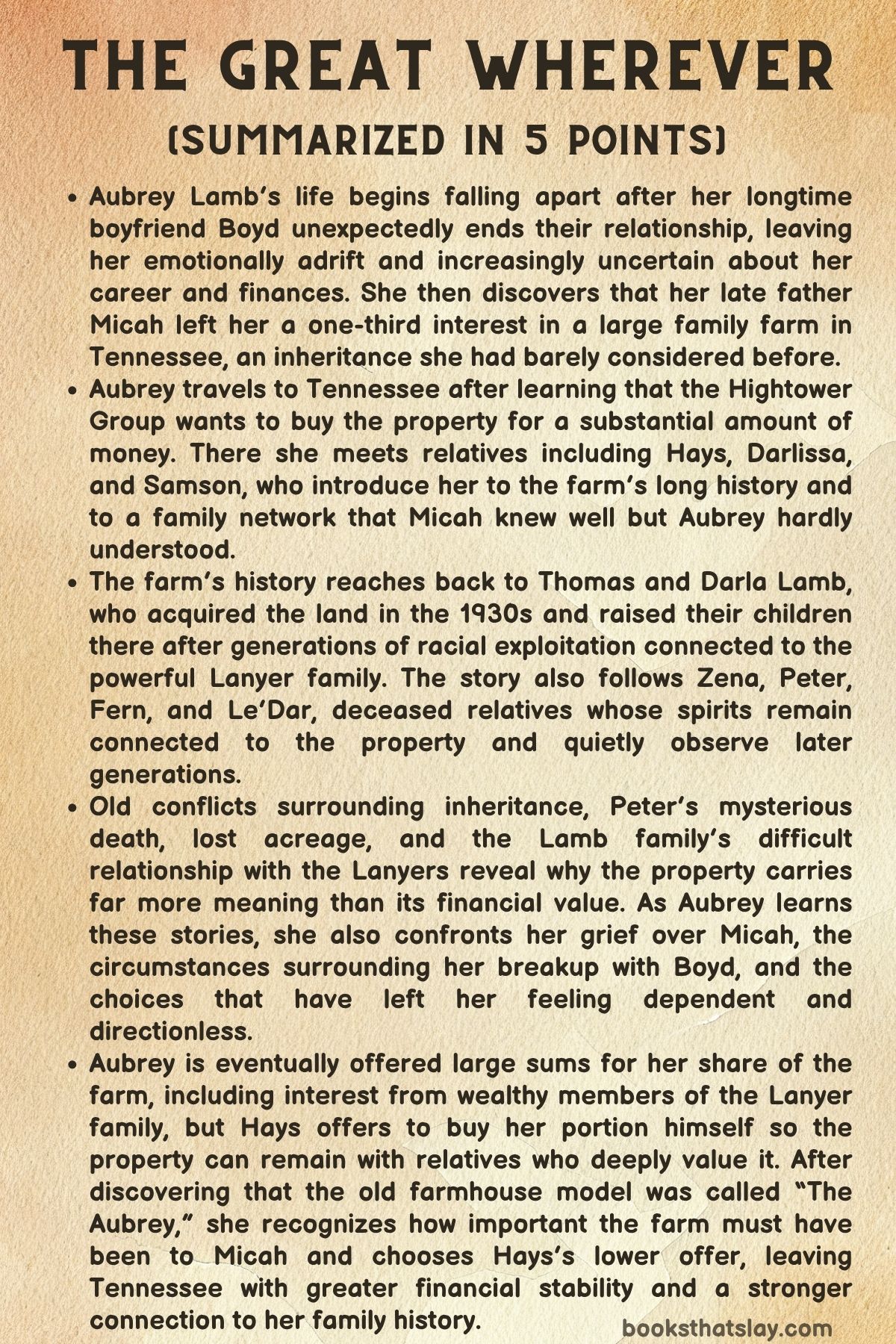
Summary
The story begins with Le’Dar Valentine, a young woman who is already dead. From a strange afterlife she calls the Great Wherever, she lives alongside deceased relatives whose connection comes from the Lamb family farm in Tennessee, a property they were once expected to inherit before dying too soon.
These spirits can watch living members of the family, share pieces of their sensations and memories, and sometimes travel with those designated to inherit the farm. Their existence gives them access to generations of family history while leaving them mostly powerless to direct the people whose decisions will determine the farm’s future.
In Washington, D.C., thirty-two-year-old Aubrey Lamb believes her boyfriend, Boyd Elledge, is about to propose after four years together. Instead, Boyd ends the relationship, telling her that he feels restless and suspects they may both belong with other people.
The breakup immediately exposes how much of Aubrey’s imagined future has been built around Boyd. Her father, Micah, died a little more than a year earlier, her mother Suzette died when she was young, and Aubrey soon finds herself comparing her instability with the secure life of her older sister Bellamy, who has a husband, children, advanced education, and the childhood home Micah left her.
Aubrey received something different from Micah: his one-third interest in a 145-acre family farm near Lanyer County, Tennessee. She paid almost no attention to the inheritance when the estate was settled, but after her breakup and a painful argument with Bellamy, the property begins to look increasingly important.
Her work life is equally uncertain. Aubrey works as a Senior Document Technician at a law firm, doing much of the work of trained paralegals without having completed certification, while several other jobs help support her financially. She has repeatedly postponed law school and other permanent choices because committing to one path has always frightened her.
After Boyd leaves, Aubrey drinks too much, misses work, watches Boyd from a distance, and becomes increasingly distracted. While going through neglected email, she discovers messages about a corporation called the Hightower Group that wants to purchase the Tennessee farm.
Curiosity and financial desperation push Aubrey to Tennessee. There she meets relatives who knew Micah far better than she realized, including Darlissa Massey, Hayward “Hays” Lamb, and Samson. Aubrey arrives nearly broke, and Darlissa immediately has to rescue her when her card is declined at the hotel.
As Aubrey enters Lanyer County, the novel reveals the deeper history of the land. Long before the Lamb family owned the farm, Jean Lanyer Senior controlled a vast plantation worked by enslaved Black people. Among them was Zena, who was repeatedly exploited by Lanyer and died during childbirth after he had once discussed leaving her property but ultimately failed to do so.
After emancipation, Serviceberry develops as a Black community where formerly enslaved people and their descendants build homes, businesses, trades, and families. One Lamb ancestor becomes a skilled leatherworker, establishing a professional tradition that eventually reaches Thomas Lamb.
In 1933, Thomas is a talented shoemaker married to Darla and raising young children. He dreams of owning substantial land and learns that a financially desperate white landowner, Jack Delano, wants to sell a large Tennessee parcel.
Thomas purchases the land despite Darla’s anger that he made such an enormous decision without her. Near the pond, he also sees Zena’s spirit without understanding who she is. The family later constructs a Sears mail-order house called “The Aubrey” on the property.
Thomas and Darla eventually raise Elijah, Joah, Lena, and Peter. Their family experiences love, ambition, sibling rivalry, hardship, and choices about reproduction that reveal how differently men and women experience responsibility and control.
Peter develops an extraordinary connection to the farm. He understands plants intuitively, feels at home on the land, and can see Zena. He is also attracted to men, a part of himself he keeps mostly hidden from his family and community.
Thomas secretly decides that Peter should someday inherit the entire farm because he understands it better than any of his siblings. Joah accidentally discovers the plan and tells Elijah, creating another source of resentment between the brothers.
Joah later begins working for the Lanyer family, whose connection to the Lamb land is marked by generations of racial and economic inequality. Meanwhile Lena pursues education and independence, eventually leaving farm life for a professional career.
The family’s future changes permanently when Peter is murdered. Luke Lanyer arranges to meet him at the pond, reacts violently, and holds him underwater until he dies. Authorities accept Luke’s account that the death was accidental.
Lena suspects that Joah may have played some role because Joah arranged the meeting, but no one can prove what he knew. Peter himself, once dead, refuses to decide that Joah deliberately sent him to his death.
Thomas and Darla are devastated. Thomas throws himself into community responsibilities while Darla becomes increasingly consumed by grief. After Peter’s death, Thomas changes his inheritance plan and ultimately divides the farm equally among Elijah, Joah, and Lena.
Both parents die within a relatively short period. The three surviving siblings inherit the property together, although their conflicting attitudes toward land, money, responsibility, and Peter’s death make cooperation increasingly difficult.
Their neglect creates another loss. The Lanyers rebuild a boundary fence farther inside Lamb property and openly occupy roughly twelve acres for decades. Because the Lambs fail to challenge the occupation in time, the Lanyers eventually gain legal ownership through adverse possession.
The resulting argument destroys what remains of the relationship among Elijah, Lena, and Joah. Joah reveals that he and Elijah knew Peter had originally been designated as sole heir, deepening Lena’s suspicions, although she still refuses to accuse Joah of arranging Peter’s death without proof.
Over succeeding generations, the surviving shares continue passing through the family. Elijah’s portion eventually reaches Samson and Hays, while Joah leaves his entire third to Micah, who later passes it to Aubrey. Lena’s branch passes through Darlissa and her daughter Le’Dar.
Le’Dar had been academically brilliant and hoped for a scientific career that might eventually lead to NASA. At twenty-seven, while facing an unexpected pregnancy and preparing to make her own decision about it, she died in a car accident that sent her vehicle into the Potomac.
Her death brings her to the Tennessee pond, where Zena, Peter, and Fern are waiting. Fern is another deceased relative, the secret daughter of Elijah and Lavinia Johnston, who died at nine after being struck by a car.
In the present, Hightower offers the current owners an unusually high price for the farm. Hays and Darlissa strongly oppose selling, Samson is more willing to consider the financial advantages, and Aubrey immediately sees her one-third share as a possible escape from debt and uncertainty.
A Hightower representative named Trey privately approaches Aubrey after finding her lost money clip. Aubrey, lonely after Boyd’s rejection, sleeps with him even though he is married. She does not initially appreciate how neatly his personal interest in her aligns with Hightower’s desire to influence the owner most likely to sell.
Soon Aubrey loses her law-firm job because her recent instability has affected her work. The loss makes selling the farm even more attractive, and she begins looking beyond Hightower toward Trevor and Tolliver Lanyer, wealthy businessmen who could probably offer much more.
During this period, Aubrey also finds Micah’s grave and begins reconsidering her relationship with the father whose Tennessee history she barely knew. Sitting among the graves of people Hays has described makes the family past increasingly real.
Aubrey eventually tells Hays about a painful event that preceded her breakup with Boyd. Shortly after Micah died, Aubrey became pregnant. Boyd revealed the pregnancy to his mother without Aubrey’s permission, and Aubrey later chose a medication abortion.
Medical complications required additional treatment, cost Aubrey work and money, and led Boyd’s mother Brigid to loan her $1,400. Aubrey’s determination to repay that money becomes connected to her desire to regain control over a period when she felt dependent on everyone around her.
Darlissa’s own grief becomes clearer when Aubrey discovers Le’Dar’s grave. Hays and Aubrey eventually help Darlissa away from the cemetery, while Le’Dar, watching invisibly, recognizes the full scale of the pain her death left behind.
Hays decides to offer another solution. Rather than allowing Aubrey to sell her third to Hightower or the Lanyers, he offers to buy her share himself using money he and his husband Justin had saved toward buying a home.
His offer is lower than the corporate price, and Aubrey initially remains tempted by the Lanyer twins. She schedules a call with them and walks toward the pond while the dead family members fear they are about to lose the property.
Zena manages one rare intervention. Aubrey steps on an old Sears catalog near the pond and discovers the original advertisement for Thomas and Darla’s farmhouse. The house model is called “The Aubrey.”
The discovery transforms Aubrey’s understanding of Micah. Along with the nearby Bellamy name, it suggests that her father carried pieces of the farm into the names he gave his daughters and that this land mattered to him far more deeply than she had known.
Aubrey becomes so absorbed in the discovery that she misses the calls from the Lanyer twins. She decides not to sell to them and instead accepts Hays’s offer.
Her decision is not a rejection of money. She still needs financial stability, but she now understands that Hays genuinely values the property and that selling to him allows the land to remain within the family while giving her the resources to rebuild her life.
Before leaving Tennessee, Aubrey learns to trust Darlissa and Hays in ways she had not expected. Hays, meanwhile, reveals that he can actually see Zena, Peter, Fern, and Le’Dar at the pond, explaining why he had hoped Aubrey might experience something similar there.
Back in Washington, Aubrey reconnects with Bellamy, takes her remaining work more seriously, and completes the transfer of her farm interest to Hays. Hays behaves carefully throughout the transaction, repeatedly assuring her that she can change her mind.
When Aubrey receives the first money from the sale, she repays Brigid completely. She then signs the documents transferring her ownership.
At that precise moment, Le’Dar’s supernatural connection to Aubrey ends because Aubrey is no longer an heir to the farm. Le’Dar remembers her own arrival after death beside the Tennessee pond, where Zena, Peter, and Fern welcomed her into their strange continuing existence.
The novel closes with Le’Dar accepting that death did not leave her alone. Surrounded by relatives whose lives contain generations of love, injustice, mistakes, sacrifice, secrecy, humor, and unanswered questions, she has an eternity in the Great Wherever to keep learning who they were.
Characters
Aubrey Lamb
Aubrey is the central living character of The Great Wherever, and her movement from emotional dependence toward greater self-awareness gives the novel much of its present-day structure. At thirty-two, she is intelligent and capable but has repeatedly postponed choices that might define her future, including professional certification, law school, and other forms of long-term commitment.
Her relationship with Boyd becomes another version of that postponement. Aubrey has allowed herself to imagine that marrying him will provide the stability she has not created independently, so his decision to leave exposes weaknesses in nearly every part of her life at once. Her drinking, fixation on Boyd, missed work, impulsive trip to Tennessee, affair with Trey, and eagerness to sell the farm show someone responding to pain through immediate relief rather than sustained judgment.
Yet Aubrey is not simply irresponsible. Her behavior grows from accumulated grief, financial pressure, professional uncertainty, Micah’s death, and the physical and emotional consequences of an abortion that became medically complicated. Her insistence on repaying Brigid demonstrates that personal dignity matters enormously to her even when that pride occasionally works against her practical interests.
Tennessee changes Aubrey because it gives her a history larger than the immediate disaster of losing Boyd. She does not suddenly become sentimental about the farm, but she learns that Micah’s inheritance carried emotional meaning, that relatives she barely knew can become trustworthy, and that maximizing financial profit is not the only reasonable measure of a good decision. Accepting Hays’s offer therefore becomes an act of maturity rather than surrender.
Le’Dar Valentine
Le’Dar serves as the dead narrator of The Great Wherever, giving the story its unusual position between family chronicle and supernatural observation. She is intelligent, funny, curious, judgmental, and deeply aware of the frustration of watching people she loves while being unable to communicate with them directly.
During life, Le’Dar was an academically gifted only child whose family invested heavily in her education. She studied mathematics, built a promising scientific career, and imagined reaching NASA, making her sudden death at twenty-seven especially painful because her future seemed so expansive.
Her death also occurs at a moment of personal uncertainty. She has discovered an unexpected pregnancy and, after initially waiting for Khari to discuss it with her, decides that the choice belongs to her. Her fatal accident occurs just as she begins reclaiming authority over what comes next.
As a spirit, Le’Dar gains access to a family history she only partly understood while alive. Watching Aubrey forces her to confront the gap between judging a living relative and understanding the pressures influencing that person. Her most significant emotional realization concerns Darlissa: seeing her mother at her grave allows Le’Dar to understand the depth of parental grief that she could never witness from inside her own living perspective.
Zena
Zena is the oldest and most historically significant spirit connected to the farm. Born into slavery and repeatedly exploited by Jean Lanyer Senior, she represents the human cost underlying the property’s earliest history.
Jean occasionally imagines compensating Zena with land, but his gestures never become meaningful justice. She dies during the difficult birth of her eighth child, and whatever promise he considered making disappears, while his legitimate heirs retain both property and power.
Her existence after death is initially defined by confinement. She remains attached to the land for decades, watching history move while lacking the freedom even to leave the place associated with her exploitation.
The arrival of Thomas’s family changes that experience. Zena sees descendants of enslaved people living freely on land once controlled by the Lanyers, and she gradually becomes a guardian of later generations. She saves Joah from drowning, places Thomas’s awl where Lena can use it against Luke, welcomes Peter after his murder, and eventually manages the intervention that helps Aubrey reject the Lanyers’ offer.
Zena cannot correct history, but she repeatedly protects possibilities that slavery attempted to deny her descendants. Her presence turns the farm from a simple possession into evidence that Black survival has outlasted the people who once claimed absolute ownership over both land and human beings.
Hays Lamb
Hays is one of the strongest forces drawing Aubrey toward the family history she has ignored. He initially appears almost uncanny to her because he resembles Micah, yet his warmth and openness distinguish him from the father Aubrey remembers.
Successful, financially stable, openly gay, married to Justin, and involved in musical theater, Hays embodies a version of adulthood Aubrey has not yet achieved. He has built professional and emotional stability without presenting his life as perfect or complete.
His relationship with the farm is deeply emotional, but Hays is not entirely rigid about inheritance. He wants the property preserved because he understands what it represents, yet his eventual solution recognizes that Aubrey should not be forced to keep an asset merely because previous generations valued it.
Using his house savings to buy Aubrey’s share is therefore both personal sacrifice and practical compromise. He preserves the land without demanding that Aubrey adopt his own relationship to it.
The revelation that Hays can see the dead also explains his special sensitivity to the property. He brings Aubrey to the pond hoping she may recognize the spirits herself, making him another living person whose perception reaches beyond ordinary family memory.
Darlissa Massey
Darlissa initially presents herself as practical, blunt, and unwilling to indulge Aubrey’s poor decisions. Her immediate response to Aubrey arriving in Tennessee without sufficient money is to help her while also making clear that she finds the situation irresponsible.
Beneath that stern manner is a strong instinct for care. Darlissa feeds Aubrey, gives her somewhere to sleep, monitors her condition, and asks a question Aubrey resists: who takes care of her when she is home?
Her understanding of dependence is shaped by the death of Le’Dar, her only child. Darlissa’s continuing visits to her daughter’s grave reveal that grief remains an active relationship rather than an event she has completed.
She strongly values the farm, but she ultimately supports Hays buying Aubrey’s portion because she refuses to make inheritance into a prison. Her position combines respect for ancestors with concern for living descendants, making her one of the characters most capable of balancing memory and practical need.
Thomas Lamb
Thomas is the great builder of the Lamb family’s relationship with the farm. A gifted shoemaker during the Great Depression, he dreams of owning enough land to give his children greater economic security and physical freedom.
His purchase represents courage and careful judgment. As a Black buyer in 1930s Tennessee, Thomas knows that legal systems may not protect him if a transaction proves dishonest, so he insists on inspecting the property thoroughly before committing.
At the same time, Thomas can be impulsive and patriarchal. He purchases the property without first securing Darla’s agreement, forcing her to absorb the consequences of his ambition while already carrying heavy domestic responsibilities.
Thomas later becomes deeply concerned with inheritance because he understands that badly divided land can destroy families. His initial decision to leave everything to Peter is based on ability rather than birth order, affection, or mathematical equality.
Peter’s death destroys that careful solution. Thomas eventually chooses equal thirds for Elijah, Joah, and Lena because he can no longer determine which unequal arrangement will protect the family. The decision is understandable, but it also creates the ownership structure that later generations must struggle to manage.
Darla Lamb
Darla provides an essential counterweight to Thomas’s ambitions. While he imagines acreage, crops, buildings, and generational opportunity, she must consider pregnancies, children, dying relatives, household labor, and the immediate physical demands of family life.
Her anger over Thomas buying the farm without consulting her is therefore not resistance to progress. It reflects the reality that his grand decision will create work and obligations that she will also carry.
Darla’s decision to use Carrie’s herbal tea when she believes she is pregnant shows her desire for control over the timing of motherhood. She later has Lena when circumstances are more manageable, demonstrating that her earlier choice concerns capacity and timing rather than a rejection of family.
Peter’s death changes Darla permanently. She retreats inward and becomes intensely attached to maintaining the farm and household. Her eventual decline shows how grief can reduce a person’s world until ordinary routines become nearly inseparable from mourning.
Peter Lamb
Peter is the Lamb child most naturally connected to the physical farm. He understands plants instinctively, can restore damaged vegetation, and possesses a relaxed relationship with the land that Thomas recognizes as genuine stewardship.
He is also one of the family members capable of seeing Zena. That perception strengthens the idea that his connection with the property extends beyond practical farming knowledge.
Peter’s sexuality creates another hidden part of his identity. His relationships with men exist in a social environment where he does not believe he can live openly, yet the private moments shown in the story reveal happiness rather than shame.
His murder by Luke Lanyer becomes the central unresolved trauma of the older Lamb generation. Peter knows Luke killed him, but he refuses to decide that Joah knowingly arranged the murder.
That refusal is important to his character. Peter does not confuse suspicion with knowledge, even when accepting uncertainty means living forever without an answer about his brother.
Lena Lamb
Lena is serious, intelligent, ambitious, and determined to build a professional life beyond the farm. Her education at Spelman and eventual accounting career distinguish her from the expectations that might otherwise confine her to domestic or agricultural work.
Her adolescence also teaches her the dangers attached to gender and race. Luke Lanyer threatens her near the pond, and Zena’s placement of Thomas’s awl gives Lena the means to protect herself.
Later, an unexpected pregnancy creates another crisis. Lena seeks help independently, but the pregnancy ends naturally before she reaches Jenny Lang. Cora’s quiet assistance becomes a family model for helping someone without demanding that they first explain or justify their need.
As an adult, Lena becomes one of the farm’s most responsible owners. She opposes selling to the Lanyers and contributes financially even when others neglect the property.
Her greatest unresolved wound concerns Peter. She suspects Joah but refuses to accuse him without proof, demonstrating both loyalty to her dead brother and a disciplined respect for the difference between fear and certainty.
Joah Lamb
Joah is one of the novel’s most morally uncertain characters. Growing up in rivalry with Elijah leaves him highly sensitive to status, recognition, and the possibility that others are preferred over him.
Discovering Thomas’s plan to leave the entire farm to Peter intensifies those insecurities. His later employment with the Lanyers gives him a route toward independence and professional advancement but also places him inside a power structure his family distrusts.
Joah’s possible involvement in Peter’s death is intentionally left unresolved. He tells Luke about Thomas’s plan, remembers Luke suggesting that he might somehow “help,” and arranges the meeting that ends with Peter’s murder. Yet even Joah later seems uncertain about what he understood at the time.
His failure to challenge the Lanyers’ movement of the boundary fence further damages his relationship with his siblings. Nevertheless, his refusal to sell his inherited third to Luke and his instruction that Micah keep the land within the family suggest that age brings regret and a stronger appreciation of what earlier decisions cost.
Elijah Lamb
Elijah is confident, charismatic, politically successful, and accustomed to appearing competent. His ability to command attention contrasts sharply with Joah’s resentment and Peter’s easy indifference to conventional status.
His public success, however, exists beside significant private failures. Elijah has an affair with Lavinia Johnston and fathers Fern while maintaining his marriage to Naomi. Rather than openly acknowledging Fern, he provides money from a distance.
Fern’s death leaves Elijah with guilt that later influences his estate planning. His complicated family life reveals the contrast between respectable public identity and hidden private responsibility.
Elijah also shares the family tendency to avoid unbearable questions. Although he knows enough about Peter’s death to be troubled, he ultimately admits that he cannot allow himself to examine the possibility of Joah’s involvement too deeply.
Micah Lamb
Micah is dead before Aubrey’s present-day story begins, yet his decisions shape nearly everything that follows. He loved Aubrey and Bellamy while also worrying about Aubrey’s tendency to postpone adulthood.
His estate planning appears unequal from Aubrey’s perspective because Bellamy receives the childhood home while Aubrey receives the Tennessee farm interest. The larger family history gradually reveals that Micah was matching assets to circumstances rather than simply assigning identical values.
Micah’s greatest mistake may have been protecting his daughters too effectively from his Tennessee family. By leaving them home when he traveled for funerals and family obligations, he spared children who had already lost their mother from repeated exposure to death, but he also prevented them from forming relationships with living relatives.
The farmhouse discovery later allows Aubrey to see him differently. Evidence that he may have drawn his daughters’ names from the farm suggests that Micah carried that family history quietly even when he failed to explain it.
Bellamy Lamb
Bellamy represents the stability Aubrey believes she lacks. She has education, marriage, children, and the family home, making her an easy target for Aubrey’s resentment after Boyd leaves.
Her concern is genuine but not always expressed gently. During their argument she repeats Micah’s criticism of Aubrey, raises questions about career and fertility, and suggests that Aubrey may have expected marriage to Boyd to solve her professional problems.
Bellamy therefore occupies a realistic sibling role rather than functioning simply as either supporter or critic. She knows Aubrey well enough to identify uncomfortable truths but can also use that knowledge in ways that wound her.
Their eventual reconciliation shows that Aubrey’s connection to family does not require idealized harmony. The sisters can hurt each other, separate, and still remain part of one another’s lives.
Boyd Elledge
Boyd is less important as a romantic partner than as the person around whom Aubrey has organized an imagined future. His breakup destroys that imagined structure and exposes how dependent Aubrey has become on the possibility of marrying him.
His worst violation occurs before the breakup when Aubrey becomes pregnant. Although they agree to keep the information private, Boyd tells his mother, allowing Brigid to approach Aubrey with knowledge she was never given permission to possess.
Boyd is not portrayed as a spectacular villain. His failures are often ordinary failures of courage, loyalty, emotional maturity, and respect for boundaries.
That ordinariness matters because Aubrey must eventually stop treating the end of the relationship as the destruction of something uniquely irreplaceable. Boyd becomes part of a future she imagined rather than proof that no other future is possible.
Brigid Elledge
Brigid is intelligent, financially comfortable, and capable of generous action, but her relationship with Aubrey is complicated by class and by Boyd’s betrayal of confidence.
When she learns of Aubrey’s pregnancy from Boyd, she offers highly specific advice and access to medical care before Aubrey has chosen to tell her anything. Her intentions may be practical, but the interaction makes Aubrey feel that decisions about her body have already become family business.
Later Brigid loans Aubrey money during the complications following the abortion and eventually forgives the remaining debt. Aubrey nevertheless continues paying because accepting forgiveness would leave her feeling permanently indebted.
Brigid therefore becomes tied to Aubrey’s struggle over independence. Repaying her in full after selling the farm share is one of Aubrey’s first uses of her new financial freedom.
Trey
Trey represents the danger of confusing attention with genuine security during a period of vulnerability. As a representative connected to Hightower, he already has a professional reason to understand Aubrey’s intentions concerning the farm.
His recovery of her lost money clip gives him an apparently innocent reason to contact her. He then combines flirtation with questions about ownership and family decision-making.
Aubrey knowingly sleeps with him despite knowing he is married. The encounter shows her acting impulsively after Boyd’s rejection, but Trey’s position adds another ethical problem because his personal interest and corporate incentives are impossible to separate.
When he contacts Aubrey later asking whether she has had “any thoughts,” she realizes how easily she interpreted professional manipulation as personal intimacy. Deleting his message marks a small but meaningful return of judgment.
Samson
Samson is one of the present-day co-owners and offers an important counterargument to Hays and Darlissa. He does not treat selling the farm as automatically immoral.
His position recognizes that inherited property can create financial obligations while providing little direct income. A large corporate payment could materially improve the lives of living relatives who have their own responsibilities.
Samson therefore prevents the family conflict from becoming a simplistic struggle between greedy sellers and noble preservationists. His willingness to consider a sale reflects legitimate economic reasoning.
At the same time, he never demonstrates Aubrey’s desperation to liquidate immediately. His perspective shows that one can respect family history while still questioning whether preservation should always take priority over present-day needs.
Fern
Fern is Elijah and Lavinia’s unacknowledged daughter and one of the youngest spirits connected to the farm. Her childhood is shaped by secrecy because Elijah provides financial support without publicly accepting the role of father.
The silver lamb bracelet Lavinia gives Fern represents the connection she has been denied openly. Tragically, Fern dies in a traffic accident the day after receiving it.
In death, she finally enters the family network that remained incomplete during life. Zena and Peter welcome her, giving her companionship and recognition that secrecy prevented her from fully experiencing while alive.
Luke Lanyer
Luke represents the continuation of Lanyer power into the twentieth century. His threat against teenage Lena demonstrates how older racial and gender hierarchies continue to shape ordinary encounters long after slavery has ended.
His murder of Peter is his most terrible act. Luke creates a situation in which Peter can be isolated, becomes violent, drowns him, and then benefits from a legal and social system willing to accept the death as accidental.
Luke’s influence also reaches Joah, whose employment with the Lanyers creates an uneasy relationship of opportunity and dependence. He therefore represents both direct violence and the quieter power of a wealthy local family capable of shaping employment, land ownership, and official narratives.
Suzette Lamb
Suzette, Aubrey and Bellamy’s mother, dies while the girls are young but remains strongly present in family memory. An accomplished violinist, she represents an artistic and cultivated side of Aubrey’s background that Boyd initially seems not to expect.
Aubrey’s discomfort when Boyd sees Suzette’s portrait comes from realizing that his assumptions about her family may have been shaped by class or cultural expectations.
Suzette’s absence also helps explain the emotional importance of Micah and Bellamy in Aubrey’s life. The sisters preserve their mother through stories, letters, jokes, and imagined advice, turning memory into another form of continuing family presence.
Themes
Inheritance as Responsibility Rather Than Simple Ownership
Inheritance repeatedly creates obligations that cannot be measured by market value alone. The Great Wherever treats land as property, history, burden, opportunity, memory, and evidence of survival at the same time.
Thomas purchases the farm because he wants to create economic security for descendants, yet his attempt to control what happens after his death immediately encounters the unpredictability of life. Peter, the person he believes best suited to inherit, dies first, forcing Thomas to redesign the future without knowing how his surviving children will change.
Later generations repeatedly face the same problem. Equal ownership produces conflict, divided interests become harder to manage, and the Lanyers exploit neglect to obtain twelve acres legally. Micah then makes another unequal decision by giving the house to Bellamy and the farm interest to Aubrey.
Aubrey’s eventual sale to Hays shows that responsible inheritance does not always mean retaining inherited property personally. Hays and Darlissa recognize that forcing Aubrey to remain an owner would turn ancestral intention into an obligation the dead can never revise.
The novel ultimately separates preservation from possession. Aubrey can respect the farm by transferring it to a relative who values it more deeply, while Hays can preserve it without demanding that every future descendant experience the land in exactly the same way.
Family Memory, Storytelling, and Uncertainty
Family history survives through stories, photographs, objects, names, property, and repeated explanations, but none of these preserves the past perfectly. Thomas’s family cannot even agree on whether a famous conversation at Elijah’s wedding truly occurred, demonstrating how later events reshape memories of earlier moments.
The novel repeatedly allows uncertainty to remain unresolved. Lena suspects Joah may have contributed knowingly to Peter’s death, while Peter refuses to treat suspicion as fact. Joah himself grows old unable to decide what he understood when Luke offered to “help.”
That refusal to produce easy certainty gives memory moral significance. Families often inherit incomplete stories, and later generations must decide whether to preserve ambiguity or replace missing knowledge with convenient explanations.
Aubrey initially knows almost nothing about Micah’s Tennessee life because he did not bring his daughters into that part of the family. Her journey therefore becomes an act of recovery, but she never gains complete access to her father’s inner thoughts.
The discovery of the Sears catalog is powerful precisely because it offers evidence without full explanation. Aubrey can reasonably infer that the farmhouse and surrounding family history influenced Micah’s choices, but she cannot ask him whether that interpretation is correct.
Memory therefore becomes something living descendants build from fragments. Understanding the past requires humility about what cannot be recovered as much as curiosity about what can.
Control Over One’s Own Life and Body
Across several generations, women confront decisions in which family expectations, economic circumstances, sexuality, pregnancy, and personal autonomy collide. Darla seeks Carrie’s herbal tea because another pregnancy would overwhelm her at a moment when she is already responsible for young children and an ailing mother.
Lena later confronts an unexpected pregnancy while trying to build an academic future. Remembering what Darla taught her gives her a path toward making her own decision, even though the pregnancy ends before she reaches the woman who could help her.
Le’Dar faces the same question decades later. Her final meaningful decision before her fatal accident is that she will determine what happens next rather than waiting indefinitely for Khari to tell her what he wants.
Aubrey’s experience adds another complication because Boyd violates the privacy of her pregnancy by telling Brigid. Although Aubrey ultimately chooses an abortion herself, the medical complications leave her physically ill, financially strained, and dependent on Brigid for money.
These experiences connect bodily autonomy with economic autonomy. Having the legal or personal right to choose does not erase the material consequences surrounding a decision.
The novel therefore presents independence not as total self-sufficiency but as the ability to make meaningful decisions while receiving care that does not become control. Cora’s quiet help to Lena becomes the clearest expression of that principle: support can protect another person’s dignity rather than demanding ownership over their choices.
Land, Race, and the Long Reach of History
The Lamb farm cannot be separated from the racial history of Lanyer County. Zena’s enslavement under Jean Lanyer Senior establishes the earliest relationship between the two families as one based on ownership, exploitation, sexual violence, and denied property.
Thomas’s later purchase of land therefore carries meaning beyond ordinary real estate acquisition. A Black man whose ancestors lived within a system that denied them legal control over their bodies and labor becomes the owner of substantial property near land once controlled by the same white family.
Yet ownership does not erase unequal power. Thomas knows he must inspect the purchase carefully because legal protection cannot be assumed. Lena faces Luke’s personal threat, Peter’s murder is officially misrepresented, Joah depends professionally on the Lanyers, and the family eventually loses twelve acres through a legal process the wealthy Lanyers are positioned to exploit.
The present-day offers continue that history in more sophisticated form. Wealthy corporations and Lanyer descendants no longer need direct physical force to obtain the property; extraordinary purchase prices can accomplish what earlier generations sought through other forms of power.
Aubrey’s decision to sell to Hays does not reverse history, but it interrupts repetition. The farm remains connected to descendants whose possession of it represents survival, while Aubrey receives enough money to improve her own circumstances.
Land therefore becomes both material and symbolic. Its value lies not only in acreage or corporate offers but also in what continued ownership says about who endured, who remembers, and who has the power to decide what happens next.