The Wedding Week Summary, Characters and Themes
The Wedding Week by Aisha Saeed is a family drama, romantic mystery, and suspense novel centered on Hena Mirza, a woman forced to return to the South Florida community she fled after her fiancé vanished three years earlier.
What begins as an eight-day wedding celebration for Hena’s younger sister quickly becomes a reckoning with family abuse, old secrets, a criminal inheritance, and the unanswered questions surrounding Nasir’s disappearance. Beneath the lavish ceremonies is a story about sisters repairing their bond, a daughter confronting her dying mother, and a woman learning that the people she trusted most may have shaped the danger surrounding her.
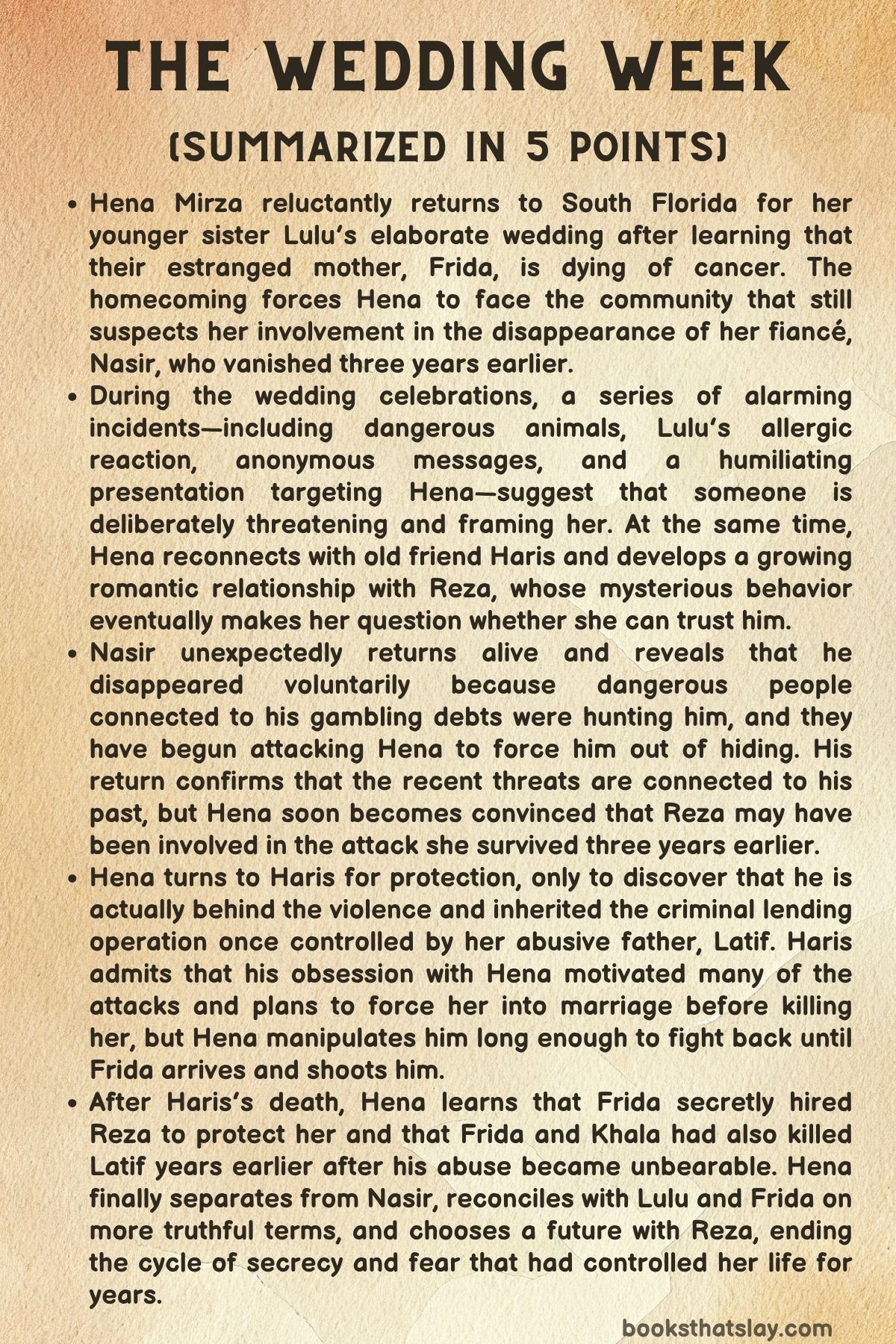
Summary
Hena Mirza has built a new life in San Francisco after leaving South Florida three years earlier under painful circumstances. Her younger sister Lulu unexpectedly calls to announce that she is marrying Khaled and desperately wants Hena at the wedding, but Hena initially refuses because returning would mean facing a community that still associates her with the disappearance of her fiancé, Nasir Wahidi.
Lulu finally reveals the reason for the rushed wedding: their mother, Frida, has stage-four lung cancer and may have only a short time left. Hena has been estranged from Frida since their terrible final encounter, yet Lulu’s confession that she needs her older sister persuades Hena to return.
Hena arrives at Vista Del Sol, a lavish Moroccan-inspired resort bordering the Everglades, only to discover that Lulu has concealed several details. The wedding is an eight-day affair, the resort now belongs to Lulu, and Nasir’s younger sister Irum is serving as maid of honor.
Hena is immediately thrown back into a community filled with whispers about Nasir. Her reunion with Frida is cold and critical rather than loving, although the sight of her mother weakened by cancer makes Hena realize that whatever remains unresolved between them may soon become permanent.
Among the guests, Hena reconnects with Haris, her teenage first kiss and Nasir’s closest friend. She also develops an immediate attraction to Reza, one of Khaled’s groomsmen, whose ignorance of her scandalous reputation allows her to speak to him without feeling watched or judged.
Reza and Hena begin spending time together, and what Hena expects to be a casual flirtation becomes increasingly personal. He speaks openly about losing his mother and having a difficult father, while Hena slowly allows him to see parts of herself that she has kept guarded for years.
At the same time, the wedding repeatedly awakens memories of Nasir. Hena recalls their long relationship, the gambling problems he kept hidden, and the terrible night after his disappearance when a masked man entered her bridal suite, strangled her, demanded to know where Nasir was, and fled after she stabbed him in self-defense.
The festivities begin producing disturbing incidents. A cruel anonymous message about disappearing husbands humiliates Irum at Lulu’s bridal shower, and Hena later finds another anonymous message in her own purse insulting her personally.
Danger then moves beyond words. Several enormous pythons appear unusually close to the resort, forcing Hena to rescue a child who has wandered toward them, and Lulu later suffers a dangerous allergic reaction despite the wedding staff supposedly controlling exposure to nuts.
Hena becomes especially suspicious when she finds a crushed pistachio shell inside a private elevator used by Lulu. During an Everglades excursion, another apparent accident occurs when a huge alligator escapes its enclosure and raw chicken is discovered near where Hena had been standing, making it appear that the animal may have been deliberately drawn toward her.
A blackout confined to Frida’s penthouse creates another terrifying encounter. Hena hears footsteps and strange metallic noises, knocks over Lulu’s prematurely delivered wedding cake while trying to escape, and discovers a knife embedded in it that resembles the weapon she used against her attacker three years earlier.
Detective Milcheck soon arrives with new information about Nasir. A device associated with Nasir’s phone has apparently been activated near Homestead, while an anonymous source tells police two secrets that few people should know: Hena saw Nasir on the morning he vanished, and the $250,000 he withdrew before disappearing actually belonged to her.
Haris steps in as Hena’s lawyer and prevents Milcheck from questioning her further. Hena eventually tells Haris that Nasir had developed a serious gambling addiction, accumulated dangerous debts, stolen their house fund, and repeatedly promised her he would stop while falling deeper into trouble.
Meanwhile, Frida’s health deteriorates rapidly. After she is hospitalized coughing up blood, Hena learns that her mother may have weeks or perhaps only days left, forcing her to recognize that their complicated relationship cannot remain unresolved forever.
Hena and Lulu also repair their own broken relationship. Lulu explains that she never truly resented Hena over money; she was devastated because the sister she adored left without saying goodbye, while Hena had wrongly assumed Lulu wanted nothing to do with her.
Their reconciliation is followed by the most public attack yet. During the mehndi, an anonymous presentation titled “The Truth About Hena Mirza” hijacks the celebration, showing private photographs, manipulated evidence linking Hena to recent incidents, and security footage proving that she argued with Nasir on the morning of his disappearance.
Humiliated and overwhelmed, Hena leaves with Reza. During a night on his sailboat, both reveal painful truths about their childhoods: Reza describes violence from his father, while Hena finally speaks about Latif Mirza’s brutal abuse and the serious injuries he once inflicted on her.
Their emotional connection becomes romantic, and they spend the night together. Hena begins to see Reza as something far more meaningful than a temporary escape, although his later nervousness and secretive behavior make her increasingly uncertain about who he really is.
The danger escalates when Frida’s caregiver, Gita, disappears and is found badly injured. Police believe she may have been mistaken for Hena because the two women have similar appearances, and the attacker tried to strangle Gita in the same manner used against Hena three years earlier.
Security cameras have also been disabled with red paint, exactly as they were during the earlier attack. Hena now understands that the person connected to the old assault has returned and that she, rather than Gita, was probably the intended target.
Despite the crisis, Lulu and Khaled proceed with a quiet marriage ceremony. Hena then shares a rare honest conversation with Frida, who admits that she once tried to escape Latif but was violently forced back into the marriage and that Hena suffered because of the choices Frida made while trying to survive him.
Just before Lulu’s larger wedding celebration, Nasir suddenly walks into the resort alive. His appearance shocks everyone, but Hena immediately senses danger because she knows he vanished deliberately to escape people who intended to kill him.
Privately, Nasir explains that he returned because the people pursuing him had begun targeting Hena to force him out of hiding. They had sent him evidence showing that they orchestrated the snakes, the nut contamination, and other attacks, and after Gita was nearly killed, Nasir concluded that surrendering himself was the only way to protect Hena.
Soon afterward, Hena overhears Reza speaking secretly on the phone about Nasir, a tracker, and ending the situation. She also notices a scar on Reza’s abdomen and remembers that she stabbed her masked attacker in roughly that area, leading her to believe Reza may have lied about his past and could be the man who attacked her.
Terrified, Hena flees from Reza and accepts Haris’s apparent rescue. Haris drives her to a remote cabin in the Everglades, confesses that he has loved her since they were teenagers, and presents himself as the one person she can still trust.
That illusion collapses when Hena finds photographs, restraints, masks, knives, brass knuckles, and bloodstained tools hidden inside the cabin. Messages on Haris’s phone reveal that Reza has been targeted and that one of Haris’s associates is waiting for an opportunity to shoot Nasir.
Haris finally admits the truth. Latif recruited him as a teenager into the Mirza family’s criminal lending operation, trained him to punish people who failed to pay, and treated him as the son he never had; after Latif’s death, Haris inherited the operation and became Nasir’s lender.
Haris also engineered the attacks surrounding the wedding and arranged the original assault on Hena. His obsession with her has become part romantic fixation and part desire to fulfill Latif’s old plan that Haris marry Hena and inherit the family legacy.
He drugs Hena and reveals an even darker plan: force her into a secret marriage, change her financial arrangements, kill her, and make her disappearance appear to be suicide. Hena awakens tied to a chair and realizes she must use Haris’s emotional weaknesses rather than physical strength to survive.
Pretending that she might return his feelings, Hena convinces Haris to loosen her restraints. When she finally reaches his gun and holds him at gunpoint, she hesitates long enough for the cabin door to burst open and reveal Frida.
Frida initially pretends to support Haris and orders Hena to surrender the weapon. Hena eventually understands the silent message in her mother’s behavior and gives Frida the gun, after which Frida turns it on Haris and shoots him repeatedly, ending the threat.
The aftermath exposes still more family history. Frida reveals that she and Khala killed Latif years earlier after his abuse of Hena became intolerable, and she explains that she secretly hired Reza to protect Hena during the wedding because she feared that enemies connected to Latif might return.
Reza therefore was protecting Hena rather than hunting her, while Haris had deliberately twisted circumstances to make him appear suspicious. Hena uses Haris’s phone to cancel the attack on Nasir, and the women burn the cabin and vehicle, destroying the remaining evidence of Haris’s operation.
Back at the resort, Nasir’s voluntary disappearance becomes clear, weakening the investigation against Hena. Hena also recognizes that Lulu cannot continue rebuilding their father’s business empire without knowing the truth about Latif, and she decides the family’s habit of concealing painful realities must finally end.
Hena and Nasir meet privately one last time. Although Nasir still loves her, they understand that love cannot restore the relationship damaged by addiction, secrecy, fear, and three years of separation, and they part accepting that their lives must now move in different directions.
Hena finally finds Reza preparing to leave and learns that his feelings for her were never part of his assignment. He admits that he has fallen in love with her, Hena forgives his secrecy, and she openly chooses him, ending the story no longer imprisoned by Nasir’s disappearance, her father’s violence, her mother’s rejection, or the expectations of the community that once defined her.
Characters
Hena Mirza
Hena is the emotional and narrative center of The Wedding Week, carrying three years of unresolved fear, shame, anger, and grief back into the community she deliberately escaped. Her decision to attend Lulu’s wedding is not driven by nostalgia but by the knowledge that Frida is dying and that avoiding her family forever would leave important relationships permanently unfinished.
Her guarded personality is the result of several betrayals layered across her life. She survived Latif’s physical abuse, Nasir’s gambling and financial deception, a violent attack connected to his debts, Frida’s rejection, and a community that turned her trauma into gossip.
Hena’s greatest difficulty is trusting her own judgment. She repeatedly questions whether threatening incidents are genuinely connected or whether her past has made her paranoid, which allows Haris’s manipulation to remain hidden longer than it otherwise might.
Her development becomes most visible when she stops simply reacting to other people’s versions of her life. She reconciles with Lulu, begins hearing Frida’s history without erasing the harm Frida caused, accepts that Nasir’s love cannot undo the damage between them, and refuses Haris’s fantasy of possessing her.
Her escape from Haris also demonstrates how much she has learned from the women around her. Rather than relying entirely on physical resistance, she observes his emotional needs, feeds his desire for validation, and creates an opening to save herself.
By the ending, Hena has not simply chosen a new romantic partner. She has reclaimed authority over her own story and can finally distinguish love from control, loyalty from silence, and protection from possession.
Frida Mirza
Frida is one of the most difficult characters to judge because The Wedding Week gradually changes the meaning of many of her earlier actions. At first she appears harsh, controlling, status-conscious, and emotionally withholding, greeting Hena after three years of estrangement with criticism rather than affection.
Her terminal illness forces Hena to confront the possibility that their relationship may end before either woman understands the other. Frida never becomes a conventionally affectionate mother, but the book slowly reveals that her hardness was shaped by decades spent surviving Latif’s violence.
Her history does not erase the pain she caused Hena. Frida admits that her daughter suffered because of decisions she made, and her ability to treat Gita with warmth shows Hena that Frida was capable of an emotional openness she rarely offered her own child.
Yet Frida’s protectiveness has always existed beneath that emotional distance. The childhood story of her physically fighting a python to save Hena becomes an early symbol of what she later proves at the cabin: whatever her failures as a mother, she will become dangerous when someone threatens her child.
Her decision to kill Haris is the clearest expression of this instinct. Frida recognizes in him the same entitlement and violence that defined Latif and refuses to allow another man built by that system to control Hena’s future.
Lulu Mirza
Lulu begins as the younger sister who manipulates Hena into returning by withholding the true length and scale of her wedding celebration. Beneath that behavior, however, lies genuine fear that Hena will refuse to return if given any opportunity to escape the family gathering.
Her relationship with Hena has been damaged largely by misunderstanding rather than hatred. Hena assumes Lulu resented her because of financial complications created by Frida, while Lulu reveals that her real wound was simply losing the older sister who had once been central to her childhood.
Lulu is also deeply invested in the Mirza family legacy. She sees Vista Del Sol and the possibility of rebuilding Latif’s hotel empire as ways to honor a beloved father, not realizing that Hena and Frida remember a violent man whose business success was connected to criminal activity.
Her loyalty becomes particularly important after the humiliating presentation against Hena. Rather than abandoning her sister once more evidence appears, Lulu concludes that someone has deliberately manipulated the event and insists on discovering what happened.
By asking Hena to walk her down the aisle, Lulu quietly confirms that their bond has been restored. Her marriage therefore marks not only the beginning of her life with Khaled but also the reopening of a relationship with the sister she thought she had lost.
Nasir Wahidi
Nasir is absent through much of the story, but nearly every mystery initially revolves around him. To the community, he is the vanished groom whose disappearance made Hena suspicious; to Hena, he is simultaneously the man she loved for nine years and the person whose addiction destroyed their shared future.
His gambling addiction becomes the central secret of their relationship. Nasir repeatedly promised to change, accumulated dangerous debts, allowed himself to become dependent on Haris’s money, and eventually took $250,000 belonging to Hena while preparing to disappear.
His disappearance is both selfish and desperate. He allows Hena and his family to live with uncertainty for years, yet he is genuinely hiding from people capable of torture and murder, and he believes staying away is the only way to keep others alive.
His return demonstrates that his feelings for Hena remain powerful. When he learns that Haris’s people are targeting her to force him into the open, Nasir abandons his own safety and returns believing he may have to die to protect her.
Even so, his final conversation with Hena acknowledges that love cannot restore what addiction, secrecy, and prolonged absence destroyed. Their parting allows Nasir to remain significant without turning his survival into an automatic romantic reunion.
Haris
Haris initially appears to be one of Hena’s safest relationships. He is her teenage first kiss, Nasir’s closest friend, a lawyer willing to protect her from aggressive police questioning, and one of the few people in the community who does not openly condemn her.
That apparent safety makes his eventual betrayal especially destructive. Haris understands Hena’s memories, knows her vulnerabilities, and repeatedly uses shared history to make himself appear more trustworthy than Reza.
His criminal development began under Latif, who recruited him while he was still young and offered him the approval of a powerful father figure. Haris internalized Latif’s ideas about debt, punishment, entitlement, and family succession until he became the continuation of the man who damaged Hena’s childhood.
His feelings for Hena are therefore inseparable from possession. He claims to have loved her since adolescence, yet he imagines love as a right to control her, marry her against her will, reshape her finances, and eventually kill her once she has served his purpose.
His jealousy toward Reza also exposes the emptiness of his supposed devotion. Haris humiliates Hena publicly and places her in danger because another man is becoming important to her, proving that preserving his fantasy matters more to him than her happiness.
Haris ultimately represents the continuation of Latif’s abusive legacy. His death ends not merely one individual threat but the possibility that the same system of coercion will continue controlling Hena through another generation.
Reza
Reza initially offers Hena something almost no one else at the wedding can provide: interaction untouched by the story of Nasir. Because he does not know her reputation, his attraction feels refreshingly separate from suspicion, family politics, and community gossip.
Their relationship develops through conversation before physical intimacy. Reza discusses grief, family violence, and the refuge he found through sailing, while Hena responds by revealing experiences with Latif that she has carried privately for years.
His secrecy creates genuine danger for their relationship. Frida hired him to protect Hena, but because he cannot explain his assignment, his surveillance, secret phone calls, unusual behavior, and abdominal scar make him appear capable of being the attacker Hena has feared for years.
The eventual revelation does not make his deception meaningless. Reza acknowledges that concealing the truth was a mistake, and Hena’s forgiveness comes only after she understands that his professional role and his personal feelings were separate.
He finally represents a form of love that Hena is learning to accept without surrendering herself. Unlike Haris, he does not claim ownership of her, and unlike Nasir, his relationship with her is not already burdened by years of addiction and broken promises.
Khala Simki
Khala is one of the most consistently nurturing figures in Hena’s life. Her warmth at the wedding immediately contrasts with Frida’s criticism, and Hena remembers that Khala cared for her during important parts of her childhood and provided some of her happiest early memories.
She also understands Frida more completely than Hena does because she knows the violence and fear that shaped her sister’s marriage. Khala therefore acts as a bridge between Hena’s justified anger and the hidden history that explains, without excusing, Frida’s behavior.
The revelation that Khala helped Frida kill Latif transforms her from a comforting aunt into someone willing to act decisively against extreme violence. She shares Frida’s belief that protecting Hena ultimately required ending the threat Latif represented.
Gita
Gita is Frida’s caregiver, but her importance extends beyond practical assistance. She speaks to Frida with unusual confidence, challenges her directly, and receives affection that Hena finds difficult to witness because it reveals a softer side of her mother she rarely experienced herself.
Frida later explains that Gita reminds her of the younger woman she might have been had she escaped Latif earlier. This gives Gita symbolic importance as a version of female independence and emotional openness that Frida once lost.
Her attack dramatically raises the danger surrounding Hena. Because Gita resembles Hena physically and is assaulted from behind using the same strangulation method employed against Hena years earlier, the police conclude that she may have been attacked by mistake.
Irum Wahidi
Irum carries the emotional consequences of Nasir’s disappearance from the perspective of the family he left behind. She became consumed with searching for answers and eventually required treatment after her obsession with the case overwhelmed her.
Her relationship with Hena is therefore built on conflicting emotions. She wants to believe Hena, but she cannot completely stop wondering whether the woman who was closest to Nasir knows more than she has admitted.
Her anger after the anonymous presentation is understandable because the footage proves that Hena lied about the last time she saw Nasir. Irum’s reaction reflects years of uncertainty rather than simple hostility, making her one of the people most seriously injured by Nasir’s decision to disappear.
Nasir’s return finally gives Irum what she has wanted for three years: proof that her brother is alive. Her overwhelming response reinforces how widely the consequences of his disappearance extended beyond Hena alone.
Latif Mirza
Latif is dead before the central events begin, yet his influence controls much of the conflict. Lulu remembers a charismatic father and successful hotelier, while Hena remembers a violent man who punished and physically abused her.
The contradiction between his public and private identities becomes essential to the family’s history. His charm enabled outsiders, including Haris, to admire him without understanding what Hena and Frida endured inside the family.
Latif’s criminal lending operation also outlives him. By recruiting Haris while he was young and teaching him to enforce debts through violence, Latif effectively creates the man who later destroys Nasir’s life and attempts to control Hena.
The revelation that Frida and Khala killed Latif after his violence against Hena crossed their final boundary makes his death part of the family’s long pattern of secrecy. Even after he is gone, the refusal to speak honestly about him allows Lulu to idealize his legacy and Haris to continue it.
Khaled
Khaled occupies a quieter role but provides stability during a week defined by crisis. His relationship with Lulu survives medical emergencies, family revelations, criminal attacks, public scandals, and repeated changes to the wedding plans.
His most important function is the contrast he provides to several other male relationships in the story. He and Lulu move toward marriage without the coercion, secrecy, or destructive dependency that characterize Hena’s histories with Nasir, Haris, and Latif.
The decision to proceed with a small nikkah while Frida is ill shows that the marriage matters more than the spectacle surrounding it. Lulu and Khaled’s union therefore becomes one of the few developments that remains fundamentally hopeful amid the escalating danger.
Detective Milcheck
Detective Milcheck represents the unresolved legal suspicion that has followed Hena since Nasir vanished. His reappearance immediately reminds her that the case never truly disappeared and that new evidence could once again place her under scrutiny.
His investigation is not entirely unreasonable because the anonymous source provides accurate details that Hena concealed. From Milcheck’s perspective, discovering that Hena lied about seeing Nasir and that the missing money belonged to her creates legitimate grounds for renewed questioning.
The problem is that Haris manipulates the investigation by supplying or controlling information around Hena. Once Nasir returns alive and admits he disappeared voluntarily, much of the suspicion directed toward Hena loses its foundation.
Nipa
Nipa, Haris’s mother, reflects the community’s instinctive distrust of Hena. She pulls Haris away from Hena early in the wedding and later attacks Hena publicly when the manipulated presentation appears to confirm existing suspicions.
Her behavior demonstrates how easily partial evidence can reinforce a reputation that has already been socially established. Nipa does not understand the criminal reality surrounding Nasir and Haris, but her certainty contributes to the hostile environment Hena must endure.
Lucinda
Lucinda is connected to Lulu’s plans for reviving the Mirza hotel legacy and therefore becomes part of the contrast between the family’s glamorous public history and its hidden violence. Lulu sees figures like Lucinda as links to the father she wants to honor, while Hena knows that Latif’s legacy is far less admirable than it appears.
Lucinda also provides an important practical clue when she reveals the existence of the service entrance and exterior metal staircase connecting the VIP suites. Her explanation resolves Hena’s mysterious noises while simultaneously proving that someone could have entered the suites without appearing on the main hallway surveillance system.
Auntie Hanifa
Auntie Hanifa represents the cruelty of community gossip in its most personal form. Her public use of the exact phrase from the anonymous insult Hena received confirms that she deliberately placed the message in Hena’s belongings.
Her behavior matters because not every hostile act during the wedding comes from Haris’s larger conspiracy. Some cruelty grows simply from judgment, rumor, and the willingness of people to treat another person’s suffering as entertainment.
Lulu’s decision to expel Hanifa shows her growing willingness to defend Hena openly. It is another sign that the sisters’ repaired relationship has become more important than protecting appearances within their social circle.
Themes
Abuse, Control, and the Inheritance of Violence
Violence in The Wedding Week does not end when the original abuser dies. Latif’s abuse shapes Hena’s fear, Frida’s emotional hardness, Lulu’s distorted understanding of her father, and Haris’s entire conception of power.
Haris becomes especially important because he demonstrates how abusive systems reproduce themselves. Latif recruits him as a teenager, rewards his loyalty, teaches him that debts justify punishment, and gives him the paternal approval he craves; years later, Haris uses those lessons against Nasir and Hena.
Control is repeatedly disguised as love or protection. Nasir conceals serious problems while telling himself he is protecting Hena, Haris calls his obsession love, and Frida makes controlling decisions for her daughters while believing she is preserving them from danger or humiliation.
The story gradually distinguishes genuine protection from possession. Reza’s assignment is secretive and flawed, but his goal is Hena’s safety rather than ownership, while Frida’s final intervention against Haris comes from her refusal to let another violent man determine her daughter’s future.
Breaking the pattern therefore requires more than removing Haris. Hena must recognize the emotional logic that allowed men like Latif and Haris to confuse domination with devotion, and she must refuse to carry that logic into her own future.
Family Secrecy and the Cost of Silence
Nearly every central relationship has been damaged by information deliberately withheld. Hena conceals the truth about Nasir’s disappearance, Frida conceals what happened to Latif, Nasir hides his gambling and later his location, Reza hides his role as Hena’s protector, and Lulu is left with an idealized version of her father because nobody tells her what he actually did.
These secrets are often defended as necessary protection. Hena keeps information about Nasir because revealing it could expose him to danger, Frida hides her past because survival once required secrecy, and Reza cannot openly explain the work Frida hired him to perform.
Yet silence repeatedly creates new harm. Irum spends years wondering whether her brother is dead, Lulu believes Hena abandoned her without caring, Hena mistakes Reza for an attacker, and Lulu begins rebuilding Latif’s empire without knowing what the name represents.
The sisters’ reconciliation demonstrates the alternative. Once Hena and Lulu finally state what each believed about the other, they discover that years of estrangement were built partly on false assumptions rather than irreparable hostility.
By the ending, Hena concludes that Lulu must learn the truth about Latif. That decision marks a larger rejection of the family habit of treating secrecy as the safest solution, acknowledging that hidden truths often continue exerting power precisely because nobody is willing to name them.
Love, Loyalty, and Possession
Several relationships force Hena to reconsider what love should require from the people involved. Her nine years with Nasir contain genuine affection and companionship, yet his addiction repeatedly asks her to forgive deception, financial betrayal, and promises he cannot keep.
Haris presents an even more dangerous version of distorted love. He insists that his feelings began when they were teenagers and imagines their shared history as proof that Hena belongs with him, but his idea of devotion ultimately includes coercion, forced marriage, financial control, and murder.
Frida’s maternal love is also complicated. She can be emotionally cruel and controlling, yet she once fought an animal to save Hena, later arranged protection for her at the resort, and ultimately walks into Haris’s cabin prepared to kill the man threatening her daughter.
Reza offers Hena a different possibility. His secrecy damages her trust, but he does not demand that she surrender independence in exchange for affection, and when the truth emerges, he admits his mistake rather than insisting that his protective intentions justify everything.
Hena’s final choices show that she no longer considers love sufficient by itself. She can care for Nasir and still leave him, understand Frida without erasing the past, and choose Reza only after deciding that their connection leaves room for her freedom.
Memory, Reputation, and Reclaiming the Truth
Hena returns to a community that has already decided what her story means. Nasir disappeared, Hena survived, and the absence of answers allowed gossip to transform uncertainty into increasingly cruel narratives about betrayal, pregnancy, affairs, and possible guilt.
Her own memories are equally unstable. The wedding setting causes buried experiences involving Latif, Frida, Nasir, and the attack in her bridal suite to return gradually, forcing Hena to reconsider people she once understood in simpler terms.
Public reputation and private reality repeatedly contradict each other. Latif is remembered by others as charismatic and successful despite being abusive and criminal, Hena is treated as suspicious despite being a victim, and Haris appears loyal and respectable while secretly operating the violent system Latif created.
The manipulated presentation at the mehndi shows how easily fragments of truth can be rearranged into a false story. Hena really did meet Nasir, really did argue with him, and really did conceal information, but those facts do not mean she caused his disappearance.
Freedom finally comes when Hena stops allowing other people to define the meaning of her past. By confronting Nasir, Haris, Frida, Lulu, and the history of Latif’s empire, she replaces rumor and inherited mythology with knowledge, accepting painful truths without allowing them to dictate the rest of her life.