Three Reasons for Revenge Summary, Characters and Themes
Three Reasons for Revenge by Dervla McTiernan is a crime novel built around the consequences of an old sexual-assault allegation, a carefully planned revenge campaign, and the guilt carried by people who believe they failed a vulnerable young woman.
Detective Sergeant Judith Lee begins investigating psychologist Robert Walker after a young woman accuses him of misconduct, only to discover that almost every part of the complaint has been deliberately constructed. As Robert’s public life collapses and a murder follows, Judith is drawn into a case connecting false identities, surveillance, planted evidence, family trauma, and a tragedy from ten years earlier.
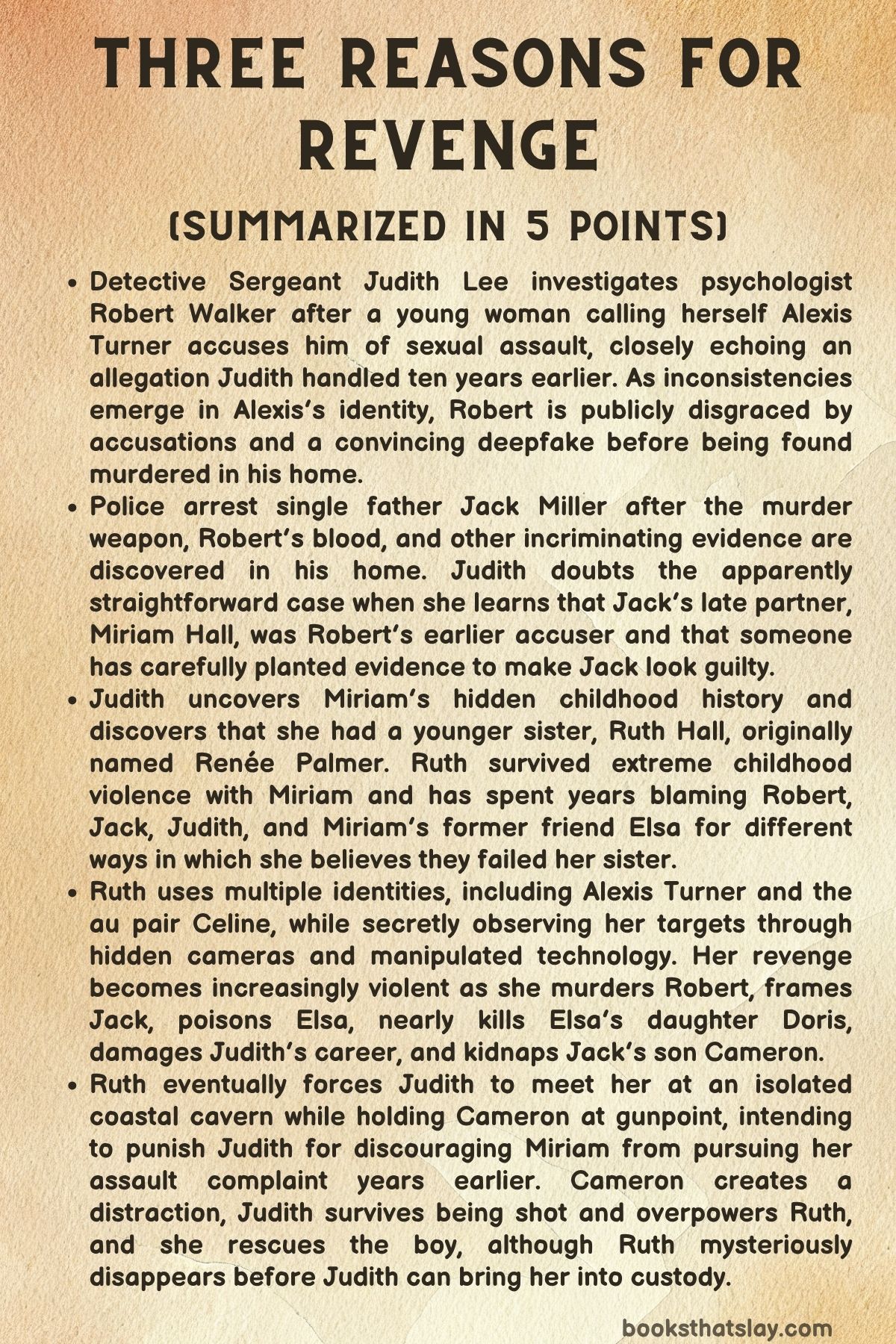
Summary
Detective Sergeant Judith Lee is approached by twenty-year-old Alexis Turner, who insists on speaking specifically to her about an alleged sexual assault by psychologist Robert Walker. Alexis says she sought Robert’s help for panic attacks and anxiety, but during an evening consultation he offered cannabis, massaged her shoulders, and touched her breasts without permission before she escaped.
The allegation affects Judith deeply because another young woman made a remarkably similar complaint against Robert ten years earlier. Judith had failed to move that earlier case forward, and Alexis’s accusation feels like an opportunity to correct something she has regretted ever since.
Judith is already under professional pressure because she recently intervened when police officer Luke Fraser used excessive force while apparently affected by methamphetamine. Luke’s powerful father, Assistant Commissioner Eddie Fraser, has repeatedly protected him, and Judith’s insistence on drug testing threatens Luke’s career and places her directly in Eddie’s path.
While Judith questions Robert at his home, Robert’s wife Vanessa receives a mysterious black-wrapped package containing a USB drive. The video on it appears to show Robert having sex with a woman inside his consulting rooms, leaving Vanessa horrified by what seems to be visual proof of serious professional misconduct.
Robert insists that the man shown in the recording is not him and points out physical details that support his claim. Vanessa takes the footage to video editor Craig Wallace, who eventually determines that it is a sophisticated deepfake combining genuine images of Robert’s consulting room with manipulated explicit footage and an artificial version of Robert’s face.
The fabricated video does not solve Robert’s larger problem. Vanessa admits that their marriage has been deteriorating for years, and although she believes the video itself is false, she cannot confidently say Robert has never behaved improperly with patients.
Judith soon finds serious problems in Alexis’s story. Alexis gave a false phone number, a false address, and a university connection that cannot be verified, while Robert discovers that the student identification number she supplied is also fake.
Meanwhile, allegations against Robert begin appearing online. An influencer named Chloe receives anonymous footage supposedly showing Robert having sex with a patient, and multiple women post accounts describing inappropriate remarks and shoulder massages similar to Alexis’s accusation.
Judith deliberately gives journalist Mike Russo information about Robert in the hope that publicity will encourage genuine victims to come forward. Her determination is increasingly personal, and she is willing to operate beyond normal professional boundaries because she cannot separate the current investigation from what happened ten years earlier.
The public scandal destroys Robert’s home life. Vanessa’s network tells her it will support her only if she separates from him, and when she confronts Robert about whether he has ever touched patients improperly, she sees enough uncertainty in his reaction to doubt him.
Vanessa leaves the marriage. Robert responds with anger, self-pity, drinking, threats, and resentment, while privately remembering occasions when he may have crossed professional boundaries and dismissing them as conduct that belonged to another era.
Judith’s own situation becomes increasingly dangerous. Her motorbike is deliberately vandalised inside the secure police garage, she is lured to an empty warehouse through a false emergency call, and her superiors begin asking questions about the childhood killing of her violent stepfather Gerry, whom she killed while protecting her mother.
Then an anonymous woman calls Judith and tells her that Robert is dead and that Judith will be blamed. At Robert’s house, Judith finds him shot through the head beside a handwritten note declaring that Judith caused his death.
Panicking, Judith removes the note before Rocky Jansen arrives. She then notices that the gun is missing, proving that Robert has not committed suicide but has been murdered.
The investigation unexpectedly shifts toward Jack Miller, a struggling single father raising his ten-year-old son Cameron. Jack receives another black-wrapped parcel containing a handgun and a cryptic message, but before he can take the weapon to police, officers arrive with a warrant to search his home.
The gun is identified as Robert’s murder weapon. Police also find Robert’s blood on one of Jack’s shirts and soil from Robert’s property on Jack’s boots, creating an apparently overwhelming case against a man who insists he has never heard of Robert.
Investigators then discover that Robert once treated Miriam Hall, Jack’s late girlfriend and Cameron’s mother, shortly before she died by suicide ten years earlier. Jack remembers Miriam’s severe postnatal depression and admits that he has spent years blaming himself for working too much, withdrawing emotionally, and failing to understand how desperately she needed help.
Judith knows something far more important: Miriam was the woman who accused Robert of sexual assault ten years ago. Because that connection gives Jack an obvious motive, Judith initially conceals it while investigating whether the evidence against him has been deliberately planted.
Her investigation into the gun leads to Steve and Alison Gifford, foster parents whose locked safe was carefully targeted months earlier. Two weapons were stolen by someone who knew exactly where the hidden key was kept, suggesting that the thief had once lived in their home.
Judith discovers that Miriam was one of the Giffords’ foster children and that she had a younger sister named Ruth Hall. Further investigation reveals that Miriam and Ruth were originally Margaux and Renée Palmer, daughters of Anita Fournier and violent criminal Charlie Palmer.
Their mother was murdered after reporting suspicions about Charlie’s involvement in the disappearances of several women. The sisters were found beside their mother’s body and later entered foster care under protected identities, carrying profound trauma from what they had witnessed and survived.
The Giffords remember the sisters very differently. Miriam was quiet and anxious, while Ruth was intensely possessive, violent, and capable of severe retaliation, once cutting off the tip of Steve Gifford’s finger after being reprimanded.
Judith develops a new theory: Alexis Turner was actually Ruth using a false identity. Ruth copied Miriam’s allegation against Robert, manipulated Judith into reopening the old wound, arranged Robert’s public destruction, murdered him, and planted evidence to frame Jack.
Jack’s supposed motive is therefore part of the trap. Ruth appears to blame him for failing Miriam during her depression and holds him responsible for the circumstances surrounding her decline, even though Jack himself has spent ten years punishing himself for those same failures.
Judith finally confesses to her friend Katy what happened with Miriam. Ten years earlier, Miriam came directly to Judith after Robert assaulted her, but Judith, influenced by a previous failed sexual-assault prosecution, advised the fragile young woman not to pursue the case because she believed the legal process might destroy her.
Miriam later died by suicide, leaving Judith convinced that she had failed her. Katy challenges Judith’s assumptions, arguing that Judith’s violent childhood made her respect resistance and toughness while becoming too judgmental toward people whose trauma made them frightened, passive, or emotionally overwhelmed.
Judith also learns from former psychologist Lawrence Barr that Ruth displayed manipulative behaviour, emotional detachment, obsessive surveillance, false identities, stalking, and extreme psychological identification with Miriam. Barr believes Ruth experienced Miriam less as a separate person than as part of herself, making Miriam’s death feel like a personal injury requiring punishment.
Ruth’s revenge extends beyond Robert and Jack. Elsa Anderson, Jack’s wealthy friend and Miriam’s former university friend, receives another black-wrapped package containing gourmet marshmallows and a strange handwritten message.
At the same time, a secretly recorded private conversation in which Elsa cruelly criticises influencer Darla Darling’s weight is released online. Elsa falsely claims the genuine recording may be an AI fabrication, unaware that the person targeting her has already entered her private world.
Judith visits Elsa’s home to check on Cameron and notices the same distinctive handwriting from the earlier packages. Elsa suddenly becomes violently ill and collapses, while her young daughter Doris also begins vomiting blood after eating some of the poisoned sweets.
Elsa dies from sodium fluoroacetate poisoning, while Doris survives because she consumed less. Judith concludes that Ruth considers Elsa guilty of abandoning Miriam emotionally during a period when Miriam desperately needed support.
The investigation then reveals that Ruth has been much closer than anyone realised. An apartment rented under the Alexis Turner name contains disguises and surveillance access to Robert’s office, while a phone left behind leads Judith to recognise that Ruth has also been living inside Elsa’s household disguised as Celine, the family’s French au pair.
By the time police reach the Anderson house, Celine has disappeared and Cameron is missing. Hidden cameras around Robert’s rooms and Jack’s home confirm that Ruth had been watching her targets for months, studying their routines before acting.
Ruth also destroys Judith professionally. She sends police leadership proof that Judith leaked confidential information to Mike Russo and video showing her removing the note from Robert’s murder scene, forcing Judith into an emergency disciplinary hearing where she is immediately suspended and stripped of her gun and identification.
Cameron, meanwhile, trusts Celine completely. Ruth tells him that Jack has been cleared and will soon be released, then manipulates him into insisting that she drive him to meet his father, allowing Cameron to believe the decision to leave with her is his own.
Judith returns home to find another black package. Inside is a video showing Ruth following Katy onto a crowded railway platform and pushing her onto the tracks as a train approaches.
Ruth calls Judith and explains that she has taken Judith’s closest friend because Judith helped take Miriam from her. She also reveals that Cameron is her hostage and orders Judith to reach Devil’s Elbow near the Great Ocean Road alone within a strict time limit.
Suspended, unarmed, and monitored through her compromised phone, Judith rides through heavy rain to the isolated coastal location. She follows Ruth’s directions down dangerous cliffs and through a cave passage that opens into an enormous cavern containing a deep pit.
Ruth waits there with Cameron and a gun. She reveals that Charlie Palmer once used the same cave to murder women and dispose of their bodies, turning the place associated with her father’s crimes into the setting for the final stage of her own revenge.
Ruth accuses Judith of the greatest betrayal because Judith had survived domestic violence herself and therefore, in Ruth’s view, should have understood Miriam. Ruth interprets Judith’s decision to discourage Miriam from pursuing Robert as a conscious abandonment rather than a mistaken attempt to protect her.
When Ruth prepares to kill Cameron, he knocks a lantern into the pit and jumps after it, preferring the dangerous water below to being shot. Judith uses the distraction to attack Ruth, but Ruth shoots her in the thigh during the struggle.
Judith manages to overpower Ruth with a heavy tactical torch, disarms her, and handcuffs her. She then finds Cameron alive in the freezing water and pulls him to safety.
When Judith later returns to Ruth, however, Ruth has disappeared despite the handcuffs and her injuries, leaving only blood behind. Judith also discovers decaying backpacks that appear connected to Charlie Palmer’s long-missing victims, suggesting that the cavern may finally provide answers to crimes committed long before Robert’s murder.
Badly injured but still conscious, Judith takes the recovered weapon and leads Cameron out of the cave. Her priority is no longer professional redemption or proving that she was right about Ruth, but returning the frightened boy safely to Jack after both father and son have been used as pieces in someone else’s revenge.
Characters
Judith Lee
Judith Lee is the central investigative figure in Three Reasons for Revenge, but her importance comes as much from her personal failures as from her professional abilities. She is experienced, forceful, suspicious of authority, and willing to confront powerful people, as shown by her refusal to overlook Luke Fraser’s drug use and violence despite knowing that Eddie Fraser may retaliate.
Her greatest weakness is the certainty with which she judges strength and weakness. Having killed her violent stepfather at fifteen to protect her mother, Judith developed a survival instinct built around action, resistance, and self-control, and that history partly explains why she once believed Miriam was too fragile to survive a sexual-assault prosecution.
Judith’s guilt over Miriam controls much of her behaviour when Alexis appears. She keeps a case she normally would not handle, leaks information to the media, conceals relevant facts from Rocky, and removes evidence from Robert’s murder scene because she has stopped approaching the situation as a detached investigator.
Katy forces Judith to recognise the uncomfortable truth that surviving trauma through aggression has made her impatient with people who respond differently. This insight does not erase Judith’s mistakes, but it changes how she understands Miriam and why the advice she once considered protective could also have felt dismissive and abandoning.
By the final confrontation, Judith is stripped of institutional authority, suspended, unarmed, and physically isolated. Her decision to pursue Ruth and save Cameron therefore becomes an intensely personal act in which she finally uses her strength on behalf of someone more vulnerable rather than measuring that person against her own standards of survival.
Ruth Hall / Renée Palmer / Alexis Turner / Celine
Ruth is the principal force behind the violence in Three Reasons for Revenge, yet she is not presented as someone motivated by a single spontaneous act of anger. Her revenge is systematic, patient, technically sophisticated, and built on years of observation, false identities, surveillance, manipulation, and an obsessive loyalty to Miriam.
Her childhood explains the origins of her instability without excusing what she becomes. She and Miriam witnessed the murder of their mother, survived a violent father, entered foster care under protected identities, and experienced a childhood shaped by fear and secrecy.
Even as a child Ruth responded differently from Miriam. Where Miriam became quiet and anxious, Ruth became possessive and violent, attacking other children and retaliating against Steve Gifford by cutting off part of his finger after he disciplined her.
Lawrence Barr’s account suggests that Ruth learned to survive through watching and imitation. She creates identities rather than simply disguises, studying what people expect and then becoming the person most capable of gaining their trust.
Her Alexis persona manipulates Judith’s professional guilt, while her Celine persona wins Cameron’s complete trust and gives her access to Elsa’s family. Ruth understands that emotional control is more powerful than physical force because a victim who believes her can often be guided into danger voluntarily.
Her relationship with Miriam is the emotional centre of her psychology. Barr believes Ruth experienced her sister almost as an extension of herself, making Miriam’s death feel like a personal violation that could only be answered by punishing everyone she believed contributed to it.
This logic becomes increasingly distorted. Robert, Jack, Elsa, and Judith all occupy different moral positions, yet Ruth reduces their failures to the same category and constructs punishments for each of them, eventually becoming willing to murder Elsa and endanger Doris and Cameron.
Robert Walker
Robert Walker is both a target of a fabricated campaign and a man whose own conduct gives that campaign credibility. The deepfake depicting him is false, Alexis’s identity is false, and the murder plot against him is carefully manufactured, but these facts do not establish Robert as innocent in every meaningful sense.
His contemptuous comments about younger patients expose how far he has moved from the responsibilities of his profession. Vanessa is disturbed not merely by the accusation but by hearing him speak about vulnerable patients with impatience and disdain.
Robert also privately remembers moments when he may have crossed professional boundaries. Rather than seriously reconsidering them, he protects himself by treating those actions as acceptable behaviour from an earlier period, revealing a strong capacity for self-justification.
His response to crisis further exposes his character. He drinks, blames the police, threatens Vanessa with disclosure of her past painkiller dependence, abandons the family dog, demands lawsuits, and treats the collapse of his reputation mainly as an injustice being done to him.
Robert therefore occupies an uncomfortable moral position. He is murdered and framed through fabricated evidence, but the revenge campaign works partly because his past behaviour has already given others reasons to distrust him.
Vanessa Walker
Vanessa begins as a highly successful television presenter who has spent years maintaining public composure while her private marriage deteriorates. The deepfake forces her to confront not only the possibility of Robert’s misconduct but also how little confidence she has left in the man she has been married to for twenty-six years.
Her first instinct is partly strategic because she understands immediately how scandal can destroy a public career. She considers media narratives, network support, her sons’ welfare, and the difference between defending Robert and protecting herself.
Yet Vanessa’s eventual decision to leave is not merely professional damage control. Robert’s resentment of her success, emotional distance, contempt for patients, threatening behaviour, and uncertain response when asked about past misconduct confirm that the marriage has been empty for much longer than the scandal has existed.
Vanessa also becomes important to Judith’s investigation when she reports the distinctive package containing the deepfake. That detail helps Judith connect Robert’s targeting with the package sent to Jack and eventually with the larger revenge operation.
Jack Miller
Jack Miller is defined by guilt long before he is accused of murder. He has raised Cameron alone since Miriam’s death and believes that his own emotional absence, long working hours, and inability to recognise the severity of her postnatal depression contributed to her suicide.
His guilt makes Ruth’s plan particularly cruel. She does not need to invent a regret for Jack because he has already spent ten years punishing himself, and framing him for Robert’s murder transforms that private self-condemnation into public accusation.
Jack’s strongest characteristic is his devotion to Cameron. Even while being arrested and confronted with evidence that could imprison him for life, his immediate concern is finding someone trustworthy to care for his son.
His reaction to learning that Miriam had a sister and had seen Robert shortly before her death appears genuine to Judith. That sincerity helps her recognise that Jack is not the secret avenger the physical evidence suggests but another person whose past failures have been transformed into a weapon against him.
Miriam Hall / Margaux Palmer
Miriam remains absent from the present-day action but determines almost everything that happens. As a child she survives extraordinary violence, including the murder of her mother, but unlike Ruth she turns inward, becoming anxious, quiet, and emotionally vulnerable.
As a young mother she experiences severe postnatal depression and struggles within a life marked by financial pressure, isolation, and Jack’s increasing absence through work. Shortly before her suicide, she sees Robert and later tells Judith that he sexually assaulted her.
Judith’s decision to discourage Miriam from pursuing the complaint becomes one of the central moral failures of the story. Judith believes she is protecting someone fragile from a damaging legal process, but Miriam may instead experience the encounter as confirmation that even the police will not fight for her.
Miriam’s tragedy is then interpreted differently by everyone who survives her. Jack sees personal failure, Judith sees professional failure, Elsa carries unresolved questions about their lost friendship, and Ruth turns the death into a justification for punishment.
Elsa Anderson
Elsa is successful, socially confident, generous toward Jack and Cameron, and deeply invested in maintaining the appearance that her life is effortless. Her fashion company, however, is financially vulnerable, and she hides much of the pressure from her husband Nathan.
Her cruel private remarks about Darla expose a more judgmental side. When the recording is leaked, Elsa falsely claims it may be an AI creation even though she knows it is genuine, showing how quickly fear of reputational collapse can overpower honesty.
Her loyalty to Jack is nevertheless genuine. She offers to fund his legal defence, gives Cameron a home, and refuses to allow the boy to enter foster care, actions that demonstrate generosity alongside her flaws.
Ruth judges Elsa almost entirely through her earlier friendship with Miriam. Because Elsa drifted away while pursuing modelling and a different social life, Ruth converts an ordinary but painful failure of friendship into a crime deserving death.
Cameron Miller
Cameron is one of the clearest innocent victims of the conflict. He loses his mother as a baby, watches his father being arrested for murder, is displaced into Elsa’s household, experiences Elsa’s death and Doris’s poisoning, and is then manipulated by a woman he trusts.
Ruth’s control of Cameron demonstrates her skill at psychological manipulation. She does not force him into the car but gives him information designed to make him demand that they leave immediately, allowing him to believe he is acting to reunite his family.
At the cavern Cameron also shows remarkable courage. When Ruth prepares to shoot him, he creates his own escape by knocking away the lantern and jumping into the dark pit, giving Judith the opportunity she needs to attack Ruth.
Rocky Jansen
Rocky is Judith’s superior, mentor, and father figure. He understands her stubbornness and repeatedly tries to protect her from consequences without completely shielding her from responsibility.
He initially interprets the evidence against Jack through conventional investigative logic because the gun, blood, boots, and Miriam connection all appear to support guilt. Judith’s competing theory forces him to consider that overwhelming physical evidence can itself be manufactured.
Rocky also understands the danger posed by Eddie Fraser more clearly than Judith does. His warnings about retaliation show that he is politically experienced and aware that institutional power can operate through informal intimidation rather than official channels.
Katy
Katy is Judith’s childhood friend and one of the few people willing to challenge her without hesitation. Her greatest contribution is not investigative but moral: she refuses to comfort Judith with an easy explanation for what happened to Miriam.
She argues that Judith’s own survival has created a bias toward people who fight visibly against danger. By telling Judith that strength should be used to support those who cannot defend themselves rather than judge them, Katy forces her friend to reconsider a belief system built over decades.
Ruth recognises Katy’s emotional importance and therefore targets her as Judith’s symbolic sister. The railway-platform attack is designed not simply to injure Katy but to make Judith experience the kind of helpless loss Ruth associates with Miriam.
Luke Fraser
Luke Fraser represents entitlement protected by institutional influence. His history includes drug use, violence, misogyny, and misconduct, yet his father’s position has repeatedly allowed him to avoid consequences.
When Judith forces him to undergo drug testing, Luke retaliates personally by destroying her motorbike inside a secure police facility. The vandalism shows both his immaturity and his assumption that the police environment belongs to him strongly enough that he can violate it without fear.
The security footage that finally exposes him marks the collapse of that protection. His downfall operates as a smaller parallel to the novel’s larger concern with people who believe status can shield them from accountability.
Eddie Fraser
Eddie Fraser uses senior police authority to protect Luke rather than demand better conduct from him. His influence creates a climate in which Judith expects professional retaliation simply for doing what would normally be considered basic police work.
The pressure placed on Judith, including renewed attention to Gerry’s death and scrutiny from senior officers, suggests how easily institutional processes can be turned into weapons. Eddie therefore represents a quieter form of manipulation than Ruth, relying on hierarchy and influence rather than disguise and surveillance.
Penelope Ford
Penelope is Vanessa’s ambitious producer and understands the media consequences of Robert’s scandal almost immediately. She sees that defending him publicly will work only if his private history is clean and recognises that Vanessa’s professional survival may depend on separating herself from him.
Her perspective is practical rather than emotional. She approaches the crisis through reputation, strategy, and the likely response of audiences and network executives, making her an important reflection of the public world Vanessa has spent years navigating.
Claire Holdsworth
Claire is a technical analyst who assists Judith with digital evidence surrounding Alexis. Judith briefly becomes suspicious of her because certain physical details remind her of Alexis, demonstrating how Ruth’s deception causes Judith to distrust even people close to the investigation.
Claire’s role also reinforces how central technology is to the case. False accounts, deepfakes, compromised devices, recordings, and hidden surveillance repeatedly make appearance unreliable and force investigators to question what supposedly objective evidence actually proves.
Nathan Anderson
Nathan is Elsa’s husband and a surgeon whose life becomes suddenly overwhelmed by events he does not understand. He is disturbed by Elsa’s harsh remarks about Darla and later confronts the financial and personal consequences of Jack’s arrest entering their household.
During the poisoning, his medical training allows him to respond immediately when Elsa collapses. His inability to save her despite that expertise adds another layer of helplessness to Ruth’s attack, while his children become unintended victims of a revenge campaign directed at their mother.
Lachy Walker
Lachy is one of Robert and Vanessa’s sons and experiences the scandal mainly as a collapse of certainty about his father. He wants Vanessa to tell him that every accusation is false, but she cannot provide the reassurance he desperately wants.
His reaction shows the secondary damage caused by both Robert’s past behaviour and Ruth’s campaign. Even before Robert is murdered, the family has already been forced into suspicion, shame, and public exposure.
Lawrence Barr
Lawrence Barr provides Judith with the psychological framework that finally makes Ruth’s behaviour comprehensible. He remembers a child who was hypervigilant, emotionally detached, capable of false personalities, intensely interested in watching others, and prone to stalking and hidden surveillance.
His most important insight concerns Ruth’s relationship with Miriam. By suggesting that Ruth experienced Miriam almost as an extension of herself, Barr explains why grief has become identity-based revenge rather than ordinary mourning.
Steve and Alison Gifford
Steve and Alison provide the connection between Ruth’s childhood and the stolen murder weapon. Their long history as foster parents gives them direct knowledge of Miriam and Ruth before both disappeared into adulthood.
Steve’s story about Ruth cutting off the tip of his finger becomes an early warning that Ruth’s violence is neither new nor purely the product of Miriam’s death. The theft of his guns also shows that Ruth remembered the details of the foster home years later and was capable of returning with a carefully prepared plan.
Linda
Linda is Judith’s mother, whose continued romanticisation of Gerry creates an unresolved conflict between mother and daughter. Judith killed Gerry at fifteen while defending Linda from his violence, yet Linda still wants to commemorate him through an anniversary mass.
Her refusal to see Gerry as Judith sees him helps explain Judith’s emotional rigidity. Judith learned very young that even someone being harmed might remain attached to the person harming them, a reality she has never fully learned to accept.
Themes
Revenge, Justice, and Moral Distortion
Revenge in Three Reasons for Revenge begins with recognisable grievances but becomes increasingly detached from proportion. Robert may have harmed Miriam, Judith undeniably failed her in an important moment, Jack was an overwhelmed partner who withdrew when Miriam needed support, and Elsa allowed a friendship to fade, yet Ruth treats all four failures as offences requiring punishment.
This refusal to distinguish between different kinds of responsibility is what turns Ruth’s desire for justice into moral distortion. She can identify genuine failures in other people while remaining unable to recognise the far greater harm she causes through murder, poisoning, kidnapping, framing, and attacks on innocent people.
Her actions also reveal why revenge cannot restore Miriam. Every punishment creates new victims: Cameron loses access to his father, Doris is nearly killed, Elsa’s family is shattered, Vanessa and her sons lose Robert, and Judith is professionally destroyed before being physically attacked.
Ruth imagines herself as correcting the past, but she repeatedly reproduces the same helplessness and terror that defined her own childhood. The result is a cycle in which suffering becomes justification for causing more suffering rather than a reason to prevent it.
Guilt and the Burden of Responsibility
Several major characters organise their lives around guilt, but each assigns responsibility differently. Jack believes he failed Miriam by working too much and withdrawing from the unbearable pressure at home, while Judith believes she failed Miriam by discouraging her from pursuing the allegation against Robert.
Neither can change what happened, so guilt becomes a permanent internal punishment. Jack spends years raising Cameron while carrying the belief that Miriam might have survived if he had been more attentive, and Judith becomes intensely invested in Alexis because she sees the new case as an opportunity to repair an old failure.
Ruth exploits this guilt because it makes both characters vulnerable to manipulation. Jack does not need to be persuaded that he failed Miriam, while Judith becomes willing to break professional rules because her desire to correct the past overwhelms her judgment.
The novel distinguishes responsibility from total blame. Jack, Judith, Elsa, and Robert did not occupy identical positions, and Miriam’s death cannot be reduced to one action by one person.
Katy’s confrontation with Judith becomes especially important because it demands accountability without reducing a person to a single mistake. Judith must accept that her decision harmed Miriam while also understanding the assumptions and experiences that led her to make it.
Trauma and Different Forms of Survival
Judith, Miriam, and Ruth all experience severe violence, yet their responses could hardly be more different. Judith survives by fighting, Miriam turns inward and becomes increasingly fragile, while Ruth develops hypervigilance, emotional detachment, manipulation, and obsessive control.
The contrast challenges the idea that there is one correct way to respond to trauma. Judith’s greatest mistake is assuming that the form of strength that saved her should also define what strength looks like in other people.
Katy directly exposes this problem when she tells Judith that her own history has made her contemptuous of women she considers weak. The criticism forces Judith to recognise that passivity, fear, confusion, and emotional collapse can also be consequences of trauma rather than evidence of poor character.
Ruth represents another extreme. Her childhood suffering explains why she became obsessed with control and surveillance, but the story refuses to treat trauma as automatic moral permission for later violence.
Miriam’s experience remains the clearest example of someone whose vulnerability was repeatedly misunderstood. She needed support that recognised the seriousness of her condition without deciding on her behalf what she could or could not survive.
Truth, Evidence, and Manipulation
Much of the conflict depends on evidence that appears convincing while creating a false conclusion. The video of Robert is technically fabricated but visually persuasive, while Jack’s gun, bloodstained shirt, and muddy boots are genuine physical objects deliberately arranged to frame him.
Ruth understands that people trust what appears concrete. Instead of merely telling lies, she builds environments in which other people reach the false conclusion themselves.
Her fake identities operate on the same principle. Alexis seems emotionally credible enough to deceive Judith, while Celine becomes a trusted caregiver because Ruth studies what Elsa, Cameron, and the household expect from her.
The theme also extends beyond Ruth. Elsa responds to the genuine recording of her cruel comments by claiming it may be artificial, showing how the existence of convincing digital manipulation can make genuine evidence easier to deny.
Judith’s investigation therefore becomes a lesson in separating evidence from interpretation. A gun may genuinely be the murder weapon without proving that the person holding it committed the murder, just as a fabricated video can expose real suspicions about someone without proving the event shown actually happened.
The story repeatedly demonstrates that truth requires context, motive, and careful examination rather than simple faith in whatever looks most convincing.