Immortal Rose Summary, Characters and Themes
Immortal Rose by Alexandra Bracken is a historical fantasy centered on Viola Lockwood, a fairyborn perfumer whose forbidden ability allows her to turn emotion, memory, and personal sacrifice into magical scents.
What begins as Viola’s arrest for illegal perfumery quickly expands into a struggle involving a poisoned king, political conspiracy, family secrets, organized crime, and a dangerous battle over who should control magic. At the center of the story is Viola’s uneasy partnership with Hugh Foxcourt, an aristocrat whose ruthless investigation hides a strong instinct to protect vulnerable people. Their relationship gradually becomes inseparable from the larger conflict over power, freedom, inheritance, and sacrifice. It’s the 1st book of the Immortal Rose Duology.
Summary
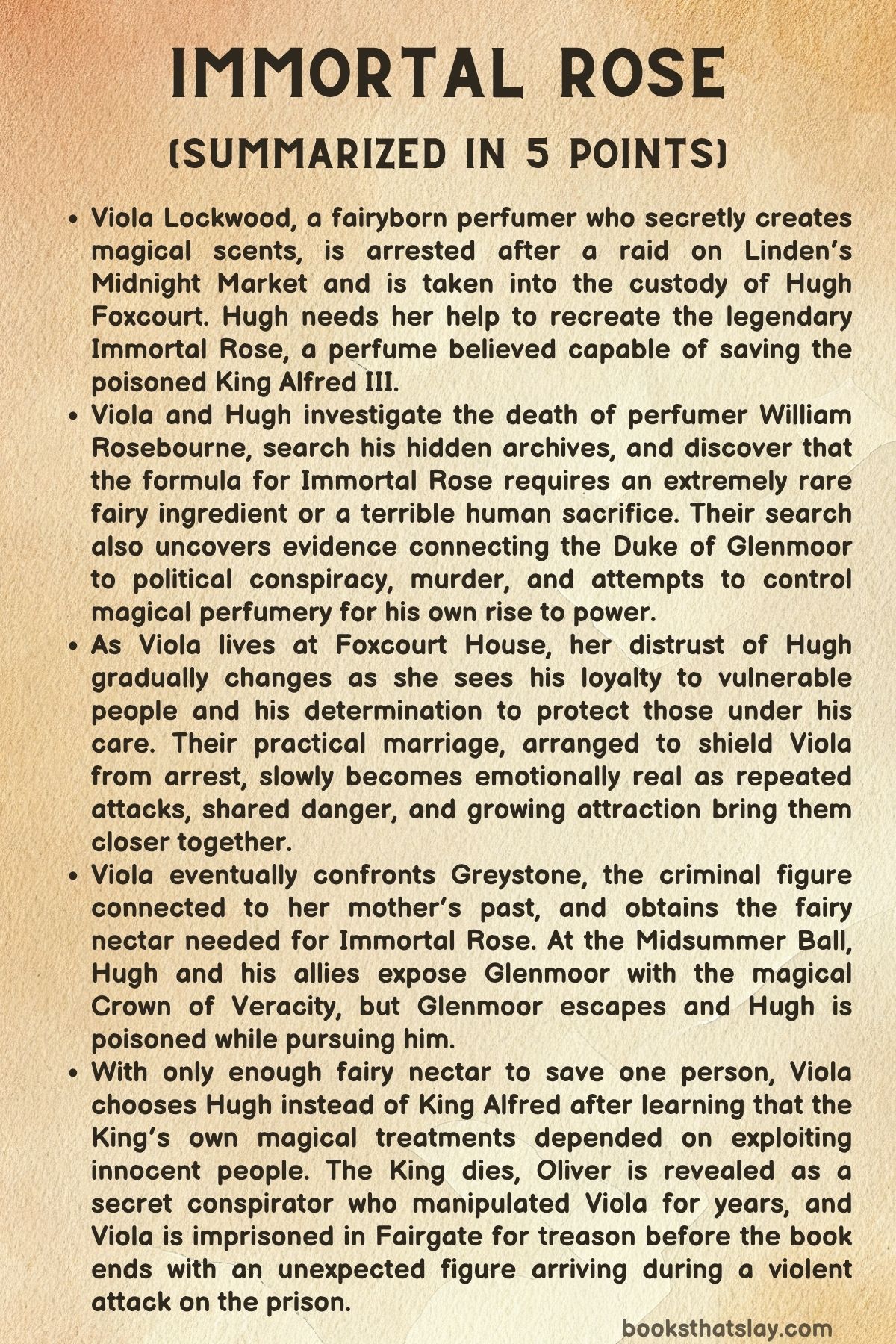
Immortal Rose begins with Hugh Foxcourt confronting the celebrated perfumer William Rosebourne about a secret magical perfume Hugh urgently needs. Rosebourne has been working on the commission but refuses to complete it without an exceptionally rare ingredient, while Hugh presses him because the matter involves far more than private aristocratic business.
Their conversation also reveals Hugh’s suspicion that his great-uncle Giles was murdered rather than dying by suicide. Moments after Rosebourne leaves, his carriage explodes, killing him and destroying Hugh’s best chance of obtaining the perfume he needs.
Elsewhere in Linden, Viola Lockwood sells illegal magical perfumes at the Midnight Market. Viola is fairyborn, giving her the ability to perceive emotional essences through scent and create enchanted perfumes, although every magical creation demands that she surrender something personal.
Viola is already preparing to flee because someone has been asking about a red-haired perfumer. Before she can escape, soldiers raid the market, and a strange silver-eyed man captures her after using enchanted perfume to render her unconscious.
Viola spends two dangerous days in Fairgate prison. Her friend Oliver attempts to help her, but Viola refuses to become dependent on him, and she faces growing danger from the abusive guard Branson.
The silver-eyed man eventually appears and reveals himself as Hugh, Earl of Foxcourt. He tells Viola that Rosebourne is dead and offers her freedom from Fairgate if she agrees to recreate the perfume Rosebourne had been making.
Viola accepts after negotiating conditions and is taken to Foxcourt House. There she encounters an unusual household made up of servants such as Mrs. Keyes, Felicity, Fleming, Mrs. Silver, and the Longmount brothers, many of whom seem to possess secrets of their own.
Hugh then brings Viola to the royal palace and reveals the true purpose of her commission. King Alfred III has been poisoned, and Hugh and Princess Eleanor believe the attack is part of a political conspiracy.
The only possible cure may be a legendary Rosebourne perfume called Immortal Rose. According to family history, the scent once restored a dying queen, but recreating such powerful magic could demand an enormous price from Viola.
Viola agrees after forcing the King to offer her financial and legal security connected to the Rosebourne inheritance. Her decision places her at the center of both the royal crisis and the struggle over her own family legacy.
Working with Hugh, Viola begins investigating Rosebourne’s records. Their search takes them to Rosebourne’s home, where an unknown intruder has already broken in looking for information.
Viola and Hugh eventually discover a hidden archive containing forbidden magical perfumes and the Rosebourne Treasury. Because the book is protected by fairy ink tied to Rosebourne blood, Viola can read it as the daughter of Lily Rosebourne.
The Treasury provides the formula for Immortal Rose, but the crucial ingredient is a fairy substance thought to have vanished. Worse, Viola learns that the perfume can alternatively be created through human sacrifice: one life can be exchanged to preserve another.
Hugh’s investigation meanwhile points toward the Duke of Glenmoor, his powerful relative and the current home secretary. Hugh believes Glenmoor was connected to Giles’s murder and may be working with foreign interests while maneuvering toward greater control of the kingdom.
Viola gradually discovers another side of Hugh. Beneath his harsh reputation, he repeatedly gives vulnerable people places in his household, rescues exploited children such as Theo, protects his servants, and treats people ignored by polite society as worthy of dignity.
Their partnership becomes increasingly personal. Hugh grows jealous of Oliver, while Viola begins noticing acts of tenderness that contradict Hugh’s insistence that he is dangerous, including his concern for her health and a simple gift of flowers that affects her deeply.
Danger intensifies when Viola’s rooms are searched and political accusations begin connecting her to the King’s poisoning. Hugh realizes his legal custody of Viola may no longer protect her from arrest.
His solution is extraordinary: he obtains a special marriage license. Becoming his wife would place Viola under the protection of his rank, making it much harder for the authorities to return her to Fairgate.
Viola agrees after negotiating for her independence, but their practical wedding becomes another assassination attempt. During the ceremony Viola is poisoned by a magical substance carrying the distinctive scent of licorice.
Hugh saves her by identifying and removing the source, cooling her body, and keeping her conscious while the poison burns through her. Viola survives, but the attack makes clear that the enemies surrounding them can reach even inside Foxcourt House.
A severed-hands threat sent afterward convinces Hugh that Glenmoor is responsible. Viola knows otherwise because the package reminds her of a darker figure from her childhood, but she initially keeps that knowledge to herself.
Her past is tied to Greystone, a feared criminal leader who once married her mother Lily. Lily had warned Viola that a dangerous man would come for her if her fairyborn identity became known.
Meanwhile, Viola receives confirmation that William Rosebourne recognized her as Lily’s natural-born daughter. Although she has not inherited the business outright, the acknowledgement strengthens her determination to claim her family legacy and eventually use its wealth to help abandoned women, children, and others society neglects.
Hugh’s political problems also worsen. Glenmoor gains King Alfred’s approval to marry Princess Eleanor, which would move him dangerously close to royal power and place Eleanor directly under his control.
When Viola is nearly kidnapped while investigating the Rosebourne estate, Hugh arrives and reacts with extreme violence against her attacker. His terror at losing her finally breaks through the emotional distance he has maintained, and he and Viola kiss.
The captured attacker is then deliberately killed by a policeman before he can reveal his employer. Viola is privately relieved because he appeared to know secrets concerning her identity.
Soon afterward, another assassin enters Viola’s bedroom. Mrs. Keyes helps stop him, revealing that members of Foxcourt House are connected to the Black Needle, a covert network whose members have carried out secret operations and protected one another for years.
Viola finally tells Hugh the truth about Greystone. Her mother had once married the criminal leader, and Viola suspects he may possess information about the fairy ingredient needed for Immortal Rose.
Rather than remain afraid, Viola decides to confront him. She and Hugh meet Greystone at Ardent’s, where he confirms he has access to the fairy nectar required for the cure.
Greystone demands a costly agreement in return. Although Hugh fears Viola is surrendering too much, she accepts terms because she believes obtaining the nectar is the only way to avoid sacrificing a human life.
The confrontation also forces Viola to discuss Lily’s death. Lily poisoned both herself and Greystone while trying to destroy the danger surrounding them, leaving Viola to survive the consequences alone.
Viola uses this history to challenge Hugh’s obsession with revenge against Glenmoor. She argues that self-destruction disguised as sacrifice can leave terrible damage behind for the people who remain.
As their emotional bond deepens, Viola refuses Hugh’s claim that he is fundamentally cruel or unworthy. She recognizes his capacity for violence while also seeing his loyalty, compassion, fear, and love.
The political investigation reveals that Glenmoor may be working with the DeForest family, former rivals of the Rosebournes. Controlling Rosebourne perfumery would allow Glenmoor to obtain a permanent supply of magical scents capable of manipulating people and strengthening his political influence.
At the Midsummer Ball, Viola and Hugh put their plan into motion. Viola discovers that Eleanor is already being abused and controlled by Glenmoor, increasing the urgency of removing him.
Glenmoor captures Viola and reveals that he anticipated Hugh’s actions. His ambitions extend beyond becoming regent: he intends to use magical perfumes created through human sacrifice to maintain his rule and power.
However, Viola’s apparent capture is partly accounted for within Hugh’s larger strategy. Members of the Foxcourt network infiltrate the palace while Glenmoor publicly presents himself as Eleanor’s protector and future husband.
Hugh secretly places the Crown of Veracity on Glenmoor. The magical object punishes him whenever he resists giving truthful answers.
Before the assembled court, Eleanor questions Glenmoor about his involvement in the King’s poisoning, Hugh’s family deaths, and betrayal of Albion. Glenmoor attempts to evade her questions but suffers increasing pain as the magical crown forces his deception into the open.
Realizing he has been trapped, Glenmoor escapes through the palace. Hugh pursues him through armed resistance, refusing to let the man responsible for so much suffering disappear again.
During the chase, Hugh is exposed to magical poison. Although he continues fighting for as long as possible, his body begins failing, and he eventually collapses.
Viola rushes Hugh back to Foxcourt House. At precisely that moment, Greystone’s promised package finally arrives with the fairy ingredients needed to create Immortal Rose.
The delivery contains only one drop of the crucial nectar. Viola therefore has enough to save either Hugh or King Alfred, but not both.
While struggling with the decision, Viola questions Vernon, the King’s valet. She discovers that Rosebourne’s supposedly restorative royal perfumes had themselves been created through exploitation.
The King’s rejuvenating perfume stole youth and vitality from other people, including Vernon. Glenmoor had manipulated Vernon by promising that the years taken from him might someday be restored.
The revelation changes Viola’s understanding of the conflict. The institutions she believed she was preserving have tolerated suffering whenever powerful people benefited from it.
Viola chooses Hugh.
She creates Immortal Rose specifically for him, combining the nectar with part of Hugh’s own essence so the perfume will recognize its intended recipient. The magic works, stabilizing his breathing and offering a real possibility of recovery.
Viola then travels to the palace because she still has unfinished business with the King. Instead of continuing the cycle of sacrificing others for Alfred’s survival, she allows his condition to take its natural course.
King Alfred dies while Viola is present. Because she brought perfume into his chamber and is standing beside him at the moment of death, she immediately appears responsible.
Viola flees the guards with Oliver following her. When he catches her, however, his reaction exposes the greatest betrayal in the story.
Oliver admits that he has known Viola was fairyborn since first meeting her. His kindness and friendship were partly a long-term effort to gain her trust and use her connection to Lily’s magical knowledge.
He was involved in the poisoning conspiracy and hoped to restore his own influence through magical perfumery. His confession reveals an entitlement Viola had never recognized beneath his supportive behavior.
Their confrontation becomes violent. Viola fights back with broken glass and magic, but palace guards eventually overwhelm and arrest her.
She awakens in Fairgate, in the same cell where her forced partnership with Hugh began. Accused of high treason, she expects execution and does not know whether Hugh survived.
Even then, Viola begins searching for possible tools or weaknesses that might help her escape. She has learned too much about survival to simply surrender.
Explosions and gunfire suddenly shake the prison. Someone is attacking Fairgate from outside.
A hooded figure approaches Viola’s cell carrying a lantern and finally reveals a familiar face. The book ends before the identity and purpose of the rescuer are fully explained, leaving Viola’s legal fate, Hugh’s recovery, Glenmoor’s escape, and the political future of Albion unresolved.
Characters
Viola Lockwood
Viola is the central character of Immortal Rose, and her development is shaped by the conflict between survival and self-determination. Years of hiding her fairyborn identity have trained her to expect exploitation whenever someone discovers what she can do.
Her perfumery makes that fear especially justified because every magical scent costs her something personal. Magic is therefore never simply a talent for Viola; it is a form of labor in which her body, memories, emotions, or identity can become part of the price.
At the beginning, Viola values independence so strongly that she often interprets dependence as danger. She resists Oliver’s help, distrusts Hugh’s generosity, and refuses to believe that Foxcourt House can become anything more than another temporary place controlled by someone else.
Her experiences gradually transform this position. Viola does not become passive or suddenly comfortable with authority; instead, she learns the difference between relationships based on possession and relationships built on mutual protection.
Her relationship with Lily strongly influences her behavior. Viola carries guilt over her mother’s death and fears that her fairyborn nature caused the tragedy, yet she eventually understands that Lily’s desperate decisions should not define the limits of her own future.
Her decision to confront Greystone marks a major change. The frightened child who once escaped him becomes an adult capable of negotiating directly with him without allowing him to determine her identity.
Viola’s final decision to save Hugh rather than King Alfred is equally important. She rejects the assumption that royal life automatically possesses greater moral value than the lives of ordinary people, particularly after learning that the King’s survival has repeatedly depended on exploiting others.
Hugh Foxcourt
Hugh is one of the most internally conflicted figures in Immortal Rose. He begins as Viola’s captor and appears cold, manipulative, and willing to use questionable methods when pursuing information.
His treatment of Fairgate, his interrogations, and his willingness to use magical truth techniques demonstrate that he is capable of brutality. Hugh rarely attempts to present himself as morally pure and often assumes that his capacity for violence makes him fundamentally unworthy of affection.
His household contradicts this self-image. Hugh repeatedly gives employment, safety, and dignity to people whom respectable society has exploited or discarded, including former criminals, abused individuals, vulnerable children, and people with unconventional histories.
His connection to Giles is central to his obsession with Glenmoor. Giles’s murder becomes a symbol of Hugh’s repeated belief that he always realizes the danger too late, leaving him trapped between grief and the desire to prevent another loss.
Viola becomes the person who most effectively challenges this mentality. Hugh initially views protecting her as part of his responsibility, but protection soon becomes emotional attachment, jealousy, romantic love, and fear of losing another person who matters to him.
His reaction to Viola’s kidnapping demonstrates the danger inside that devotion. Hugh can become terrifyingly violent when he believes she has been harmed, making his love both protective and potentially destructive.
The novel therefore treats Hugh not as a simple dark romantic hero but as someone continually deciding what kind of man he wishes to become. Viola’s refusal to reduce him either to his violence or his kindness gives their relationship much of its emotional force.
Oliver
Oliver occupies one of the most deceptive roles in Immortal Rose because his apparent identity and actual motives differ so dramatically. For much of the story, he seems to represent security, friendship, kindness, and the ordinary future Viola might have chosen.
He helps Viola after her imprisonment, assists with ingredients, restores Lily’s necklace, and repeatedly presents himself as someone who believes in her ability. Viola’s trust in him is therefore based on years of apparently supportive behavior rather than simple foolishness.
His eventual confession changes the meaning of those actions. Oliver recognized Viola’s fairyborn nature long before the main events and cultivated a relationship that would give him access to her talents and Rosebourne knowledge.
His betrayal is particularly damaging because he believes his years of attention should have earned Viola’s admiration and loyalty. His resentment exposes a possessive attitude hidden beneath his gentleness.
Oliver also acts as a contrast to Hugh. Hugh begins their relationship with Viola through coercion but gradually becomes more honest about his emotions and motives, while Oliver begins with apparent kindness and gradually reveals manipulation.
Duke of Glenmoor
Glenmoor functions as the principal political antagonist through most of Immortal Rose. His power comes not simply from cruelty but from his ability to operate inside respectable institutions while using family connections, government authority, magical resources, and social conventions for personal advancement.
His treatment of Hugh reflects a long history of control and psychological manipulation. He understands Hugh’s grief and anger well enough to provoke reactions that can make Hugh appear reckless or unstable.
Glenmoor’s attempted marriage to Eleanor is another expression of this desire for domination. The engagement would provide him with direct access to the royal succession while placing Eleanor under his personal authority.
His plans involving magical perfume reveal an even greater disregard for human life. He is willing to treat people as ingredients whose suffering can be converted into political strength or extended power.
The public confrontation at the Midsummer Ball is therefore significant because it reverses Glenmoor’s normal method of operating. Instead of controlling information privately, he is forced to answer questions before witnesses while magic makes concealment increasingly painful.
Princess Eleanor
Eleanor becomes one of the strongest political figures in Immortal Rose despite living in an environment where older men repeatedly attempt to control her choices. Her intelligence is evident from Viola’s earliest palace visit, when Eleanor skillfully manages the King’s temper and helps Viola secure acceptable terms.
She understands politics as a matter of language, presentation, timing, and strategic pressure. Unlike Hugh, whose anger can push him toward direct confrontation, Eleanor is capable of turning formal procedure into a weapon.
Her situation with Glenmoor also reveals her vulnerability. His planned marriage to her is not simply a political arrangement but a method of gaining personal and constitutional control over her.
When Eleanor publicly questions Glenmoor under the Crown of Veracity, she transforms herself from his intended possession into one of the people responsible for exposing him. The scene confirms that her strength comes from discipline rather than physical force.
William Rosebourne
William Rosebourne initially appears to be the lost expert whose death creates the central problem of the story. His reputation as a brilliant perfumer makes him seem like the guardian of rare knowledge Viola must recover.
Later revelations complicate that image severely. Rosebourne participated in creating perfumes whose benefits depended upon the stolen youth and vitality of other people.
His character therefore demonstrates that artistic brilliance and social respectability do not guarantee moral integrity. Viola must inherit his knowledge without reproducing the exploitation embedded within the system he helped sustain.
Lily Rosebourne
Lily exists largely through Viola’s memories, family history, and the consequences of her decisions. She was a gifted woman who understood both the possibilities and dangers associated with fairyborn magic.
Her relationship with Greystone becomes increasingly destructive as she recognizes the darkness developing around him. Her final attempt to poison both herself and Greystone is intended to protect Viola but leaves her daughter with lasting abandonment, guilt, and fear.
Viola eventually rejects the idea that Lily’s sacrifice should be idealized simply because it was motivated by love. She recognizes that desperate self-destruction can still harm the people left behind.
Greystone
Greystone represents Viola’s most personal source of fear. Unlike Glenmoor, whose threat develops through political events, Greystone belongs to the childhood history Viola has spent years trying to escape.
His connection to Lily and Linden’s criminal world makes him both emotionally dangerous and practically useful. He controls networks capable of obtaining materials unavailable through legal trade, including the fairy nectar Viola desperately needs.
Greystone’s negotiation with Viola is important because he no longer faces a powerless child. He recognizes her growing influence and treats her as someone capable of bargaining in her own right.
His position remains morally ambiguous rather than benevolent. He provides the nectar only for a price and continues to exert psychological pressure, yet his information about Glenmoor also helps Viola and Hugh understand the scale of the political threat.
Samir Reddy
Reddy is Hugh’s closest friend and one of the people most capable of challenging him without fear. His humor provides relief, but beneath it lies considerable loyalty, intelligence, and awareness of Hugh’s emotional habits.
He understands Hugh well enough to recognize his feelings for Viola before Hugh willingly acknowledges them. Reddy also acts as a moderating force when Hugh’s desire for revenge threatens to overwhelm strategic judgment.
His contacts with smugglers and Linden’s underground networks make him valuable to the investigation. At the same time, his relationship with Hugh shows that genuine friendship in the story depends upon disagreement as much as support.
Arabella
Arabella is one of Viola’s strongest links to the life she lived before Foxcourt House. Older, experienced, and skilled at theft, she has survived by understanding how dangerous Linden can be for women without social protection.
She provides Viola with both companionship and practical survival knowledge. Even when absent for long stretches, her influence remains visible whenever Viola refuses helplessness and begins looking for ways to escape a dangerous situation.
Felicity
Felicity initially seems like a cheerful maid, but her importance grows as Viola becomes more comfortable at Foxcourt House. Her friendliness offers Viola something different from political alliances or bargains: ordinary companionship.
Felicity also helps Viola prepare for aristocratic society and openly discusses her own complicated past. Her desire to write fiction gives her a life and ambition beyond domestic service, reinforcing the idea that the Foxcourt household allows people to construct identities beyond what society expects from them.
Mrs. Keyes
Mrs. Keyes initially appears mysterious because Viola detects blood within her essence. That impression encourages suspicion, but the truth reveals her as one of the household’s most capable protectors.
Her connection to the Black Needle explains her skill with weapons, secrecy, and danger. She also possesses strong compassion, particularly when caring for Viola after Fairgate and rejecting simplistic claims that suffering automatically improves people.
Mrs. Keyes embodies the hidden nature of Foxcourt House itself. Respectable surfaces conceal histories of violence, resistance, and survival.
Mrs. Silver
Mrs. Silver, the cook, similarly possesses an essence suggesting dangerous knowledge. Her association with nightshade hints that her past contains experiences far outside ordinary domestic service.
Like Mrs. Keyes, she contributes to the unusual community Hugh has gathered around him. Her presence reinforces Viola’s realization that Foxcourt House is not simply staffed by servants but inhabited by survivors who have found protection together.
Fleming
Fleming is part of the dependable structure surrounding Hugh. His service places him close to dangerous political events, and he himself becomes affected during the poisoning attack connected with Viola’s wedding.
His survival matters because the household treats injury to any member as significant. This contributes to Viola’s growing awareness that Foxcourt House functions more like a chosen family than a conventional aristocratic residence.
Willie and Thomas Longmount
The Longmount brothers are part of Hugh’s unusual network and initially appear as servants whose backgrounds are not immediately explained. Their later participation in covert operations demonstrates that their roles within the household extend far beyond domestic responsibilities.
Willie becomes especially important during the confrontation at Summerland Palace, where disguise and infiltration help undermine Glenmoor’s control. Their loyalty demonstrates the depth of preparation behind Hugh’s apparent eccentricities.
Theo
Theo is a vulnerable child Hugh brings into Foxcourt House after seeing the conditions in which he has been surviving. Hugh refuses to treat Theo’s exploitation as someone else’s problem and immediately provides him with safe employment.
Theo therefore serves a small but revealing role in Hugh’s characterization. His presence also supports Viola’s growing desire to use Rosebourne wealth to protect children and others abandoned by society.
Vernon
Vernon initially appears to be a loyal royal servant and useful witness in the investigation. His true history eventually reveals how deeply exploitation has shaped the monarchy’s use of magical perfume.
The King’s rejuvenation came partly from vitality stolen from Vernon and others. Glenmoor exploits Vernon’s bitterness by promising that what was taken might be returned, turning a victim of one powerful system into a participant in another conspiracy.
His character demonstrates how wrongdoing creates consequences that can spread far beyond the original perpetrators. Resentment does not excuse his actions, but understanding what happened to him changes the moral context surrounding the conspiracy.
King Alfred III
King Alfred is presented as physically weakened but still abrasive, entitled, and accustomed to authority. His illness creates the political crisis that drives much of the novel.
As the truth about his rejuvenating perfumes emerges, his status becomes morally complicated. Preserving his life has required costs borne by people with far less power.
Viola’s eventual refusal to save him is therefore not merely a romantic preference for Hugh. It represents her rejection of a system that repeatedly assumes ordinary people can be consumed in order to preserve rulers.
Giles Foxcourt
Giles, Hugh’s late great-uncle, influences the story despite dying before its main events. His murder becomes the foundation of Hugh’s investigation and his hatred of Glenmoor.
Giles also appears to have left clues connected to the conspiracy before his death. Hugh’s memories of him combine affection, mentorship, and guilt, explaining why solving his murder becomes almost inseparable from Hugh’s identity.
Branson
Branson represents institutional cruelty in its most direct form. As a Fairgate guard, he uses Viola’s imprisonment and social vulnerability as permission to threaten her sexually.
His behavior demonstrates why Viola fears dependence on systems supposedly designed to enforce law. Hugh’s immediate recognition of Branson’s intentions is one of the earliest moments suggesting that Hugh’s morality is more complicated than Viola first assumes.
Captain Carrington
Captain Carrington belongs to the illegal networks through which rare and magical goods circulate. His dealings with Reddy provide Viola with access to information conventional aristocratic channels cannot supply.
Although distrustful and difficult, Carrington represents the practical reality that banned knowledge and materials have not disappeared. They have simply been pushed into markets controlled by smugglers and criminals.
Hornsby
Hornsby represents the respectable legal resistance Viola encounters while claiming her Rosebourne heritage. He assumes her illegitimacy, gender, and social position will make her easy to dismiss.
Viola’s refusal to accept his condescension demonstrates her increasing confidence. Her confrontation with him transforms inheritance from a private family matter into a question of who has the right to control knowledge, wealth, and institutional power.
Brighten
Brighten appears during Viola’s attempt to escape after discovering Oliver’s betrayal. His use of magical command allows the guards to stop her physically when ordinary pursuit might have failed.
His brief role reinforces a central danger of magical power in the story. Enchantment can remove personal choice just as effectively as chains, law, or political authority.
Themes
The Cost of Power
Power in Immortal Rose is repeatedly shown as something purchased through another person’s loss. Magical perfumes provide the clearest example because powerful effects are never free: Viola must surrender something from herself, while other formulas use the vitality, youth, pain, or even life of unwilling victims.
The political system operates according to a similar principle. King Alfred’s continued vitality has depended on ordinary people paying costs he does not personally experience, and Glenmoor’s ambitions rely on treating human beings as material that can be converted into influence.
This creates a moral distinction between sacrifice freely chosen and sacrifice imposed by powerful people. Viola accepts personal costs when creating her own perfumes, but she becomes increasingly unwilling to accept systems in which someone else decides whose life, youth, or freedom can be spent.
Her final choice concerning the single drop of fairy nectar brings this theme into its sharpest form. Saving the King would preserve political continuity and strengthen Viola’s legal future, while saving Hugh prioritizes one individual who has become personally important to her.
The decision becomes morally significant after Viola discovers how often the monarchy has already justified exploitation in the name of preserving authority. She refuses to repeat that reasoning, even though doing so leaves her exposed to accusations of treason.
Identity, Inheritance, and Self-Definition
Viola’s struggle over the Rosebourne name is about much more than money. She has inherited magical ability, family history, trauma, forbidden knowledge, social stigma, and the consequences of choices made long before she could influence them.
For much of her life, those inherited circumstances determine how she sees herself. Being Lily’s daughter connects Viola to love and talent, but it also connects her to Greystone, secrecy, fear, and the belief that discovery inevitably leads to destruction.
The Rosebourne Treasury changes the meaning of inheritance. Viola becomes capable of accessing knowledge unavailable to outsiders because the book recognizes her blood, yet she quickly realizes that possessing family knowledge does not require preserving family morality.
William Rosebourne’s cruelty becomes essential to this distinction. Viola can inherit his techniques without defending his actions, just as she can love Lily without repeating Lily’s destructive final choice.
Her imagined future for the Rosebourne fortune demonstrates how thoroughly her understanding changes. Instead of treating inheritance as proof that she belongs among the elite, Viola wants to transform inherited privilege into resources for women, children, and other people whom existing institutions abandon.
Identity therefore becomes something she constructs through choices rather than something fully determined by blood. She can be fairyborn, Rosebourne, Hugh’s wife, Lily’s daughter, and still remain Viola on terms she chooses herself.
Love, Protection, and Possession
Romantic and familial relationships throughout the story repeatedly test the difference between protecting someone and controlling them. Hugh, Oliver, Greystone, Lily, and Glenmoor all claim or display forms of attachment, but the consequences vary depending on whether the other person’s autonomy is respected.
Hugh begins in a morally uncomfortable position because he arranges Viola’s arrest and then bargains for her cooperation. His later relationship with her develops only as he learns to recognize her decisions even when they frighten or anger him.
Their marriage makes this tension especially visible. Legally, becoming Hugh’s wife protects Viola because of the very social system that restricts women’s independence, yet Viola enters the arrangement only after negotiating conditions intended to preserve her freedom.
Oliver offers the opposite progression. He appears respectful and supportive for years, but his confession reveals that he expected his attention to produce emotional ownership over Viola.
His sense that she should recognize his supposed greatness turns affection into entitlement. What seemed like patience becomes manipulation once the assumptions beneath it are exposed.
Glenmoor represents the most extreme form of possession. His proposed marriage to Eleanor is designed to gain access to her political position while restricting her ability to resist him.
The story ultimately treats love as meaningful only when it allows the loved person to remain fully human and self-directed. Protection without respect can become another form of imprisonment.
Corruption Beneath Respectability
Immortal Rose repeatedly overturns the assumption that respectable institutions are morally superior to criminal or marginalized communities. Palaces, prisons, aristocratic houses, government offices, legal systems, and prestigious businesses often conceal violence more effectively than Linden’s openly dangerous streets.
Fairgate is one of the clearest examples. It officially represents law and order, yet Viola is threatened with sexual violence by a guard while imprisoned largely because of her social position and magical identity.
William Rosebourne provides another example. His reputation rests on artistry, refinement, and service to powerful clients, but his perfumes have been created through suffering that the people benefiting from them rarely see.
The monarchy itself becomes implicated once Viola discovers the cost of the King’s rejuvenation. Royal survival appears noble only while the victims supplying that survival remain invisible.
By contrast, Foxcourt House is filled with people respectable society might distrust: spies, former criminals, abused women, vulnerable children, servants with violent histories, and individuals connected to illegal networks. Yet it becomes the place where Viola experiences genuine loyalty and belonging.
Even Greystone’s criminal network occasionally provides truths and resources unavailable through official channels. This does not make Greystone virtuous, but it prevents the story from equating legality with morality.
Viola’s transformation depends on recognizing this distinction. By the end, she judges people and institutions according to what they actually do to human beings rather than according to title, wealth, law, or reputation.