Lilac by B.B. Reid Summary, Characters and Themes
Lilac by B.B. Reid is a contemporary rock-star romance centered on Braxton Fawn, an ambitious guitarist who is unexpectedly chosen to join the famous band Bound after the death of its guitarist, Calvin Everill.
What begins as a hostile professional arrangement gradually becomes a complicated emotional bond involving Braxton and the band’s three surviving members—Houston Morrow, Loren James, and Jericho “Rich” Noble. The novel combines music, fame, damaged friendships, religious shame, unconventional love, and the difficult work of rebuilding trust. Braxton’s arrival challenges not only Bound’s sound but also the rules each character has created to protect themselves from loss.
Summary
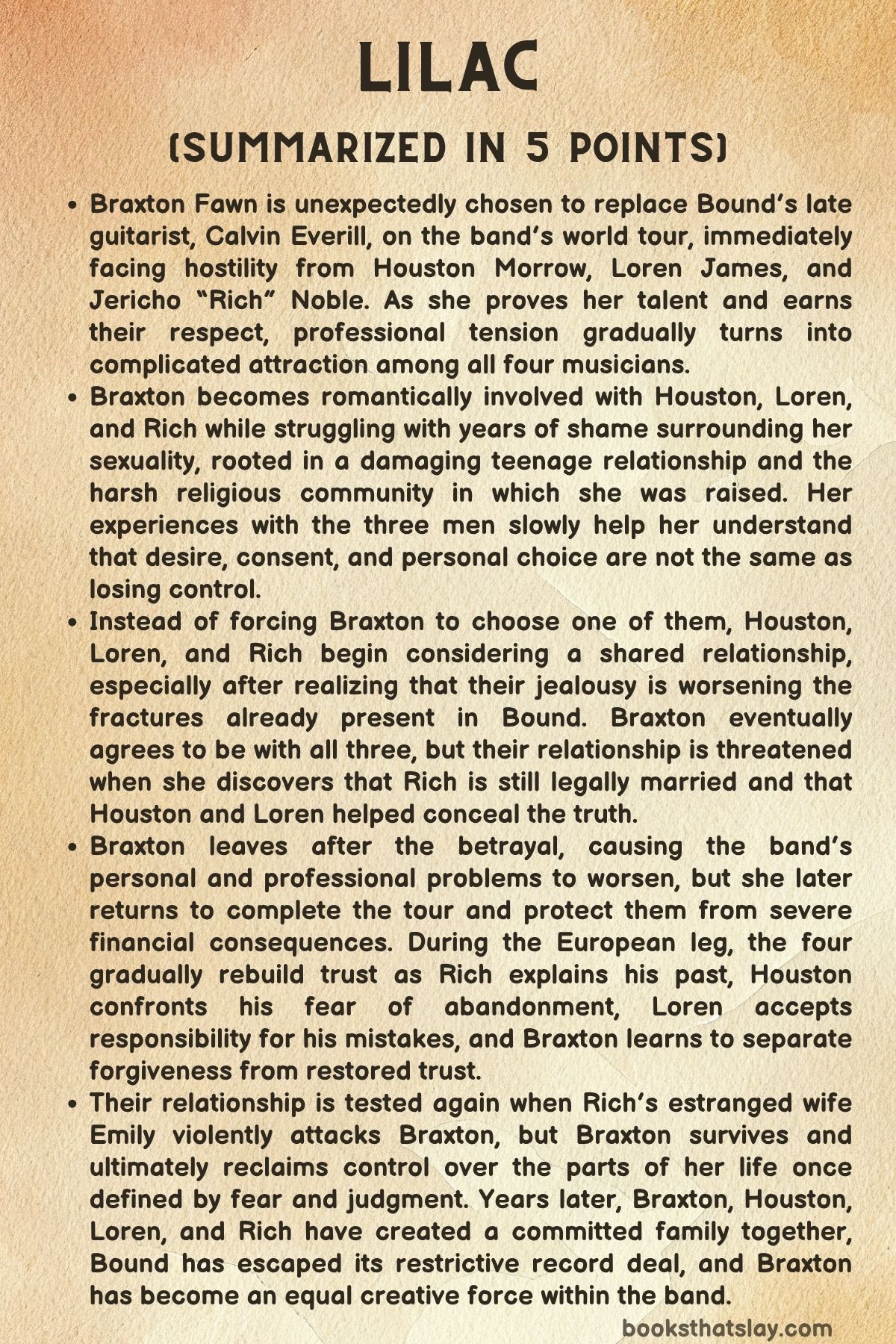
Three months after Bound guitarist Calvin Everill dies from a cocaine overdose, aspiring musician Braxton Fawn receives an opportunity she never expected: Savant Records wants her to accompany Bound on its world tour as Calvin’s replacement. Houston Morrow, Loren James, and Jericho “Rich” Noble immediately resist the decision, partly because Braxton is inexperienced at their level of fame and partly because the label has spent years interfering with the band’s affairs.
Braxton refuses to be intimidated by their hostility and proves that she knows Bound’s music well enough to challenge even Loren’s mistakes. Oni Sridhar, who originally discovered Bound, privately gives Braxton another task as well: she wants Braxton to understand what destroyed the once-close friendship among Houston, Loren, and Rich and somehow keep them together long enough to complete the tour.
When Bound unexpectedly appears at one of Braxton’s festival performances, she finally gets the opportunity to prove herself through music rather than argument. Her ability, stage presence, and individuality force the men to recognize that she is not simply a label-selected replacement, and Houston reluctantly begins rehearsing with her while pushing her through exhausting tests designed to determine whether she can handle the pressure of performing with Bound.
Braxton gradually earns their professional respect, but attraction complicates everything almost immediately. Loren openly pursues her, Rich develops a quieter emotional attachment, and Houston tries to suppress his desire by becoming increasingly controlling, even insisting that none of them should become involved with her.
Opening night proves that Braxton belongs onstage with Bound. Her guitar blends naturally with Rich’s drumming, Loren’s bass, and Houston’s vocals, and the audience accepts her, but the success also places the four musicians in constant proximity during the tour, making Houston’s attempt to separate professional and personal feelings increasingly unrealistic.
Loren is the first to pursue Braxton seriously, taking her out in Las Vegas and discovering that her reluctance toward sex comes from a deep fear of losing control. She believes she may be addicted to sex, although her behavior repeatedly shows that she can establish boundaries, refuse intimacy, and make deliberate choices; Loren begins questioning where this belief came from.
Houston eventually gives in to his attraction and kisses Braxton, prompting her to confess the shame she associates with sexuality. Instead of creating closeness, the confession causes Houston to move her onto a separate tour bus because he believes distance will protect the band, but Rich and Loren resent the decision and continue seeking Braxton’s company.
Braxton later sleeps with Houston and then becomes increasingly intimate with Rich, while Loren struggles with jealousy and his own fear that he is becoming unnecessary to the people he considers family. Rather than choosing one man, Braxton insists that none of them has the right to claim ownership over her, forcing Houston, Loren, and Rich to consider the possibility that their rivalry is based on assumptions they do not actually need to follow.
After Braxton temporarily withdraws from all three, the men begin reconnecting with each other and seriously discuss whether they could share a relationship with her rather than compete. A playful scavenger hunt through Central Park becomes a test of their cooperation, and Braxton eventually allows herself to consider a relationship involving all four of them.
The arrangement develops gradually rather than instantly. Houston learns to ask instead of command, Loren apologizes for the invasive and cruel behavior he used to disguise insecurity, and Rich offers Braxton emotional gentleness, while the men begin accepting that their own bonds with one another have always been more complicated than ordinary friendship.
Braxton eventually agrees to become their girlfriend collectively, and the foursome begins establishing rules based on exclusivity, consent, honesty, and equal emotional importance. Yet their new relationship contains a devastating hidden truth: Rich is legally married to a woman named Emily, and Houston and Loren both know about the marriage even though Braxton does not.
The tour is interrupted when Braxton’s younger sister Rosalie is hospitalized in Faithful, the strict religious community where Braxton grew up. Braxton returns home with the band and discovers thirteen-year-old Rosalie pregnant and married, forcing the men to see the environment that taught Braxton to associate female sexuality with disgrace and obedience.
Braxton finally tells them about Jacob Fried, the thirty-six-year-old musician who became her mentor when she was sixteen and later entered a sexual relationship with her. After Jacob disappeared, Braxton rebelled through relationships with boys from her religious community, only to be publicly humiliated by the church and condemned by her parents, experiences that led her to internalize the idea that her sexual desire represented addiction and moral failure.
Houston, Loren, and Rich reject the judgment Braxton has imposed on herself. Their acceptance helps her recognize that desire itself does not make her defective, and during a break at the band’s Portland home, she begins experiencing intimacy as something based on choice, safety, and mutual trust instead of punishment.
That progress collapses when Braxton discovers Rich’s divorce documents while he is sleepwalking. She learns that he is married to Emily and that Emily disappeared years earlier while pregnant, leaving Rich uncertain whether he might have a child; realizing Houston and Loren also knew about the marriage makes Braxton feel betrayed by all three men.
She leaves them, and the resulting crisis nearly destroys Bound again. Loren returns to his father, Rich becomes withdrawn, the tour is postponed, and Savant Records’ exploitative contract creates severe financial consequences that could keep the band trapped if the remaining performances are canceled.
Braxton agrees to return for the European leg because she refuses to let the men lose their financial future, but she separates forgiveness from trust. Rich eventually explains that his attachment to the possibility of Emily’s child came from his traumatic childhood in foster care and his desperate desire for a permanent family, while Houston and Loren acknowledge that concealing the truth was still a betrayal regardless of their intentions.
In Paris, the four begin rebuilding their relationship on greater honesty. Braxton makes Rich remain and repair the harm instead of disappearing, Houston finally tells her he loves her, Loren reconciles with Rich, and the men disclose painful parts of their histories they previously concealed.
Houston eventually reveals that he discovered his parents after they died by suicide when he was thirteen. His lifelong need to control the people he loves comes from his fear of sudden abandonment, and Braxton helps him understand that caring for others cannot mean making every decision for them.
Just when the foursome finally appears stable, Emily returns. She attacks Braxton outside Houston’s grandmother Laine’s home with a baseball bat, then confronts Houston, Loren, and Rich with a gun, reveals that she terminated the pregnancy years earlier, and shoots at Rich after admitting what she has done to Braxton.
Braxton survives severe head injuries but temporarily suffers memory problems and loses the unusual phantom tastes and smells through which she has always experienced emotions. Her mother explains that as a child Braxton repeatedly escaped to a field of lilacs whenever she became overwhelmed, and when Braxton smells one of the flowers in the hospital, memories of Houston, Loren, and Rich return.
She finally understands that lilac has become her internal association with love, safety, and home. After leaving the hospital, she reunites with Rich and learns that Emily’s shot missed him and that Loren subdued her until police arrived.
Braxton also confronts her mother about the religious control that damaged both her and Rosalie. She no longer allows her family or Faithful to dictate what kind of love, sexuality, or future she is permitted to choose.
Months later, Houston, Loren, and Rich take Braxton back to the church where she was once publicly shamed. By returning voluntarily with people she trusts, Braxton replaces the place’s old meaning of punishment with one based on agency, intimacy, and freedom, and when Rich asks whether she trusts them, she can finally answer without hesitation.
Four years later, Braxton, Houston, Loren, and Rich have created their own marriage ceremony and exchanged rings even though their four-person union lacks formal legal recognition. Their commitment includes the men’s devotion to one another as well as their love for Braxton, making their family a collective bond rather than three separate relationships centered only on her.
Rosalie has divorced Pete and begun college at Berkeley while raising her son Braxen, proving that the future Faithful tried to determine for her was not permanent. Griffin and Maeko are married, Bound has finally escaped Savant Records, and Braxton permanently shares the Portland home with Houston, Loren, Rich, and their young son Coda, whose biological father they deliberately do not identify because all three men consider themselves his fathers.
Rich has planted lilacs at their home, giving Braxton a lasting version of the refuge she lost as a child. Onstage at the Forum, she steps forward as Bound’s front person, completing her transformation from an unwanted temporary replacement into an equal creative partner whose music, love, and identity are defined on her own terms.
Characters
Braxton Fawn
Braxton is the emotional and narrative center of Lilac, beginning as an ambitious guitarist who wants professional recognition but carries years of shame about her sexuality and her ability to trust her own desires. Her refusal to submit to Bound’s intimidation establishes one of her defining qualities: she may doubt herself internally, but she is fiercely resistant when others attempt to decide her life for her.
Her musical talent also distinguishes her from the role everyone initially assigns her. She does not become valuable by imitating Calvin; she earns respect because she possesses her own instincts, sound, and stage identity.
Braxton’s greatest internal conflict concerns the belief that she is sexually addicted. She interprets desire as evidence that she is morally dangerous because her religious community taught her to distrust herself after an exploitative teenage relationship and publicly punished her for later rebellion.
Her relationships with Houston, Loren, and Rich gradually challenge that belief because she repeatedly demonstrates the ability to choose, refuse, negotiate, forgive, and establish boundaries. By the ending, Braxton’s growth is not simply that she accepts an unconventional relationship; she learns that agency, rather than conformity, determines whether her choices truly belong to her.
Her unusual experience of emotions through phantom tastes and smells reinforces her difficulty identifying feelings without external signs. Losing that ability after Emily’s attack initially frightens her, but discovering that lilac signifies love allows her to understand that emotional certainty can come from experience and trust rather than an involuntary sensory response.
Houston Morrow
Houston is Bound’s front man and the member most determined to control the band’s environment. In Lilac, his hostility toward Braxton initially appears arrogant and territorial, but the story gradually reveals that control is his primary defense against abandonment.
Houston is accustomed to making decisions for Loren and Rich because he believes leadership means protecting them from consequences they may not anticipate. That attitude may come from loyalty, but it repeatedly becomes domination, particularly when he tries to determine where Braxton lives, whom she can see, and what kind of relationship she should accept.
His history explains without excusing that behavior. Discovering his parents after their deaths when he was thirteen left Houston with a lasting fear that people can disappear without warning, and he consequently tries to prevent loss by controlling every variable around him.
Braxton forces him to recognize the difference between protection and possession. His development becomes visible through small changes, especially when he begins asking for affection instead of assuming access and when he supports Braxton’s request for distance despite wanting the opposite.
Houston eventually becomes capable of apologizing not merely for individual actions but for the entire pattern through which he has confused love with authority. His relationship with Braxton succeeds only when he accepts that loving her means respecting decisions he cannot make for her.
Loren James
Loren is charismatic, provocative, wealthy, insecure, and far more emotionally vulnerable than his public behavior suggests. Lilac initially presents him as the band member most willing to treat Braxton like entertainment, yet his teasing quickly becomes genuine fascination because she refuses to flatter him or surrender to his charm.
His flirtation often functions as emotional camouflage. Loren can speak openly about sex while avoiding direct conversations about fear, loyalty, rejection, and his uncertainty about whether Houston and Rich truly need him.
His relationship with his father, Orson, intensifies that insecurity. Loren has spent years choosing Bound over the powerful family he came from, so every conflict inside the band threatens the identity he built through that choice.
Loren also causes substantial harm. He intentionally provokes Braxton’s jealousy, invades her privacy, sabotages situations to keep her nearby, and participates in keeping Rich’s marriage secret; his later growth matters because he is eventually forced to acknowledge these actions rather than hiding behind charm.
His bond with Rich is especially important because it reveals that Loren’s emotional life has never fit conventional categories. Once he accepts his feelings for Braxton without treating Rich and Houston as competitors, he becomes part of rebuilding the intimacy among Bound’s original members.
Jericho “Rich” Noble
Rich appears at first to be the gentlest and most reasonable member of Bound, but Lilac gradually reveals that his quietness can become another method of avoidance. He understands Braxton’s feelings quickly and offers her patience when Houston pressures her and Loren provokes her, yet he withholds the truth that could most affect her choices.
His childhood in foster care left him intensely attached to the idea of creating a family that could not abandon him. That longing helps explain why his marriage to Emily carried such emotional weight even after the relationship itself became destructive.
Rich’s uncertainty about Emily’s pregnancy is therefore not merely a legal complication. The possibility that he might have a child activates his deepest need to become the stable parent he never had, leading him to imagine sacrificing his other relationships if necessary.
His greatest failure is allowing fear to justify secrecy. By deciding that Braxton would leave if she knew the truth, he denies her the very agency the foursome claims to value.
Rich develops when he accepts that rebuilding trust may be slow and painful and that he has no right to escape simply because facing Braxton’s disappointment hurts. His decision to stay, remain honest, and earn his place again transforms him from someone who avoids conflict into someone capable of enduring it for the people he loves.
Calvin Everill
Calvin is dead before the main action begins, yet his influence remains central to Lilac because his presence helped change the structure of Bound long before Braxton arrived. He was never part of the original friendship in the same way Houston, Loren, and Rich were, and his addition contributed to resentments and divisions that the surviving members never fully resolved.
His cocaine overdose leaves the band surrounded by grief, suspicion, guilt, and fear of self-destruction. The surviving members respond by creating rules around sobriety, but those rules cannot address the emotional damage beneath their behavior.
Calvin also becomes an unconscious standard against which Braxton is judged. Her eventual success comes from refusing to become another version of him and instead changing Bound through her own musicianship.
His affair with Emily reveals how deeply his presence became connected to Rich and Loren’s personal conflicts. Even after his death, the unresolved consequences of his choices continue affecting the people around him.
Oni Sridhar
Oni is one of the first people to recognize that Braxton can offer Bound something beyond technical guitar ability. She chooses Braxton partly because of talent and partly because Braxton’s presence temporarily unites Houston, Loren, and Rich against a common target.
That decision is ethically complicated because Oni places Braxton inside an emotionally unstable situation without fully preparing her. She effectively asks a young musician to help repair relationships damaged by fame, resentment, grief, and years of secrecy.
At the same time, Oni understands the band more clearly than most outsiders because she remembers who the men were before success changed them. Her faith in Braxton proves justified, even though the result becomes far more personal than she anticipated.
Xavier Gray
Xavier functions as a stabilizing professional presence around Bound. His loyalty to the group is personal as well as managerial because of their earlier role in protecting his son Raleigh from Savant Records.
He often notices problems before the musicians are prepared to admit them, particularly Rich’s exhaustion and Braxton’s anxiety. Unlike Carl, Xavier sees the members of Bound as people rather than merely financial assets.
His tense history with Oni also suggests that the adults managing the band carry unresolved conflicts of their own. Even so, Xavier consistently acts as someone trying to keep the musicians functioning without reducing them to products.
Griffin Sinclair
Griffin is one of Braxton’s closest friends and an essential link to the life she had before Bound. He offers support without treating her success as an excuse to surrender ordinary judgment, and he is immediately suspicious of the emotional power Houston and the others can exercise over her.
His willingness to confront Houston shows that fame does not impress him enough to silence his protective instincts. Griffin represents the kind of loyalty Braxton already possessed before entering the band’s world.
His later relationship with Maeko also mirrors the novel’s larger interest in allowing relationships to develop outside predetermined expectations. Their eventual marriage provides Braxton with another model of chosen stability.
Maeko
Maeko serves as another emotional anchor for Braxton throughout the upheaval created by joining Bound. She helps preserve Braxton’s connection to friendship, ordinary life, and people who knew her before she became publicly famous.
Her presence is particularly important during the European tour after Braxton’s breakup with the men. By traveling with Braxton, Maeko gives her enough security to return to professional obligations without becoming emotionally dependent on Houston, Loren, and Rich before trust has been repaired.
Her relationship with Griffin develops quietly beside the central romance. Their eventual marriage shows that the supporting characters also move toward lives created through choice rather than outside expectation.
Emily
Emily is initially an absent figure whose importance comes entirely through Rich’s secrecy. She eventually becomes one of the story’s most destructive characters because she represents the unresolved past everyone hoped could remain buried.
Her marriage to Rich is shaped by manipulation, infidelity, disappearance, and uncertainty about pregnancy. By refusing to clarify what happened to the child, she keeps Rich psychologically trapped for years even when the emotional relationship itself is over.
Her return exposes the danger of believing an unresolved problem has disappeared simply because no one is discussing it. Her attack on Braxton and armed confrontation with the men turn emotional deception into direct physical violence.
Emily also functions as a final test of Rich’s loyalties. When he tells her that what existed between them was not the love he once imagined, he formally rejects the past he had been unable to resolve.
Rosalie Fawn
Rosalie is Braxton’s younger sister and one of the clearest demonstrations of what Braxton fears Faithful can do to young women. Her pregnancy and marriage at thirteen show a community responding to a child’s situation by imposing an adult future instead of preserving her range of choices.
Braxton’s anger comes partly from guilt because she hoped her own rebellion would show Rosalie that another life was possible. Seeing Rosalie apparently accept marriage and motherhood makes Braxton feel that she failed to create an escape route for her.
The epilogue changes that interpretation. Rosalie eventually divorces Pete, attends Berkeley, raises her son, and retains her faith, demonstrating that rejecting the community’s control does not require rejecting every part of her identity.
Amelia Fawn
Amelia is Braxton’s mother and embodies the conflict between parental care and ideological control. She stays beside Braxton during her hospitalization and remembers details about her childhood sensory experiences, showing that her love for her daughter is real.
Yet Amelia also participates in the religious system that caused Braxton lasting psychological harm. She allowed Braxton’s public humiliation and later attempts to restrict access to Houston, Loren, and Rich while Braxton is hospitalized.
Her conflict with Braxton after the attack makes clear that affection does not automatically erase damage. Braxton can recognize that her mother cared for her while still rejecting Amelia’s belief that love gives parents the right to control their children’s adult choices.
David Fawn
David, Braxton’s father, represents a stricter and more openly judgmental side of her family environment. When Braxton first reveals the opportunity to tour with Bound, his instinct is to treat the contract as something from which she should be rescued rather than a career choice she has made.
His earlier destruction of the lilac field is also significant. He acts because he sees Braxton’s habit of disappearing there as dangerous, but the result is the removal of the one place where she felt naturally calm and secure.
David therefore reflects one of the story’s recurring problems: actions can be motivated by protection while still denying another person agency. Braxton’s adulthood requires separating her parents’ intentions from her right to determine what is best for herself.
Orson James
Orson is Loren’s estranged father and a source of both privilege and emotional pressure. He offers Loren wealth, professional status, and a future outside Bound, but the offer is designed to exploit Loren’s insecurity about whether Houston and Rich truly value him.
His influence helps explain Loren’s sensitivity to control. Although Loren resents Houston for behaving dictatorially, he has spent much of his life dealing with a father who also assumes authority gives him the right to determine Loren’s future.
Loren’s ultimate refusal to abandon Bound for Orson confirms where he believes his real family exists. His return is not simply a rejection of wealth but an affirmation that chosen loyalty matters more to him than inheritance.
Jacob Fried
Jacob occupies a relatively small amount of narrative space but has enormous influence on Braxton’s understanding of herself. As a thirty-six-year-old musician mentoring a sixteen-year-old Braxton, he holds an obvious imbalance of age, experience, and authority even though Braxton later insists she initiated the sexual relationship.
Braxton uses her own participation as evidence that she was entirely responsible. Houston, Loren, and Rich challenge that interpretation by recognizing how easily a teenager could confuse mentorship, admiration, emotional dependence, and sexual agency.
Jacob therefore represents the origin point of much of Braxton’s later shame. His disappearance leaves her to process an adult relationship without adult support, after which Faithful punishes her reactions instead of examining what happened to her.
Carl Cole
Carl represents the corporate power Savant Records holds over Bound. He recognizes Braxton’s usefulness early, but his interest is connected to the label’s ability to maintain leverage over the band.
The exploitative contract becomes especially important when Braxton leaves and the tour is postponed. Carl’s company can transform canceled performances into extended obligations and financial losses, revealing why Houston has spent years viewing every disruption as a threat to the band’s freedom.
Carl therefore embodies the business structure behind much of Bound’s pressure. The musicians may be famous, but fame does not automatically give them control over their careers.
Laine
Laine, Houston’s grandmother, provides a rare family relationship that is welcoming rather than controlling. Her acceptance of Braxton and the unconventional foursome contrasts sharply with the judgment Braxton experiences from her own parents and religious community.
Her home also becomes connected to the final crisis when Emily attacks Braxton nearby. Even after that violence, Laine remains part of the stable family environment the group constructs around itself.
Pete
Pete is Rosalie’s young husband and another child caught inside Faithful’s expectations. Although his marriage to Rosalie has enormous consequences, he is not presented with the same level of personal agency or malicious intent as the adults who normalize the situation.
His later divorce from Rosalie confirms that the arrangement was not an inevitable lifelong destiny. Through Pete and Rosalie, the story shows how institutions can place permanent expectations on people who are still far too young to understand what those expectations will require.
Danielle
Danielle is a smaller but revealing figure in Loren’s characterization. Loren’s support for her demonstrates that his selfish and provocative public behavior does not represent the whole of his personality.
His willingness to help her financially and treat her as someone he trusts exposes a quieter generosity. Danielle therefore helps establish that Loren’s capacity for loyalty exists long before he learns how to express it honestly with Braxton and the other members of Bound.
Themes
Agency, Sexuality, and the Rejection of Shame
Braxton’s central struggle concerns who has the authority to define her desires. Lilac repeatedly places her between people and institutions that claim to know what is best for her: her parents, Faithful, Houston, the music industry, and even Braxton herself when she repeats the judgment that she is sexually addicted.
Her childhood community teaches her that desire is evidence of moral failure, and the relationship with Jacob leaves her without a healthy framework for understanding consent, power, or adolescent vulnerability. When she later acts rebelliously, the church responds with public humiliation rather than compassion, encouraging her to interpret every strong sexual feeling as proof that something inside her is dangerous.
The relationships she develops on tour challenge this belief because her actual behavior contradicts the identity she has been given. She refuses Loren, chooses Houston, chooses Rich, withdraws from all three, returns on her own terms, and repeatedly renegotiates boundaries as her feelings change.
Her liberation therefore does not come from sexual experience itself. It comes from recognizing that healthy freedom includes the right to desire, refuse, reconsider, establish conditions, make mistakes, and still remain worthy of respect.
Returning to the church near the end completes this movement symbolically. A place that once taught Braxton she had no authority over her own identity becomes a place where she consciously chooses trust and defines love for herself.
Love Beyond Conventional Structures
The relationship among Braxton, Houston, Loren, and Rich develops only after they stop assuming that love must produce a single winner. Their early jealousy is based on possession: Houston expects exclusivity after sleeping with Braxton, Loren resents her intimacy with the others, and Rich fears being replaced.
Braxton challenges the premise behind those reactions by insisting that loving one person does not automatically erase her feelings for another. Once the men seriously consider sharing a relationship, the issue becomes less about sexual novelty and more about whether they can create an emotionally sustainable structure without reducing one another to rivals.
The novel also makes clear that the foursome is not simply three men independently attached to Braxton. Houston, Loren, and Rich have their own intense history, emotional dependence, and sexual connections, and accepting those bonds becomes essential to repairing Bound.
Their later commitment ceremony reinforces that idea. The men wear symbols of commitment to one another as well as to Braxton, rejecting a structure in which she functions as the sole center connecting otherwise separate relationships.
The story consequently presents permanence as something created through mutual agreement rather than guaranteed by legal or social convention. The relationship succeeds only when everyone involved accepts responsibility for communication, exclusivity, boundaries, and the continuing work of choosing one another.
Trust, Secrets, and the Cost of Protection
Nearly every major relationship is damaged when one character decides that hiding information will protect someone else. Rich conceals his marriage because he fears Braxton will leave if she learns about Emily and the possible child, while Houston and Loren support the secrecy because they believe they are protecting Rich.
Their reasoning contains genuine concern, but the result demonstrates why benevolent motives cannot substitute for consent. Braxton cannot make an informed choice about her future because the men remove information they know could affect that choice.
Houston repeatedly commits a similar error when he tries to control Braxton’s transportation, living arrangements, relationships, and safety. He often acts because he is afraid of losing her, yet his attempts to prevent danger create emotional distance and resentment.
The same pattern appears elsewhere in Lilac through parents, religious authorities, and even the record label. People repeatedly justify control by claiming they know what another person needs, but the story distinguishes genuine care from authority imposed without permission.
Rebuilding trust therefore requires more than forgiveness. After Braxton leaves, she admits that she still loves and even forgives the men, but she refuses to restore the relationship until they demonstrate that difficult truths will no longer be hidden from her.
Trust eventually returns because the four begin sharing the information that makes them most vulnerable. Their relationship becomes stronger not when danger disappears, but when they stop trying to protect one another through deception.
Chosen Family, Healing, and Home
Bound begins as a damaged version of a chosen family. Houston, Loren, and Rich once shared music, friendship, a home, and an unusually close emotional bond, but fame, Calvin’s presence, personal betrayals, and Houston’s controlling leadership leave that connection fractured.
Braxton initially appears to threaten what remains of their friendship. Ironically, her presence gradually forces the men to communicate again because their feelings for her expose resentments they had avoided for years.
The development of the foursome therefore runs alongside the restoration of the original trio. Loren and Rich confront their shared sexual history, Loren apologizes for interfering in Rich’s marriage, Houston admits that leadership became control, and the three rediscover the affection that existed before success turned every decision into a battle.
Braxton undergoes a parallel transformation in her understanding of family. Her biological family loves her but repeatedly places religious rules above her autonomy, while Griffin, Maeko, the band, Xavier, Oni, and Laine gradually form a network in which belonging depends on chosen loyalty rather than compulsory obedience.
The symbol of lilacs brings these ideas together. As a child, Braxton found peace in a field of flowers that her father later destroyed, but Rich eventually plants lilacs at the Portland home she shares with the men.
What was once a temporary hiding place becomes permanent. By the epilogue, home is no longer somewhere Braxton escapes to when overwhelmed; it is the life she has deliberately built with people who know her history, accept her choices, and continue choosing her in return.