The Crying Killer Summary, Characters and Themes
The Crying Killer by Jess Lourey is a psychological thriller that examines the lasting consequences of violence, family secrets, and traumatic memory.
Set primarily in Minnesota, the novel follows a private investigator whose carefully constructed life begins to unravel when a series of murders resembles the crimes that destroyed her family years earlier. As she investigates, her memories become increasingly unreliable, forcing her to question the circumstances of her sister’s death and the identity of the person pursuing her. Through a story filled with disturbing revelations and complicated relationships, Lourey explores how childhood experiences can shape adulthood and how confronting the truth can become essential to survival.
Summary
In June 1986, eighteen-year-old Tuesday Hendrickson, her younger sister Trixie, and their closest friend Nicholas Gajdusek are preparing to leave Lilydale, Minnesota. Trixie has recently given birth to a daughter named Julia, and the three friends intend to raise the baby together while keeping her existence secret from her dangerous father.
The sisters have already exchanged identities at the hospital, allowing medical staff to believe that Tuesday gave birth. Their deception is intended to protect Trixie and Julia from Arsen Bauer, Trixie’s abusive former boyfriend, who knows nothing about the pregnancy.
Their escape plans collapse when Arsen arrives at the family trailer during the night. Gunfire erupts, Trixie is apparently murdered, and the police discover a badly disfigured corpse identified as Arsen, although Tuesday notices that the dead man’s hands look nothing like his.
Nearly nine years later, Tuesday lives in Saint Paul with eight-year-old Julia, whom she raises as her own daughter. She has built a life around protecting the child, surrounding their home with security measures and carefully monitoring everyone who enters Julia’s world.
Tuesday shares her home with Nicolette, formerly Nicholas, whose friendship has survived their troubled childhood and years of separation. Their relationship provides emotional support, although unresolved questions about the past continue to complicate their connection.
Tuesday works as a private investigator for Cornell Stamoran, a retired detective who recognizes her professional abilities. She previously served as a police officer, but a psychological crisis following a disturbing domestic violence investigation forced her to leave the department.
Her difficulties are closely connected to Trixie’s murder. Tuesday experiences nightmares, frightening memories, and repeated episodes in which she mistakes strangers for Arsen, despite the official conclusion that he died in the trailer shooting.
She manages her distress through medication, mixed martial arts, and Alcoholics Anonymous meetings. Nevertheless, she conceals many of her experiences from her doctor, fearing that admitting the full extent of her difficulties could result in hospitalization or separation from Julia.
Her fragile stability is threatened when she believes she sees Arsen entering a coffee shop. Although she eventually dismisses the sighting, another development intensifies her fears: Corn has arranged for her photograph to appear in a professional magazine, making her whereabouts discoverable to anyone familiar with her past.
Meanwhile, Corn assigns Tuesday to investigate Melissa Hachette, a young woman who claims someone is stalking her. The police have dismissed Melissa’s concerns, but Tuesday takes the complaint seriously because she understands the danger of overlooking threatening behavior.
Tuesday also secretly patrols areas near bars, intervening when she believes women are being threatened by men. These activities began after she witnessed a suspicious confrontation several years earlier, and they temporarily relieve her guilt over being unable to save Trixie.
During one nighttime patrol, Tuesday follows a suspicious man into an alley. When she hears a scream and returns toward a nearby bar, she discovers a murdered woman whose body has been deliberately arranged in an X.
The victim resembles Trixie, making the discovery particularly disturbing. Tuesday recognizes the positioning as the signature of the Crying Killer, a serial murderer who stabbed women and subsequently telephoned authorities or radio stations with emotional confessions.
The original victims included Mary Lenzen, Patricia Olson, Sylvia Schwab, and Brenda Checkers. Although Arsen was believed responsible for their murders, Tuesday has always questioned whether the man killed at the trailer was actually him.
Her doubts are strengthened when another woman, Hannah Wheaton, survives a brutal assault. Hannah has an X carved into her back, a detail that resembles the scar Arsen inflicted on Trixie during their abusive relationship.
Tuesday visits Hannah in the hospital and learns that the attacker approached from behind before fleeing when passersby interrupted the assault. Their conversation provides little identifying evidence, but the wound convinces Tuesday that the recent attacks are connected to the original murders.
Detective Tayari Smith subsequently approaches Tuesday about the investigation. Smith is interested in her connection to the Crying Killer and repeatedly asks about Nicholas Gajdusek, but Tuesday conceals her continuing relationship with Nic because she fears exposing another closely guarded family secret.
As Tuesday investigates, memories of her childhood reveal how thoroughly violence shaped her family. Her father, Daryl Hendrickson, frequently abused their mother Pia, while the sisters learned to recognize his moods and protect themselves from his unpredictable behavior.
Daryl could occasionally be affectionate, making his cruelty especially confusing for his daughters. Trixie continued seeking his approval, while Tuesday became increasingly determined to protect her sister from both their father and other dangerous men.
Trixie’s relationship with Arsen repeated many of these destructive patterns. Arsen was possessive, physically violent, and fascinated by Charles Manson, eventually carving an X into Trixie’s back as a disturbing expression of ownership.
Tuesday remembers an important telephone conversation from the night Julia was born. She confronted Arsen about his treatment of Trixie, but Julia cried in the background, alerting him to the existence of a baby who might be his daughter.
Arsen arrived at the trailer shortly afterward. Tuesday believes her decision to challenge him caused Trixie’s death, and this conviction has governed her life ever since.
The investigation becomes increasingly personal as Tuesday encounters suspicious strangers, receives an intimidating book associated with Arsen, and discovers information suggesting that another murder occurred after his supposed death. She also learns from Arsen’s sister Elizabeth that he inflicted similar scars on other women, including Elizabeth herself.
An intrusive man named Jackson Lightman repeatedly approaches Tuesday at Alcoholics Anonymous meetings and eventually admits leaving the threatening book in her mailbox. However, his involvement does not explain the murders, and investigators discover that he has an alibi for the more serious crimes.
Tuesday receives another mysterious telephone call from someone claiming to be Margot Andrews, an old schoolmate who possesses information about Trixie. She arranges to meet the caller at an airport hotel, but nobody appears.
The encounter proves particularly unsettling because the caller knows private details about Tuesday’s adolescence. When Tuesday later visits Margot’s family, she discovers that the real Margot is serving in the military overseas and never arranged the meeting.
Meanwhile, Tuesday’s relationships deteriorate under the pressure of her fears. She quarrels with Corn, becomes suspicious of Nic’s unexplained absences, and struggles to maintain a normal relationship with Julia, whose growing awareness of her mother’s anxiety threatens the childhood Tuesday wants to provide.
The danger escalates when Tuesday discovers gummy bears pinned to a photograph taken outside the apartment of her former police partner, Shawn. The colors correspond to the preferences of Tuesday, Trixie, and Nicholas during their adolescence, suggesting that the stalker possesses intimate knowledge of their childhood friendship.
Tuesday initially believes Julia has disappeared, but finds her sleeping beside her bed. Detective Smith then arrives with devastating news: Corn has been murdered, apparently by someone imitating the Crying Killer.
Corn’s death destroys one of Tuesday’s strongest sources of emotional security. While organizing his belongings, she later discovers that he left his investigation agency to her and arranged for Julia to inherit the building, ensuring their financial stability.
Further discoveries begin to transform the investigation. Tuesday learns that Melissa was paid to fabricate her stalking complaint and impersonate Margot, confirming that someone has been deliberately manipulating her movements and fears.
Smith also discovers evidence suggesting that the corpse buried as Arsen was incorrectly identified. Investigators arrange to exhume the remains, and dental records establish that the dead man possessed teeth Arsen had already had removed.
The revelation confirms Tuesday’s longstanding belief that Arsen escaped the trailer shooting. However, Smith raises another possibility: the unidentified corpse may belong to Nicholas, whose whereabouts have never been satisfactorily established.
Tuesday insists that Nicholas survived and now lives with her as Nicolette. When she attempts to prove this by showing Smith Nic’s bedroom, however, the room is completely empty, containing no evidence that another person has been living there.
The discovery devastates Tuesday and forces her to reconsider the experiences she has treated as unquestionable reality. Smith encourages her to follow her prescribed treatment and promises to help protect Julia.
Another revelation follows when investigators exhume the body buried as Trixie. Although the medical records initially appear consistent with the deceased sister’s identity, examination establishes that the woman in the grave had never been pregnant.
Tuesday cannot reconcile this information with her memories of Julia’s birth. Her confusion deepens until the person responsible for the recent violence finally enters her bedroom.
The intruder is not Arsen but Daryl Hendrickson, her father. He addresses her as Trixie, exposing the central deception of her adult life: the woman who has called herself Tuesday is actually Trixie, who survived the trailer shooting.
The real Tuesday died protecting Julia, while Nicholas was also killed. Terrified that she and her newborn daughter would enter foster care, Trixie assumed her dead sister’s identity, taking advantage of the names they had already exchanged at the hospital.
Her subsequent life as Tuesday Kenn was built upon this deception. The identity allowed her to remain with Julia, pursue educational opportunities, and escape the circumstances of her childhood, but it also required her to suppress the truth about the people she lost.
Daryl reveals that he was the original Crying Killer. Arsen had falsely claimed responsibility for the murders, and after the trailer shooting he escaped by dressing Nicholas’s corpse in his own clothing and leaving his identification behind.
Daryl subsequently tracked Arsen to Florida and murdered him. Years later, he recognized Trixie in the magazine article featuring Tuesday Kenn and began orchestrating the recent killings, harassment, and staged encounters.
His intention is to murder Trixie, make her death appear to be suicide, and take Julia away. He believes he can finally establish the obedient family he has always demanded.
Daryl approaches with a straight razor, attempting to intimidate his daughter through the familiar whistling associated with his earlier violence. Although Trixie initially becomes immobilized by fear, she thinks of Julia, retrieves a concealed revolver, and shoots him.
Police officers immediately enter the bedroom. The confrontation was part of a protective plan arranged with Smith, who secretly moved Julia to a safe house while an officer impersonated the child to convince the intruder she remained at home.
Daryl’s death ends the immediate threat, but Trixie must still confront the losses and psychological consequences that have shaped her adult life. Smith comforts her as she finally allows herself to grieve without attempting to control every feeling.
By February, Trixie continues living as Tuesday Kenn and has reopened Corn’s investigation agency. She is receiving regular treatment for post-traumatic stress disorder and complicated grief, while Julia remains unaware of the family’s original identities.
At the cemetery, Tuesday visits the graves of Corn and her sister, whose headstone still bears Trixie’s name. She also senses Nic beside her, although the novel finally confirms that Nicholas died in 1986 and that Nicolette’s adult companionship existed within Tuesday’s mind.
The imagined friendship helped her survive the emotional consequences of losing Nicholas and her sister. As Tuesday leaves the cemetery with Julia, she begins accepting that the past will remain part of her identity without determining every aspect of their future.
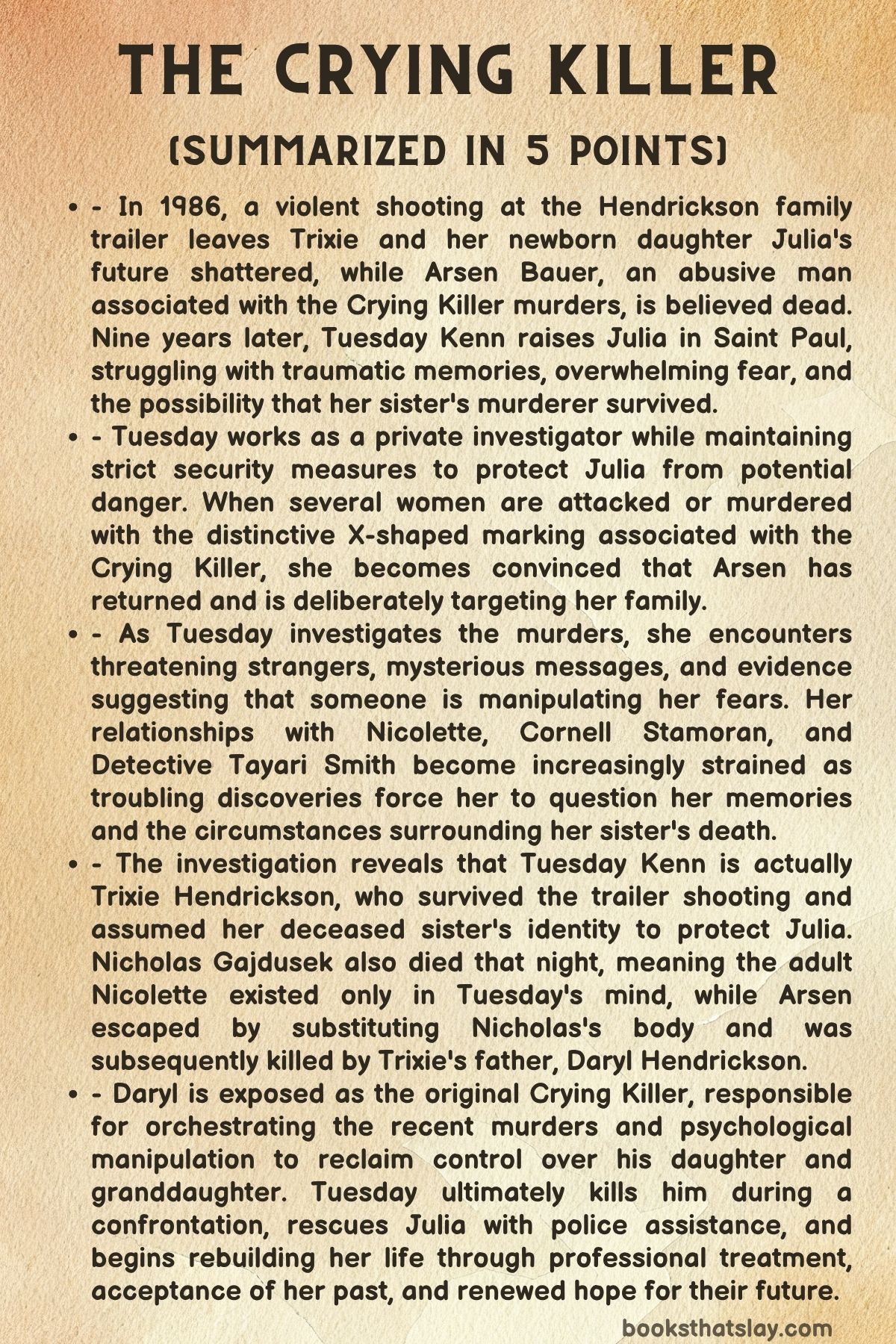
Characters
Trixie Hendrickson / Tuesday Kenn
Trixie Hendrickson, who assumes her deceased sister’s identity and becomes Tuesday Kenn, is the central character of The Crying Killer. Her experiences demonstrate how childhood trauma, survivor’s guilt, and the desperate need for security can reshape a person’s understanding of herself.
Growing up in an abusive household, Trixie learns to associate love with unpredictability and control. Her father’s occasional affection makes it difficult for her to recognize the full extent of his cruelty, leaving her particularly vulnerable to Arsen Bauer’s possessive behavior.
Her relationship with Arsen initially offers the security and affection she has been denied at home. However, his violence gradually destroys her independence, culminating in the X-shaped scar he carves into her body.
Following the trailer shooting, Trixie makes the extraordinary decision to assume Tuesday’s identity. Her fear of losing Julia motivates the deception, but maintaining it also allows her to distance herself from the traumatic circumstances of her previous life.
As Tuesday Kenn, she becomes fiercely independent, professionally capable, and intensely protective of her daughter. Her investigative skills, martial arts training, and elaborate security precautions demonstrate both her resourcefulness and her inability to feel safe.
Her relationship with Julia provides her life with meaning, yet her determination to prevent another tragedy sometimes becomes overwhelming. She struggles to distinguish reasonable parental concern from the fear generated by her childhood experiences.
Her imagined friendship with Nicolette reveals another dimension of her psychological distress. Rather than accepting Nicholas’s death, she continues experiencing his presence as a source of reassurance, preserving a connection to the childhood she lost.
The discovery of her true identity forces her to reconsider nearly every assumption she has made about herself. Her eventual confrontation with Daryl marks a decisive moment because she acts against the person whose violence originally taught her to feel powerless.
By the novel’s conclusion, she begins accepting professional treatment and emotional support without treating them as threats to her independence. Her development reflects a movement from survival through secrecy toward a life in which she can acknowledge her past without surrendering her future to it.
Tuesday Hendrickson
The original Tuesday Hendrickson is one of the most consequential characters in The Crying Killer, despite dying before the events of the principal timeline. Her personality and actions continue influencing the surviving characters long after her death.
As the older Hendrickson sister, Tuesday assumes responsibilities that should have belonged to her parents. She protects Trixie from their father, recognizes the dangers of her sister’s relationship with Arsen, and repeatedly attempts to create opportunities for them to escape Lilydale.
Tuesday possesses considerable intelligence and determination. Her ambitions extend beyond their impoverished circumstances, and she hopes that education will provide her with the independence necessary to improve her life.
Her protective instincts are demonstrated through incidents such as rescuing Trixie from a creek and preventing their father from taking her away. These experiences establish her role as the person Trixie trusts when their family becomes dangerous.
However, Tuesday is not simply defined by her responsibilities. Her friendship with Nicholas, occasional disagreements with Trixie, and dreams of a different future reveal an adolescent who wants the freedom to develop an identity beyond the demands of her family.
Her death while protecting Julia represents the ultimate expression of her devotion. By assuming Tuesday’s identity, Trixie preserves her sister’s name and ambitions, although the deception also prevents her from fully acknowledging the loss.
The original Tuesday therefore remains central to the novel’s examination of sacrifice, sisterhood, and the lasting influence of people who are no longer alive.
Nicholas Gajdusek / Nicolette
Nicholas Gajdusek occupies a distinctive position in The Crying Killer because the novel presents both the real childhood friend and the adult Nicolette whom the protagonist believes is living with her.
As a teenager, Nicholas belongs to the close friendship shared with the Hendrickson sisters. Their collective identity as the Three Musketeers reflects the affection and solidarity they establish while navigating difficult family circumstances.
Nicholas is imaginative, generous, and interested in performing magic. The character’s dream of becoming a magician represents a desire for independence and the possibility of creating a life beyond Lilydale.
Nicholas also struggles with gender expectations and dreams of living more openly as a woman. The sisters offer support, demonstrating that their friendship provides an environment in which personal identity can be discussed without the hostility encountered elsewhere.
The revelation that Nicholas died during the trailer shooting fundamentally changes the meaning of Nicolette’s adult presence. The protagonist has continued experiencing her friend as an independent person despite the absence of a living companion.
Nicolette’s apparent maturity, confidence, and fulfilling career reflect the possibilities Nicholas hoped to achieve. Through this imagined continuation, the protagonist preserves both a cherished relationship and an unrealized future.
Nic frequently challenges Tuesday’s excessive vigilance and urges her to seek treatment. These interactions reveal how the protagonist uses the imagined friendship to express competing thoughts about her own behavior.
The distinction between Nicholas’s genuine adolescent identity and Nicolette’s imagined adult existence is essential. His gender identity is an authentic part of his characterization, while the protagonist’s perception that he survived represents her difficulty accepting his death.
Ultimately, Nic symbolizes the comfort of remembered love and the painful necessity of acknowledging loss.
Daryl Hendrickson
Daryl Hendrickson is the principal antagonist of The Crying Killer, and his actions connect the murders, family violence, and psychological suffering that define the narrative. His revelation as the original serial murderer establishes that the danger threatening his daughter has its origins in the household where she grew up.
Daryl is abusive, manipulative, and determined to exercise authority over his family. He uses physical violence, intimidation, and emotional cruelty to maintain control while presenting obedience as an essential expression of family loyalty.
His occasional affectionate behavior complicates his daughters’ understanding of him. By alternating cruelty with generosity, he creates confusion about the meaning of love and encourages them to seek his approval.
Daryl’s influence extends into his daughters’ adult lives through the fear and self-blame he instills. His familiar whistling becomes particularly significant because it can trigger intense memories of childhood violence.
His crimes against women also reveal how he transforms resentment into a justification for brutality. He directs hostility toward women who remind him of his mother, demonstrating his determination to punish others for grievances rooted in his own past.
After recognizing Trixie under her sister’s name, Daryl orchestrates a campaign of manipulation intended to destabilize her. He manufactures threatening encounters, exploits private information, and commits murders to create the impression that Arsen has returned.
His ultimate objective is to claim Julia and establish the obedient family he imagines he deserves. This desire exposes the central contradiction in his understanding of family: he claims to value belonging while destroying the autonomy and security of those closest to him.
Daryl’s death ends the immediate threat, but it does not erase the consequences of his actions. His influence persists through the psychological injuries his daughter must continue addressing.
Julia Hendrickson / Julia Kenn
Julia is the emotional center of The Crying Killer, representing both the future the protagonist hopes to preserve and the family connection that makes her vulnerable to renewed danger. Although she is Trixie and Arsen’s biological daughter, she grows up believing that Tuesday Kenn is her mother.
Julia is intelligent, affectionate, and increasingly independent. Her enthusiasm for school, friendships, mathematics, and ordinary childhood activities provides moments of warmth amid the violence surrounding her family.
Her relationship with her mother is loving but complicated by the extraordinary precautions governing her daily life. Julia gradually recognizes that Tuesday worries more intensely than other parents, although she does not understand the experiences responsible for this behavior.
Julia’s growing independence challenges Tuesday’s belief that protection requires constant supervision. Activities such as visiting the mall and spending time with friends become important tests of whether her mother can allow her to develop a life beyond the family home.
Her attachment to Corn also demonstrates the significance of the extended family surrounding her. His murder introduces Julia to grief, while his inheritance ensures that his affection continues providing for her future.
Julia’s compassion becomes especially evident when she comforts Tuesday after the discovery of Corn’s will. Their interaction demonstrates that emotional support within the family is not exclusively the responsibility of the parent.
Although Julia remains unaware of her biological family’s original identities, the novel establishes that her relationship with Tuesday is founded upon genuine love. Her future represents the possibility of interrupting the destructive patterns that shaped earlier generations.
Arsen Bauer
Arsen Bauer initially appears to be the principal threat against Tuesday and Julia. His abusive relationship with Trixie and apparent involvement in the original serial murders make him the central figure in the protagonist’s understanding of her past.
Arsen is arrogant, possessive, and attracted to displays of power. His fascination with Charles Manson and his practice of carving X-shaped marks into women reveal a disturbing desire to establish ownership through violence.
His relationship with Trixie demonstrates how manipulation can be presented as devotion. He promises permanence and loyalty while progressively restricting her independence and frightening her into submission.
Arsen’s treatment of his younger sister Elizabeth establishes that his cruelty is not confined to romantic relationships. Both women bear physical evidence of his violence, indicating a repeated pattern of domination.
Although his own father was abusive, the novel does not present Arsen’s upbringing as an excuse for his actions. Elizabeth’s account emphasizes that he repeatedly chose to harm others.
The revelation that Arsen was not the original Crying Killer changes his role in the larger mystery without diminishing his responsibility for abusing Trixie. His false claims about the murders and his escape from the trailer contributed directly to the confusion surrounding the case.
Arsen also represents the danger of mistaking outward confidence and possessiveness for genuine love. His relationship with Trixie demonstrates how familiar patterns of violence can become difficult to recognize when they are disguised as affection.
Pia Hendrickson
Pia Hendrickson is the mother of Tuesday and Trixie, whose life reflects the devastating consequences of domestic violence, poverty, and psychological illness. Her characterization is deliberately more complicated than that of a parent who simply fails to protect her children.
During the sisters’ early childhood, Pia displays considerable warmth and creativity. She makes fashionable clothing, takes pride in her appearance, and occasionally creates happy experiences despite the family’s limited resources.
Her outing with the girls to Lake Koronis demonstrates that affection and joy exist within their troubled household. These memories remain important because they prevent her daughters from understanding their mother exclusively through her later difficulties.
Nevertheless, Pia repeatedly fails to challenge Daryl’s violence. Her insistence that injuries resulted from accidents reveals the fear, shame, and resignation governing her relationship with him.
Her psychiatric illness eventually requires permanent institutional care. Tuesday’s anxiety about developing a similar condition reflects how deeply her mother’s experiences influence her own fears.
Pia also possesses fragments of information about the families connected to the original murders. Her recollections of Aramis Bauer, Donny McDowell, and Daryl suggest that the violence threatening her daughters originated within a wider network of disturbing relationships.
Her confusion between Tuesday and Trixie gains additional significance after the identity revelation. What initially appears to be another symptom of her illness becomes connected to the truth her surviving daughter has concealed.
Pia represents a woman whose ability to protect herself and her children has been severely compromised, but whose capacity for love remains visible beneath the consequences of her suffering.
Cornell Stamoran
Cornell Stamoran, generally called Corn, is Tuesday’s employer, mentor, and one of the most important sources of stability in her adult life. As a retired detective, he recognizes her investigative abilities and helps her establish a career after she leaves the police department.
Corn treats Tuesday with respect and professional confidence. His decision to nominate her for recognition demonstrates his belief in her capabilities, although the resulting publicity unintentionally exposes her location to Daryl.
His relationship with Julia extends beyond ordinary childcare arrangements. He becomes a trusted family figure who provides patience, affection, and practical assistance.
Corn also recognizes Tuesday’s psychological difficulties and encourages her to seek support. Their disagreements arise because his concern sometimes conflicts with her determination to manage every problem independently.
His murder represents an especially painful loss because he embodies the dependable care missing from Tuesday’s childhood.
The discovery of his will reveals the depth of his commitment. By leaving his agency to Tuesday and arranging for Julia to inherit the building, Corn provides practical security for the people he loves.
Corn’s legacy demonstrates that meaningful family relationships can develop through sustained kindness rather than biological connection.
Detective Tayari Smith
Detective Tayari Smith is the investigator whose involvement gradually transforms Tuesday’s relationship with the police. Initially, Smith approaches her cautiously because she recognizes both the importance of Tuesday’s personal knowledge and the possibility that traumatic memories are influencing her conclusions.
Smith is observant, methodical, and unwilling to accept assumptions without supporting evidence. Her questions about Julia’s parentage and Nicholas’s whereabouts reveal her determination to investigate the case beyond its most obvious explanations.
Although Tuesday initially interprets Smith’s scrutiny as threatening, their relationship develops through repeated demonstrations of professional responsibility. Smith arranges protection, examines physical evidence, and eventually authorizes further investigation of the original murders.
Her willingness to reconsider Arsen’s supposed death becomes particularly important. Rather than dismissing Tuesday permanently because of her psychiatric history, she recognizes that some of her suspicions may be supported by evidence.
Smith also demonstrates compassion without abandoning her investigative responsibilities. She encourages Tuesday to follow medical advice and remains with her during moments of considerable distress.
Their cooperation during the final confrontation demonstrates the importance of combining personal knowledge with professional assistance. Smith’s continued involvement suggests that Tuesday can develop relationships based on trust without surrendering her independence.
Coretta
Coretta is the elderly owner of the Victorian house where Tuesday and Julia live. Her stern personality and religious beliefs coexist with considerable generosity, making her an essential member of their unconventional family.
She provides affordable accommodation and cares for Julia while Tuesday attends college, works, or participates in recovery meetings. These practical contributions help Tuesday establish the stability she has struggled to achieve.
Coretta also recognizes Tuesday’s problematic relationship with alcohol and encourages her to attend Alcoholics Anonymous. Her intervention demonstrates that she is willing to confront difficult circumstances rather than simply offer reassurance.
Her occasional sleepwalking and complaints about strange noises contribute to the uncertainty surrounding the house. The references to her troubled son also complicate Tuesday’s attempts to determine whether someone is entering the property.
Despite these unsettling details, Coretta consistently provides care. Her relationship with the family demonstrates the importance of dependable community support in overcoming isolation.
Shawn
Shawn is Tuesday’s former police partner and occasional romantic companion. His familiarity with her professional history gives him insight into the psychological crisis that ended her police career.
Their relationship combines physical attraction with emotional distance. Tuesday seeks his company when she wants temporary relief from fear, but she resists the vulnerability associated with a committed partnership.
Shawn respects certain personal boundaries and demonstrates attentiveness during their private encounters. These qualities allow Tuesday to experience moments of relaxation that are otherwise difficult for her to achieve.
However, their connection also reveals the limitations of intimacy without emotional openness. Tuesday can accept physical companionship while continuing to conceal the circumstances causing her greatest distress.
Shawn’s assistance with information about Hannah Wheaton further complicates their relationship by connecting his professional responsibilities with his personal concern for Tuesday.
Hannah Wheaton
Hannah Wheaton survives an attack that bears the distinctive X-shaped marking associated with the original murders. Her survival provides Tuesday with important evidence that the recent violence involves more than an isolated killing.
Hannah is frightened and physically injured when Tuesday visits her in the hospital. Her reluctance to discuss the attack demonstrates the vulnerability experienced by people who have recently survived violence.
Although she cannot identify her assailant, she provides essential information about the circumstances of the assault. Her testimony helps establish a connection between the new crimes and the earlier murders.
Tuesday’s interactions with Hannah also reveal her developing understanding of support. Rather than concentrating exclusively on investigative information, she encourages Hannah to accept assistance from others.
Hannah therefore functions both as a witness and as a reflection of the emotional challenges Tuesday has experienced herself.
Melissa Hachette
Melissa Hachette initially appears to be a young woman whose stalking complaint has been dismissed by the police. Her apparent vulnerability immediately attracts Tuesday’s professional concern.
Melissa describes suspicious surveillance and threatening telephone calls, presenting herself as someone who needs protection. Tuesday accepts the investigation because her own experiences have made her particularly sensitive to the danger of overlooking such complaints.
The revelation that Melissa was paid to fabricate the stalking transforms her role in the novel. She becomes part of Daryl’s campaign to manipulate Tuesday’s fears and movements.
Melissa also impersonates Margot Andrews, exploiting an intimate detail from Tuesday’s adolescence. Her deception demonstrates how easily personal information can be used to manufacture convincing threats.
Her willingness to participate for money contrasts sharply with the experiences of the women who genuinely suffer violence. Through Melissa, the novel examines the consequences of exploiting another person’s vulnerability for personal gain.
Jackson Lightman
Jackson Lightman is the intrusive Alcoholics Anonymous member who repeatedly approaches Tuesday despite her refusal to engage with him. His persistence makes her uncomfortable in a setting where she expects support and emotional security.
Jackson eventually admits placing a copy of Helter Skelter in her mailbox. Although the action is threatening, investigators establish that he has an alibi for the recent murders.
His involvement demonstrates how Daryl manipulates other people to create misleading evidence. By paying Jackson to intimidate Tuesday, the real killer provides investigators with a plausible suspect while continuing his own activities.
Jackson also contributes to the novel’s examination of personal boundaries. His refusal to accept rejection becomes another example of a man treating a woman’s wishes as less important than his own desires.
Elizabeth Bauer
Elizabeth Bauer, known as Liz, is Arsen’s younger sister. Her testimony provides Tuesday with important information about the violence that shaped the Bauer household.
Liz reveals that Arsen carved an X into her body when she was sixteen. This discovery establishes that his abusive behavior existed beyond his relationship with Trixie.
Her account of their father’s cruelty and their mother’s failure to intervene reveals a family environment defined by intimidation. Nevertheless, Liz refuses to treat Arsen’s upbringing as sufficient justification for his actions.
She also challenges Tuesday’s tendency to imagine Arsen as an unusually powerful criminal. By describing him as an entitled man who repeatedly chose violence, Liz places his behavior within the recognizable patterns of abuse rather than treating him as an extraordinary figure.
Her characterization offers an alternative response to childhood suffering: she recognizes the harm inflicted upon her without accepting the inevitability of repeating it.
Dr. Simpson
Dr. Simpson is Tuesday’s psychiatrist, who begins treating her after the psychological crisis that ends her police career. His role establishes the medical context surrounding her difficulties with perception, memory, and emotional regulation.
He prescribes medication and recommends regular therapy, but Tuesday attends only the sessions initially required of her. Her reluctance to disclose her experiences prevents him from obtaining a complete understanding of her condition.
During a later appointment, she conceals important symptoms because she fears hospitalization and separation from Julia. Her behavior demonstrates how fear can interfere with a patient’s willingness to participate openly in treatment.
Dr. Simpson’s role is therefore significant less because of any deliberate failure on his part than because Tuesday’s secrecy limits the assistance she can receive.
The eventual changes to her treatment demonstrate the importance of establishing a more honest relationship with medical professionals.
Aramis Bauer
Aramis Bauer is Arsen and Elizabeth’s father and a former police chief whose reputation is associated with troubling events in Lilydale. His abusive behavior establishes another example of family violence continuing across generations.
His connections with Daryl Hendrickson and Donny McDowell suggest that the town’s history contains secrets extending beyond the crimes initially investigated.
Aramis also represents the contradiction between public authority and private misconduct. His former position in law enforcement does not prevent him from creating a dangerous environment within his own household.
Although he remains a secondary character, his influence helps explain the conditions surrounding Arsen’s childhood.
Donny McDowell
Donny McDowell is associated with Aramis Bauer and Daryl Hendrickson through disturbing recollections about their activities. References to him introduce the possibility that several adults in Lilydale participated in or knew about events the younger characters never fully understood.
His involvement remains insufficiently explained in the supplied account to establish a precise role in the crimes. Nevertheless, his connection to the other men contributes to the atmosphere of secrecy surrounding the families.
Donny’s presence suggests that the dangers threatening the children cannot be understood exclusively through their immediate domestic relationships.
Margot Andrews
Margot Andrews is a former schoolmate whose name becomes important when Tuesday receives a mysterious telephone call. Their shared adolescent history includes a brief romantic encounter that Tuesday remembers with some embarrassment.
The caller claims to possess information about Trixie and arranges a meeting at an airport hotel. Tuesday’s willingness to attend demonstrates how strongly her desire for answers influences her decisions.
The real Margot, however, is serving in the military overseas and has not contacted Tuesday. Her identity has been appropriated as part of Daryl’s effort to manipulate the protagonist.
Margot’s role illustrates how private memories can be transformed into instruments of intimidation when they become accessible to someone intent on causing harm.
Bob Andrews
Bob Andrews is Margot’s father, whose conversation with Tuesday establishes that the mysterious telephone call was fraudulent. His information confirms that Margot is stationed in Germany rather than working as a flight attendant.
Although his appearance is brief, Bob provides an important factual correction at a time when Tuesday is uncertain about her own judgment.
His testimony demonstrates the value of independent evidence in distinguishing genuine events from deliberate deception.
Mr. Abrams
Mr. Abrams is Julia’s new teacher, whom Tuesday initially mistakes for Arsen Bauer. His appearance and distinctive posture trigger her memories of the man who abused Trixie.
The misunderstanding causes Tuesday to behave alarmingly at Julia’s school, embarrassing her daughter and attracting the attention of the principal.
Mr. Abrams subsequently asks Julia about her mother because he believes he recognizes her. This interaction reinforces Tuesday’s concern about strangers acquiring personal information.
His character demonstrates how traumatic associations can affect the interpretation of ordinary encounters, even when the person involved has done nothing threatening.
Sarah and Ethan Lennox
Sarah is Julia’s school friend, whose companionship represents the ordinary childhood experiences Tuesday wants her daughter to enjoy. Their planned visit to the Mall of America becomes an important test of Tuesday’s willingness to permit independence.
Ethan Lennox, Sarah’s father, appears as a responsible adult entrusted with Julia’s care. Tuesday’s decision to record his license plate demonstrates that even an ordinary arrangement requires considerable emotional effort.
Together, Sarah and Ethan represent the social world beyond Tuesday’s immediate control. Their presence emphasizes the distinction between protecting a child and preventing that child from developing independent relationships.
Mary Lenzen, Patricia Olson, Sylvia Schwab, and Brenda Checkers
Mary Lenzen, Patricia Olson, Sylvia Schwab, and Brenda Checkers are the women murdered during the original Crying Killer investigation. Their deaths establish the pattern that later becomes central to Tuesday’s attempts to identify the murderer.
The victims differ in their personal circumstances, but their murders share distinctive features, including deliberate positioning and the killer’s subsequent emotional telephone confessions.
Their characterization is primarily established through the records and recollections surrounding their deaths. Nevertheless, the novel repeatedly contrasts the reality of their suffering with the public fascination generated by the killer’s apparent remorse.
Their presence emphasizes that the murderer’s emotional performances cannot diminish his responsibility for the women whose lives he destroyed.
Mark Clamchik
Mark Clamchik is a younger acquaintance of Arsen who appears during the teenagers’ gathering at the Hendrickson trailer. His casual joking about Arsen’s father provokes a disproportionately threatening response.
Although Mark has a limited role, the encounter reveals Arsen’s sensitivity to challenges involving his family and reputation.
Mark’s presence also establishes the social environment surrounding the teenagers, where apparently ordinary gatherings can quickly become threatening because of Arsen’s unpredictable behavior.
Themes
The Lasting Consequences of Trauma
Traumatic experiences influence nearly every aspect of the protagonist’s adult life. In The Crying Killer, childhood violence does not remain confined to memory but continues affecting her relationships, professional decisions, and understanding of ordinary events.
Tuesday’s upbringing teaches her that danger can emerge without warning, particularly from people who claim to love her. Her father’s unpredictable behavior establishes patterns of fear that persist long after she leaves the family home.
The trailer shooting intensifies these experiences by connecting love with catastrophic loss. Tuesday’s inability to save her sister becomes a source of guilt that influences her determination to protect Julia from every possible threat.
Her security precautions demonstrate the practical consequences of this fear. Although cameras, alarms, and careful monitoring provide some protection, they cannot eliminate the memories responsible for her distress.
The novel also examines how traumatic experiences can affect the reliability of memory and perception. Tuesday repeatedly mistakes strangers for people associated with her past, while her understanding of the trailer shooting conceals the truth about her own identity.
The imagined companionship of Nicolette represents another consequence of unresolved grief. By continuing to experience Nicholas as alive, Tuesday preserves a relationship that provides comfort while preventing her from fully acknowledging his death.
Importantly, her psychological difficulties do not mean that every suspicion is incorrect. Daryl deliberately exploits her history, creating genuine threats that resemble the experiences she has learned to question.
This distinction complicates the relationship between trauma and reality. Tuesday must recognize that her perceptions can sometimes be misleading without concluding that she is incapable of identifying actual danger.
Her eventual treatment represents a meaningful change because she begins addressing the consequences of violence rather than attempting to control them exclusively through vigilance.
Recovery does not require forgetting the past. Instead, the novel presents healing as the gradual development of an ability to remember painful experiences without allowing them to govern every aspect of the present.
Family Violence and the Cycle of Abuse
The destructive relationships within the Hendrickson and Bauer households reveal how violence can shape successive generations. In The Crying Killer, abusive behavior becomes particularly dangerous when it is presented as love, loyalty, or an unavoidable part of family life.
Daryl establishes this pattern through his treatment of Pia and their daughters. His occasional tenderness complicates the family’s understanding of his cruelty, encouraging the children to interpret affection and intimidation as inseparable aspects of the same relationship.
Pia’s reluctance to report his violence demonstrates the pressures that can prevent victims from seeking protection. Poverty, fear of public judgment, and uncertainty about receiving help contribute to her continued exposure to abuse.
These circumstances influence Trixie’s relationship with Arsen. Having grown up with a father who alternates affection and hostility, she becomes vulnerable to a boyfriend who presents possessiveness as proof of devotion.
Arsen’s insistence that loved ones must never leave him reflects a desire for ownership rather than mutual commitment. His physical violence and the scar he inflicts on Trixie expose the cruelty beneath his declarations of loyalty.
The Bauer family’s history demonstrates a similar pattern. Arsen and Elizabeth experience abuse from their father, while their mother repeatedly fails to protect them.
However, Elizabeth’s refusal to excuse Arsen’s behavior challenges the idea that abusive childhood experiences inevitably produce abusive adults. Her perspective distinguishes the circumstances that shape a person’s behavior from the responsibility that person retains for subsequent actions.
Daryl’s plan to claim Julia represents another attempt to continue the cycle. He imagines that obtaining control of his granddaughter will allow him to create the obedient family his earlier violence destroyed.
The protagonist’s resistance interrupts this pattern. By confronting Daryl and preserving Julia’s safety, she rejects the idea that biological relationships require submission to harmful authority.
The novel consequently distinguishes family loyalty from unquestioning obedience. Genuine care depends upon protection, respect, and the freedom to develop independently rather than the power to determine another person’s life.
Motherhood, Protection, and Personal Sacrifice
Motherhood provides the protagonist with her strongest motivation while exposing the difficulties created by her unresolved fears. Her relationship with Julia demonstrates how the desire to protect a child can become complicated when a parent has experienced severe violence.
The original Tuesday sacrifices her life while protecting Julia during the trailer shooting. Trixie’s subsequent decision to assume her sister’s identity represents another extraordinary act intended to preserve the child’s future.
Although the deception creates considerable psychological and practical difficulties, it allows Trixie to remain with her daughter. Her determination to prevent their separation becomes the foundation of her adult identity.
However, the novel does not present protection as an uncomplicated expression of love. Tuesday’s constant vigilance gradually interferes with Julia’s ability to experience ordinary childhood independence.
Her reluctance to permit outings, friendships, and school activities reveals the conflict between immediate safety and long-term development. Julia needs protection from genuine danger, but she also needs opportunities to establish confidence and relationships beyond her mother.
The story repeatedly returns to this conflict through ordinary domestic experiences. Preparing breakfast, helping with homework, and discussing school provide glimpses of the stable family life Tuesday wants to create.
Her anxiety sometimes prevents her from enjoying these moments. Julia eventually recognizes her mother’s unusual behavior and begins wondering whether something about her makes constant concern necessary.
Corn’s death creates another challenge because Tuesday initially attempts to protect Julia from grief by concealing what happened. She eventually recognizes that withholding difficult truths cannot prevent her daughter from experiencing loss.
Their conversation about Corn demonstrates a more constructive form of protection. Tuesday begins acknowledging painful realities while offering reassurance and emotional support.
The final confrontation further develops this understanding. By cooperating with Smith and placing Julia in a safe house, Tuesday accepts that protecting her daughter does not require confronting every danger alone.
Motherhood ultimately becomes a source of both responsibility and personal growth. Tuesday’s development suggests that loving a child means creating conditions in which that child can eventually live without constant fear.
Identity, Secrecy, and the Possibility of Healing
The identities people construct for themselves are central to the novel’s examination of memory, survival, and personal change. Tuesday’s assumed identity initially protects her from circumstances she believes would otherwise destroy her relationship with Julia.
After the trailer shooting, Trixie adopts her sister’s name because she fears entering foster care with her newborn daughter. The decision provides immediate security, but maintaining the deception requires her to suppress essential truths about her past.
Her new identity also allows her to pursue opportunities that seemed unavailable during her childhood. By becoming Tuesday Kenn, she establishes a professional life and creates an environment in which Julia can grow up.
Nevertheless, the concealment carries considerable emotional consequences. The protagonist cannot fully acknowledge her sister’s death without confronting the circumstances surrounding her own survival.
Her imagined relationship with Nicolette extends this pattern. Rather than accepting the loss of Nicholas, she experiences an adult version of her friend who appears to have achieved the future he once imagined.
The novel distinguishes this imagined continuation from Nicholas’s genuine desire to express his gender identity. His adolescent hopes belong to his authentic characterization, while the belief that he survived reflects the protagonist’s unresolved grief.
Daryl exploits the secrecy surrounding the family by using information Tuesday has concealed. His ability to manipulate her depends partly upon her unwillingness to explain her experiences openly to those who might help.
Detective Smith’s involvement gradually challenges this isolation. As Tuesday reveals more of her history, she gains access to evidence and assistance that would have been difficult to obtain independently.
The identity revelation also changes her understanding of responsibility. Recognizing that she is Trixie forces her to reconsider the guilt she has carried for the deaths of her sister and Nicholas.
Her decision to continue living as Tuesday Kenn demonstrates that confronting the truth does not necessarily require abandoning every part of the identity developed through survival. The name has become associated with her work, motherhood, and relationships, even though its origins remain painful.
By the conclusion, she begins receiving regular treatment and accepting support from others. Her progress suggests that recovery depends less upon recovering an entirely unchanged original self than upon developing a more truthful and compassionate relationship with the person she has become.
The novel ends with the possibility of a future in which memory and identity can coexist without requiring continued self-punishment. Tuesday cannot restore the people she has lost, but she can honor their importance while allowing herself and Julia to build lives beyond the circumstances of their deaths.