Fury in Death Summary, Characters and Themes
Fury in Death by J.D. Robb is a futuristic crime novel centered on Lieutenant Eve Dallas as she investigates a series of extraordinarily violent murders linked to a powerful corporation and a tragedy buried for thirteen years.
The case gradually reveals the story of scientist Steven Redman, whose humanitarian climate technology was targeted for weaponization by people willing to kill to protect their ambitions. The novel places Eve between two forms of wrongdoing: the institutional corruption of the powerful and the personal vengeance of a man whose family was deliberately destroyed. At its center are questions about justice, grief, scientific responsibility, family, and the limits of revenge. It’s the 63rd book in the In Death series.
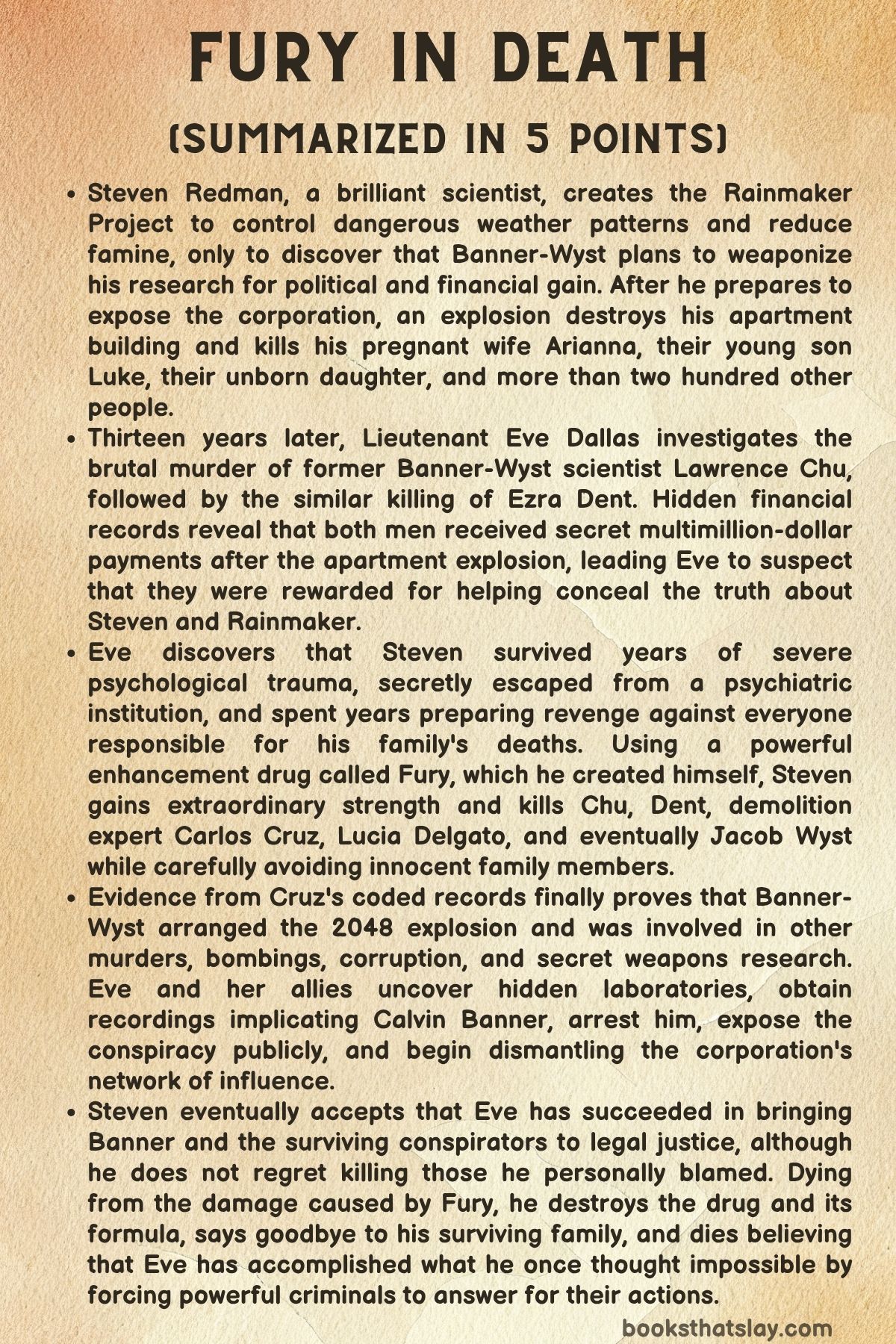
Summary
In 2048, scientist Steven Redman appears to have everything he once dreamed of possessing. He is married to Arianna, is the father of two-year-old Luke, is expecting another child, and has become the youngest director at the powerful Banner-Wyst corporation because of his revolutionary work on the Rainmaker Project.
Rainmaker is intended to regulate weather patterns, control droughts and floods, improve agriculture, and reduce hunger. Steven discovers, however, that senior people within Banner-Wyst intend to transform the technology into a weapon capable of creating environmental disasters, destabilizing entire regions, and allowing the corporation to profit from the destruction it secretly caused.
Steven decides to expose what is happening and prepares evidence for the FBI. He also places a safeguard inside Rainmaker so that anyone trying to access the research without his cooperation will destroy the usable data, then confides in his wife and his trusted colleague Lawrence Chu.
One evening, Steven briefly leaves his apartment to get ice cream for Arianna. While he is away, the apartment building explodes, killing Arianna, Luke, their unborn child, and more than two hundred other people; Steven survives only because he was outside when the blast occurred.
Thirteen years later, Lieutenant Eve Dallas is called to the home of Lawrence Chu, now a high-ranking Banner-Wyst executive. Chu has been beaten to death inside his supposedly secure office with such extraordinary force that nearly every major part of his body has been destroyed, yet the security system suggests that no conventional intruder could have entered or left.
Roarke discovers that the system was manipulated remotely using authorized credentials. Eve notices that the killer’s violence was intensely personal but not completely uncontrolled, because a photograph of Chu’s family was deliberately protected while the office around it was damaged.
The investigation soon reveals a financial secret. Years earlier, Chu received millions of dollars through a concealed offshore account, with additional payments arriving afterward, and the timing corresponds to the period following the destruction of Steven Redman’s apartment building.
Eve begins to suspect that Chu had been paid for silence rather than rewarded for legitimate work. Her suspicions deepen when Ezra Dent, another scientist with long-standing ties to Banner-Wyst, is found beaten to death in almost exactly the same fashion.
Dent’s home security system was manipulated through the same method, and photographs of his family were again left unharmed. Financial research reveals that Dent also received a mysterious multimillion-dollar payment at the same time Chu received his hidden money, convincing Eve that both men were connected to the same secret.
Banner-Wyst founder Jacob Wyst becomes increasingly defensive as Eve asks questions about the payments. The corporation attempts to use its wealth and influence to pressure the police investigation, but Eve’s superiors support her, while reporter Nadine Furst begins examining the company’s past.
A major breakthrough comes through information about Steven Redman. Eve learns that Steven survived the apartment explosion but suffered such severe psychological damage that he spent years almost completely unresponsive in a psychiatric institution before mysteriously disappearing six years earlier.
Steven’s sister Olivia describes him as an ethical scientist who had genuinely believed his research could improve human life. His disappearance had long been interpreted as a possible suicide, but Eve begins considering another possibility: Steven recovered secretly, escaped intentionally, and spent the following years preparing to punish the people responsible for destroying his family.
Private investigator Melody Donahue confirms that Steven’s escape from the institution showed careful planning rather than confusion. She also recalls that Lawrence Chu appeared burdened and nervous whenever Steven’s name arose, while Jacob Wyst had been evasive and Calvin Banner appeared emotionally cold and highly conscious of his own power.
Eve develops a theory explaining Steven’s extraordinary physical ability. She believes he created a chemical enhancer capable of increasing strength, speed, endurance, and resistance to pain without destroying his ability to think clearly, allowing him to commit the murders with enormous force while still planning every movement carefully.
Roarke then discovers evidence involving demolition specialist Carlos Cruz. Cruz received millions shortly before and after the 2048 explosion, suggesting that he had been hired to destroy the building, but when Eve arrives to arrest him, Steven has already reached him.
Cruz has been beaten to death in the same manner as Chu and Dent, although Steven’s violence against him appears even more extreme. His property contains illegal weapons, explosives, false identities, cash, and coded records that may contain proof of his work for powerful clients.
Eve increasingly understands the structure of Steven’s revenge. He is not choosing victims randomly but moving through everyone he believes participated in the conspiracy, including those who planned the killing, those who helped carry it out, and those who accepted money to conceal the truth afterward.
Dr. Mira concludes that Steven may have regained awareness long before people at the psychiatric institution realized it. If conspirators visited him and spoke openly in his presence because they believed he could not understand them, Steven could have spent years silently learning the identities and roles of those responsible.
Steven’s old friend Mitchell Rosenthal confirms that Steven contacted him after escaping. Steven borrowed money but insisted that his surviving family must not know he was alive because he feared Banner-Wyst would use them against him, demonstrating that even during his revenge campaign he continued trying to protect innocent people.
The investigation uncovers another suspected victim, former Banner-Wyst climatologist Lucia Delgato, who had died in an apparent climbing accident. Her connection to Carlos Cruz suggests that Steven may have killed her before Chu and that she may have helped recruit Cruz for the apartment bombing.
Another executive, Jack O’Brian, suddenly flees the country and moves his money under an assumed identity. Eve sees his flight as further evidence that senior Banner-Wyst figures know the old conspiracy is being exposed and understand that Steven is hunting them.
The decisive breakthrough comes when law-enforcement specialists decipher Cruz’s coded files. The records prove that Banner-Wyst hired him to carry out the apartment explosion and reveal that the company had also been connected to additional murders, bombings, acts of sabotage, political manipulation, and operations designed to expand corporate influence.
Police raids uncover even more disturbing evidence. Secret Banner-Wyst laboratories contain weaponized climate research and an airborne hallucinogenic compound, showing that the corporation had repeatedly turned scientific innovation toward coercion, destruction, and control.
Gretta Dolbey, horrified by what she learns about her employer, agrees to cooperate with investigators. Calvin Banner becomes the target of arrest while Jacob Wyst retreats into a highly protected residence, but Steven reaches Wyst before Eve can stop him.
Using service passages, ventilation routes, elevator shafts, and extensive advance planning, Steven bypasses Wyst’s security without attacking innocent staff. He kills Wyst and escapes, only to encounter Eve inside the building’s elevator system.
Under the influence of the compound he calls Fury, Steven is physically superior to Eve and injures her badly, but he repeatedly refuses to kill her. Instead, he forces Eve to listen as he explains the full history of Rainmaker, his discovery of the corporation’s intentions, and the betrayal that led to the murder of his family.
Steven reveals that Lawrence Chu was the colleague he trusted most. Rather than helping him expose Banner-Wyst, Chu warned the corporation and later accepted money to remain silent, while Ezra Dent also chose institutional loyalty over moral responsibility.
Steven also confirms that Fury is his own creation. The drug gives him extreme physical power, but prolonged use is destroying his organs, and he fully expects his revenge campaign to end with his own death.
Despite threatening Eve and injuring her, Steven tells her that he trusts her because he believes she cannot be bought. He wants her to expose the corporation even if he cannot survive long enough to witness its destruction.
After Steven escapes, investigators recover a recorded conversation between Jacob Wyst and Calvin Banner. In it, Banner openly acknowledges that Cruz was used against Steven because Steven could not be controlled and treats the deaths of hundreds of innocent people as acceptable damage in the protection of his corporate empire.
The recording destroys Banner’s remaining ability to deny the conspiracy. Eve and prosecutor Reo confront him with Cruz’s records, evidence from the secret laboratories, cooperating witnesses, and information exposing extensive bribery and blackmail involving politicians, judges, officials, and international institutions.
Eve then addresses the public. She reveals that the 2048 explosion was deliberately carried out to eliminate Steven and that more than two hundred innocent people were sacrificed to protect Banner-Wyst’s ambitions.
Her announcement serves another purpose as well. Eve knows Steven will probably see it, and she makes it clear that Banner has been arrested, the conspiracy is being dismantled, and the people Steven believed were beyond punishment are finally being subjected to the law.
Banner eventually accepts that his wealth cannot save him and faces multiple life sentences. Jack O’Brian is pursued for extradition, the corporation’s criminal network begins collapsing, and the immediate threat posed by its leadership is removed.
The story then moves from death toward new life when Eve and Roarke attend a gathering at the home shared by Peabody, McNab, Mavis, and Leonardo. During the celebration, Mavis unexpectedly goes into labor and safely gives birth to a daughter named Adora Dee.
The contrast is significant for Eve. After confronting the destruction of Steven’s family and the consequences of years spent living through grief, she finds herself surrounded by friends who have created a family defined by loyalty, protection, birth, and hope.
Steven’s story reaches its conclusion when he voluntarily enters Mercy Hospital after stopping Fury. His body is failing from the damage caused by the compound, and he has contacted his surviving relatives so they can see him before his death.
Steven tells Eve that he destroyed the remaining Fury, along with his research and formula, because he does not want anyone else to possess the power he created. He also apologizes for hurting Eve, acknowledging that she was the first innocent person he knowingly harmed during his campaign.
Having watched Eve’s public statement, Steven accepts that Banner and the surviving conspirators will face consequences without his intervention. He does not renounce what he did to the people he blamed, but he recognizes that Eve has proven the law capable of reaching people he once considered untouchable.
As death approaches, Steven remembers Arianna, Luke, and the unborn daughter he imagined calling Chloe. His final conversation with Eve returns him to the idealistic scientist he once was, a man who wanted his work to improve the world rather than destroy it.
Eve leaves understanding both the terrible cost of Steven’s choices and the human suffering that produced them. His victims were guilty of extraordinary crimes, but his decision to become their executioner transformed a devastated survivor into a killer, leaving Eve to defend the difficult principle that justice matters most precisely when vengeance feels deserved.
Characters
Eve Dallas
Eve Dallas is the moral and investigative center of Fury in Death, and the case challenges her because she understands Steven Redman’s pain more deeply than she would like. Her own history of abuse and violence gives her an instinctive understanding of what it means to survive something capable of permanently changing a person’s identity.
That understanding never becomes an excuse for murder. Eve can sympathize with Steven, despise Banner-Wyst, and recognize the guilt of Steven’s victims while still insisting that personal suffering does not create the right to execute another person.
Her greatest strength is her refusal to let wealth, reputation, political connections, or institutional pressure alter her standards. Whether investigating an elderly man’s accidental death or confronting one of the world’s most powerful corporations, she believes every death deserves serious attention.
Eve’s development is especially visible in her determination to offer Steven an alternative to revenge. She does not merely want to capture him; she wants to prove that the system can punish Banner and the surviving conspirators so completely that Steven no longer needs to see murder as the only form of justice available.
Steven Redman
Steven Redman is the tragic center of Fury in Death, simultaneously a victim, scientist, grieving husband and father, vigilante, and murderer. Before the explosion, his defining qualities are intelligence, idealism, loyalty, and a desire to use scientific knowledge to solve problems affecting millions of people.
The destruction of his family destroys his former relationship with the world. Years of psychological collapse are followed by a hidden period of recovery in which grief becomes purpose, and that purpose is reduced to identifying and punishing everyone responsible for the deaths of Arianna, Luke, his unborn child, and the other residents of the building.
Steven remains morally complicated because revenge does not erase every part of the person he once was. He avoids harming innocent relatives, protects photographs of victims’ families, refuses to kill Eve, keeps his surviving relatives at a distance for their safety, repays Mitchell Rosenthal, and ultimately destroys the Fury formula so nobody can reproduce it.
These choices show that Steven’s conscience survives even while he commits calculated killings. His tragedy lies in the fact that he can still distinguish innocence from guilt but has lost faith in lawful justice until Eve demonstrates that the powerful people behind his suffering can actually be held responsible.
Roarke
Roarke is both Eve’s husband and one of her most important investigative partners in Fury in Death. His extraordinary technological and financial resources allow him to uncover hidden accounts, security manipulation, suspicious corporate transactions, and payments that would otherwise be extremely difficult to trace.
His personal history also gives him a particularly clear understanding of powerful people who believe money places them outside ordinary moral rules. He is therefore less surprised than Eve by the possibility that Banner-Wyst could sacrifice innocent people to protect a profitable secret.
Roarke’s relationship with Eve provides an emotional counterweight to Steven’s loss. Steven had a home and family destroyed through deliberate violence, while Eve has gradually built a home with Roarke after surviving her own traumatic past.
His anger after Steven injures Eve also reveals how fiercely protective he is, but he does not interfere with her professional judgment. Their partnership is based on respect for Eve’s identity as a police officer even when her work terrifies him.
Delia Peabody
Peabody functions as Eve’s dependable investigative partner throughout Fury in Death, contributing research, interviews, financial tracking, and practical support as the case expands far beyond a conventional murder investigation. She is capable of following Eve’s rapid reasoning while still bringing her own observations and persistence to the work.
Her presence also provides an important connection between Eve’s professional and personal worlds. By the end of the story, the home Peabody shares with McNab, Mavis, and Leonardo represents the kind of chosen family Eve has gradually allowed herself to join.
Peabody’s role may be less psychologically conflicted than Eve’s, but she helps make the investigation possible through consistency and loyalty. She represents teamwork rather than solitary heroism, which contrasts with Steven’s belief that he must carry out justice entirely by himself.
Calvin Banner
Calvin Banner represents institutional arrogance and corrupted power in Fury in Death. He has built wealth and influence on such a scale that he no longer appears to recognize ordinary moral or legal boundaries as restraints that apply to him.
His willingness to authorize the destruction of an apartment building in order to eliminate Steven demonstrates the extreme form of his worldview. Hundreds of innocent people are reduced to acceptable losses because Steven’s refusal to surrender Rainmaker threatens Banner’s plans and control.
Even when evidence begins closing around him, Banner assumes that lawyers, political allies, judges, and money will protect him. His eventual defeat therefore has significance beyond a normal arrest because it attacks the central belief upon which his identity depends: that wealth gives him the authority to decide who matters and who can be sacrificed.
Lawrence Chu
Lawrence Chu is one of the most morally complicated victims in the book because his public personality and private choices exist in sharp conflict. His family remembers him as gentle, patient, generous, diplomatic, and deeply devoted to the people around him.
Steven, however, remembers Chu as the trusted colleague who knew the truth about Rainmaker and betrayed him. Chu warned the corporation rather than helping Steven expose it, then accepted secret money after Steven’s family was killed.
The fact that Chu appears to have lived with guilt makes him different from someone like Calvin Banner. He may have regretted what he did, but regret never led him to confess, return the money, expose the conspiracy, or seek justice for the people whose deaths his silence helped conceal.
His protected family photograph becomes especially meaningful. Steven hates Chu for his betrayal but refuses to punish Rachel, Bradley, Nathan, or the grandchildren for Lawrence’s actions, showing that Steven’s revenge remains narrowly directed even at its most violent.
Jacob Wyst
Jacob Wyst is one of the chief architects and protectors of Banner-Wyst’s criminal system. He initially presents himself as controlled, professional, and reasonable, but Eve’s questions about old payments and Steven Redman gradually break through that polished exterior.
Wyst differs from Banner mainly in presentation rather than responsibility. Where Banner displays open arrogance, Wyst relies more heavily on evasion, institutional authority, and controlled defensiveness.
His visits to the institutionalized Steven reveal an especially disturbing form of cruelty. Believing Steven incapable of understanding, Wyst speaks freely around him and exposes details that later help Steven identify the people responsible for his suffering.
Wyst ultimately becomes one of Steven’s final victims. His death demonstrates both the impressive preparation behind Steven’s campaign and the failure of wealth and private security to protect someone once the secrets supporting that protection begin collapsing.
Ezra Dent
Ezra Dent is a former Banner-Wyst scientist whose murder confirms that Lawrence Chu’s death was part of a larger revenge campaign. His hidden payments match the pattern found in Chu’s finances, connecting him directly to the old conspiracy.
Dent appears to have had a stable family life and no obvious personal enemies, which initially makes his brutal death difficult to explain. His association with Steven’s former scientific circle provides the missing connection.
Like Chu, Dent seems to have chosen institutional loyalty and personal security over moral responsibility. His death reinforces the book’s question of how much guilt belongs to people who may not design a crime but knowingly help conceal it afterward.
Arianna Redman
Arianna is Steven’s wife and the emotional center of the life he loses. Although she appears only briefly, her importance extends through the entire story because Steven’s memories of family, home, ordinary affection, and future happiness are inseparable from her.
She knows about Steven’s discovery concerning Rainmaker and understands that he intends to expose the corporation. Her death transforms Steven’s conflict with Banner-Wyst from a professional and ethical struggle into an unbearable personal catastrophe.
Arianna also represents the innocent lives that powerful people treat as disposable. To Banner, she is collateral damage; to Steven, she is an irreplaceable person whose death gives permanent emotional meaning to the corporation’s crime.
Luke Redman
Luke is Steven and Arianna’s two-year-old son. His death is particularly important because it captures the complete innocence of the victims destroyed by Banner-Wyst’s decision.
Steven’s revenge cannot restore Luke or recover the future they would have shared. The child’s absence becomes part of the reason Steven is incapable of accepting financial, political, or institutional explanations for what happened.
Luke therefore represents both Steven’s love and the moral horror of the original crime. The people responsible did not merely try to kill a scientist; they knowingly destroyed children and families in order to protect corporate power.
Chloe
Chloe is the name Steven and Arianna imagine for their unborn daughter. She never has the opportunity to be born, yet she occupies an important place in Steven’s grief because she symbolizes the future that disappeared with the explosion.
Near his own death, Steven still thinks of Arianna, Luke, and Chloe as a family he hopes somehow to see again. His use of her imagined name shows that his grief includes not only people he knew but also an entire life that was prevented from existing.
Olivia Redman
Olivia is Steven’s sister and an important source of insight into the man he was before the explosion. She describes an ethical, intelligent scientist who loved his family and genuinely believed science should improve people’s lives.
Her long uncertainty about Steven’s disappearance adds another dimension to his suffering. He allows his family to believe he may be dead because he thinks contacting them could expose them to the same people who murdered Arianna and Luke.
When Steven eventually contacts his surviving relatives before dying, Olivia becomes part of his final return to human connection. His decision gives his family something they had been denied for years: knowledge of what happened to him and an opportunity to say goodbye.
Rachel Chu
Rachel is Lawrence Chu’s widow and embodies the innocent family members left behind by Steven’s campaign. Her marriage appears loving and stable, and she knows nothing about the secret payments or her husband’s involvement in the conspiracy.
Her grief strengthens the moral complexity of Steven’s revenge. Lawrence may have committed serious wrongdoing, but his death creates suffering for people who played no part in those choices.
Steven’s decision not to damage the Chu family photograph shows that he understands this distinction. Rachel therefore becomes evidence that revenge can be narrowly targeted while still creating consequences that extend beyond the guilty person.
Bradley Chu
Bradley is Lawrence’s older son and an emergency-room physician. He arrives after his father’s murder and struggles to understand how a man he experienced as gentle and conflict-averse could have been hated enough to inspire such violence.
His perspective highlights the gap between private family identity and concealed moral history. Bradley’s father can simultaneously be a loving parent and a man who made a devastating decision years earlier.
Nathan Chu
Nathan, Lawrence’s younger son, also remembers his father as patient and decent. Like Bradley and Rachel, he cannot offer Eve a personal motive because the side of Lawrence that created his greatest danger was hidden from his family.
Nathan reinforces the idea that people can compartmentalize guilt. Lawrence’s participation in the conspiracy does not erase his love for his children, but his love for his children does not erase his responsibility for remaining silent.
Carlos Cruz
Carlos Cruz is the demolition specialist who physically carries out the apartment bombing. Unlike Chu and Dent, whose guilt centers heavily on betrayal and concealment, Cruz is directly involved in the act that destroys Steven’s family.
His financial records and criminal property reveal a long history of violence carried out for money. The coded information he leaves behind eventually becomes one of the most important sources of evidence against Banner-Wyst.
Steven’s attack on Cruz is even more violent than his attacks on his other victims, reflecting the special place Cruz occupies in his mind. Cruz is not merely associated with the conspiracy; he is the person who turned the order into an explosion that killed Steven’s wife, children, neighbors, and hundreds of others.
Lucia Delgato
Lucia Delgato is a Banner-Wyst climatologist connected to the restricted project and to Carlos Cruz. Her apparent climbing death becomes suspicious once Eve recognizes the pattern linking people involved with Steven’s past.
Evidence suggesting that Delgato knew Cruz raises the possibility that she helped connect the corporation with the man who carried out the bombing. If Steven killed her, she represents an earlier stage of his revenge campaign before Eve even realized the campaign existed.
Jack O’Brian
Jack O’Brian is a senior operations executive whose sudden flight becomes a practical admission that something inside Banner-Wyst is collapsing. He leaves under suspicious circumstances, moves funds to an alias, and attempts to escape beyond the immediate reach of investigators.
His actions distinguish him from executives who continue relying on institutional protection. O’Brian appears to understand that both the police and Steven are getting closer to the truth, and his response is self-preservation rather than confession.
Gretta Dolbey
Gretta initially appears as one of Lawrence Chu’s colleagues and remembers him as supportive and generous. Her position becomes more important after investigators begin accessing restricted sections of Banner-Wyst.
When Gretta discovers the secret research being conducted inside the corporation, she is horrified rather than defensive. Her willingness to cooperate and testify establishes an important moral contrast between employees who obey institutions regardless of what they discover and those who reject wrongdoing once the truth becomes undeniable.
Nadine Furst
Nadine serves as Eve’s trusted connection to investigative journalism. Eve understands that Banner-Wyst’s public image is one of its greatest defenses, so exposing inconsistencies through the media becomes a strategic part of the investigation.
Nadine contributes crucial historical research, including information about Lucia Delgato and the old scientific team. She represents the importance of public accountability alongside formal police work.
Her reporting also helps remove the secrecy that allowed the corporation’s crimes to survive for years. Once the truth becomes public, Banner-Wyst loses some of its ability to control the narrative through influence and intimidation.
Dr. Charlotte Mira
Mira helps Eve understand Steven’s psychology without reducing him to either a monster or a victim. She recognizes that his murders combine enormous rage with planning, restraint, intelligence, and a carefully maintained distinction between the guilty and the innocent.
Her insight that Steven may have been conscious during portions of his apparent catatonia becomes essential. It explains how he could have gathered information while conspirators assumed he was incapable of hearing or understanding them.
Mira’s analysis also reinforces the difference between explanation and justification. Understanding why Steven became a killer does not erase responsibility for the killings he commits.
Roarke’s Chief Medical Examiner Morris
Morris provides the medical evidence necessary to understand the extraordinary violence of Steven’s attacks. His examinations establish that the victims suffered injuries beyond what would normally be expected from an unarmed attacker.
The consistency across the bodies helps Eve recognize one offender and supports her theory that Steven is using some form of enhancement. Morris also remains calm around violence that would overwhelm many people, giving Eve reliable professional judgment when emotion threatens to dominate the case.
Feeney
Feeney brings both technical expertise and historical memory to the investigation. He remembers the original apartment explosion from his earlier police career and recalls that elements of the supposed gas accident never felt completely convincing.
His memory gives Eve reason to reopen assumptions that had remained untouched for thirteen years. He also contributes through EDD’s effort to decode Carlos Cruz’s records, helping transform suspicion into evidence.
Callendar
Callendar assists with the electronic aspects of the murder investigation, particularly the sophisticated manipulation of home security systems. Her work helps establish that the killer is not relying solely on physical strength but possesses significant technical skill.
This combination of electronic competence and extreme violence becomes one of the clues pointing toward Steven. The murders require someone capable of both scientific planning and direct physical execution.
Arleen Norse
Arleen Norse, Jacob Wyst’s former wife, provides crucial historical information about Steven’s work at Banner-Wyst. Her memories help Eve identify Steven as the scientist whose life was destroyed shortly after his environmental research became important.
Her role demonstrates how old personal connections can become vital when corporations attempt to bury institutional history. She helps Eve connect a current murder case to events that had been treated as unrelated for years.
Madeline Reece Banner
Madeline is Calvin Banner’s former wife, described as a multilingual humanitarian and former international interpreter. Her separation from Banner suggests a life and identity distinct from his corporate empire.
She remains relatively distant from the active investigation because she is unavailable while traveling. Even so, her background offers a contrast with Calvin’s worldview, particularly the difference between humanitarian engagement and his willingness to sacrifice people for power.
Joleen Everly
Joleen is Ezra Dent’s longtime partner and the person who discovers his body. Like Rachel Chu, she knows nothing that could explain the savage violence directed at the man she loves.
Her grief reveals the secondary victims created by Steven’s revenge. Dent may have hidden serious moral compromises, but Joleen is forced to suffer for actions she did not commit and may never have known existed.
Melody Donahue
Melody is the private investigator hired by the Redman family after Steven disappears from psychiatric care. Her earlier investigation gives Eve valuable information about how deliberately Steven escaped and how carefully he erased his trail.
Her recollections also provide character evidence about Lawrence Chu, Jacob Wyst, and Calvin Banner. Information that seemed inconclusive years earlier gains new meaning once the murders begin.
Mitchell Rosenthal
Mitchell is Steven’s old friend and one of the few people Steven trusts after escaping the institution. Steven asks him for money and secrecy, making clear that contact with his family might place them in danger.
Mitchell keeps his promise even when the decision becomes uncomfortable in retrospect. Steven later repays him, an action that reveals the continuing influence of Steven’s old personal code despite his violent mission.
Reo
Prosecutor Reo represents the legal structure Eve is determined to defend. She repeatedly insists that suspicion, however convincing, must be converted into evidence strong enough to justify warrants and prosecution.
Her role becomes especially important because the investigation concerns extraordinarily powerful suspects. Reo’s insistence on legal standards prevents the police from simply becoming another force acting according to personal certainty.
Once the evidence becomes sufficient, she aggressively uses it against Banner and the wider conspiracy. She helps demonstrate that lawful justice may be slower than vengeance, but it can produce consequences with far greater reach.
Commander Whitney
Whitney provides Eve with institutional support when Banner-Wyst attempts to use influence against the investigation. His refusal to allow powerful corporate figures to intimidate his detectives is essential because Eve’s determination alone cannot overcome every political obstacle.
He represents legitimate authority used responsibly. Where Banner treats power as permission to control others, Whitney uses authority to protect the integrity of an investigation.
Chief Tibble
Chief Tibble also supports Eve despite pressure from Banner-Wyst. His backing confirms that the corporation’s status will not automatically shield it from scrutiny.
Although his role is limited, his support matters symbolically. The investigation succeeds partly because key people inside the justice system refuse to become intimidated or purchased.
Henry Mertz
Henry Mertz is a Banner-Wyst security figure whose aggressive response to Eve and Peabody reflects the corporation’s defensive culture. His resistance makes the detectives more suspicious rather than less.
He represents an institution trained to protect itself from outsiders. Even when he may not possess complete knowledge of the conspiracy, his instinct is to guard corporate authority rather than assist an investigation involving murdered employees.
Lorilee Janis
Lorilee Janis is Jacob Wyst’s assistant and is present during parts of Eve’s confrontation with the corporation. She appears genuinely disturbed by the murders but operates within an environment where information is tightly controlled.
Her position illustrates how employees can remain close to powerful figures without necessarily sharing full knowledge of their crimes. Banner-Wyst’s structure depends partly on compartmentalization, limiting what ordinary employees are allowed to know.
Allen McKay
Allen McKay is the Chu family’s longtime houseman and views the family with genuine affection. His description of Lawrence reinforces the image of a generous and organized man whose darkest secret was completely separated from his domestic life.
Allen’s concern after the murder is directed toward Rachel and the children rather than himself. His willingness to arrange professional cleaning of the murder scene reflects practical compassion during a moment of severe family trauma.
David Pressley
David Pressley appears at the beginning of Eve’s investigation in an apparently unrelated accidental death. His case matters because it establishes Eve’s basic professional philosophy before the larger conspiracy begins.
Even when evidence suggests no crime occurred, Eve investigates thoroughly because she believes death deserves attention regardless of the victim’s social importance. That principle later becomes crucial when she confronts people who believe some lives matter less than their ambitions.
Marleen Pressley
Marleen is David’s grieving wife and confirms the circumstances surrounding his fatal accident. Her brief appearance contributes to the contrast between ordinary human loss and the calculated destruction later uncovered in the Banner-Wyst case.
Her grief has no conspiracy behind it and no enemy to punish. The simplicity of that tragedy emphasizes how unnatural and morally outrageous the deliberate deaths connected to Steven’s family are.
Mae
Mae is the frightened Banner-Wyst employee who secretly contacts Eve with information about suspicious internal activity. Her decision involves personal risk because she works inside a corporation known for aggressive control.
She demonstrates how large corrupt institutions can still contain individuals willing to resist. Small acts of cooperation from people like Mae help investigators break through structures designed to prevent accountability.
Ellyn Dossier
Ellyn is Jack O’Brian’s wife and initially believes his sudden departure is legitimate corporate business. Her lack of knowledge about his real motives shows that the conspirators often maintain separate domestic identities that conceal their professional wrongdoing.
Evidence from the household contradicts the story she has been given. Like the Chu family, Ellyn becomes another person forced to discover that someone close to her had hidden important truths.
Mavis Freestone
Mavis represents life, friendship, and chosen family in a story dominated by murder and grief. Her late pregnancy becomes especially significant after Eve has spent so much time thinking about Steven’s lost children.
Her unexpected labor transforms the final portion of the book into a scene of creation rather than destruction. The birth of Adora Dee reminds Eve that family can continue to grow even after terrible experiences.
Leonardo
Leonardo is part of Eve’s extended chosen family and shares the household that becomes the setting for Mavis’s labor. His presence contributes to the domestic community that surrounds Eve outside her professional life.
That community is important because Eve once lived emotionally isolated by her own past. The stable relationships around Leonardo, Mavis, Peabody, and the others show how far Eve’s understanding of home has changed.
McNab
McNab is another member of the shared household and Eve’s wider circle of friends. His presence contributes to the communal family structure that contrasts sharply with Steven’s isolation.
Where Steven responds to loss by separating himself from everyone who loves him, Eve has gradually learned to accept connection. McNab forms part of the life she returns to after facing the darkness of the investigation.
Louise
Louise helps manage Mavis’s labor and provides calm, experienced support during the home birth. Her competence contrasts with Eve’s discomfort and near panic around childbirth.
She contributes to a scene built around cooperation and protection. Everyone present has a role in helping bring a new life safely into the world, directly opposing the destructive choices that define the criminal case.
Bella
Bella is Mavis’s older daughter and becomes a big sister when Adora Dee is born. Her presence reinforces the sense of continuity and growing family that closes the primary investigation.
For Eve, children often activate memories of vulnerability and violence. Bella instead belongs to a loving environment surrounded by adults committed to protecting her, offering a different vision of childhood from those associated with Eve’s and Steven’s pasts.
Adora Dee
Adora Dee is the newborn daughter whose arrival closes the case on an image of life rather than death. Her middle name honors Peabody, further emphasizing the bonds within Eve’s chosen family.
She cannot function as an active personality because she has only just been born, but her symbolic importance is substantial. After hundreds of pages shaped by lost children and destroyed futures, her birth represents continuation, possibility, and hope.
Summerset
Summerset appears most significantly when Eve returns home injured after Steven attacks her. He treats her physical injuries while Roarke struggles emotionally with how close she came to serious harm or death.
His practical care reflects the unusual family structure Eve has acquired over time. Their relationship can contain irritation and conflict, but when genuine danger appears, Summerset’s loyalty and concern are unquestionable.
Themes
Justice and Vengeance
Fury in Death draws its central moral conflict from the difference between justice and vengeance, particularly when the legal system appears too weak to confront people protected by wealth and power. Steven Redman’s revenge seems emotionally understandable because his targets are not random innocents: they are people involved in the murder of his family, the concealment of that crime, or the larger system of violence built around Banner-Wyst.
That understanding creates the novel’s most uncomfortable question. If the people Steven kills are responsible for terrible acts and have escaped consequences for thirteen years, the reader can understand why he believes ordinary justice has failed, yet Eve insists that guilt does not give an individual the authority to decide punishment through murder.
Eve’s position becomes more convincing because she does more than demand that Steven stop. She proves that the legal system can reach Banner, expose the conspiracy, imprison the surviving participants, uncover additional crimes, and destroy the protection that money once provided them.
Steven’s final decision not to pursue Banner after Eve’s public announcement shows the difference between revenge as an emotional response and justice as a social principle. He begins to accept that punishment has meaning even when he is not personally delivering it, allowing the story to defend lawful accountability without pretending that the desire for revenge is difficult to understand.
Corruption, Wealth, and the Abuse of Power
Banner-Wyst demonstrates how enormous institutional power can distort moral judgment when people begin treating success as proof of their right to control others. Calvin Banner does not merely break laws for financial gain; he reaches a point where human beings become variables in a larger strategy, valuable only when they serve his ambitions.
The apartment bombing expresses this mentality in its most extreme form. Eliminating Steven is considered important enough to justify killing hundreds of unrelated people, while later evidence suggests that similar tactics were used internationally whenever violence could expand corporate influence or remove resistance.
Money becomes one of the conspiracy’s primary tools. Lawrence Chu and Ezra Dent receive secret payments, Carlos Cruz is hired for murder, officials are bribed, political relationships are cultivated, and legal or governmental influence is treated as another resource that can be purchased.
The eventual collapse of this system depends on people refusing to behave as Banner expects. Eve cannot be intimidated, Roarke cannot be financially impressed, Reo insists on evidence rather than influence, Gretta chooses cooperation, Mae risks providing information, and senior police officials defend the investigation.
The theme therefore concerns more than one corrupt corporation. It examines the danger created when institutions accumulate enough power to believe accountability is optional and argues that resistance depends on individuals continuing to act according to standards that power cannot buy.
Grief, Family, and the Meaning of Home
Steven’s transformation begins with the destruction of home in both a physical and emotional sense. The explosion does not merely kill Arianna, Luke, and his unborn child; it destroys the future Steven had imagined, including ordinary experiences, relationships, memories, and family milestones that will now never occur.
His revenge campaign can therefore be understood partly as an attempt to remain connected to the dead. Every target becomes associated with his duty to Arianna and the children, allowing him to turn grief into a mission when ordinary life no longer feels possible.
Eve’s experience offers a contrasting response to trauma. Her childhood left her with profound damage and an understandable instinct toward emotional isolation, yet over time she has allowed Roarke, Peabody, Mavis, and others to become a family she chooses rather than one defined by blood.
The shared household and the birth of Adora Dee give this contrast visible form. Steven has spent years moving toward death because his family was taken from him, while Eve returns from the case to a crowded home where friends are helping bring another child safely into the world.
The story does not suggest that new relationships erase old suffering. Instead, it presents human connection as one possible answer to trauma, showing that survival becomes more than endurance when a person can eventually build something after losing what once seemed impossible to replace.
Science, Responsibility, and the Morality of Knowledge
Scientific discovery in Fury in Death is never presented as automatically good or evil; its moral meaning depends on what people choose to do with it. Rainmaker begins as Steven’s attempt to reduce drought, flooding, famine, and agricultural instability, making it an expression of his belief that intelligence should be used in service of human life.
Banner-Wyst sees the same technology differently. Climate control becomes valuable not because it can protect vulnerable populations but because manufactured disasters could destabilize governments, create economic dependence, and expand corporate power.
Steven later repeats a smaller version of the same ethical problem when he creates Fury. His compound gives him extraordinary physical ability, but its immediate purpose is tied to violence, and its destructive effects on his own body reveal the danger of creating powerful tools without a sustainable moral purpose.
His decision to destroy the remaining compound, notes, and formula before his death becomes one of his final responsible acts. Steven cannot undo the murders he committed, but he can prevent Fury from becoming another technology that ambitious people might exploit.
The secret Banner-Wyst laboratory reinforces the warning by showing other forms of weaponized research, including an airborne hallucinogenic agent. Knowledge itself does not determine its moral outcome; the decisive factor is whether scientists, corporations, governments, and individuals accept responsibility for how that knowledge is used.