Trad Wife by Sarah Langan Summary, Characters and Themes
Trad Wife by Sarah Langan is a psychological horror novel that examines the dangerous consequences of idealized domestic life, religious extremism, social media manipulation, and the systematic destruction of women’s independence.
The story follows Jenny Kaplan, a journalist whose investigation into a successful traditional-wife influencer leads her to an isolated Pennsylvania farm with a disturbing history. What begins as an inquiry into manufactured online perfection gradually becomes a terrifying struggle involving supernatural possession, stolen identities, and inherited violence. Through its unsettling characters and increasingly sinister events, the novel explores how promises of security, belonging, and fulfillment can conceal systems built upon exploitation, obedience, and control.
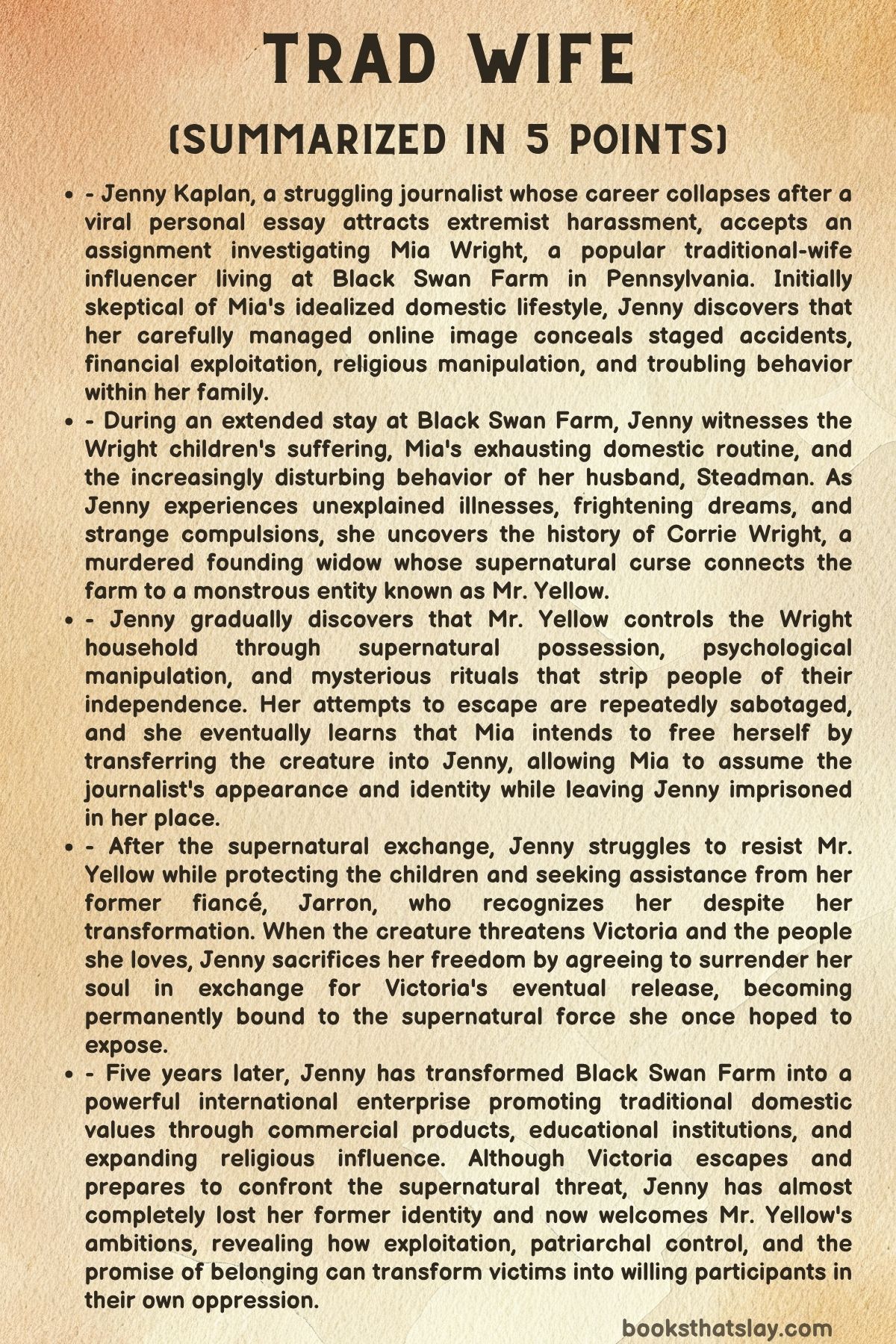
Summary
Jenny Kaplan is a thirty-two-year-old journalist living in Queens, New York, whose professional and personal lives have reached a crisis. After spending ten years working for the struggling magazine Bread and Circus, she feels increasingly frustrated by an industry that values commercial success over serious investigative reporting, while the collapse of her relationship with Jarron Stills has left her emotionally vulnerable and financially insecure.
Jarron experienced a severe mental health crisis during which he emptied their apartment and disappeared with Jenny’s possessions, including her personal journals. His departure has left Jenny struggling with painful memories, unresolved questions about their relationship, and a growing fear that she has lost control over the direction of her life.
When Jenny proposes an ambitious investigation into America’s expanding evangelical movement, her editor, Milton King, rejects it because the magazine cannot afford such an extensive assignment. Disappointed, Jenny writes a deeply personal essay about her childhood, her relationships, her abortion, and the emotional difficulties that have shaped her adulthood.
Milton publishes the essay under a sensational title, and it quickly becomes a viral success, bringing Jenny sudden recognition and opportunities in publishing and entertainment. However, the attention soon turns hostile as online extremists condemn her personal choices, organize harassment campaigns, and transform her private experiences into material for public humiliation.
A particularly aggressive group, the Brotherhood of the American Agenda, targets Jenny relentlessly, with an anonymous persecutor calling himself DirtyGarry becoming one of her most persistent tormentors. As the campaign intensifies, the magazine’s wealthy owners pressure Milton to dismiss her, leaving Jenny unemployed just when she believed her career was finally advancing.
Milton subsequently offers her a freelance assignment investigating Mia Wright, a remarkably popular traditional-wife influencer who lives at Black Swan Farm in rural Pennsylvania. Jenny initially finds the subject objectionable because Mia’s celebration of religious obedience, motherhood, and traditional gender roles conflicts with her own beliefs about independence and women’s rights.
While researching the movement, Jenny visits her younger sister, Melissa, whose seemingly comfortable suburban marriage conceals emotional isolation and unhappiness. Melissa’s admiration for Mia makes Jenny realize that traditional-wife influencers succeed partly because they offer lonely women the reassurance and recognition missing from their everyday lives.
Jenny begins watching Mia’s videos and notices that their most successful moments often involve accidents, injuries, or apparent domestic failures. Careful examination reveals that many incidents seem deliberately arranged to generate sympathy and engagement, raising questions about the authenticity of Mia’s carefully cultivated image.
Jenny travels to Sylvan Village, a deteriorating Pennsylvania community near Lake Erie, where Black Swan Farm stands in striking contrast to the surrounding economic decline. She stays at an inn operated by Claire and Frank Helel and encounters references to Corrie Wright, a historical figure whose violent death remains connected to the town’s unsettling folklore.
At Black Swan Farm, Jenny meets Mia, her husband Steadman, and their seven children, discovering a household that initially appears extraordinarily prosperous, orderly, and harmonious. Mia presents domestic labor, religious submission, and constant motherhood as the foundations of happiness, while Steadman projects the confidence and authority of a successful traditional husband.
The interview becomes contentious when Jenny demonstrates that Mia has staged certain accidents for her videos, using the family’s dog to reproduce one of her tricks. Although Mia denies manipulating her audience, she unexpectedly begs Jenny to return for an extended visit, suggesting that beneath her cheerful performance lies an urgent desire for outside intervention.
Back in New York, Jenny discovers that Black Swan Farm’s business assets and property legally belong to Steadman and his brothers rather than Mia. Interviews with company ambassadors Blair Roberts and Ashley Vonnegut further reveal a multilevel marketing network that draws financially vulnerable women into an enterprise promising community, independence, and prosperity without necessarily delivering those benefits.
Jenny also reconnects with Jarron, who has received treatment for schizoaffective disorder, although their conversations expose unresolved hurt and conflicting memories. Meanwhile, Mia posts a flattering video showing Jenny holding her youngest child, Isaac, and Mia’s supporters begin defending Jenny against the extremists who had previously attacked her.
The gesture leaves Jenny suspicious of Mia’s power to redirect online hostility, but it also convinces her that Black Swan Farm conceals a much larger story. She agrees to spend a week living with the Wright family, accompanied to Pennsylvania by experienced photographer Phil Parmet, who encourages her to recognize how Milton has exploited her professional vulnerability.
During their investigation of Sylvan Village, Jenny and Phil uncover the history of six founding women who were forced into marriages with wealthy settlers. After their husbands died, the women claimed ownership of their estates, only to be murdered by descendants unwilling to accept their financial independence.
The final survivor, Corrie Wright, was burned alive, and her death became associated with a supernatural curse that supposedly brought sickness, agricultural failure, and destruction to the settlement. Local legends connect Corrie with Mr. Yellow, a monstrous presence associated with a mysterious realm called Carcosa and the luminous yellow mist that sometimes rises across the countryside.
Upon returning to the farm, Jenny begins participating in Mia’s exhausting schedule, which includes strenuous exercise before sunrise, extensive childcare, cooking, cleaning, and agricultural work. Although heavily pregnant, Mia maintains an almost impossible pace, exposing the enormous physical demands concealed beneath her effortless online persona.
Jenny gradually recognizes that the children’s disciplined behavior masks fear and suffering rather than genuine contentment. Eden displays intense religious fanaticism, Victoria seems particularly frightened, and several of the younger children experience injuries that Jenny suspects are connected to Mia’s manufactured domestic accidents.
When Victoria shares an illustrated account of Corrie’s death, Jenny learns more about the supernatural force believed to haunt Sylvan Village. The girl describes the household’s strange influence and eventually tells Jenny that Mia is not her real mother, making the journalist increasingly suspicious that the family’s apparent unity conceals something far more disturbing than ordinary abuse.
Jenny’s concerns intensify when Victoria experiences serious breathing difficulties and Steadman’s brother, Dr. John Wright, dismisses the episode without providing appropriate asthma treatment. Jenny obtains an inhaler herself, and Victoria’s rapid improvement confirms that the child’s suffering has been unnecessarily prolonged by the adults responsible for her care.
Meanwhile, Jenny develops frightening physical symptoms, including hair loss, painful inflammation, disturbed sleep, and the appearance of unexplained injuries. Her dreams repeatedly feature Corrie’s execution, the Wright children, and something monstrous moving through the farmhouse, while the property’s animals and buildings show increasingly obvious signs of decay.
Attempts to obtain medical assistance offer little reassurance, particularly when a physician becomes dismissive after recognizing Mia’s name. Jenny also discovers suspicious information about Mia’s professional history and notices that the strange symbols decorating the farmhouse are associated with an occult tradition through which Mr. Yellow supposedly communicates.
As Mia’s appearance begins changing, she helps Jenny cut her damaged hair and gives her clothing and a wig that make the two women look increasingly similar. Jenny suspects that Mia wants Black Swan Farm exposed, yet she cannot understand why her host continues participating in the deception rather than openly seeking freedom.
The situation becomes increasingly alarming when Jenny temporarily assumes Mia’s household responsibilities and discovers that the children sometimes enter unnatural, motionless states. A sharp clap appears capable of interrupting or controlling their behavior, suggesting that the family’s extraordinary obedience results from supernatural interference rather than ordinary discipline.
Jenny also begins experiencing strange compulsions, particularly an uncontrollable need to exercise, even while her body continues deteriorating. Following an encounter in which Steadman mistakes her for his wife and approaches her intimately, she realizes that the disturbing events she has dismissed as dreams may actually be occurring.
Determined to escape, Jenny discovers that her luggage and computer have disappeared, while Mia’s clothing has replaced her belongings. The women’s physical resemblance continues increasing, and Steadman repeatedly confuses Jenny with his wife, suggesting that an elaborate process of identity substitution is underway.
Jenny attempts to flee in her rental car, but supernatural interference prevents her from leaving, and even the farm’s cameraman appears vulnerable to Mia’s commands. Exploring the locked chapel, Jenny discovers possessions stolen from her apartment during Jarron’s breakdown and realizes that the company responsible for acquiring them has a name that is an anagram of Black Swan.
When Jenny finally reaches Sylvan Village, the townspeople increasingly mistake her for Mia, and her appeals for assistance accomplish nothing. Eugene Wright briefly offers to drive her away but eventually returns her to the farm under Mr. Yellow’s influence, while Jenny discovers that Steadman has been operating the DirtyGarry account used to persecute her.
Trapped by a blizzard, Jenny takes shelter in Mia’s exercise shed, where the supernatural presence finally overcomes her resistance. She subsequently discovers that her personal records, online identity, and investigative article have been altered to support Black Swan Farm, erasing evidence of her former beliefs and experiences.
Jenny makes another desperate escape attempt with the family dog, Buddy, and Victoria, who explains that Mr. Yellow controls the household and spreads his influence through Mia’s broadcasts and Black Swan products. However, Victoria deceives Jenny into returning by claiming to need her forgotten inhaler, allowing the Wright brothers to capture the journalist.
Inside the chapel, Jenny encounters a sinister gathering of relatives and townspeople assembled for a supernatural ceremony. Mia, now resembling Jenny and wearing her possessions, orchestrates a ritual in which Dr. John restrains and sedates Jenny while Mr. Yellow transfers his possession from Mia into his carefully prepared replacement.
Following the ritual, Jenny finds herself physically transformed into Mia Wright, while the previous occupant assumes Jenny Kaplan’s identity and leaves Black Swan Farm. Phil unknowingly photographs both women before departing with the impostor, allowing the identity exchange to succeed without attracting outside suspicion.
Now imprisoned within Mia’s body, Jenny struggles against Mr. Yellow’s commands while attempting to protect the children and communicate with the outside world. Jarron eventually recognizes her despite her changed appearance and tries to rescue her, but the Wright family captures him, leaving Jenny increasingly isolated.
Jenny learns that Mr. Yellow has maintained his existence through successive female hosts, promising them release if they help prepare another woman to inherit their suffering. She also discovers that Jarron originated the DirtyGarry identity while mentally unwell and under supernatural influence, although Steadman subsequently used it in the campaign against her.
After giving birth to a son she names Luke, Jenny continues resisting, but Mr. Yellow threatens Victoria and the people she loves. Desperate to protect the girl, Jenny negotiates an agreement that will eventually secure Victoria’s freedom in exchange for surrendering her own soul and accepting permanent service to the creature.
The bargain gives Jenny extraordinary abilities and makes the demanding work of Black Swan Farm easier, but it also destroys her independence. Five years later, the enterprise has expanded into a vast international commercial network, including Black Swan University, an institution teaching traditional domestic skills while extending the creature’s supernatural reach.
Victoria has escaped with Buddy after reaching adulthood, while Melissa has become financially entangled in Black Swan’s business, Jarron remains hospitalized, and Milton has lost his magazine. Jenny, having borne additional children and endured severe physical deterioration, now anticipates Mr. Yellow’s next transfer into a preacher planning to establish the Black Swan Church.
Rather than seeking freedom, Jenny welcomes the supernatural power promised by her agreement and no longer separates her own desires from the creature’s ambitions. The novel ends with the disturbing realization that the system which destroyed her identity is expanding across the world, transforming an individual tragedy into a threat to countless other lives.
Characters
Jenny Kaplan
Jenny Kaplan is the central protagonist of Trad Wife, a journalist whose professional ambition, emotional vulnerability, and commitment to exposing deception make her both a determined investigator and an attractive target for supernatural manipulation. At thirty-two, she has spent much of her adulthood attempting to establish an independent identity through her career, relationships, and personal choices.
Her early experiences reveal a woman who values intellectual honesty but struggles to protect herself from the consequences of public exposure. By publishing an intimate account of her abortion, failed relationship, and personal suffering, Jenny attempts to reclaim control over her experiences, only to discover that public recognition can become another means of exploitation.
Her investigation of Mia Wright initially reflects her skepticism toward religious traditionalism and commercialized domestic perfection. However, Jenny gradually recognizes that the women attracted to Mia’s message are not necessarily foolish or submissive, but frequently lonely individuals searching for security, purpose, and recognition.
Jenny’s treatment of Victoria demonstrates her capacity for compassion even when helping the girl places her investigation and personal safety at risk. She challenges the family’s neglect, obtains necessary medication, and repeatedly attempts to rescue Victoria from an environment in which obedience takes precedence over health.
Her gradual transformation into Mia represents the systematic destruction of everything she once considered essential to her identity. The supernatural entity steals her appearance, possessions, professional voice, bodily autonomy, and eventually her ability to distinguish between personal desire and imposed obligation.
Jenny’s final decision to surrender her soul in exchange for Victoria’s freedom gives her fate a particularly troubling moral complexity. Although the choice originates in protective love, it ultimately makes her an active participant in the expansion of the very system she attempted to destroy.
Mia Wright
Mia Wright is the charismatic traditional-wife influencer whose apparent domestic perfection conceals the central horror of Trad Wife. Through carefully produced videos, religious instruction, and demonstrations of household competence, she presents herself as the embodiment of feminine fulfillment through marriage, motherhood, and obedience.
Her public personality combines warmth, humor, vulnerability, and extraordinary discipline, creating an image that millions of women find reassuring. Behind this performance, however, Mia manipulates domestic accidents, exploits her children’s suffering, and uses carefully orchestrated emotional moments to strengthen her audience’s attachment.
Mia’s behavior initially makes her appear calculating and cruel, particularly when Jenny notices the deliberate staging of injuries and the mistreatment of her children. Yet her increasingly desperate requests for Jenny’s presence suggest that she is also trapped within circumstances she cannot escape through ordinary means.
The revelation that Mia is one of Mr. Yellow’s successive hosts fundamentally changes the reader’s understanding of her actions. She has discovered that her only apparent route to freedom involves transferring the supernatural burden to another woman, forcing her to choose between continued enslavement and the destruction of someone else’s life.
Her transformation into Jenny Kaplan exposes the selfishness concealed within her apparent vulnerability. Mia becomes both a victim of a monstrous system and an active agent of its continuation, demonstrating how prolonged exploitation can encourage victims to reproduce the violence inflicted upon them.
Steadman Wright
Steadman Wright represents the patriarchal authority that sustains the oppressive household at the center of Trad Wife. Handsome, confident, and outwardly devoted to his family, he initially appears to be the stable husband whose financial support allows Mia to enjoy her elaborate domestic lifestyle.
His actual position within the family reveals a profound imbalance of power, particularly because the farm’s assets and business operations legally belong to him and his brothers. Mia performs the work that generates the company’s appeal, while Steadman retains the ownership and authority associated with its success.
As Jenny’s investigation progresses, Steadman’s pleasant exterior becomes increasingly threatening. His refusal to obtain proper medical treatment for injured children and his willingness to dismiss their suffering demonstrate how his concept of family leadership depends on obedience rather than responsible care.
The discovery that he has used the DirtyGarry account to persecute Jenny establishes his direct involvement in the campaign that destroyed her career. His participation demonstrates that the supposed distinction between the family’s wholesome public image and extremist online harassment is deliberately manufactured.
Steadman’s inability to distinguish Jenny from Mia during their physical transformation also reveals how little significance he attaches to their individual identities. His behavior suggests that the woman occupying the position of wife matters less to him than the continued preservation of the household’s established hierarchy.
Mr. Yellow
Mr. Yellow is the supernatural antagonist whose influence transforms Trad Wife from a disturbing account of domestic exploitation into a story of possession and psychological horror. Associated with disease, decay, bodily suffering, and the mysterious realm of Carcosa, he embodies an ancient destructive power that operates through ordinary human relationships.
His connection to Sylvan Village stretches across generations, beginning with the region’s history of violence and continuing through Corrie Wright’s execution and subsequent curse. Unlike a conventional monster that relies exclusively on physical violence, Mr. Yellow achieves dominance through temptation, psychological intrusion, coercion, and gradual manipulation.
His methods are especially effective because he exploits the emotional and social vulnerabilities already present in his victims’ lives. Jenny’s professional insecurity, unresolved guilt, and desire for meaningful accomplishment become opportunities through which he weakens her resistance.
The creature’s ability to control bodies, alter identities, influence perception, and command obedience makes individual resistance exceptionally difficult. His power also extends through Black Swan’s videos and products, suggesting that modern commercial systems provide him with methods of expansion unavailable in earlier centuries.
Mr. Yellow’s ultimate ambition is not simply to destroy Jenny but to transform her into a productive participant in his enterprise. By making submission pleasurable and rewarding, he ensures that his victims eventually begin defending and expanding the systems responsible for their captivity.
Victoria Wright
Victoria Wright is one of the most emotionally significant characters in Trad Wife, serving as both a vulnerable child trapped within an abusive household and an important source of knowledge about its supernatural secrets. Unlike many of her siblings, she displays obvious fear and discomfort, allowing Jenny to recognize the suffering concealed behind the family’s carefully maintained appearance.
Her serious breathing difficulties demonstrate the dangers of a household in which religious convictions and parental authority are allowed to override basic medical responsibility. When Dr. John Wright dismisses her symptoms, Victoria becomes an example of how children can be denied essential care because adults refuse to acknowledge anything that challenges their beliefs.
Victoria’s illustrated account of Corrie Wright provides Jenny with important information about the family’s history and Mr. Yellow’s influence. Her insistence that Mia is not her real mother also indicates that she understands the household’s shifting identities more clearly than the adults realize.
Despite her vulnerability, Victoria is not entirely innocent in her actions, particularly when she deceives Jenny into returning to the farm. Her betrayal demonstrates how frightened children can become instruments of the systems that oppress them, especially when resistance carries frightening consequences.
Her eventual escape with Buddy represents one of the few meaningful victories against Mr. Yellow. By adulthood, Victoria understands the supernatural threat and begins preparing to oppose it, preserving the possibility that the destructive cycle might eventually be challenged.
Corrie Wright
Corrie Wright is the historical figure whose suffering and supernatural inheritance establish the origins of Sylvan Village’s curse. Unlike the other founding women, who were forcibly brought into marriages, Corrie voluntarily enters the settlement as the daughter of Mr. Yellow, originally intending to help her father spread destruction.
Her relationship with her elderly husband changes her understanding of humanity because he treats her with kindness rather than domination. Through this experience, Corrie develops emotional attachments and helps the other women escape the restrictions imposed by the men who acquired them.
After their husbands die, Corrie and the other widows attempt to retain control over their inherited property. Their independence provokes resentment among descendants who view female ownership as a violation of the social order, leading to poisoning, murder, and finally Corrie’s public execution.
Corrie’s transformation from supernatural accomplice into a woman capable of love and solidarity makes her more complicated than an ordinary figure of vengeance. Her decision to sacrifice her acquired human soul and curse the settlement emerges from both the brutality of her persecution and the destruction of the community she helped establish.
Her legacy demonstrates how violence against women can produce consequences that extend far beyond the original perpetrators. The curse preserves the memory of historical injustice while also perpetuating suffering among later generations, including people who never participated in the initial crimes.
Jarron Stills
Jarron Stills is Jenny’s former fiancé, whose severe mental health crisis leaves lasting consequences for both characters. His schizoaffective disorder contributes to the breakdown of their relationship, particularly when he empties their apartment and disappears with possessions that contain important records of Jenny’s personal history.
Jarron’s subsequent treatment creates the possibility of reconciliation, but his conversations with Jenny reveal how difficult it is to rebuild trust after an experience involving profound emotional and material loss. His discomfort with the public disclosure of their private relationship also exposes the complicated ethical consequences of Jenny’s journalism.
The revelation that Jarron originated the DirtyGarry identity while mentally unwell and under supernatural influence connects his earlier actions to the forces operating at Black Swan Farm. This development complicates his responsibility without erasing the suffering Jenny experienced during their relationship.
His recognition of Jenny after her physical transformation demonstrates a degree of personal understanding that many supposedly respectable members of the Wright family lack. His attempt to rescue her becomes an act of courage and continued attachment, although his eventual capture and hospitalization reinforce the story’s tragic examination of vulnerability.
Melissa Kaplan
Melissa Kaplan is Jenny’s younger sister, whose apparently comfortable suburban existence conceals substantial emotional dissatisfaction. Her admiration for Mia Wright initially frustrates Jenny, who struggles to understand why someone with a successful domestic life would seek reassurance from an influencer advocating restrictive traditional roles.
Melissa’s experiences reveal that material stability and social respectability do not necessarily produce happiness. Her marriage to Portia is troubled by loneliness, emotional distance, and feelings of inadequacy, leaving her particularly susceptible to Mia’s comforting message.
Her conversations with Jenny expose the differences between the sisters’ understandings of independence and fulfillment. Whereas Jenny associates freedom with professional achievement and personal autonomy, Melissa longs for recognition, emotional security, and a clear sense of purpose.
By the novel’s conclusion, Melissa is divorced, financially indebted, and involved in Black Swan’s commercial network. Her circumstances demonstrate how the company exploits women who are searching for belonging during periods of personal uncertainty.
Milton King
Milton King is the editor-in-chief of Bread and Circus and represents the compromised professional institutions that contribute to Jenny’s vulnerability. Although he recognizes her talent, his editorial decisions are increasingly influenced by financial pressures and the magazine’s dependence on wealthy owners.
His publication of Jenny’s personal essay initially appears to provide the career breakthrough she desperately needs. However, the sensational presentation of her experiences exposes her to widespread harassment, and Milton ultimately sacrifices her employment when protecting her becomes commercially inconvenient.
His later offer to investigate Mia Wright allows Jenny to continue working, but it also places her in dangerous circumstances without adequate institutional support. Phil’s criticism encourages Jenny to recognize that Milton’s apparent generosity frequently conceals self-interest.
Milton’s eventual professional downfall, marked by the loss of his magazine, exposes the fragility of the authority he once possessed. His character illustrates how institutions can exploit vulnerable individuals while presenting their actions as opportunities for advancement.
Phil Parmet
Phil Parmet is an experienced photographer whose practical judgment and professional awareness provide an important contrast to Jenny’s determination to succeed at almost any cost. Assigned to accompany her investigation, he quickly recognizes the imbalance of power between Jenny and her editor.
Phil encourages Jenny to demand fair compensation, obtain professional representation, and understand how her previous experiences have been used against her. His advice demonstrates that professional independence requires more than ambition; it also depends on the ability to recognize exploitation and establish boundaries.
Although he participates in the investigation, Phil remains largely outside the supernatural transformation occurring within Black Swan Farm. His eventual photographs of Jenny and her replacement become an especially disturbing example of how convincing appearances can prevent outsiders from recognizing extraordinary violence.
His inability to identify the identity exchange reinforces the novel’s distinction between observing something and understanding its significance.
Eden Wright
Eden Wright is one of the Wright children whose intense religious convictions reveal the psychological consequences of growing up in a household governed by fear and absolute obedience. Her behavior initially resembles the exaggerated devotion encouraged by her parents, but her fascination with supernatural symbols indicates that something more disturbing is influencing her beliefs.
Eden regards words, rituals, and religious declarations as sources of genuine power. This conviction becomes particularly threatening when Jenny discovers the extent to which Mr. Yellow has shaped the children’s behavior and understanding of reality.
Her hostility and difficult behavior are especially apparent when Jenny attempts to manage the household in Mia’s absence. Rather than functioning merely as a rebellious child, Eden represents the damage caused when children are taught to confuse domination with spiritual authority.
Her characterization demonstrates how authoritarian beliefs can become deeply embedded during childhood, making manipulation appear like devotion and preventing children from developing an independent understanding of right and wrong.
Dr. John Wright
Dr. John Wright is Steadman’s brother and a physician whose conduct exposes the corruption of professional responsibility within the Wright family’s sphere of influence. Despite possessing medical training, he dismisses Victoria’s breathing difficulties and refuses to provide appropriate treatment.
His suggestion that the girl’s symptoms are a form of psychological manipulation demonstrates his willingness to prioritize family ideology over observable physical suffering. Jenny’s successful intervention makes his failure particularly disturbing because Victoria’s condition can be treated through ordinary medical care.
John’s involvement in the supernatural ceremony further establishes his role as an active participant in the family’s system of control. By restraining and sedating Jenny, he transforms his medical authority into an instrument of violence.
His character demonstrates how specialized knowledge can become dangerous when ethical obligations are abandoned in favor of obedience to a powerful family or institution.
Claire Helel
Claire Helel is the innkeeper in Sylvan Village whose actions connect the contemporary events at Black Swan Farm with the town’s troubling history. She witnesses an earlier episode in which a heavily pregnant Mia arrives in a desperate condition and begs for help.
Although Claire initially responds to Mia’s distress, she ultimately assists Steadman in returning his wife to his custody. The encounter illustrates how an apparently respectable husband’s explanation can override a visibly frightened woman’s request for assistance.
Claire’s position within Sylvan Village also places her among residents exposed to the mysterious yellow mist and the supernatural manipulation associated with the community. Her failure to intervene meaningfully reflects a broader pattern in which ordinary people become passive participants in someone else’s captivity.
Frank Helel
Frank Helel helps operate the inn where Jenny stays during her visits to Sylvan Village. Although his role is limited, his presence contributes to the appearance of the town as an ordinary rural community with familiar institutions and established social relationships.
The inn initially offers Jenny a place outside Black Swan Farm’s controlled environment. However, the broader community’s inability to protect her reveals that physical distance from the farmhouse does not guarantee freedom from Mr. Yellow’s influence.
Frank’s supporting role reinforces the contrast between Sylvan Village’s recognizable everyday life and the supernatural corruption concealed beneath it.
Blair Roberts
Blair Roberts is a Black Swan ambassador whose participation in the company’s marketing network allows Jenny to examine its commercial structure. Her involvement demonstrates how the business recruits women through promises of opportunity, emotional support, and financial improvement.
Blair’s role is significant because the company depends on representatives who transform their personal relationships into channels for product promotion. Through her interview, Jenny recognizes that Black Swan’s commercial success is sustained by women who may themselves be financially insecure.
The character illustrates how exploitative organizations can attract willing participants by offering the appearance of independence while preserving structures that concentrate wealth and power elsewhere.
Ashley Vonnegut
Ashley Vonnegut is another Black Swan ambassador whose experiences help expose the contradictions between the company’s public promises and its actual business practices. Together with Blair Roberts, she provides Jenny with insight into the emotional and economic appeal of the traditional-wife movement.
Ashley’s involvement reflects the importance of community within Black Swan’s commercial strategy. The business does not merely sell products; it promotes an identity that allows participants to feel recognized, purposeful, and connected to other women.
Her supporting role emphasizes that exploitation frequently operates through relationships that appear supportive. Women may sincerely value the communities they join even when the organizations themselves benefit disproportionately from their labor.
Eugene Wright
Eugene Wright is a member of the extended Wright family whose actions reveal the extraordinary reach of Mr. Yellow’s influence. When Jenny attempts to escape Sylvan Village, Eugene initially appears willing to help her leave the area.
His apparent assistance briefly creates the possibility that Jenny has found someone outside the immediate household who can be trusted. However, supernatural interference causes him to return her to Black Swan Farm, destroying that hope.
Eugene’s actions demonstrate how the creature can turn potential rescuers into instruments of captivity. His role also reinforces the difficulty of distinguishing genuine human intentions from behavior imposed through supernatural control.
Josie Wright
Josie Wright is one of Mia and Steadman’s younger children and an example of the physical vulnerability concealed beneath the family’s cheerful domestic image. Jenny becomes suspicious when Mia appears to cause Josie to fall during the filming of a religious video.
The incident suggests that the children’s safety may be deliberately sacrificed to produce entertaining and emotionally engaging content. Mia’s denial leaves Jenny increasingly concerned that the household treats injuries as opportunities for publicity rather than events requiring care.
Josie’s role illustrates how children can become participants in commercial performances without possessing the freedom or understanding necessary to consent.
Isaac Wright
Isaac Wright is the youngest child Jenny encounters during her initial involvement with the family and becomes important to the influencer’s carefully constructed public image. A video of Jenny holding Isaac allows Mia to present the journalist sympathetically to her followers, temporarily reversing the hostility directed toward Jenny online.
Isaac also suffers injuries involving lye and a damaged floorboard, incidents that expose the dangerous conditions concealed within the household. The adults’ inadequate responses reveal how the children’s welfare is repeatedly subordinated to the family’s religious convictions and commercial priorities.
His vulnerability makes the contrast between Black Swan Farm’s affectionate public presentation and its actual practices especially disturbing.
Luke Wright
Luke Wright is the son born after Jenny becomes Mr. Yellow’s new host and assumes Mia’s position within the household. His birth occurs during a period when Jenny is struggling against supernatural domination and attempting to protect the children already living at the farm.
Luke’s presence emphasizes that the identity exchange has consequences extending beyond Jenny’s personal freedom. She is forced to occupy a domestic role that includes pregnancy and motherhood while lacking meaningful control over her own body.
His birth also contributes to the continuing expansion of the Wright family, reinforcing the reproductive expectations that sustain the household’s ideology and supernatural system.
Buddy
Buddy is the Wright family’s dog and an important companion during Jenny’s investigation and attempts to escape. Early in the story, Jenny uses him to demonstrate how Mia stages accidents for her videos, making the animal part of her effort to expose the influencer’s deception.
Later, Buddy accompanies Jenny and Victoria during their desperate attempt to flee Black Swan Farm. His presence offers a rare form of uncomplicated companionship within a household dominated by manipulation and fear.
Buddy’s eventual escape with Victoria establishes him as part of the small surviving connection to a life beyond Mr. Yellow’s immediate control.
Leo
Leo is the cameraman associated with Black Swan Farm’s video production. His presence demonstrates that Mia’s apparently spontaneous domestic performances depend on a carefully managed process involving equipment, assistance, and professional presentation.
When Jenny attempts to enlist his help in escaping, Mia uses a sharp clap to influence his behavior. This incident reveals that the supernatural obedience affecting the children can also extend to adults working within the household.
Leo’s role reinforces the connection between media production and control, showing how the people responsible for creating an influencer’s public image can themselves become instruments of manipulation.
Dr. Patil
Dr. Patil is a physician in Erie whom Jenny consults after developing disturbing physical symptoms. Her initial medical assessment offers potentially ordinary explanations for Jenny’s hair loss and disturbed sleep, providing a brief alternative to the supernatural conclusions developing in Jenny’s mind.
However, her attitude changes when Jenny raises concerns about the Wright family’s treatment of its children. After recognizing Mia’s name, she dismisses Jenny’s suspicions rather than seriously examining them.
This response contributes to Jenny’s growing isolation and illustrates how social influence can discourage professionals from investigating possible wrongdoing. Dr. Patil’s role demonstrates the danger of allowing personal impressions or community loyalties to interfere with professional judgment.
Portia
Portia is Melissa’s spouse, whose troubled relationship with her provides insight into the emotional difficulties that make Melissa receptive to Mia Wright’s message. Although Portia is not extensively developed in the narrative, the marriage becomes an important example of the difference between outward stability and private unhappiness.
Melissa’s feelings of being unwanted and burdensome reveal that the relationship is failing to meet her emotional needs. The marriage eventually ends in divorce, leaving Melissa financially and personally vulnerable.
Portia’s supporting role helps establish that dissatisfaction and isolation are not limited to any particular household arrangement. The deeper problem concerns the absence of recognition, mutual care, and meaningful connection.
Lucinda Wright
Lucinda Wright appears through a historical testimony describing the supernatural presence associated with Sylvan Village. Her account provides evidence that Mr. Yellow’s methods of psychological intrusion and possession existed long before Jenny’s arrival.
Lucinda describes encountering a strange creature that moves in a serpentine fashion and communicates directly within her mind. Once she recognizes the entity, she discovers that the connection cannot easily be broken.
Her attempts to escape fail because the creature continues approaching her at night and seeking permission to enter. The testimony establishes that Mr. Yellow’s power depends partly on recognition, invitation, and the gradual violation of personal boundaries.
Lucinda’s experience provides a historical counterpart to Jenny’s nightmares, suggesting that the creature’s methods have remained consistent across generations.
Jacob Von Wisher
Jacob Von Wisher is an evangelical preacher whose recorded sermon introduces an important distinction between genuine religious faith and the exploitation of spiritual authority. He argues that the corruption of sacred spaces occurs when material interests and ideological conflicts prevent people from recognizing deeper spiritual obligations.
His criticism of those who use God’s name for personal power closely resembles the abuses practiced at Black Swan Farm. However, his decision to advertise religious merchandise at the conclusion of the sermon exposes the contradictions within his own public presentation.
Jacob’s appearance reinforces the novel’s criticism of commercialized spirituality. His character illustrates how religious figures may condemn the exploitation of faith while simultaneously participating in systems that profit from their followers’ devotion.
Eddie Dante Quist
Eddie Dante Quist is the historian whose research into early American settlement patterns provides an analytical explanation for the deaths of the six founding women. His work examines the geographical distribution of the murders and connects them with historical restrictions on women’s property ownership.
By identifying the circular sequence of deaths and its resemblance to recurring occult symbols, his research establishes a connection between documented historical violence and the supernatural mythology surrounding Sylvan Village.
Eddie’s role is primarily investigative rather than dramatic, but his findings provide essential context for understanding the town’s history. His scholarly perspective also contrasts with the community’s tendency to preserve disturbing events as vague folklore rather than confronting the human decisions that caused them.
Themes
Patriarchal Control and the Destruction of Female Autonomy
The conflict between women’s independence and patriarchal authority shapes the historical and contemporary events of Trad Wife. Through the experiences of Corrie Wright, the founding widows, Mia, and Jenny, the novel examines how systems built around male ownership and female obedience can persist across generations while adopting different outward forms.
The murder of the Sylvan Six establishes the historical foundations of this conflict. Although the women become lawful owners of their husbands’ property, their descendants refuse to accept their independence and eventually resort to violence to reclaim control.
This history establishes that patriarchal domination is not simply a matter of restrictive social expectations. It can involve economic exclusion, bodily violence, legal manipulation, and the deliberate destruction of women who challenge established arrangements.
Black Swan Farm reproduces similar structures in a modern setting, although its oppression is presented through the appealing language of family values and domestic fulfillment. Mia performs the labor responsible for the company’s popularity, yet Steadman and his brothers retain legal control over its assets.
Jenny initially believes that her education, career, and independent beliefs protect her from such systems. However, her professional dismissal, public harassment, and eventual physical transformation demonstrate that autonomy can be undermined through multiple institutions operating together.
The supernatural theft of her body and identity represents the ultimate expression of patriarchal domination. Her thoughts, appearance, labor, reproductive capacity, and personal history become resources controlled by others.
The novel therefore challenges the assumption that independence is secured permanently through individual achievement. Freedom remains vulnerable when institutions possess the power to determine whose identity, labor, property, and choices deserve recognition.
Social Media Manipulation and the Commercialization of Domestic Life
Mia Wright’s online popularity demonstrates how digital media can convert private experiences into carefully managed commercial performances. Her audience believes that it is observing an authentic family whose happiness comes from traditional values, but the apparent spontaneity of her videos conceals deliberate manipulation.
The staged accidents are particularly revealing because they transform physical suffering into entertaining content. Injuries, embarrassment, and emotional vulnerability become opportunities for attracting attention, strengthening audience loyalty, and increasing the commercial value of Mia’s public identity.
This process also affects Jenny, whose personal essay initially earns praise before becoming the foundation of an organized harassment campaign. Both women’s experiences demonstrate that online audiences can elevate individuals or destroy their reputations without necessarily understanding the reality behind their public images.
Mia possesses an extraordinary ability to redirect these reactions, as demonstrated when her followers begin defending Jenny after a flattering video. The incident exposes how quickly collective emotions can be shaped by trusted digital personalities.
Black Swan’s multilevel marketing network extends this manipulation into women’s financial lives. Followers are encouraged to purchase products, become representatives, and associate commercial participation with personal improvement and meaningful community.
The supernatural dimension intensifies the criticism because Mr. Yellow’s influence travels through the very media and products used to expand the company. Digital connectivity becomes a mechanism through which psychological dependence develops into something approaching literal possession.
By the conclusion, Black Swan University and the anticipated church demonstrate how successful commercial identities can evolve into powerful institutions. The novel suggests that the danger lies not simply in persuasive advertising, but in systems that profit by transforming people’s insecurities, relationships, and beliefs into permanent sources of control.
Identity, Bodily Autonomy, and Psychological Possession
Jenny’s transformation demonstrates how personal identity depends on much more than physical appearance. Her journals, professional achievements, intimate relationships, memories, and moral convictions collectively establish her understanding of herself, making their systematic destruction central to the novel’s horror.
The process begins long before Mr. Yellow physically possesses her. Jarron’s disappearance with her possessions, the public distortion of her personal essay, and the organized campaign against her reputation all weaken Jenny’s ability to control how others understand her life.
At Black Swan Farm, these experiences become more invasive as her body begins changing without her consent. Hair loss, exhaustion, unexplained injuries, and uncontrollable compulsions establish that she is losing authority over even her most basic physical actions.
Mia’s efforts to make Jenny resemble her demonstrate how identity can be constructed through clothing, appearance, behavior, and social recognition. Steadman’s repeated confusion between the women exposes the disturbing possibility that others may recognize a social role more readily than an individual personality.
The supernatural exchange makes this problem literal when Jenny becomes Mia and the previous host assumes Jenny’s identity. The world accepts their altered appearances, allowing one woman to inherit another’s freedom while leaving the victim trapped within a role she never chose.
The destruction of Jenny’s writings and online accounts extends the violation into her personal history. Her former beliefs are replaced with manufactured declarations, demonstrating that controlling someone’s story can become another form of psychological imprisonment.
The conclusion is especially disturbing because Jenny eventually welcomes the power that has overtaken her. Her inability to distinguish between personal desire and supernatural influence raises the question of whether consent has meaning when the capacity to choose has itself been systematically altered.
Complicity, Sacrifice, and the Cycle of Exploitation
The transformation of victims into participants in their own oppression gives Trad Wife much of its moral complexity. Rather than portraying exploitation as a simple conflict between innocent sufferers and unmistakable villains, the novel examines how people living under unbearable pressure may eventually cooperate with the systems that harm them.
Mia’s decision to transfer Mr. Yellow into Jenny illustrates this pattern most clearly. Her desire for freedom is understandable, but the method she chooses requires the destruction of another woman’s independence, turning her escape into an act of deliberate betrayal.
The Wright children demonstrate a related process on a smaller scale. Victoria desperately wants to leave the household, yet she deceives Jenny into returning to the farm, revealing how fear and coercion can make vulnerable individuals participate in harmful actions.
Steadman and Dr. John represent more active forms of complicity because they use their social and professional authority to preserve the household’s power structure. Their participation shows how exploitation survives through cooperation among people who benefit from it or refuse to challenge it.
Jenny initially resists these patterns by investigating wrongdoing and attempting to protect the children. However, her eventual bargain with Mr. Yellow forces her into a painful ethical compromise when she surrenders her soul to secure Victoria’s freedom.
The decision complicates the meaning of sacrifice because an act motivated by compassion also guarantees Jenny’s continued participation in the creature’s expanding enterprise. Her protective instincts are manipulated into serving the very power she wants to oppose.
Five years later, Jenny has become successful, influential, and seemingly satisfied, but these achievements depend on her permanent submission. The anticipated transfer of Mr. Yellow into another host reveals that the system is preparing to repeat its violence on an even greater scale.
Victoria’s escape offers a limited possibility of resistance, suggesting that the cycle might eventually be interrupted. Nevertheless, the ending emphasizes how difficult genuine liberation becomes when exploitation offers its victims comfort, status, power, and the illusion that their submission is a freely chosen path to happiness.